The Lamp — Roman Polanski

Trapper’s Wedding — Walt Whitman

I saw the marriage of the trapper in the open air in the far west,
the bride was a red girl,
Her father and his friends sat near cross-legged and dumbly smoking,
they had moccasins to their feet and large thick blankets
hanging from their shoulders,
On a bank lounged the trapper, he was drest mostly in skins, his luxuriant
beard and curls protected his neck, he held his bride by the hand,
She had long eyelashes, her head was bare, her coarse straight locks
descended upon her voluptuous limbs and reach’d to her feet.

—Walt Whitman, Song of Myself, section 10.

21 Citations on Pablo Picasso — David Markson

Pablo Picasso, Les Demoiselles d'Avignon, oil on canvas, 1907 (MoMA)

Painting is not done to decorate apartments –PICASSO

People speak of naturalism in opposition to modern painting.
Where and when has anyone ever seen a natural work of art?
Asked Picasso.

Depressed at the apparent lack of interest in one of his early still lifes, Matisse visited his dealer to retrieve it, only to learn that it had been purchased after all.
By Picasso.

The interrelationship of Picasso and Braque during Cubism:
Like being roped together on a mountain, Braque said.

The oddity that Velazquez and Picasso, surely two of the three greatest Spanish-born painters, each used his mother’s name rather than his father’s.

Among the many paintings in her Paris flat, Gertrude Stein had two exceptional Picassos.
If there were a fire, and I could save only one picture, it would be those two. Unquote.

The Bateau-Lavoir, the legendary former Montmartre piano factory broken up into artists’ studios, where Picasso contrived any number of his early masterpieces — while living with no running water and only one communal toilet.

The so-called anarchist artist who in 1988 smeared a large X in his own blood on a wall in the Museum of Modern Art — and in the process splattered an adjacent Picasso.

Picasso. Cézanne. Matisse. Braque. Bonnard. Renoir.
All of whom painted portraits of Ambroise Vollard.

Cartier-Bresson. Brassaï. Man Ray. Lee Miller. Robert Doisneau. Robert Capa. David Douglas Duncan. Cecil Beaton.
All of whom photographed Picasso.

Picasso’s play, Desire Caught by the Tail — which could be performed for the first time only privately, because of the Nazi occupation of Paris.
But avec Camus, Sartre, Michel Leiris, Raymond Queneau, Dora Maar, Pierre Reverdy, Simone de Beauvoir.

There is no such thing as abstract art, said Picasso.
You always have to start somewhere or other.

Gertrude Stein once delighted Picasso by reporting that a collector had been dumbfounded, years afterward, to hear that Picasso had given her her portrait as a gift, rather than asking payment.
Not understanding that that early in Picasso’s career, the difference had been next to negligible.

You never paint the Parthenon; you never paint a Louis XV armchair. You make pictures out of some little house in the Midi, a packet of tobacco, or an old chair.
Said Picasso.

Future generations will regard Bob Dylan with the awe reserved for Blake, Whitman, Picasso and the like.
Said an otherwise seemingly rational writer named Jonathan Lethem.

Picasso, avec laughter, after being asked if he had used models for Les Demoiselles d’Avignon:
Where would I have found them?

Picasso’s admiration for Charlie Chaplin.
Diego Rivera’s.
Stalin’s.

Kees van Dongen’s admission that there were occasions during his own early Montmartre years when he was forced to filch milk and/or bread from neighborhood doorsteps — with an accomplice named Picasso.

Picasso, in Paris during the Nazi occupation and learning that someone had accused him of having Jewish blood:
I wish I had.

A rejection of all that civilization has done.
Said the London Times of a first Post-Impressionist exhibition, in 1910 — which included Cézanne, van Gogh, Gauguin, Matisse, Picasso, others.

My old paintings no longer interest me. I’m much more curious about those I haven’t done yet.
Said Picasso, at seventy-nine.

From David Markson’s The Last Novel

Ray Harryhausen Discusses His Collection of John Martin Engravings

Birdseed Anecdote — F. Scott Fitzgerald

Once there was a whole lot of bird seed around the room because an author had adopted a chicken. It was impossible to explain to anyone just why he had adopted the chicken but still more impossible to know why he had bought the bird seed for the chicken. The chicken was later broiled and the bird seed thrown out, but the question of whether the man was an author or a lunatic was still unsolved in the minds of the hotel servants who had to deal with the situation. The hotel servants didn’t understand it. They didn’t understand how months later the author could write a story about it but they all bought the magazine.

—F. Scott Fitzgerald, The Notebooks

Charlie Chaplin’s Eating Machine (Modern Times)

Excursion into Philosophy — Edward Hopper

“My Precious!”

“You Must Have Been Vaccinated with a Phonograph Needle” (Duck Soup)

“Little or No Love” — Nietzsche on Good and Bad Books

158. Little or no Love. —Every good book is written for a particular reader and men of his stamp, and for that very reason is looked upon unfavourably by all other readers, by the vast majority. Its reputation accordingly rests on a narrow basis and must be built up by degrees.—The mediocre and bad book is mediocre and bad because it seeks to please, and does please, a great number.

—Friedrich Nietzsche, Human, All Too Human, Part II.

Topless Hemingway Slideshow

This slideshow requires JavaScript.

“Real Beauty Turns” — Nick Zammuto

Book Shelves #14, April 1, 2012

20120401-104052.jpg

Book shelves series #14, fourteenth Sunday of 2012.

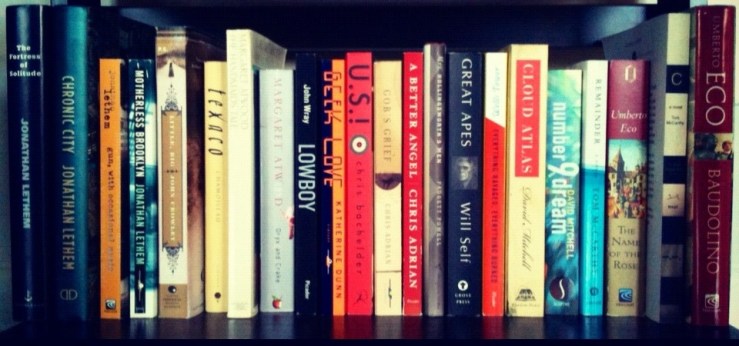
This is a strange shelf: it’s the bottom shelf of the ladder book shelf I’ve been photographing over the past few weeks, and it’s probably the least organized so far. There’s also a higher ratio of unread books on this shelf than in previous shelves. Anyway, left to right:

I was far more enthusiastic about Jonathan Lethem just a few years ago. I still think The Fortress of Solitude and Motherless Brooklyn hold up (they do in my memory, anyway), but Chronic City was awful (then why is it still on my shelf) and You Don’t Love Me Yet is one of the most pointless, silly, and gross books I’ve ever read.

I had good intentions to read John Crowley’s Little, Big and  Patrick Chamoiseau’s Texaco and John Wray’s Lowboy and Katherine Dunn’s Geek Love: I’m actually pretty sure I got all these novels around the same time. They must have been in a stack that eventually got shelved here during a reshelving.

I’ve read at least five or six more Margaret Atwood novels than the ones here, but have no idea where they are (likely a combination of cheap mass markets that I gave to friends or lost).

Chris Bachelder’s U.S.! is an underread gem. Chris Adrian: Again, I was more enthusiastic about his work a few years ago, but I think it holds up. Also, would the person who borrowed my first edition hardback of The Children’s Hospital please return it? Padgett Powell’s slim novel is not bad.

Will Self’s Great Apes holds the distinction of being the ickiest novel I’ve ever read. Horrifying stuff. I bought it at an airport—in Bangkok? LA? Houston? I really can’t remember—I was returning to the US from Thailand and had bought the cheapest possible plane ticket—one that would basically keep me en route for three days, sleeping on planes and in airports. Anyway, Self’s nightmare book is bound up in that experience: it’s a riff on Kafka; dude wakes up to find that he’s become a chimp. It’s just so gross on so many levels. (Maybe I should add that I find seeing chimps dressed as humans to be the acme of perversion).

The Wells Tower collection is gold.

David Mitchell’s Cloud Atlas is gold, but I never got past the first 20 pages of number9dream, which seemed to really bite from William Gibson. I loved both the Tom McCarthy books, particularly C. Eco’s The Name of the Rose is a bit overrated and Baudolino’s first half is not bad, but it just goes on and on and on . . .  but it’s funny.

“How Can I Be Silent?”

20120401-103621.jpg

(From Stuart Kendall’s Gilgamesh)

“Love Is Strange” (Badlands)

April Fools: Seven Literary Hoaxes

J.T. LeRoyJames FreyHerman Rosenblat, Margaret Seltzer . . . recent years have seen an explosion of memoirists lying, faking, or otherwise hoaxing the public—but this is hardly anything new. In honor of April Fool’s Day we present seven April Fools.

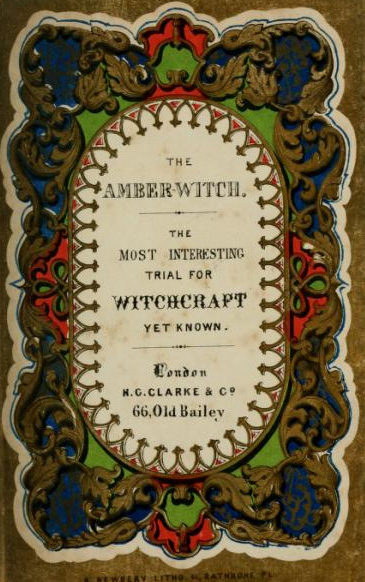
The Amber Witch — Johannes Wilhelm Meinhold (1844)

Meinhold pretended that The Amber Witch was the true story of a seventeenth-century minister’s daughter falsely accused of witchcraft. Meinhold claimed he found the minister’s manuscript in the refuse of an old church. When the book received critical attention, Meinhold admitted to the hoax, but audiences didn’t believe him at first.

“Geraint the Blue Bard” aka Iolo Morganwg aka Edward Williams (1747-1826)

Welshman Edward Williams was widely considered a leading antiquarian and expert on the antiquities of the British Isles. After his death, however, many of his manuscripts were revealed to have been forgeries, including those produced by “Geraint the Blue Bard,” supposedly a ninth-century composer. Oh well.

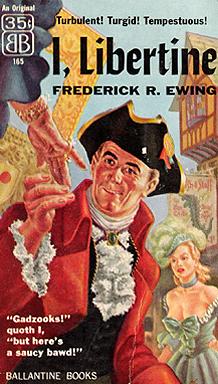
I, Libertine — Frederick R. Ewing  (1956)

Proto-shock jock Jean “Shep” Shepherd perpetrated I, Libertine as a purposeful hoax. He told his radio audience to demand the (non-existent) book by the (non-existent) author “Frederick R. Ewing” from their local booksellers, and even fabricated a basic plot for listeners to in turn relate (he even included the salacious detail that the book had been banned in Boston). Publisher Ballantine hired sci-fi scribe Theodore Sturgeon to write the book from Shepherd’s outline, and the book was published very soon after. All proceeds went to charity.

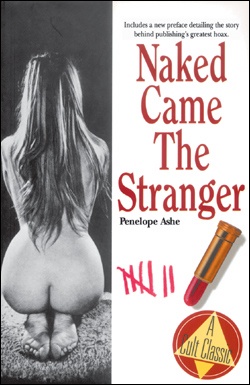
Naked Came the Stranger — Penelope Ashe (1969)

To prove that American culture was smutty and degraded, Newsday columnist Mike McGrady enlisted 24 of his fellow writers to write a smutty and degraded novel that they believed would top the bestseller list in spite of its lack of literary value. By the time “Penelope Ashe” had put out Naked Came the Stranger, the hoax had leaked, and it was unclear if this is what led to the book actually topping the New York Times bestseller list (for one slim week). The book later became the basis of a porno film.

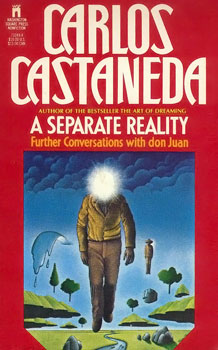
A Separate Reality — Carlos Castaneda (1971)

The debate around Castaneda’s series of “memoirs” in some ways gets to the heart of the problems of truth and invention, facts and authenticity, experience and memory. Castaneda claimed that he trained under Don Juan Matus, a Yaqui Indian sorcerer. Part of that training included taking massive amounts of psychotropic drugs like peyote as a means to “see” the energy of the universe. Don Juan Matus’s actual existence is questionable at best, but hey, when you’re doing large quantities of peyote, who knows what, like, truth is, man.

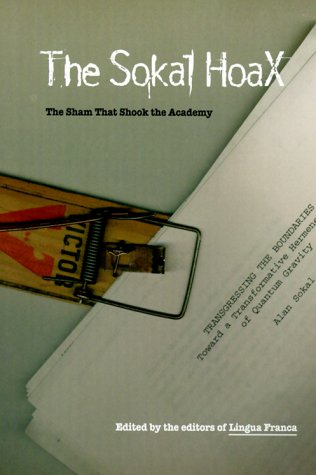
“Transgressing the Boundaries: Towards a Transformative Hermeneutics of Quantum Gravity”– Alan Sokal (1996)

Disgusted with a perceived slackness and ineptitude in modern academia, Dr. Alan Sokal published a paper full of nonsensical gibberish in Duke University’s cultural studies journal Social Text. The same day the essay was published, he announced the hoax in the journal Lingua Franca. Ouch. Biblioklept wrote a post about the incident a few years ago, if you’re interested.

The Songs of Bilitis — Pierre Louÿs (1894)

Louÿs claimed that the erotic poems he fabricated were the work of “Bilitis,” one of Sappho’s lovers; he even invented a biography of the woman, citing a fictional archaeologist named Herr G. Heim with discovering her tomb. (“Herr G. Heim” translates roughly to “Lord S. Ecret”). Despite the hoax, many critics consider it a work of literary merit, and it’s become something of a cult book among queer theory enthusiasts.

[Biblioklept originally published this post in 2010].

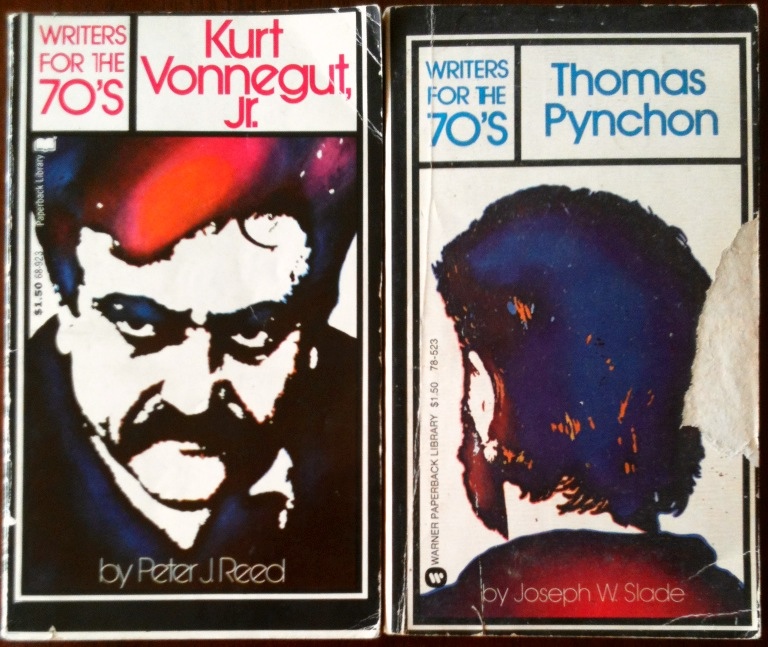
Pynchon/Vonnegut (Books Acquired, 3.28.2012)

20120330-194551.jpg

Saw these in my favorite used book shop and had to have them. Shabby copies of contemporary criticisms (i.e., old criticism) of Pynchon and Vonnegut. Love the covers.