Slavoj Žižek Riffs on Kung Fu Panda

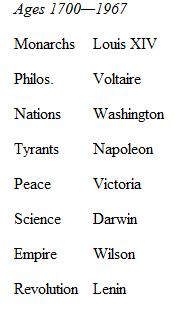
“Ages 1700-1967” — F. Scott Fitzgerald

From F. Scott Fitzgerald’s Notebooks.

The Resurrection — Andrea Mantegna

Book Shelves #15, 4.08.2012

20120407-140053.jpg

1st Gent. How class your man? – as better than the most,

Or, seeming better, worse beneath that cloak?

As saint or knave, pilgrim or hypocrite?

2nd Gent. Nay, tell me how you class your wealth of books

The drifted relics of all time.

As well sort them at once by size and livery:

Vellum, tall copies, and the common calf

Will hardly cover more diversity

Than all your labels cunningly devised

To class your unread authors.

—George Eliot, Middlemarch, epigraph to Chapter 13

Book shelves series #15, fifteenth Sunday of 2012

A new book-case this week; the shorter triplet of the twin ladders seen here. What do the volumes on this top shelf hold in common? They are hardback. That’s about it. Yes, I actually go through The Riverside Shakespeare every now and then, especially when sparking new ideas for class lectures. The Balthus memoir is pretty good. No, I never finished Godel, Escher, Bach. It’s not hardback, come to think of it. The Fallada books are good stuff. Will Dylan ever finish up the Chronicles? Probably not. Maybe so. Who knows? We all love Shel Silverstein, of course.

“I Created the Truth out of What People Needed” — Paul and Jesus (From Scorsese’s The Last Temptation of Christ)

Pieta — El Greco

The Easter Fires — A Short Chapter on Easter Eve Fire Festivals from Frazer’s The Golden Bough

A passage Sir James George Frazer’s The  Golden Bough:

The Easter Fires

ANOTHER occasion on which these fire-festivals are held is Easter Eve, the Saturday before Easter Sunday. On that day it has been customary in Catholic countries to extinguish all the lights in the churches, and then to make a new fire, sometimes with flint and steel, sometimes with a burning-glass. At this fire is lit the great Paschal or Easter candle, which is then used to rekindle all the extinguished lights in the church. In many parts of Germany a bonfire is also kindled, by means of the new fire, on some open space near the church. It is consecrated, and the people bring sticks of oak, walnut, and beech, which they char in the fire, and then take home with them. Some of these charred sticks are thereupon burned at home in a newly-kindled fire, with a prayer that God will preserve the homestead from fire, lightning, and hail. Thus every house receives “new fire.” Some of the sticks are kept throughout the year and laid on the hearth-fire during heavy thunder-storms to prevent the house from being struck by lightning, or they are inserted in the roof with the like intention. Others are placed in the fields, gardens, and meadows, with a prayer that God will keep them from blight and hail. Such fields and gardens are thought to thrive more than others; the corn and the plants that grow in them are not beaten down by hail, nor devoured by mice, vermin, and beetles; no witch harms them, and the ears of corn stand close and full. The charred sticks are also applied to the plough. The ashes of the Easter bonfire, together with the ashes of the consecrated palm-branches, are mixed with the seed at sowing. A wooden figure called Judas is sometimes burned in the consecrated bonfire, and even where this custom has been abolished the bonfire itself in some places goes by the name of “the burning of Judas.” The essentially pagan character of the Easter fire festival appears plainly both from the mode in which it is celebrated by the peasants and from the superstitious beliefs which they associate with it. All over Northern and Central Germany, from Altmark and Anhalt on the east, through Brunswick, Hanover, Oldenburg, the Harz district, and Hesse to Westphalia the Easter bonfires still blaze simultaneously on the hill-tops. As many as forty may sometimes be counted within sight at once. Long before Easter the young people have been busy collecting firewood; every farmer contributes, and tar-barrels, petroleum cases, and so forth go to swell the pile. Neighbouring villages vie with each other as to which shall send up the greatest blaze. The fires are always kindled, year after year, on the same hill, which accordingly often takes the name of Easter Mountain. It is a fine spectacle to watch from some eminence the bonfires flaring up one after another on the neighbouring heights. As far as their light reaches, so far, in the belief of the peasants, the fields will be fruitful, and the houses on which they shine will be safe from conflagration or sickness.

At Volkmarsen and other places in Hesse the people used to observe which way the wind blew the flames, and then they sowed flax seed in that direction, confident that it would grow well. Brands taken from the bonfires preserve houses from being struck by lightning; and the ashes increase the fertility of the fields, protect them from mice, and mixed with the drinking-water of cattle make the animals thrive and ensure them against plague. As the flames die down, young and old leap over them, and cattle are sometimes driven through the smouldering embers. In some places tar-barrels or wheels wrapt in straw used to be set on fire, and then sent rolling down the hillside. In others the boys light torches and wisps of straw at the bonfires and rush about brandishing them in their hands. In Munsterland these Easter fires are always kindled upon certain definite hills, which are hence known as Easter or Paschal Mountains. The whole community assembles about the fire. The young men and maidens, singing Easter hymns, march round and round the fire, till the blaze dies down. Then the girls jump over the fire in a line, one after the other, each supported by two young men who hold her hands and run beside her. In the twilight boys with blazing bundles of straw run over the fields to make them fruitful.

At Delmenhorst, in Oldenburg, it used to be the custom to cut down two trees, plant them in the ground side by side, and pile twelve tar-barrels against each. Brush-wood was then heaped about the trees, and on the evening of Easter Saturday the boys, after rushing about with blazing bean-poles in their hands, set fire to the whole. At the end of the ceremony the urchins tried to blacken each other and the clothes of grown-up people. In the Altmark it is believed that as far as the blaze of the Easter bonfire is visible, the corn will grow well throughout the year, and no conflagration will break out. At Braunrude, in the Harz Mountains, it was the custom to burn squirrels in the Easter bonfire. In the Altmark, bones were burned in it. Near Forchheim, in Upper Franken, a straw-man called the Judas used to be burned in the churchyards on Easter Saturday. The whole village contributed wood to the pyre on which he perished, and the charred sticks were afterwards kept and planted in the fields on Walpurgis Day (the first of May) to preserve the wheat from blight and mildew. About a hundred years ago or more the custom at Althenneberg, in Upper Bavaria, used to be as follows. On the afternoon of Easter Saturday the lads collected wood, which they piled in a cornfield, while in the middle of the pile they set up a tall wooden cross all swathed in straw. After the evening service they lighted their lanterns at the consecrated candle in the church, and ran with them at full speed to the pyre, each striving to get there first. The first to arrive set fire to the heap. No woman or girl might come near the bonfire, but they were allowed to watch it from a distance. As the flames rose the men and lads rejoiced and made merry, shouting, “We are burning the Judas!” The man who had been the first to reach the pyre and to kindle it was rewarded on Easter Sunday by the women, who gave him coloured eggs at the church door. The object of the whole ceremony was to keep off the hail.

At other villages of Upper Bavaria the ceremony, which took place between nine and ten at night on Easter Saturday, was called “burning the Easter Man.” On a height about mile from the village the young fellows set up a tall cross enveloped in straw, so that it looked like a man with his arms stretched out. This was the Easter Man. No lad under eighteen years of age might take part in the ceremony. One of the young men stationed himself beside the Easter Man, holding in his hand a consecrated taper which he had brought from the church and lighted. The rest stood at equal intervals in a great circle round the cross. At a given signal they raced thrice round the circle, and then at a second signal ran straight at the cross and at the lad with the lighted taper beside it; the one who reached the goal first had the right of setting fire to the Easter Man. Great was the jubilation while he was burning. When he had been consumed in the flames, three lads were chosen from among the rest, and each of the three drew a circle on the ground with a stick thrice round the ashes. Then they all left the spot. On Easter Monday the villagers gathered the ashes and strewed them on their fields; also they planted in the fields palmbranches which had been consecrated on Palm Sunday, and sticks which had been charred and hallowed on Good Friday, all for the purpose of protecting their fields against showers of hail. In some parts of Swabia the Easter fires might not be kindled with iron or steel or flint, but only by the friction of wood. The custom of the Easter fires appears to have prevailed all over Central and Western Germany from north to south. We find it also in Holland, where the fires were kindled on the highest eminences, and the people danced round them and leaped through the flames or over the glowing embers. Here too, as often in Germany, the materials for the bonfire were collected by the young folk from door to door. In many parts of Sweden firearms are discharged in all directions on Easter Eve, and huge bonfires are lighted on hills and eminences. Some people think that the intention is to keep off the Troll and other evil spirits.

Crucifixion — Antonello da Messina

Easter in Shakespeare

From Thomas Firminger Thiselton-Dyer’s indispensable volume Folk-lore in Shakespeare:

Easter. According to a popular superstition, it is considered unlucky to omit wearing new clothes on Easter Day, to which Shakespeare no doubt alludes in “Romeo and Juliet” (iii. 1), when he makes Mercutio ask Benvolio whether he did “not fall out with a tailor for wearing his new doublet before Easter.” In East Yorkshire, on Easter Eve, young folks go to the nearest market-town to buy some new article of dress or personal adornment to wear for the first time on Easter Day, as otherwise they believe that birds—notably rooks or “crakes”—will spoil their clothes. In “Poor Robin’s Almanac” we are told: “At Easter let your clothes be new, Or else be sure you will it rue.” Some think that the custom of “clacking” at Easter—which is not quite obsolete in some counties—is incidentally alluded to in “Measure for Measure” (iii. 2) by Lucio: “his use was, to put a ducat in her clack-dish.” [649] The clack or clap dish was a wooden dish with a movable cover, formerly carried by beggars, which they clacked and clattered to show that it was empty. In this they received the alms. Lepers and other paupers deemed infectious originally used it, that the sound might give warning not to approach too near, and alms be given without touching the person. A popular name for Easter Monday was Black Monday, so called, says Stow, because “in the 34th of Edward III. (1360), the 14th of April, and the morrow after Easter Day, King Edward, with his host, lay before the city of Paris; which day was full dark of mist and hail, and so bitter cold, that many men died on their horses’ backs with the cold. Wherefore unto this day it hath been call’d the Blacke Monday.” Thus, in the “Merchant of Venice” (ii. 5), Launcelot says, “it was not for nothing that my nose fell a-bleeding on Black Monday last at six o’clock i’ the morning.”

Rabbits — David Lynch

Read “Scholars of Sodom,” an Excerpt from Roberto Bolaño’s New Book The Secret of Evil

It’s 1972 and I can see V.S. Naipaul strolling through the streets of Buenos Aires. Well, sometimes he’s strolling, but sometimes, when he’s on his way to meetings or keeping appointments, his gait is quick and his eyes take in only what he needs to see in order to reach his destination with a minimum of bother, whether it’s a private dwelling or, more often, a restaurant or a café, since many of those who’ve agreed to meet him have chosen a public place, as if they were intimidated by this peculiar Englishman, or as if they’d been disconcerted by the author of Miguel Street and A House for Mr. Biswas when they met him in the flesh and had thought: Well, I didn’t think it would be like this, or: This isn’t the man I’d imagined, or: Nobody told me.

So there he is, Naipaul, and it seems that all he can notice are outward movements, but in fact he’s noticing inward movements too, although he interprets them in his own way, sometimes arbitrarily, and he’s moving through Buenos Aires in the year 1972 and writing as he moves or perhaps only wanting to write as his legs move through that strange city, and he’s still young, forty years old, but he already has a considerable body of work behind him, a body of work that doesn’t weigh him down or prevent him from moving briskly through Buenos Aires when he has an appointment to keep—the weight of the work, that’s something to which we shall have to return, the weight and the pride that he takes in his work, the weight and the responsibility, which don’t prevent his legs from moving nimbly or his hand from rising to hail a taxi, as he acts in character, like the man he is, a man who keeps his appointments punctually—but he is weighed down by the work when he goes strolling through Buenos Aires without appointments to exercise his British punctuality, without any pressing obligations, just walking along those strange avenues and streets, through that city in the southern hemisphere, so like the cities of the northern hemisphere, and yet nothing like them at all, a hole, a void that someone has suddenly inflated, a show that is strictly for local consumption; that’s when he feels the weight of the work, and it’s tiring to carry that weight as he walks, it exhausts him, it’s irritating and shameful.

Read the rest of the essay at NRYBFrom The Secret of Evil by Roberto Bolaño, translated by Chris Andrews, new from New Directions this month.

“I shall tell you a story about four little rabbits whose names were Flopsy, Mopsy, Cottontail and Peter” — Beatrix Potter Letter

‘Eastwood, Dunfield. Sept 4th ’93
My dear Noel, I don’t know what to write to you, so I shall tell you a story about four little rabbits whose names were – Flopsy, Mopsy, Cottontail and Peter. They lived with their mother in a sand bank under the root of a big fir tree.’

(Via/more).

“Holy Thursday” — William Blake

Studies of Embryos — Leonardo da Vinci

“Sex Crazed Love Goddesses” — Steve Martin

20120404-185250.jpg

(From Cruel Shoes).

The Opening of the Fifth Seal — El Greco

Books Acquired, 3.19.2012 — Or, Here’s What’s New From Picador

20120403-153037.jpg

New and newish titles from the good people at Picador. A few highlights:

20120403-153044.jpg

I read Peter Hoeg’s bestseller Smilla’s Sense of Snow over a decade ago; I recall reading it in a day or two, maybe as part of a long bus ride somewhere, and enjoying caustic Smilla’s murder investigation. It’s 20 years old now and getting the rerelease treatment. From Robert Nathan’s original 1993 review at The New York Times:

TRY this for an offer you could easily refuse. How would you like to be locked in a room for a couple of days with an irritable, depressed malcontent who also happens to be imperiously smart, bored and more than a little spoiled? Say no, and you will miss not only a splendid entertainment but also an odd and seductive meditation on the human condition. With “Smilla’s Sense of Snow,” his American debut following two previous books, the Danish novelist Peter Hoeg finds his own uncommon vein in narrative territory worked by writers as varied as Martin Cruz Smith and Graham Greene — the suspense novel as exploration of the heart. Mr. Hoeg’s heroine, Smilla Jaspersen, is the daughter of an Eskimo mother who was a nomadic native of Greenland and a wealthy Danish anesthesiologist father, parentage that endows her with the resilience of the frozen north and urban civilization’s existential malaise. One day just before Christmas, Smilla arrives at her Copenhagen apartment building to find a neighbor boy, 6-year-old Isaiah Christiansen, sprawled face down in the snow, dead after a fall from the roof of a nearby warehouse.

20120403-153052.jpg

Love love love the covers for these pair by Nadine Gordimer—nice design work. I haven’t read Gordimer’s stuff — she’s a South African writer who won the Nobel in 1991 — so Jump and Other Stories seems like a good starting place. Here’s James Wood on Gordimer:

Gordimer’s talent is poetic and intellectual…Her best writing, sensuous, but aerated with deep intelligence, moving shrewdly between the serene claims of the poetic and the frantic compulsions of the political, makes her the lyrical analyst of an entire country

20120403-153103.jpg

Amy Waldman’s The Submission is a 9/11 novel. Here’s Michiko Kakutani gushing in The New York Times:

A decade after 9/11, Amy Waldman’s nervy and absorbing new novel, “The Submission,” tackles the aftermath of such a terrorist attack head-on. The result reads as if the author had embraced Tom Wolfe’s famous call for a new social realism — for fiction writers to use their reporting skills to depict “this wild, bizarre, unpredictable, Hog-stomping baroque country of ours” — and in doing so, has come up with a story that has more verisimilitude, more political resonance and way more heart than Mr. Wolfe’s own 1987 best seller, “The Bonfire of the Vanities.”

20120403-153120.jpg

A Death in the Summer is new in trade paperback. It’s another in the Quirke crime series from Benjamin Black — pen name of writer John Banville. Jacket copy:

On a sweltering summer afternoon, newspaper tycoon Richard Jewell—known to his many enemies as Diamond Dick—is discovered with his head blown off by a shotgun blast. But is it suicide or murder? For help with the investigation, Detective Inspector Hackett calls in his old friend Quirke, who has unusual access to Dublin’s elite.

Jewell’s coolly elegant French wife, Françoise, seems less than shocked by her husband’s death. But Dannie, Jewell’s high-strung sister, is devastated, and Quirke is surprised to learn that in her grief she has turned to an unexpected friend: David Sinclair, Quirke’s ambitious assistant in the pathology lab at the Hospital of the Holy Family. Further, Sinclair has been seeing Quirke’s fractious daughter Phoebe, and an unlikely romance is blossoming between the two. As a record heat wave envelops the city and the secret deals underpinning Diamond Dick’s empire begin to be revealed, Quirke and Hackett find themselves caught up in a dark web of intrigue and violence that threatens to end in disaster.

Tightly plotted and gorgeously written, A Death in Summer proves to the brilliant but sometimes reckless Quirke that in a city where old money and the right bloodlines rule, he is by no means safe from mortal danger.

20120403-153135.jpg

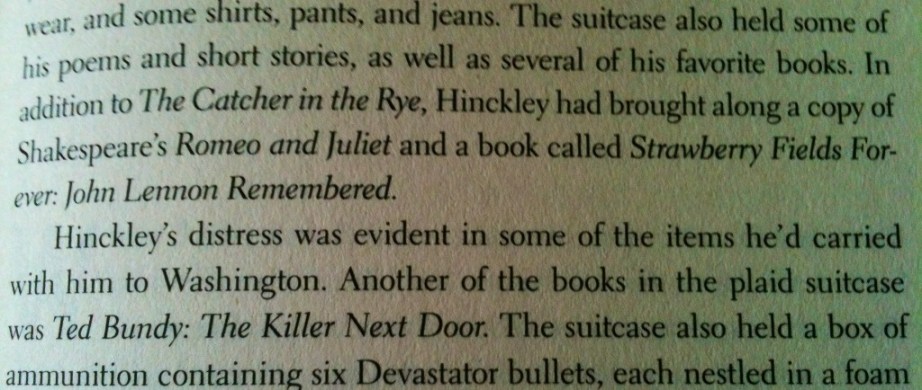
Del Quentin Wilber’s Rawhide Down: The Near Assassination of Ronald Reagan demanded more of my attention than I thought it would. It’s tightly paced book, telegraphed in sharp language—but most of all, the story of John Hinckley is just too bizarre. Here’s a sample of the would

20120403-153153.jpg

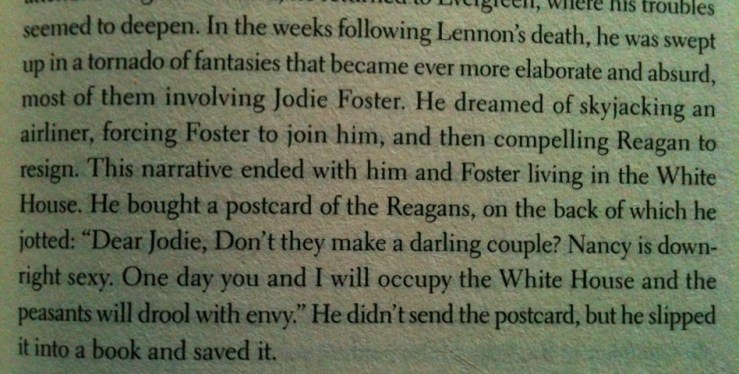
And if that’s not weird enough for you, check out Hinckley’s fantasy life:

20120403-153208.jpg