As always, Kenny Powers is heroically NSFW —
And then there’s his seriously NSFW K-Swiss ad campaign —

As always, Kenny Powers is heroically NSFW —
And then there’s his seriously NSFW K-Swiss ad campaign —
In his forthcoming cultural history of euphemisms, Euphemania, Ralph Keyes offers the following (seemingly apocryphal) origin of the euphemism “Johnson” (for “penis,” of course) —
Johnson is the last name most often used for the male sex organ. According to one theory, this slangy euphemism originated with the name of a large railroad brake lever. Lexicographer Eric Partridge thought it was more likely an abbreviated version of Dr. Johnson, a onetime synonym for “penis” that Partridge said might be based on the assumption that ‘there was no one Dr. [Samuel] Johnson was not prepared to stand up to.’ Working under the verbal restraints of his times, Partridge said this synonym was for the ‘membrum virile.’
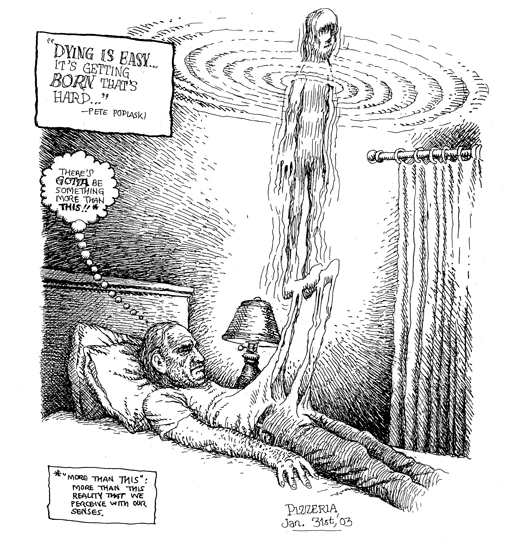
(Via).
Roy Peter Clark, in his excellent guide to practical writing The Glamour of Grammar, offers the following advice on two of the trickiest homophones in the English language, lie and lay —
Here’s the simplest way to remember the difference: lie means “to recline”; lay means “to place.” As in “I lay the cushions on the floor so I can recline in comfort.” (You can use the vowel sounds as a memory aid: lie/recline; lay/place.)
Confusion sweeps in when we move from the present tense to the past. Alas, the past tense of lie happens to by lay: “When I heard the news, I lay on the bed in disbelief.” And the past tense of lay is laid, as in “The bank robbers laid their weapons on the ground.”
Clark then gives us the following helpful examples that distinguish the principal parts of these tricky irregular verbs —
Lie: Today I lie on the bed. Yesterday I lay on the bed. I have lain on that bed so many times there are holes in the mattress.
Lay: Today I lay my cards on the table. Yesterday I laid my cards on the table. I have laid my cards on the table so many times that I was bound to win.
Significantly, Clark uses lie and lay as part of a larger discussion about how a writer can master irregular verbs. He suggests that learning the principal parts of these verbs and understanding the distinction between transitive and intransitive verbs will help writers to communicate more clearly. (The Glamour of Grammar is a fantastic book, by the way, and would make a vital addition to the libraries of experience and inexperienced writers alike).
So, ready for a quiz? One of our favorite blogs, Ironic Sans, compiled every use and misuse of lay and lie from the first three seasons of Mad Men. You’ll have a moment after hearing a character use or misuse lay or lie to decide if he or she has done so with grammatic fidelity. After that, a graphic (and sound) will let you know if the word has been used correctly. Good luck!
I’m not interested in writing short stories. Anything that doesn’t take years of your life and drive you to suicide hardly seems worth doing.
(Via).
“Honoring the Subjunctive,” a very short story by Lydia Davis, from The Collected Stories of Lydia Davis —
It invariably precedes, even if it do not altogether supersede, the determination of what is absolutely desirable and just.
Cool post over at Flavorwire on authors’ favorite foods — we like Truman Capote’s baked potato lunch the best:
Though Truman Capote’s writing was mostly occupied with social dealings, he managed to find time to write a forward to Myrna Davis’ The Potato Book, a cookbook penned to raise funds for a Long Island day school. In his brief contribution, Capote offers a recipe for what he describes as “my one and only most delicious ever potato lunch.” In a tribute to the then existing potato fields of Long Island, the recipe called for a baked potato smothered in sour cream and caviar, then paired with a chilled bottle of 80-proof Russian vodka.
Read our list of literary recipes here.
Saucy sex advice sage Dan Savage said, when Obama made an “It Gets Better” vid —
“The president of the United States has the power to do more than assure LGBT kids that it will get better,” Mr. Savage said. “The president of the United States and his administration have the power to make it better.”
“Treasure,” a creepy/fun webcomic by Edgar R. McHerly. From his website The Invisible Hair Suit.

El Guincho’s video for “Bombay” is heroically and emphatically NSFW—
David Mitchell talks about writing his novel Black Swan Green in his 2010 Paris Review interview—
MITCHELL
I’d actually started Black Swan Green years earlier. In 2003, while I was finishing Cloud Atlas, Granta asked for an unpublished story, and all I had were a few sketches about the world I grew up in. I didn’t want to be overly distracted from the end of Cloud Atlas, so I decided to knock one of the sketches into a publishable story. In doing so, I began my next novel.
INTERVIEWER
Did you, like Jason, write poetry under a pseudonym for the parish newsletter?
MITCHELL
I did.
INTERVIEWER
Was your pseudonym the same as Jason’s: Eliot Bolivar?
MITCHELL
James Bolivar—after a character created by an American science-fiction writer, Harry Harrison. I’ve never told anyone that before. You can see why.
INTERVIEWER
And, like Jason, did you go see a speech therapist?
MITCHELL
Just the same, aged about thirteen. Like Jason, I would go, and my stammer would vanish in the presence of the therapist, but come the next day, I’d be stammering again. One very pleasing result of Black Swan Green is that the book now appears on course syllabi for speech therapists in the UK. I hope that the book is useful for anyone wanting to understand an insider’s account of disfluency. For most of my life, the subject was a source of paralyzing shame, scrupulously avoided by family and friends. They were being kind, but to do something about a problem it must be named, discussed, and thought about. After writing the second chapter of Black Swan Green I realized, This is true, real, and liberating. I felt a little like how I imagine a gay man feels when he comes out. Thank God—well, thank me actually—that I don’t have to pretend anymore. Now I’m more able to feel that if people have a problem with my stammer, that problem is theirs and not mine. Almost a militancy. If Jason comes back in a future book, he’ll be an adult speech therapist.
INTERVIEWER
When you were creating Jason Taylor, did you ask yourself, What was David Mitchell like at that age?
MITCHELL
It was largely that, yes. Arguably, the act of memory is an act of fiction—and much in the act of fiction draws on acts of memory. Despite the fact that Jason’s and my pubescent voices are close, his wasn’t the easiest to crack because it had to be both plausible and interesting for adult readers.
INTERVIEWER
It was perverse of you to write a first novel after having written three others.
MITCHELL
When I started out on this head-banging vocation, my own background simply didn’t attract me enough to write about it. An island boy looking for his father in Tokyo; sarin-gas attackers; decayed future civilizations in the middle of the Pacific—these were what attracted me. It took me three books to realize that any subject under the sun is interesting, so long as the writing is good. Chekhov makes muddy, disappointed tedium utterly beguiling.
INTERVIEWER
Black Swan Green is very carefully structured.
MITCHELL
Get the structure wrong and you blow up shortly after takeoff. Get it right and you save yourself an aborted manuscript and months and months of wasted writing. Make your structure original and you may end up with a novel that looks unlike any other. So yes, Black Swan Green is carefully structured—like all halfway decent books—but simply structured too, with one story per month for thirteen months. After Cloud Atlas I wanted a holiday from complexity. I was reading Raymond Carver, John Cheever, and Alice Munro—all three great No Tricks merchants. After doing a half Chinese-box, half Russian-doll sort of a novel, I wanted to see if I could write a compelling book about an outwardly unremarkable boy stuck in an outwardly unremarkable time and place without any jiggery-pokery, without fireworks—just old-school.
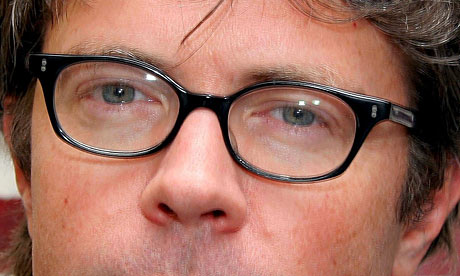
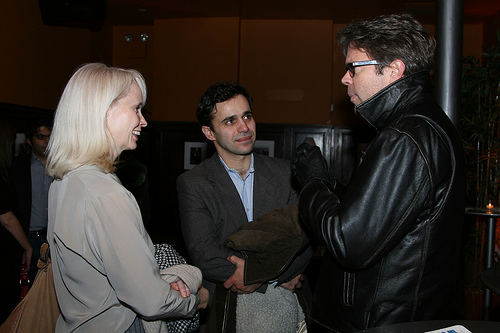
On October 4th of this year, right in the midst of Franzen-mania (and Franzenfreude), two ballsy Londoners jacked Jonathan Franzen’s signature spectacles during a Hyde Park bookstore launch party for Freedom. They left a ransom note asking for $100,000, but were eventually caught, and the glasses were returned. Now, if only someone could do him a favor and steal his silly leather jacket because, jeez, c’mon.
We always knew that comedian Louis CK was funny, insightful, and daring, but his new show Louie was a revelation, a masterful blend of humor and pathos. Louie eschewed traditional storytelling arcs in favor of vignettes that examined — often quite painfully — some of the harshest realities that comedy traditionally glosses over. The following clip is especially memorable, as a heated but humorous discussion at a poker game tips over into a stunning riff on the etymology of the word “faggot.”
Vodpod videos no longer available.

 Biblioklept