
Last week, the Smithsonian’s National Portrait Gallery acquired Andrew Tift’s kinda stark portrait of Cormac McCarthy. More info here.

Last week, the Smithsonian’s National Portrait Gallery acquired Andrew Tift’s kinda stark portrait of Cormac McCarthy. More info here.
Do you remember when you were like thirteen or fourteen and you read that bit in Naked Lunch about the supposed mind-expanding properties of nutmeg? Nutmeg! Like your mom baked with! Like, readily-available, no questions asked! And then you took it, just like Burroughs indicated, and it made your stomach hurt and gave you a headache (just like he said it would). And nothing else happened. No visions, no enlightenment, nada. Do you remember that? Oh, wait…that wasn’t you? That was someone else? Sorry…
From “Afterthoughts on a Deposition,” an index to Naked Lunch:
Convicts and sailors sometimes have recourse to nutmeg. About a tablespoon is swallowed with water. Results are vaguely similar to marijuana with side effects of headache and nausea. Death would probably supervene before addiction before addiction if such addiction is possible. I have only taken nutmeg once.
There you go, kids. Knock yourselves out. Actually, don’t. Just rent Altered States instead.
Burroughs, of course, was far more interested in yagé, or ayahuasca, a psychoactive preparation of a South American vine. At the end of his spare, funny, first novel Junky, Burroughs writes:
I decided to go down to Colombia and score for yage. … My wife and I are separated. I am ready to move on south and look for the uncut kick that opens out instead of narrowing down like junk.
Kick is seeing things from a special angle. Kick is momentary freedom from the claims of aging, cautious nagging, frightened flesh. Maybe I will find in yage what I was looking for in junk and weed and coke. Yage may be the final fix.
I’ve read Junky a few times and it seems that these lines are strangely half-hopeful and also deeply ironic. Burroughs’s stand-in, narrator William Lee doesn’t get what the writer William Burroughs seems to realize: there is no permanent solution, no “final fix.” Still, Burroughs sure did have some wacky adventures looking for it. Check out this clip from a documentary, apparently called Ayahuasca, narrated by Burroughs (if anyone out there knows anything about this movie, please let us know):

“You were not there for the beginning. You will not be there for the end. Your knowledge of what is going on can only be superficial and relative” — Naked Lunch
In 1970, William Burroughs was living in London. While there, he collaborated with young English artist Malcolm McNeill on a comic series for a magazine called Cyclops. The series was called The Unspeakable Mr. Hart, and remains uncollected/reprinted to date. Too bad, because it looks like really cool stuff. We got these images via The Virtual Library’s Beats collection, where there’s a really cool interview with McNeill (he discusses Burroughs habit of “going to movies to admire hard-ons and talking about them all afternoon,” which is kinda hilarious):
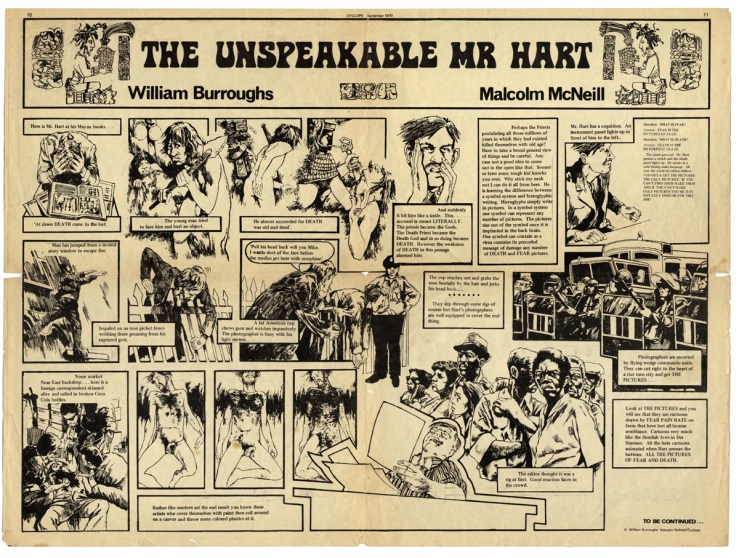

After Cylcops went kaput, Burroughs and McNeill continued the story in a project called Ah Pook Is Here, (a reference to the Mayan death god). Ah Pook Is Here, unfinished, was collected in the early eighties in Ah Pook Is Here and Other Texts which unfortunately is out of print. And very expensive. (Feel free to send it to me, anyone).

Fortunately, we can at least get a peek at some of McNeil’s hellish art at burroughsmcneillart.com. A few Boschian samples
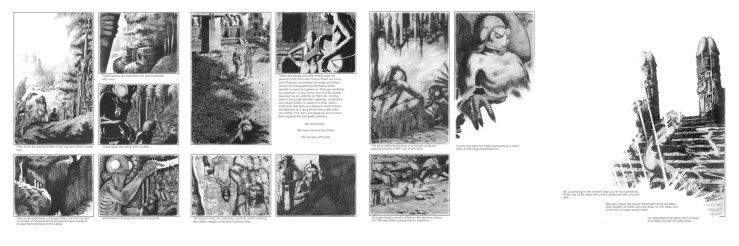

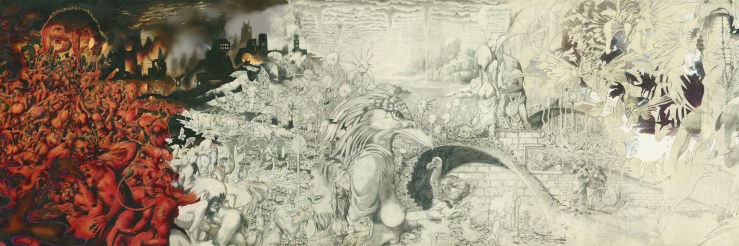
Again, we want this book. Please send us this book. In the meantime, filmmaker Philip Hunt made this 1994 6 minute animated short of Ah Pook Is Here:
Gus Van Sant’s great little short film from 1978, based on William Burroughs’s essay, explains the art of DE, or “Do Easy.” Our clumsy ass has been trying too hard, apparently. The film is quite funny but also useful, and well worth watching in full. It’s also included in the latest issue of Wholphin, if thou art so moved.

Look at these guys! I kind of have to have this record. If you have a copy, go ahead and send it to me. No? Okay, what about uploading the tracks somewhere as mp3s? No? Okay…
Image and LP info via Brainwashed.
William S. Burroughs/John Giorno (1975), GPS 006-007
William Burroughs
1. “103rd Street Boys” from Junkie 2. excerpt from Naked Lunch 3. “From Here To Eternity” from Exterminator 4. excerpt from Ah Pook Is Here 5. “The Chief Smiles” from Wild Boys 6. “The Green Nun” 7. excerpt from Cities Of The Red Night
John Giorno 8. “Eating Human Meat”
And so as not to just beg for mp3s but to also give, check out Burroughs explaining how tape manipulation helps to expand conciousness in “Origin and Theory of the Tape,” and get horrified by an example of said technique with “Present Time Exercises,” both from Break Through in Grey Room, a collection of Burroughs’s tape experiments and speeches (not to mention a dash of Ornette Coleman freaking freestyle in Morocco).

“Praise Song for the Day” by Elizabeth Alexander (Obama 2009 inaugural poem)
Praise song for the day.
Each day we go about our business, walking past each other, catching each others’ eyes or not, about to speak or speaking. All about us is noise. All about us is noise and bramble, thorn and din, each one of our ancestors on our tongues. Someone is stitching up a hem, darning a hole in a uniform, patching a tire, repairing the things in need of repair.
Someone is trying to make music somewhere with a pair of wooden spoons on an oil drum with cello, boom box, harmonica, voice.
A woman and her son wait for the bus.
A farmer considers the changing sky; A teacher says, “Take out your pencils. Begin.”
We encounter each other in words, words spiny or smooth, whispered or declaimed; words to consider, reconsider.
We cross dirt roads and highways that mark the will of someone and then others who said, “I need to see what’s on the other side; I know there’s something better down the road.”
We need to find a place where we are safe; We walk into that which we cannot yet see.
Say it plain, that many have died for this day. Sing the names of the dead who brought us here, who laid the train tracks, raised the bridges, picked the cotton and the lettuce, built brick by brick the glittering edifices they would then keep clean and work inside of.
Praise song for struggle; praise song for the day. Praise song for every hand-lettered sign; The figuring it out at kitchen tables.
Some live by “Love thy neighbor as thy self.”
Others by first do no harm, or take no more than you need.
What if the mightiest word is love, love beyond marital, filial, national. Love that casts a widening pool of light. Love with no need to preempt grievance.
In today’s sharp sparkle, this winter air, anything can be made, any sentence begun.
On the brink, on the brim, on the cusp — praise song for walking forward in that light.

Found this on the ground today:
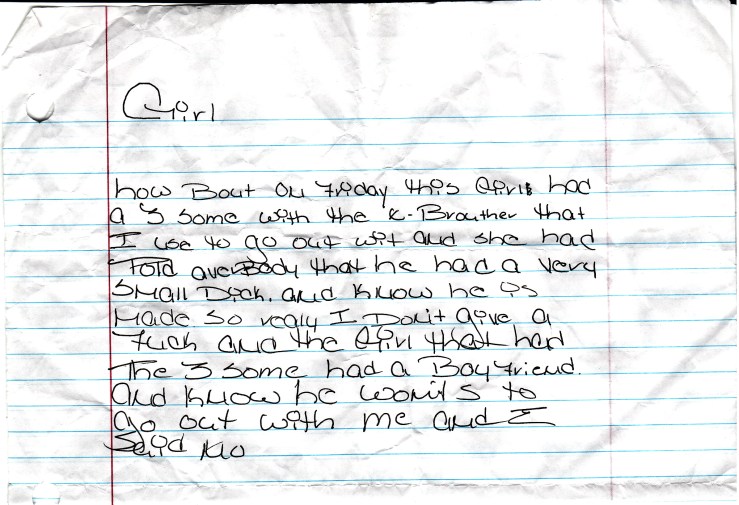
Translation:
“Dearest Friend,
Have you heard the gossip? Apparently, this past Friday, a certain young lady engaged in, as the French say (forgive me for being indelicate here) a ménage à trois. My ex-boyfriend was one of the participants, and, after the escapade, she reported that his sexual appendage was, well, smaller than average (he had a very small dick). Well, of course such spiteful calumny greatly agitated the young man, and, as for me, well, I must admit some measure of apathy (and perhaps distaste) for the whole matter. The young lady involved in the threesome had a boyfriend, and this young man has now turned his romantic–perhaps amorous–attentions in my direction; however, I declined his advances.”
Ah…kids.
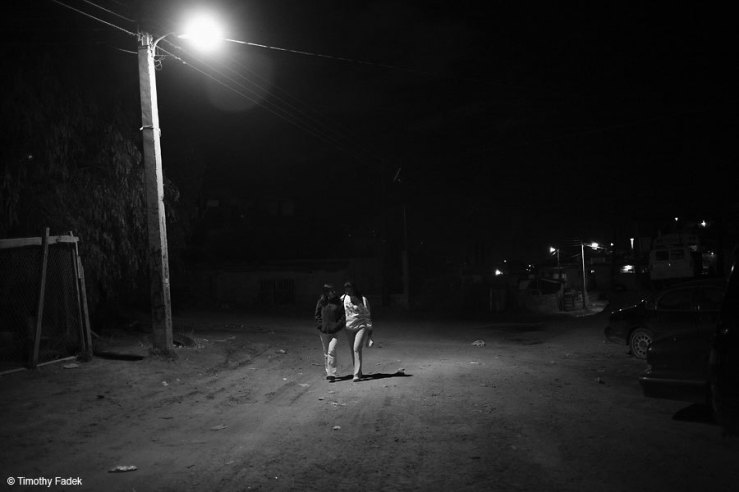
I’m about 60 pages away from finishing Roberto Bolaño’s posthumous magnum opus, 2666, an astounding, shocking book that you should pick up right now and start reading, unless, of course, you hate the idea of getting hopelessly addicted to a book that coerces you to read it, that lingers in the back of your mind and gut, beckoning, calling you, even as you should be working or spending time with your family or doing errands or chores, etc. But otherwise: read it. A proper review forthcoming.
Anyway. The backbone of the plot, or, rather, the peripheral story that haunts the plot(s) of this massive, heavy novel, involves a seemingly endless string of largely unsolved murders in the fictional Mexican border city of Santa Teresa. An ugly industrial town in the Sonora Desert, Santa Teresa is a thinly disguised stand-in for Ciudad Juárez, where over the past 15 years over 400 young women have been raped and killed, their murders unsolved. While searching the gruesome real-life back story that informs Bolaño’s masterpiece, I came across Fadek’s eerie and sympathetic images of Juárez (this background story on Fadek and the Juárez photos is also quite good). Fadek aims clearly to draw attention to these underreported crimes, but his photographs also capture the doom and foreboding that looms in the blood of 2666. Those who’ve read the novel will no doubt find them evocative of the fourth book of 2666, “The Part About the Crimes,” and those who are flirting with undertaking Bolaño’s big book may find their interest redoubled. In any case, Fadek’s photojournalism is well worth a look. Great stuff.
Yesterday, CNN’s Political Ticker blog published a short piece on Joe “The Plumber” Wurzelbacher (you know, that dick who landed on our Worst People of 2008 list). Wurzelbacher is covering the Israeli attacks on the people of Gaza for a conservative website called Pajamas Media. In the report, Joe waxes philosophical on the nature of war and freedom of the press:
“I think media should be abolished from, you know, reporting,” Wurzelbacher said. “You know, war is hell. And if you’re gonna sit there and say, ‘well, look at this atrocity,’ well you don’t know the whole story behind it half the time, so I think the media should have no business in it.”
So, let’s figure out Joe’s line of reasoning: War is bad. We don’t know “the whole story” behind the situations and circumstance in which war occurs. Therefore, because we don’t know “the whole story,” we should cease from any “you know, reporting.” To simplify it further: We do not know certain things. News reporters, whose job it is is to determine and then report these certain things we do not know, do not know these certain things. Because reporters do not know these certain things (these certain things there job is to determine), they should be stopped from determining the truth of these unknown certain things.
We all owe Joe a debt of gratitude for demonstrating the rhetorical art of paradox so beautifully. A regular Xeno, this guy. Additionally, Joe here graces us with not only a demonstration of paradox, but also gives us a great model of irony–a reporter (okay, an unlicensed plumber pretending to be a reporter) ostensibly reporting a war calling for the abolishment of the reporting of war! Bravo! Now, if Joe could please give us a better demonstration of a prick by proceeding to fuck himself with a hat pin, I believe we would all be thrilled.

From Simon Critchley’s The Book of Dead Philosophers:
In a text called Auto-Icon: or, Farther uses of the dead to the living, Bentham gave careful instructions for the treatment of his corpse and its presentation after his demise. If an icon is an object of devotion employed in religious ritual, then Bentham’s “Auto-Icon” was conceived in the spirit of irreligious jocularity. The “Auto-Icon” is a godless human being preserved in their own image for the small benefit of posterity. [. . .] As such, Bentham’s body is a posthumous protest against the religious taboos surrounding the dead [. . .] Bentham’s body was dissected and his skeleton picked clean and stuffed with straw. [. . .] Sadly, the mummification process went badly wrong and a wax head was used as a replacement. The original, rotting and blackened head used to be kept on the floor of the wooden box between Bentham’s feet . However, the head became a frequent target for student pranks, being used on one occasion for football practice in the front quadrangle.
Biblioklept’s Chief Eco-Travel Correspondent Damon Noisette recently filed the following report about the earthquake last Thursday in Costa Rica. Don’t worry, gentle readers, Damon and his entourage are all fine and dandy, cotton candy. All of the following words are Damon’s, verbatim–
—————————————————————————————————————————————————-
To survive a 6+ Richter Scale earthquake first you have to make sure you don’t fall down. Keep your balance. Once the initial earthquake is over make sure to run out of the structure you were in and get to a safe place. In an ideal situation the staff of the resort at which you are staying will direct you to a safe and covered place, triage, and distribute food and water to everyone.
If you are at a resort in Costa Rica you may have to do just a little more to make it through because the resort staff may just decide to say something to the effect of “screw those tourists”; things like scavenging through the wreckage of restaurants and rooms for food and water — and toilet paper — in the dark, carrying firewood to make your own fire, and using as much charm as possible to convince some other tourists to let you sleep in their rented van. That evening you should then try to make arrangements for a helicopter transport — at any price — with virtually no levels of cellular service. When that doesn’t work you should then try to sleep in the van parked on the side of the cliff while it rocks back and forth quite regularly from aftershocks.
Eventually the next day, after not sleeping and sitting in relative terror the entire night before, you should then wait patiently for your $850 helicopter to show up for half of the day. While you wait you should eat the pineapples you scrounged, drink the remaining water and Coca-Cola, enjoy a cold Hershey’s bar (kept cool in the small cooler you picked up in the destroyed restaurant), and watch as the helicopters continually take out other people and leave you at the defunct resort. By some stroke of luck or through sheer force of will you will find another resort-owner-provided helicopter that can seat three out of the four people in your group and you take advantage. The remaining person in your group should then get taken by four-wheeler across the ravaged countryside to meet up with the rest of the party.
The Croja Roja (Red Cross) should be in place by now, providing transportation for your party, sitting with luggage by the roadside, to a nearby refugee center. If your eyesight is good you should then accidentally bump into your travel agent’s driver and wrangle a ride back to San Jose where you then hook up with another driver to take you three hours to your next hotel on the Pacific coast.
When you return to the States you should then swear off eco-travel for at least a few years and stick to locations with minimal seismic activity.


When Biblioklept’s Chief Science Reporter Nicky Longlunch sent us this article about coked-up bees from The New York Times, we knew we had to give it the old Dada treatment, or in this case, the new Dada treatment. In 1920, Tristan Tzara gave the following directions:
TO MAKE A DADAIST POEM
Take a newspaper.
Take some scissors.
Choose from this paper an article of the length you want to make your poem.
Cut out the article.
Next carefully cut out each of the words that makes up this article and put them all in a bag.
Shake gently.
Next take out each cutting one after the other.
Copy conscientiously in the order in which they left the bag.
The poem will resemble you.
And there you are—an infinitely original author of charming sensibility, even though unappreciated by the vulgar herd.
Of course, scissors and cutting and actual papers and bags can be messy and tiresome, not to mention terribly old fashioned. Luckily for us, there’s a hypertext version, and we used this Dada poem generator to make our own poem out of the NYT article. Here is our poem:
liquefied brain so backs, it
liquefied brain so backs, it
scientists Australia dropped freebase cocaine
freebase liquefied brain so in
in Australia freebase cocaine bees’
circulatory backs, dropped it brain
freebase on bees’ backs, so
much judgment, their behavior makes
like stimulates their behavior and
humans much their enthusiastic them
much humans cocaine judgment, their
much like alters their their
react bees makes like enthusiastic
its odor exhibit plummets syrup
exhibit coked-up bee cold turkey
bees symptoms stop test of
bee its score standard test
turkey its test associate syrup
exhibit turkey test of bee
The real article’s actually kinda sorta better. Try this (any of it) at home.

From Mark Twain’s January 1st, 1863 column in the Territorial Enterprise:
Now is the accepted time to make your regular annual good resolutions. Next week you can begin paving hell with them as usual. Yesterday, everybody smoked his last cigar, took his last drink, and swore his last oath. To-day, we are a pious and exemplary community. Thirty days from now, we shall have cast our reformation to the winds and gone to cutting our ancient short comings considerably shorter than ever. We shall also reflect pleasantly upon how we did the same old thing last year about this time. However, go in, community. New Year’s is a harmless annual institution, of no particular use to anybody save as a scapegoat for promiscuous drunks, and friendly calls, and humbug resolutions, and we wish you to enjoy it with a looseness suited to the greatness of the occasion.
10. Joe the Plumber
Joseph Wurzelbacher, as manipulated by the McCain campaign, somehow came to stand for the “common man,” the “everyday” American (from real America, of course) who would just totally get dicked-over by a pinko like Obama. If Joe the Plumber does represent the average, everyday common American, that basically means the average, everyday common American is kinda dimwitted, slovenly, and prone to saying stupid stuff. And around Biblioklept Headquarters in Real America, we’re too patriotic to suggest such a thing. Olbermann takes down Joe:
9. Michael Phelps

Okay. We get it. You can swim fast. But please. Please. Don’t be such a smug dick–you’re not charming, as your awkward, unfunny appearances on SNL and The Colbert Report attest. Also, your skanky new girlfriend hardly lends you class. Thank god the Olympics only happen every four years.
8. Elisabeth Hasselback
Hasselback’s yapping maw jibber-jabbered at such a consistently shrill pitch for most of 2008, that even those of us who avoid The View like the special little plague it is were subject to take some notice. Someone has thoughtfully distilled Hasselback’s 25 most annoying moments into one dandy poisonous clip:
7. FOX News
6. Voters who voted for anti-gay ballot measures in California, Florida, Arkansas, and Arizona this year.
Evangelical leaders–many who claim to “love” everyone–consistently attempt to turn this fight into a matter of semiotics, into the meaning of the word “marriage.” Hogwash. Years from now–hopefully not too many–we, as a country, will look back on these anti-gay measures with the same sense of shame that now surrounds opposition to the Civil Rights movement. Anyone who claims that the issue is simply about what the word “marriage” means is being dishonest with themselves and everyone else. At least the loonies who follow Fred Phelps are openly and honestly bigoted.

5. John McCain

Dear Maverick McCain,
We used to like you, a little bit, way back in 2000, but yeah, we really did see you as an outsider for awhile, and sure, you’re a war hero (if getting shot down and surviving as a prisoner-of-war makes one a hero)–But–
Don’t you think the campaign you ran against Obama was kinda sorta most definitely shameful? I mean, like, aren’t you literally ashamed of the tacit and not-so-implicit and sometimes downright violent xenophobia and (yes) racism that you guys incited in your mobs? Aren’t you worried that any goodwill capital you built over you last 25 years in politics has been more or less spent? And Palin? Jesus! Seriously? Palin? Don’t get me wrong, your choice was truly a delight to watch, but come on, man. Show some sense.
4. Wall Street Investment Bankers
You oily pricks get what you deserve. Never have so many done so little for so much money. Also: Anyone who still believes that unregulated laissez-faire capitalism just “works.” Look around you.
3. The Bush Gang

Let’s lump them all together and let God sort them out. Or, better yet, let’s prosecute them. Or, better yet, tar-and-feather them, and run them out of town on a pole.
2. Sarah Palin
This year, Biblioklept is doling out a first: a special “Cunt of the Year” award, just for Palin. Aw, that’s kind of mean. Actually, it was really entertaining to watch Palin fumble through interviews (she reads “everything”!), wink and consistently drop the word-final “g” sound from her every utterance, and destroy any hopes that the GOP had of winning the ’08 election. And for every time she infuriated us (insinuating that there is a “real America,” one we are not a part of), she always made up for it with some comic gold. (The infamous turkey-pardoning-while-turkeys-get-slaughtered-in-the-background-video is a particular gem from 2008; (How, oh how, can Palin not see the irony here?)):
Of course, had McCain-Palin won–which is to say, if Americans had yet again made a bad, poor, ignorant, stupid, willfully stupid decision about who should lead them–we would not make light of Palin’s idiocy. But they lost. They lost! Ha ha, they lost! So, it’s perfectly fine and dandy to recall all of Palin’s flubs (Remember when that morning shock jock pranked her? Remember the debate?!) With a little luck, the Republican leadership will continue to stand behind Palin (literally!) and ruin any chances the party has to ascend to power again in 2010 or 2012.
1. George Bush
As of this writing, there are only 25 days left in the Bush presidency (keep track here if you want), yet it seems probable that he’ll manage to fuck something else up for the incoming administration. I say the decade officially ends this January. Let’s move on.
Just like last year, we find Dubya dancing:
 Biblioklept