

Category: Art
Where am I going to get a human skull? (From Bob Dylan’s Nobel Prize speech)
I was out on the road when I received this surprising news, and it took me more than a few minutes to properly process it. I began to think about William Shakespeare, the great literary figure. I would reckon he thought of himself as a dramatist. The thought that he was writing literature couldn’t have entered his head. His words were written for the stage. Meant to be spoken not read. When he was writing Hamlet, I’m sure he was thinking about a lot of different things: “Who’re the right actors for these roles?” “How should this be staged?” “Do I really want to set this in Denmark?” His creative vision and ambitions were no doubt at the forefront of his mind, but there were also more mundane matters to consider and deal with. “Is the financing in place?” “Are there enough good seats for my patrons?” “Where am I going to get a human skull?” I would bet that the farthest thing from Shakespeare’s mind was the question “Is this literature?”
Fenris Bound — Ingri and Edgar Parin d’Aulaire
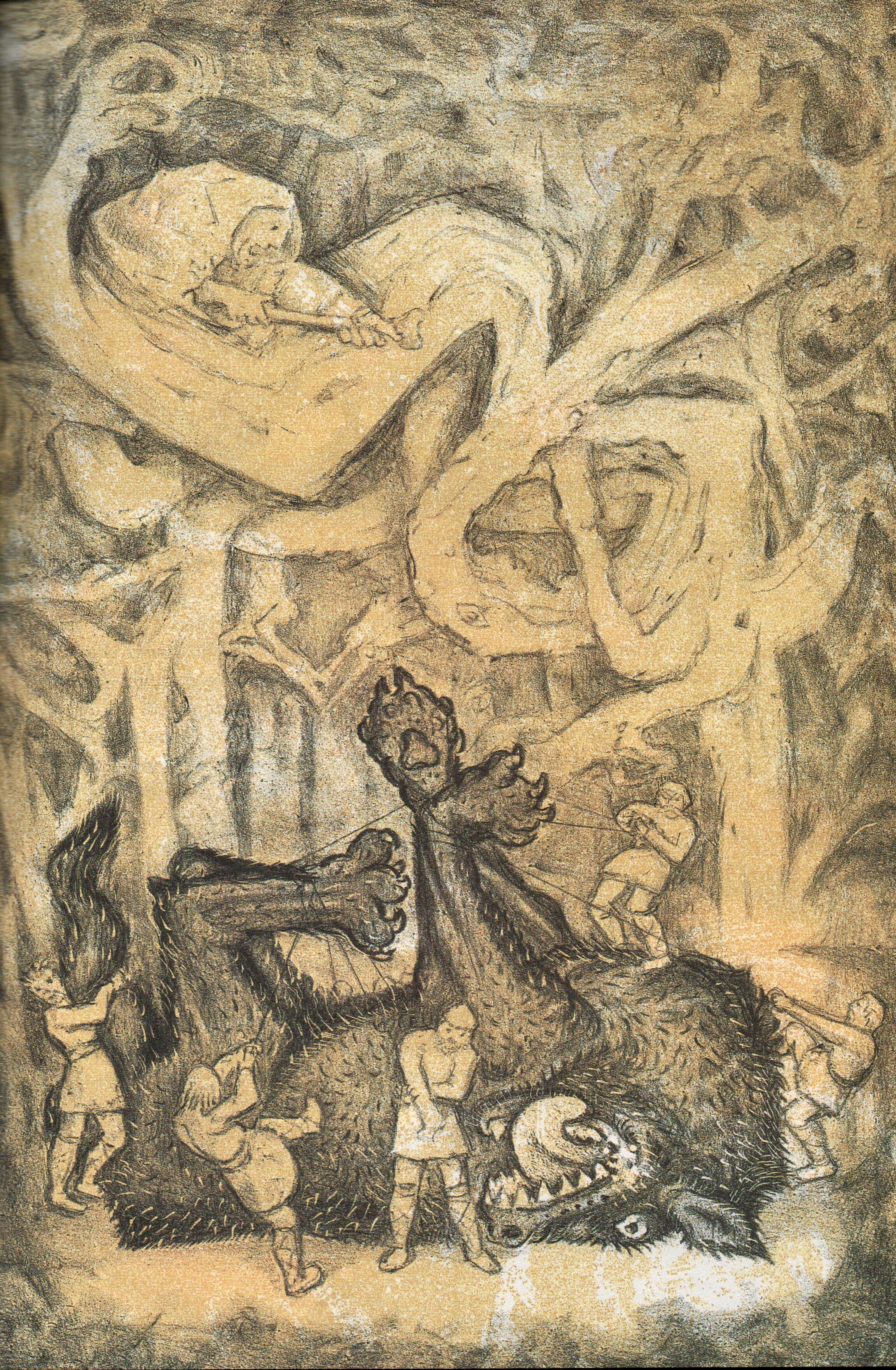
From Ingri and Edgar Parin d’Aulaire’s Book of Norse Myths. Published by NYRB. My son and I have enjoyed the hell out of it.
Perpetually postponed to the future (Alan Watts)
…we have an absolutely extraordinary attitude in our culture and in various other cultures—high civilizations—to the new member of human society. Instead of saying, “Thank you,” to children, “How do you do? Welcome to the human race; we are playing a game, and we are playing by the following rules… We want to tell you what the rules are so that you’ll know your way around, and when you’ve understood what rules we’re playing by, when you get older you may be able to invent better ones.”
But instead of that we still retain an attitude to the child that he is on probation; he’s not really a human being, he’s a candidate for humanity. …we have a whole system of preparation of the child for life, which always is preparation and never actually gets there…. as a result of this problem being insoluble, it is perpetually postponed to the future so that one lives—one is educated—to live in the future, and one is not ever educated to live today.
Alan Watts.
Coronation of Sesostris — Cy Twombly

Strips #313, #314, #315 — Samplerman

Pynchon invests his work with mythological associations on a vast scale
…Pynchon…invests his work with mythological associations on a vast scale, in a manner both deliberate and mocking, utilizing both central myths of Western civilization and popular culture myths. Orphic myths, manifested in various descents into the underworld, jostle against Faustian legend, which calls for trips up the Brocken, the Walpurgisnacht mountain, and these in turn are juxtaposed with fairytales like Hansel and Gretel, children’s stories like Alice in Wonderland or the Wizard of Oz, and archetypical figures from movies, such as Dracula, King Kong, and Jack Slade. In addition, there are allusions to classical, kabbalistic, and Christian contexts. By far the most significant are references to Norse and Teutonic myth. Swirling in the background of the novel are the trappings of Northern epic: runes, the Northern Lights (the flickering light given off by the Valkyries), dwarves, the titans Etzel and Utgarthaloki, and rainbows (the bridge to the abode of the gods), The distillation of meat and the novels first scene. Two of the principal figures are Blicero, or “white,” and his former love, the Herero Enzian, or “blue,” a name Blicero borrowed from Rilke; the body of the Norse goddess of death, Hela, is half white, half blue.
From Joseph W. Slade’s long essay “Living on the Interface: Preterition in Gravity’s Rainbow.” The essay is part of Slade’s 1974 book Thomas Pynchon, part of Warner Paperback Library’s “Writers for the 70’s” series.
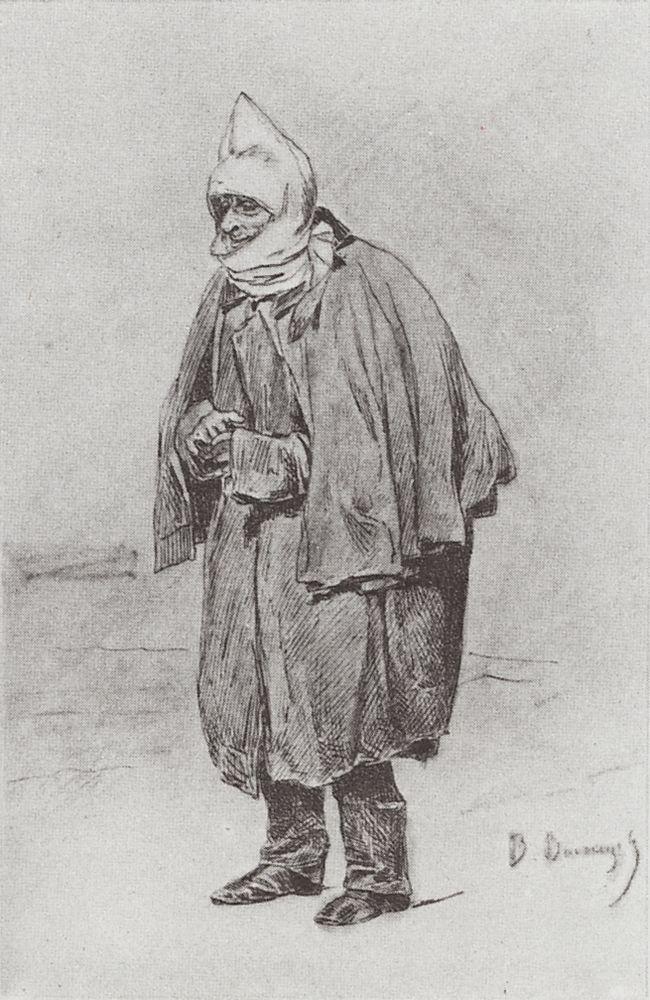
Pharmacist — Viktor Vasnetsov
Bathsheba in the Bath — Hans Memling

Wild Apples — Fairfield Porter

Roman Muradov’s graphic novella Jacob Bladders and the State of the Art reviewed
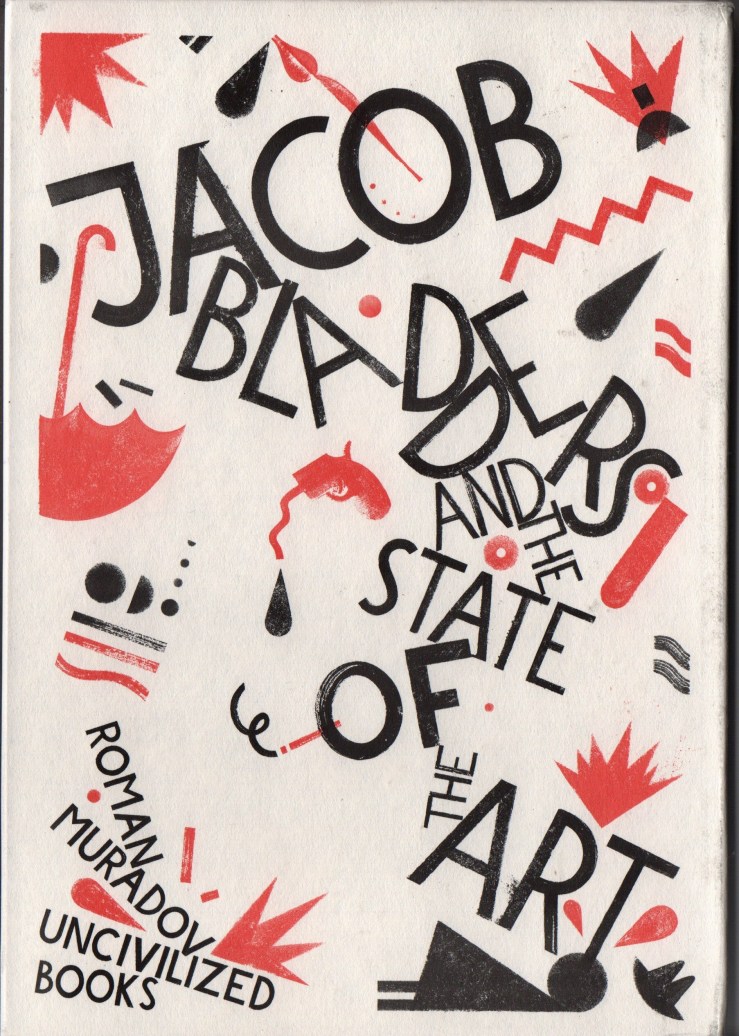
Roman Muradov’s newest graphic novella, Jacob Bladders and the State of the Art (Uncivilized Books, 2016), is the brief, shadowy, surreal tale of an illustrator who’s robbed of his artwork by a rival.
There’s more of course.
In a sense though, the plot is best summarized in the first line of Jacob Bladders:

Okay.
Maybe that’s too oblique for a summary (or not really a summary at all, if we’re being honest).
But it’s a fucking excellent opening line, right?
Like I said, “There’s more” and if the more—the plot—doesn’t necessarily cohere for you on a first or second reading, don’t worry. You do have worth, reader, and Muradov’s book believes that you’re equipped to tangle with some murky noir and smudgy edges. (It also trusts your sense of irony).
The opening line is part of a bold, newspaperish-looking introduction that pairs with a map. This map offers a concretish anchor to the seemingly-abstractish events of Jacob Bladders.

The map isn’t just a plot anchor though, but also a symbolic anchor, visually echoing William Blake’s Jacob’s Ladder (1805). Blake’s illustration of the story from Genesis 28:10-19 is directly referenced in the “Notes” that append the text of Jacob Bladders. There’s also a (meta)fictional “About the Author” section after the end notes (“Muradov died in October of 1949”), as well as twin character webs printed on the endpapers.
Along with the intro and map, these sections offer a set of metatextual reading rules for Jacob Bladders. The map helps anchor the murky timeline; the character webs help anchor the relationships between Muradov’s figures (lots of doppelgänger here, folks); the end notes help anchor Muradov’s satire.
These framing anchors are ironic though—when Muradov tips his hand, we sense that the reveal is actually another distraction, another displacement, another metaphor. (Sample end note: “METAPHOR: A now defunct rhetorical device relying on substitution of a real-life entity with any animal”).
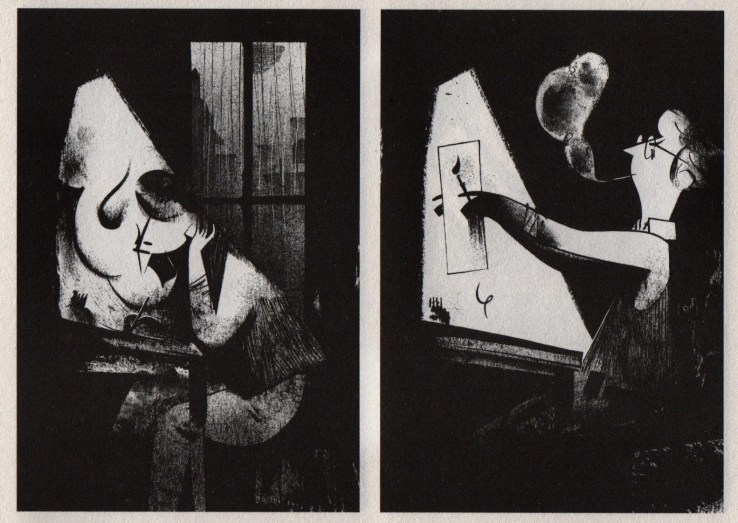
It’s tempting to read perhaps too much into Jacob Bladder’s metatextual self-reflexivity. Here is writing about writing, art about art: an illustrated story about illustrating stories. And of course it’s impossible not to ferret out pseudoautobiographical morsels from the novella. Roman Muradov is, after all, a working illustrator, beholden to publishers, editors, art-directors, and deadlines. (Again from the end notes: “DEADLINE: A fictional date given to an illustrator to encourage timely delivery of the assignment. Usually set 1-2 days before the real (also known as ‘hard’) deadline”). If you’ve read The New Yorker or The New York Times lately, you’ve likely seen Muradov’s illustrations.
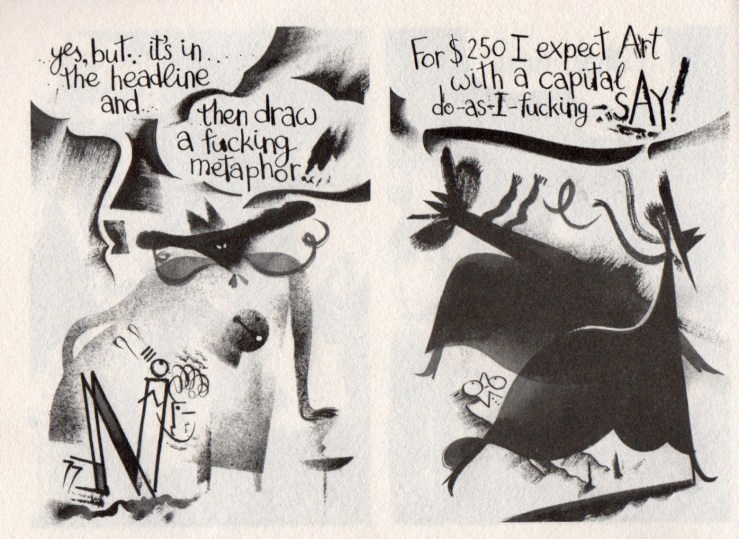
So what to make of the section of Jacob Bladders above? Here, a nefarious publisher commands a hapless illustrator to illustrate a “career ladders” story without using an illustration of a career ladder (From the end notes: “CAREER LADDER: An illustration of a steep ladder, scaled by an accountant in pursuit of a promotion or a raise. The Society of Illustrators currently houses America’s largest collection of career ladders, including works by M.C. Escher, Balthus, and Marcel Duchamp”).
Draw a fucking metaphor indeed. (I love how the illustrator turns into a Cubist cricket here).
Again, it’s hard not to find semi-autobiographical elements in Jacob Bladders’s publishing satire. Muradov couches these elements in surreal transpositions. The first two panels of the story announce the setting: New York / 1947—but just a few panels later, the novella pulls this move:
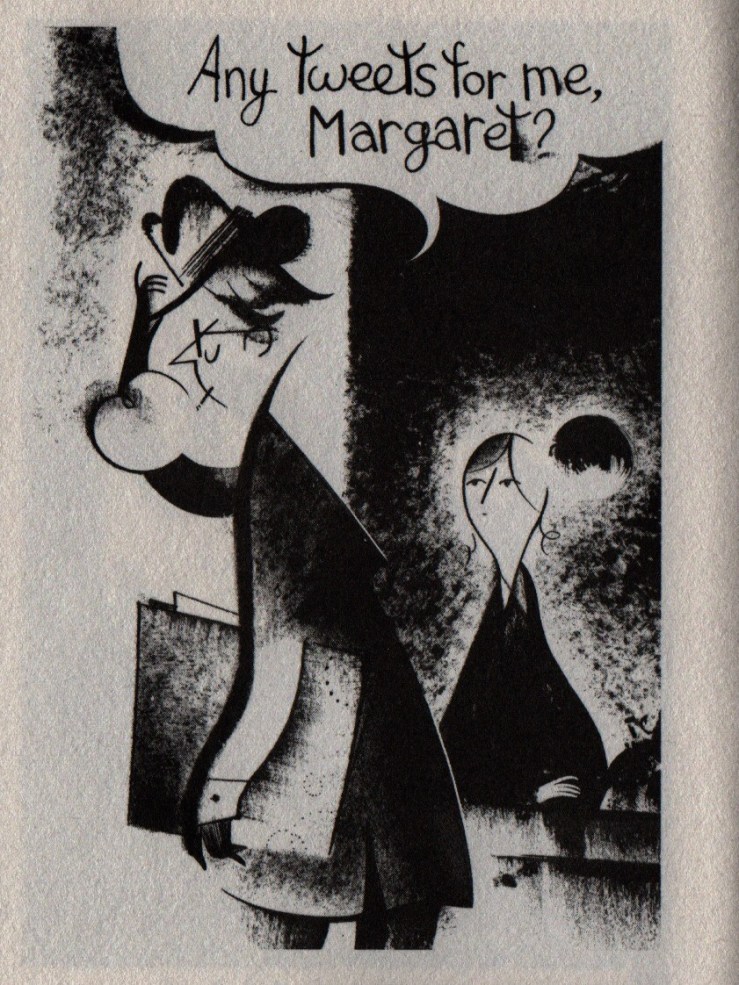
Here’s our illustrator-hero Jacob Bladders asking his secretary (secretary!) for “any tweets”; he seems disappointed to have gotten “just a retweet.” In Muradov’s transposition, Twitter becomes “Tweeter,” a “city-wide messaging system, established in 1867” and favored by writers like E.B. White and Dorothy Parker.
Do you follow Muradov on Twitter?
I do. Which makes it, again, kinda hard for me not to root out those autobiographical touches. (He sometimes tweets on the illustration biz, y’see).
But I’m dwelling too much on these biographical elements I fear, simply because, it’s much, much harder to write compellingly about the art of it all, of how Muradov communicates his metatextual pseudoautobiographical story. (Did I get enough postmoderny adjectives in there? Did I mention that I think this novella exemplary of post-postmodernism? No? These descriptions don’t matter. Look, the book is fucking good).
Muradov’s art is better appreciated by, like, looking at it instead of trying to describe it (this is an obvious thing to write). Look at this spread (click on it for biggeration):

The contours, the edges, the borders. The blacks, the whites, the notes in between. This eight-panel sequence gives us insides and outsides, borders and content, expression and impression. Watching, paranoia, a framed consciousness.
And yet our reading rules—again, from the end notes: “SPOTILLO: Spot illustration. Most commonly a borderless ink drawing set against white background”; followed by “CONSTRAINT: An arbitrary restriction imposed on a work of art in order to give it an illusion of depth”.
Arbitrary? Maybe. No. Who cares? Look at the command of form and content here, the mix and contrast and contradistinctions of styles: Cubism, expressionism, impressionism, abstraction: Klee, Miro, Balthus, Schjerfbeck: Robert Wiene and Fritz Lang. Etc. (Chiaroscuro is a word I should use somewhere in this review).
But also cartooning, also comix here—Muradov’s jutting anarchic tangles, often recoiling from the panel proper, recall George Herriman’s seminal anarcho-strip Krazy Kat. (Whether or not Muradov intends such allusions is not the point at all. Rather, what we see here is a continuity of the form’s best energies). Like Herriman’s strip, Muradov’s tale moves under the power of its own dream logic (more of a glide here than Herriman’s manic skipping).
That dream logic follows the lead (lede?!) of that famous Romantic printmaker and illustrator William Blake, whose name is the last “spoken” word of the narrative (although not the last line in this illustrated text). Blake is the illustrator of visions and dreams—visions of Jacob’s Ladder, Jacob Bladders. Jacob Bladders and the State of the Art culminates in the Romantic/ironic apotheosis of its hero. The final panels are simultaneously bleak and rich, sad and funny, expressive and impressive. Muradov ironizes the creative process, but he also points to it as an imaginative renewal. “Imagination is the real,” William Blake advised us, and Muradov, whether he’d admit it or not, makes imagination real here. Highly recommended.
They’ve Already Got a Seat — Goya

Jon Frankel’s The Man Who Can’t Die (Book acquired sometime in October of 2016, or maybe some other time, not sure, early November was rough)
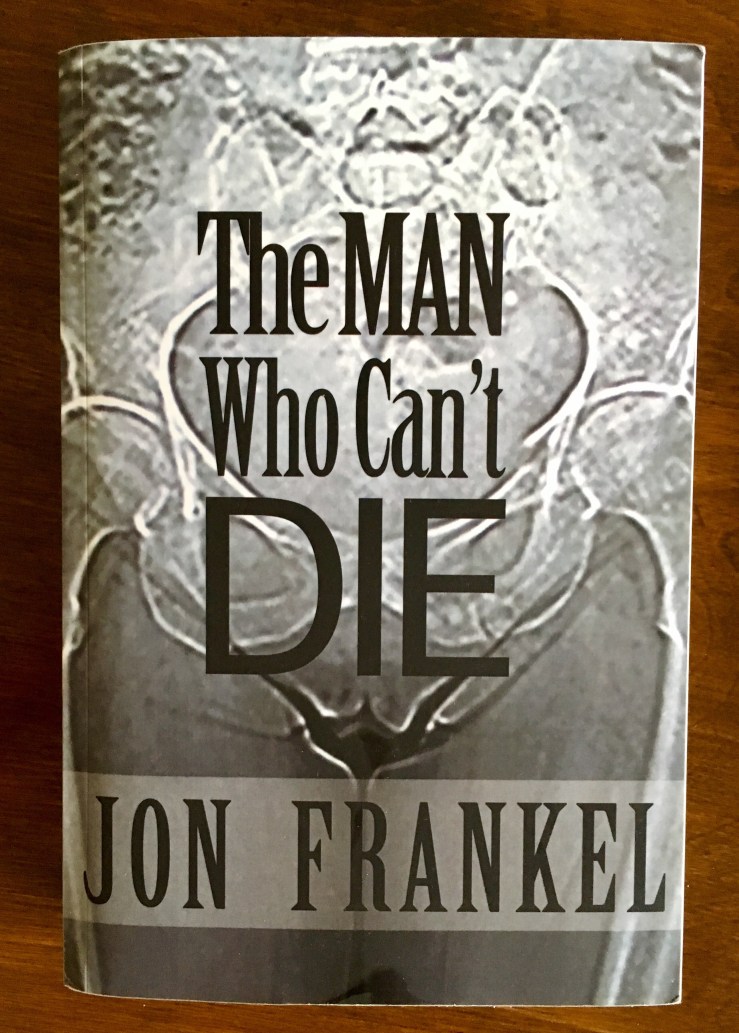
Jon Frankel’s The Man Who Can’t Die is new from Whisk(e)y Tit. Their blurb:
New York, 2180. Manhattan is cut with sewage-filled canals and walled in by levees. The world has been suffering from epidemic despair and apathy, when Dr. Ruth Bryson invents Paragane, a Euphoric drug that cures ennui and depression. Monozone Inc, the monopolistic pharmaceutical who employs her, is thrilled.
There is only one problem: the drug kills 10% of everyone who takes it. Monozone decides to market it anyway, despite Bryson’s objections, and puts her former lover Owen Bradlee in charge. Bryson knows she must either fix Paregane or stop it, but if she is caught she will certainly be killed.
Meanwhile, Felix and Veronica Clay are typical pod-dwelling office workers, whose lives seem like an endless extenuation of meaningless circumstance. When Veronica plunges into psychosis and tries to kill herself, her doctor prescribes the new drug Paragane, and everything changes. Soon Felix is also taking the drug, and they spend their nights under its influence, roaming Paradise and conversing with Angels. One day Felix returns from work to discover her dead, of no apparent cause. In short order, he loses his job and apartment and soon finds himself living in the wilds of upper Manhattan, addicted to Paregane, unable to find Veronica in Paradise, unable to die. Meanwhile, Dr. Bryson searches for a test subject. When she discovers Felix they are set on a course that will lead them deep into the Iroquois territories of upstate New York and a bloody struggle for survival.
The Scenic Painters — Adrian Cox

Giant — Lynd Ward

Courtesan Reading a Letter — Ishikawa Toyonobu

Selections from One-Star Amazon Reviews of Don DeLillo’s White Noise
[Editorial note: The following citations come from one-star Amazon reviews of Don DeLillo’s novel White Noise. I’ve preserved the reviewers’ original punctuation and spelling. More one-star Amazon reviews].
quips
UGH
rubbish
chubby wife
Verble sparing
Love the cover
nothing happens
frequently witless
watching paint dry
orgasmic experiences
Barak Hussein Obama
supremely unamusing
my daughter hated this
rampant commercialism
trying to be ironic but failing
it’s not clear what the point is
hated this book with a violent passion
he goes to the grocery store about 4 times
slobbering self appointed literary pillocks
Fred Flintstonesque postmodern hectoring
some generic non-descript mid-western city
ultra trite unimaginative obsession about death
Theme is supposed to emerge from a work of fiction
desperately avoids any of the conventional trappings of fiction
a silly trick by a critic’s darling to help us feel more self-rightous
A left wing hipster might relate to the message the book is trying to communicate
It has good ideas and themes for a literature class if you look at it from that perspective
Feels false, like the author was trying to make sublime points about human nature and the direction of society
The cartoonish characters are about as credible as the windbag Biden is on foreign policy
felt like the author was just using the characters and the plot as puppets
I invested almost six minutes reading this book before I threw it out
I read this book so I’m smarter than the rest of you
Even allowing for the mid 1980’s publication date
entire pages go by and nothing really happens
moaning middle class left wing academics
they go through an airborne toxic event
the Sopranos and Anne of Green Gables
dated technology/consumer references
Droned on and on and on about death
wasn’t a single character I cared about
a Hannah Montana puke fest
tossed it into the trash
watching grass grow
I prefer life to death
local supermarket
A Seinfield book
literary (as if?)
he goes crazy
anal vacuity
it bore me
dullardish
it just ends
 Biblioklept