Biblioklept Is Seven Today, So Here are Seven Sets of Seven Somethings

*

Seven Reviews of Seven Books I Love

The Rings of Saturn — W.G. Sebald

Denis Johnson’s Train Dreams Is a Perfect Novella

The Pale King — David Foster Wallace

Candide — Voltaire

I Riff on Clarice Lispector’s Novella The Hour of the Star, a Strange Work of Pity, Humor, Terror, and Abjection

The Collected Stories of Lydia Davis

Intertexuality and Structure in Roberto Bolaño’s 2666

*

Seven Hands (Van Gogh)

*

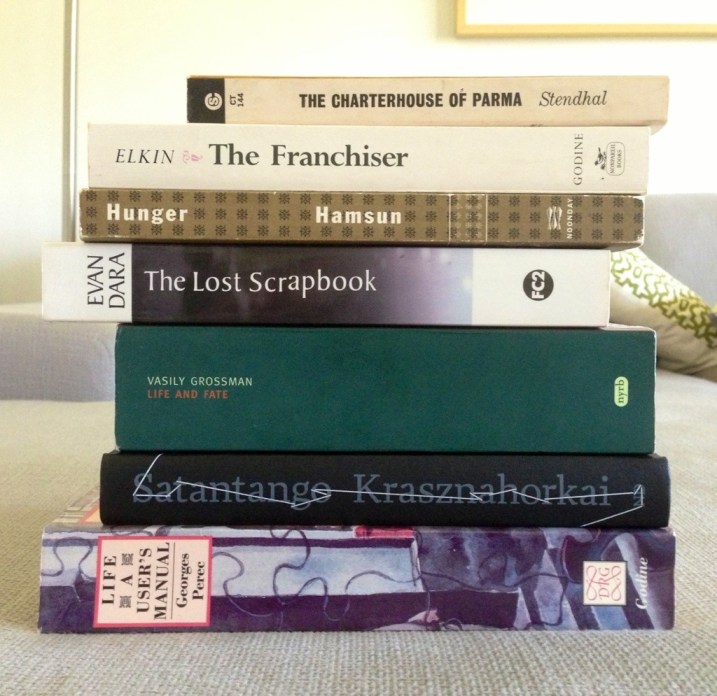
Seven Books I’d Like to Read Sometime in the Next Seven Years

20130909-164115.jpg

*

Seven Negative Reviews

Why I Abandoned Chad Harbach’s Over-Hyped Novel The Art of Fielding After Only 100 Pages

Jonathan Lethem’s Bloodless Prose

I Super Hated Gary Shteyngart’s Super Sad True Love Story

The Instructions — Adam Levin

Sunset Park — Paul Auster

The Passage — Justin Cronin

The Sot-Weed Factor — John Barth

*

Seven Ballerinas (Picasso)

*

Seven Perfect Short Stories

“The Death of Me” — Gordon Lish

“A Good Man Is Hard to Find” — Flannery O’Connor

“Emergency” — Denis Johnson

“The School” — Donald Barthelme

“Sweat” — Zora Neale Hurston

“Wakefield” — Nathaniel Hawthorne

“Good Old Neon” — David Foster Wallace

*

Seven Deadly Sins (Bosch)

*

KB with Art in America — Alex Kanevsky

alex-kanevsky

Biblioklept’s Dictionary of Literary Terms

APHORISM

A concise, often witty, turn of phrase that should be shared out of context on Twitter or Pinterest.

BILDUNGSROMAN

Novel where someone (preferably male) matures into the ideal state of bitter disillusionment.

CATHARSIS

Evocation of fear and pity. Best exemplified in modern storytelling by Lifetime Network original movies.

DECONSTRUCTION

A form of textual analysis. No one knows what it means. Apply liberally.

EXISTENTIALIST

Use to describe any French novel of the 20th century. Serve with coffee and cigarettes.

FOIL

First, Outer, Inner, Last.

GENRE FICTION

Deride genre fiction at all times. If a writer uses genre tropes, praise her for genre bending. (See LITERARY FICTION).

HYSTERICAL REALISM

Use to describe any big ambitious novel that does not meet your aesthetic and/or moral needs.

IAMBIC PENTAMETER

All poetry is composed in iambic pentameter.

JUVENILIA

A writer’s immature work, which she usually (wisely) withholds from publication. After the writer dies, every scrap should be published, scrutinized, and passed around the internet out of context.

KAKFAESQUE

Synonym for “odd.” Apply freely.

LITERARY FICTION

A genre of fiction that pretends not to be a genre. What your book club is reading this month.

MAGICAL REALISM

Use to describe any novel by a South American writer.

NARRATOLOGY

Use structuralist techniques to analyze narrative plots—and watch the kids go wild! Narratology is the number one thing the audience of a book review is interested in.

ORPHAN

All heroes must be orphans.

PANOPTICON

Use this term liberally in any discussion of modern politics. Pairs well with film studies courses.

QUEER THEORY

A form of literary analysis that conveniently begins with the letter “Q,” making it ideal for silly alphabetized lists like this one.

ROUND CHARACTER

A character portrayed in psychological and emotional depth to the degree that she comes alive in your imagination. Round characters provide an excellent alternative to making meaningful human relationships.

SOUTHERN GOTHIC

Use to describe the style of any writer from the Southern part of the United States.

TAUTOLOGY

A tautology is a tautology.

UTOPIA

Synonym for dystopia. Argue about its pronunciation, indicating that you understand the complexities of Greek prefixes.

VERISIMILITUDE

Literary trickery.

WHODUNNIT

A genre of books that sells well in airports.

XENA

Beloved warrior princess. Look, is hardokay?

YOUNG WERTHER

The original sad bastard; he invented emo.

ZEITGEIST

Time’s ghost. You’re soaking in it, which makes it hard to see.

Interior with a Young Man Reading — Vilhelm Hammershøi

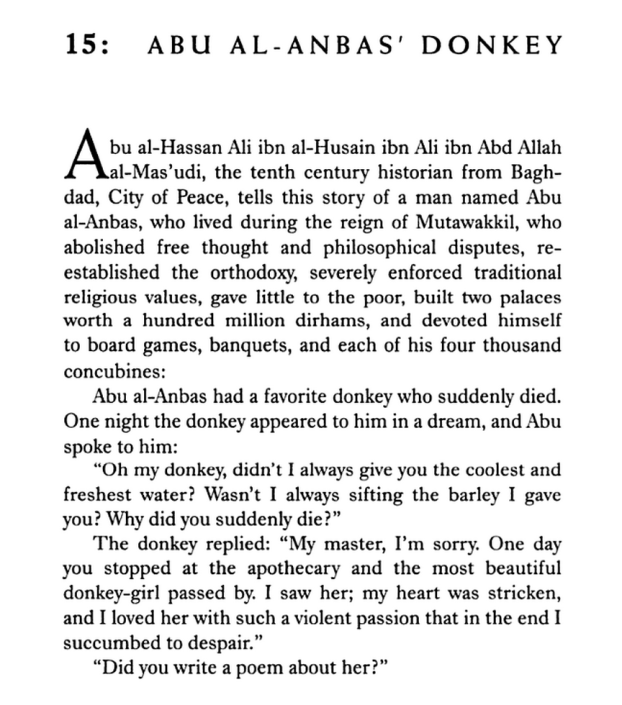
“Abu Al-Anbas’ Donkey” – Eliot Weinberger

Screen Shot 2013-09-07 at 11.51.10 AM Screen Shot 2013-09-07 at 11.51.48 AM

“—you see you were always lost” (Thomas Bernhard)

“You just arrive in a place,” said the painter,“ and then you leave it again, and yet everything, every single object you take in, is the sum of its prehistory. The older you become, the less you think about the connections you’ve already established. Table, cow, sky, stream, stone, tree, they’ve all been studied. Now they just get handled. Objects, the harmonic range of invention, completely unappreciated, no more truck with variation, deepening, gradation. You just try to work out the big connections. Suddenly you look into the macro-structure of the world, and you discover it: a vast ornament of space, nothing else. Humble backgrounds, vast replications—you see you were always lost. As you get older, thinking becomes a tormenting reference mechanism. No merit to it. I say ‘tree,’ and I see huge forests. I say ‘river,’ and I see every river. I say ‘house,’ and I see cities with their seas of roofs. I say ‘snow,’ and I see oceans of it. A thought sets off the whole thing. Where it takes art is to think small as well as big, to be present on every scale …”

From Thomas Bernhard’s novel Frost.

Lesender Knabe — Frans Hals

World of Pains and Troubles (John Keats)

—The common cognomen of this world among the misguided and superstitious is ‘a vale of tears’ from which we are to be redeemed by a certain arbitrary interposition of God and taken to Heaven–What a little circumscribed straightened notion! call the world if you Please ‘The vale of Soul-making’ Then you will find out the use of the world (I am speaking now in the highest terms for human nature admitting it to be immortal which I will here take for granted for the purpose of showing a thought which has struck me concerning it) I say “Soul making” Soul as distinguished from an Intelligence– There may be intelligences or sparks of the divinity in millions–but they are not Souls till they acquire identities, till each one is personally itself. Intelligences are atoms of perception–they know and they see and they are pure, in short they are God–how then are Souls to be made? How then are these sparks which are God to have identity given them–so as ever to possess a bliss peculiar to each ones individual existence? How, but by the medium of a world like this? This point I sincerely wish to consider because I think it a grander system of salvation than the chrystain religion–or rather it is a system of Spirit-creation–This is effected by three grand materials acting the one upon the other for a series of years–These Materials are the Intelligence–the human heart (as distinguished from intelligence or Mind) and the World or Elemental space suited for the proper action of Mind and Heart on each other for the purpose of forming the Soul or Intelligence destined to possess the sense of Identity. I can scarcely express what I but dimly perceive–and yet I think I perceive it–that you may judge the more clearly I will put it in the most homely form possible–I will call the world a School instituted for the purpose of teaching little children to read–I will call the Child able to read, the Soul made from that school and its hornbook. Do you not see how necessary a World of Pains and troubles is to school an Intelligence and make it a soul? A Place where the heart must feel and suffer in a thousand diverse ways! Not merely is the Heart a Hornbook, it is the Minds Bible, it is the Minds experience, it is the teat from which the Mind or intelligence sucks its identity–As various as the Lives of Men are–so various become their Souls, and thus does God make individual beings, Souls, Identical Souls of the sparks of his own essence–“

—From a letter John Keats wrote to his brother George, dated April 21, 1810. (More excerpts from Keats’s letters with commentary).

Woman Reading — Utagawa Kuniyoshi

Kuniyoshi_Utagawa_Woman_reading

Susan Sontag’s List of Novels with Cinematic Structure

Novels with cinematic structure:

Hemingway, In Our Time

Faulkner,

[Horace] McCoy, They Shoot Horses, Don’t They?

Robbe-Grillet, Les Gommes [The Erasers]

[Georges] Bernanos, M. Ouine

I[vy] Compton-Burnett,

V Woolf, Between the Acts

Philip Toynbee, Tea with Mrs. Goodman

des Forêts, Les Mendiants

his first novel—multiple pov [points of view]

[Barnes,] Nightwood

Reverzy, Le Passage

Burroughs,

[John] Dos Passos

Firbank, CapriceVainglory; and [Inclinations] (trilogy)

Jap[anese] writer [Yasunari Kawabata] (N.B. visual sense, suppleness of changing scenes)—Snow Country, etc.

Dickens (cf. Eisenstein)—

There are people who thought with camera eye (a unified p-o-v that displaces itself) before the camera

N[athaniel] West,

Blechman

“new novelists”: Claude Simon, Le Palace

Claude Ollier, La Mis-en-Scène

(all based on organization of a decor (N[orth] Africa)

–From an entry dated 6/26/66 Paris in Susan Sontag’s notebook, published as part of As Consciousness Is Harnessed to Flesh. (I’ve maintained the bracketed editorial intrusions of the published text, even with they did not seem necessary).

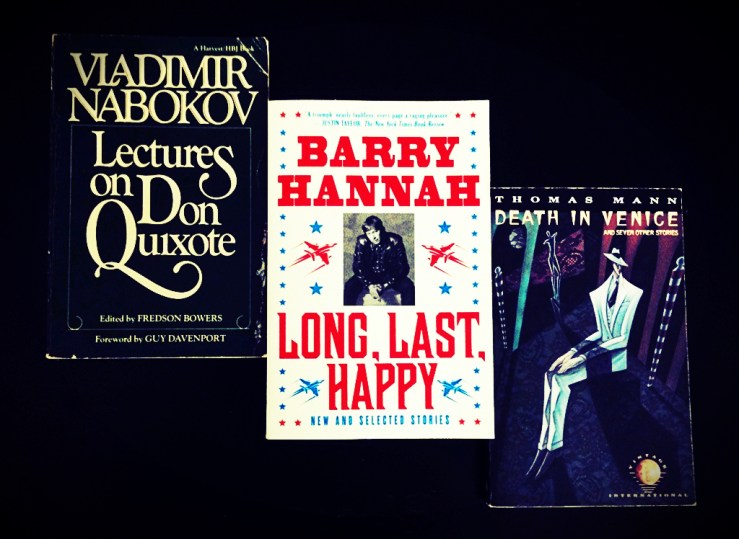
Hannah/Nabokov/Mann (Books Acquired, 8.30.2013)

20130905-153520

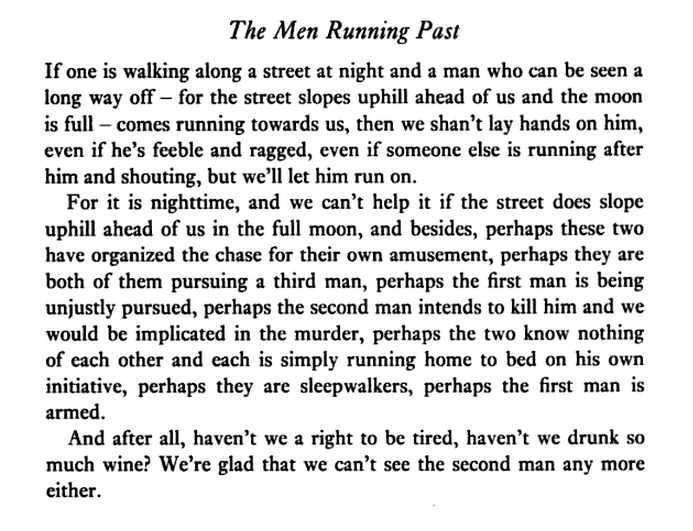
“The Men Running Past” — Franz Kafka

kafka

Two Arabs Reading — Edwin Lord Weeks

Watch This Terrible Book Trailer for Thomas Pynchon’s New Novel Bleeding Edge (Or Don’t)

I don’t know, I’m guessing this is intentionally awful. I mean, book trailers are supposed to be awful, right?

“Why I Am Not a Painter” — Frank O’Hara

“Why I Am Not a Painter” by Frank O’Hara

I am not a painter, I am a poet.
Why? I think I would rather be
a painter, but I am not. Well,

for instance, Mike Goldberg
is starting a painting. I drop in.
“Sit down and have a drink” he
says. I drink; we drink. I look
up. “You have SARDINES in it.”
“Yes, it needed something there.”
“Oh.” I go and the days go by
and I drop in again. The painting
is going on, and I go, and the days
go by. I drop in. The painting is
finished. “Where’s SARDINES?”
All that’s left is just
letters, “It was too much,” Mike says.

But me? One day I am thinking of
a color: orange. I write a line
about orange. Pretty soon it is a
whole page of words, not lines.
Then another page. There should be
so much more, not of orange, of
words, of how terrible orange is
and life. Days go by. It is even in
prose, I am a real poet. My poem
is finished and I haven’t mentioned
orange yet. It’s twelve poems, I call
it ORANGES. And one day in a gallery
I see Mike’s painting, called SARDINES.


“Bernhard is an architect of consciousness” — Ben Marcus on Thomas Bernhard

Bernhard is an architect of consciousness more than a narrative storyteller. His project is not to reference the known world, stuffing it with fully rounded characters who commence to discover their conflicts with one another, but to erect complex states of mind-usually self-loathing, obsessive ones-and then set about destroying them. Bernhard’s characters are thorough accomplices in their own destruction, and they are bestowed with a language that is dementedly repetitive and besotted with the appurtenances of logical thinking. The devious rationality of Bernhard’s language strives for a severe authority, and it tends to make his characters seem believable, no matter how unhinged their claims. Phrases don’t get repeated so much as needled until they yield graver meanings, with incremental changes introduced as though a deranged scientist were adding and removing substances in the performance of an experiment. “You wake up, and you feel molested,” Strauch says:

In fact: the hideous thing. You open your chest of drawers :a further molestation. Washing and dressing are molestations. Having to get dressed! Having to eat breakfast! When you go out on the street you are subject to the gravest possible molestations. You are unable to shield yourself. You lay about yourself, but it’s no use. The blows you dole out are returned a hundred fold. What are streets, anyway? Wendings of molestation, up and down. Squares? Bundled together molestations.

Without a story to drive it, Frost builds not through unfolding events but by telemarking around Strauch’s bitter cosmology while the narrator follows him through the woods, fattening himself on the rage of his new mentor. A chart of Strauch’s worldview would produce a splotchy Rorschach of points and counterpoints, contradictions, reversals, and the occasional backflip, none of which could really hold up to a logician’s scrutiny, which adds to his mystery. Strauch, a failed artist who only painted in total darkness, is opposed to nearly everything, and lest you think he’s a humanist at the core, with a fondness for the arts (that classic virtue of the misanthrope), he claims that “artists are the sons and daughters of loathsomeness, of paradisiac shamelessness, the original sons and daughters of lewdness; artists, painters, writers and musicians are the compulsive masturbators on the planet.”

From Ben Marcus’s 2011 essay “Misery Loves Nothing,” first published in Harper’s and available in full for free at Marcus’s site. I’m about halfway through Bernhard’s early novel Frost, a book that is very dark, bitter, intriguing, and funny. Very very funny.

The Artist’s Granddaughter at the Table — Max Liebermann