George Catlin Biography (Book Acquired, Some Time Back in the End of June)

20130708-151619.jpg

The end of June kinda got away with me with these books acquired posts.

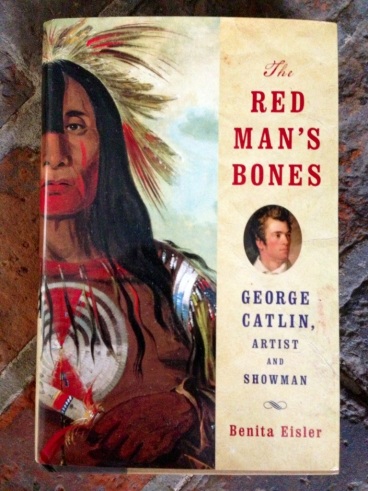
Anyway, I haven’t really made any time to check out Benita Eisler’s biography of lawyer-turned-painter George Catlin, a self-taught artist who chronicled the lives and culture of the Indians of the Great Plains in the nineteenth century. I like Catlin’s work, so this one might be interesting.

Publisher Norton’s blurb, followed by two of Catlin’s paintings:

The first biography in over sixty years of a great American artist whose paintings are more famous than the man who made them.

George Catlin has been called the “first artist of the West,” as none before him lived among and painted the Native American tribes of the Northern Plains. After a false start as a painter of miniatures, Catlin found his calling: to fix the image of a “vanishing race” before their “extermination”—his word—by a government greedy for their lands. In the first six years of the 1830s, he created over six hundred portraits—unforgettable likenesses of individual chiefs, warriors, braves, squaws, and children belonging to more than thirty tribes living along the upper Missouri River.

Political forces thwarted Catlin’s ambition to sell what he called his “Indian Gallery” as a national collection, and in 1840 the artist began three decades of self-imposed exile abroad. For a time, his exhibitions and writings made him the most celebrated American expatriate in London and Paris. He was toasted by Queen Victoria and breakfasted with King Louis-Philippe, who created a special gallery in the Louvre to show his pictures. But when he started to tour “live” troupes of Ojibbewa and Iowa, Catlin and his fortunes declined: He changed from artist to showman, and from advocate to exploiter of his native performers. Tragedy and loss engulfed both.

This brilliant and humane portrait brings to life George Catlin and his Indian subjects for our own time. An American original, he still personifies the artist as a figure of controversy, torn by conflicting demands of art and success.


“…a spectral cavalry, faces disquietingly wanting in detail, eyes little more than blurred sockets…” (Another Riff on Thomas Pynchon’s Against the Day)

  1. Another riff on/citation from Thomas Pynchon’s Against the Day.
  2. In this episode, our heroes, Chums of Chance Chick Counterfly (chief science officer) and Darby Suckling (chief horndog) have found their way to an off-brand time machine, managed and (shoddily) maintained by Dr. Zoot (whose doctorate seems unlikely). Dr. Zoot sends the boys (ostensibly) to the future for a brief glimpse:

They seemed to be in the midst of some great storm in whose low illumination, presently, they could make out, in unremitting sweep across the field of vision, inclined at the same angle as the rain, if rain it was—some material descent, gray and wind-stressed—undoubted human identities, masses of souls, mounted, pillioned, on foot, ranging along together by the millions over the landscape accompanied by a comparably unmeasurable herd of horses. The multitude extended farther than they could see—a spectral cavalry, faces disquietingly wanting in detail, eyes little more than blurred sockets, the draping of garments constantly changing in an invisible flow which perhaps was only wind. Bright arrays of metallic points hung and drifted in three dimensions and perhaps more, like stars blown through by the shock waves of the Creation. Were those voices out there crying in pain? sometimes it almost sounded like singing. Sometimes a word or two, in a language almost recognizable, came through. Thus, galloping in unceasing flow ever ahead, denied any further control over their fate, the disconsolate company were borne terribly over the edge of the visible world. . . .

The chamber shook, as in a hurricane. Ozone permeated its interior like the musk attending some mating dance of automata, and the boys found themselves more and more disoriented. Soon even the cylindrical confines they had entered seemed to have fallen away, leaving them in a space unbounded in all directions. There became audible a continuous roar as of the ocean—but it was not the ocean—and soon cries as of beasts in open country, ferally purring stridencies passing overhead, sometimes too close for the lads to be altogether comfortable with—but they were not beasts. Everywhere rose the smell of excrement and dead tissue.

Each lad was looking intently through the darkness at the other, as if about to inquire when it would be considered proper to start screaming for help.

“If this is our host’s idea of the future—” Chick began, but he was abruptly checked by the emergence, from the ominous sweep of shadow surrounding them, of a long pole with a great metal hook on the end, of the sort commonly used to remove objectionable performers from the variety stage, which, being latched firmly about Chick’s neck, had in the next instant pulled him off into regions indecipherable. Before Darby had time to shout after, the Hook reappeared to perform a similar extraction on him, and quick as that, both youngsters found themselves back in the laboratory of Dr. Zoot. The fiendish “time machine,” still in one piece, quivered in its accustomed place, as if with merriment. (403-04)

  1. I think the most obvious interpretation here is that our Chums witness part of a battle of the Great War, which is where Against the Day seems to be heading.

  1. What I find most fascinating, though, is the way that Pynchon moves from the physical to the metaphysical in the series of images the Chums witness.

We get an image of “undoubted human identities, masses of souls, mounted, pillioned, on foot, ranging along together by the millions over the landscape accompanied by a comparably unmeasurable herd of horses” seems simultaneously concrete and metaphysical, specific but also hyperbolic.

The scene continues to tread this line—we witness “a spectral cavalry, faces disquietingly wanting in detail, eyes little more than blurred sockets, the draping of garments constantly changing in an invisible flow which perhaps was only wind.”

On one hand, our disoriented Chums (to whose perspective Pynchon limits us) perceive ghosts here (almost cartoonish ghosts, I might add, of the holes-cut-out-for-eyes variety); on the other hand, the “blurred sockets” suggest gas masks and the “constantly changing” garments could perhaps be the variety of uniforms (and armor) of the soldiers.

Continuing: “Bright arrays of metallic points hung and drifted in three dimensions and perhaps more” — Bullets? Bayonets? Missiles? The concrete image is then likened to “stars blown through by the shock waves of the Creation.” The physical shifts into the metaphysical again as Pynchon sends “the disconsolate company . . . terribly over the edge of the visible world.”

  1. Here, the Chums seem to experience the Great War as an intensely compressed allegorical sensation.
  • The second paragraph in the above citation moves the boys into “a space unbounded in all directions” where they perceive “a continuous roar as of the ocean—but it was not the ocean—and soon cries as of beasts in open country, ferally purring stridencies passing overhead, sometimes too close for the lads to be altogether comfortable with—but they were not beasts.”

  • The Chums have no language to describe what they hear; Pynchon has to mediate the similes available to them in negation. But we (and Darby and Chick, of course) know that this place is no bueno: “Everywhere rose the smell of excrement and dead tissue.”

    1. Where have they gone? Are they still in the midst of war—are the sounds planes, bombs? World War I? WWII, site of that other giant Pynchon novel? Hiroshima? Vietnam? The WTC on 9/11? Where? When?

    1. I take the second paragraph to be a brief homage to the penultimate chapter of H.G. Wells’s slim novel The Time Machine (frequently and directly invoked throughout this particular episode of AtD, btw). At the end of that novella, the time traveler, dispensing with Eloi and Morlock alike, takes his machine to the brink of time, to witness the end of the earth and our solar system: “A horror of this great darkness came on me. The cold, that smote to my marrow, and the pain I felt in breathing, overcame me. I shivered, and a deadly nausea seized me.” The Chums of Chance seem to witness a similar extinction.
    2. Ah, but this is Pynchon, of course—so and how does the episode end? With a gag. In a vaudevillian twist, our players are removed from the stage via hook as the time machine, their audience, quivers “as if with merriment.”

    Despite the zaniness of this exit, keep in mind that our heroes are hooked around their necks, lassoed by a noose of sorts—Pynchon saves them, but at the same time visually suggests their death, linking back to the image of mass extinction at the core of the passage.

    1. The paintings in this riff are by the late Polish artist Zdzisław Beksiński; like all of his work they are untitled.

    Young Girl Reading a Manuscript — Thomas Cooper Gotch

    c4e94758b1b56d43a661def4de68ed60

    Manuscript Page of Dostoevsky’s Demons (With Doodles)

    Dostoyevsky_The_Demons_Manuscript

    The Henry Miller Odyssey

    New York Office — Edward Hopper

    “Life Is Motion” — William Carlos Williams

    Capture

    Five from Félix Fénéon

    ff

    “On Reading” — William Gass

    on reading gass


    (Via).

    The Novelist — Frantisek Kupka

    Wittgenstein’s ____________ (David Markson)

    Capture

    “This Schedule In Effect July 5th, 1922” — The Great Gatsby’s House Guests

    In Chapter 4 of F. Scott Fitzgerald’s The Great Gatsby, narrator Nick Carraway recounts the names of the rich, shallow, parasitic guests who attended Gatsby’s parties. Nick tells us the list comes from “an old time-table” of names he originally recorded in July 5th—significantly, the day after Independence Day: the day after the hopes and dreams of a new country. From the chapter—-

    Once I wrote down on the empty spaces of a time-table the names of those who came to Gatsby’s house that summer. It is an old time-table now, disintegrating at its folds, and headed “This schedule in effect July 5th, 1922.” But I can still read the gray names, and they will give you a better impression than my generalities of those who accepted Gatsby’s hospitality and paid him the subtle tribute of knowing nothing whatever about him.

    From East Egg, then, came the Chester Beckers and the Leeches, and a man named Bunsen, whom I knew at Yale, and Doctor Webster Civet, who was drowned last summer up in Maine. And the Hornbeams and the Willie Voltaires, and a whole clan named Blackbuck, who always gathered in a corner and flipped up their noses like goats at whosoever came near. And the Ismays and the Chrysties (or rather Hubert Auerbach and Mr. Chrystie’s wife), and Edgar Beaver, whose hair, they say, turned cotton-white one winter afternoon for no good reason at all.

    Clarence Endive was from East Egg, as I remember. He came only once, in white knickerbockers, and had a fight with a bum named Etty in the garden. From farther out on the Island came the Cheadles and the O. R. P. Schraeders, and the Stonewall Jackson Abrams of Georgia, and the Fishguards and the Ripley Snells. Snell was there three days before he went to the penitentiary, so drunk out on the gravel drive that Mrs. Ulysses Swett’s automobile ran over his right hand. The Dancies came, too, and S. B. Whitebait, who was well over sixty, and Maurice A. Flink, and the Hammerheads, and Beluga the tobacco importer, and Beluga’s girls.

    From West Egg came the Poles and the Mulreadys and Cecil Roebuck and Cecil Schoen and Gulick the state senator and Newton Orchid, who controlled Films Par Excellence, and Eckhaust and Clyde Cohen and Don S. Schwartze (the son) and Arthur McCarty, all connected with the movies in one way or another. And the Catlips and the Bembergs and G. Earl Muldoon, brother to that Muldoon who afterward strangled his wife. Da Fontano the promoter came there, and Ed Legros and James B. (“Rot-Gut.”) Ferret and the De Jongs and Ernest Lilly — they came to gamble, and when Ferret wandered into the garden it meant he was cleaned out and Associated Traction would have to fluctuate profitably next day.

    A man named Klipspringer was there so often and so long that he became known as “the boarder.”— I doubt if he had any other home. Of theatrical people there were Gus Waize and Horace O’donavan and Lester Meyer and George Duckweed and Francis Bull. Also from New York were the Chromes and the Backhyssons and the Dennickers and Russel Betty and the Corrigans and the Kellehers and the Dewars and the Scullys and S. W. Belcher and the Smirkes and the young Quinns, divorced now, and Henry L. Palmetto, who killed himself by jumping in front of a subway train in Times Square.

    Benny McClenahan arrived always with four girls. They were never quite the same ones in physical person, but they were so identical one with another that it inevitably seemed they had been there before. I have forgotten their names — Jaqueline, I think, or else Consuela, or Gloria or Judy or June, and their last names were either the melodious names of flowers and months or the sterner ones of the great American capitalists whose cousins, if pressed, they would confess themselves to be.

    In addition to all these I can remember that Faustina O’brien came there at least once and the Baedeker girls and young Brewer, who had his nose shot off in the war, and Mr. Albrucksburger and Miss Haag, his fiancee, and Ardita Fitz-Peters and Mr. P. Jewett, once head of the American Legion, and Miss Claudia Hip, with a man reputed to be her chauffeur, and a prince of something, whom we called Duke, and whose name, if I ever knew it, I have forgotten.

    All these people came to Gatsby’s house in the summer.

    Woman Reading — Pierre-Auguste Renoir

    Great American Nude — Tom Wesselmann

    Topless Kafka (Bonyass Franz + Homebro Brod Kick It on the Beach)

    k

    (Via).

    Some form of zombie powder (Pynchon’s Against the Day)

    Reef joined Ruperta’s loose salon of neuræsthenics traveling hot spring to spring in search of eternal youth or fleeing the deadweight of time, finding enough impulsive or inattentive cardplayers to keep him in Havanas and $3.50-a-quart Champagne, and Ruperta surprised enough now and then with silver and lapis Indian trinkets and the odd bushel of flowers to keep her guessing, she having figured him for a white savage masquerading as an exquisite. Which did not prevent them from going round and round on average once a week, memorable uproars that sent everybody running for the periphery, uncertain as to what distance was safe. In between these dustups, Reef had long, desultory conversations with his penis, to the effect that there wasn’t much point missing Stray too much right now, was there, as it would only blunt the edge of desire, not only for Ruperta but whoever else, Yup Toy or whoever, might drift by over the course of their travels.

    They finally parted company in New Orleans after a confused and repetitive headache of a night that began at the establishment of Monsieur Peychaud, where the Sazeracs, though said to’ve been invented there, were not a patch, it seemed to Reef, on those available at Bob Stockton’s bar in Denver, though those Absinthe Frappés were another matter. After taking on fuel, the party moved out into the French Quarter hunting for modes of intoxication “more exotic,” meaning, if you pushed it, some form of zombie powder. Ruperta tonight was in a narrow black bengaline costume with a Medici collar and cuffs of bastard chinchilla. Nothing on underneath except for stays and stockings, as Reef had had occasion to find out earlier, at their habitual lateafternoon rendezvous.

    It had soon become apparent in this town that what you could see from the street was not only less than “the whole story” but in fact not even the picture on the cover. The real life of this place was secured deep inside the city blocks, behind ornate iron gates and up tiled passages that might as well’ve run for miles. You could hear faint strands of music, crazy stuff, banjos and bugling, trombone glissandi, pianos under the hands of whorehouse professors sounding like they came with keys between the keys. Voodoo? Voodoo was the least of it, Voodoo was just everywhere. Invisible sentinels were sure to let you know, the thickest of necks being susceptible here to monitory pricklings of the Invisible. The Forbidden. And meantime the smells of the local cuisine, cheurice sausages, gumbo, crawfish étouffé, and shrimp boiled in sassafras, proceeding from no place you could ever see, went on scrambling what was left of your good sense. Negroes could be observed at every hand, rollicking in the street. The so-called Italian Troubles, stemming from the alleged Mafia assassination of the chief of police here being yet fresh in the civic memory, children were apt to accost strangers, Italian or not, with, “Who killa da chief?” not to mention “Va fongoola your sister.”

    Another passage from Thomas Pynchon’s novel Against the Day.