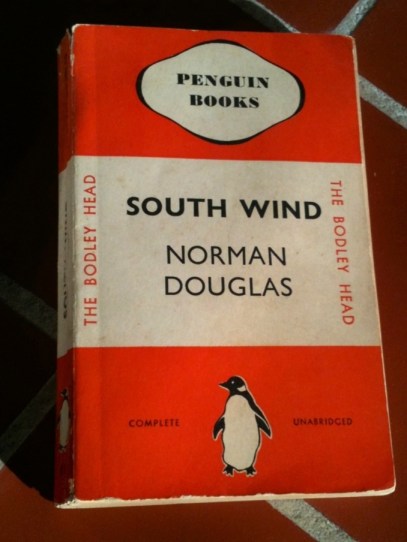
Big thanks to Ryan Mihaly for sending me this copy of Norman Douglas’s novel South Wind, which is the 11th Penguin Book (1st printing, 1935). This book is beautiful and it was very kind of Ryan to send it to me. Ryan writes reviews (good ones!) at Flying Object.
The bishop was feeling rather sea-sick. Confoundedly sea-sick, in fact.
This annoyed him. For he disapproved of sickness in every shape or form. His own state of body was far from satisfactory at that moment; Africa—he was Bishop of Bampopo in the Equatorial Regions—had played the devil with his lower gastric department and made him almost an invalid; a circumstance of which he was nowise proud, seeing that ill-health led to inefficiency in all walks of life. There was nothing he despised more than inefficiency. Well or ill, he always insisted on getting through his tasks in a businesslike fashion. That was the way to live, he used to say. Get through with it. Be perfect of your kind, whatever that kind may be. Hence his sneaking fondness for the natives—they were such fine, healthy animals.
Fine, healthy animals; perfect of their kind! Africa liked them to “get through with it” according to their own lights. But there was evidently a little touch of spitefulness and malice about Africa; something almost human. For when white people try to get through with it after their particular fashion, she makes hay of their livers or something. That is what had happened to Thomas Heard, D.D., Bishop of Bampopo. He had been so perfect of his kind, such an exemplary pastor, that there was small chance of a return to the scenes of his episcopal labours. Anybody could have told him what would happen. He ought to have allowed for a little human weakness, on the part of the Black Continent. It could not be helped. For the rest, he was half inclined to give up the Church and take to some educational work on his return to England. Perhaps that was why he at present preferred to be known as “Mr. Heard.” It put people at their ease, and him too.
Whence now this novel and unpleasant sensation in the upper gastric region? Most annoying! He had dined discreetly at his hotel the evening before; had breakfasted with moderation. And had he not voyaged in many parts of the world, in China Seas and round the Cape? Was he not even then on his return journey from Zanzibar? No doubt. But the big liner which deposited him yesterday at the thronged port was a different concern from this wretched tub, reeking with indescribable odours as it rolled in the oily swell of the past storm through which the MOZAMBIQUE had ridden without a tremor. The benches, too, were frightfully uncomfortable, and sticky with sirocco moisture under the breathless awning. Above all, there was the unavoidable spectacle of the suffering passengers, natives of the country; it infected him with misery. In attitudes worthy of Michelangelo they sprawled about the deck, groaning with anguish; huddled up in corners with a lemon-prophylactic against sea-sickness, apparently-pressed to faces which, by some subtle process of colour-adaptation, had acquired the complexion of the fruit; tottering to the taffrail….
There was a peasant woman dressed in black, holding an infant to her breast. Both child and parent suffered to a distressing degree. By some kindly dispensation of Providence they contrived to be ill in turns, and the situation might have verged on the comical but for the fact that blank despair was written on the face of the mother. She evidently thought her last day had come, and still, in the convulsions of her pain, tried to soothe the child. An ungainly creature, with a big scar across one cheek. She suffered dumbly, like some poor animal. The bishop’s heart went out to her.
He took out his watch. Two more hours of discomfort to be gone through!
Then he looked over the water. The goal was far distant.
Essay describing the structure of Infinite Jest as Hofstadterian strange loop, the novel’s structure being that of a circle with a missing section—between the last and first pages—which must be filled in by the reader who has been, by the end of the novel, prepared, practiced, coached to do so, just as life allegedly teaches one how to die.
It was stated at the outset, that this system would not be here, and at once, perfected. You cannot but plainly see that I have kept my word. But I now leave my cetological System standing thus unfinished, even as the great Cathedral of Cologne was left, with the crane still standing upon the top of the uncompleted tower. For small erections may be finished by their first architects; grand ones, true ones, ever leave the copestone to posterity. God keep me from ever completing anything. This whole book is but a draught—nay, but the draught of a draught. Oh, Time, Strength, Cash, and Patience!
TheNewerYorkis a new little magazine or journal or whatever you want to call it, featuring short fiction, poetry, art, lists, labels, fake reviews, and other stuff. Issue #2, clocking in at just over 80 pages fits neatly into a man’s jacket pocket and can be read in queues or at red lights or in between other readings or discreetly during end of semester faculty meetings. (I’m pretty sure you could read it in other occasions but I didn’t). You can see the front cover above; here’s the back cover, featuring this worrisome promise:

Maybe the best way to summarize (what I take to be) theNewerYork’s aesthetic/literary mission is to show off the issue’s disclaimer (which is preceded by a fancy Foucault quote):
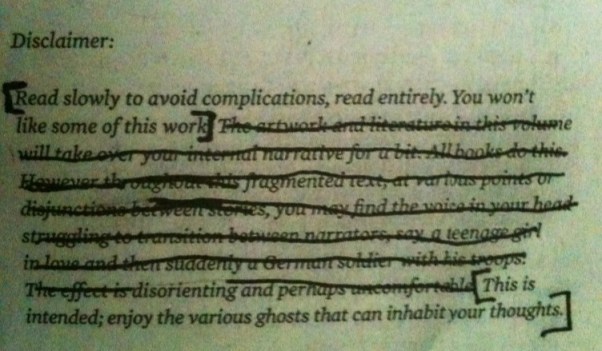
“You won’t like some of this work” seems like a fair warning, but theNewerYork is more hit than miss, starting with its excellent opener, ‘The Thank You War” by Elliot L. Ackerman, a four-paragraph flash that tackles how would-be patriotic citizens bungle human relationships with returning soldiers. Also very good is Jamie Grefe’s list “Over Thirteen,” which is a lovely little horror story that makes meaningful use of the reader’s imagination. Another list, Bruce Harris’s “Nearly A Dozen Things Sherlock Holmes Never Said” made me laugh (sample: “Watson, you’re right.”)
One of my favorite pieces in the volume is “Not a Writer” by Joseph Rathberger (indexed as “A Put Down”). You can see it below, filling up a page; you can also see the art that precedes it and the nifty bookmark that comes with the issue:
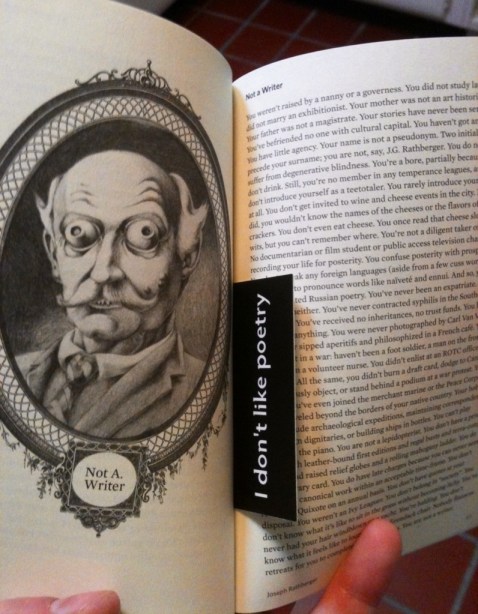
Most of the art in the issue is black and white and all of it is varied (in style and in quality). Here is Food Poop by Shaina Yang:
TheNewerYork’s willingness to showcase experimentation in what goes on paper for people to look at and read is both a strength and a weakness. Most of the pieces succeed, even when they shouldn’t (why is a Google translation from “Baby Got Back” from English to Latin and then back into English so funny?). The pieces in the issue that don’t succeed fail on their own terms: half-formed or poorly executed ideas, the occasionally gimmicky experiment, and, thankfully more rarely, pieces that feel too imitative. But like I said, most of the texts in theNewerYork’s second issue succeed, which is to say they entertain or amuse or baffle or occasionally move the reader. What I like most about theNewerYork is its spirit, which is daring and experimental without the heavy robes of irony that often cloak these sorts of operations. A promising beginning.

When Infinite Jest was published in 1996 and David Foster Wallace set the literary world on fire, he was the epitome of cool. He looked like Ethan Hawke and Kurt Cobain’s brother—and he was authentic, not just some poseur. And his talent could blow your mind; he was bona fide, high-brow literary, and important people called him a genius because they couldn’t think of a better word. Every lengthy, “literary” novel that has been published since Infinite Jest lives in its shadow. Is Adam Levin the next David Foster Wallace? Marisha Pessl? Zadie Smith? Eugenides? Is House of Leaves as good as Infinite Jest? How does Freedom or Witz compare? Safran Foer? Who is the female DFW? The thing is, at that moment, Wallace could have taken another direction. He could’ve gone on The Today Show or Good Morning America or been on a billboard in Times Square. He could’ve done some self-promotion and become the most famous young writer in America. But it’s not like he turned Pynchon and disappeared—he struggled with his gift and the image of himself. He winced on Charlie Rose and then went back to teaching in Illinois.
2. There are seven Maqroll novellas; I’ve read the first three. They are excellent.
3. Let me steal from Cianci’s review. He describes Maqroll the Gaviero as
a fleshed-out character, as well as the embodiment of an ideal: the knife fighters and Viking poets idolized by Borges, a mixture of Robinson Crusoe, Sam Spade, and Don Quixote. He indulges fantasy but prepares for disappointment. He lives between lawlessness and acceptability.
4. The Gaviero—the lookout—is a picaro, a roguish but poetical sailor. Mutis’s book is picaresque, carnivalesque, a river—or maybe a maze—of storytelling.
5. This is maybe what Maqroll is about: storytelling. Each Maqroll novella is framed as another’s story, or a found document—you know this trick, you’ve read Borges, right?
6. The book is crammed with stories, stories that lead to other stories, that recall other stories, that tell their own stories—or cover over other stories.
7. A line that might instructively illustrate point 6: In Ilona Comes with the Rain, Mutis unpacks the life of a minor character, a sea captain named Wito. Consider his opening gambit:
His life deserves an entire book. It was so full of adventures, some of which he hurried over as if they were hot coals, that one became lost in their labyrinthine complexity.
The life described here could just as well be the Gaviero’s.
8. Well of course, that’s what Mutis is doing, channeling and conveying and expressing Maqroll’s life, a life of picaresque adventures (and titular misadventures), of loss and gain, of love and despair, drinking, sailing, scheming and plotting—a life full of allusions and hints and digressions. Mutis’s technique is marvelous (literally; he made this reader marvel): he gives us an aging (anti-)hero, a hero whose life is overstuffed with stories and mishaps and feats and enterprises and hazards; he gives us one strand of that life at a time in each novella—but then he points to the other adventures, the other serials of Maqroll that we would love to tune into if only we could.
9. To illustrate point 8: Consider Maqroll in Un Bel Morir, doing some time in prison: His consciousness floats to other prisons, other countries: Afghanistan, British Columbia: And then we get those stories, miniature epics—and nested within them, their own characters tell stories.
10. There’s a wonderful timelessness to Maqroll, a sense that the adventures exist somehow before the postmodern world, that they belong to the pulp fictions of jungle adventure…
11. (Indeed, re: point 10: In Ilona, we find one character who is unstuck in time, taking a Naopleonic lover during a transcontinental voyage…)
12. I’ve already noted the Borgesian quality of Mutis’s tales, brought up their picaresque scope (a la Cervantes), so let me lazily compare Mutis to others: let me note the sprawl of his storytelling, which recalls García Márquez—only more compact, more precise. Let me suggest that there’s something of Kafka in there too—indeed, the first novella, The Snows of the Admiral seems to me a reworking of “Before the Law.” (The tale is also conspicuously quixotic; tilting at windmills and all that). Conrad of course, but also something of Melville—the grand (Moby-Dick) and the sly (The Confidence Man). And hell, also something of Edgar Rice Burroughs’s high adventure, or even, dare I say it, the better parts of the Indiana Jones films.
13. Lazy as I am, I’ve failed to quote Mutis at any length—a shame, because it’s wonderful prose (translated by Edith Grossman, by the way). So here’s a little morsel—one that I think captures why we tell stories—from the appendix to Un Bel Morir, the last of the three novellas I read; before I offer it up I’ll conclude my riff by saying how happy I am that there are four more of these Maqroll novellas to read:
All the stories and lies about his past accumulating until they formed another being, always present and naturally more deeply loved than his own pale, useless existence composed of nausea and dreams.
Men may seem detestable as joint stock-companies and nations; knaves, fools, and murderers there may be; men may have mean and meagre faces; but man, in the ideal, is so noble and so sparkling, such a grand and glowing creature, that over any ignominious blemish in him all his fellows should run to throw their costliest robes. That immaculate manliness we feel within ourselves, so far within us, that it remains intact though all the outer character seem gone; bleeds with keenest anguish at the undraped spectacle of a valor-ruined man. Nor can piety itself, at such a shameful sight, completely stifle her upbraidings against the permitting stars. But this august dignity I treat of, is not the dignity of kings and robes, but that abounding dignity which has no robed investiture. Thou shalt see it shining in the arm that wields a pick or drives a spike; that democratic dignity which, on all hands, radiates without end from God; Himself! The great God absolute! The centre and circumference of all democracy! His omnipresence, our divine equality!
I got a little lax with these “books acquired” posts at the end of last year—chalk it up to end of semester deadlines and meetings, family-oriented holiday stuff, and an awful illness. Anyway–
Mike Chasar’s Everyday Reading: Poetry and Popular Culture in Modern America, new from Columbia University Press is pretty cool: it’s kind of a dialogic study of how poetry evinces (or infiltrates or collides or emerges from or is bound by) a variety of popular media. Some of the most fascinating chapters dwell on scrapbooking. Here’s Columbia U of P’s blurb:
Exploring poetry scrapbooks, old-time radio show recordings, advertising verse, corporate archives, and Hallmark greeting cards, among other unconventional sources, Mike Chasar casts American poetry as an everyday phenomenon consumed and created by a vast range of readers. He shows how American poetry in the first half of the twentieth century and its reception helped set the stage for the dynamics of popular culture and mass media today.
Poetry was then part and parcel of American popular culture, spreading rapidly as the consumer economy expanded and companies exploited its profit-making potential. Poetry also offered ordinary Americans creative, emotional, political, and intellectual modes of expression, whether through scrapbooking, participation in radio programs, or poetry contests. Reenvisioning the uses of twentieth-century poetry, Chasar provides a richer understanding of the innovations of modernist and avant-garde poets and the American reading public’s sophisticated powers of feeling and perception.
A couple of snaps from the book—pics of pages from one of those scrapbooks—