
Category: Books
Books Acquired, 9.21.2012
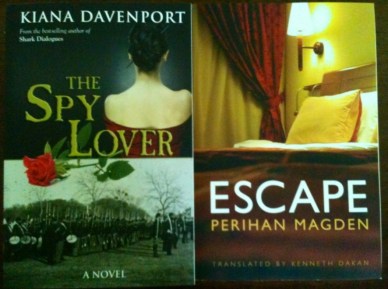
Perhihan Magden’s Escape. Pub copy:
Time passes slowly in the hotel rooms. This is what the daughter thinks. They’ve been moving since the beginning, in and out of hotels, sometimes staying for months, sometimes for a mere hour, but never with luggage, heavy things weighing them down. The mother and daughter are singular, a “Moon Unit,” revolving so far away that no one can touch them. They form attachments to no one, not the pool boy who watches the daughter swim for hours, nor the girl at the front desk who counts the moments she sees the daughter as little good luck charms for her day. They are bound together with a secret language, the beautiful girl loved solely by her mother, who will never ever ever leave her side.
Prize-winning Turkish novelist and journalist Perihan Magden delivers a heartbreaking meditation on the intense and sometimes isolated love between a mother and daughter against the world.
Kiana Davenport’s The Spy Lover. Pub copy:
Thrust into the savagery of the Civil War, a Chinese immigrant serving in the Union Army, a nurse doubling as a spy for the North, and a one-armed Confederate cavalryman find their lives inextricably entwined.
Fleeing drought and famine in China, Johnny Tom arrives in America with dreams of becoming a citizen. Having survived vigilantes hunting “yellow dogs” and slave auction- blocks, Johnny is kidnapped from his Mississippi village by Confederate soldiers, taken from his wife and daughter, and forced to fight for the South. Eventually defecting to the Union side, he is promised American citizenship in exchange for his loyal services. But first Johnny must survive the butchery of battles and the cruelties inflicted on non-white soldiers.
Desperate to find Johnny, his daughter, Era, is enlisted as a spy. She agrees to work as a nurse at Confederate camps while scouting for the North. Amidst the unspeakable carnage of wounded soldiers, she finds solace in Warren Petticomb, a cavalryman who lost an arm at Shiloh. As devastation mounts in both armies, Era must choose where her loyalties lie—with her beloved father in the North, or with the man who passionately sustains her in the South.
A novel of extraordinary scope that will stand as a defining work on the Chinese immigrant experience, The Spy Lover is a paean to the transcendence of love and the resilience of the human spirit.
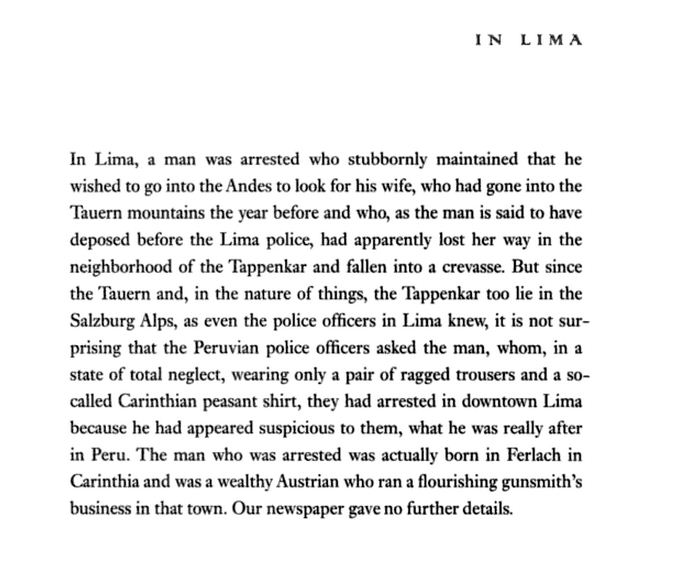
“In Lima” — Thomas Bernhard
Jurisprudence — Edvard Munch

The Scapegoat — William Holman Hunt

Kafka Doodle

Kafka doodle. From his Diaries (vol.1).
Bartleby the Scrivener (Book Acquired, 9.25.2012)
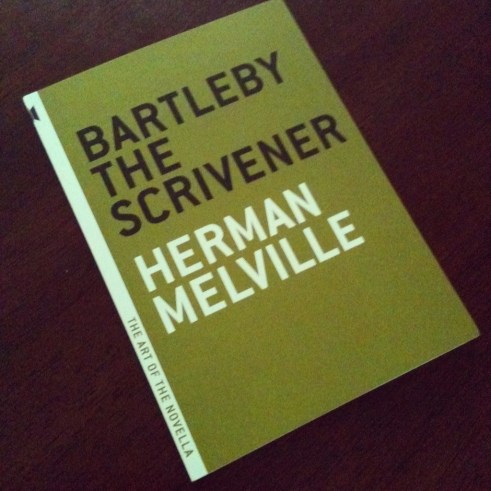
The good people at Melville House sent me their edition of Melville’s classic novella Bartleby the Scrivener. I’ve read it at least half a dozen times since the 10th grade, but the Melville House version is part of their Hybrid Books series, which features digital illuminations. I shall report in full in a week or two, focusing on what the illuminations add to the book, and what the reading experience is like.
“Do You Despair?” (Kafka)

(From a 1910 diary entry).
Auguste Reading to Her Daughter — Mary Cassatt

Orson Welles as Falstaff in Chimes at Midnight (Full Film)
Poor Old Robinson Crusoe
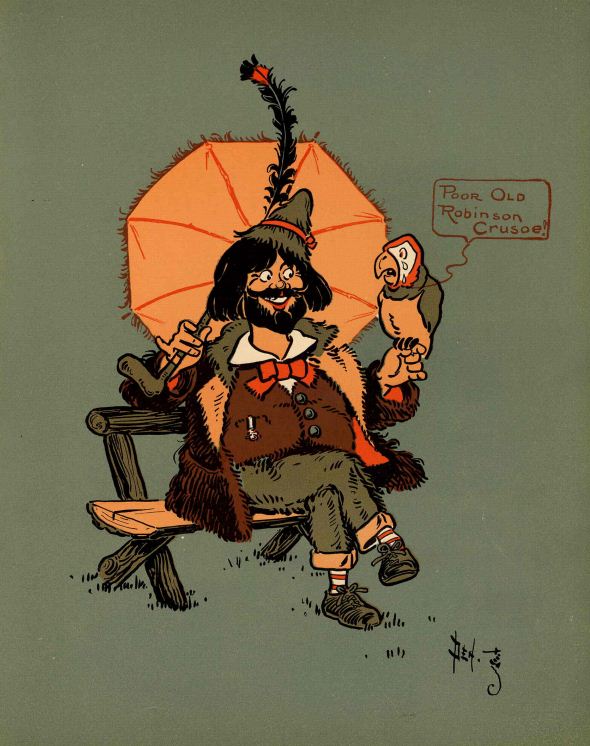
From Denslow’s Humpty Dumpty / Adapted and Illustrated by W.W. Denslow.
Barry Hannah Fragment (From “Water Liars”)
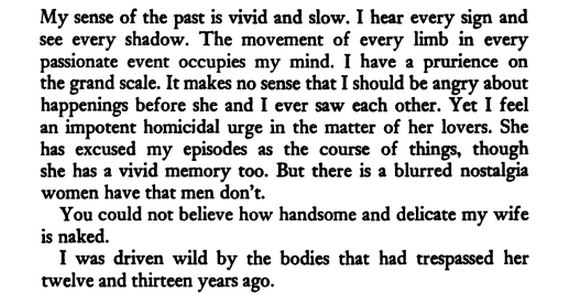
From the Barry Hannah story “Water Liars,” collected in Airships.
Stuck Inside — Norman Rockwell

Dwarves — M.C. Escher

List with No Name #9
- A Peep at Polynesian Life
- A Narrative of Advenures in the South Seas
- And a Voyage Thither
- His First Voyage
- The World in a Man-of-War
- The Whale
- The Ambiguities
- His Fifty Years of Exile
- His Masquerade
- An Inside Narrative
Robert Hughes’s Goya Biography (Book Acquired, 9.21.2012)

I’d been wanting to read a biography of Goya for some time now. For a few years now, his art has come occupy a strange space in the back of my subconscious mind—all the pain and violence and horror of it. Maybe it’s all the Roberto Bolaño I’ve been reading. I’m convinced that if you want to understand Bolaño it helps to have Goya as a visual referent. Also, I cut up an oversized Italian collection of color prints from Goya to hang in my office, so they’re always kinda in my visual field.
Anyway, last week I went by my favorite local used bookstore to pick up a copy of W.G. Sebald’s After Nature that they’d kindly ordered for me and went through the biographies as well to find something on Goya. There were at least half a dozen, but the recently deceased Robert Hughes’s was the most beautiful and most recent, and its opening captivated me: In the first chapter, Hughes describes how a near-fatal car crash in 1999 unlocked the Goya study that he’d been wanting to write for years. The scene unfolds as a bizarre prolonged fever dream, a horrifying narrative informed by Goya’s asylums and bullfights, with the strange layer of modern airport slathered on top.
I’ve read the first 150 pages since then. Hughes’s writing is crisp and the text is rich; Hughes builds a slow case, arguing against Goya’s reputation as a radical but also highlighting the artist’s powers of pathos (not to mention his skill, both raw and refined). Hughes had me hooked with the following paragraph, which could also stand in as a simple description of a decsonstructionist theory of identity:
Goya was in some ways the greatest of all delineators of madness, because he was unrivaled in his ability to locate it among the common presences of human life, to see it as a natural par t of man’s (and woman’s) condition, not as an intrusion of the divine or the demonic from above or below. Madness does not come from outside into a stable and virtuous normality. That, Goya knew in his excruciating sanity, was nonsense. There is no perfect stability of the human condition, only approximations of it, sometimes fragile because created by culture. Part of his creed, indeed the very core of his nature as an artist, was Terence’s “Nihil humanum a me alienum puto,” “I think nothing human alien to me.” This was part of Goya’s immense humanity, a range of sympathy, almost literally, “co-suffering,” rivaling that of Dickens or Tolstoy.
Tests and Composition Exercises for Young Writers — Ezra Pound

 Biblioklept