Blood Meridian — Judge Holden on the Raising of Children

Cormac McCarthy’s Blood Meridian is larded with strange little pockets of the black humor, humor so black that it’s hard to catch on the first or second reading. Re-reading the book again this week, I was struck by how funny a passage in Chapter XI is. The passage comes immediately after one of the more confounding moments of the book. Judge Holden, the giant, malevolent, Mephistophelean antagonist who dominates the narrative, has just told a puzzling parable about a harness maker who commits a murder and then begs for his son’s forgiveness. It’s a strange story and I’m not sure exactly what it means. Anyway, after he tells this story, Tobin, the ex-priest asks the Judge, “So what is the way of raising a child?” Here’s the reply–

At a young age, said the judge, they should be put in a pit with wild dogs. They should be set to puzzle out from their proper clues the one of three doors that does not harbor wild lions. They should be made to run naked in the desert until…

Hold on now, said Tobin. The questions was put in all earnestness.

And the answer, man, said the judge. If God meant to interfere in the degeneracy of mankind, would he not have done so by now? Wolves cull themselves, man. What other creature could? And is the race of man not more predacious yet?

The humor of the Judge’s initial, concrete answer rests on the fact that it is wholly earnest: even in his bizarre, hyperbolic surrealism, the judge is serious. Pits, wild dogs, wild lions. Running naked in the desert. That’s how kids should be raised. The move to the abstract–to highlight humanity’s predatory instincts–is a retreat from humor to philosophy, a pattern that McCarthy repeats in the novel. The effect stuns the impulse to find humor in the language. Humor cannot sustain throughout the narrative, even though it is present.

Blood Meridian — The Open Yale Lectures

Dr. Amy Hungerford’s lectures on Cormac McCarthy’s Blood Meridian are part of Yale University’s “Open Yale” series. The lectures were originally presented as part of ENGL 291, The American Novel Since 1945. From the course description–

In this first of two lectures on Blood Meridian, Professor Hungerford walks us through some of the novel’s major sources and influences, showing how McCarthy engages both literary tradition and American history, and indeed questions of origins and originality itself. The Bible, Moby-Dick, Paradise Lost, the poetry of William Wordsworth, and the historical narrative of Sam Chamberlain all contribute to the style and themes of this work that remains, in its own right, a provocative meditation on history, one that explores the very limits of narrative and human potential.

And again–

In this second lecture on Blood Meridian, Professor Hungerford builds a wide-ranging argument about the status of good and evil in the novel from a small detail, the Bible the protagonist carries with him in spite of his illiteracy. This detail is one of many in the text that continually lure us to see the kid in the light of a traditional hero, superior to his surroundings, developing his responses in a familiar narrative structure of growth. McCarthy’s real talent, and his real challenge, Hungerford argues, is in fact to have invoked the moral weight of his sources–biblical, literary, and historical–while emptying them of moral content. Much as the kid holds the Bible an object and not a spiritual guide, McCarthy seizes the material of language–its sound, its cadences–for ambiguous, if ambitious, ends.

Win a Copy of Blood Meridian

Biblioklept wants to give you a copy of Random House’s new 25th anniversary edition of Cormac McCarthy’s Blood Meridian. But you’ll have to earn it because if Blood Meridian teaches us anything (beyond spitting and scalping and riding on), it’s that existence costs. So, if you’d like one to win a handsome new hardback, send us a postcard–the most Blood Meridianish one you can muster. (Do not put blood or anything like blood on the postcard. Seriously). If you’re a fan of the book, include a favorite quote. If you’ve never read it before, let us know why you want to read it. Email us at biblioklept.ed at gmail dot com to get our snail mail address (please make “Blood Meridian contest” the subject of your email). The sender of our favorite postcard will receive a copy of the book, courtesy Biblioklept and Random House. Contest closes October 12, 2010 and is limited to addresses in the continental US.

Six Versions of Blood Meridian

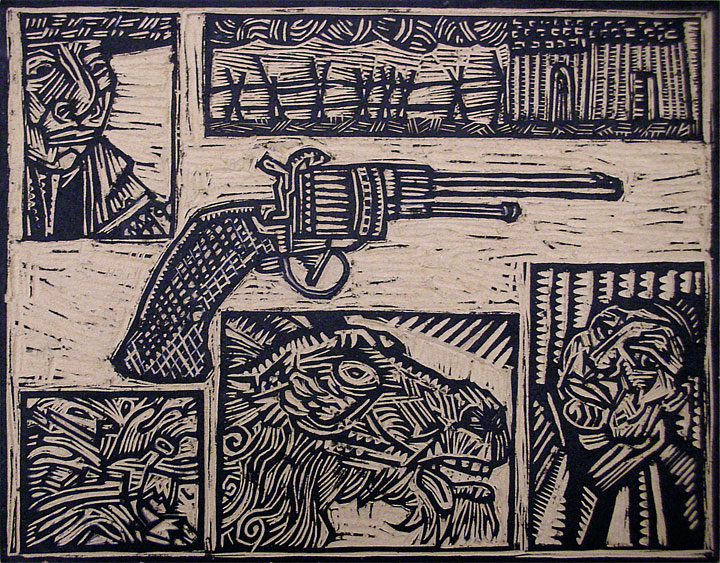
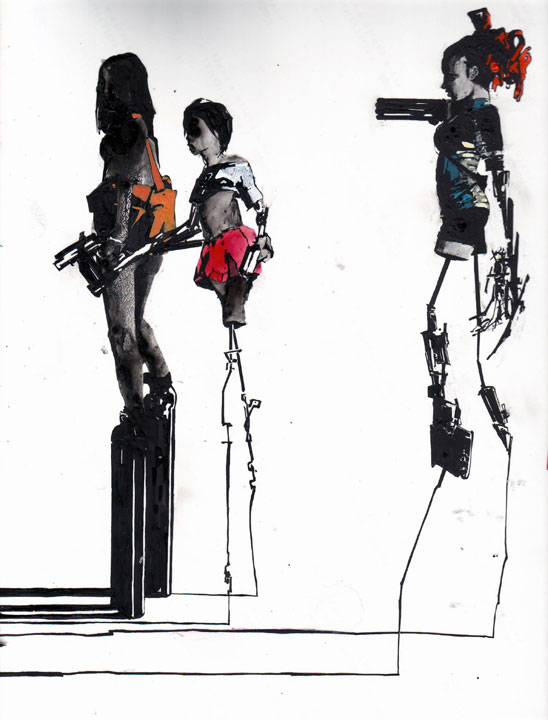
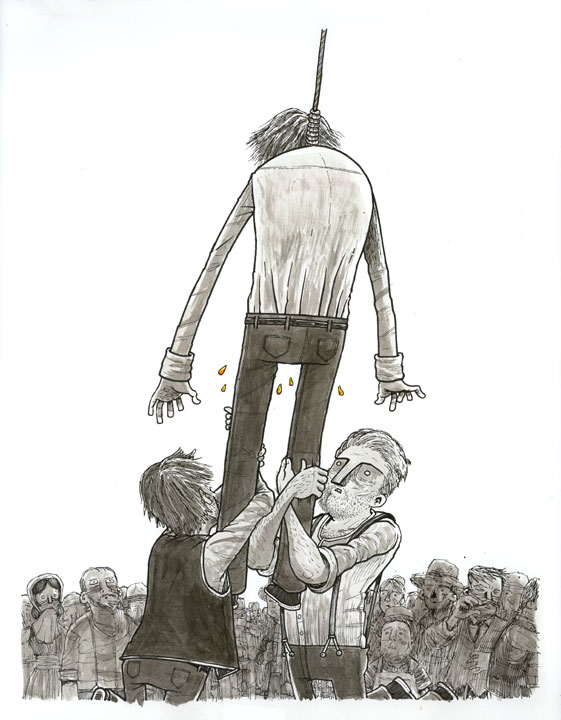
Six Versions of Blood Meridian is an ongoing project where six artists–Zak Smith, Sean McCarthy, John Mejias, Craig Taylor, Shawn Cheng, and Matt Wiegle–illustrate each page of Cormac McCarthy’s novel Blood Meridian. Zak Smith’s illustrations are particularly intriguing; he depicts the Glanton gang as women, a strange inversion that for some reason recalls the “Circe/Nighttown” episode of Joyce’s Ulysses. The Six Versions project’s eclectic range of styles and interpretations makes for one of the more fascinating approaches to a contemporary illuminated manuscript that I’ve seen on the internet (I’m also keen on Matt Kish’s handling of Moby-Dick). A few examples–

They aint worth no fifty dollars.
Dawn saw them deployed in a long file over the plain...
He sees a parricide hung in a crossroads hamlet...

James Wood (Is Wrong) on Blood Meridian

Critic James Wood wrote extensively about Cormac McCarthy’s Blood Meridian in his 2005 essay for The New Yorker, “Red Planet.” Here’s his lede–

To read Cormac McCarthy is to enter a climate of frustration: a good day is so mysteriously followed by a bad one. McCarthy is a colossally gifted writer, certainly one of the greatest observers of landscape. He is also one of the great hams of American prose, who delights in producing a histrionic rhetoric that brilliantly ventriloquizes the King James Bible, Shakespearean and Jacobean tragedy, Melville, Conrad, and Faulkner.

Wood later details McCarthy’s gift as “one of the greatest observers of landscape”–

“Blood Meridian” is a vast and complex sensorium, at times magnificent and at times melodramatic, but nature is almost always precisely caught and weighed: in the desert, the stars “fall all night in bitter arcs,” and the wolves trot “neat of foot” alongside the horsemen, and the lizards, “their leather chins flat to the cooling rocks,” fend off the world “with thin smiles and eyes like cracked stone plates,” and the grains of sand creep past all night “like armies of lice on the move,” and “the blue cordilleras stood footed in their paler image on the sand like reflections in a lake.”

Wood then goes about attempting to explain his problems with McCarthy the “ham” who produces “histrionic rhetoric” —

[McCarthy’s] prose opens its lungs and bellows majestically, in a concatenation of Melville and Faulkner (though McCarthy always sounds more antique, and thus antiquarian, than either of those admired predecessors).  . . .

It is a risky way of writing, and there are times when McCarthy, to my ear, at least, sounds merely theatrical. He has a fondness for what could be called analogical similes, in which the linking phrase “like some” introduces not a visual likeness but a hypothetical and often abstract parallel: “And he went forth stained and stinking like some reeking issue of the incarnate dam of war herself.” . . .

The danger is not just melodrama but imprecision and, occasionally, something close to nonsense. . . .

The inflamed rhetoric of “Blood Meridian” is problematic because it reduces the gap between the diction of the murderous judge and the diction of the narration itself: both speak with mythic afflatus. “Blood Meridian” comes to seem like a novel without internal borders.

So, Blood Meridian doesn’t meet the standard of Wood’s cherished “free indirect style,” where an author subtly shifts into a character’s voice. Wood craves these delicate internal borders. He can’t bear the idea that the towering figure of Judge Holden might come to ventriloquize the novel. It is worth noting here that Wood frequently extols the free indirect styles of Marcel Proust and Henry James–two authors McCarthy dismissed in a 1992 interview with The New York Times, saying “I don’t understand them . . . that’s not literature.”  Wood values a mannered precision of realism that McCarthy openly professes little interest in; rather, McCarthy uses a mythic, amplified, and at times grandiose style in Blood Meridian to explore issues of life and death. And Wood is perhaps not wrong here. At times Blood Meridian edges into bombast, although I believe McCarthy controls his language more than Wood allows. In either case, McCarthy’s language is ripe for parody, as exemplified in this clip from Wes Anderson’s 2001 film The Royal Tenenbaums

I would be happy to leave Wood’s criticism of Blood Meridian and McCarthy alone at this point. Fine, Wood doesn’t like it when McCarthy goes balls-to-the-wall; whatever. But at the end of “Red Planet” Wood turns to attacking McCarthy’s perceived failure to vindicate God’s goodness in the face of evil. Wood here (and elsewhere, always elsewhere) shows his deep conservatism. Wood necessitates that all literature reveal a platonic center, a stable, beating heart that must also be a platonic good. Here he is, griping about McCarthy’s “metaphysical cheapness”–

Like most writers committed to pessimism, McCarthy is never very far from theodicy. Relentless pain, relentlessly displayed, has a way of provoking metaphysical complaint. . . .

But McCarthy stifles the question of theodicy before it can really speak. His myth of eternal violence—his vision of men “invested with a purpose whose origins were antecedent to them”—asserts, in effect, that rebellion is pointless because this is how it will always be. Instead of suffering, there is represented violence; instead of struggle, death; instead of lament, blood.

If Wood finds only a nihilism in Blood Meridian (and the rest of McCarthy’s oeuvre) that he fundamentally disagrees with, he should simply say so. Instead, Wood demands that Blood Meridian be a theodicy and then condemns it for not being one. He shamefully attempts to hold the work to a radically subjective rubric that cannot be answered. Put another way, the failure that Wood finds in Blood Meridian is a failure to answer to a version of God–and God’s judgment–that Wood would like to believe in (or, more accurately, be comforted by).

Wood is a bully (of both authors and readers) whose criticisms rarely enlarge the works they seek to address. We see his program at work in “Red Planet,” where his aim is to deflate Blood Meridian’s giant language and not appraise it on its own terms. That the book survives–and thrives–despite Wood’s criticism is hardly surprising; that a critical conversation of Blood Meridian should include Wood is depressing.

Blood Meridian — Cormac McCarthy

Blood Meridian is a blood-soaked, bloodthirsty bastard of a book, and certainly the most violent piece of literature I’ve read outside of the Bible and certain Greek tragedies. Cormac McCarthy’s 1985 novel passes itself off as a Western–and it is a Western, to be sure–but more than anything, it’s a brutal horror story.

Set predominantly in the 1850s, Blood Meridian chronicles the westward journey of a protagonist we know only as “the kid.” After a few false starts (including getting shot, robbed, arrested, and surviving a Comanche massacre) the kid eventually meets up with John Joel Glanton‘s “expedition”–a group of men of mixed backgrounds hired by Mexican authorities to kill–and scalp–the nomadic Apache who prey upon Mexican villages. However, led by the nefarious, larger-than-life Judge Holden, Glanton’s gang quickly descends into a relentless robbing, raping, and killing spree; they savagely massacre peaceful Indian settlements along with the Mexican villages they were contracted to protect.

I could keep summarizing the book, but I don’t see the point, honestly–a mere description of the plot could never do real justice to the weight of this book. The narrative is taut and fast-paced–in fact, at points the action is so radically condensed that I had to go back and re-read sections–and there’s no shortage of the “men doing men stuff” that McCarthy is so good at detailing–but it’s really the combination of the book’s evocative imagery and philosophical pondering that hook the reader.

Most of that philosophical pondering comes from the Judge, who waxes heavy on everything from space aliens to metallurgy. In his parables and aphorisms, the Judge comes across as part-Mephistophelean, part-Nietzschean, all dark wisdom and irreverent chaos. I found myself re-reading the Judge’s speeches several times and chewing them over, trying to digest them; for me, they were the best part of a great book.

Blood Meridian, like most excellent things, is simply not for everyone, and I don’t mean that in any snobbish, elitist sense. Any reader turned off by its freewheeling violence would be justified, and I’m sure plenty of folks out there would take issue with its ambiguous conclusion. Depictions of genocidal mania that seem to end inconclusively are not for everyone, particularly when they are rife with archaisms, untranslated Spanish, and McCarthy’s signature apostrophe-free punctuation. I had two false starts with the novel, including one where, at about exactly half way through, I realized I had to go back and start the novel again. I owed it that much. And it was worth it.

Blood Meridian is literally stunning; perhaps the best analogy I can think of is going to see a really, really good band that plays really, really brutal and strange music that sorta melts your face off. After the show you’re sweaty and exhilarated and even unnerved; your ears are ringing and your chest is pounding. And then the band packs up, and the house lights go on, and they pump in music from a CD, of all things, and the music just sounds tinny and pale and blanched of life after the raw power you’ve witnessed. Reading anything else right after finishing Cormac McCarthy’s Blood Meridian, or the Evening Redness in the West is sort of like that. Highly recommended.

[Editorial note–Biblioklept originally published this review on April 6th, 2008. We’re running it again as part of a week of coverage celebrating Blood Meridian’s 25th anniversary].

Blood Meridian — 25th Anniversary Edition

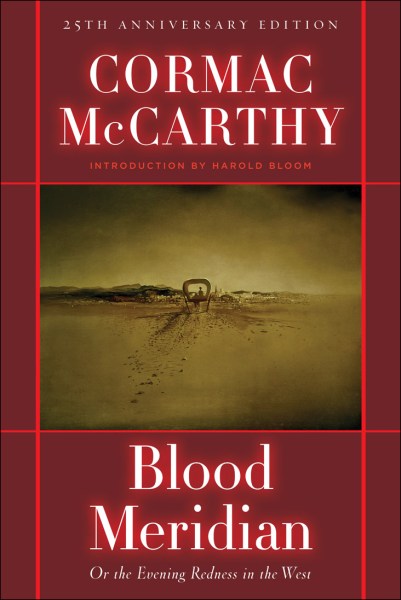
This week, Random House celebrates the 25th anniversary of Cormac McCarthy’s masterpiece Blood Meridian by releasing a new hardback edition of the book. This new Modern Library version retains Harold Bloom’s now-oft-cited introductory essay and features a new cover design by Richard Adelson that echoes the first edition and restores its original art work, The Phantom Cart by Salvador Dali. Here is the new cover–

The release of this new edition and the book’s anniversary give us a great excuse to declare the next five days Blood Meridian Week on Biblioklept. (Yes, we know that it’s also Banned Books Week this week. But celebrating Blood Meridian seems to gel with that). We’ll re-run our original review, take a look at what different critics have had to say about the book, quote some of our favorite passages at length, share some of the better resources at large for tackling this often difficult book, examine some of the history behind it, and generally laud it for its horrifying excellence. We’ll also be giving away a copy of the new 25th anniversary edition to one lucky reader, so keep your eyes peeled for details.

JG Ballard on William Burroughs

We continue to raid The Paris Review’s interview archive. Here’s J.G. Ballard on William Burroughs, in a 1984 interview–

INTERVIEWER: Burroughs wrote an eccentric and laudatory, in its way, introduction to the American edition of Atrocity Exhibition. Do you know him?

BALLARD: Burroughs, of course, I admire to the other side of idolatry, starting with Naked Lunch, then Ticket, Soft Machine, and Nova Express. I’m less keen on his later books. In his way he’s a genius. It’s a pity that his association with drugs and homosexuality has made him a counterculture figure, but I suppose his real links are with Jack Kerouac, Allen Ginsberg, and the Beats. Still, I think he’s much more of an establishment figure, like Dean Swift, with a despairing disgust for the political and professional establishments of which he is a part. I have met Burroughs quite a few times over the last fifteen years, and he always strikes me as an upper-class Midwesterner, with an inherent superior attitude towards blacks, policemen, doctors, and small-town politicians, the same superior attitude that Swift had to their equivalents in his own day, the same scatological obsessions and brooding contempt for middle-class values, thrift, hard work, parenthood, et cetera, which are just excuses for petit-bourgeois greed and exploitation. But I admire Burroughs more than any other living writer, and most of those who are dead. It’s nothing to do with his homosexual bent, by the way. I’m no member of the “homintern,” but a lifelong straight who prefers the company of women to most men. The few homosexual elements in Crash and Atrocity Exhibition, fucking Reagan, et cetera, are there for reasons other than the sexual—in fact, to show a world beyond sexuality, or, at least beyond clear sexual gender

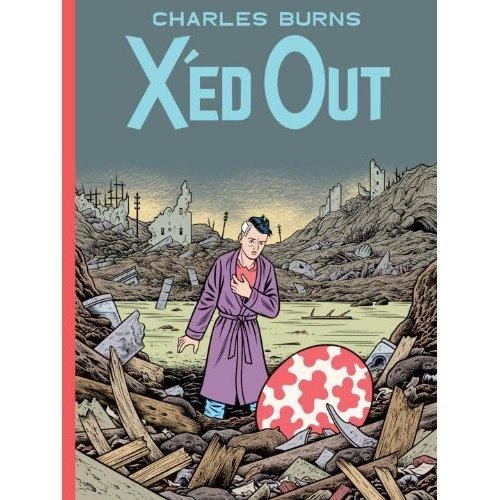
Charles Burns’s X’ed Out Is Fantastic

I devoured Charles Burns’s X’ed Out last night. Then I read it again this afternoon. I’ll read it again before I give it a proper review closer to its release date near the end of October. It’s weird, wild stuff, working in the idioms of William Burroughs and Hergé, brimming with punk rock energy and druggy art madness. It’s thoroughly Burnsian. X’ed Out is the first volume in what the publisher promises will be “an epic masterpiece of graphic fiction in brilliant color.” Like I said, full review down the line, but look out for this book. X’ed Out comes from the good folks at Pantheon, who’ve already proven their commitment to the graphic novel medium in stunners by publishing soon-to-be classics like David Mazzucchelli’s Asterios Polyp and Dash Shaw’s BodyWorld.

“I’m Not Sure Why You Love Reading About Drugs” — The Paris Review Interviews Sam Lipsyte

The Paris Review interviews Biblioklept fave Sam Lipsyte. From the interview–

I’m not sure why you love reading about drugs. Maybe at a certain point the reading high is better than actually doing them? That could be preposterous though. I guess I’ve written about drugs a good deal because for a time, in my younger days, certain hard substances were the major elements in my life. My movements and decisions revolved around them. I like to pretend it was all some meaningless blur, but it was a very intense and focused time. I had a daily purpose (to get more drugs) that heightened the experience of being alive (a heightening then nullified by the drugs). I felt very alert during the mission phase of the day. Make no mistake, it was a horrible time, but I’ve always been fascinated by that robotic intensity. Also, it’s a way to give your character something to do, and we all know you have to keep those fuckers in motion, or readers might find out they are just constructions in a fiction! I try to make sure the drug-users in my stories aren’t acting high. Most of them tend to do drugs to get straight anyway. They are in that awful place. So their interactions might seem slightly off, but mostly these could easily be people not doing dangerous drugs. It’s just that occasionally they die from their addictions or else make really bad decisions that lead to more misery. That’s where the comedy kicks in. Drugs are hard to resist for some people because they work really well. And then don’t. But you find that out later.


Many books have been written depicting drug addictions, drug addicts and how drug addiction treatment centers actually work, with varying degrees of consistency.

Umberto Eco Invented Dan Brown

More from The Paris Review’s vaults–a 2008 interview with Umberto Eco

INTERVIEWER: Have you read The Da Vinci Code?

ECO: Yes, I am guilty of that too.

INTERVIEWER: That novel seems like a bizarre little offshoot of Foucault’s Pendulum.

ECO: The author, Dan Brown, is a character from Foucault’s Pendulum! I invented him. He shares my characters’ fascinations—the world conspiracy of Rosicrucians, Masons, and Jesuits. The role of the Knights Templar. The hermetic secret. The principle that everything is connected. I suspect Dan Brown might not even exist.

Harold Bloom Explains Why the New Testament Is an Aesthetic Disappointment

The Paris Review has made their famous cache of author reviews–spanning seven decades–available online. Here’s Harold Bloom griping about the New Testament in a 1991 interview

INTERVIEWER: You’ve written that the Christian Bible is, on the whole, a disappointment.

BLOOM: The aesthetic achievement is so much less than that of the Old—or original—Testament. The New Testament is a very curious work from a literary point of view. So much of it is written by writers who are thinking in Aramaic and writing in demotic Greek. And that curious blend of Aramatic syntax with a Greek vocabulary is a very dubious medium. It’s particularly egregious in the Revelation of St. John the Divine, the Apocalypse, which is a very bad and hysterical and nasty piece of writing. Even the most powerful parts of the New Testament from a literary point of view—certain epistles of Paul and the Gospel of John—are not works that can sustain a close aesthetic comparison with the stronger parts of the Hebrew Bible. It is striking how the Apocalypse of John has had an influence out of all proportion to its aesthetic, or for that matter, I would think, its spiritual value. It is not only an hysterical piece of work, but a work lacking love or compassion. In fact, it is the archetypal text of resentment, and it is the proper foundation for every school of resentment ever since.

Cloud Atlas — David Mitchell

Friedrich Nietzsche famously wrote that “There are no facts, only interpretations.” David Mitchell takes this idea to heart in his 2004 novel Cloud Atlas, using six nested narratives to mull over Nietzschean matters of truth and perspective, the will to power, what it means to be a slave or a master, and the different methods by which one might narrativize one’s life. At its core, Cloud Atlas works to illustrate Nietzsche’s hypothesis of eternal recurrence, the idea that we live our lives again and again. To wit, each of the central characters in Cloud Atlas‘s six sections seems to be a reincarnation of a previous one. Mitchell arranges his narrative like a matryoshka doll, interrupting the first five stories with Scheherazade-style cliffhangers. Each narrative propels the book’s chronology forward a century or more until reaching a crescendo in a post-apocalyptic world, the only section that remains uninterrupted. Mitchell then resumes each narrative, working backward through time to his starting point in 1850, with The Pacific Journal of Adam Ewing.

The Pacific Journal of Adam Ewing features a naïve American’s tour of the South Pacific, focusing roughly on his trek from New Zealand to Hawaii. The journal’s style readily and purposefully recalls Herman Melville; indeed, Ewing himself professes to be a fan of Melville. Early in Ewing’s journal–which is to say, early in the novel Cloud Atlas–we are treated to (or subjected to) a somewhat lengthy description of the enslavement and slaughter of the pacifist Moriori tribes of the Chatham Islands at the hands of the Māori. Here, Mitchell introduces his novel’s dominant theme of slavery and civilization. Again and again in Cloud Atlas, we find groups of people preying upon other people, enslaving them and decimating their cultures. The Pacific Journal reiterates this theme when Ewing helps to rescue an enslaved Moriori who has escaped his slavers by stowing away; the episode also echoes the relationship between Ishmael and Queequeg, of course.

The next episode, Letters from Zedelghem, features a young bisexual composer named Frobisher; his narrative comprises letters he sends to his best-friend (and sometime lover) Rufus Sixsmith. Frobisher’s robust voice is one of the great achievements of Cloud Atlas; he finds music everywhere and in everything, and even though he repeatedly gets himself into terrible situations (which are always entirely his own fault) it’s hard not to feel for him. In debt and on the lam, he finds work as an amanuensis in Belgium, laboring under an aged, sometimes-despotic composer named Ayrs. Ayrs enlists Frobisher’s talents in creating a work named “Eternal Recurrence,” but ends up stealing most of his ideas. The Frobisher narrative is the only section to explicitly name Nietzsche and his ideas. Given the setting–Belgium, 1931, Europe precariously dangling before the precipice of another war–there’s a certain ambivalence toward Nietzsche perhaps, or at least a tacit acknowledgment that ideas like the Will to Power might be radically misapplied. Letters also most openly alludes to the structure of Cloud Atlas. In its second part–which is to say its conclusion, which is to say near the end of Cloud Atlas–Frobisher writes the following–

Spent the fortnight gone in the music room, reworking my year’s fragments into a “sextet for overlapping soloists”: piano, clarinet, ‘cello, flute, oboe, and violin, each in its own language of key, scale, and color. In the first set, each solo is interrupted by its successor: in the second, each interruption is recontinued, in order. Revolutionary or gimmicky?

Frobisher’s question perhaps reflects Mitchell’s own reticence over his complicated structure; in any case, it amounts to a post-modern wink. Frobisher’s narrative also initiates the book’s process of connecting the narratives, as each protagonist finds a copy of the earlier principal’s story. Frobisher finds Ewing’s Journal and devours it; in one of the book’s funnier moments, he scolds Ewing’s naïvety, comparing him to Captain Delano in Melville’s Benito Cereno. Frobisher’s criticism is apt. With its themes of slavery and mastery, truth and representation, and exterior and interior, there is probably no book that Cloud Atlas echoes as strongly as Benito Cereno.

Mitchell moves from a wonderful and witty approximation of the epistolary novel into a dull exercise in boilerplate fiction with the next narrative. Half-Lives: The First Luisa Rey Mystery follows the adventures of a plucky newspaper reporter in the 1970s as she tries to reveal a multinational corporation’s evil doings to the public. Aided by the report of a scientist named Rufus Sixsmith (yes, that Rufus Sixsmith), Luisa plunges into a world of intrigue and mystery and blah blah blah. Half-Lives intends to comment on airport novels, but Mitchell outdoes himself with the bad writing–it’s easily the weakest section of Cloud Atlas, and although it plays with the novel’s overarching themes it does little to enlarge or invigorate them. It does, however, introduce the comet-shaped birthmark that connects the heroes of these tales as they are born and reborn.

Mitchell seems more at home in the amplified voice that propels The Ghastly Ordeal of Timothy Cavendish. Set in and outside of London in the near future–that is to say, our near future–The Ghastly Ordeal is probably the funniest section of Cloud Atlas. Cavendish, the aging publisher of a small vanity press, finds success (and trouble) when one of his authors openly murders a critic. A dispute over royalties finds him hitting the road and fleeing for safety outside the urbane confines of London. Soon, he’s held prison in a home for the elderly somewhere in the barbaric north. Cavendish is scowling, imperious, overeducated, and arch; his racism and classism seem to belong to a different age and he’s prone to hyperbole (scratch that–he’s all hyperbole). Cavendish’s narrative is deeply reactionary: early in, he relates being mugged by a group of school girls, and the episode seems to come from A Clockwork Orange. How honest he is here, of course, is under suspicion, but that’s kinda sorta the whole point of Cloud Atlas. Cavendish’s narrative is the hardest to place stylistically–it doesn’t immediately resonate with any of the genre tropes that characterize the other section–but I suppose that there’s something of the post-Modernist (as opposed to postmodernist, of course) white-male-reactionary flavor to his Ordeal–hints of Saul Bellow, Updike, Roth perhaps? I’m not sure. The Ghastly Ordeal is the most contemporaneous episode of Cloud Atlas, so its tropes may be harder to spot.

The dystopian tropes of An Orison of Sonmi-451 are more readily apparent. Orison jumps centuries ahead, pointing to a future where an imperial Korean dominates what’s left of the non-burned Earth. Corporations have replaced government and consumerism has replaced religion. The rigid class structure that has developed relies on a slave class of fabricants–genetically modified clones–who perform dangerous jobs and manual labor. The narrative unfolds as an interview with Sonmi-451, a fabricant who “ascends,” positioning her in a level of unprecedented self-awareness that positions her to become the signal in a revolution to end slavery. There’s more to Orison than I can possibly unpack here, an observation that cuts both ways for Cloud Atlas. On one hand, Mitchell’s dystopia is repellent and enchanting, grimy and brightly lit, a world of fascinating extrapolations that mirror and satire contemporary society. On the other hand, Orison is overstuffed; its seams show the strains of containment. One gets the sense that Mitchell’s had to restrain an entire novel here, and the frequent need to dump exposition on his readers undercuts his otherwise nimble prose. (Alternately, the clunky exposition dumping might be a reference to Philip K. Dick). Mitchell is clearly comfortable working in the idiom of Orwell and Huxley (Sonmi explicitly references both writers, by the by), but the second half of Orison–the descending half, if you will–cannot reclaim the energy of its first part. Beyond Orison, a sense of contraction rules the second half of Cloud Atlas.

Perhaps the deflation in the novel’s second half results from its triumphant middle passage, Sloosha’s Crossin’ an’ Ev’rythin’ After. Dystopia moves to post-apocalypse, and maybe a thousand years after the time of Ewing, we are back in the Pacific, in the Hawaiian islands, where a man named Zachry spins one of the better adventure yarns I’ve heard in some time. Mitchell writes Sloosha’s Crossin’ in an invented argot that readily (and purposefully) recalls Russell Hoban’s post-apocalyptic masterpiece Riddley Walker. Like that book, Sloosha’s Crossin’ showcases an environment removed from the apocalypse–the narrative is more about how civilizations might reform after a fall. When a woman named Meronym from a “tribe” called the Prescients comes to stay with Zachry’s family, the stress between civilization and savagery comes to a head. The Prescients seem to be the last group of people on earth with any vestige of command over prelapsarian technology. Meronym (who bears a comet-shaped birthmark) does her best not to intervene in the day-to-day life of the family, but when the Kona, an aggressive tribe of slavers attack, she finds her self unable not to act. As the central, unbroken narrative of Cloud Atlas, Sloosha’s Crossin’ must both climax the novel as well as tie its disparate ends to its organizing themes. It doesn’t disappoint, both encapsulating, repeating, and commenting on the various slave-slaver narratives that run through the rest of the text. When the Kona attack Zachry’s Valleysmen, we see eternal recurrence–Māori slaughtering Moriori, Christian colonials ousting aboriginals, corporations using their fabricants for slave labor. A dialogue between Zachry and Meronym (delivered in Zachry’s argot, of course) spells out the novel’s concerns. Zachry asks Meronym if it’s “better to be savage’n to be Civ’lized?” She replies–

What’s the naked meanin’ b’hind them two words?

Savages ain’t got no laws, I said, but Civ’lizeds got laws.

Deeper’n that it’s this. The savage sat’fies his needs now. He’s hungry, he’ll eat. He’s angry, he’ll knuckly. He’s swellin’, he’ll shoot up a woman. His master is his will, an if his will say soes “Kill” he’ll kill. Like fangy animals.

Yay, that was the Kona.

Now the Civ’lized got the same needs too, but he sees further. He’ll eat half his food now, yay, but plant half so he won’t go hungry ‘morrow. He’s angry, he’ll stop’n’ think why so he won’t get angry next time. He’s swellin’, well, he’s got sisses an’ daughters what need respectin’ so he’ll respect his bros’ sisses and daughters. his will is his slave, an’ if his will say soes, “Don’t!” he won’t, nay.

What we see here is, I believe, a subtle reading of Nietzsche’s famous, infamous, and not-so-well understood concept of the will to power. Meronym’s solution to save endangered humanity is not blind adherence to conventional morality but rather an individual’s ability to overcome his or her animal instincts to thrive. The Übermensch enslaves his own will, his id, and preserves his ego.

As Sloosha’s Crossin’ concludes and Cloud Atlas moves outward and back into the past, there’s a twin sense of deflation and redemption. Orision does not have the room it needs to breathe; although Sonmi’s inevitable martyrdom follows a narrative logic that Sloosha’s Crossin’ more than justifies, it feels undercooked. The second half of the Cavendish narrative is more fulfilling. No spoilers. Mitchell manages to shoehorn a strange missive by a physicist into the second half of Luisa Rey; it’s only a page and a half, it doesn’t really belong there, and it’s the most interesting thing about the whole narrative. Like Frobisher’s description of his sextet, it functions as one description of the book. Luisa gets to hear that sextet, by the way; she special orders one of only fifty pressings. Frobisher’s narrative I’ve remarked upon at some length, so I will leave it alone by saying that it’s one of the finer points of Cloud Atlas and noting that it ends with a specific invocation of Nietzsche’s idea of eternal recurrence. The Journal of Adam Ewing is also very satisfying; in many ways it has to be, for it is the beginning and the end and the second end (and thus new beginning) of the novel. Ewing’s experiences–which, to leap right through the chain of protagonists, must also be Meronym’s experiences–lead him to reject the common morality of his time. As the novel concludes, he elects to return to the United States as a committed abolitionist, his stated mission in life to fight slavery in all its forms.

Cloud Atlas is a postmodern novel through and through. It riffs on genre and style with a keen awareness of textuality, an overt reliance on intertextuality, and a formally experimental schema that, as one of its principals puts it, might be “Revolutionary or gimmicky.” It lovingly pairs the high with the low, the philosophical with the vulgar, the musical with the mud, and its best moments do so seamlessly and gracefully. It’s a very good read–a fun read–and readers daunted by its structure need not be: Mitchell has created a book that they in many ways probably already know–they just don’t know that they know it like this. Highly recommended.

The Strange and Disorienting World of Authors’ Personal Libraries

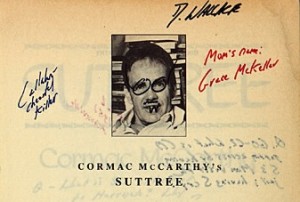
Craig Fehrman’s new article “Lost Libraries” (at The Boston Globe) provides a fascinating overview of how author libraries — that is, the books, usually heavily annotated, that authors own — find their way into archives, and why those archives matter. Fehrman begins by detailing the strange case of recently-deceased novelist David Markson, whose personal library was kinda sorta reassembled by fans after a reader named Annecy Liddell bought Markson’s (cleverly-annotated) copy of Don DeLillo’s White Noise–

The news of Liddell’s discovery quickly spread through Facebook and Twitter’s literary districts, and Markson’s fans realized that his personal library, about 2,500 books in all, had been sold off and was now anonymously scattered throughout The Strand, the vast Manhattan bookstore where Liddell had bought her book. And that’s when something remarkable happened: Markson’s fans began trying to reassemble his books. They used the Internet to coordinate trips to The Strand, to compile a list of their purchases, to swap scanned images of his notes, and to share tips. (The easiest way to spot a Markson book, they found, was to look for the high-quality hardcovers.) Markson’s fans told stories about watching strangers buy his books without understanding their origin, even after Strand clerks pointed out Markson’s signature. They also started asking questions, each one a variation on this: How could the books of one of this generation’s most interesting novelists end up on a bookstore’s dollar clearance carts?

Fehrman g0es on to point out that–

David Markson can now take his place in a long and distinguished line of writers whose personal libraries were quickly, casually broken down. Herman Melville’s books? One bookstore bought an assortment for $120, then scrapped the theological titles for paper. Stephen Crane’s? His widow died a brothel madam, and her estate (and his books) were auctioned off on the steps of a Florida courthouse. Ernest Hemingway’s? To this day, all 9,000 titles remain trapped in his Cuban villa.

Why does this matter? As Fehrman notes, “authors’ libraries serve as a kind of intellectual biography.” And while universities do their best to archive these materials, as Fehrman’s article reveals, much of what gets saved is left to chance. For instance, how did David Foster Wallace’s personal library get to the Harry Ransom Archive?

When Wallace’s widow and his literary agent, Bonnie Nadell, sorted through his library, they sent only the books he had annotated to the Ransom Center. The others, more than 30 boxes’ worth, they donated to charity. There was no chance to make a list, Nadell says, because another professor needed to move into Wallace’s office. “We were just speed skimming for markings of any kind.”