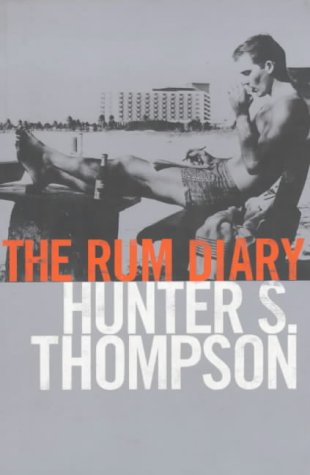
The Rum Diary–Hunter S. Thompson

Set in the 1950s, Hunter S. Thompson’s second novel The Rum Diary chronicles the drunken misadventures of Paul Kemp, a journalist who moves from New York City to Puerto Rico to write for a small newspaper. While there, Kemp gets involved with a crazy couple who fight all the time (he develops a serious crush on the girl), attends a rum festival, and winds up in jail. Along the way there’s enough drinking to put Hemingway’s characters to shame, and plenty of nude swimming to boot.

Although The Rum Diary was written in the early sixties, it wasn’t published until 1998, long after the infamous gonzo godfather had made his indelible mark on the American literary consciousness. Thompson was 22 when he wrote The Rum Diary, a significant eight years younger than his stand-in in the novel, jaded journalist Paul Kemp. And while it’s easy to imagine that HST was born a cranky old man, at times Kemp’s world-weariness reads more like an affected pose rather than an earned cynicism.
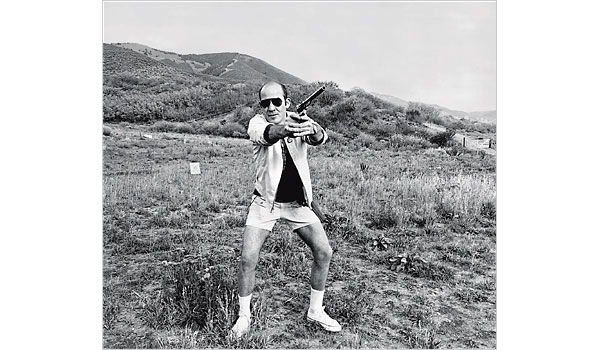
The novel works best when HST focuses on denigrating the cretins, phonies, perverts, and degenerates that are never in short supply in his sick universe. Where the average travel writer might see a joyous festival throbbing with life and humanity, HST finds dread and disgust, fear and loathing. His frenzied yet steady prose moves quickly, adding to the general manic tone of the novel, and, despite its 200+ pages, The Rum Diary is an easy weekend read. Additionally, HST’s reflections on American imperialism and tourism in general remain relevant and fresh over forty years later.

The Rum Diary is hardly the HST starting place, but this is quite obvious (if, dear reader, this is not obvious to you, get thee to a bookstore posthaste and obtain Fear and Loathing in Las Vegas). However, for casual fans The Rum Diary will make an interesting beach read. Apparently a movie featuring HST friend-alum Johnny Depp (as Paul Kemp) is slated to come out next year, so stay one step ahead of Hollywood by reading this now. Recommended.

Down to a Sunless Sea

Mathias B. Freese’s slim collection of short stories, Down to a Sunless Sea, relays the weird, miserable, and even sometimes ghoulish existences of people you might pass on the street everyday. The stories read like psychological case studies, and there’s frequently a strange distance between the clinical detachment of the prose and the depressed or depraved sentiment expressed by the narrator. At times the effect is painful, as in “Herbie,” where the titular protagonist’s rage at his abusive father spills over into Oedipal violence. Elsewhere, the stories take on a wry surrealist humor. Freese’s knack for dissonance evinces in “Juan Peron’s Hands,” where a grave robber pines for a head but settles for hands. Far closer to home is “Young Man,” where Freese distills an entire life to a few bitter pages, exploring the modern disconnect between thought, action and identity.

I can’t be who I am in real life, so I can be who I am in thought, but who I am in thought is not who I am in deed, so I live between what is and what should be, and this serves to make sharper the cleavage–the crevices are clearly marked.

One of my favorites in the collection, “Arnold Schwarzenegger’s Father Was a Nazi,” disconcertingly (and humorously) condenses American obsession with celebrity into a fantasy ski trip, complete with the oddly sorta-prescient line: “I might even run for president if I can lose this accent” (the story was originally published in 1991). It is probably the deformed voyeur hero of “I’ll Make It, I Think” who delivers the closest thing to a mantra for these characters:

I’m not hurting anyone. So what if my morning shorts are sticky. I’m a good person. The outside, for sure, is a shambles–that’s not completely true, but I’ve made my point. Inside is fucked up some, but I’ll make it, I think.

Down to a Sunless Sea, for all its monsters and perverts and manic depressives, is never cruel in its darkness or unsympathetic in its distance. Freese creates real people here, and if we laugh at their pain, we’re laughing with them. Highly recommended.

Galactic Pot-Healer–Philip K. Dick

Philip K. Dick’s bizarrely titled Galactic Pot-Healer begins in a dystopian future (more 1984 than Brave New World), before moving into–you guessed it–more galactic territory. Joe Fernwright “heals” ceramic pots–a relatively useless job, seeing as all the broken pots have now been mended. He wiles away his time playing word games with other cubicle minions across the globe, until an alien called Glimmung wisps him away to Sirius Five so that he can aid in resurrecting an ancient cathedral from the depths of an ocean where the laws of time do not apply. Lots of very strange stuff happens.

Galactic Pot-Healer is typical PKD, which is to say thoroughly atypical sci-fi with a philosophically paranoid twist (or is that a paranoid philosophical twist?). The story begins as a satire of modern workaday existence, and Dick’s assessment of cubicle life, written in the late 1960s, is almost too-prescient. Fernwright is a typical Dickian hero, a Walter Mitty figure who, real or not, gets to live his dream out (there’s a girl, of course, a sexy alien). After the action moves to Sirius Five, Dick becomes overtly concerned with the major themes of the novel. A precognitive alien race called the Kalends publish a book, a sort of daily newspaper, that accurately predicts the future. The Kalends predict that the raising of the cathedral will fail, and all involved will die. Glimmung, who is repeatedly compared to Faust by everyone in the book (all of these aliens from different planets are not only familiar with Goethe’s version, but other versions as well), attempts to prove that he is master of his own fate. Attracted to this, Fernwright risks his life in the project, and finds a new hope and vitality in meaningful work that he didn’t have back in his cubicle on Terra.

Galactic Pot-Healer is as weird as its title, and at times suffers from Dick’s manic jumpiness. One imagines him sweating out the novel over a few weeks, feverishly hacking at his typewriter. The links between concrete events–narrative action–are often frantic (if they exist at all), and there’s little subtlety here: Dick’s characters will quote verbatim Kant or Goethe, or wax heavy on determinism and ontology at the drop of a hat. At other times, the prose sings with lyrical beauty, sorrow, and a density of imagination that more than makes up for Dick’s occasional lack of cohesion. As good a place as any to begin a journey into the weird wonderful world of PKD.

(Images from philipkdick.com’s kickass covers gallery)

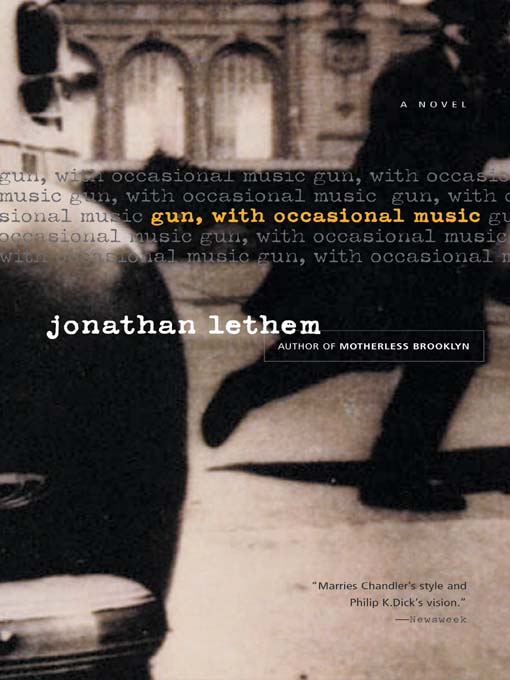
Gun, with Occasional Music–Jonathan Lethem

Jonathan Lethem’s novel Gun, with Occasional Music blends hardboiled crime noir with trippy sci-fi to examine the ethical ramifications of murder in a dystopian future where evolved animals work along side humans, mind altering drugs are not only free but encouraged by the authorities, and asking questions requires a license. Conrad Metcalf is a Private Inquisitor trying to solve a murder case involving a urologist, a baby-head (a failed evolved baby), and a gun-wielding kangaroo.

Two of the blurbs for Lethem’s debut describe the work as a marriage of Philip K. Dick and Raymond Chandler, but for my taste their wasn’t enough PKD. The details involving the “make” that Metcalf compulsively snorts, the genetic evolution techniques society now uses to produce children, and the genital nerve-ending swaps that people now enjoy are never fully explored. Sometimes bizarre details left unexplained create the dramatic immersion that the best SF achieves; Gun seems to throw ideas up against a wall to see if any stick. Many of the SF tropes that Lethem evokes are simply under-utilized. His ideas are playful, so why doesn’t he play with them more?

On the noir, end, the book also disappoints a little. The case is solved, but Metcalf’s solution–delivered entirely in a brief chapter crammed with exposition–seems hardly believable, or even really that interesting. This isn’t to suggest that Lethem’s/Conrad’s Chandlerisms aren’t enjoyable, and at times downright genius. Even when Lethem cranks out a clunker of a simile–and there’s more than one here–the rhetoric comes across more as satire of the genre as opposed to bad writing. The book also moves at a nice clip, with short, snappy chapters that always propel the narrative action. Eventually though, it just runs out steam. The story doesn’t really add up, and towards the end, it becomes clear that Lethem’s not going to fill us in on all of the cool ideas he initiated. I recommend those new to Lethem start with Motherless Brooklyn or The Fortress of Solitude instead. Or Men and Cartoons. Or The Disappointment Artist. Avoid You Don’t Love Me Yet like the plague.

What, Me Worry?

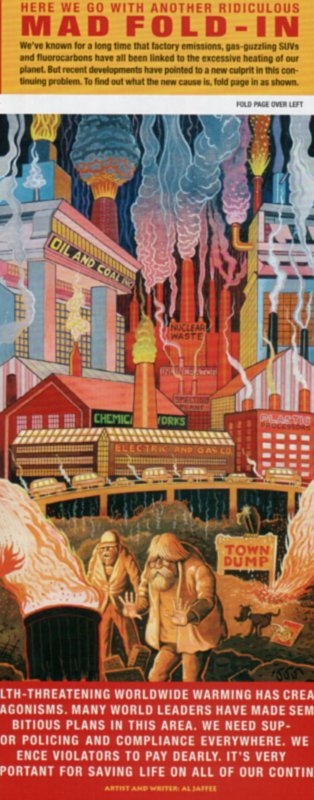
I’ve already documented my love of MAD magazine when I was younger. It pretty much was my cultural currency, and, perhaps unfortunately, much of my understanding of pop culture was warped through the lens of MAD. Anyway, I was psyched when Longlunch sent me this fun, playful link to the New York Times‘s “Fold-In Feature.” You remember Al Jaffee’s fold-ins, right? They always got all messed up after one or two folds…but they were fun. Interactive. I like that. More fold-ins here. Bleechh!

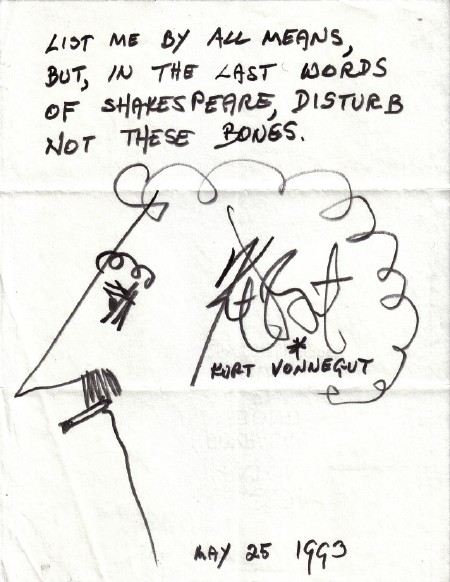
Kurt Vonnegut Reconsidered

Kurt Vonnegut died a year ago today. Vonnegut’s death has left neither a cultural vacuum nor a pining after another great work now never to be. And why should it? He was pretty old–84–and he’d written a relatively substantial collection of novels, plays, essays, and short stories. And admittedly, he hadn’t written a truly great book in decades. Like Bob Dylan, Vonnegut produced his greatest work in the 1960s: Mother Night, Cat’s Cradle, God Bless You, Mr. Rosewater, and, of course, Slaughterhouse-Five (even 1968’s short story collection Welcome to the Monkey House–a book I proudly admit I stole from my 10th grade English teacher–is superior to Vonnegut’s later work). Yet there’s still something about his death that makes me feel a little melancholy, even now–not sad, per se, but rather–and it sounds corny–like something is missing.

See, I learned to read by reading Vonnegut. Sure, I knew how to read before I read Cat’s Cradle, but, beyond Tolkien, C.S. Lewis, and a number of classic adventure books by authors like Edgar Rice Burroughs and Mark Twain, Vonnegut was the first “literary” author I was exposed to. I learned irony. I learned detached pessimism. I was exposed to a writer who knew how to explode genre convention. And, in a short period–roughly from the ages of 12 to 16–I read everything that Vonnegut had written. Then I dismissed him as a “lesser” writer, and moved on, until I was required to re-read Slaughterhouse-Five in college. I’d forgotten how good it was. I re-read Cat’s Cradle, my first and favorite (to this day) Vonnegut novel. Again, great. I then picked up Vonnegut’s final novel, 1997’s Timequake, a shambolic wreck of semi-autobiography that is at turns drastically pessimistic, utterly depressive, and hilariously cynical. It’s really a terrible book, to be honest, but taken as a final statement, I think it works. In any case, after college I managed to get over the silly embarrassment I felt for my love of Vonnegut, an author often relegated to the second or even third tier of American letters, or, even worse, a personality reviled in the press (watch Fox News’s scandalous obituary. Or, if you prefer watching something positive, watch Vonnegut on The Daily Show.)

I suppose, when I say that Vonnegut’s death presents an absence, a feeling of something missing, I really mean to say that it marks me, it ages me: it makes me feel old. After all, we measure our own lives in part against the deaths of others, particularly against the deaths of the famous and celebrated. Vonnegut preceded me; his novels were there, waiting for me, and I was grateful. I read all of them–all of them–I don’t know if I can say that of another author (except maybe Salinger, and I don’t think that counts). But I still haven’t read A Man Without a Country, his 2005 collection of essays, and I haven’t read the posthumously published short story collection, Armageddon in Retrospect, which came out just the other week. It makes me happy to know that there’s something out there of his that I haven’t yet touched, that I can read for the first time as an adult, and not a teenager. I don’t know why I should feel this way, but I do. So it goes.

Vonnegut plays himself in an classic film:

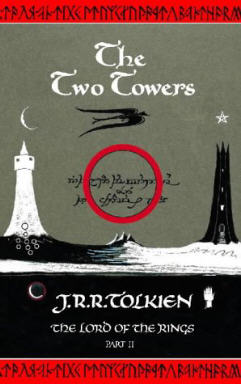
Tolkien Cover Gallery

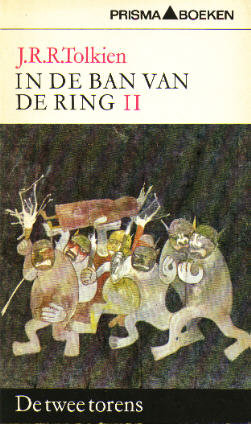
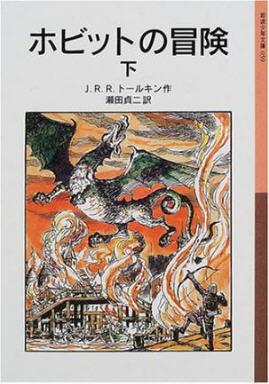
All images from the LOTR Fanclub Scrapbook outstanding cover gallery. Their collection is exhaustive (literally), so we’ve cherry-picked for you. Enjoy!

The original 1935 first edition of The Hobbit, featuring Tolkien’s own artwork and design

More of Tolkien’s own art and design

Watercolors by–you guessed it–Tolkien

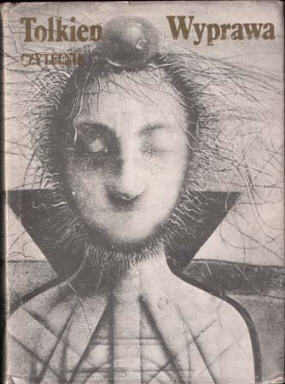
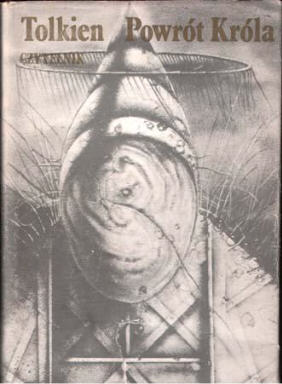
These Polish editions are, um, kinda freaky

Happy fun times

There’s a certain Where the Wild Things Are quality to this one

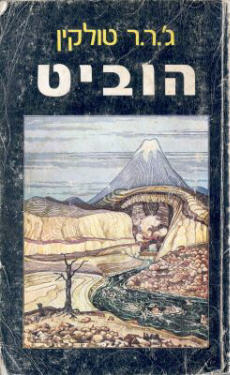
According to the cover gallery site, this 1977 edition was the first Hebrew translation of The Hobbit, the work of Israeli air pilots passing time while imprisoned in Egypt. Art by Tolkien hisself.

A Midsummer Night’s Dream

Every year, I try to pick a different Shakespeare play to read with my students, preferably one I haven’t read in a long time. This year, I have one group of tenth graders, and right now we’re reading A Midsummer Night’s Dream. As I’ve mentioned elsewhere on this blog, most of the students at my school read well below their grade level, so Shakespearean language can often be a challenge. I’ve found that Alan Durband’s Shakespeare Made Easy series does a great job at clarifying the narrative action without sacrificing too much of Shakespeare’s poetry. It presents the original text on the left side with the clarified “translation” on the right, which allows us to read and act out the play without spending too much time and effort breaking down every little (or long…) speech. Every couple of pages I’ll pick out a key passage from the original text which we’ll read and discuss. I’ve also been showing them the film adaptation that came out in the nineties (with Kevin Kline, Michelle Pfeiffer, and Christian Bale). We’re about half way through so far, and we’re enjoying the whole process.

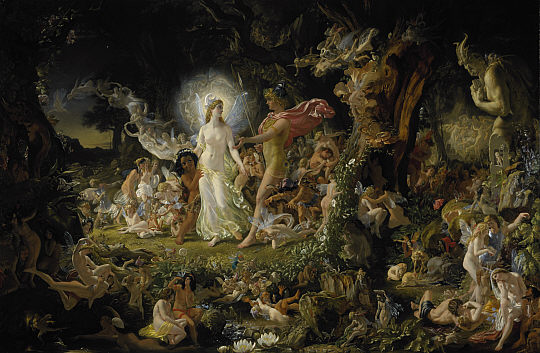
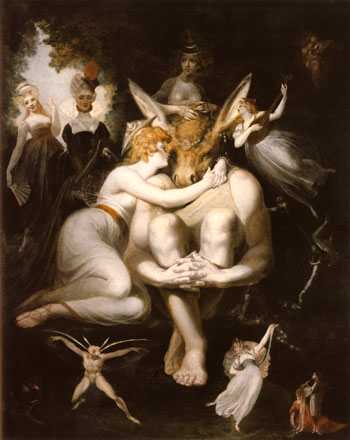
I haven’t read this play since I was in the tenth grade, and I really didn’t think too much of it then–it certainly didn’t seem as weighty as, say, Othello, Macbeth, or Hamlet. Anyway, in re-reading it, I notice now that there’s an underlying rape motif throughout the text. For example, Theseus has captured his bride Hippolyta by seizing her in a classical rape; Demetrius threatens taking the “rich worth” of Helena’s virginity if she won’t quit stalking him in the woods; Lysander forces himself onto Hermia in the woods, and she’s barely able to keep him off. Oberon and Titania’s quarrel over the beautiful Indian boy is pretty weird, and is just one strange detail in a play full of aggressive sexuality, possibly most neatly summed up in the bestiality implicit in Titania’s affair with ass-headed Bottom. Of course, Titania doesn’t really love bottom–she’s just been dosed by her jealous hubby, who has a frat boy’s penchant for drugging people to get the love buzz going. Good stuff.

Blood Meridian–Cormac McCarthy

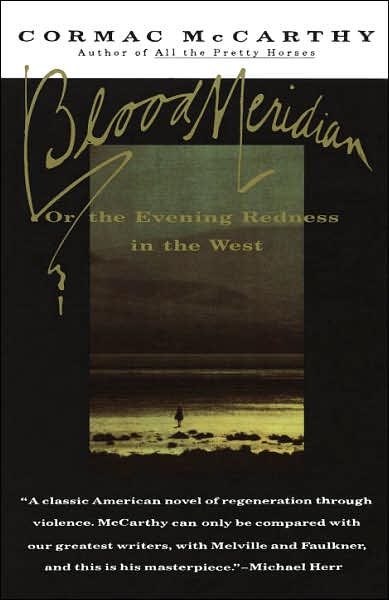
Blood Meridian is a blood-soaked, bloodthirsty bastard of a book, and certainly the most violent piece of literature I’ve read outside of the Bible and certain Greek tragedies. Cormac McCarthy’s 1985 novel passes itself off as a Western–and it is a Western, to be sure–but more than anything, it’s a brutal horror story.

Set predominantly in the 1850s, Blood Meridian chronicles the westward journey of a protagonist we know only as “the kid.” After a few false starts (including getting shot, robbed, arrested, and surviving a Comanche massacre) the kid eventually meets up with John Joel Glanton‘s “expedition”–a group of men of mixed backgrounds hired by Mexican authorities to kill–and scalp–the nomadic Apache that prey upon Mexican villages. However, led by the nefarious, larger-than-life Judge Holden, Glanton’s gang quickly descends into a relentless robbing, raping, and killing spree; they savagely massacre peaceful Indian settlements along with the Mexican villages they were contracted to protect.

I could keep summarizing the book, but I don’t see the point, honestly–a mere description of the plot could never do real justice to the weight of this book. The narrative is taut and fast-paced–in fact, at points the action is so radically condensed that I had to go back and re-read sections–and there’s no shortage of the “men doing men stuff” that McCarthy is so good at detailing–but it’s really the combination of the book’s evocative imagery and philosophical pondering that hook the reader.

Most of that philosophical pondering comes from the Judge, who waxes heavy on everything from space aliens to metallurgy. In his parables and aphorisms, the Judge comes across as part-Mephistophelean, part-Nietzschean, all dark wisdom and irreverent chaos. I found myself re-reading the Judge’s speeches several times and chewing them over, trying to digest them; for me, they were the best part of a great book.

Blood Meridian, like most excellent things, is simply not for everyone, and I don’t mean that in any snobbish, elitist sense. Any reader turned off by its freewheeling violence would be justified, and I’m sure plenty of folks out there would take issue with its ambiguous conclusion. Depictions of genocidal mania that seem to end inconclusively are not for everyone, particularly when they are rife with archaisms, untranslated Spanish, and McCarthy’s signature, apostrophe-free punctuation. I had two false starts with the novel, including one where, at about exactly half way through, I realized I had to go back and start the novel again. I owed it that much. And it was worth it.

Blood Meridian is literally stunning; perhaps the best analogy I can think of is going to see a really, really good band that plays really, really brutal and strange music that sorta melts your face off. After the show you’re sweaty and exhilarated and even unnerved; your ears are ringing and your chest is pounding. And then the band packs up, and the house lights go on, and they pump in music from a CD, of all things, and the music just sounds tinny and pale and blanched of life after the raw power you’ve witnessed. Reading anything else right after finishing Cormac McCarthy’s Blood Meridian, or the Evening Redness in the West is sort of like that. Highly recommended.

His Dark Materials Trilogy — Philip Pullman

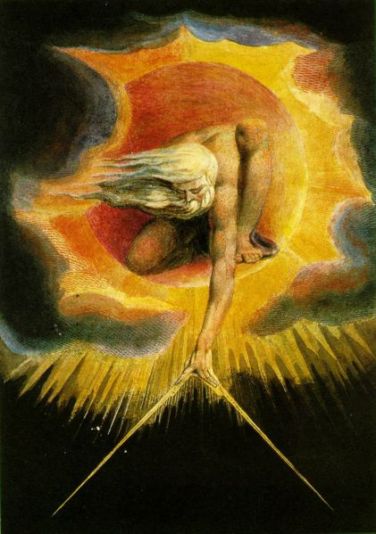
421px-blake_ancient_of_days.jpg
William Blake, “Ancient of Days”

Over the past three weeks, I read, and, alternately listened to, Philip Pullman’s fantastic His Dark Materials trilogy–The Golden Compass, The Subtle Knife, and The Amber Spyglass. Here’s the short review:

If it’s necessary to critically situate and compare a fantasy or sci-fi series against precursor series–namely, The Lord of the Rings, The Chronicles of Narnia, The Chronicles of Prydain, Harry Potter, etc.–and I don’t think it is necessary to critically situate and compare a fantasy or sci-fi series against its precursors, but that’s generally how these things are done–(this is turning into a monster of a “short review”)–but if it is necessary to critically situate and compare a fantasy or sci-fi series against precursor series, I think that Pullman’s His Dark Materials must be considered a new classic, an instantly-canonizable contribution to children’s literature, imaginative fiction, sci-fi, fantasy, or whatever genre you want to affix to these marvelous books.

His Dark Materials follows Lyra and Will, two children from different worlds (literally) who must work together to repair a damaged multiverse. Lyra comes from a world where people travel side by side with their daemons, spirit-images of their souls who take animal shapes. Will is an outsider in “our” world, a young fatherless boy who must take care of his mentally ill mother. The novels, in their simplest sense, detail the coming of age of these two as the traverse multiple parallel universes. In the backdrop there are witches and zeppelins, armored bears and dark specters, a compass that can point to the truth and a knife that can open all worlds, angels and scientists, and Lyra’s cruel and terrible parents, the cunning Mrs. Coulter, and Lord Asriel, whose will to kill God–The Authority–precipitates the action of the narrative.

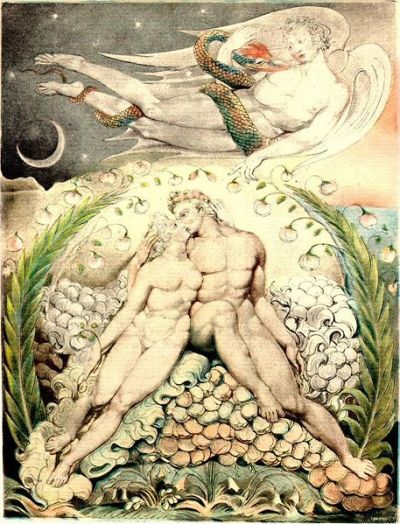
blake_satan_adam_eve.jpg
William Blake, “Satan Watching the Caress of Adam and Eve”

As many critics have pointed out, His Dark Materials recapitulates Milton’s Paradise Lost (the series takes its name from a line from that epic poem). However, the series really reinterprets the British Romantics’ assessment of Paradise Lost. Pullman engages a host of Romantic writers, foregrounding Keats’s idea of negative capability, and prefacing many of the chapters with quotes from Romantic poetry. In particular, Pullman cites William Blake. Indeed, it seems to me that His Dark Materials effectively synthesizes many of Blake’s poems and ideas, The Marriage of Heaven and Hell and Songs of Innocence and of Experience in particular. The novel also engages a number of Nietzsche’s ideas, and even, I believe, alludes to several concepts of Derrida’s (in particular, the idea of the gift of death). Additionally, Pullman weaves in the many-worlds theory, extended discussions of evolutionary anthropology, rampant infanticide, and auto-trepanation. Good stuff.

When the film of The Golden Compass (I didn’t see it) came out last year, it ignited a small controversy about the books. According to the Baptist Press, Pullman presents “a fantasy universe where witches are good, the church is bad, and at the end of it all, God dies.” This really isn’t the case, if you want to go with a precise reading of Pullman’s actual words, but, consider the source. I’m sure the controversy is healthy for Pullman’s sales; it certainly piqued my interest in the book, and I’m guessing that there are plenty of kids who, once their private Christian schools banned the books, couldn’t wait to get their hands on the verboten goods. And that’s a good thing.

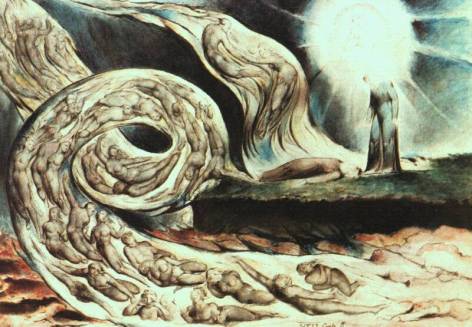
blake2.jpg
William Blake, “Whirlwind of Lovers”

His Dark Materials meets and surpasses my notions of good fantasy/sci-fi/imaginative fiction: the books engage multiple complex ideas in a new and often unsettling way. Unlike the Harry Potter series, which simply operates within familiar, preexisting archetypes of fantasy, Pullman’s work consistently disrupts reader expectations, pushing set ideas about religion and science, art and fantasy into new and fantastic places. Ultimately, although many will seek to suppress this book as an “amoral” work, His Dark Materials proposes a very real set of ethics inscribed in a world of moral relativity. The characters grow up and make good, selfless choices, decisions they make independent of absolute moral authority.

I very highly recommend these books.

The Art of Modern Memory

From conscientious reader Dave C. ((very) minor editorial changes by the Biblioklept):

“The NY Times posted an article about an author who was outed as a fraud for writing a memoir about her life as a half-Native American, half-white gangbanger from South Central Los Angeles who escaped to the University of Oregon when she was really just an activist who at one point worked with gangs and created the characters in her memoir based on real people she had met in her real/fake life.The Times actually reviewed the book just last week and praised it.

I’ve just been pissed ever since that James Frey controversy about the idea that a supposed memoir has to be true. Does the fact that she made up portions of this book make her accomplishment any less significant? Isn’t a moving work of fiction a greater accomplishment than a moving autobiography? Are people really so concerned with whether someone actually did something that they are willing to ignore a touching, well-written narrative?

That James Frey novel, what I’ve read of it, was a tad overcooked, but about 10 people told me I had to read it because it was sooooo good. After Oprah (who made a gazillion dollars promoting his work) sold him down the river, he became a literary pariah.

Is the phrase “based on a true story” important in the appreciation of a story at all?”

I wrote a blog a few weeks ago about a few run-ins I had at an AP workshop, specifically related to teaching the canon. Anyway, that aside, during that workshop, this question came up. The mediator/instructor had the room show, by hands, their opinion on the issue. It was roughly a 70-30 split, with the majority favoring “authenticity” in their memoirs. I was, of course, in the minority.

Like Dave, I was steamed over the James Frey thing, not because I cared about the book–it looked like trash, frankly–but because he became a strange acid test for what America now thinks it needs from a memoir.

If we start from the assumption that genres impose a functional structure that inheres within the reading of a book, we’ve already made a strange, silly, and ultimately illusory set of distinctions to guide our reading. All one has to do is look at the travel literature of the sixteenth century or a science text book from the 1920s to see how quickly “validity” melts under context.

But even if we grant that genre has a meaningful or necessary purpose, and we work from this assumption, I think it’s a huge mistake to believe that “memoir” is the same as “nonfiction.” There are several simple reasons for this.

For one, to tell an effective and affecting story requires a manipulation of events–editing, hyperbole, recoloring, touch-ups, and so on. Events in life don’t necessarily unfold in a “readable” way. And I think that many, if not most readers go into a memoir understanding that the tale they read may be compressed or somehow aestheticized.

But I think a more fundamental reason that memoir shouldn’t be held to the strictest ideals of verity follows from the simple fact that memory is in no way perfect, absolute, or unchanging. We cannot perfectly record our memories, nor do they stay stable to us. Memories are always volatile, swirling; we forge our identity in every moment by reinterpreting and reimagining our past.

Any memoirist must literally reimagine their memories in order to write, and if they choose not to reimagine, but to instead imagine (invent and create) memories, what does it say about our expectations and needs as readers to judge their writing based solely on adherence to structural genre?

In the preface to Dave Eggers’s What is the What, Valentino Achak Deng foregrounds these problems. He says that the book–his “autobiography,” written by Dave Eggers (and hence not his autobiography)–must be considered a novel, as he was very, very young when many of the events recorded in the book happened. Similarly, Eggers’s own memoir, A Heartbreaking Work of Staggering Genius, repeatedly references its own flights of fiction, acknowledges its own need to invent a new imagined version of memories that never happened in order to better explain what really did happen. The Autobiography of Malcolm X was written by Alex Haley; The Interesting Narrative of Olaudah Equiano is rife with distortions, inaccuracies and completely fabricated events; in crafting A Portrait of the Artist as a Young Man–which may or may not be a memoir (although it is certainly a book…)–James Joyce wholly lifted entire passages of contemporary religious tracts.

James Weldon Johnson’s novel, The Autobiography of an Ex-Colored Man, illustrates how easily notions of genre–just like notions of race and stable identity–can be deconstructed. Johnson anonymously published the “autobiography” in 1912, and it was received as the true life story of an extraordinary “Negro” who shockingly was able to “pass” as a white man, to the extent that he (gasp!) married a white woman and became a major property owner. The book initiated a minor racial panic, causing some critics to insist that it must be fake because no black man could effectively “pass” as the unnamed narrator claimed to do. JWJ’s deconstruction of race and identity could not have worked in the same way had he presented it within the limits of a “true” memoir. It took fiction (masquerading as fact) to reveal a more profound reality.

A good writer makes stuff up and writes it down in a way that makes us want to read it and not put it down and keep reading it until we’ve read it all and want to read it again. If finding out the circumstances of the writing of the book do not match a set of expectations we had going into reading the book, we need to re-evaluate those expectations.

A Diddy in the Sun

I teach four sections of 11th grade AP English Language and Composition; I’m really hard on these kids. I also teach one section of 10th graders. I see these kids dark and early every morning, and I’m not very hard on them. It’s impossible to be, really. They–and I–are still sort of asleep. So, even though the FCAT is but a week away, when one assertive young lady in the class thought to tape record the new TV movie version of A Raisin in the Sun and bring it in, I agreed to let them watch it. After all, we’d read the play in class back in November, and watched the entire 1989 filmed stage production starring Danny Glover, as well as parts of the 1961 version starring Danny Glover.

glover.jpg

I’ve been using Lorraine Hansberry’s play in the classroom for years, with great success, I might add–the themes of race, economics, integration, assimilation, acculturation, generational change, and women’s rights continue to be as vital and thought-provoking as when the play was first produced a half-century ago. Which is why the early aughties revival starring Sean “Puff Daddy P-Diddy, No, Just Diddy (Diddy Dumb Diddy Do)” Combs seemed like a great idea. It was met with good reviews and ran to 88 performances. I know this play inside and out, and was excited to see a new version of it.

It was awful. Just plain awful. I can only hope that most of the people who saw it last week had some previous exposure. The depth of inter-generational conflict of Hansberry’s original text is drained of all energy and force, leaving only a weak trace of sappy melodrama. Both Poitier and Glover carried their versions, exploring the role of Walter Lee, a man whose dreams and ambitions are outmatched by the limited station thrust upon him. Walter Lee, properly, must be a man-child animal, lean and angry, a volcano ready to explode in rage and desperation. Walter Lee’s transformation into an adult man is painful; it almost undoes his family, metonymized neatly in the abortion his wife plans to have. Diddy, however, turns in one of the laziest one-note performances I’ve ever seen. He relies on every hackneyed trope of melodrama as a substitution for really emoting his part. In short, it’s impossible to believe that he’s Walter Lee. He’s just Diddy casually pretending to be Walter Lee. And the producers and director seem to know this. Whereas Walter Lee at least punctuates each scene of ARITS–and usually is at the forefront of catalytic action–the 2008 version reduces the scope of Diddy’s screen time, even omitting the famous “flaming spear” scene (my students were appalled at this elision–they determined that Diddy wouldn’t want to appear foolish). Furthermore, every single scene with Puffy Daddy (yes, I kept track) relies on the most saccharine of music to make sure the audience knows how to feel.


diddy.jpg

It’s left then to a chubbyish Phylicia Rashad to carry the movie, and while she’s a great actress, her Mama Younger is far too keenly self-aware. She’s simply not Hansberry’s Mama; instead, she’s Rashad’s late aughties update on what Rashad thinks a strong black woman should be. The original Mama’s ideology is defined (perhaps even limited) by the Great Migration; ARITS is largely the story of this mentality clashing with the artistic, educational, and economic aspirations inherent in the Civil Rights movement. Rashad’s Mama is never confused or even especially distraught over this changing ideology, and even some of the original lines that show her distress are cut. It just doesn’t work.

Maybe I gripe too much–my kids enjoyed it on the whole, but conceded that it wasn’t nearly as good as Glover’s take. I have to admit that I liked John “Uncle Jessie” Stamos as Mr. Lindner. He brought a silly unself-conscious humor to the role that exposed the inherent conflict of the original character: a guy whose actions are incredibly racist who can at no point recognize this racism because it’s so indelibly entrenched within him.

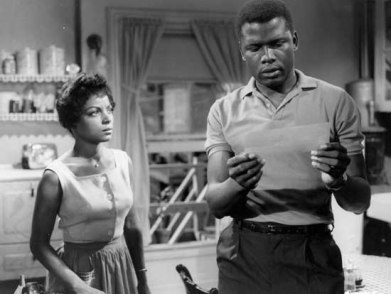
Still, if you’ve never seen the play before, I recommend going to the Danny Glover version, or at least the Poitier “classic.” Our inaugural post was about A Raisin in the Sun.

poitier.jpg

Azar Nafisi to Speak at UNF

nafisi-cropjpg.jpg

Readers in Northeast Florida may be interested in catching Azar Nafisi speak at the University Center of the University of North Florida at 7:30PM on Monday, March 3rd. Nafisi’s bestselling memoir Reading Lolita in Tehran recounts the Western literature course that Nafisi taught in secret to a small group of Iranian women in her house in the late 90s, and engages the events of the Islamic Revolution, the Iran-Iraq war, and the conservative cultural revolution that led to the necessity of keeping such a course on the down-low. My wife didn’t finish the book; I didn’t start it. My wife said it was good though; she told me she can’t remember why she quit reading it. How’s that for a book review? (I highly recommend Hamid Dabashi’s highly-critical and thoroughly engrossing critique of the book, “Native informers and the making of the American empire,” in which he refers to Reading Lolita in Tehran as “the locus classicus of the ideological foregrounding of the US imperial domination at home and abroad” — read the whole essay here.)

lolita.jpg

Nafisi’s lecture, “The Republic of the Imagination,” is part of UNF’s ongoing “Distinguished Voices” series (great name, by the way, guys. Lot of thought and creativity put into that one). The next speaker in the series is pretty-boy news analyst and frequent Daily Show guest Fareed Zakaria. Get free tickets for any of the lectures in the series here.

Profanity/Hogs Mating

mating-pigs-thumb2869398.jpg

I work as a teacher for Duval County Public Schools. Last week, a 15 page document titled “Alphabetical Listing of Multimedia Material Reevaluated in Duval County” was dropped off in my mailbox; I’m not sure exactly why. The document lists well over 250 books, magazines, videos, and albums that were “reevaluated” due to complaints. Some of these books are frequent guests on the censorship block (The Adventures of Huckleberry Finn, “Racial,” Catcher in the Rye, “Offensive Language,” Are You There God? It’s Me, Margeret, “Religious, Sex, Introduction to Pornography,” As I Lay Dying “Profanity/Racial Slur”) and some are destined to be under scrutiny for a long time (Harry Potter, entire series, “Witchcraft, Occult, Spellcasting”). As you might expect, the dominant complaints revolve around profanity, sex, and a general sense that the book doesn’t fit in to the complainant’s worldview. Here are a few favorites of mine:

Goosebumps Series, R.L Stine — “Scary” (Yes. Correct. They’re supposed to be scary, jackass).Guns, Germs, and Steel, Jared Diamond — “Bestiality/Darwinian evolution” (Natch–bestiality and Darwinian evolution go together like PB & J).

Halloween, Joyce K. Kessell — “Evil, Full of Lies” (Ach! Oh no! A fiction book that doesn’t tell the truth!)

The Butter Battle Book, Dr. Seuss — “Violence” (Admittedly, The Butter Battle Book was the peak of Seuss’s “Tarantino phase”)

Four Good Friends, Margaret Hillert — “Negative, Nonproducive tone” (What the fuck is a “Nonproducive tone”? What does that even mean?)

In the Night Kitchen, Maurice Sendak — “Nudity” (This charming kid’s book repeatedly lands on the Most Frequently Challenged Books List)

Learning to Swim, Ann Turner — “Erotic and Sexual Nature” (Erotic and sexual? Intriguing…)

A Light in the Attic, Shel Silverstein — “Illustrations” (Huh? “Illustrations”? Huh? This book is actually right by me, my childhood copy, proudly shelved on the mantle…let’s review these nefarious illustrations…let’s see, let’s see…An Icarian hippo, perhaps? An unscratchable itch?Rhino pen? Nah…Is it perhaps, the “Union for Children’s Rights” picture (pgs 140-141 in my 1981 Harper & Row edition)? Gotta be…unionized kids…scary!)

Kid in the Red Jacket, Barbara Park — “”Stupid” and “God”” (Again, I ask “Huh?”)

Little Red Riding Hood, Paul Galdone — “Violence/Wine” (Two of my favorite things!)

Marijuana, Martin Godfrey — “Drugs” (Really? Who knew Marijuana would contain “drugs”)

Matilda, Roald Dahl — “Vulgar, Unethical” (This is one of my favorite books. Attempting to suppress it and keep kids from reading it is both vulgar and unethical)

Our Country Spain, David Cumming — “Mediterranean Beach Picture” (Good lord no!)

The Picture of Dorian Gray, Oscar Wilde — “Morality” (What is the problematic “morality” of Dorian Gray? Or did the offended parent have a problem with Oscar’s proclivities for the lovely youths?)

Santa Claus Mystery, John Godman — “Conflict w/ Santa Myth” (I wish they’d be more specific–what’s the conflict? Is there a “set” Santa myth? What is it?)

Tar Baby, Toni Morrison — “Sex, Violence, Myth” (Myth? Really? Myth is offensive?)

The Visitors Who Came to Stay, A. McAffee and A. Browne — “Pictures” (Again, please, be specific when you want to ban a book. “Pictures” simply won’t cut it)

Where is Gah-Ning, Robert Munsch — “Blatant disregard for moral standard” (Okay, that’s a little more specific, I guess–but still asinine).

Which Witch, Eva Ibboston; The Witches, Roald Dahl; Witches, Witches, Witches, Helen Hoke; Witches, Rhoda Blumberg; The Witches of Worm, Z. Keatley Snyder; The Witch’s Handbook, Malcolm Bird — “Witchcraft, Occult” (Duh)

Worry Worts, Morris Gleitzman — “Sexual Context” (I wonder if this book is about STDs…)

A Day No Pigs Would Die, Robert Newton — “Profanity/Hogs Mating” (Sounds like a party to me!)

Steve Fossett Fan Fiction Contest

Last week, millionaire adventurer Steve Fossett was declared legally dead after having been missing since fall of last year when his single-engine plane disappeared in Nevada. Neither Fossett’s body or his plane were found, but nevertheless, on November 26, 2007 his wife petitioned to have him declared legally dead.

fossett.jpg

Fossett set 116 records over his lifetime, including feats in ballooning, aviation, and sailing that still stand. His career as an adventurer is so storied and fascinating that we at Biblioklept refuse to believe that Fossett died; in fact, we propose that he’s still alive, in the midst of some new adventure, perhaps of the time-traveling or extra-dimensional exploration variety, no doubt as secret as it is mind-shattering.

So–

What do you think? Take part in Biblioklept’s Steve Fossett Fan Fiction Contest. Where is Fossett now, and what marvelous adventuring is he up to? Entries should be mailed (no attachments, please!) to biblioklept.ed@gmail.com, or, alternately (preferably) posted in the comments section below. All entries will be considered the owned intellectual property of the original author. The contest is open until a year from today. The winner of the contest, chosen by the Biblioklept and His Esteemed Council, will receive their choice of a dirty postcard or a stolen book, chosen by the Biblioklept.

Essential Short Story Collections: Brief Interviews with Hideous Men

brief-interviews-wit_79fe25.jpg

Properly describing David Foster Wallace’s Brief Interviews with Hideous Men involves using all of those words that I hate to see in any book review: “radiates,” “pathos,” “poignancy,” “gut-busting laughs,” “existential crises of identity in the post-modern world,” and so on. Now that I have them out of the way, let me tell you why you should read this book: it will make you laugh, it will make you cry. Out loud. After you read it, you will want to press it on other people, who will say, “Yeah, sure, okay”; only their eyes’ will be slightly-slanted, their mouths just a bit crooked, even their nose will appear askew at your demand. They will hurriedly change the subject–you’ve already foisted so many unwanted books on them, and who even has time to read now?–but you will persevere! “Here,” you’ll say, “Read “A Radically Condensed History of Postindustrial Life”–it’s only two paragraphs! You can read the whole thing in under a minute!”:

When they were introduced, he made a witticism, hoping to be liked. She laughed extremely hard, hoping to be liked. Then each drove home alone, staring straight ahead, with the very same twist to their faces.

The man who’d introduced them didn’t much like either of them, though he acted as if did, anxious as he was to preserve good relations at all times. One never knew, after all, now did one now did one now did one.

And, as they finish reading, you’ll beam at them and nod your head knowingly. They’ll look a little confused, perhaps bored. “It’s like an overture, see? It’s like, about loss, the inability to connect, the masks we wear to hide our hideousnessnesses.” Your victim will nod politely and begin to bring up an interesting thing he saw on the local news concerning pet ownership, but you’ll cut him off before he can get out of this. “Check out the “Brief Interviews with Hideous Men” sections that permeate the book–they’re like little vignettes, interviews where you only get the interviewee’s responses. They’re funny, shocking sad–they’re really good! Also, check out my favorites– “Adult World (I)” and “Adult World (II)”–these stories are about a wife who it turns out doesn’t really know her husband at all. Just read the beginning– ”

For the first three years, the young wife worried that their lovemaking together was somehow hard on his thingie. The rawness and tenderness and spanked pink of the head of his thingie. The slight wince when he’d enter her down there. The vague hot-penny taste of rawness when she took his thingie in her mouth–she seldom took him in her mouth, however; there was something about it that she felt he did not quite like.

“See?” you’ll demand uncaringly of your now-obviously exasperated detainee, “See? Sex! It’s got sex in it! Everyone loves to read about sex, especially weird awkward sex!” Your victim will now stand up, feigning the need to visit the restroom. But you won’t let him go that easily! “There’s another series of running vignettes that unify the book’s structure, making its sum more than just a collection of previously-published stories–check out a selection from one of the “Yet Another Example of the Porousness of Certain Borders” series”–

“Don’t love you no more.”

“Right back at you.”

“Divorce your ass.”

“Suits me.”

“Except now what about the doublewide.”

“I get the truck is all I know.”

“You’re saying I get the doublewide you get the truck.”

“All I’m saying is that truck out there’s mine.”

“Then what about the boy.”

“For the truck you mean?”

Your poor visitor is now literally walking away from you, ignoring the book in your hands, yet still somehow politely smiling–though only with his mouth–his hard eyes show how much he hates you right now. As he retreats to the toilet, your feelings hurt, you comfort yourself by declaring that he doesn’t read anyway; besides, he wouldn’t be able to figure out that “Tri-Stan: I Sold Sissee Nar to Ecko” was a retelling of both the Tristan and Isolde and Narcissus and Echo stories, set in Hollywood; he wouldn’t appreciate the book’s themes of child-abuse, repressed (false?) memories, and lost love. Philistine.

When he comes out of the bathroom you chit-chat a little more and then he’s ready to go. He holds his hand out toward the book. He wants to borrow the book. He wants to take your book. Oh shit. What have you done?

_____________________________________________________________________

Believe it or not, that dude who plays “Jim” from The Office is directing a movie version of Brief Interviews with Hideous Men, scheduled to come out later this year.

You can read the first part of this series here.

A Few Thoughts on (Not Teaching) The Canon

Today I attended the first day of a two-day College Board workshop meant to provide additional training to teachers of Advanced Placement English Language and Composition. I’ve been to a number of these over the years, and College Board’s trainers tend to be better than the average presenters we get in education. The workshops also provide an opportunity to see what teachers at other schools are doing with their students.

Anyway, the only reason I bother to write about this is because of an interesting conversation/confrontation that happened almost immediately at the beginning of the session. As per usual with these things, we were to introduce ourselves–how long we’d been teaching, where we teach, the grade levels we teach, etc. The presenter also asked us to identify the book we most enjoyed “teaching.” That was the verb used–“teaching.” We were in a circle; I was one of the last people to have to introduce myself, and I heard repeatedly “I like to teach Gatsby” or “I like to teach Night” or “I like to teach To Kill a Mockingbird” or “I teach Faulkner.” I was getting a little antsy. Here’s why: 1) I don’t teach books–I don’t even know what it means to teach a book, 2) I rarely have my students read a complete book as part of their curriculum–I abridge almost everything, and 3) I’d been in this same situation more than once, and I knew that saying this was going to rub some of these English teachers the wrong way. And of course it did rub wrong, in particular two musty hags of the old school, one of whom cut me off condescendingly in mid-sentence: “So you’re saying that your kids never read a whole book?”

As pleasantly as possible, I tried to explain that I aim to expose my students to a multiplicity of voices and themes and rhetorical styles and methods, and that I didn’t see my primary job as fostering a love of literature; rather, I believe that the main duty of the English teacher is to facilitate the development of reading, composition, and thinking. I tried to explain that, even in my AP classes, most of my students are not avid readers and most of my students do not read at their grade level, and therefore struggling through 4 or 5 novels or plays over the course of one year didn’t seem as valuable to me as working through over a hundred different writers writing in a variety of styles for a variety of purposes. I tried to explain that reading a selection on slavery from 1789 by Olaudah Equiano in conjunction with a 2005 UN report on human trafficking, and then responding to these text was a far more valuable skill than wading through a dusty “classic” hunting down “universal” themes (whatever those are…).

The response, predictably was: “You mean, your 11th graders don’t read The Scarlet Letter? They don’t read Gatsby? That’s terrible!”

Why? Why should The Scarlett Letter or The Great Gatsby be so reverently “taught” to sixteen and seventeen year olds in this country? I like both of these books–I really do (although I think Gatsby is possibly the most overrated and over-read book ever published, and I’d take Hawthorne’s fabulous short stories any day over dreary Dimsdale and Hester Prynne)–but what purpose is there in making kids read them? Are they truly that relevant, or important?

I should be clear here that I am in no way at all against students reading these books; I wish that they would read these books, in fact. Only, I wish that they would love reading so much that they would be inspired to read books that they’ve heard are great or classic. But here’s the thing: I don’t think that telling a student they must read a book and that that book is a great work of literature and that they should enjoy or be inspired by that book is in any way a fair proposition. It leads only to anxiety, frustration, boredom, and then defeat.

Instead, English teachers should recognize that literature is just one part of reading and writing, and that most of our students are not going to go on to be English teachers or fiction writers. We should focus on a heteroglossic range of voices, styles, and purposes in introducing texts into the classroom. Students should be taught to respond to a variety of texts across a variety of disciplines, not to a few canonical authors. What happens more often than not in English classrooms is something like this: students are forced to read a work too complex for them to comprehend; they rely on the teacher’s interpretation to guide them through the novel (never having been taught a close-reading method that might give them access to the text); the student then writes a meaningless recapitulation of the teacher’s own “universalist” interpretation of the literary work, to the egotistical delight of the teacher who is enthralled that the student has “got it.” What’s lost is the opportunity to engage in relevant, “real-life” writing, writing that enters into an ongoing conversation in a meaningful way.

This is has been a straight-up rant–I’m sorry. I think that the following scene from Freaks and Geeks says it all better than I just did. Kim Kelly (Busy Phillips) critiques On the Road: