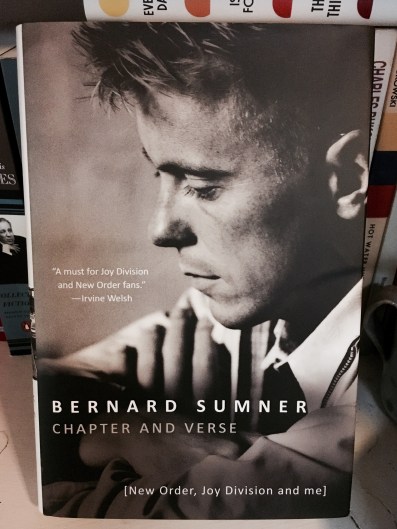
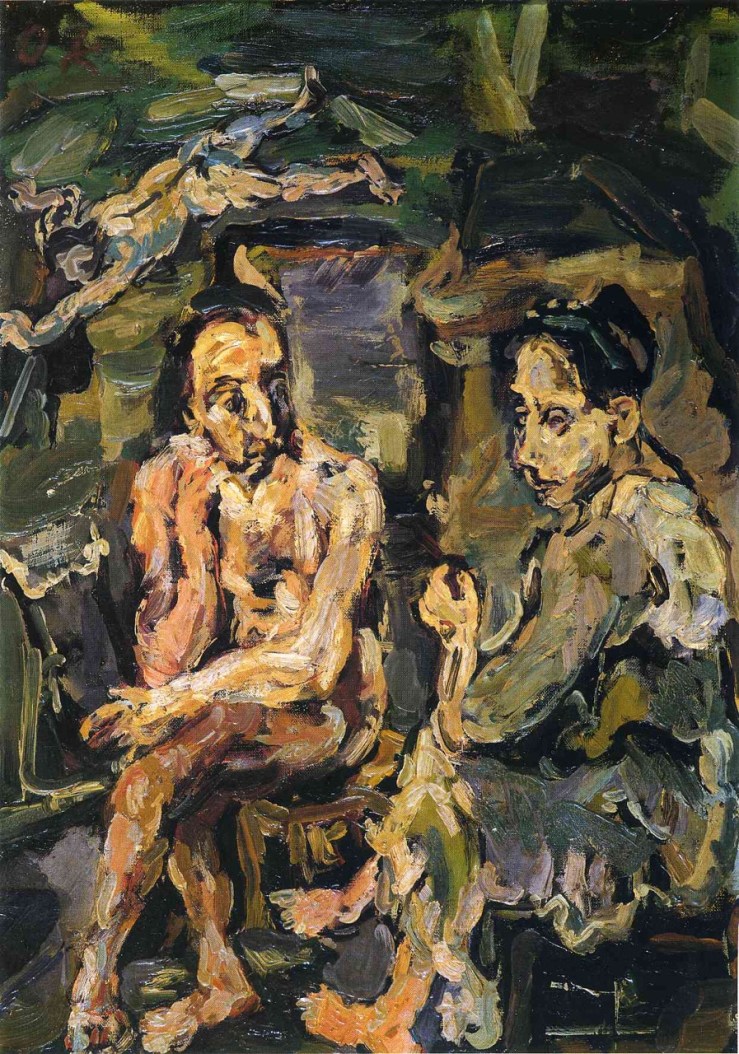
Bernard Sumner’s memoir, Chapter and Verse (Book acquired sometime in November of 2015)

IMG_0971

This afternoon, I finally got into Bernard Sumner’s memoir Chapter and Verse: New Order, Joy Division and Me. Actually, I obviously flicked through it when it showed up, looking at the glossy pictures, dabbling here and there (somehow read not one but two anecdotes about Seal (?)), and then reading the book’s first appendix, a transcript of a recording of Sumner’s hypnotizing Ian Curtis (excuse that mangled clause). The book has a U.S. Hardcover release from Thomas Dunne; their blurb:

Founding member and guitarist of Joy Division and the lead singer of New Order, Bernard Sumner has been famous over the years for his reticence. Until now . . .

An integral part of the Manchester, UK, music scene since the late 1970s, his is the definitive version of the events that created two of the most influential bands of all time.

Chapter and Verse includes a vivid and illuminating account of Bernard Sumner’s childhood, the early days of Joy Division, the band’s enormous critical and popular success, and the subsequent tragic death of Ian Curtis. Sumner describes the formation of New Order, takes us behind the scenes at the birth of classics such as “Blue Monday,” and gives his firsthand account of the ecstasy and the agony of the Haçienda days.

Sometimes moving, often hilarious, and occasionally completely out of control, this is a tale populated by some of the most colorful and creative characters in music history, such as Ian Curtis, Tony Wilson, Rob Gretton, and Martin Hannett. Others have told parts of the story, in film and book form. Now, for the first time, Bernard Sumner gives you chapter and verse.

Three Books

IMG_0950

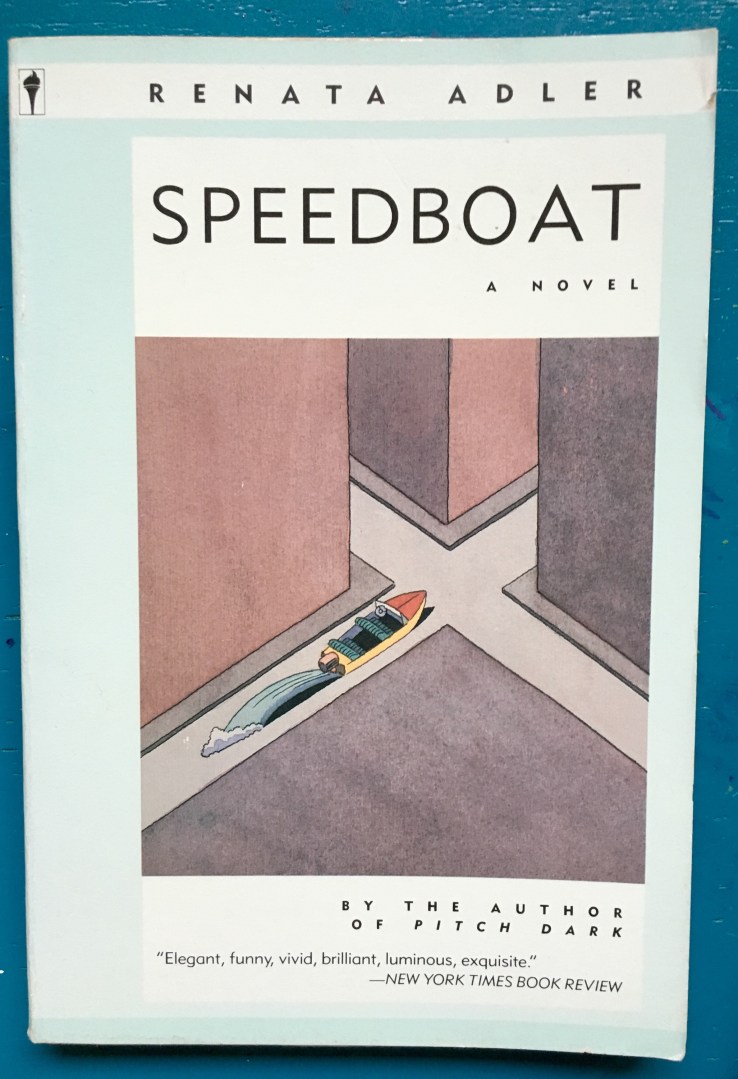
Speedboat by Renata Adler. 1988 trade paperback edition by Perennial Fiction Library (Harper & Row). No designer credited, but the cover illustration is by Steve Guarnaccia. A strange and funny (anti-)novel.

IMG_0953

The Uses of Literature by Italo Calvino (trans. Patrick Creagh). 1986 trade paperback by Harvest/HBJ. Design by Kaelin Chappell, with a cover illustration by Saul Steinberg. A book to never finish.


IMG_0951

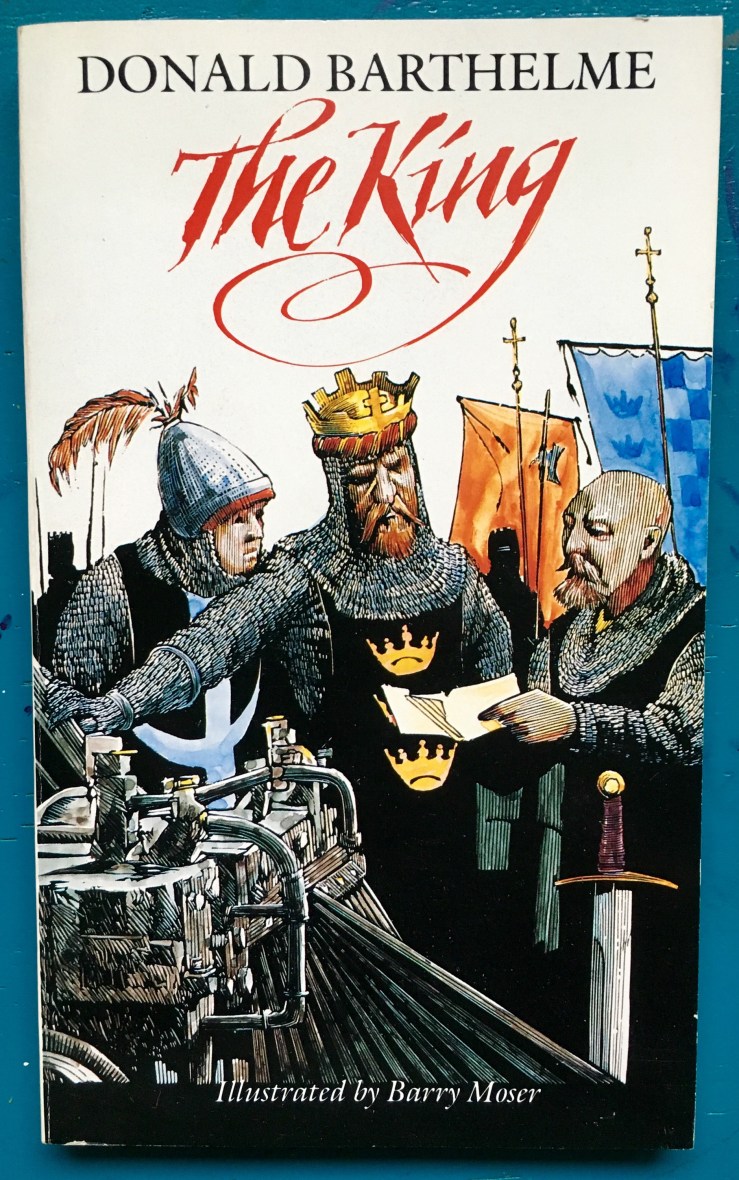
The King by Donald Barthelme. Features wood engravings by Barry Moser. 1990 trade paperback by Harper and Row. No designer credited, but surely Moser had a hand, no? This is the only Barthelme novel I haven’t read. Every time I pick it up I think, But then there will be no more. Fool. One can always reread.

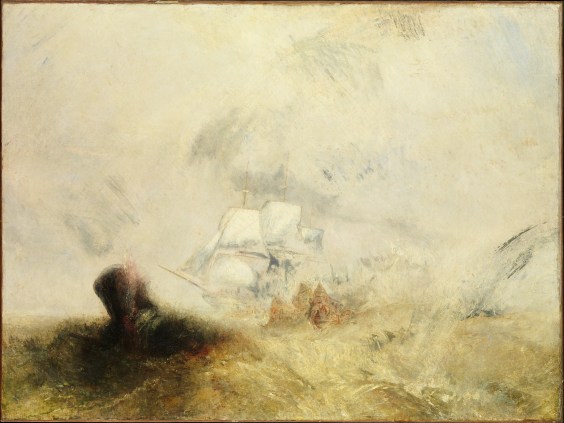
…it was here that Melville saw the work of JMW Turner

DP169567.jpg
Whalers, JMW Turner

It is clear from Melville’s journal, one of only two such surviving documents, that his mind was already playing with these ideas. Late at night, he “turned flukes” down Oxford Street as if he were being followed by a great whale, and thought he saw “blubber rooms” in the butcheries of the Fleet Market. And when he saw Queen Victoria riding past in a carriage, he joked that the young man sitting beside her was the Prince of Whales. London – which itself had only lately been a whaling port – was stirring up the ghosts of his past.

Perhaps most importantly, it was here that Melville saw the work of J M W Turner, a clear visual influence on his book-to-be. Turner had painted a series of whaling scenes for Elhanan Bicknell, whose British whaling company was based in the Elephant and Castle; parts of Moby-Dick would read like commentaries to those tempestuous, brutally poetic canvases, not least the painting that greets Ishmael at the Spouter-Inn, “a boggy, soggy, squitchy picture” of “a black mass . . . floating in a nameless yeast . . . an exasperated whale”. It is all the more intriguing to note how Melville’s Anglophilia was the yeast out of which this great American novel emerged – especially given that the book failed spectacularly in his homeland and it was left to British writers to recognise first its wilful, prophetic genius.

Read the rest of Philip Hoare’s essay “White Whale in the Big Smoke: How the Geography of London Inspired Moby-Dick” at the New Statesmen.

Bolaño Beyond

roberto-bolanoOn Avenida Juárez, across from the Alameda in Mexico City, sits an unassuming little bookstore, three steps below street level. It was here at the Librería del Sótano where Roberto Bolaño would buy novels or poetry books or, when he was short on cash (which was often), just pocket them. For centuries Latin American literature belonged not to those passionate, young biblioklepts like Bolaño but to affluent property owners who dabbled in writing the way they might take up equestrianism or falconry. Some time in the 1960s the roles reversed and the middle class became the seedbed of national literature. Bookstores, libraries, and the literary life prevailed in the cultural scene of Mexico City and Buenos Aires just as much as they did in Paris, New York, or London. This bibliophilia, this bibliomania, this passion for the literary life binds the world together in a global industry that sadly still remains separated by language barriers and a lack of curiosity.

Serious readers are omnivorous. They want to read everything great. The best translated fiction, emerging writers, overlooked classics, small-press finds, public intellectuals of the moment, mind-bending poetry—it all goes down the hatch. The problem, of course, is that no one can read everything. Selecting which books to read requires discernment, a degree of happenstance, and an iterative process that ideally sharpens the discernment itself with each volume digested.

Read the rest of Matt Bucher’s essay “Beyond Bolaño and Beyond” at Full Stop.

A daily diet of morning mist – from Bruce Chatwin’s The Songlines


Welwitchia-Louise Nienaber.jpg

It was nonsense, Dr Vrba continued, to study the emergence of man in a vacuum, without pondering the fate of other species over the same time-scale. The fact was that around 2.5 million, just as man took his spectacular ‘jump’, there was a ‘tremendous churning over of species’.

‘All hell’, she said, ‘broke loose among the antelopes.’

Everywhere in eastern Africa, the more sedentary browsers gave way to ‘brainier’ migratory grazers.  The basis for a sedentary existence was simply no longer there.

‘And sedentary species,’ she said, ‘like sedentary genes, are terribly successful for a while, but in the end they are self-destructive.’

In arid country, resources are never stable from one year to the next. A stray thunderstorm may make a temporary oasis of green, while only a few miles off the land remains parched and bare. To survive in drought, therefore, any species must adopt one of two stratagems: to allow for the worst and dig in; to open itself to the world and move.

Some desert seeds lie dormant for decades. Some desert rodents only stir from their burrows at night. The weltwitchia, a spectacular, strap-leaved plant of the Namib Desert, lives for thousands of years on its daily diet of morning mist. But migratory animals must move – or be ready to move.

Elizabeth Vrba said, at some point in the conversation, that antelopes are stimulated to migrate by lightning.

‘So’, I said, ‘are the Kalahari Bushmen. They also “follow” the lightning. For where the lightning has been, there will be water, greenery and game.’

From Bruce Chatwin’s novel/memoir/travelogue The Songlines. The image is Welwitschia by Louise Nienaber.

The possibility of mislocation of the self (Donald Barthelme)

It was suggested that what was admired about the balloon was finally this: that it was not limited, or defined.  Sometimes a bulge, blister, or subsection would carry all the way east to the river on its own initiative, in the manner of an army’s movements on a map, as seen in a headquarters remote from the fighting.  Then that part would be, as it were, thrown back again, or would withdraw into new dispositions; the next morning, that part would have made another sortie, or disappeared altogether.  This ability of the balloon to shift its shape, to change, was very pleasing, especially to people whose lives were rather rigidly patterned, persons to whom change, although desired, was not available.  The balloon, for the twenty-two days of its existence, offered the possibility, in its randomness, of mislocation of the self, in contradistinctions to the grid of precise, rectangular pathways under our feet.  The amount of specialized training currently needed, and the consequent desirability of long-term commitments, has been occasioned by the steadily growing importance of complex machinery, in virtually all kinds of operations; as this tendency increases, more and more people will turn, in bewildered inadequacy, to solutions for which the balloon many stand as a prototype, or “rough draft.”

From Donald Barthelme’s short story “The Balloon.”

The sentence is itself an odyssey | William H. Gass analyzes a sentence from Joyce’s Ulysses

Stephen Dedalus and Leopold Bloom have stopped at a cabman’s shelter, a small coffeehouse under the Loop Line Bridge, for a cuppa and a rest on their way home. And the hope that the coffee will sober Stephen up. After an appropriate period of such hospitality, Bloom sees that it is time to leave.

James Joyce. Ulysses, (1921).

To cut a long story short Bloom, grasping the situation, was the first to rise to his feet so as not to outstay their welcome having first and foremost, being as good as his word that he would foot the bill for the occasion, taken the wise precaution to unobtrusively motion to mine host as a parting shot a scarcely perceptible sign when the others were not looking to the effect that the amount due was forthcoming, making a grand total of fourpence (the amount he deposited unobtrusively in four coppers, literally the last of the Mohicans) he having previously spotted on the printed price list for all who ran to read opposite to him in unmistakable figures, coffee ad., confectionary do, and honestly well worth twice the money once in a way, as Wetherup used to remark.

Commonplaces     Narrative Events

1. to cut a long story short     authorial intervention

2. grasp the situation     subjective interpretation

3. rise to his feet     narrative action

4. don’t outstay your welcome     rationale or justification

5. first and foremost     subjective evaluation

6. good as his word     characterization

7. foot the bill promise, therefore     a prediction

8. take the wise precaution     subjective evaluation

9. mine host     authorial archness

10. parting shot     subjective evaluation

11. scarcely perceptible sign     narrative action

12. to the effect that     subjective interpretation

13. amount due is forthcoming     subjective interpretation

14. grand total     characterization

15. literally the last of the Mohicans     authorial intervention, allusion

16. previously spotted     subjective interpretation

17. all who run can read     authorial intervention, allusion

18. honestly (in this context)     subjective interpretation

19. well worth it     subjective interpretation

20. worth twice the money     subjective interpretation

21. once in a waysubjective     allusion

22. as [Wetherup] used to [remark] say     attribution

The sentence without its commonplaces:

To be brief, Bloom, realizing they should not stay longer, was the first to rise, and having prudently and discreetly signaled to their host that he would pay the bill, quietly left his last four pennies, a sum—most reasonable—he knew was due, having earlier seen the price of their coffee and confection clearly printed on the menu.

Bloom was the first to get up so that he might also be the first to motion (to the host) that the amount due was forthcoming.

The theme of the sentence is manners: Bloom rises so he and his companion will not have sat too long over their coffees and cake, and signals discreetly (unobtrusively is used twice) that he will pay the four pence due according to the menu. The sum, and the measure of his generosity, is a pittance.

The sentence is itself an odyssey, for Bloom and Dedalus are going home. They stop (by my count) at twenty-two commonplaces on their way. Other passages might also be considered for the list, such as “when others were not looking.” Commonplaces are the goose down of good manners. They are remarks empty of content, hence never offensive; they conceal hypocrisy in an acceptable way, because, since they have no meaning in themselves anymore they cannot be deceptive. That is, we know what they mean (“how are you?”), but they do not mean what they say (I really don’t want to know how you are). Yet they soothe and are expected. We have long forgotten that “to foot the bill,” for instance, is to pay the sum at the bottom of it, though it could mean to kick a bird in the face. Bloom, we should hope, is already well above his feet when he rises to them. The principal advantage of the commonplace is that it is supremely self-effacing. It so lacks originality that it has no source. The person who utters a commonplace—to cut a long explanation short—has shifted into neutral.

From William H. Gass’s essay “Narrative Sentences.” Collected in Life Sentences.

Three Books

IMG_0829-2

Usually, these Three Books posts come from my own library (with scans of the covers and not photos). Today’s post features books from my uncle’s library (my family stayed with my aunt and uncle for the Thanksgiving week and had a marvelous time—thanks for asking). Anyway, my uncle had a tremendous early influence on the books I read—he turned me on to Kurt Vonnegut and Hunter S. Thompson, for example.

Anyway, above:

The Garden of Eden by Ernest Hemingway. 1986 hardback by Collier. Ruth Kolbert is credited with design; the cover painting is Woman with a Basket by Juan Gris. I reviewed the novel here.IMG_0830-2

Slapstick by Kurt Vonnegut. 1976  first edition hardback by Delacorte. Design credited to Joel Schick.
IMG_0831-2

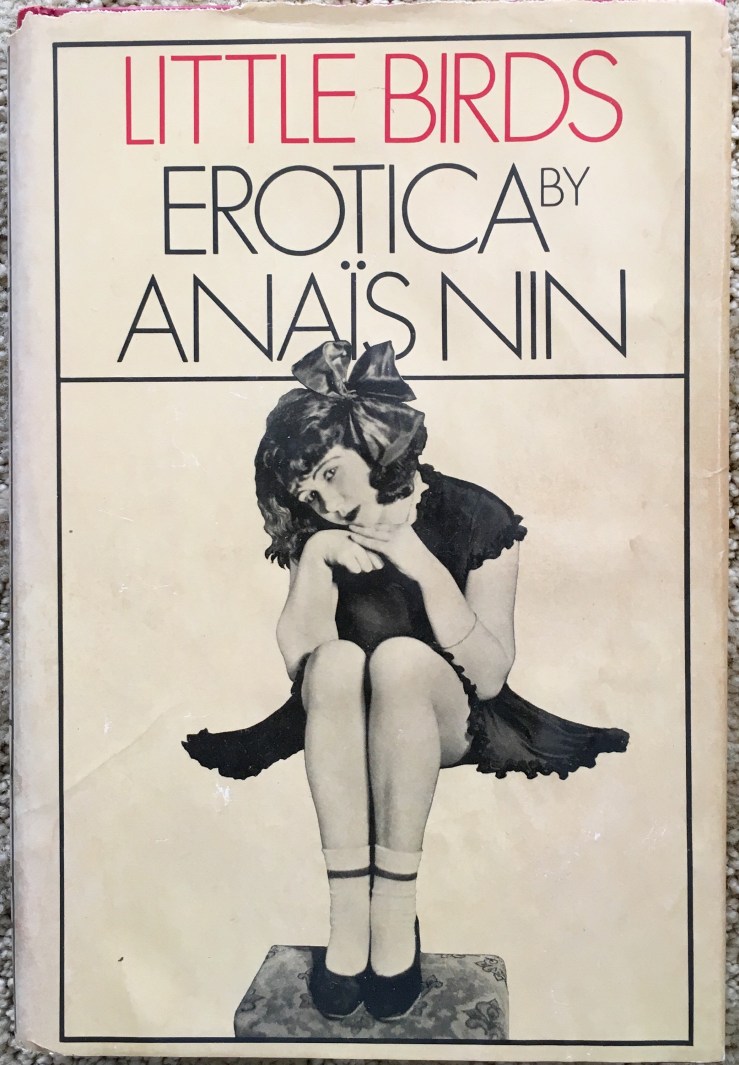
Little Birds by Anaïs Nin. 1979 hardback by Harcourt Brace Jovanovich. Jacket design by Milton Glaser; photo credited to Richard Merkin. I surreptitiously read Little Birds—this particular copy of Little Birds—over and over again one summer that I stayed at my aunt and uncle’s. I reread the first three tales in the volume again. Good times.