

Category: Books
Ishmael Reed (Book acquired, 8.20.2015)

I love love love the cover of this Ishmael Reed mass market paperback Bantam edition of The Free-Lance Pallbearers. 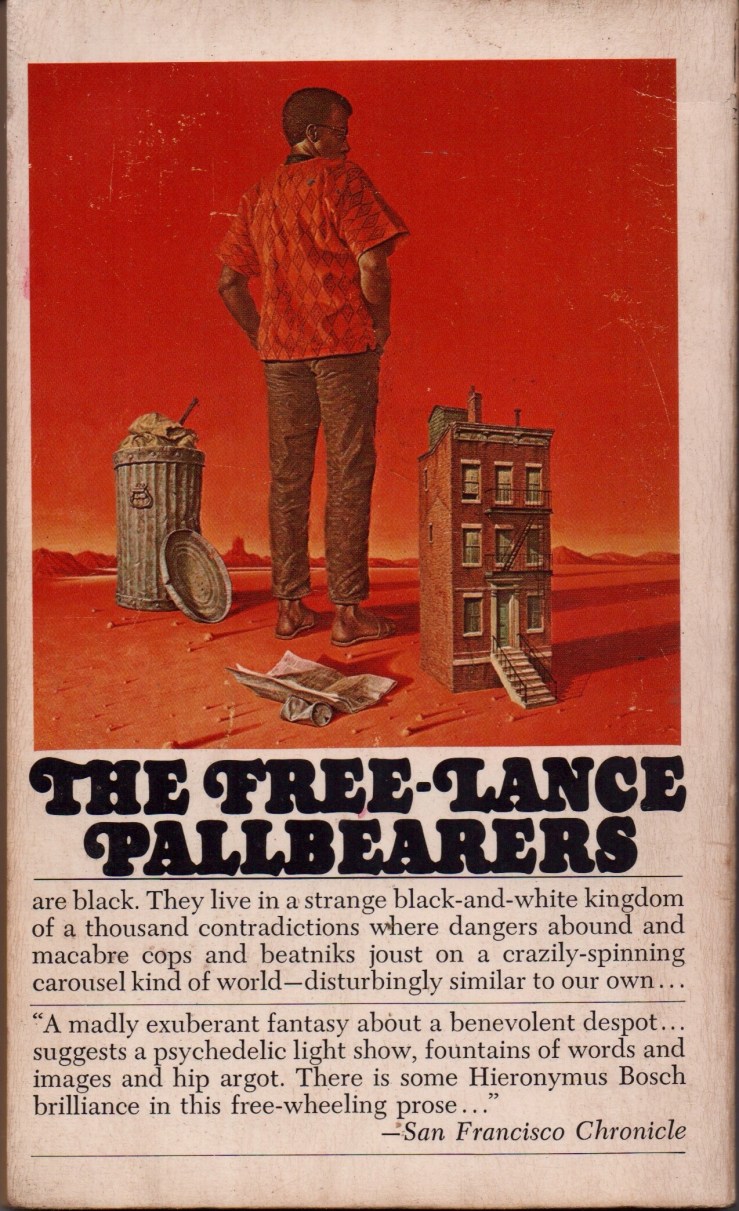
The Bus, Paul Kirchner’s marvelous and surreal comic strip trip

For the past year, I’ve run a strip from Paul Kirchner’s cult classic The Bus each Sunday. The strips come from an album posted at Imgur full of high quality scans. I posted the last scan last week.
The Bus originally ran in Heavy Metal from 1979-1985; Kirchner’s done a few over 40 new strips over the past few years, as he notes in a recent memoir-piece at The Boston Globe. The new strips will be collected in The Bus 2 from Editions Tanibis. Editions Tanibis also has collected the original run of The Bus in an edition that’s more complete than the Imgur page.

I’ve enjoyed posting the strips tremendously. I first saw a few strips at an image forum I frequent, and quickly found the Imgur album. Posting one each Sunday was my way of, well, not bingeing on them.
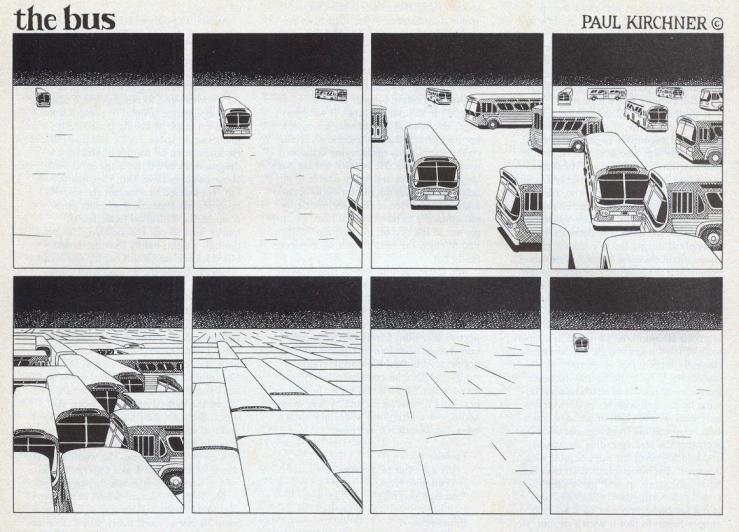
The Bus is a profound strange wonderful trip. Kirchner’s visions often evoke Escher’s paradoxes, and the best of his strips make us attend closely to what we’d otherwise dismiss. The Bus is subtle and sly, occasionally (very occasionally) dark, but also, I would argue, sensitive—there’s something deeply endearing about the strip’s central human protagonist, an often passive (even hapless) passenger, a kind of late-20th century Everyman. Continue reading “The Bus, Paul Kirchner’s marvelous and surreal comic strip trip”
Crimes of the Moonlight Melonmounter (Cormac McCarthy’s Suttree)

Two pairs of brogans went along the rows.
You aint goin to believe this.
Knowin you for a born liar I most probably wont.
Somebody has been fuckin my watermelons.
What?
I said somebody has been …
No. No. Hell no. Damn you if you aint got a warped mind.
I’m tellin you …
“I dont want to hear it.
Looky here.
And here.
They went along the outer row of the melonpatch. He stopped to nudge a melon with his toe. Yellowjackets snarled in the seepage. Some were ruined a good time past and lay soft with rot, wrinkled with imminent collapse.
It does look like it, dont it?
I’m tellin ye I seen him. I didnt know what the hell was goin on when he dropped his drawers. Then when I seen what he was up to I still didnt believe it. But yonder they lay.
What do you aim to do?
Hell, I dont know. It’s about too late to do anything. He’s damn near screwed the whole patch. I dont see why he couldnt of stuck to just one. Or a few.
Well, I guess he takes himself for a lover. Sort of like a sailor in a whorehouse.
I reckon what it was he didnt take to the idea of gettin bit on the head of his pecker by one of them waspers. I suppose he showed good judgment there.
What was he, just a young feller?
I dont know about how young he was but he was as active a feller as I’ve seen in a good while.
Well. I dont reckon he’ll be back.
I dont know. A man fast as he is ought not to be qualmy about goin anywheres he took a notion. To steal or whatever.
What if he does come back?
I’ll catch him if he does.
And then what?
Well. I dont know. Be kindly embarrassin now I think about it.
I’d get some work out of him is what I’d do.
Ought to, I reckon. I dont know.
You reckon to call the sheriff?
And tell him what?
They were walking slowly along the rows.
It’s just the damndest thing I ever heard of. Aint it you? What are you grinnin at? It aint funny. A thing like that. To me it aint.
One of my favorite passages from Cormac McCarthy’s novel Suttree. The title of this post also comes from the novel, several pages later, after the melonmounter has been apprehended.
Entries under “D” from Captain Grose’s Dictionary of the Vulgar Tongue (1811)
The following definitions are from the “D” section of Captain Grose’s Dictionary of the Vulgar Tongue (1811).
DAB. An adept; a dab at any feat or exercise. Dab,
quoth Dawkins, when he hit his wife on the a-se with a
pound of butter.
DACE. Two pence. Tip me a dace; lend me two pence.
CANT.
DADDLES. Hands. Tip us your daddle; give me your hand.
CANT.
DADDY. Father. Old daddy; a familiar address to an old man. To beat daddy mammy; the first rudiments of drum beating, being the elements of the roll.
DAGGERS. They are at daggers drawing; i.e. at enmity,
ready to fight.
DAIRY. A woman’s breasts, particularly one that gives
suck. She sported her dairy; she pulled out her breast.
DAISY CUTTER. A jockey term for a horse that does not lift up his legs sufficiently, or goes too near the ground, and is therefore apt to stumble.
DAISY KICKERS. Ostlers at great inns.
DAM. A small Indian coin, mentioned in the Gentoo code of laws: hence etymologists may, if they please, derive the common expression, I do not care a dam, i.e. I do not care half a farthing for it.
DAMBER. A rascal. See DIMBER.
DAMME BOY. A roaring, mad, blustering fellow, a scourer of the streets, or kicker up of a breeze. Continue reading “Entries under “D” from Captain Grose’s Dictionary of the Vulgar Tongue (1811)”
I’ve salvaged not a word (Cormac McCarthy’s Suttree)
From all old seamy throats of elders, musty books, I’ve salvaged not a word. In a dream I walked with my grandfather by a dark lake and the old man’s talk was filled with incertitude. I saw how all things false fall from the dead. We spoke easily and I was humbly honored to walk with him deep in that world where he was a man like all men. From the small end of a corridor in the autumn woods he watched me go away to the world of the waking. If our dead kin are sainted we may rightly pray to them. Mother Church tells us so. She does not say that they’ll speak back, in dreams or out. Or in what tongue the stillborn might be spoken. More common visitor. Silent. The infant’s ossature, the thin and brindled bones along whose sulcate facets clove old shreds of flesh and cerements of tattered swaddle. Bones that would no more than fill a shoebox, a bulbous skull. On the right temple a mauve halfmoon.
I read Cormac McCarthy’s Suttree five years ago and still haven’t recovered.
I started listening to the audiobook of it this week as I returned to my fall work (school) commute—the language is marvelous in the reading—but I have to go back and dwell on passages, like the one above, which resonates strongly with so much of McCarthy’s work—the son or grandson communing with the dead father, out of dimness, opposite equals advancing. And damn, somehow I’d forgotten that Suttree had a stillborn twin brother. And that the novel begins with a suicide. More to come.
Three Princesses of the Underworld — Viktor Vasnetsov

William Faulkner’s 4th grade report card

If Nabokov ruled any modern industrial state absolutely, what would he abolish?
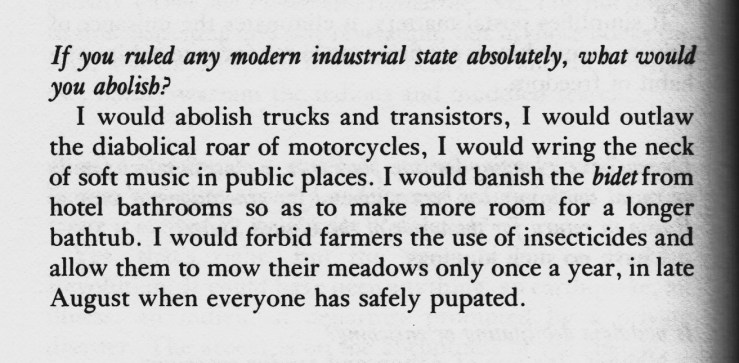
From Vladimir Nabokov’s 1969 interview with James Mossman for BBC2’s Review. Reprinted in the same year in The Listener, and collected in Strong Opinions.
“The Sisters” — James Joyce
“The Sisters”
by
James Joyce
THERE was no hope for him this time: it was the third stroke. Night after night I had passed the house (it was vacation time) and studied the lighted square of window: and night after night I had found it lighted in the same way, faintly and evenly. If he was dead, I thought, I would see the reflection of candles on the darkened blind for I knew that two candles must be set at the head of a corpse. He had often said to me: “I am not long for this world,” and I had thought his words idle. Now I knew they were true. Every night as I gazed up at the window I said softly to myself the word paralysis. It had always sounded strangely in my ears, like the word gnomon in the Euclid and the word simony in the Catechism. But now it sounded to me like the name of some maleficent and sinful being. It filled me with fear, and yet I longed to be nearer to it and to look upon its deadly work.
Old Cotter was sitting at the fire, smoking, when I came downstairs to supper. While my aunt was ladling out my stirabout he said, as if returning to some former remark of his:
“No, I wouldn’t say he was exactly… but there was something queer… there was something uncanny about him. I’ll tell you my opinion….”
He began to puff at his pipe, no doubt arranging his opinion in his mind. Tiresome old fool! When we knew him first he used to be rather interesting, talking of faints and worms; but I soon grew tired of him and his endless stories about the distillery.
“I have my own theory about it,” he said. “I think it was one of those… peculiar cases…. But it’s hard to say….” Continue reading ““The Sisters” — James Joyce”
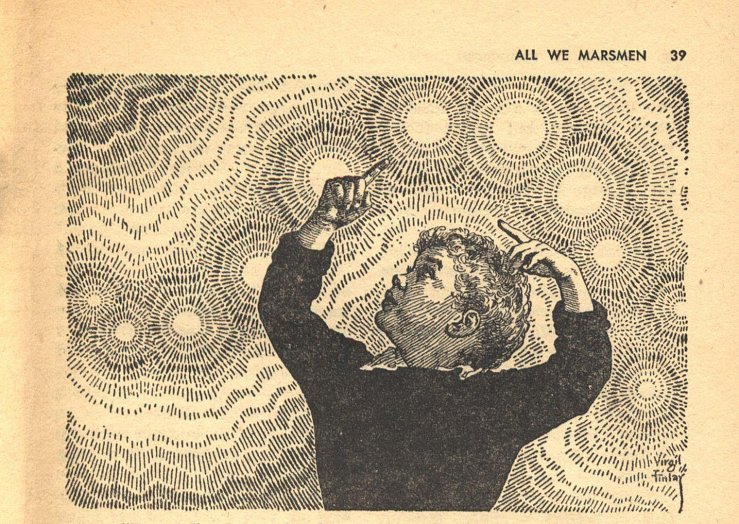
All We Marsmen (PKD)
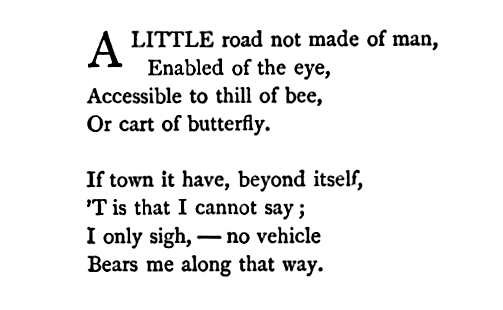
“A little road not made of man” — Emily Dickinson
It was about the commander of a death squad in El Salvador who falls in love with a nun he’s supposed to massacre (Nell Zink’s Mislaid)
Meg took advantage of Karen’s absence to start another play. It was about the commander of a death squad in El Salvador who falls in love with a nun he’s supposed to massacre. In the early drafts, they were a man and a woman. They were always in bed by act 1, scene 2, because they didn’t have much to say to each other.She decided to draft them as lesbians to make them more communicative. Afterward she could go back and change the death squad commander character to be male. But it didn’t work. The openhearted death squad commander refused to seem male to her.
She rewrote him as a man. Pouty and sarcastic. Instantly the nun became a solicitous bore. He ignored her. And there they were again, back in bed.
She tried again, establishing the female character first, in scenes with other nuns. Now the death squad commander seemed superfluous. She made him win her heart away from the nice nuns by being even nicer, but they were both so unsexy as affectionate chatterboxes, the love story just fell apart. They had to ignore each other to get anything done.
She tried one last time. She rewrote him as a complete jerk. Instead of falling in love with anybody, the commander said he would kill his own death squad to have sex with the nun. Afterward the nun went to bed with him to reward him. It was kind of sexy.
Meg saw a distinct pattern to it: patriarchy.
She had wanted to write about idealized partners. But the impressive men she had known weren’t anybody’s partner. They were lone wolves and dictatorial heads of families. The idea of partnering with a powerful man—well, it sounds nice enough, but even on paper it won’t fly. A novel ends with a wedding for a reason. Partnership is antidramatic. Partners are not adversaries. Partners don’t fuck. Yet she dreamed of loving a lesbian partner. Was she stupid?
Lee had been sexy to her at one time. But it wasn’t because they had a relationship. It was the opposite. Because they didn’t. And then she stupidly became his partner. She wasted her love on a wolf. What an excellent use of her youth and beauty! She glared at the typewriter, blaming it for her existential angst.
She finished the play with the nun sacrificing the other nuns one by one to protect the death squad commander from the revenge of his dead death squad’s death squad friends. She tore it into very small pieces and buried it deep in the trash can.
From Nell Zink’s novel Mislaid.
Mislaid is taking me a lot longer to get through than The Wallcreeper, maybe in large part because I’m reading it as an ebook, which means it’s competing with other stuff on my iPad that’s easier to read after a glass or two (or bottle or two) of red wine—Wittgenstein’s aphoristic Culture and Value, which I can squint at, or Netflix, which is also easier to read. But Mislaid is not uneasy to read at all—it’s good stuff—very very funny, pivoting into plots and places unexpected. The passage above stands on its own (I think), but also does a fair job summarizing (a part of the piece of an aspect of) the plot.
Watch A Day in the Afterlife, a 1994 documentary about Philip K. Dick
Gubbish (Philip K. Dick)
They gubbled and gubbled. He put his hands to his ears, but the product crept up through his nose. Then he saw the place. It was where he wore out. They threw him away there, and gubbish lay in heaps up to his waist; gubbish filled the air.
“What is your name?”
“Steiner, Manfred.”
“Age.”
“Eightythree.”
“Vaccinated against smallpox?”
“Yes.”
“Any venereal diseases?”
“Well, a little clap, that’s all.”
“V.D. clinic for this man.”
“Sir, my teeth. They’re in the bag, along with my eyes.”
“Your eyes, oh yes. Give this man his teeth and eyes before you take him to the V.D. clinic. How about your ears, Steiner?”
“Got ’em on, sir. Thank you, sir.”
They tied his hands with gauze to the sides of the bed because he tried to pull out the catheter. He lay facing the window, seeing through the dusty, cracked glass.
Outside, a bug on tall legs picked through the heaps. It ate, and then something squashed it and went on, leaving it squashed with its dead teeth sunk into what it had wanted to eat. Finally its dead teeth got up and crawled out of its mouth in different directions.
He lay there for a hundred and twentythree years and then his artificial liver gave out and he fainted and died. By that time they had removed both his arms and legs up to the pelvis because those parts of him had decayed.
He didn’t use them anyhow. And without arms he didn’t try to pull the catheter out, and that pleased them.
I been at AMWEB for a long time, he said. Maybe you can get me a transistor radio so I can tune in Friendly Fred’s Breakfast Club; I like to hear the tunes, they play a lot of the oldtime favorites.
Something outside gives me hay fever. Must be those yellow flowering weeds, why do they let them get so tall?
I once saw a ballgame.
For two days he lay on the floor, in a big puddle, and then the landlady found him and called for the truck to bring him here. He snored all the way, it woke him up. When they tried to give him grapefruit juice he could only work one arm, the other never worked again ever. He wished he could still make those leather belts, they were fun and took lots of time. Sometimes he sold them to people who came by on the weekend.
“Do you know who I am, Manfred?”
“No.”
“I’m Arnie Kott. Why don’t you laugh or smile sometimes, Manfred? Don’t you like to run around and play?”
As he spoke Mr. Kott gubbled from both his eyes.
“Obviously he doesn’t, Arnie, but that’s not what concerns us here anyhow.”
“What do you see, Manfred? Let us in on what you see. All those people, are they going to live there, is that it? Is that right, Manfred? Can you see lots of people living there?”
He put his hands over his face, and the gubble stopped.
“I don’t see why this kid never laughs.”
Gubble, gubble.
Another passage from Philip K. Dick’s novel Martian Time-Slip.
I find the passage’s rhetorical construction remarkable—the “he” whose consciousness we dip into here, briefly, is Manfred Steiner, an “autistic” child with precognitive abilities. The narrative here takes us into the (a?) future (maybe?) for a few sentences, before pivoting back into the novel’s “present” (1994!) with the verbal intrusion of Kott. This little episode ends a chapter, and the next begins with close attention to Kott’s perception of Manfred. I’ve provided some context here, but I think the little passage also stands on its own as a strange flight into breakdown.
Girl Reading on a Divan — Ceri Richards

Spirits will hover over the ashes (Wittgenstein)

From Culture and Value.
 Biblioklept