Jeffrey Rotter’s The Only Words That Are Worth Remembering (Book acquired, 4.14.2015)

Jeffrey Rotter’s novel The Only Words That Are Worth Remembering  is new in hardback from Henry Holt. Their blurb:

A darkly comic, wildly original novel of a family in flight from the law, set in a near-future America — a Clockwork Orange with a Huck Finn heart.

In a not-so-distant future, astronomy has become a fairy tale, Copernicus is forgotten, and the Earth has resumed its lonely spot in the center of the universe. But when an ancient bunker containing a preserved space vehicle is discovered beneath the ruins of Cape Canaveral, it has the power to turn this retrograde world inside out.Enter the Van Zandt clan, whose run-ins with the law leave them with a no-win choice: test-pilot the rocket together as a family or be sent separately to prison for life. Their decision sets off an antic and heartbreaking search for human solace in a world bent on isolation, as the Van Zandts embark on an unforgettable road trip across the ass-end of an America only slightly more dissolute than our own. Uniquely tying an absurdist future to gut-bucket wit, The Only Words That Are Worth Remembering hauls our dark humanity into the light and shows us the precious places where it gleams.

Leonora Carrington in the LRB

 spaw01_3708_04

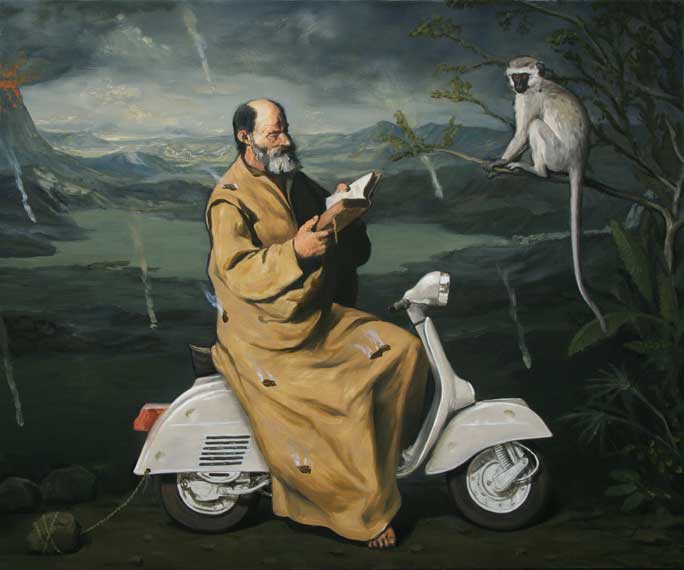
The Temptation of St. Antony, Leonora Carrington

Nice piece by Alice Sprawls on Leonora Carrington (whose work is now on display in the Tate) in The London Review of Books today. Excerpt:

Domesticity in Carrington’s paintings and stories is the scene of Ovidian and spiritual transformations; cooking was a sort of alchemy, like painting, and she began increasingly to use egg tempera – influenced by paintings she had seen in Siena but also by its almost culinary processes (separating the egg yolk, adding wine or vinegar then water and pigment). She refused to explain her personal symbolism, but called reading The White Goddess ‘the greatest revelation of my life’. The figure of the muse, Robert Graves’s ‘Mother of all Living, the ancient power of fright and lust’, became less burdensome as manifested in The Giantess (c.1950), whose colossal central figure towers over the scene like a Madonna della Misericordia. She cradles an egg; geese fly out from beneath her pallium; her golden hair is a field of wheat. Around her feet a hunt is taking place – Uccello’s Hunt in the Forest but with a sylph instead of a stag – while the sea behind is teeming with boats, whales, crabs and bizarre creatures like monsters on a medieval map.

From 1950 the paintings become even more fantastical. Many are dominated by bald, spectral white figures: the Sidhe of Irish legends her grandmother told her. In Darvault(1950), Carrington’s two sons by Weisz, Pablo and Gabriel, stand in a de Chirico-esque courtyard, pale and cloaked with small plants growing from their heads. Is Carrington the feline figure in the apron with the elaborate white headdress and whiskers? InDown Below Carrington had described the worldview of her madness – ‘the father was the planet Cosmos, represented by the planet Saturn: the son was the Sun and I the Moon, an essential element of the Trinity, with a microscopic knowledge of the earth’ – and in Mexico she incorporated more and more elements of myth and occultism into her works; not just the Catholicism and Celtic stories of her childhood but astrological and Egyptian imagery, cabbala, Tibetan Buddhism, tarot.

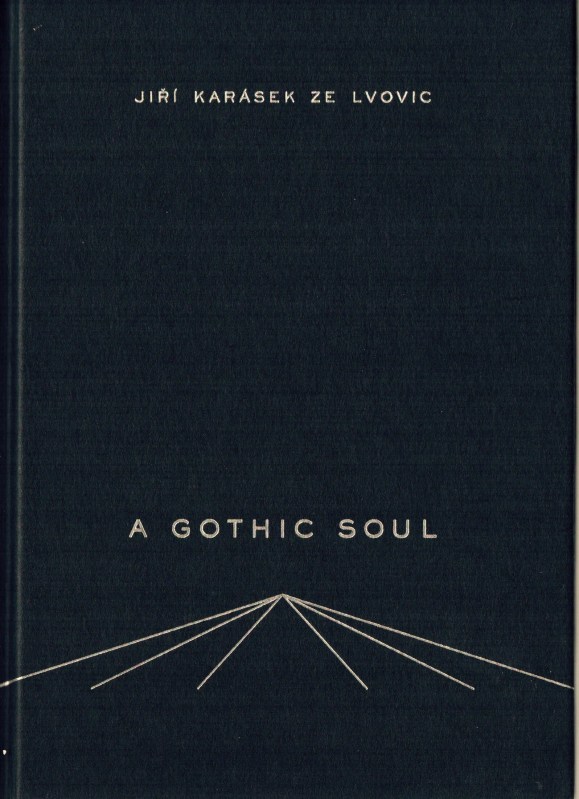
Jiří Karásek ze Lvovic’s A Gothic Soul (Book acquired, 3.30.2015)

image

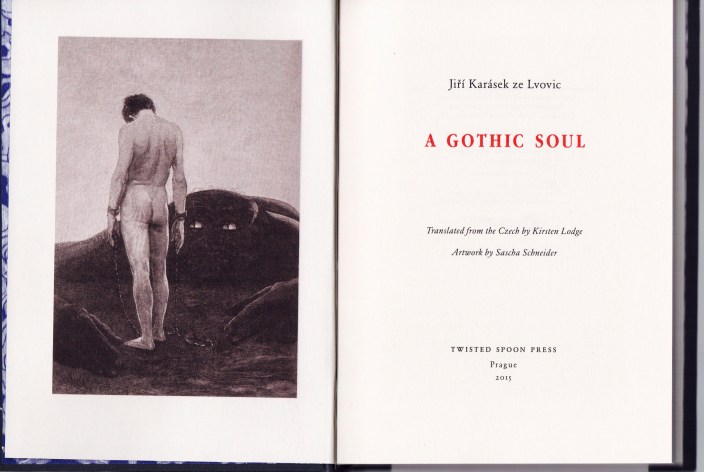
Another beautiful volume from Twisted SpoonA Gothic Soul by Jiří Karásek ze Lvovic, translated from the Czech by Kirsten Lodge, featuring prints by Sascha Schneider.

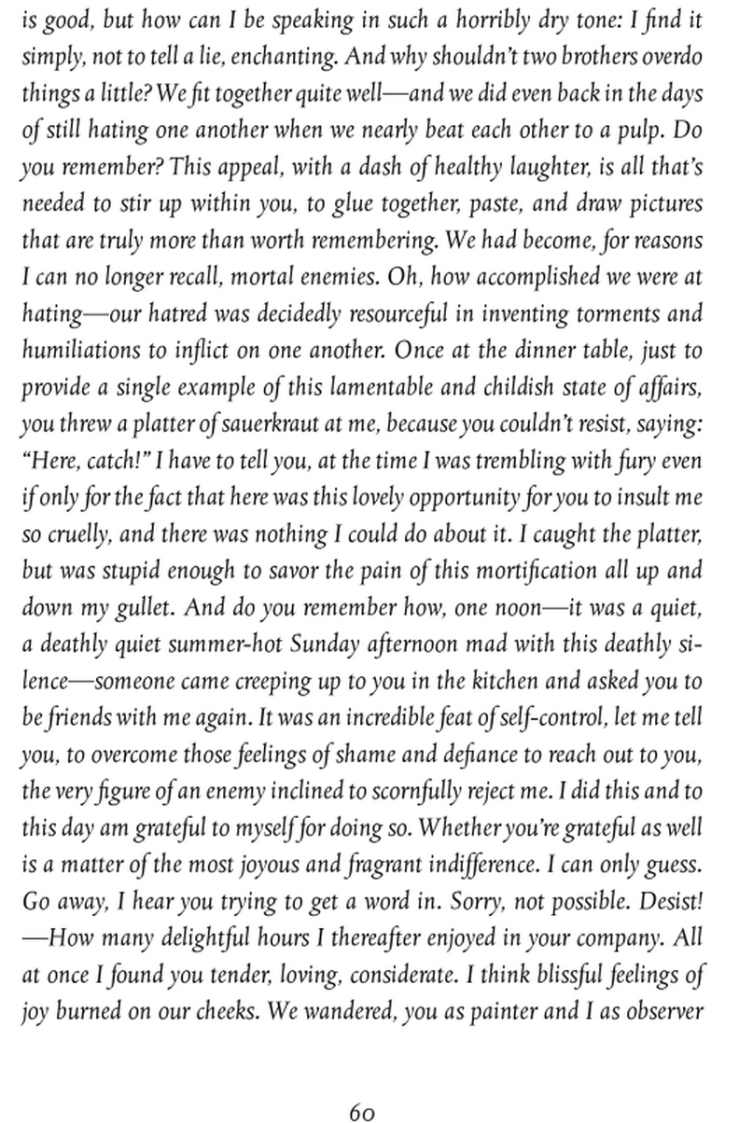
I dipped my toe in this weekend—strange, brooding stuff. More to come.

image

Twisted Spoon’s blurb:

A Gothic Soul is the most acclaimed work of Czech Decadent prose. Expressing concerns that are unique to the Czech movement while alluding creatively and ironically to Joris-Karl Huysman’s Against Nature, the novella is set in Prague, which is portrayed as a dead city, a city peopled by shades, who, like the protagonist — a nihilist and the “last scion of a noble line” — are only a dim reflection of the city’s medieval splendor. The man lives in a dreamworld, the labyrinth of his soul giving rise to visions. In his quest for meaning, he walks the city, often hallucinating, while pondering questions of religious fervor and loss of faith, the vanity of life, his own sense of social alienation, human identity and its relationship to a “nation,” the miserable situation of the Czechs under Habsburg rule, and Prague’s loss of its soul on the cusp of modernity as old sections, such as much of the squalid Jewish Quarter, are demolished to make way for gaudy new buildings and streets. With a history of madness running in the family and afraid the same fate awaits him, he ultimately retreats into seclusion, preferring the monastic way of life as the epitome of unity and wholeness and a tonic to present-day fragmentation. Yet Karásek eschews the mawkish, opting instead for darker tones that play with the tropes and motifs of Decadence while conflating the same-sex desires of his protagonist, the fatalism and futility of such an existence within the social construct of the day, with concerns for the dual fates of his nation and city.

Given his importance for Czech literature and for European Decadence, very little of Karásek’s work has been translated into English. Kirsten Lodge included translations of his poetry in Solitude, Vanity, Night: An Anthology of Czech Decadent Poetry, and we have made available her translations of some of his shorter prose here and here. This is the first time A Gothic Soul, or any full-length work of Karásek’s prose, has been translated into English.

As birds as well as words (Gertrude Stein on the way Chaucer sounds)

You do remember Chaucer, even if you have not read him you do remember not how it looks but how it sounds, how simply it sounds as it sounds. That is as I say because the words were there. They had not yet to be chosen, they had only has yet to be there just there.

That makes a sound that gently sings that gently sounds but sounds as sounds. It sounds as sounds of course as words but it sounds as sounds. It sounds as sounds that is to say as birds as well as words. And that is because the words are there, they are not chosen as words, they are already there. That is the way Chaucer sounds.

From Gertrude Stein’s lecture “What Is English Literature” (no question mark); collected in Look at Me Now and Here I Am.

Riff on the end/beginning of Gravity’s Rainbow

Well: “A screaming comes across the sky. It has happened before [—]”

□ □ □ □ □ □ □

So. Okay. So I finished Gravity’s Rainbow on Friday night, and reread the opening section (and more than the opening section) on Saturday morning, resisting a compulsion to immediately return to the beginning.

□ □ □ □ □ □ □

So: Okay: Right?

The ending of Gravity’s Rainbow cycles back to the beginning (like Finnegans Wake): Blicero’s rocket, screaming across the sky—yes? no?—to invade the dreams (?) of psychic Pirate Prentice? The book: a loop, a Möbius strip, a film, its reels discombobulated, jostled, scattered

□ □ □ □ □ □ □

“…it’s all theatre,” we learn on the book’s first page (page 3); the book ends in a theater—the Orpheus Theater!—where maybe scattered Slothrop is the leading man, scattered, we find ourselves in him, parts of him—where the audience demands, on the book’s last page: “Start-the-show!”

□ □ □ □ □ □ □

“You’re putting response before stimulus,” Spectro shakes his head at Pointsman, early in “Beyond the Zero,” the first section of Gravity’s Rainbow—does this describe the beginning/end of the novel? (“It has happened before”).

□ □ □ □ □ □ □

Or, a bit earlier even, at the seance, (page 32), Gloaming describes one kind of plot: “…we should get something like a straight line” — but then gives us another kind of plot — “…however we’ve data that suggest the curves for certain —conditions, well they’re actually quite different—schizophrenics for example tend to run a bit flatter in the upper part then progressively steeper—a sort of bow shape … classical paranoiac—” Is this the shape of Gravity’s Rainbow?

□ □ □ □ □ □ □

—but right this moment it’s that final dash that intrigues me—this in a novel full of dashes, this in a novel that name-checks Emily Dickinson, Eternal Empress of Dashes—the fragmented conclusion is full of dashes, lines obliterated by more perfect, straight lines, simultaneously connecting and disconnecting—like the novel’s final line:

“Now everybody—“

□ □ □ □ □ □ □ Continue reading “Riff on the end/beginning of Gravity’s Rainbow”

Lydia Davis on Thomas Pynchon

A rather appealing specimen of early Pynchon is the last story in his collection Slow Learner. The story, “The Secret Integration”—first published in the Saturday Evening Post more than forty years ago (three years after V. appeared)—involves a gang of young practical jokers and a rich childhood setting of an old town with a new development, a sprawling estate with a derelict mansion, and a downtown, complete with seedy hotel. In one deftly described scene, the boys coast on their bikes down a long hill in the early evening toward the hotel, “leaving behind two pages of arithmetic homework and a chapter of science” and, on the TV, “a lousy movie, some romantic comedy.” Because all the televisions in town receive only one channel, the boys, as they fly by, are able to follow the movie’s progress from house to house, through doors and windows “still open for the dark’s first coolness.”

In his introduction to Slow Learner, Pynchon, who somewhat preempts our reactions to the story, remarks that he likes it more than he dislikes it. In fact it is so likable that one envies the boys their comfortable society and the fields, streams, and town of their games. Their collaboration and apportioning of assignments is charming (to develop an arsenal for sabotaging the railroad; to enlist malcontent first-graders to destroy the boys’ latrine; to infiltrate PTA meetings); the elaborateness of their schemes, and the number that succeed, is impressive; and the animation of the central character, Grover the boy genius—with his enormous vocabulary, fund of information, and flights of hilarity—is particularly savory. The pranks the boys plan are potentially devastating to the community, yet, as Pynchon says in a lovely bit of writing, the boys would never actually take “any clear or irreversible step,” because “everybody on the school board, and the railroad, and the PTA and paper mill had to be somebody’s mother or father, whether really or as a member of a category; and there was a point at which the reflex to their covering warmth, protection, effectiveness against bad dreams, bruised heads and simple loneliness took over and made worthwhile anger with them impossible.”

There is a lyrical humanity in this story, an almost unapologetic gentleness, inviting and inclusive, that contrasts with the weightier, complex pessimism and bravura of Pynchon’s later works, in which perhaps it is more difficult for the characters to go home and be comforted at the end of the day.

From the Summer 2005 issue of Bookforum.

A scattered riff on Thomas Pynchon’s novel Gravity’s Rainbow

I’m safe here at my office, away from Thomas Pynchon’s Gravity’s Rainbow. I almost certainly would not dare to write about it were it proximal. If the book were here with me, its text would infect me, and I’d replicate it in chunks here for you, dear reader, to sort out (or not sort out) as you wish (or do not wish).

□ □ □ □ □ □ □

I’m almost finished with Gravity’s Rainbow, which is how I know that I’m not finished with Gravity’s Rainbow. I’m going to have to read it again. (I want to read it again).

□ □ □ □ □ □ □

I’m about fifty pages from the last page—just got through/endured/delighted in/icked and acked at the Gross Suckling Conference, or, as I like to think of it, the alliterative abject dinner party.

□ □ □ □ □ □ □

Gravity’s Rainbow is filled with more abject imagery than any novel I’ve ever read.

□ □ □ □ □ □ □

I mean abjection here in the general sense of degradation, etc., but also in the specific sense that Julia Kristeva uses in Powers of Horror:

The corpse (or cadaver: cadere, to fall), that which has irremediably come a cropper, is cesspool, and death; it upsets even more violently the one who confronts it as fragile and fallacious chance. A wound with blood and pus, or the sickly, acrid smell of sweat, of decay, does not signify death. In the presence of signified death—a flat encephalograph, for instance—I would understand, react, or accept. No, as in true theater, without makeup or masks, refuse and corpses show me what I permanently thrust aside in order to live. These body fluids, this defilement, this shit are what life withstands, hardly and with difficulty, on the part of death. There, I am at the border of my condition as a living being. My body extricates itself, as being alive, from that border. Such wastes drop so that I might live, until, from loss to loss, nothing remains in me and my entire body falls beyond the limit—cadere, cadaver. If dung signifies the other side of the border, the place where I am not and which permits me to be, the corpse, the most sickening of wastes, is a border that has encroached upon everything. It is no longer I who expel, “I” is expelled. The border has become an object. How can I be without border? That elsewhere that I imagine beyond the present, or that I hallucinate so that I might, in a present time, speak to you, conceive of you—it is now here, jetted, abjected, into “my” world. Deprived of world, therefore, I fall in a faint. In that compelling, raw, insolent thing in the morgue’s full sunlight, in that thing that no longer matches and therefore no longer signifies anything, I behold the breaking down of a world that has erased its borders: fainting away. The corpse, seen without God and outside of science, is the utmost of abjection. It is death infecting life. Abject. It is something rejected from which one does not part, from which one does not protect oneself as from an object. Imaginary uncanniness and real threat, it beckons to us and ends up engulfing us.

□ □ □ □ □ □ □

Forgive me for citing at such length, but perhaps Kristeva summarizes some aspect of Gravity’s Rainbow that deeply interests me: The core of the novel (the core that Pynchon atomizes, decentralizes, scatters like his main man Tyrone Slothrop)—the core of the novel rests on love and death, me and not-me: “How can I be without border?” The war and its corpses and rockets and dissolutions. Continue reading “A scattered riff on Thomas Pynchon’s novel Gravity’s Rainbow”

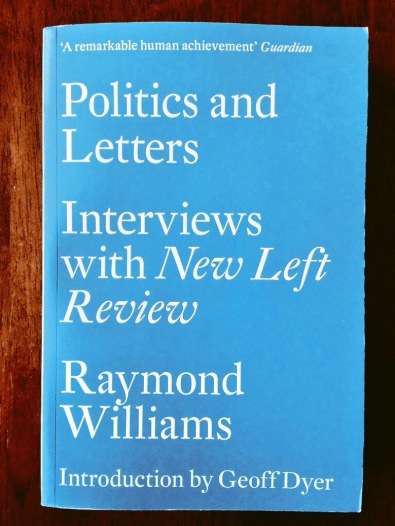
Raymond Williams’s Politics and Letters: Interviews with New Left Review (Book acquired, 4.03.2015)

IMG_5721

Politics and Letters: Interviews with New Left Review collects Raymond Williams’s interviews with the New Left Review. It’s new from Verso. Their blurb:

Raymond Williams made a central contribution to the intellectual culture of the Left in the English-speaking world. He was also one of the key figures in the foundation of cultural studies in Britain, which turned critical skills honed on textual analysis to the examination of structures and forms of resistance apparent in everyday life. Politics and Letters is a volume of interviews with Williams, conducted by New Left Review, designed to bring into clear focus the major theoretical and political issues posed by his work. Introduced by writer Geoff Dyer, Politics and Letters ranges across Williams’s biographical development, the evolution of his cultural theory and literary criticism, his work on dramatic forms and his fiction, and an exploration of British and international politics.

Incapable of writing even one word (Kafka diary entry, 8 April 1914)

8 April. Yesterday incapable of writing even one word. Today no better. Who will save me? And the turmoil in me, deep down, scarcely visible; I am like a living lattice-work, a lattice that is solidly planted and would like to tumble down.

Today in the coffee-house with Werfel. How he looked from the distance, seated at the coffee-house table. Stooped, half reclining even in the wooden chair, the beautiful profile of his face pressed against his chest, his face almost wheezing in its fullness (not really fat); entirely indifferent to the surroundings, impudent, and without flaw. His dangling glasses by contrast make it easier to trace the delicate outlines of his face.


From the diaries of Franz Kafka. The entry is from 8 April 1914. English translation by Martin Greenberg.

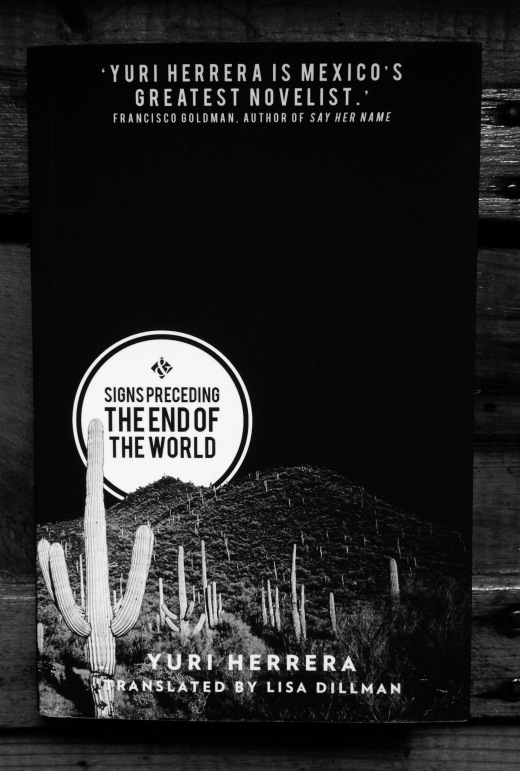
Yuri Herrera’s Signs Preceding the End of the World is sharp subterranean fiction

IMG_5790

Yuri Herrera’s sharp, thrilling novella Signs Preceding the End of the World opens with calamity. A sinkhole — “the earth’s insanity” — nearly swallows our hero before we can properly meet her:

I’m dead, Makina said to herself when everything lurched: a man with a cane was crossing the street, a dull groan suddenly surged through the asphalt, the man stood still as if waiting for someone to repeat the question and then the earth opened up beneath his feet: it swallowed the man, and with him a car and a dog, all the oxygen around and even the screams of passers-by. I’m dead, Makina said to herself, and hardly had she said it than her whole body began to contest that verdict and she flailed her feet frantically backward, each step mere inches from the sinkhole, until the precipice settled into a perfect circle and Makina was saved.

This opening passage sets the tone of Signs Preceding the End of the World. Makina will repeatedly plunge into and out of danger as she treks from her village in borderland Mexico into the weird world of the Big Chilango–the United States.

Makina crosses the border to find her estranged brother, who left the village years ago with the dubious plan of claiming some land (supposedly) owned by his family. (Reader, mark the symbolism there). Makina’s mother prompts her journey, but she’s also aided by a trio of adversarial gangsters—Mr. Double-U, Mr. Aitch, and Mr. Q. At the end of the first chapter of Signs, Mr. Q summarizes Makina’s impending quest (and the novella itself) in terse but eloquent language:

You’re going to cross and you’re going to get your feet wet and you’re going to be up against real roughnecks; you’ll get desperate, of course, but you’ll see wonders and in the end you’ll find your brother, and even if you’re sad, you’ll wind up where you need to be.

Mr. Q plays seer in his short monologue, just one example of the novella’s mythic overtones. Or maybe the word I want is undertones: Signs Preceding the End of the World opens with the earth swallowing victims; underworld mobsters send a hero on a night-quest over rough waters and alien terrain; aided by an underground network, Makina must traverse labyrinths and mazes and dark spaces; and, yes, the book ends underground. This is subterranean fiction. Continue reading “Yuri Herrera’s Signs Preceding the End of the World is sharp subterranean fiction”