Category: Comics
More Wuthering Heights Humor from Hark! A Vagrant

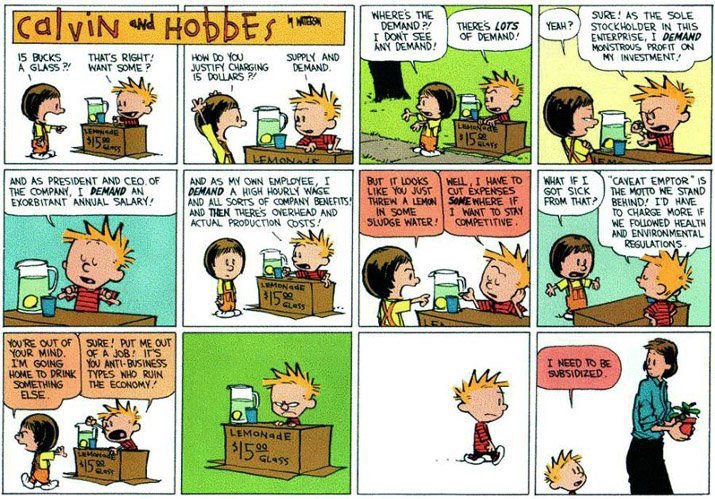
Calvin & Hobbes on Capitalism, Regulation, and “Anti-Business Types”
The AV Club Interviews Cartoonist Kate Beaton (Hark! A Vagrant)
The AV Club interviews Kate Beaton, she of Hark! A Vagrant. Here, she talks a bit about A Game of Thrones—
AVC: You were a history major. Do you still read history for fun?
KB: I do, yeah. I pick up books every now and then. The only problem is, I pick up books and I don’t read them, because if I do reading, it’s for a comic. But I will. I will probably pick up the second half of John A. Macdonald’s biography, which comes out this year. [Laughs.] Because I think he’s a fascinating guy. [Macdonald was the first prime minister of Canada. —ed.] I read so much, but it’s always for comics, and there’s not much time in between to just settle down and start reading something for yourself. Recently, I started reading that Game Of Thrones that everybody was reading. It’s kind of a quick and fun read. And that was really nice, because I made time to read something that wasn’t for comics. Reading history for fun will turn my brain into, “How do you make this into a comic?” and then it turns into work. [Laughs.] There’s dangerous waters there.
AVC: I’d love to see the Kate Beaton take on A Game Of Thrones. And that’s at least somewhat less polarizing than politics. You do a lot of literary strips—would you ever consider one about contemporary literature?
KB: [Laughs.] Oh, no. No. I like doing literature that’s popular, that a lot of people have read or know about, so Game Of Thrones does fit into there. I did do a couple drawings and put them on Twitter, and they get good reactions. But I feel like, for a while, everybody was doing Game Of Thrones something or other, so I just sort of stayed out of there. And besides, you could hardly do a comic about that without spoiling it, because someone new dies every chapter. [Laughs.] It’s likeGame Of Massacres. And you wouldn’t want to ruin that for anybody.
Recipe Comix
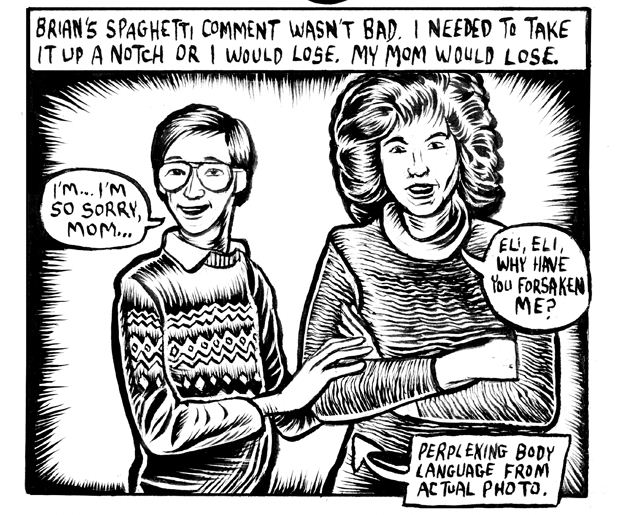
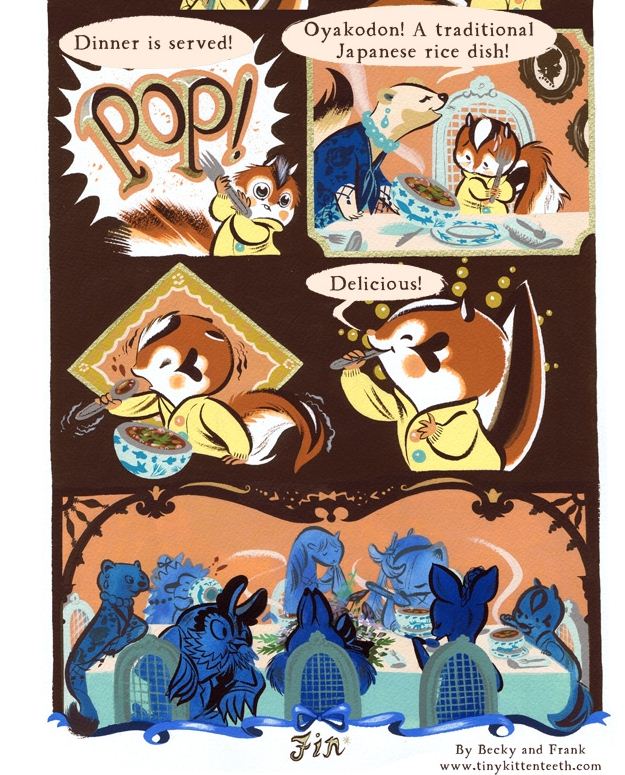
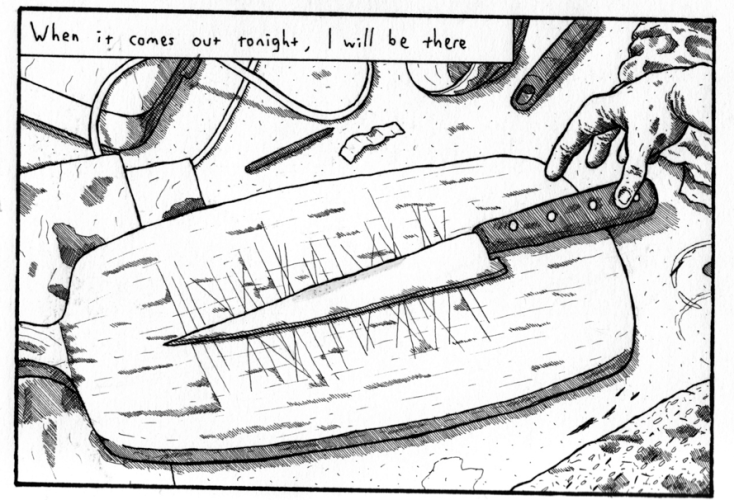
Great collection of recipe comix at Saveur magazine. Marvelous stuff. A few choice panels, plucked not entirely but still somewhat at random—

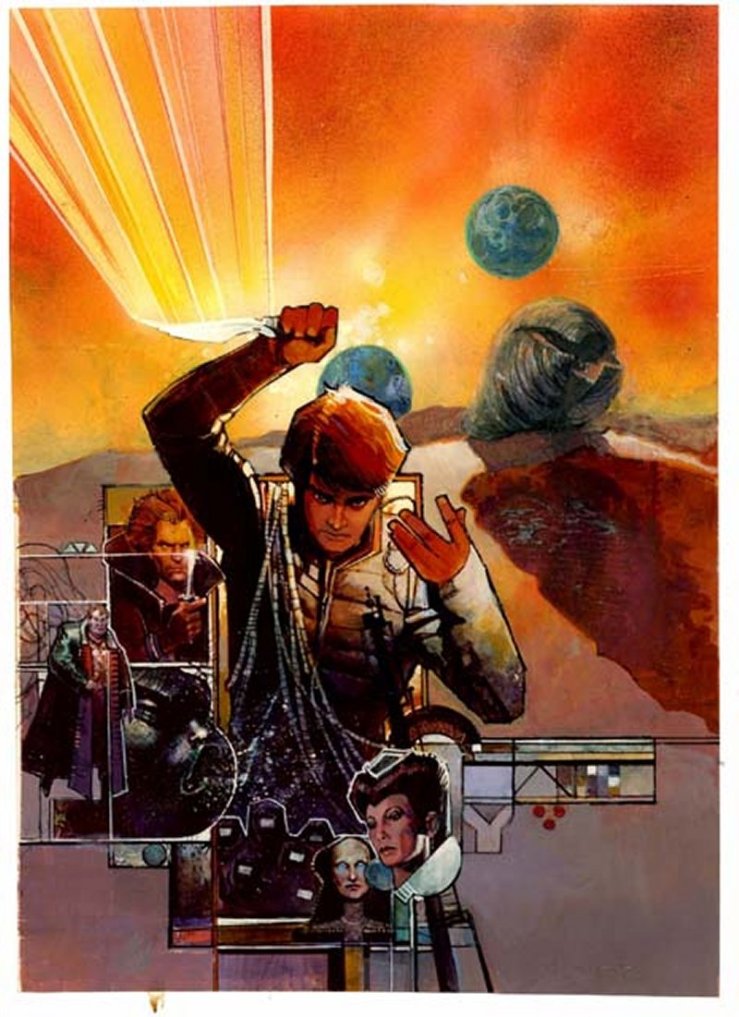
Dune Cover (Marvel Comics Adaptation) — Bill Sienkiewicz
Hark, a Vagrant! Does the Romantics

All Four Twilight Books in One Short Webcomic

“The Prince and the Sea” — Em Carroll
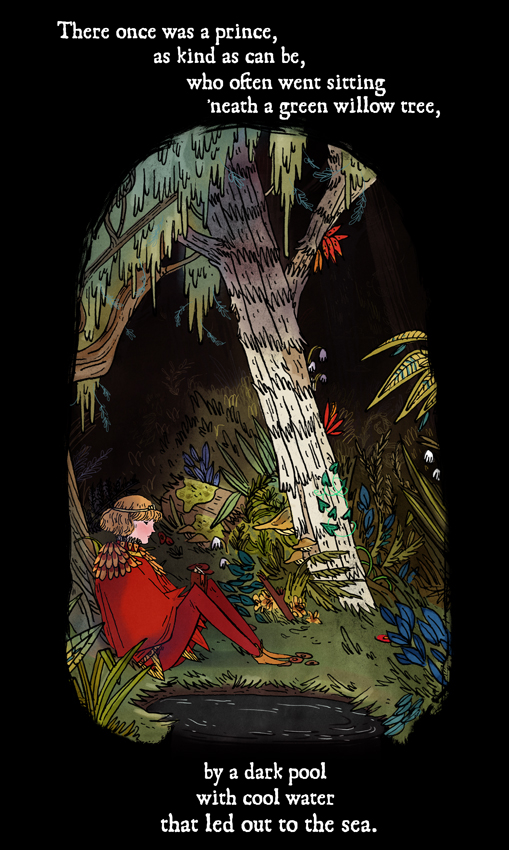 Read “The Prince and the Sea,” another beautiful, dark webcomic from Em Carroll (she also did the brilliant tale “His Face All Red”).
The AV Club Interviews Comix Journalist Joe Sacco
The AV Club interviews Biblioklept fave Joe Sacco, whose books Palestine and Safe Area Goražde should be required reading for any thinking person. Sacco explores some of the messiest, ugliest terrains in the world, plumbing disaster and war with heart, wit, and insight (read our post on Sacco for more, including links to shorter works). From the interview—
AVC: You got out of journalism school in 1981, so in addition to the shift in public perception about comics as an adult medium, your career has also spanned a profound shift in the journalism industry. Do you think in some ways you’ve been the beneficiary of that?
JS: As many problems as I have with the mainstream media and the way it goes about its business, I’d say at least journalists were, for the most part, trained in discrimination. I have my problems, mostly with editorial decisions in bigger cities, in editorial offices as opposed to with columnists or reporters. I realize that, as time’s gone by with the new media—I’m talking about the electronic media—you could see a shift to emphasis on visuals and on shorter attention spans. I’m sorry, in a way, if my work is a beneficiary of that. I would hope my work has other attributes that have led to a success. But I can’t know for sure, you know? I think the comics market is the only growing part of the publishing industry, of the book-publishing trade. It’s increasing its share as time goes by. I think it also has to do with the sheer weight of good work that’s out there now—obviously not just my work. There are many other great cartoonists working in fiction and other fields that are just really doing work that has to be looked at, that you cannot ignore.
See the Trailer for Spielberg’s Adventures of Tintin
Wilson — Daniel Clowes
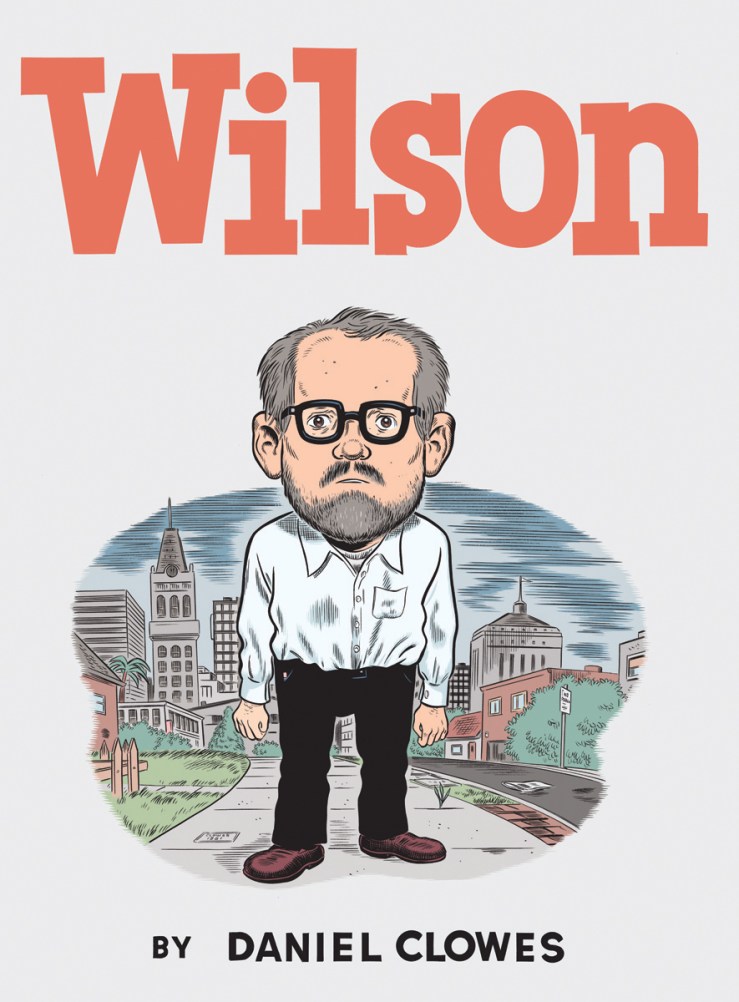
In the first line of the first panel of the first strip in Daniel Clowes’s graphic novel Wilson, the eponymous character, looking directly at the reader, claims, “I love people!” The statement is both ironic and strangely true. Our hero Wilson loves the idea of loving people, and goes about his daily business (walking his dog, drinking coffee, mailing boxes of shit to his former in-laws) in a way that maximizes human contact. With no real family of his own, Wilson reaches out to every person he passes by, addressing them as “brother” or “sister” in an embracing, Emersonian spirit. The problem is that, as much as he loves the idea of loving humanity, Wilson pretty much hates every person he meets. Here’s the opening episode—
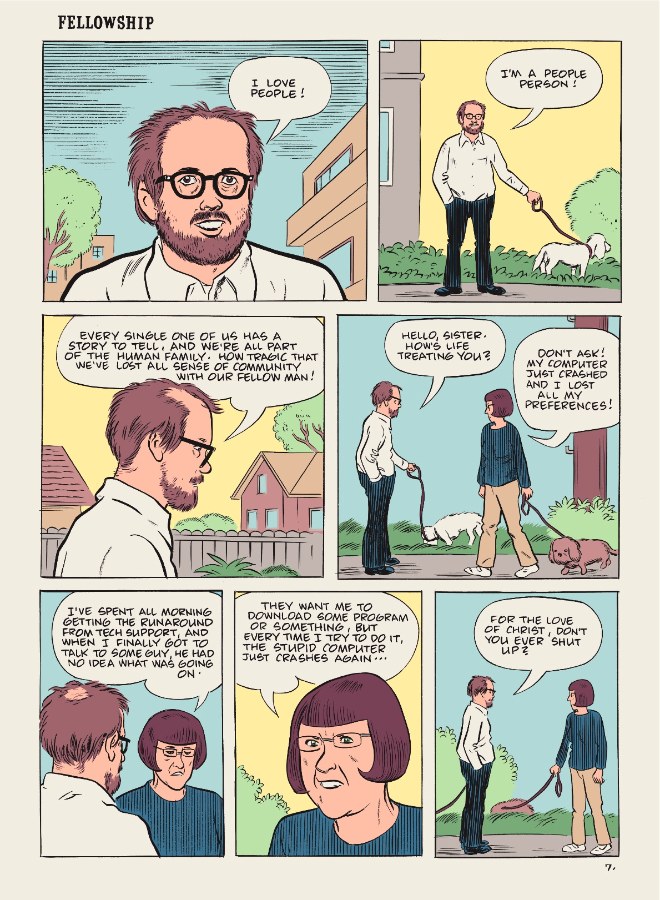
Wilson comprises about 70 one-page episodes, each with six or seven panels, each essentially self-contained yet part of a loose plot. The episode above is indicative of the structure of each chapter: a build-up, a monologue, often delivered to disinterested stranger, and then an anti-punchline in which Wilson reveals the ironic cognitive dissonance at the core of his being. The effect can be hard to process, and Clowes’s acerbic humor is clearly not for everyone. Although Clowes uses a traditional Sunday comic page structure, his technique is unsettling: the humor is drawn not so much from the deflationary punchlines that end each chapter, but the overall disconnect between perception, desire, and reality that those punchlines reveal.
Clowes uses this method consistently throughout Wilson, but alternates styles and color palettes, moving from a classic-Clowes style familiar to anyone who’s read Eightball or Ghost World, to a bouncy, cartoony style (see: “Marriage”). The choice to change up the styles calls back, again, to the Sunday comic pages of yore; it also underscores Wilson’s unstable identity, as the narrative slips through gradations of more realistic to more cartoony representations. It is a consistent inconsistency.
Surprisingly, Wilson has a cohesive plot. After the death of his father, Wilson seeks to reunite with his ex-wife, whom he believes to be a drug-addicted hooker. He also hopes to meet the child she was pregnant with when she left him—
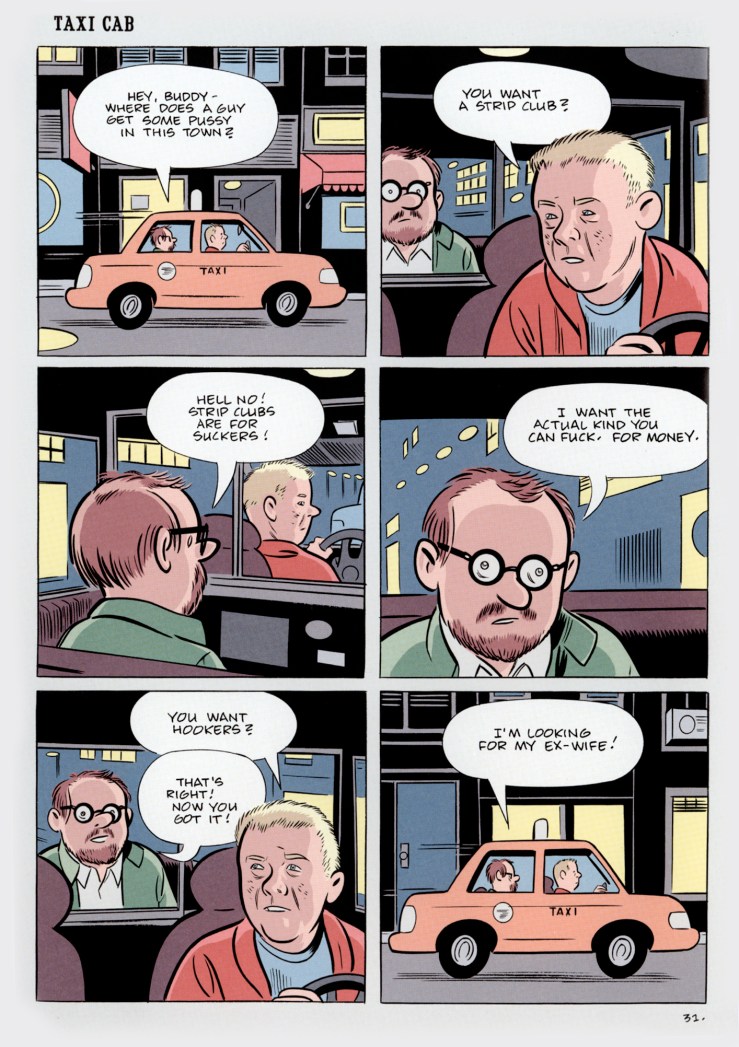
Wilson does find his wife. And then he finds his teenage daughter. And then he kinda sorta kidnaps her, or at least doesn’t bother to return her to her adoptive parents. And then he goes to prison. But maybe I’m spoiling the plot now. In any case, Wilson’s adventures are hardly zany. They are poignant and sad and pathetic and cringe-worthy. Clowes is willing to punish his already-tortured protagonist, and yet there’s a payoff for pour Wilson. Throughout the graphic novel, Wilson yearns for human connection, yet is always disappointed by the humans around him who can never measure up to his ideals. Like any sociopath, Wilson lacks a meaningful emotional core; throughout the narrative he longs to experience an epiphany, staring at the ocean, for example, in the hopes illumination. He finally earns this epiphany near the close of his life. The moment is unexpectedly touching, and provides the kind of balance that proves Wilson a work of art and not merely a collection of funny strips. Recommended.
Wilson is available now from Drawn & Quarterly.
“Marriage” — Daniel Clowes
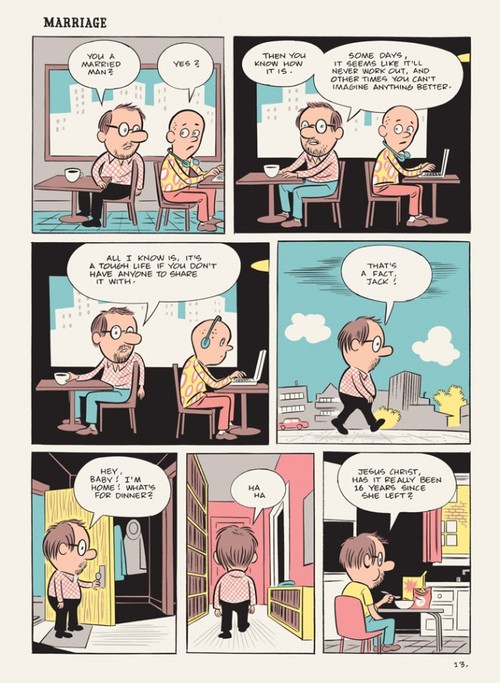
From Daniel Clowes’s graphic novel Wilson, available from Drawn & Quarterly.
Hayao Miyazaki and Moebius in Conversation
“How to Catch a Man” — Lynda Barry

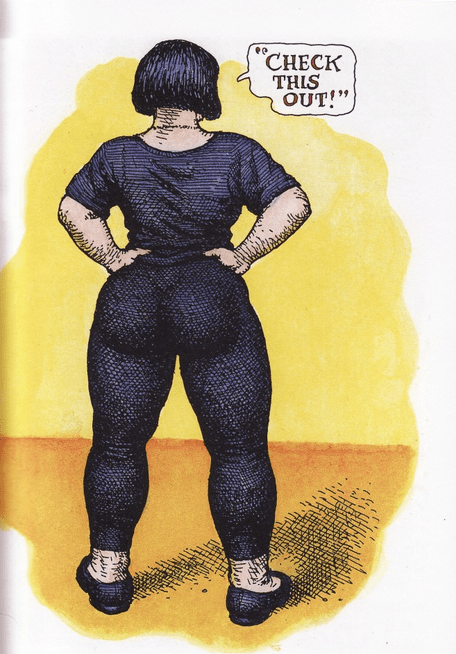
“Check This Out!” — Robert Crumb
 Biblioklept