Could this ragged girl with brindled lugs have spoken like we do she would have called herself a wolf, but she cannot speak, although she howls because she is lonely–yet’ howl’ is not the right word for it, since she is young enough to make the noise that pups do, bubbling, delicious, like that of a panful of fat on the fire. Sometimes the sharp ears of her foster kindred hear her across the irreparable gulf of absence; they answer her from faraway pine forest and the bald mountain rim. Their counterpoint crosses and criss-crosses the night sky; they are trying to talk to her but they cannot do so because she does not understand their language even if she knows how to use it for she is not a wolf herself, although suckled by wolves.
Her panting tongue hangs out; her red lips are thick and fresh. Her legs are long, lean and muscular. Her elbows, hands and knees are thickly callused because she always runs on all fours. She never walks; she trots or gallops. Her pace is not our pace.
Two-legs looks, four-legs sniffs. Her long nose is always a-quiver, sifting every scent it meets. With this useful tool, she lengthily investigates everything she glimpses. She can net so much more of the world than we can through the fine, hairy, sensitive filters of her nostrils that her poor eyesight does not trouble her. Her nose is sharper by night than’ our eyes are by day so it is the night she prefers, when the cool reflected light of the moon does not make her eyes smart and draws out the various fragrances from the woodland where she wanders when she can. But the wolves keep well away from the peasants’ shotguns, now, and she will no longer find them there.
Wide shoulders, long arms and she sleeps succinctly curled into a ball as if she were cradling her spine in her tail. Nothing about her is human except that she is not a wolf; it is as if the fur she thought she wore had melted into her skin and become part of it, although it does not exist. Like the wild beasts, she lives without a future. She inhabits only the present tense, a fugue of the continuous, a world of sensual immediacy as without hope as it is without despair.
When they found her in the wolf’s den beside the bullet-riddled corpse of her foster mother, she was no more than a little brown scrap so snarled in her own brown hair they did not, at first, think she was a child but a cub; she snapped at her would-be saviours with her spiky canines until they tied her up by force. She spent her first days amongst us crouched stockstill, staring at the whitewashed wall of her cell in the convent to which they took her. The nuns poured water over her, poked her with sticks to rouse her. Then she might snatch bread from their hands and race with it into a corner to mumble it with her back towards them; it was a great day among the novices when she learned to sit up on her hind legs and beg for a crust.
They found that, if she were treated with a little kindness, she was not intractable. She learned to recognize her own dish; then, to drink from a cup. They found that she could quite easily be taught a few, simple tricks but she did not feel the cold and it took a long time to wheedle a shift over her head to cover up her bold nakedness. Yet she always seemed wild, impatient of restraint, capricious in temper; when the Mother Superior tried to teach her to give thanks for her recovery from the wolves, she arched her back, pawed the floor, retreated to a far corner of the chapel, crouched, trembled, urinated, defecated–reverted entirely, it would seem, to her natural state. Therefore, without a qualm, this nine days’ wonder and continuing embarrassment of a child was delivered over to the bereft and unsanctified household of the Duke. Continue reading ““Wolf-Alice” — Angela Carter”→
Our body to be possessed by two different spirits; so that half of the visage shall express one mood, and the other half another.
An old English sea-captain desires to have a fast-sailing ship, to keep a good table, and to sail between the tropics without making land.
A rich man left by will his mansion and estate to a poor couple. They remove into it, and find there a darksome servant, whom they are forbidden by will to turn away. He becomes a torment to them; and, in the finale, he turns out to be the former master of the estate.
Two persons to be expecting some occurrence, and watching for the two principal actors in it, and to find that the occurrence is even then passing, and that they themselves are the two actors.
There is evil in every human heart, which may remain latent, perhaps, through the whole of life; but circumstances may rouse it to activity. To imagine such circumstances. A woman, tempted to be false to her husband, apparently through mere whim,–or a young man to feel an instinctive thirst for blood, and to commit murder. This appetite may be traced in the popularity of criminal trials. The appetite might be observed first in a child, and then traced upwards, manifesting itself in crimes suited to every stage of life.
The good deeds in an evil life,–the generous, noble, and excellent actions done by people habitually wicked,–to ask what is to become of them.
A satirical article might be made out of the idea of an imaginary museum, containing such articles as Aaron’s rod, the petticoat of General Hawion, the pistol with which Benton shot Jackson,–and then a diorama, consisting of political or other scenes, or done in wax-work. The idea to be wrought out and extended. Perhaps it might be the museum of a deceased old man.
An article might be made respecting various kinds of ruin,–ruin as regards property,–ruin of health,–ruin of habits, as drunkenness and all kinds of debauchery,–ruin of character, while prosperous in other respects,–ruin of the soul. Ruin, perhaps, might be personified as a demon, seizing its victims by various holds.
We came out of the larch wood, making for the village and beyond into the deep forest. I was leading the way. The painter followed me, all the time I had the sense he’s about to lay into me, he’ll attack me from behind. I don’t know what prompted me to think that way, but I was unable to lose the fear that was oozing out of me. From time to time I picked up a word he was saying, it was completely incomprehensible to me, I couldn’t answer him when he asked me something, because really he was only asking himself. He growled at me: “Kindly stop when I ask you a question!” I stopped. “Come here!” he commanded. Suddenly I realized (it was in his tone, and I felt only I was in a position to realize this) the resemblance to his brother, the assistant. He said: “The air is the only true conscience, do you understand me?” I replied: “I don’t understand you.”—“The air, I say, is the only true science!” he repeated. I still didn’t understand, but nodded anyway. He said: “The gesture of the air, the great aerial gesture, you understand. The nightmarish sweat of fear, that’s the air.” I told him that was a great thought. In my opinion it was even poetry, to me what he had just said was the distillation of all memory, of all possibility. “Poetry is nothing!” he said. “Poetry as you understand it is nothing. Poetry as the world understands it, as the poetry hound understands it, is nothing. No, this poetry is nothing! The poetry that I have in mind is something else. If you meant that poetry, then you’d be right. Then I’d have to embrace you!” I said: “What is your poetry?”—“My poetry isn’t my poetry. But if you mean my poetry, then I’ll have to admit I’m unable to offer you a description of it. You see, my poetry, which is the only poetry, and therefore also the only truth, just as much as the only truth that I find in the air, which I feel in the air, which is the air, this poetry of mine is always generated at the center of its own thought, which is all its own. This poetry is momentary, is instantaneous. And therefore it isn’t. It is my poetry.”—“Yes,” I said, “it is your poetry.” I had understood nothing of what he had said. “Let’s go on,” he said, “it’s cold. The cold is eating into the center of my brain. If only you knew how far the cold had already advanced into my brain. The insatiable cold, the cold that insists on its bloody nourishment of cells, that insists on my brain, on everything that could make anything, could become anything. You see,” he said, “the brain, the skull and the brain within it, are an incredible irresponsibility, a dilettantism, a lethal dilettantism, that’s what I want to say. One’s forces are attacked, the cold bites into my forces, into my human forces, into the lofty muscle power of reason. It’s this ancient tourism of cold, billions of years old, this exploitative and pernicious tourism, that penetrates my brain, the entry of frost … There is,” he said, “no longer the category of ‘secret,’ it doesn’t exist, everything is just frigor mortis. I see the cold, I can write it down, I can dictate it, it’s killing me …” In the village, he popped into the abattoir. He said: “Cold is one of the great A-truths, the greatest of all the A-truths, and therefore it is all truths rolled into one. Truth is always a process of extermination, you must understand. Truth leads downhill, points downhill, truth is always an abyss. Untruth is a climbing, an up, untruth is no death, as truth is death, untruth is no abyss, but untruth is not A-truth, you understand: the great infirmities do not approach us from outside, the great infirmities have been within us, surprisingly, for millions of years …” He says, staring through the open abattoir doors: “There it is clearly in front of you, broken open, sliced apart. And there’s the scream as well, of course! If you listen, you’ll catch the scream as well. You will still hear the scream, even though the facility for the production of the scream is dead, is severed, chopped up, ripped open. The vocal cords have been rendered, but the scream is still there! It’s a grotesque realization that the vocal cords have been smashed, chopped up, sliced apart, and the scream is still there. That the scream is always there. Even if all the vocal cords have been chopped up and sliced apart, are dead, all the vocal cords in the world, all the vocal cords of all the worlds, all the imaginations, all the vocal cords of every creature, the scream is always there, is always still there, the scream cannot be chopped up, cannot be cut through, the scream is the only eternal thing, the only infinite thing, the only ineradicable thing, the only constant thing … The lesson of humanity and inhumanity and human opinions, and of the great human silence, the lesson of the great memory protocol of the great being, should all be tackled through the abattoir! Schoolchildren should not be brought to heated classrooms, they should be made to attend abattoirs; it is only from abattoirs that I expect understanding of the world and of the world’s bloody life. Our teachers should do their work in abattoirs. Not read from books, but swing hammers, wield saws, and apply knives … Reading should be taught from the coiled intestines, and not from useless lines in books … The word ‘nectar’ should be traded in forthwith for the word ‘blood’ … You see,” said the painter, “the abattoir is the only essentially philosophical venue. The abattoir is the classroom and the lecture hall. The only wisdom is abattoir wisdom! A-truth, truth, untruth, all added up come to the vast abattoir immatriculation, which I would like to make compulsory for humans, for new humans, and those tempted to become humans. Knowledge in the world is not abattoir knowledge, and it lacks thoroughness. The abattoir makes possible a radical philosophy of thoroughness.” We had gone into the slaughterhouse. “Let’s go,” said the painter, “in me the smell of blood turns into the extraordinary, the smell of blood is the only parity. Let’s go, otherwise I should have to uproot the possibility of new intellectual disciplines from my own thinking materiality, and I don’t have the strength for that.” He took large steps, and said: “The beast bleeds for the human, and knows it. Meanwhile the human doesn’t bleed for the beast, and doesn’t know it. The human is the incomplete beast, the beast could be fully human. Do you understand what I mean: the one is disproportionate to the other, the one is massively dark to the other. Neither is for the other. Neither excludes the other.”
Dracula is a character in Roberto Bolaño’s dark opus 2666.
Specifically, I’m suggesting that Dracula (like, theCount Dracula) is the unnamed SS officer in “The Part About Archimboldi” who hosts a strange party in a Romanian castle.
2. I’m willing to concede that my idea is probably full of holes and more than a little silly, but I think there’s some textual support for such a claim.
3. I’ve already suggested on this blog that 2666 is full of lycanthropic transformations, and in that earlier essay, I linked werewolves to vampires (using the work of mythologist Sabine Baring-Gould).
It’s a work of mesmerism and transformation—vampire powers. Dracula showing up is a winking sick joke, a satire.
4. In his post “Castle Dracula” at Infinite Zombies, Daryl L. L. Houston connects the many strands of vampirism that run through 2666, suggesting that “Bolaño is using the vampirism in the story, and Dracula in particular, to tie together some of the threads he’s been unwinding pertaining to insiders and outsiders, parasitism and consumption of people, and a sort of larger parasitism of nations.” Hence Aztec blood rituals, the Holocaust, the murder of helpless, marginalized women in Santa Teresa . . .
5. Okay, so back to that thesis. Let’s start with the first appearance of the unnamed SS officer:
At midmorning they came to a castle. The only people there were three Romanians and an SS officer who was acting as butler and who put them right to work, after serving them a breakfast consisting of a glass of cold milk and a scrap of bread, which some soldiers left untouched in disgust. Everyone, except for four soldiers who stood guard, among them Reiter, whom the SS officer judged ill suited for the task of tidying the castle, left their rifles in the kitchen and set to work sweeping, mopping, dusting lamps, putting clean sheets on the beds.
Fairly banal, right? Also, “midmorning” would entail, y’know, sunlight, which is poison for most vampires. Let me chalk this up to the idea that the SS officer is inside the castle, which is sufficiently gloomy and dark enough to protect him (I’m not going to get into any vampire rules that might spoil my fun, dammit!). In any case, hardly noteworthy. Indeed, the SS officer—a butler commanding house chores—seems hardly a figure of major importance.
6. Next, we get the Romanian castle explicitly identified as “Dracula’s castle” and meet the actors for this milieu:
“And what are you doing here, at Dracula’s castle?” asked the baroness.
“Serving the Reich,” said Reiter, and for the first time he looked at her.
He thought she was stunningly beautiful, much more so than when he had known her. A few steps from them, waiting, was General Entrescu, who couldn’t stop smiling, and the young scholar Popescu, who more than once exclaimed: wonderful, wonderful, yet again the sword of fate severs the head from the hydra of chance.
(I love Popescu’s line here).
7. Our principals soon take a tour of castle and environs, led by the SS officer (boldface emphasis is mine):
Soon they came to a crypt dug out of the rock. An iron gate, with a coat of arms eroded by time, barred the entrance. The SS officer, who behaved as if he owned the castle, took a key out of his pocket and let them in. Then he switched on a flashlight and they all ventured into the crypt, except for Reiter, who remained on guard at the door at the signal of one of the officers.
So Reiter stood there, watching the stone stairs that led down into the dark, and the desolate garden through which they had come, and the towers of the castle like two gray candles on a deserted altar. Then he felt for a cigarette in his jacket, lit it, and gazed at the gray sky, the distant valleys, and thought about the Baroness Von Zumpe’s face as the cigarette ash dropped to the ground and little by little he fell asleep, leaning on the stone wall. Then he dreamed about the inside of the crypt. The stairs led down to an amphitheater only partially illuminated by the SS officer’s flashlight. He dreamed that the visitors were laughing, all except one of the general staff officers, who wept and searched for a place to hide. He dreamed that Hoensch recited a poem by Wolfram von Eschenbach and then spat blood. He dreamed that among them they had agreed to eat the Baroness Von Zumpe.
He woke with a start and almost bolted down the stairs to confirm with his own eyes that nothing he had dreamed was real.
When the visitors returned to the surface, anyone, even the least astute observer, could have seen that they were divided into two groups, those who were pale when they emerged, as if they had glimpsed something momentous down below, and those who appeared with a half smile sketched on their faces, as if they had just been reapprised of the naivete of the human race.
Bolaño concludes the crypt passage by highlighting an essential ambiguity that courses throughout the entire “Castle Dracula” episode, a strange axis of horror/humor, romance/banality. What has been revealed in the crypt? We don’t know, of course, but our surrogate Reiter allows us access to a few visions of what might have happened, including terror and fear and cannibalism. (He employs Hawthorne’s escape hatch too—it was all a dream).
The Knight of Death, Salvador Dali
8. Then, supper time:
That night, during dinner, they talked about the crypt, but they also talked about other things. They talked about death. Hoensch said that death itself was only an illusion under permanent construction, that in reality it didn’t exist. The SS officer said death was a necessity: no one in his right mind, he said, would stand for a world full of turtles or giraffes. Death, he concluded, served a regulatory function.
Clearly it’s easy to link any of the dinnertime comments about death to Dracula, but note that the SS officer’s idea that death is a “regulatory function” is terribly banal, is quite literally regular—this idea contrasts with Hoensch’s more poetic notion that death is an illusion (an illusion that the SS officer, if he is in fact Count Dracula, would realize in a perfectly mundane way that foreclosed the necessity of metaphor).
9. Dinner conversation turns to murder—obviously one of the central themes of 2666:
The SS officer said that murder was an ambiguous, confusing, imprecise, vague, ill-defined word, easily misused.
Again, ambiguity: on one hand, sure, an SS officer’s job was in large part about coordinating and executing mass murder. At the same time, we might appreciate that murder is a vague term if people are one’s lunch.
10. Then conversation turns to culture:
The SS officer said culture was the call of the blood, a call better heard by night than by day, and also, he said, a decoder of fate.
I’m pretty sure that this was the moment I started entertaining the fancy that the SS officer might be Dracula.
11. Popescu the intellectual also seems to reconsider the SS officer:
The intellectual Popescu remained standing, next to the fireplace, observing the SS officer with curiosity.
12. Then, they finally riff on Dracula. Significantly, the SS officer believes that Dracula is a good German (bold emphasis mine):
First they praised the assortment of little cakes and then, without pause, they began to talk about Count Dracula, as if they had been waiting all night for this moment. It wasn’t long before they broke into two factions, those who believed in the count and those who didn’t. Among the latter were the general staff officer, General Entrescu, and the Baroness Von Zumpe. Among the former were Popescu, Hoensch, and the SS officer, though Popescu claimed that Dracula, whose real name was Vlad Tepes, aka Vlad the Impaler, was Romanian, and Hoensch and the SS officer claimed that Dracula was a noble Teuton, who had left Germany accused of an imaginary act of treason or disloyalty and had come to live with some of his loyal retainers in Transylvania a long time before Vlad Tepes was born, and while they didn’t deny Tepes a real historical or Transylvanian existence, they believed that his methods, as revealed by his alias or nickname, had little or nothing to do with the methods of Dracula, who was more of a strangler than an impaler, and sometimes a throat slitter, and whose life abroad, so to speak, had been a constant dizzying spin, a constant abysmal penitence.
The SS officer is the noble Teuton. More importantly, we get language that connects Dracula to the murders in Santa Teresa, most of which are stranglings; we also get the idea that Dracula has had a “life abroad”—one outside of time—a life that might see his spirit inhabit and ventriloquize an industrial city in the north of Mexico. (Or not. I know. Look, I’m just riffing here).
We also get the idea of an abyss (this is the structure of 2666), as well as the idea of Dracula as a penitent of sorts.
So, let us recall that early in “The Part About the Crimes,” detective Juan de Dios Martinez is searching for a criminal dubbed The Penitent who desecrates churches and has committed a few murders in the process. He goes to psychologist Elvira Campos for help:
Sacraphobia is fear or hatred of the sacred, of sacred objects, especially from your own religion, said Elvira Campos. He thought about making a reference to Dracula, who fled crucifixes, but he was afraid the director would laugh at him. And you believe the Penitent suffers from sacraphobia? I’ve given it some thought, and I do. A few days ago he disemboweled a priest and another person, said Juan de Dios Martinez.
This is the first mention of Dracula in 2666, and he’s explicitly likened to the Penitent; later, as we see above, Dracula will be explicitly linked to penitence.
(I’m not suggesting that the Penitent is Dracula traveled to Mexico to piss in churches. What I want to say is that Dracula’s dark spirit ventriloquizes the text of 2666).
(I’m also suggesting, again, that 2666 be read intertextaully).
Riding with Death, Jean-Michel Basquiat
13. Our other principals continue to discuss Dracula, but I won’t belabor that discussion (I’d prefer you, dear reader, to return to the text).
I will summarize though: Popescu sees Dracula in nationalistic terms (“a Romanian patriot” who repels the Turks), and General Entrescu goes on a long rant about heroism and villainy and history, culminating in a lengthy digression on Jesus Christ (recall now that Entrescu will be crucified JC-style by his men).
One aside on the SS officer bears mentioning: we learn that “the fastidious SS officer” is the most sober conversant as he “scarcely wet his lips with alcohol.” (Because he’s a vampire who prefers blood! Muahahahaha!)
14. Fast forward a few hours. Our man Reiter, among fellow soldiers, sets out to explore the secret crannies and passageways of Castle Drac and play voyeur:
The room they came to was empty and cold, as if Dracula had just stepped out. The only thing there was an old mirror that Wilke lifted off the stone wall, uncovering a secret passageway.
Dracula’s spirit leaves the room, creating an opening, behind the ever-symbolic mirror. (Muahahahaha!). (2666: Mirror, tunnels, chambers, labyrinths).
They enter the passageway and come first upon our supposed Dracula, the SS officer:
And so they were able to look into the room of the SS officer, lit by three candles, and they saw the SS officer up, wrapped in a robe, writing something at a table near the fireplace. The expression on his face was forlorn. And although that was all there was to see, Wilke and Reiter patted each other on the back, because only then were they sure they were on the right path. They moved on.
15. Dracula, the epistolary novel. Count Dracula, troubled writer of letters, will author the following scenes, his spirit ventriloquizing the principals all: Here, we find Reiter and his homeboy Wilke, lurking in a secret passage, jerking off to werewolf-cum-Jesus-Christ-figure Gen. Entrescu screwing the lovely Baroness Von Zumpe and reciting poetry (emphasis per usual mine):
Then Wilke came on the wall and mumbled something too, a soldier’s prayer, and soon afterward Reiter came on the wall and bit his lips without saying a word. And then Entrescu got up and they saw, or thought they saw, drops of blood on his penis shiny with semen and vaginal fluid, and then Baroness Von Zumpe asked for a glass of vodka, and then they watched as Entrescu and the baroness stood entwined, each with a glass in hand and an air of distraction, and then Entrescu recited a poem in his tongue, which the baroness didn’t understand but whose musicality she lauded, and then Entrescu closed his eyes and cocked his head as if to listen to something, the music of the spheres, and then he opened his eyes and sat at the table and set the baroness on his cock, erect again (the famous foot-long cock, pride of the Romanian army), and the cries and moans and tears resumed, and as the baroness sank down onto Entrescu’s cock or Entrescu’s cock rose up into the Baroness Von Zumpe, the Romanian general recited a new poem, a poem that he accompanied by waving both arms (the baroness clinging to his neck), a poem that again neither of them understood, except for the word Dracula,which was repeated every four lines, a poem that might have been martial or satirical or metaphysical or marmoreal or even anti-German, but whose rhythm seemed made to order for the occasion, a poem that the young baroness, sitting astride Entrescu’s thighs, celebrated by swaying back and forth, like a little shepherdess gone wild in the vastness of Asia, digging her nails into her lover’s neck, scrubbing the blood that still flowed from her right hand on her lover’s face, smearing the corners of his lips with blood, while Entrescu, undeterred, continued to recite his poem in which the word Dracula sounded every four lines, a poem that was surely satirical, decided Reiter (with infinite joy) as Wilke jerked off again.
I contend that the poem is the work of the SS officer, psychic mesmerist, the poet Dracula, a poem no one in the scene can understand, a dark satire that might also be a war poem or a love poem or an elegy, but definitely a dark satire, written in violence and sex and blood, a poem that ventriloquizes not only Entrescu, phallic delivery device, but also the baroness, and also Reiter and Wilke. And perhaps the reader.
16. Where to go after such a climax? Maybe point out that Dracula infects Reiter and Wilke, of whom we learn:
Some of their battalion comrades dubbed them the vampires.
(But better to return I think to our strange figure, the SS officer).
17. Here, his last appearance:
The next morning the detachment left the castle after the departure of the two carloads of guests. Only the SS officer remained behind while they swept, washed, and tidied everything. Then, when the officer was fully satisfied with their efforts, he ordered them off and the detachment climbed into the truck and headed back down to the plain. Only the SS officer’s car—with no driver, which was odd—was left at the castle. As they drove away, Reiter saw the officer: he had climbed up to the battlements and was watching the detachment leave, craning his neck, rising up on tiptoe, until the castle, on the one hand, and the truck, on the other, disappeared from view.
Dracula stays in Dracula’s castle; his spirit, his seed, his blood seeps out.
[Ed. note: Biblioklept ran a version of this essay in September of 2012; I’m running it again in the healthy, evil spirit of Halloween]
Five o’clock Ed Loyce washed up, tossed on his hat and coat, got his car out and headed across town toward his TV sales store. He was tired. His back and shoulders ached from digging dirt out of the basement and wheeling it into the back yard. But for a forty-year-old man he had done okay. Janet could get a new vase with the money he had saved; and he liked the idea of repairing the foundations himself!
It was getting dark. The setting sun cast long rays over the scurrying commuters, tired and grim-faced, women loaded down with bundles and packages, students swarming home from the university, mixing with clerks and businessmen and drab secretaries. He stopped his Packard for a red light and then started it up again. The store had been open without him; he’d arrive just in time to spell the help for dinner, go over the records of the day, maybe even close a couple of sales himself. He drove slowly past the small square of green in the center of the street, the town park. There were no parking places in front of LOYCE TV SALES AND SERVICE. He cursed under his breath and swung the car in a U-turn. Again he passed the little square of green with its lonely drinking fountain and bench and single lamppost.
From the lamppost something was hanging. A shapeless dark bundle, swinging a little with the wind. Like a dummy of some sort. Loyce rolled down his window and peered out. What the hell was it? A display of some kind? Sometimes the Chamber of Commerce put up displays in the square.
Again he made a U-turn and brought his car around. He passed the park and concentrated on the dark bundle. It wasn’t a dummy. And if it was a display it was a strange kind. The hackles on his neck rose and he swallowed uneasily. Sweat slid out on his face and hands.
His sentences are oar strokes that would propel him forward if it weren’t for the powerful current. Sometimes he pauses, falls silent and listens, as though to check whether his present situation might not have been replaced by its successor. “It’s impossible to direct anything.” Things still in the future and the distant past all pull on one string with him, sometimes ten times in the space of a single sentence. He is a man who thinks continually of great losses, without any detachment. The sea surfaces in him, and in the sea is a boulder, part of an enormous sunken city, the end of an unanticipated story, far in the past. Death knots his net … Colors that are nothing but extrusions of flesh narcotize him philosophically … The adducing of extremes, so as to be able to spit them out. Tensions between eerie subaquatic scenes. The word “yoke” occurs frequently. The word “true”—but also “untrue” and “unreal.” The word “ear of corn” may acquire the same meaning as “the whole of our welfare state.” They are his eyes that speak, they enact his thought, they pitch wildness and quiet alternately at the disquiet of others. The painter is such an oddity, I think, that no one understands him. Not a type. Always reliant on himself, and always rejecting everything coming at him, he has taken advantage to excess of all possibilities. To look at him is to look at the millennia. “Mountains, you know, can serve as telescopes, through which one can see into the future.” Or “inhumanly human.” He is able to irritate people, where there are no people. To suppress effervescence, where there is no effervescence. “Isn’t that an animal speaking? Am I not vermin?” Everything purposes the acceleration of his decay. Everything indicates a decisive childhood which was soon injured, a “stung nerve center,” an organically fertile double significance of insanity.
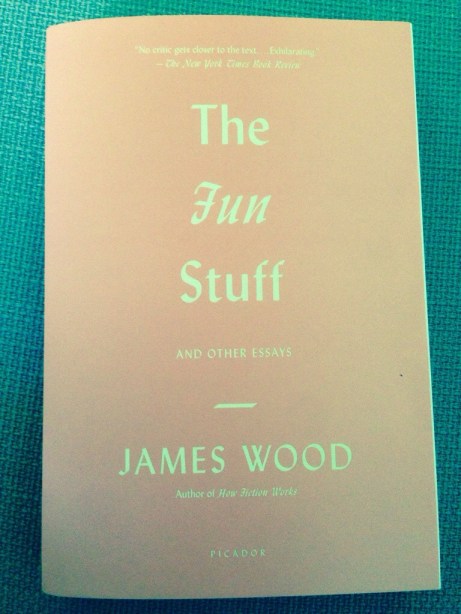
The Fun Stuff, collecting many of Wood’s pieces from The New Yorker (but also elsewhere), is less pretentious than How Fiction Works, Wood’s last book, a polemic hiding behind the guise of literary criticism that faulted pretty much any prose stylist who deviated from a certain mode of 19th-century free indirect style.
I’ve already read a number of the pieces collected in The Fun Stuff, which is finally out in the U.S. in trade paperback thanks to Picador. You might have read them too. His essays championing Lydia Davis and László Krasznahorkai are fine fun stuff, as is his take on the late W.G. Sebald (first published as an introduction to Austerlitz). His appreciative review of Cormac McCarthy’s The Roadthough is in many ways a retake on his review of Blood Meridian—Wood can only view McCarthy’s existential questions through the lens of theodicy.
James Wood is maybe most fun—or most infuriating—when he’s at his harshest. The case file here is his pointed take-down “Paul Auster’s Shallowness.” Here, Wood goes through an Auster plot “checklist”:
A protagonist, nearly always male, often a writer or an intellectual, lives monkishly, coddling a loss—a deceased or divorced wife, dead children, a missing brother. Violent accidents perforate the narratives, both as a means of insisting on the contingency of existence and as a means of keeping the reader reading—a woman drawn and quartered in a German concentration camp, a man beheaded in Iraq, a woman severely beaten by a man with whom she is about to have sex, a boy kept in a darkened room for nine years and periodically beaten, a woman accidentally shot in the eye, and so on. The narratives conduct themselves like realistic stories, except for a slight lack of conviction and a general B-movie atmosphere. People say things like “You’re one tough cookie, kid,” or “My pussy’s not for sale,” or “It’s an old story, pal. You let your dick do your thinking for you, and that’s what happens.” A visiting text—Chateaubriand, Rousseau, Hawthorne, Poe, Beckett—is elegantly slid into the host book. There are doubles, alter egos, doppelgängers, and appearances by a character named Paul Auster. At the end of the story, the hints that have been scattered like mouse droppings lead us to the postmodern hole in the book where the rodent got in: the revelation that some or all of what we have been reading has probably been imagined by the protagonist. Hey, Roger Phaedo invented Charlie Dark! It was all in his head.
I’m not a particular fan of Paul Auster, but I imagine those who deeply enjoy his work could feel personally insulted by Wood’s take-down. We get close to the books and authors we love. I think what manifests most in Wood’s criticism here—and elsewhere—is the weariness of someone who once deeply loved literature but who is now perhaps oppressed by it—who has become too aware of its mechanics, its forms, its stale formulations and bad parlor tricks.
Wood telegraphs far more passion and generosity in the collection’s title essay, which is about Keith Moon, the legendary drummer of The Who. He compares Moon’s rhythmic chops to D.H. Lawrence’s sentences:
For me, this playing is like an ideal sentence of prose, a sentence I have always wanted to write and never quite had the confidence to: a long, passionate onrush, formally controlled and joyously messy, propulsive but digressively self-interrupted, attired but disheveled, careful and lawless, right and wrong. (You can encounter such sentences in Lawrence’s prose, in Bellow’s, sometimes in David Foster Wallace’s.) Such a sentence would be a breaking out, an escape. And drumming has always represented for me that dream of escape, when the body forgets itself, surrenders its awful self-consciousness.
I like how personal he gets here. This essay opens the collection, and the one that closes it, “Packing My Father-In-Law’s Library” also communicates personally with the reader. Unconstrained by the pretense of a book review, Wood waxes on families and libraries and the meaning of life. When he writes of his father-in-law, whose books he’s sorting through, that “The books somehow made him smaller, not larger,” it’s hard not to hear a strong undertone of autobiography in the note.
Wood’s lyric essays are an unusual standout here (unusual in the sense that if someone had strung together the words James Wood’s lyric essays, I’d probably roll my eyes). They reveal a love of reading that goes missing in his attacks and his quibbling pieces. The serious literary critic is not, of course, beholden to being merely a cheerleader for literature (or worse, a cheerleader for publishing)—but I do think that the serious literary critic should offer something beyond condemnation or unenthusiastic grumbling. The risk the professional critic runs is to see the machinations of art too plainly, to become jaded to the point that experiencing the sublime is no longer possible (Tobias Wolff’s fantastic story “Bullet in the Brain” deals handily with this theme). Wood guides us here to several writers who disrupt, estrange, and resynthesize the tired tropes of literary fiction—and it’s in that strangeness where we can find the real fun stuff.
A story is told of an inhabitant of Unst, who, in walking on the sandy margin of a voe, saw a number of mermen and mermaids dancing by moonlight, and several seal-skins strewed beside them on the ground. At his approach they immediately fled to secure their garbs, and, taking upon themselves the form of seals, plunged immediately into the sea. But as the Shetlander perceived that one skin lay close to his feet, he snatched it up, bore it swiftly away, and placed it in concealment. On returning to the shore he met the fairest damsel that was ever gazed upon by mortal eyes, lamenting the robbery, by which she had become an exile from her submarine friends, and a tenant of the upper world. Vainly she implored the restitution of her property; the man had drunk deeply of love, and was inexorable; but he offered her protection beneath his roof as his betrothed spouse. The merlady, perceiving that she must become an inhabitant of the earth, found that she could not do better than accept of the offer. This strange attachment subsisted for many years, and the couple had several children. The Shetlander’s love for his merwife was unbounded, but his affection was coldly returned. The lady would often steal alone to the desert strand, and, on a signal being given, a large seal would make his appearance, with whom she would hold, in an unknown tongue, an anxious conference. Years had thus glided away, when it happened that one of the children, in the course of his play, found concealed beneath a stack of corn a seal’s skin; and, delighted with the prize, he ran with it to his mother. Her eyes glistened with rapture—she gazed upon it as her own—as the means by which she could pass through the ocean that led to her native home. She burst forth into an ecstasy of joy, which was only moderated when she beheld her children, whom she was now about to leave; and, after hastily embracing them, she fled with all speed towards the sea-side. The husband immediately returned, learned the discovery that had taken place, ran to overtake his wife, but only arrived in time to see her transformation of shape completed—to see her, in the form of a seal, bound from the ledge of a rock into the sea. The large animal of the same kind with whom she had held a secret converse soon appeared, and evidently congratulated her, in the most tender manner, on her escape. But before she dived to unknown depths, she cast a parting glance at the wretched Shetlander, whose despairing looks excited in her breast a few transient feelings of commiseration.
“Farewell!” said she to him, “and may all good attend you. I loved you very well when I resided upon earth, but I always loved my first husband much better.”
I AM come of a race noted for vigor of fancy and ardor of passion. Men have called me mad; but the question is not yet settled, whether madness is or is not the loftiest intelligence—whether much that is glorious—whether all that is profound—does not spring from disease of thought—from moods of mind exalted at the expense of the general intellect. They who dream by day are cognizant of many things which escape those who dream only by night. In their gray visions they obtain glimpses of eternity, and thrill, in awakening, to find that they have been upon the verge of the great secret. In snatches, they learn something of the wisdom which is of good, and more of the mere knowledge which is of evil. They penetrate, however, rudderless or compassless into the vast ocean of the “light ineffable,” and again, like the adventures of the Nubian geographer, “agressi sunt mare tenebrarum, quid in eo esset exploraturi.”
We will say, then, that I am mad. I grant, at least, that there are two distinct conditions of my mental existence—the condition of a lucid reason, not to be disputed, and belonging to the memory of events forming the first epoch of my life—and a condition of shadow and doubt, appertaining to the present, and to the recollection of what constitutes the second great era of my being. Therefore, what I shall tell of the earlier period, believe; and to what I may relate of the later time, give only such credit as may seem due, or doubt it altogether, or, if doubt it ye cannot, then play unto its riddle the Oedipus.
She whom I loved in youth, and of whom I now pen calmly and distinctly these remembrances, was the sole daughter of the only sister of my mother long departed. Eleonora was the name of my cousin. We had always dwelled together, beneath a tropical sun, in the Valley of the Many-Colored Grass. No unguided footstep ever came upon that vale; for it lay away up among a range of giant hills that hung beetling around about it, shutting out the sunlight from its sweetest recesses. No path was trodden in its vicinity; and, to reach our happy home, there was need of putting back, with force, the foliage of many thousands of forest trees, and of crushing to death the glories of many millions of fragrant flowers. Thus it was that we lived all alone, knowing nothing of the world without the valley—I, and my cousin, and her mother.
From the dim regions beyond the mountains at the upper end of our encircled domain, there crept out a narrow and deep river, brighter than all save the eyes of Eleonora; and, winding stealthily about in mazy courses, it passed away, at length, through a shadowy gorge, among hills still dimmer than those whence it had issued. We called it the “River of Silence”; for there seemed to be a hushing influence in its flow. No murmur arose from its bed, and so gently it wandered along, that the pearly pebbles upon which we loved to gaze, far down within its bosom, stirred not at all, but lay in a motionless content, each in its own old station, shining on gloriously forever.
The margin of the river, and of the many dazzling rivulets that glided through devious ways into its channel, as well as the spaces that extended from the margins away down into the depths of the streams until they reached the bed of pebbles at the bottom,—these spots, not less than the whole surface of the valley, from the river to the mountains that girdled it in, were carpeted all by a soft green grass, thick, short, perfectly even, and vanilla-perfumed, but so besprinkled throughout with the yellow buttercup, the white daisy, the purple violet, and the ruby-red asphodel, that its exceeding beauty spoke to our hearts in loud tones, of the love and of the glory of God.
And, here and there, in groves about this grass, like wildernesses of dreams, sprang up fantastic trees, whose tall slender stems stood not upright, but slanted gracefully toward the light that peered at noon-day into the centre of the valley. Their mark was speckled with the vivid alternate splendor of ebony and silver, and was smoother than all save the cheeks of Eleonora; so that, but for the brilliant green of the huge leaves that spread from their summits in long, tremulous lines, dallying with the Zephyrs, one might have fancied them giant serpents of Syria doing homage to their sovereign the Sun.
Hand in hand about this valley, for fifteen years, roamed I with Eleonora before Love entered within our hearts. It was one evening at the close of the third lustrum of her life, and of the fourth of my own, that we sat, locked in each other’s embrace, beneath the serpent-like trees, and looked down within the water of the River of Silence at our images therein. We spoke no words during the rest of that sweet day, and our words even upon the morrow were tremulous and few. We had drawn the God Eros from that wave, and now we felt that he had enkindled within us the fiery souls of our forefathers. The passions which had for centuries distinguished our race, came thronging with the fancies for which they had been equally noted, and together breathed a delirious bliss over the Valley of the Many-Colored Grass. A change fell upon all things. Strange, brilliant flowers, star-shaped, burn out upon the trees where no flowers had been known before. The tints of the green carpet deepened; and when, one by one, the white daisies shrank away, there sprang up in place of them, ten by ten of the ruby-red asphodel. And life arose in our paths; for the tall flamingo, hitherto unseen, with all gay glowing birds, flaunted his scarlet plumage before us. The golden and silver fish haunted the river, out of the bosom of which issued, little by little, a murmur that swelled, at length, into a lulling melody more divine than that of the harp of Aeolus-sweeter than all save the voice of Eleonora. And now, too, a voluminous cloud, which we had long watched in the regions of Hesper, floated out thence, all gorgeous in crimson and gold, and settling in peace above us, sank, day by day, lower and lower, until its edges rested upon the tops of the mountains, turning all their dimness into magnificence, and shutting us up, as if forever, within a magic prison-house of grandeur and of glory.
The loveliness of Eleonora was that of the Seraphim; but she was a maiden artless and innocent as the brief life she had led among the flowers. No guile disguised the fervor of love which animated her heart, and she examined with me its inmost recesses as we walked together in the Valley of the Many-Colored Grass, and discoursed of the mighty changes which had lately taken place therein.
At length, having spoken one day, in tears, of the last sad change which must befall Humanity, she thenceforward dwelt only upon this one sorrowful theme, interweaving it into all our converse, as, in the songs of the bard of Schiraz, the same images are found occurring, again and again, in every impressive variation of phrase.
She had seen that the finger of Death was upon her bosom—that, like the ephemeron, she had been made perfect in loveliness only to die; but the terrors of the grave to her lay solely in a consideration which she revealed to me, one evening at twilight, by the banks of the River of Silence. She grieved to think that, having entombed her in the Valley of the Many-Colored Grass, I would quit forever its happy recesses, transferring the love which now was so passionately her own to some maiden of the outer and everyday world. And, then and there, I threw myself hurriedly at the feet of Eleonora, and offered up a vow, to herself and to Heaven, that I would never bind myself in marriage to any daughter of Earth—that I would in no manner prove recreant to her dear memory, or to the memory of the devout affection with which she had blessed me. And I called the Mighty Ruler of the Universe to witness the pious solemnity of my vow. And the curse which I invoked of Him and of her, a saint in Helusion should I prove traitorous to that promise, involved a penalty the exceeding great horror of which will not permit me to make record of it here. And the bright eyes of Eleonora grew brighter at my words; and she sighed as if a deadly burthen had been taken from her breast; and she trembled and very bitterly wept; but she made acceptance of the vow, (for what was she but a child?) and it made easy to her the bed of her death. And she said to me, not many days afterward, tranquilly dying, that, because of what I had done for the comfort of her spirit she would watch over me in that spirit when departed, and, if so it were permitted her return to me visibly in the watches of the night; but, if this thing were, indeed, beyond the power of the souls in Paradise, that she would, at least, give me frequent indications of her presence, sighing upon me in the evening winds, or filling the air which I breathed with perfume from the censers of the angels. And, with these words upon her lips, she yielded up her innocent life, putting an end to the first epoch of my own.
Thus far I have faithfully said. But as I pass the barrier in Time’s path, formed by the death of my beloved, and proceed with the second era of my existence, I feel that a shadow gathers over my brain, and I mistrust the perfect sanity of the record. But let me on.—Years dragged themselves along heavily, and still I dwelled within the Valley of the Many-Colored Grass; but a second change had come upon all things. The star-shaped flowers shrank into the stems of the trees, and appeared no more. The tints of the green carpet faded; and, one by one, the ruby-red asphodels withered away; and there sprang up, in place of them, ten by ten, dark, eye-like violets, that writhed uneasily and were ever encumbered with dew. And Life departed from our paths; for the tall flamingo flaunted no longer his scarlet plumage before us, but flew sadly from the vale into the hills, with all the gay glowing birds that had arrived in his company. And the golden and silver fish swam down through the gorge at the lower end of our domain and bedecked the sweet river never again. And the lulling melody that had been softer than the wind-harp of Aeolus, and more divine than all save the voice of Eleonora, it died little by little away, in murmurs growing lower and lower, until the stream returned, at length, utterly, into the solemnity of its original silence. And then, lastly, the voluminous cloud uprose, and, abandoning the tops of the mountains to the dimness of old, fell back into the regions of Hesper, and took away all its manifold golden and gorgeous glories from the Valley of the Many-Colored Grass.
Yet the promises of Eleonora were not forgotten; for I heard the sounds of the swinging of the censers of the angels; and streams of a holy perfume floated ever and ever about the valley; and at lone hours, when my heart beat heavily, the winds that bathed my brow came unto me laden with soft sighs; and indistinct murmurs filled often the night air, and once—oh, but once only! I was awakened from a slumber, like the slumber of death, by the pressing of spiritual lips upon my own.
But the void within my heart refused, even thus, to be filled. I longed for the love which had before filled it to overflowing. At length the valley pained me through its memories of Eleonora, and I left it for ever for the vanities and the turbulent triumphs of the world.
I found myself within a strange city, where all things might have served to blot from recollection the sweet dreams I had dreamed so long in the Valley of the Many-Colored Grass. The pomps and pageantries of a stately court, and the mad clangor of arms, and the radiant loveliness of women, bewildered and intoxicated my brain. But as yet my soul had proved true to its vows, and the indications of the presence of Eleonora were still given me in the silent hours of the night. Suddenly these manifestations they ceased, and the world grew dark before mine eyes, and I stood aghast at the burning thoughts which possessed, at the terrible temptations which beset me; for there came from some far, far distant and unknown land, into the gay court of the king I served, a maiden to whose beauty my whole recreant heart yielded at once—at whose footstool I bowed down without a struggle, in the most ardent, in the most abject worship of love. What, indeed, was my passion for the young girl of the valley in comparison with the fervor, and the delirium, and the spirit-lifting ecstasy of adoration with which I poured out my whole soul in tears at the feet of the ethereal Ermengarde?—Oh, bright was the seraph Ermengarde! and in that knowledge I had room for none other.—Oh, divine was the angel Ermengarde! and as I looked down into the depths of her memorial eyes, I thought only of them—and of her.
I wedded;—nor dreaded the curse I had invoked; and its bitterness was not visited upon me. And once—but once again in the silence of the night; there came through my lattice the soft sighs which had forsaken me; and they modelled themselves into familiar and sweet voice, saying:
“Sleep in peace!—for the Spirit of Love reigneth and ruleth, and, in taking to thy passionate heart her who is Ermengarde, thou art absolved, for reasons which shall be made known to thee in Heaven, of thy vows unto Eleonora.”
These are (as near as I can tell) all the versions (translations, if you will) of Herman Melville’s Moby-Dick at our house.
This is my beloved copy, a hardback Signet Classic edition that’s the size of a mass market paperback.
I love this copy because it was the one that I read when I really read Moby-Dick (I also kinda sorta ‘klept it).
These abridged versions for young readers are the same, despite the cooler updated cover on the right, which I guess fooled my wife into buying another copy for me to read with my daughter. (She liked it the first time though, so….). Even the illustrations are the same:
More of a resource than a reading copy—although as Norton Critical Editions go, this one’s footnotes aren’t too obtrusive. Handy dictionary of nautical terms.
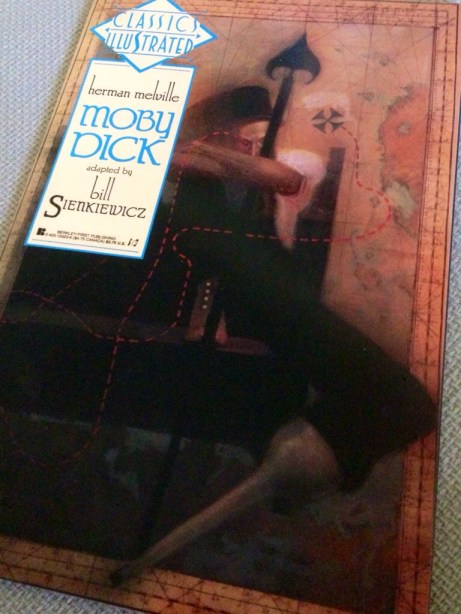
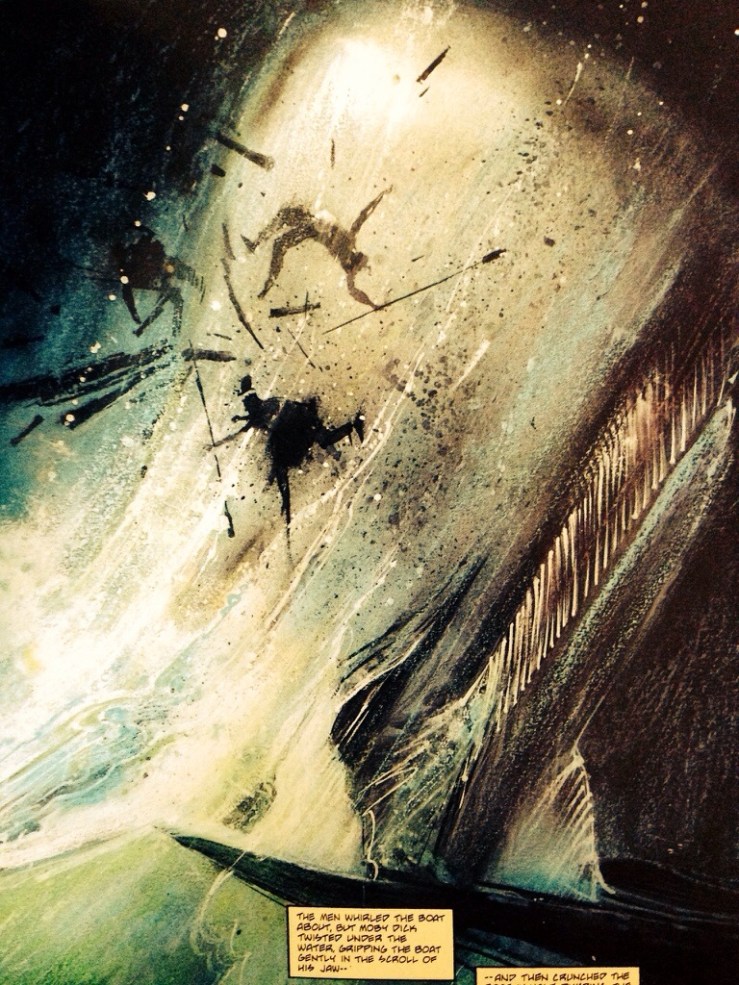
I am a huge fan of Bill Sienkiewicz. And Moby-Dick. I wish his Moby-Dick adaptation had no words though.
My dad’s childhood adaption, a Grosset & Dunlap from the early ’60s.
Sam Ita’s fantastic pop-up adaptation fails to mention Herman Melville’s name at all.
Despite the gross oversight, it’s given me hours of joy with my kids.
Moby-Dick was published on October 18th, 1851 in England.
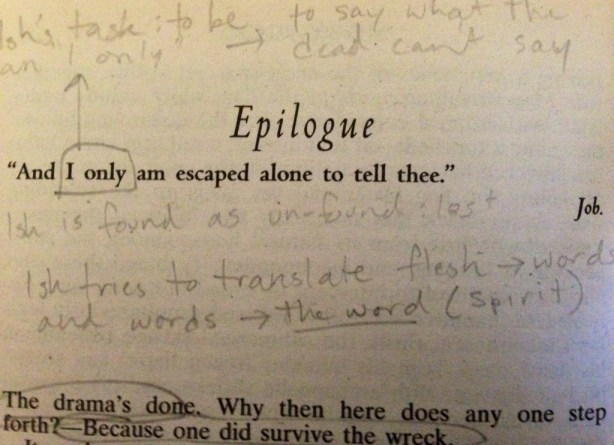
The English printer Peter Bentley’s text contained numerous errors, including leaving out the epilogue, where we learn that Ishmael survives to bear witness to disaster.
Although the American printing in November of 1851 emended many of these errors, the early reviews of Moby-Dick were scathing, and Melville’s career and reputation deteriorated.
It wasn’t until the advent of literary modernism in the first decades of the twentieth century that the world caught up to Moby-Dick.








 Biblioklept