“Togetherness” — Thomas Pynchon

160N09658_9LTYB

(Click to enlarge.)

“Togetherness,” by Thomas Pynchon was published in the vol. 16, no. 12 issue of Aerospace Safety in December 1960. The byline reads “Thomas H. Pynchon” (for Huggles, presumably).

Full text of the article here (for completists only, of course).

Culte de la mayonnaise (Thomas Pynchon)

THE NEXT TIME he saw Pléiade Lafrisée was at a café-restaurant off the Place d’Armes. It would not occur to him until much later to wonder if she had arranged the encounter. She was in pale violet peau de soie, and a hat so beguiling that Kit was only momentarily surprised to find himself with an erection. It was still early in the study of these matters, only a few brave pioneers like the Baron von Krafft-Ebing had dared peep into the strange and weirdly twilit country of hat-fetishism—not that Kit noticed stuff like that ordinarily, but it happened actually to be a gray toque of draped velvet, trimmed with antique guipure, and a tall ostrich plume dyed the same shade of violet as her dress. . . .

“This? One finds them in every other midinette’s haunt, literally for sous.”

“Oh. I must’ve been staring. What happened to you the other night?”

“Come. You can buy me a Lambic.”

The place was like a museum of mayonnaise. This being just at the height of the culte de la mayonnaise then sweeping Belgium, oversize exhibits of the ovoöleaginous emulsion were to be encountered at every hand. Heaps of Mayonnaise Grenache, surrounded by plates of smoked turkey and tongue, glowed redly as if from within, while with less, if any, reference to actual food it might have been there to modify, mountains of Chantilly mayonnaise, swept upward in gravity-impervious peaks insubstantial as cloud, along with towering masses of green mayonnaise, basins of boiled mayonnaise, mayonnaise baked into soufflés, not to mention a number of not entirely successful mayonnaises, under some obscure attainder, or on occasion passing as something else, dominated every corner.

“How much do you know of La Mayonnaise?” she inquired.

He shrugged. “Maybe up to the part that goes ‘Aux armes, citoyens’—”

But she was frowning, earnest as he had seldom seen her. “La Mayonnaise,” Pléiade explained, “has its origins in the moral squalor of the court of Louis XV—here in Belgium the affinity should not be too surprising. The courts of Leopold and Louis are not that different except in time, and what is time? Both monumentally deluded men, maintaining their power through oppression of the innocent. One might usefully compare Cleo de Mérode and the marquise de Pompadour. Neuropathists would recognize in both kings a desire to construct a self-consistent world to live inside, which allows them to continue the great damage they are inflicting on the world the rest of us must live in.

“The sauce was invented as a new sensation for jaded palates at court by the duc de Richelieu, at first known as mahonnaise after Mahon, the chief port of Minorca, the scene of the due’s dubious ‘victory’ in 1756 over the illfated Admiral Byng. Basically Louis’s drug dealer and pimp, Richelieu, known for opium recipes to fit all occasions, is also credited with the introduction into France of the cantharides, or Spanish fly.” She gazed pointedly at Kit’s trousers. “What might this aphrodisiac have in common with the mayonnaise? That the beetles must be gathered and killed by exposing them to vinegar fumes suggests an emphasis on living or recently living creatures—the egg yolk perhaps regarded as a conscious entity—cooks will speak of whipping, beating, binding, penetration, submission, surrender. There is an undoubtedly Sadean aspect to the mayonnaise. No getting past that.”

Kit was a little confused by now. “It always struck me as kind of, I don’t know . . . bland?”

“Until you look within. Mustard, for example, mustard and cantharides, n’estce pas? Both arousing the blood. Blistering the skin. Mustard is the widelyknown key to resurrecting a failed mayonnaise, as is the cantharides to reviving broken desire.”

“You’ve been thinking about mayonnaise a lot, mademoiselle.”

“Meet me tonight,” a sudden fierce whisper, “out at the Mayonnaise Works, and you shall perhaps understand things it is given only to a few to know. There will be a carriage waiting.” She pressed his hand and was gone in a mist of vetiver, abruptly as the other evening.

A passage from Thomas Pynchon’s novel Against the Day; I don’t think you need any context to appreciate this passage.


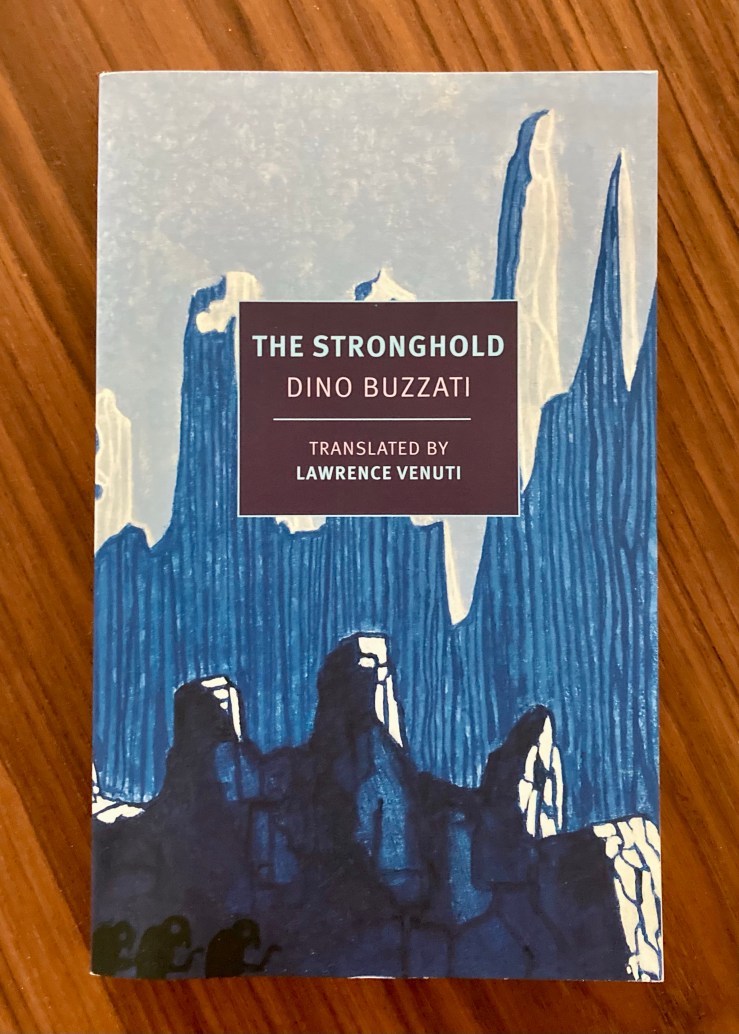
A review of The Stronghold, Dino Buzzati’s novel of deferred hope and ecstatic boredom

Dino Buzzati’s 1940 novel Il deserto dei Tartari (retitled The Stronghold in Lawrence Venuti’s new English translation) takes place in an unidentified time in an unidentified country. Our protagonist is Giovanni Drogo, freshly graduated from an unspecified military academy and ready for a thrilling life of combat and adventure at his new post, Fortezza Bastiani, a fortress at the border of the Tartar steppe. He and his fellow soldiers wait in the hope of attaining glory.

And they continue to wait.

The nebulous Tartars repeatedly fail to appear, offering only the vaguest hints of their alien existence. The soldiers of Fortezza Bastiani live a life of anxious monotony, their desires and hopes for the heroics of war flattened by the boredom of day to day life. It’s all very existentialist.

From the opening pages of The Stronghold, Buzzati conjures a strange but familiar world, usually telegraphed in brisk, unadorned prose (a style he honed in his career as a journalist). Everything is slightly off, slightly anxious. Initially, a reader might chalk the disquieting style up to our viewpoint-character Drogo’s own hesitancy as he enters into a new life as a military officer, but we soon find ourselves in an uncanny realm.

The world of the fortezza is somehow simultaneously dull and enthralling. Consider Drogo’s first glimpse of the fortress:

Fortezza Bastiani was neither imposing, with its low walls, or beautiful in any  way. Its towers and ramparts weren’t picturesque. Absolutely nothing alleviated its starkness or recalled the sweet things of life. Yet Drogo gazed at it, hypnotized, as on the previous night at the base of the gorge. And an inexplicable ardor penetrated his heart.

This “inexplicable ardor” is nevertheless ambiguous in its penetration; after learning he is nominally free to choose a different, perhaps more invigorating post, Drogo elects to transfer from the fort. However, his commanding officer suggests that he stay for four months to avoid bureaucratic problems with the higher ups. That four-month season of waiting turns into a lifetime of waiting. And then waiting some more.

Drogo and his fellow soldiers hunger for the glory of contesting the Tartars, an enemy they know utterly nothing about. Like almost every sociopolitical, cultural, and even technological detail in The Stronghold, the specific nature of the Tartar enemy is collapsed into something closer to a fairy tale or a rumor. Vague and dreamlike, the Tartars are not a geopolitical entity; they are not even an other, but rather the figment of an other, the kernel of a dream that promises action. And this dim promise keeps the soldiers waiting at the Fortezza:

From the northern desert would arrive their fortune, the occasion of their exploits, the miraculous hour that befalls everyone at least once. Because of this vague eventuality, which grew increasingly uncertain with time, grown men wasted the best part of their lives there.

The narrator, hovering in Drogo’s consciousness, imagines an interlocutor explaining to one of these soldiers that his “entire life will be the same, utterly the same, till the very last moment” — and then imagines the hypothetical soldier’s response: “Something else must come to pass, something truly worthy.” Drogo here believes he has grasped the “transparent secret” of the soldiers of the Fortezza, but also imagines himself an “uncontaminated onlooker.” But it’s too late. Drogo too has committed to waiting for something else to come to pass.

Nothing comes to pass—or nearly nothing. (One might read The Stronghold as an extended riff on Kafka’s wonderful parable “Before the Law.“) However, this is not to say though that Buzzati’s portraiture of tedium is itself tedious. The boredom he conjures is an ecstatic boredom, anxious and writhing, exploding in strange, magical moments of hallucinations and night terrors.

In one of the novel’s most extraordinary sequences, “fragile apparitions, quite like fairies” enter Drogo’s dreams, bearing away to some spectacular land Drogo’s fallen comrade who is now converted to a child dressed in a rich velvet suit. In another episode, a mysterious horse appears from the desert, sending the men into fits of hope and despair culminating in a horrific incident that underscores the absurdities of military rigor. Late in the novel, a much-older Drogo’s desire for action, for something to come to pass, tips into near-comic paranoia, as he and a younger officer fool around with a telescope to no avail.

After all this waiting in hope, The Stronghold concludes with a devastating Kafkaesque punchline which I shall not spoil here.

It will be clear to most seasoned readers that Kafka was an influence on Buzzati even without Venuti’s afterword, which details Buzzati’s admiration for the Bohemian writer. Buzzati does not ape the older master so much as evoke the same state of anxious alterity we find in texts like “The Great Wall of China” and The Castle. Stepping into The Stronghold, one is reminded of other branches of the Kafka tree, like Kazuo Ishiguro’s The Unconsoled, Kobo Abe’s The Woman in the Dunes, Alasdair Gray’s Lanark, and Albert Camus’ The Stranger, among many others.

Like many Kafkaesque works, one might be inclined to fob his own allegorical readings onto The Stronghold. In his afterword, Venuti points out that early English-language readings of Buzzati’s novel tended to interpret Il deserto dei Tartari as an anti-totalitarian tract. Il deserto dei Tartari was first translated as The Tartar Steppe by Stuart Hood in 1952, and many of its contemporary critics read the novel against the backdrop of the Cold War.

While praising the “remarkable accomplishment” of Hood’s translation, Venuti differentiates his own “historically oriented interpretation” of the novel; namely, his attempt to more emphatically underline Il deserto dei Tartari’s “latent critique” of fascism. Venuti points out that “Hood had twice rendered the generic ‘stivali’ (boots) with the politically marked term ‘jackboots,'” adding, “I tripled its use.”

Venuti also discusses at some lengths his choice to change Hood’s title. He writes that Buzzati initially wanted to title the book La fortezza, but this name was rejected by the novel’s publisher who worried it might be misunderstood by the reading public. In his attempt to further historicize his translation (and differentiate it from Hood’s), Venuti elected to remove Steppe from the title fearing it “might be taken as an anachronistic reference to the Soviet Union.” He also avoided The Fort or The Fortress as a possible titles, worried they might underscore Buzzati’s “debt to Kafka’s The Castle.” Venuti eventually settled on The Stronghold, suggesting that this title helps to emphasize the “cult of virility championed during the Fascist period” while also “conveying the sheer tenaciousness of the soldier’s heroic fantasies, as well as their inability to escape their debilitating obsession.”

I haven’t read Hood’s translation of Il deserto dei Tartari, but I appreciated Venuti’s, which, as I pointed out above, takes place in an unidentified time in an unidentified country. The novel’s eerie, fable-like quality—a quality that resists historicity—is what most engages me. Buzzati’s book captures the paradox of a modern life that valorizes the pursuit of glory (or at least happiness) while simultaneously creating a working conditions that crush the human spirit. We can find this paradox in Herman Melville’s Bartleby or Mike Judge’s Office Space; we can find it in Antonio di Benedetto’s Zama or Mike Judge’s Enlightened; we can find if in David Foster Wallace’s The Pale King or Dan Erickson’s recent show Severance. I could go on of course.

Some of these boredom narratives seek to assuage us, or make us laugh or cry—in recognition, spite, pity, despair, or hope. Some of these boredom narratives find resistance in art, or in just plain resistance. Buzzati’s novel offers something more like a warning. It is not possible to be an “uncontaminated onlooker” in one’s own life. It’s not enough to wait forever, even if we wait in hope.

The Stronghold is available now from New York Review Books.
St. Patrick and the Druid, an episode from Finnegans Wake (with explication from Joseph Campbell)

On pages 611-613 of James Joyce’s Finnegans Wake, St. Patrick meets the archdruid Balkelly:

Tunc. Bymeby, bullocky vampas tappany bobs topside joss pidgin fella Balkelly, archdruid of islish chinchinjoss in the his heptachromatic sevenhued septicoloured roranyellgreenlindigan mantle finish he show along the his mister guest Patholic with alb belongahim the whose throat hum with of sametime all the his cassock groaner fellas of greysfriaryfamily he fast all time what time all him monkafellas with Same Patholic, quoniam, speeching, yeh not speeching noh man liberty is, he drink up words, scilicet, tomorrow till recover will not, all too many much illusiones through photoprismic velamina of hueful panepiphanal world spectacurum of Lord Joss, the of which zoantholitic furniture, from mineral through vegetal to animal, not appear to full up to-gether fallen man than under but one photoreflection of the several iridals gradationes of solar light, that one which that part of it (furnit of heupanepi world) had shown itself (part of fur of huepanwor) unable to absorbere, whereas for numpa one pura —— duxed seer in seventh degree of wisdom of Entis–Onton he savvy inside true inwardness of reality, the Ding hvad in idself id est, all objects (of panepiwor) allside showed themselves in trues coloribus resplendent with sextuple gloria of light actually re-tained, untisintus, inside them (obs of epiwo). Rumnant Patholic, stareotypopticus, no catch all that preachybook, utpiam, tomorrow recover thing even is not, bymeby vampsybobsy tap — panasbullocks topside joss pidginfella Bilkilly–Belkelly say pat — fella, ontesantes, twotime hemhaltshealing, with other words verbigratiagrading from murmurulentous till stridulocelerious in a hunghoranghoangoly tsinglontseng while his comprehen-durient, with diminishing claractinism, augumentationed himself in caloripeia to vision so throughsighty, you anxioust melan-cholic, High Thats Hight Uberking Leary his fiery grassbelong- head all show colour of sorrelwood herbgreen, again, nigger- blonker, of the his essixcoloured holmgrewnworsteds costume the his fellow saffron pettikilt look same hue of boiled spinasses,other thing, voluntary mutismuser, he not compyhandy the his golden twobreasttorc look justsamelike curlicabbis, moreafter, to pace negativisticists, verdant readyrainroof belongahim Exuber High Ober King Leary very dead, what he wish to say, spit of superexuberabundancy plenty laurel leaves, after that com-mander bulopent eyes of Most Highest Ardreetsar King same thing like thyme choppy upon parsley, alongsidethat, if please-sir, nos displace tauttung, sowlofabishospastored, enamel Indian gem in maledictive fingerfondler of High High Siresultan Em-peror all same like one fellow olive lentil, onthelongsidethat, by undesendas, kirikirikiring, violaceous warwon contusiones of facebuts of Highup Big Cockywocky Sublissimime Autocrat, for that with pure hueglut intensely saturated one, tinged uniformly, allaroundside upinandoutdown, very like you seecut chowchow of plentymuch sennacassia Hump cumps Ebblybally! Sukkot?

Punc. Bigseer, refrects the petty padre, whackling it out, a tumble to take, tripeness to call thing and to call if say is good while, you pore shiroskuro blackinwhitepaddynger, by thiswis aposterioprismically apatstrophied and paralogically periparo-lysed, celestial from principalest of Iro’s Irismans ruinboon pot before, (for beingtime monkblinkers timeblinged completamen-tarily murkblankered in their neutrolysis between the possible viriditude of the sager and the probable eruberuption of the saint), as My tappropinquish to Me wipenmeselps gnosegates a handcaughtscheaf of synthetic shammyrag to hims hers, seeming-such four three two agreement cause heart to be might, saving to Balenoarch (he kneeleths), to Great Balenoarch (he kneeleths down) to Greatest Great Balenoarch (he kneeleths down quite-somely), the sound salse sympol in a weedwayedwold of the firethere the sun in his halo cast. Onmen.

That was thing, bygotter, the thing, bogcotton, the very thing, begad! Even to uptoputty Bilkilly–Belkelly-Balkally. Who was for shouting down the shatton on the lamp of Jeeshees. Sweating on to stonker and throw his seven. As he shuck his thumping fore features apt the hoyhop of His Ards.

Thud.

Good safe firelamp! hailed the heliots. Goldselforelump! Halled they. Awed. Where thereon the skyfold high, trampa-trampatramp. Adie. Per ye comdoom doominoom noonstroom. Yeasome priestomes. Fullyhum toowhoom.


Continue reading “St. Patrick and the Druid, an episode from Finnegans Wake (with explication from Joseph Campbell)”

“A Society of Scoundrels” — Franz Kafka

“A Society of Scoundrels”

by

Franz Kafka

Translated by Michael Hofmann


There was once a society of scoundrels, or rather not scoundrels per se, just ordinary, average people. They always stuck together. When one of them had perpetrated some rascally act, or rather, nothing really rascally, just averagely bad, he would confess it to the others, and they investigated it, condemned it, imposed penalties, forgave him, etc. This wasn’t corrupt — the interests of the individual and the society were kept in balance and the confessor received the punishment he asked for. So they always stuck together, and even after their death they didn’t abandon their society, but ascended to heaven in a troop. It was a sight of childlike innocence to see them flying. But since everything at heaven’s gate is broken up into its component parts, they plunged down like so many rocks.

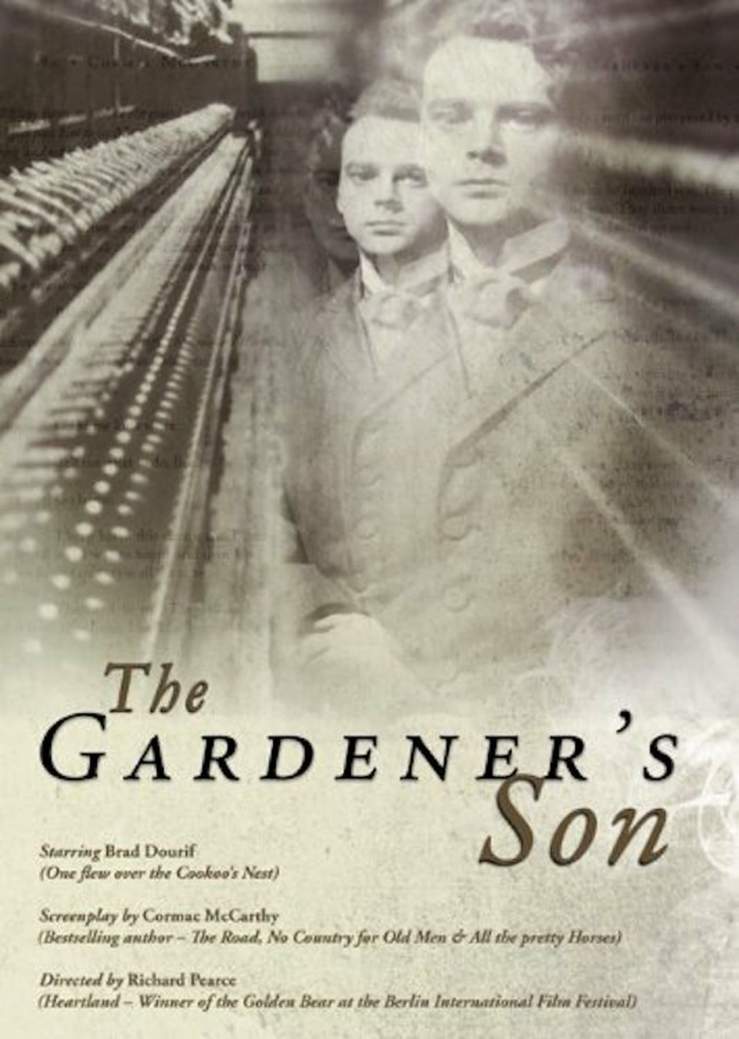
Watch a 1977 PBS film adaptation of Cormac McCarthy’s The Gardener’s Son

Well, what happened there is a metaphor | William H. Gass

The full metaphor is not accepted any more. It isn’t taken seriously, and as we say, an arm of the sea threw a curve at the batter. No. Things do deflate and become literal in that sense. That is a conventional, standard way of thinking. My notion of metaphor comes again from scientific practice. Science consists of two realms of scientific operation: on one view, mathematical systems are proceeding and developing on their own, with their own rules on relationship. Then on the other side you have a collection of observations — very chaotic, unorganized. The idea of science is to get the observations into the system, because over here in the system all is wonderful, deductive, clear (relatively speaking). If we could get the observations over here, we could create a model which is an invested system. What Galileo did, for example, was to figure out how to get motion into geometry, once he saw that an inclined plane was a triangle, or that he could get, say, distance as a rectangle with speed and time — it’s just the same formula as the area of a rectangle. Then somebody like Descartes transforms the whole science of mechanics by putting geometry into algebra—makes it a much more sophisticated, subtle system. Everything is transformed without any move except that the algebra swallows geometry, and geometry has swallowed kinetics.

So you have those great moves, and what it means is that what science does is develop a model in which we look at the shadow the tree casts, and we see a right triangle. If we make a few measurements, we make some deductions. Now, what a metaphor tends to do, it seems to me, is that one element of a metaphor tends to stand as the abstract system, while the other is the set of unorganized observations, and what you build is a model that all observational system to be structured by the abstract system is a choice — it is arbitrary, in the sense that there is nothing more abstract about the one term in the metaphor than the other. And you can have interactive ones where they take turns — this suddenly is the abstract system where it was disorganized.

Furthermore, what is the system? Let’s say, “rose.” There is a history of the term, and it isn’t organized in a nice, algebraic way. It is, in fact, this great landscape of meanings connected in various ways, and sometimes not, and even connected with other meanings — “he rose up” — just on sound parallels. We now create this model that is one thing seen in terms of this whole system. Then, just as in science, you have the scope of the law. It only holds for gases. It has only a range of things. And so there is this scope of the metaphor: How far is it pushed? Is it just to be held for a certain distance, and then dropped? Shakespeare is wonderful, because he tends to hold on to an image throughout a play.

For me, when you are doing this, you are exploring what would happen to this one meaning if it suddenly reorganized. Then it produces a multiple of metaphors, of models. One of my favorite examples is in Shakespeare’s Antony and Cleopatra, “The hearts that spanieled me at heels.” Antony is complaining that his followers have deserted him: “Hearts that spanieled me at heels, to whom I gave their wishes, do discandy, melt their sweets on blossoming Caesar, and this pine is barked, that overtopped them all.” Well, what happened there is a metaphor. “Hearts” right from the beginning is a pun on “harts,” in a way, and then the dog imagery for the followers is put inside, and then another one and then another one. Incredibly complex, incredibly rich multiplying imagery. You know how the followers behave, in detail. But every phrase is a metaphor.

From an interview with William H. Gass published in 2002 in Contemporary Literature, vol. 43, no. 4. Jim Neighbors conducted the interview.

All is telling | A passage from Cormac McCarthy’s The Crossing

The task of the narrator is not an easy one, he said. He appears to be required to choose his tale from among the many that are possible. But of course that is not the case. The case is rather to make many of the one. Always the teller must be at pains to devise against his listener’s claim–perhaps spoken, perhaps not–that he has heard the tale before. He sets forth the categories into which the listener will wish to fit the narrative as he hears it. But he understands that the narrative is itself in fact no category but is rather the category of all categories for there is nothing which falls outside its purview. All is telling. Do not doubt it.

From Cormac McCarthy’s novel The Crossing. 

The familiar story of virgin birth on December twenty-fifth, mutilation and resurrection | From William Gaddis’s The Recognitions

His father seemed less than ever interested in what passed around him, once assured Wyatt’s illness was done. Except for the Sunday sermon, public activities in the town concerned him less than ever. Like Pliny, retiring to his Laurentine villa when Saturnalia approached, the Reverend Gwyon avoided the bleak festivities of his congregation whenever they occurred, by retiring to his study. But his disinterest was no longer a dark mantle of preoccupation. A sort of hazardous assurance had taken its place. He approached his Sunday sermons with complaisant audacity, introducing, for instance, druidical reverence for the oak tree as divinely favored because so often singled out to be struck by lightning. Through all of this, even to the sermon on the Aurora Borealis, the Dark Day of May in 1790 whose night moon turned to blood, and the great falling of stars in November 1833, as signs of the Second Advent, Aunt May might well have noted the persistent non-appearance of what she, from that same pulpit, had been shown as the body of Christ. Certainly the present members of the Use-Me Society found many of his references “unnecessary.” It did not seem quite necessary, for instance, to note that Moses had been accused of witchcraft in the Koran; that the hundred thousand converts to Christianity in the first two or three centuries in Rome were “slaves and disreputable people,” that in a town on the Nile there were ten thousand “shaggy monks” and twice that number of “god- dedicated virgins”; that Charlemagne mass-baptized Saxons by driving them through a river being blessed upstream by his bishops, while Saint Olaf made his subjects choose between baptism and death. No soberly tolerated feast day came round, but that Reverend Gwyon managed to herald its grim observation by allusion to some pagan ceremony which sounded uncomfortably like having a good time. Still the gray faces kept peace, precarious though it might be. They had never been treated this way from the pulpit. True, many stirred with indignant discomfort after listening to the familiar story of virgin birth on December twenty-fifth, mutilation and resurrection, to find they had been attending, not Christ, but Bacchus, Osiris, Krishna, Buddha, Adonis, Marduk, Balder, Attis, Amphion, or Quetzalcoatl. They recalled the sad day the sun was darkened; but they did not remember the occasion as being the death of Julius Caesar. And many hurried home to closet themselves with their Bibles after the sermon on the Trinity, which proved to be Brahma, Vishnu, and Siva; as they did after the recital of the Immaculate Conception, where the seed entered in spiritual form, bringing forth, in virginal modesty, Romulus and Remus.

If the mild assuasive tones of the Reverend offended anywhere, it was the proprietary sense of his congregation; and with true Puritan fortitude they resisted any suggestion that their bloody sacraments might have known other voices and other rooms. They could hardly know that the Reverend’s powers of resistance were being taxed more heavily than their own, where he withstood the temptation to tell them details of the Last Supper at the Eleusinian Mysteries, the snake in the Garden of Eden, what early translators of the Bible chose to let the word ‘thigh’ stand for (where ancient Hebrews placed their hands when under oath), the symbolism of the Triune triangle and, in generative counterpart so distressing to early fathers of the Church, the origin of the Cross.

From William Gaddis’s novel The Recognitions.

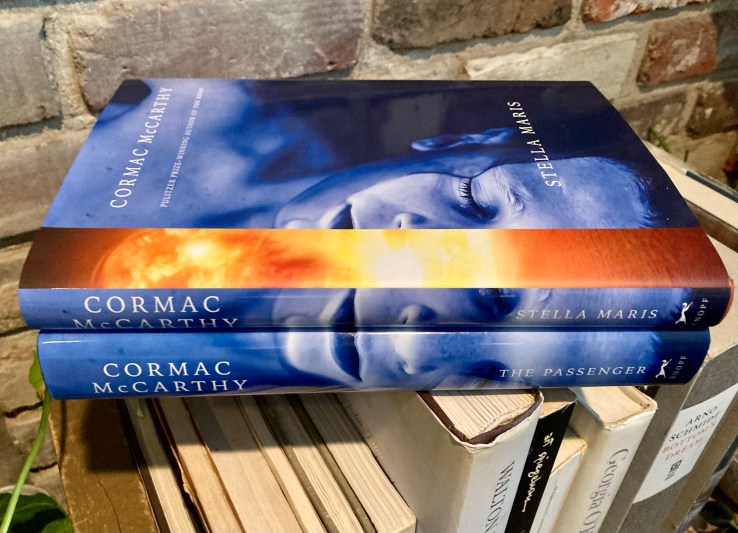
The freed and missing passenger | Joy Williams on Cormac McCarthy’s latest novels, The Passenger and Stella Maris

At Harper’s, novelist Joy Williams has a nice long essay on Cormac McCarthy’s novels The Passenger and Stella Maris. Williams begins with a concern that I think is fundamental to reading these novels: How do they talk to each other?

Cormac McCarthy’s latest offering—in that word’s fundamentally spiritual sense—is The Passenger and its coda or addendum, Stella Maris. One is prompted to read The Passenger first (it came out in October) and Stella Maris second (it came out in December). If, however, you dare to test the trickster and begin with Stella Maris—a 189-page conversation between a psychiatrist and his patient—it will seriously trouble your perception of The Passenger. If you read the books in order, you might find Stella Maris (Latin for Star of the Sea, a psychiatric hospital in Black River Falls, Wisconsin) coldly underwhelming despite, or perhaps because of, the erudition of the twenty-one-year-old, debatably schizophrenic, suicidal math genius Alice Western.

Williams focuses heavily on Stella Maris at the outset of her essay, offering a stable timeline for the two novels. If you’ve read The Passenger and Stella Maris, you know that McCarthy withholds a linear, chronological plot. Williams’ plot-making though foregrounds something that’s easy to miss in a first-reading of The Passenger: Bobby is in a coma, officially brain dead after a racing accident. Williams writes that,

The invention of brain death serves the timeline of The Passenger well, and traversing this twisting line, tracing and retracing it, contesting it, surrendering to it, is one of the great and pleasurable challenges of these books. Is there a narrative line? The Kid thinks it’s important to locate one even if, as he says, it doesn’t hold up in court. As for McCarthy, plot has always been irrelevant to his purposes.

What are those purposes?

McCarthy is not interested in the psychology of character. He probably never has been. He’s interested in the horror of every living creature’s situation.

–and–

Cormac McCarthy is interested in . . . the unconscious and in the distaste for language the unconscious harbors and the mystery of the evolution of language, which chose only one species to evolve in. He’s interested in the preposterous acceptance that one thing—a sound that becomes a word—can refer to another thing, mean another thing, replacing the world bit by bit with what can be said about it.

–and–

. . . the overwhelming subject is the soul. Where can it be found? By what means does it travel? Is it frightened when we take leave of it? Can it find rest in the darkness? Animula vagula blandula. The soul. The freed and missing passenger.

I could continue to cherrypick at Williams’ essay, but will instead simply recommend you read it yourself. There’s all kinds of insights there—McCarthy’s weakness in portraying women; the homelessness motif of The Passenger; a brief cataloging of his oeuvre to date.

For me, the most interesting idea in Williams’ essay–which she never directly states–is that Bobby is actually brain dead and that the events in his chapters of The Passenger take place in his unconscious mind.

Williams’ essay was the first (and so far only) review of McCarthy’s latest novels that I’ve read. Thanks to BLCKDGRD for sending a scan of his physical copy my way last week.

“Not His Best” — Joy Williams

“Not His Best”

by

Joy Williams

from 99 Stories of God


Franz Kafka once called his writing a form of prayer.

He also reprimanded the long-suffering Felice Bauer in a letter: “I did not say that writing ought to make everything clearer, but instead makes everything worse; what I said was that writing makes everything clearer and worse.”

He frequently fretted that he was not a human being and that what he bore on his body was not a human head. Once he dreamt that as he lay in bed, he began to jump out the open window continuously at quarter-hour intervals.

“Then trains came and one after another they ran over my body, outstretched on the tracks, deepening and widening the two cuts in my neck and legs.”

I didn’t give him that one, the Lord said.

NOT HIS BEST

“The Unhappiness of Being a Single Man” — Franz Kafka

“The Unhappiness of Being a Single Man”

by

Franz Kafka

translation by

Alexander Starritt


It seems a terrible thing to stay single for good, to become an old man who, if he wants to spend the evening with other people, has to stand on his dignity and ask someone for an invitation; to be ill and spend weeks looking out of the corner of your bed at an empty room; always to say goodbye at the door; never to squeeze your way up the stairs beside your wife; to live in a room where the side doors lead only to other people’s apartments; to carry your dinner home in one hand; to be forced to admire children you don’t know and not to be allowed to just keep repeating, “I don’t have any”; to model your appearance and behaviour on one or two bachelors you remember from childhood.

That’s how it’s going to be, except that in reality both today and in the future you’ll actually be standing there yourself, with a body and a real head, as well as a forehead, which you can use your hand to slap.

“One day is there of the series / Termed Thanksgiving day” — Emily Dickinson

ED

This is Thanksgiving Day, a good old festival | Nathaniel Hawthorne’s Journal Entry for November 24, 1843

Thursday, November 24th.–This is Thanksgiving Day, a good old festival, and we have kept it with our hearts, and, besides, have made good cheer upon our turkey and pudding, and pies and custards, although none sat at our board but our two selves. There was a new and livelier sense, I think, that we have at last found a home, and that a new family has been gathered since the last Thanksgiving Day. There have been many bright, cold days latterly,–so cold that it has required a pretty rapid pace to keep one’s self warm a-walking. Day before yesterday I saw a party of boys skating on a pond of water that has overflowed a neighboring meadow. Running water has not yet frozen. Vegetation has quite come to a stand, except in a few sheltered spots. In a deep ditch we found a tall plant of the freshest and healthiest green, which looked as if it must have grown within the last few weeks. We wander among the wood-paths, which are very pleasant in the sunshine of the afternoons, the trees looking rich and warm,–such of them, I mean, as have retained their russet leaves; and where the leaves are strewn along the paths, or heaped plentifully in some hollow of the hills, the effect is not without a charm. To-day the morning rose with rain, which has since changed to snow and sleet; and now the landscape is as dreary as can well be imagined,–white, with the brownness of the soil and withered grass everywhere peeping out. The swollen river, of a leaden hue, drags itself sullenly along; and this may be termed the first winter’s day.

From Nathaniel Hawthorne’s American Note-Books.

A review of Hilary Mantel’s novel Beyond Black

In Hilary Mantel’s 2005 novel Beyond Black, a fat psychic named Alison endures the harrowing torment of a collective of ghosts she calls the Fiends, the spirits of cruel men from her childhood. When a young, aimless woman named Colette comes into Alison’s life and assumes managerial duties for her career, Alison’s bilious past comes to a head. Colette engineers more and better gigs for Alison (the death of Princess Diana causes a huge spike in business), who, despite her genuine psychic talents, must nonetheless run the kind of scam the “punters” in her audience crave. Colette and Alison soon move in together, buying a new house in a quiet, boring suburb outside of London; their prefab homestead is drawn in sharp contrast to the slums of Aldershot where Alison grew up–the novel’s second setting. As Beyond Black progresses, contemporary suburban Britain increasingly crumbles into Alison’s grim, greasy past in Aldershot. Alison’s chief tormentor is, ironically, her “spirit guide,” a mean little man named Morris, a one-time frequent customer for Alison’s prostitute mother. Alison, like many victims, has suppressed much of her grotesque childhood, but it’s hard to black out everything with psychic baggage like Morris weighing her down. In time, more and more of the Fiends reemerge, forcing Alison to confront her mother and the abuse they both suffered at the hands of those awful men. As the book lurches to its chilling climax, Alison asserts independence, casting out her metaphysical and psychological demons.

At its core, Beyond Black asks what it means to be haunted and how one might survive an abusive past intact. A slim specter of a character named Gloria floats through the book. The Fiends, whose vile antics are sometimes compared to a gypsy circus, have dismembered Gloria with the old saw trick. In Alison’s memory, pieces of Gloria are scattered around her childhood home, parceled out, fed to dogs, transported in boxes at midnight, hidden. Alison’s awful mother frequently alludes to Alison herself being “sawed up,” a metaphor that dances on the literal as we come to realize that the old drunk has pimped out her daughter repeatedly. Mantel’s novel investigates the return of the repressed, and although she gives us something like a happy ending, the book’s central thesis seems to be that pain cannot be abandoned or hidden, but only mitigated through direct confrontation.

The book’s humor does nothing to lighten its grim subject–if anything it exacerbates and confounds the darkness at the heart of Beyond Black. Mantel’s gift for dialogue fleshes out her characters (even the spectral ones), and while the book aims for a satirical tone at times, its characters are too richly drawn to be mere cutouts in a stage production. Mantel’s satire of contemporary English life is sharp and bleak; you laugh a little and then feel bad for laughing and a page later you’re horrified. It’s a successful book in that respect. It’s one real weakness is in the character of Colette, whose voice gives way to Alison’s past by the book’s end. This is actually no problem, as Colette’s narrative life is not nearly as interesting as Alison’s psychic traumas; Colette is, however, catalyst for the changes in Alison’s life. It would’ve been nice to see more resolution here, but I suppose Beyond Black hews closer to real life here, with all its messy loose ends.

I chose to read Beyond Black because I enjoyed Mantel’s recent Booker Prize winner Wolf Hall so much. The books have little in common other than being well-written and tightly paced, and I think that anyone who wanted more Mantel after an introduction via Wolf Hall would do right to pick up Beyond Black. Recommended.

[Ed. note—Biblioklept first published this review in 2010. RIP to Hilary Mantel, who died “suddenly but peacefully” yesterday at 70.]

From Naoji’s Moonflower Journal | From Osamu Dazai’s novel The Setting Sun

From Naoji’s Moonflower Journal

from

The Setting Sun

by

Osamu Dazai

Translated by Donald Keene


A sensation of burning to death. And excruciating though it is, I cannot pronounce even the simple words “it hurts.” Do not try to shrug off this portent of a hell unparalleled, unique in the history of man, bottomless!

Philosophy? Lies. Principles? Lies. Ideals? Lies. Order? Lies. Sincerity? Truth? Purity? All lies. They say the wisteria of Ushijima are a thousand years old, and the wisteria of Kumano date from centuries ago. I have heard that wisteria clusters at Ushijima attain a maximum length of nine feet, and those at Kumano of over five feet. My heart dances only in those clusters of wisteria blossom.

That too is somebody’s child. It is alive.

Logic, inevitably, is the love of logic. It is not the love for living human beings.

Money and women. Logic, intimidated, scampers off precipitously.

The courageous testimony of Dr. Faust that a maiden’s smile is more precious than history, philosophy, education, religion, law, politics, economics, and all the other branches of learning.

Learning is another name for vanity. It is the effort of human beings not to be human beings.

I can swear even before Goethe that I am a superbly gifted writer. Flawless construction, the proper leavening of humor, pathos to bring tears to the reader’s eyes—or else a distinguished novel, perfect of its kind, to be read aloud sonorously with the deference due it, this (shall I call it running commentary on a film?) I claim I could write were I not ashamed. There’s something fundamentally cheap about such awareness of genius. Only a madman would read a novel with deference. In that case it had best be done in formal clothes, like going to a funeral. So long as it does not seem as affected as a good work! I will write my novel clumsily, deliberately making a botch of it, just to see a smile of genuine pleasure on my friend’s face—to fall on my bottom and patter off scratching my head. Oh, to see my friend’s happy face!

What is this affection which would make me blow the toy bugle of bad prose and bad character to proclaim, “Here is the greatest fool in Japan! Compared to me, you’re all right—be of good health!”

Friend! You who relate with a smug face, “That’s his bad habit, what a pity!” You do not know that you are loved.

I wonder if there is anyone who is not depraved.

A wearisome thought.

I want money.

Unless I have it….

In my sleep, a natural death!

I have run up a debt of close to a thousand yen with the pharmacist. Today I surreptitiously introduced a clerk from the pawnshop into the house and ushered him to my room. I asked, “Is anything here valuable enough to pawn? If there is, take it away. I am in desperate need of money.”

The clerk, with scarcely a glance at the room, had the effrontery to say, “Why don’t you forget the whole idea? After all, the furniture doesn’t belong to you.”

“Very well!” I said with animation, “just take the things I have bought with my own pocket money.” But not a one of all the odds and ends I piled before him had any value as a pledge.

Item. A hand in plaster. This was the right hand of Venus. A hand like a dahlia blossom, a pure white hand, mounted on a stand. But if you looked at it carefully you could tell how this pure white, delicate hand, with whorl-less finger tips and unmarked palms, expressed, so pitifully that even the beholder was stabbed with pain, the shame intense enough to make Venus stop her breath; in the gesture was implicit the moment when Venus’ full nakedness was seen by a man, when she twisted away her body, flushed all over with the prickling warmth of her shock, the whirlwind of her shame, and the tragedy of her nudity. Unfortunately, this was only a piece of bric-à-brac. The clerk valued it at fifty sen.

Items. A large map of the suburbs of Paris. A celluloid top almost a foot in diameter. A special pen-point with which one can write letters finer than threads. All things bought by me under the impression that they were great bargains.

The clerk laughed and said, “I must be leaving now.”

“Wait!” I cried, holding him back. I finally managed to load him down with an immense stack of books for which he gave me five yen. The books on my shelves were, with a few exceptions, cheap paper-bound editions, and at that I had bought them secondhand. It was not surprising that they fetched so little.

To settle a debt of a thousand yen—five yen. That is approximately my effective strength. It is no laughing matter.

But rather than the patronizing “But being decadent is the only way to survive!” of some who criticize me, I would far prefer to be told simply to go and die. It’s straightforward. But people almost never say, “Die!” Paltry, prudent hypocrites!

Justice? That’s not where you’ll find the so-called class struggle. Humanity? Don’t be silly. I know. It is knocking down your fellow-men for the sake of your own happiness. It is a killing. What meaning has it unless there is a verdict of “Die!” It’s no use cheating.

Continue reading “From Naoji’s Moonflower Journal | From Osamu Dazai’s novel The Setting Sun”

“Wild Flowers” — Gertrude Stein