Ishmael Reed . . . and more Pynchon (Books acquired, 5.22.2015)

So I finished my second full reading of Gravity’s Rainbow today. And then I read the last section three more times. And my brain feels fried. I was thinking about rereading V. after this, but I think a break will do nicely. So I picked up Ishmael Reed’s Mumbo Jumbo on Pynchon’s recommendation (“check out Ishmael Reed,” the narrator tells us on page 588 of Gravity’s Rainbow). A stroll through the lit crit section led to my spying (okay, looking for and finding) the 20th Century Views collection on Pynchon. So we’ll see how that reads.

“What You Mean I Can’t Irony?” — Ishmael Reed

“What You Mean I Can’t Irony?”
by Ishmael Reed
A high-yellow lawyer woman
told me I ought to go to
Europe to “broaden your per
spective.” This happened at
a black black cocktail party
an oil portrait, Andrew Carnegie,
smiling down

Selections from One-Star Amazon Reviews of David Foster Wallace’s Infinite Jest

[Ed. note: I usually don’t preface these one-star Amazon selection riffs with much, other than to note the occasion for the post. In this case, the occasion is my coming to the end of a second reading of Pynchon’s novel Gravity’s Rainbow, a novel that is very much about the military-industrial-entertainment complex. And so well anyway, I keep thinking about Infinite Jest, which I have not read in full since 2002, but plan to reread later this summer. I expected Pynchon to show up a few times in the one-star reviews, but he’s present throughout, often obliquely referenced. Otherwise, the one-star reviews are typical: Rants against academia, “literary elites,” etc. The term “self-indulgent” appears again and again. Only one reviewer bothers to engage the plot though.]

***

slop

passably clever

completely pointless

superfluous logorrhea

spawn of PC Elitist writers

reads like a math textbook

This is the T.S. Eliot Effect

terminally adolescent drivel.

The footnotes have footnotes.

Big words and run-on sentences

utterly lacking in aesthetic merit

I only read the first 50 pages or so

wow, that’s a heck of a lot of words.

challenging, involving, and horrifying

A humorous book? – no. Absurd – Yes.

never made it to the end of chapter one.

I never did get through Gravity’s Rainbow

the magnum opus of American hipsterism.

the worst science fiction novel ever written.

If you like Pynchon, fine, go ahead, you’ll like this.

over a hundred pages of notes that serve no purpose

I pride myself on being an intelegent well read person

At least Pynchon, has humor, literary references, etc.

He probably sold more books on hype than on talent.

All in all, I suppose Wallace will just become a footnote.

this book(?) would not be worth the money if it was free

I trie d to think of Catcher in the Rye, but no comparison.

If you want to be warm, burn your overrated copy of Infinite Jest.

Wallace makes up words which does not help one reading a story.

I think it was in that book that I learned the word “omphaloskepsis.”

I’ll bet Dave had to beat off the nubile young co-eds after they read this one

obviously didn’t follow Elmore Leonard’s last tenet of his “10 Rules for Writing”

I suppose that some might consider Wallace a great writer, but was he popular?

It’s written in the first-person from the point of view of a mentally ill teenager.

he filled it with worthless footnotes that pretend to enlighten the victim of his prose

I just don’t understand how my fellow Amazon reviewers could have scored this book highly.

I realize that this book is considered to be “literature” but IMHO the internal ravings of mentally ill people isn’t literature.

It is called “INFINITE JETS” but there is not a single aircraft within, in fact the book is about people on land with drugs problems.

The book contains an anecdote plagiarized from the humorist, Gerard Hoffnung, who recorded it in the 1950s.

700 pages of clumsy sci-fi and the kind of smarty pants absurdist nonsense you’d expect from a precocious middle schooler

The premise for this novel derives from a Monty Python sketch in which the world’s funniest joke is also fatal.

Oh one other thing that drove me crazy: he started so many sentences with “And but so..” or “So but and…”

if Finnegans Wake was a rancid fart that was proudly left to rip, Infinite Jest is a weak one, lacking sound and odor.

Just a bunch of irrelevant words to set the scene…. not to mention he described everything into painful detail.

a kid thinks he’s going to the dentist but it’s really some sort of counselor and they have a long battle of wits to see which one of them is the bigger booger-eating nerd

DWF is desperately trying to emulate one of the century’s greatest authors, and utterly fails.

Put down the bong, go outside and get some real world experience before putting pen to paper.

Comparing Wallace to Pynchon is like comparing a kettle of sponges to Disney World

Academics also praise it as a badge of courage for (allegedly) reading it

It’s just the narrator’s interior thoughts about trying to buy drugs.

I was two pages in and started to feel confused, zoned out, and lost.

It reads like the stream of consciousness of a spoiled 10th grader.

What I read would have gotten an F in a freshman writing class.

The style is Pynchon. And by style, I mean, an exact duplication

At least, now I know where Dave Eggers ripped off his garbage

sorry Amazon,you definitely missed the boat with this one.

completely lacking in any kind of moral or ethical center

He and this book are simply silly, and a waste of pulp.

Book was a work of art, one I wasted my time viewing.

seems to spend forever talking about tennis and drugs

Characters are unbelievable and are over analyzed

Sure, he was making good points, for the 1990s!

Reading a thesaurus does not count as research.

Over 1000 pages of pseudo-subersiveness.

It’s the tyranny of the English Deparment

I only read about four percent of the book

For my taste, there were too many words

I think his suicide inflated his reviews.

I still feel awful thinking about it.

narcissistic garbage

wannabe Pynchon

Bad read no stars.

…is this an essay?

Generic Pynchon

Troglodyte.

Boring.

Skip it.

The consciousness contained in any text (William H. Gass)

…the consciousness contained in any text is not an actual functioning consciousness; it is a constructed one, improved, pared, paced, enriched by endless retrospection, irrelevancies removed, so that into the ideal awareness that I imagined for the poet, who possesses passion, perception, thought, imagination, and desire, and has them present in amounts appropriate to the circumstances-just as, in the lab, we need more observation than fervor, more imagination than lust-there are introduced patterns of disclosure, hierarchies of value, chains of inference, orders of images, natures of things.

From William H. Gass’s essay “The Book as a Container of Consciousness,” published in his collection Finding a Form and available online as a pdf at Wilson Quarterly.

God’s spoilers (Gravity’s Rainbow)

What you felt stirring across the land… it was the equinox… green spring equal nights… canyons are opening up, at the bottoms are steaming fumaroles, steaming the tropical life there like greens in a pot, rank, dope-perfume, a hood of smell… human consciousness, that poor cripple, that deformed and doomed thing, is about to be born. This is the World just before men. Too violently pitched alive in constant flow ever to be seen by men directly. They are meant only to look at it dead, in still strata, transputrefied to oil or coal. Alive, it was a threat: it was Titans, was an overpeaking of life so clangorous and mad, such a green corona about Earth’s body that some spoiler had to be brought in before it blew the Creation apart. So we, the crippled keepers, were sent out to multiply, to have dominion. God’s spoilers. Us. Counterrevolutionaries. It is our mission to promote death. The way we kill, the way we die, being unique among the Creatures. It was something we had to work on, historically and personally. To build from scratch up to its present status as reaction, nearly as strong as life, holding down the green uprising. But only nearly as strong.

Only nearly, because of the defection rate. A few keep going over to the Titans every day, in their striving subcreation (how can flesh tumble and flow so, and never be any less beautiful?), into the rests of the folksong Death (empty stone rooms), out, and through, and down under the net, down down to the uprising.

In harsh-edged echo, Titans stir far below. They are all the presences we are not supposed to be seeing—wind gods, hilltop gods, sunset gods—that we train ourselves away from to keep from looking further even though enough of us do, leave Their electric voices behind in the twilight at the edge of the town and move into the constantly parted cloak of our nightwalk till

Suddenly, Pan—leaping—its face too beautiful to bear, beautiful Serpent, its coils in rainbow lashings in the sky—into the sure bones of fright—

Don’t walk home at night through the empty country. Don’t go into the forest when the light is too low, even too late. Don’t go into the forest when the light is too low, even too late in the afternoon—it will get you. Don’t sit by the tree like this, with your cheek against the bark.

From Thomas Pynchon’s Gravity’s Rainbow, pages 720-21.

No one reaches to him (Franz Kafka’s diary entry of 19 May 1922)

19 May. He feels more deserted with a second person than when alone. If he is together with someone, this second person reaches out for him and he is helplessly delivered into his hand. If he is alone, all mankind reaches out for him – but the innumerable outstretched arms become entangled with one another and no one reaches to him.

Franz Kafka’s diary entry of 19 May 1922. From The Diaries of Franz Kafka.” Schocken Books. Translation by Martin Greenberg.

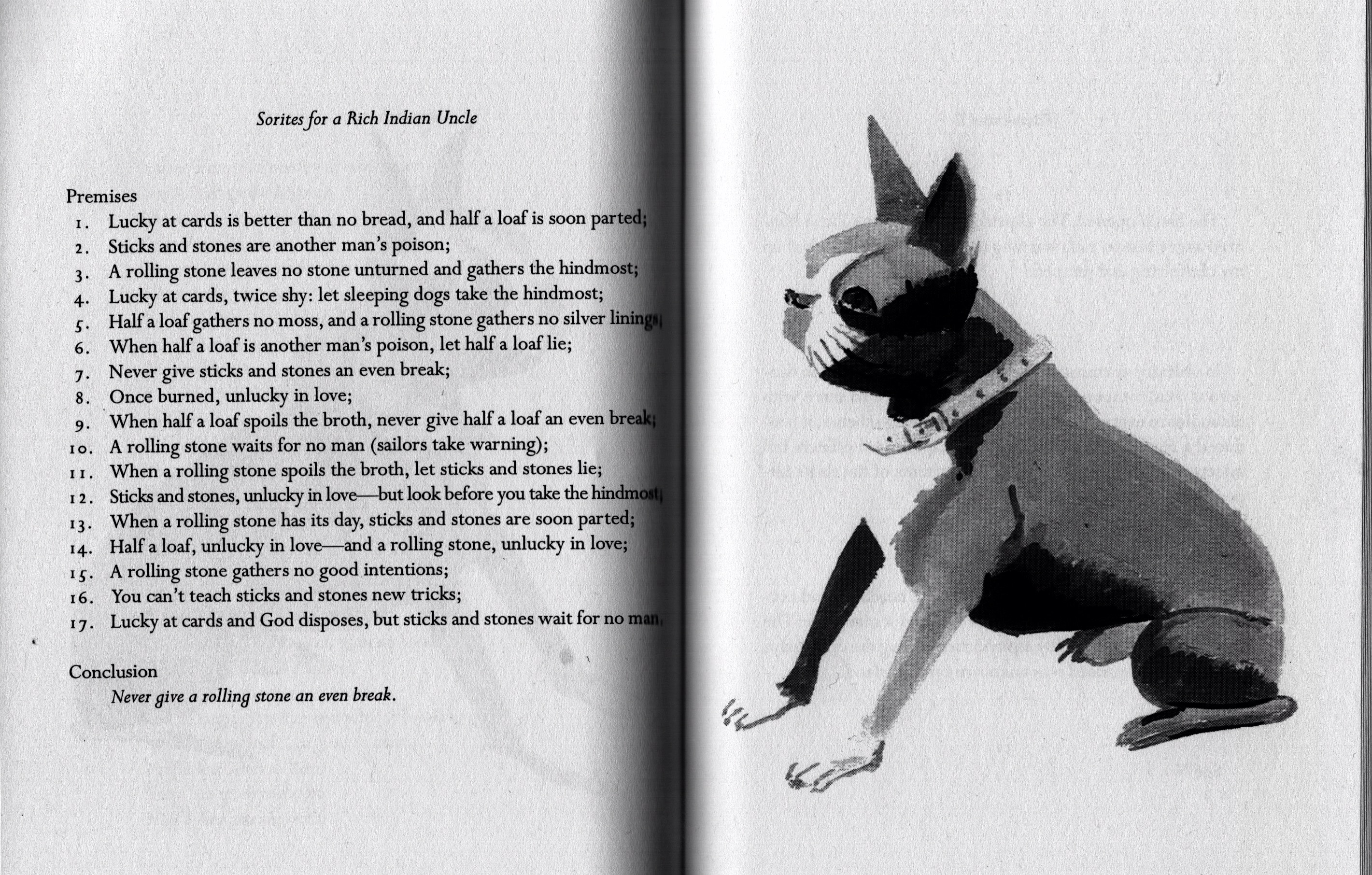
“Sorites for a Rich Indian Uncle” — Harry Mathews

IMG_6253

Click on the damn image to make it much bigger so you can read Mathews’ list (or sorites/stories/sorties). From Selected Declarations of Independence. The illustration is by Alex Katz.


“My Appearance” — David Foster Wallace

I am a woman who appeared in public on Late Night with David Letterman on March 22, 1989.

In the words of my husband, Rudy, I am a woman whose face and attitudes are known to something over half of the measurable population of the United States, whose name is on lips and covers and screens. Whose heart’s heart is invisible to the world and unapproachably hidden. Which is what Rudy thought could save me from all this appearance implied.

The week of March 19, 1989, was the week David Letterman’s variety-and-talk show featured a series of taped skits on the private activities and pastimes of executives at NBC. My husband and I sacrificed sleep and stayed up late, watching. My husband, whose name in the entertainment industry is better known than his face, had claimed at first to be neutrally excited about the call I’d gotten from Late Night, though by the time he’d been driven home, he was beginning to worry that this particular public appearance could present problems. He knew and feared Letterman; he claimed to know that Letterman loved to savage female guests. It was on a Sunday that Rudy told me we would need to formulate strategies for my appearance on Late Night. March 22nd was to be a Wednesday.

Read the rest of David Foster Wallace’s short story “My Appearance.”

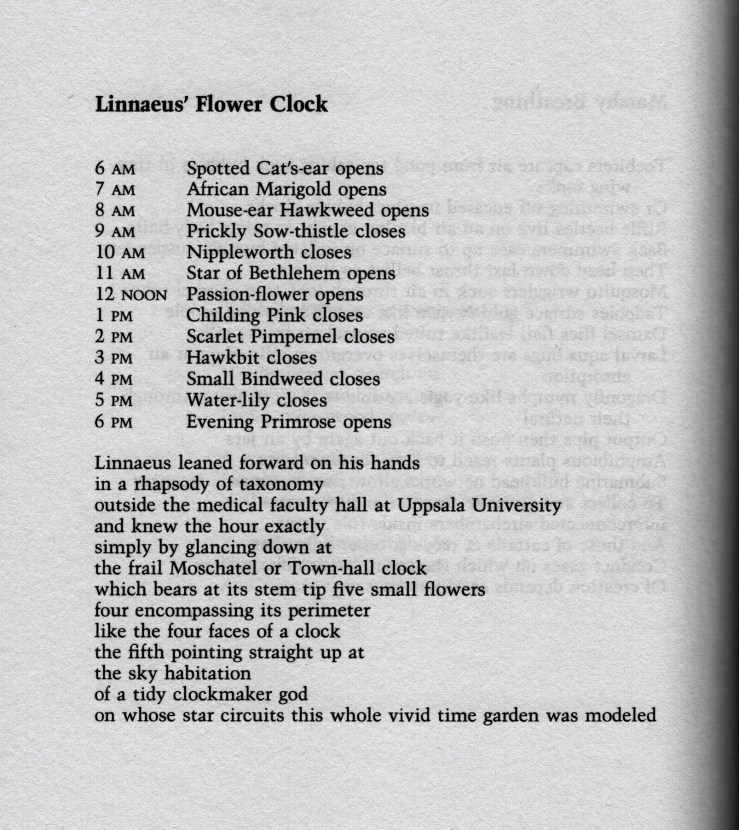
“Linnaeus’ Flower Clock” — Tom Clark

IMG_6218

Read Katherine Anne Porter’s short story “Flowering Judas”

“Flowering Judas”

by

Katherine Anne Porter

Braggioni sits heaped upon the edge of a straight-backed chair much too small for him, and sings to Laura in a furry, mournful voice. Laura has begun to find reasons for avoiding her own house until the latest possible moment, for Braggioni is there almost every night. No matter how late she is, he will be sitting there with a surly, waiting expression, pulling at his kinky yellow hair, thumbing the strings of his guitar, snarling a tune under his breath. Lupe the Indian maid meets Laura at the door, and says with a flicker of a glance towards the upper room, ‘He waits.’

Laura wishes to lie down, she is tired of her hairpins and the feel of her long tight sleeves, but she says to him, ‘Have you a new song for me this evening?’ If he says yes, she asks him to sing it. If he says no, she remembers his favorite one, and asks him to sing it again. Lupe brings her a cup of chocolate and a plate of rice, and Laura eats at the small table under the lamp, first inviting Braggioni, whose answer is always the same: ‘I have eaten, and besides, chocolate thickens the voice.’

Laura says, ‘Sing, then,’ and Braggioni heaves himself into song. He scratches the guitar familiarly as though it were a pet animal, and sings passionately off key, taking the high notes in a prolonged painful squeal. Laura, who haunts the markets listening to the ballad singers, and stops every day to hear the blind boy playing his reed-flute in Sixteenth of September Street, listens to Braggioni with pitiless courtesy, because she dares not smile at his miserable performance. Nobody dares to smile at him. Braggioni is cruel to everyone, with a kind of specialized insolence, but he is so vain of his talents, and so sensitive to slights, it would require a cruelty and vanity greater than his own to lay a finger on the vast cureless wound of his self-esteem. It would require courage, too, for it is dangerous to offend him, and nobody has this courage. Continue reading “Read Katherine Anne Porter’s short story “Flowering Judas””

A montage of fragments deleted from Inherent Vice

Read “The Ones Who Walk Away from Omelas” by Ursula K. LeGuin

“The Ones Who Walk Away from Omelas”

by

Ursula K. LeGuin

With a clamor of bells that set the swallows soaring, the Festival of Summer came to the city Omelas, bright-towered by the sea. The rigging of the boats in harbor sparkled with flags. In the streets between houses with red roofs and painted walls, between old moss-grown gardens and under avenues of trees, past great parks and public buildings, processions moved. Some were decorous: old people in long stiff robes of mauve and grey, grave master workmen, quiet, merry women carrying their babies and chatting as they walked. In other streets the music beat faster, a shimmering of gong and tambourine, and the people went dancing, the procession was a dance. Children dodged in and out, their high calls rising like the swallows’ crossing flights over the music and the singing. All the processions wound towards the north side of the city, where on the great water-meadow called the Green Fields boys and girls, naked in the bright air, with mud-stained feet and ankles and long, lithe arms, exercised their restive horses before the race. The horses wore no gear at all but a halter without bit. Their manes were braided with streamers of silver, gold, and green. They flared their nostrils and pranced and boasted to one another; they were vastly excited, the horse being the only animal who has adopted our ceremonies as his own. Far off to the north and west the mountains stood up half encircling Omelas on her bay. The air of morning was so clear that the snow still crowning the Eighteen Peaks burned with white-gold fire across the miles of sunlit air, under the dark blue of the sky. There was just enough wind to make the banners that marked the racecourse snap and flutter now and then. In the silence of the broad green meadows one could hear the music winding through the city streets, farther and nearer and ever approaching, a cheerful faint sweetness of the air that from time to time trembled and gathered together and broke out into the great joyous clanging of the bells.

Joyous! How is one to tell about joy? How describe the citizens of Omelas?

Continue reading “Read “The Ones Who Walk Away from Omelas” by Ursula K. LeGuin”

Robert Coover reads “The Fallguy’s Faith”

Read along here.

Falling from favor, or grace, some high artifice, down he dropped like a discredited predicate through what he called space (sometimes he called it time) and with an earsplitting crack splattered the base earth with his vital attributes. Oh, I’ve had a great fall, he thought as he lay there, numb with terror, trying desperately to pull himself together again. This time (or space) I’ve really done it! He had fallen before of course: short of expectations, into bad habits, out with his friends, upon evil days, foul of the law, in and out of love, down in the dumps—indeed, as though egged on by some malevolent metaphor generated by his own condition, he had always been falling, had he not?—but this was the most terrible fall of all. It was like the very fall of pride, of stars, of Babylon, of cradles and curtains and angels and rain, like the dread fall of silence, of sparrows, like the fall of doom.

A deleted scene from Inherent Vice

“All Things Decay and Die” — Robert Herrick

Screenshot 2015-05-11 at 8

Critical Mass (Gravity’s Rainbow)

“I think that there is a terrible possibility now, in the World. We may not brush it away, we must look at it. It is possible that They will not die. That it is now within the state of Their art to go on forever—though we, of course, will keep dying as we always have. Death has been the source of Their power. It was easy enough for us to see that. If we are here once, only once, then clearly we are here to take what we can while we may. If They have taken much more, and taken not only from Earth but also from us—well, why begrudge Them, when they’re just as doomed to die as we are? All in the same boat, all under the same shadow… yes… yes. But is that really true? Or is it the best, and the most carefully propagated, of all Their lies, known and unknown?

“We have to carry on under the possibility that we die only because They want us to: because They need our terror for Their survival. We are their harvests… .

“It must change radically the nature of our faith. To ask that we keep faith in Their mortality, faith that They also cry, and have fear, and feel pain, faith They are only pretending Death is Their servant—faith in Death as the master of us all—is to ask for an order of courage that I know is beyond my own humanity, though I cannot speak for others… . But rather than make that leap of faith, perhaps we will choose instead to turn, to fight: to demand, from those for whom we die, our own immortality. They may not be dying in bed any more, but maybe They can still die from violence. If not, at least we can learn to withhold from Them our fear of Death. For every kind of vampire, there is a kind of cross. And at least the physical things They have taken, from”“Earth and from us, can be dismantled, demolished—returned to where it all came from.

“To believe that each of Them will personally die is also to believe that Their system will die—that some chance of renewal, some dialectic, is still operating in History. To affirm Their mortality is to affirm Return. I have been pointing out certain obstacles in the way of affirming Return…”

From pages 539-40 of Thomas Pynchon’s novel Gravity’s Rainbow.

The sermon is from a Jesuit, one Father Rapier, and takes place in one of GR’s stranger episodes (which is really saying something, that adjective there). Before the sermon—a “Critical Mass,” our narrator takes unusual pains to make sure that we get it, that we understand that the Jesuit is here to preach “against return. Here to say that critical mass cannot be ignored. Once the technical means of control have reached a certain size, a certain degree of being connected one to another, the chances for freedom are over for good.”

Compare the Jesuit’s notation of “once, only once” to the passage on pages 412-13 on Kekulé, the snake that eats its own tale: “…a quote from Rilke: ‘Once, only once…’ One of Their favorite slogans. No return, no salvation, no Cycle—”. The sermon also echoes the They/We riff on page 521.

May 11, 1838 entry from Nathaniel Hawthorne’s Note-Books

May 11, 1838.–At Boston last week. Items:–A young man, with a small mustache, dyed brown, reddish from its original light color. He walks with an affected gait, his arms crooked outwards, treading much on his toes. His conversation is about the theatre, where he has a season ticket,–about an amateur who lately appeared there, and about actresses, with other theatrical scandal.–In the smoking-room, two checker and backgammon boards; the landlord a great player, seemingly a stupid man, but with considerable shrewdness and knowledge of the world.– F—-, the comedian, a stout, heavy-looking Englishman, of grave deportment, with no signs of wit or humor, yet aiming at both in conversation, in order to support his character. Very steady and regular in his life, and parsimonious in his disposition,–worth $50,000, made by his profession.–A clergyman, elderly, with a white neck-cloth, very unbecoming, an unworldly manner, unacquaintance with the customs of the house, and learning them in a childlike way. A ruffle to his shirt, crimped.–A gentleman, young, handsome, and sea-flushed, belonging to Oswego, New York, but just arrived in port from the Mediterranean: he inquires of me about the troubles in Canada, which were first beginning to make a noise when he left the country,–whether they are all over. I tell him all is finished, except the hanging of the prisoners. Then we talk over the matter, and I tell him the fates of the principal men,–some banished to New South Wales, one hanged, others in prison, others, conspicuous at first, now almost forgotten.–Apartments of private families in the hotel,–what sort of domesticity there may be in them; eating in public, with no board of their own. The gas that lights the rest of the house lights them also, in the chandelier from the ceiling.–A shabby-looking man, quiet, with spectacles, at first wearing an old, coarse brown frock, then appearing in a suit of elderly black, saying nothing unless spoken to, but talking intelligently when addressed. He is an editor, and I suppose printer, of a country paper. Among the guests, he holds intercourse with gentlemen of much more respectable appearance than himself, from the same part of the country.–Bill of fare; wines printed on the back, but nobody calls for a bottle. Chairs turned down for expected guests. Three-pronged steel forks. Cold supper from nine to eleven P.M. Great, round, mahogany table, in the sitting-room, covered with papers. In the morning, before and soon after breakfast, gentlemen reading the morning papers, while others wait for their chance, or try to pick out something from the papers of yesterday or longer ago. In the forenoon, the Southern papers are brought in, and thrown damp and folded on the table. The eagerness with which those who happen to be in the room start up and make prize of them. Play-bills, printed on yellow paper, laid upon the table. Towards evening comes the “Transcript.”

From Nathaniel Hawthorne’s American Note-Books.