Valentine’s Day Wishes from Thomas Bernhard

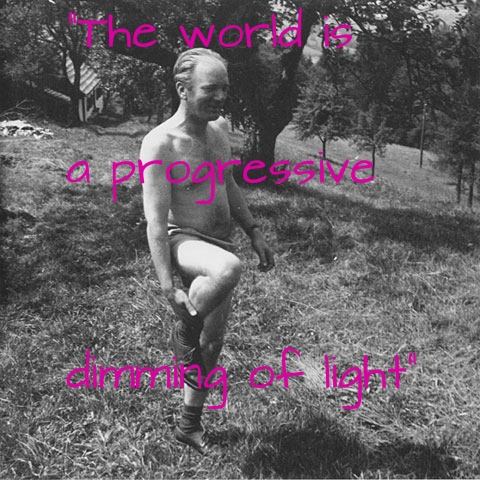
tb1

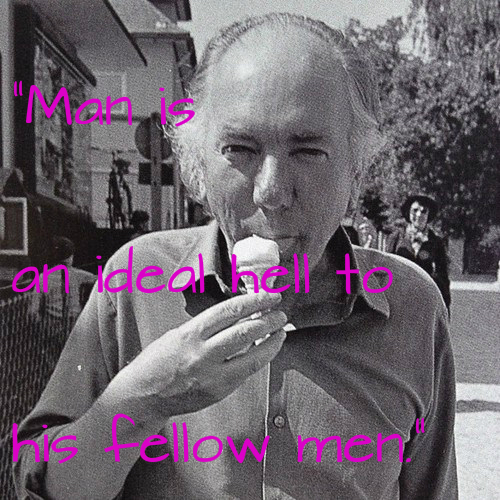
tb2

tb3

tb5

tb6

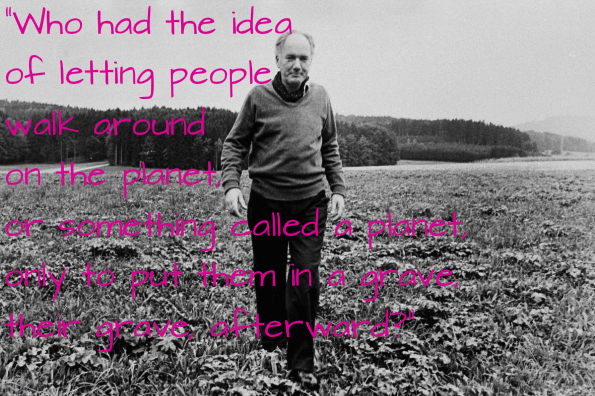
ThomasBernhardWalking

Zora Neale Hurston’s Love Spells

Conjure up some last-minute romance. In the appendix to her collection of Florida folktales, Mules and Men, author Zora Neale Hurston offers up a host of Hoodoo, including the following love spells:

TO MAKE A MAN COME HOME

Take nine deep red or pink candles. Write his name three times on each candle. Wash the candles with Van-Van. Put the name three times on paper and place under the candles, and call the name of the party three times as the candle is placed at the hours of seven, nine or eleven.

TO MAKE PEOPLE LOVE YOU

Take nine lumps of starch, nine of sugar, nine teaspoons of steel dust. Wet it all with Jockey Club cologne. Take nine pieces of ribbon, blue, red or yellow. Take a dessertspoonful and put it on a piece of ribbon and tie it in a bag. As each fold is gathered together call his name. As you wrap it with yellow thread call his name till you finish. Make nine bags and place them under a rug, behind an armoire, under a step or over a door. They will love you and give you everything they can get. Distance makes no difference. Your mind is talking to his mind and nothing beats that.

TO BREAK UP A LOVE AFFAIR

Take nine needles, break each needle in three pieces. Write each person’s name three times on paper. Write one name backwards and one forwards and lay the broken needles on the paper. Take five black candles, four red and three green.

Tie a string across the door from it, suspend a large candle upside down, It will hang low on the door; bum one each day for one hour. If you burn your first in the daytime, keep on in the day; if at night, continue at night. A tin plate with paper and needles in it must be placed to catch wax in.

When the ninth day is finished, go out into the street and get some white or black dog dung. A dog only drops his dung in the street when he is running and barking, and whoever you curse will run and bark likewise. Put it in a bag with the paper and carry it to running water, and one of the parties will leave town.

Ticket of Admission to a Lecture by Walt Whitman on Abraham Lincoln

Ticket of admission to a lecture by Walt Whitman on Abraham Lincoln,"  initialed by Whitman at lower right. Lecture "to be delivered on Thursday, April 14th [1887], at 4 o'clock P. M., in the Madison Square Theatre, New-York."

(Via/about).

Conversation (Tom Clark fragment)

Tom Clark

(From “Bugs Ate This Lake Clean,” collected in Light & Shade).

“When the Devil Was Well” — Gertrude Atherton

“When the Devil Was Well”

by

Gertrude Atherton

The Devil locked the copper gates of Hell one night, and sauntered down a Spacian pathway. The later arrivals from the planet Earth had been of a distressingly commonplace character to his Majesty–a gentleman of originality and attainments, whatever his disagreements with the conventions. He was become seriously disturbed about the moral condition of the sensational little twinkler.

“What are my own about?” he thought, as he drifted past planets which yielded up their tributes with monotonous regularity. “What a squeezed old orange would Earth become did I forsake it! I must not neglect it so long again; my debt of gratitude is too great. Let me see. Where shall I begin? It is some years since I have visited America in person, and unquestionably she has most need of my attention; Europe is in magnificent running order. This is a section of her, if my geography does not fail me; but what? I do not recall it.”

He poised above a country that looked as if it still hung upon the edge of chaos: wild, fertile, massive, barren, luxuriant, crouching on the ragged line of the Pacific. From his point of vantage he saw long ranges of stupendous mountains, some but masses of scowling crags, some green with forests of mammoth trees projecting their gaunt rigid arms above a carpet of violets; indolent valleys and swirling rivers; snow on the black peaks of the North; the riotous colour of eternal summer in the South. Suddenly he uttered a sharp exclamation and swept downward, halting but a mile above the ground. He frowned heavily, then smiled–a long, placid, sardonic smile. There appeared to be but few inhabitants in this country, and those few seemed to live either in great white irregular buildings, surmounted by crosses, in little brown huts near by, in the caves, or in hollowed trees on the mountains. The large buildings were situated about sixty miles apart, in chosen valleys; they were imposing and rambling, built about a plaza. They boasted pillared corridors and bright red tiles on their roofs. Within the belfries were massive silver bells, and the crosses could be seen to the furthermost end of the valley and from the tops of the loftiest mountain.

“California!” exclaimed the Devil. “I know of her. Her scant history is outlined in the Scarlet Book. I remember the points: Climate, the finest, theoretically, in the world; satanically, simply magnificent. I have waited impatiently for the stream of humanity to deflect thitherward, but priests will answer my present purpose exactly–unless they are all too tough. To continue, gold under that grass in chunks–aha! I shall have to throw out an extra wing in Hell! Parched deserts where men will die cursing; fruitful valleys, more gratifying to my genius; about as much of one as of the other, but the latter will get all the advertising, and the former be carefully kept out of sight. Everything in the way of animal life, from grizzly bears to fleas. A very remarkable State! Well, I will begin on the priests.” Continue reading ““When the Devil Was Well” — Gertrude Atherton”

“Wake” — Langston Hughes

wake

Read “Spunk,” a short story by Zora Neale Hurston

“Spunk”

by

Zora Neale Hurston

A giant of a brown-skinned man sauntered up the one street of the Village and out into the palmetto thickets with a small pretty woman clinging lovingly to his arm.

“Looka theah, folkses!” cried Elijah Mosley, slapping his leg gleefully. “Theah they go, big as life an’ brassy as tacks.”

All the loungers in the store tried to walk to the door with an air of nonchalance but with small success.

“Now pee-eople!” Walter Thomas gasped. “Will you look at ’em!”

“But that’s one thing Ah likes about Spunk Banks—he ain’t skeered of nothin‘ on God’s green footstool—nothin’! He rides that log down at saw-mill jus‘ like he struts ’round wid another man’s wife—jus‘ don’t give a kitty. When Tes’ Miller got cut to giblets on that circle-saw, Spunk steps right up and starts ridin’. The rest of us was skeered to go near it.”

A round-shouldered figure in overalls much too large, came nervously in the door and the talking ceased. The men looked at each other and winked.

“Gimme some soda-water. Sass’prilla Ah reckon,” the newcomer ordered, and stood far down the counter near the open pickled pig-feet tub to drink it.

Elijah nudged Walter and turned with mock gravity to the new-comer.

“Say, Joe, how’s everything up yo‘ way? How’s yo’ wife?”

Joe started and all but dropped the bottle he held in his hands. He swallowed several times painfully and his lips trembled.

“Aw ‘Lige, you oughtn’t to do nothin’ like that,” Walter grumbled. Elijah ignored him.

“She jus‘ passed heah a few minutes ago goin’ theta way,” with a wave of his hand in the direction of the woods.

Now Joe knew his wife had passed that way. He knew that the men lounging in the general store had seen her, moreover, he knew that the men knew he knew. He stood there silent for a long moment staring blankly, with his Adam’s apple twitching nervously up and down his throat. One could actually see the pain he was suffering, his eyes, his face, his hands and even the dejected slump of his shoulders. He set the bottle down upon the counter. He didn’t bang it, just eased it out of his hand silently and fiddled with his suspender buckle.

“Well, Ah’m goin‘ after her to-day. Ah’m goin’ an’ fetch her back. Spunk’s done gone too fur.”

He reached deep down into his trouser pocket and drew out a hollow ground razor, large and shiny, and passed his moistened thumb back and forth over the edge.

“Talkin‘ like a man, Joe. Course that’s yo’ fambly affairs, but Ah like to see grit in anybody.”

Joe Kanty laid down a nickel and stumbled out into the street.

Dusk crept in from the woods. Ike Clarke lit the swinging oil lamp that was almost immediately surrounded by candle-flies. The men laughed boisterously behind Joe’s back as they watched him shamble woodward.

“You oughtn’t to said whut you did to him, Lige—look how it worked him up,” Walter chided.

“And Ah hope it did work him up. ‘Tain’t even decent for a man to take and take like he do.”

“Spunk will sho’ kill him.”

“Aw, Ah doan’t know. You never kin tell. He might turn him up an‘ spank him fur gettin’ in the way, but Spunk wouldn’t shoot no unarmed man. Dat razor he carried outa heah ain’t gonna run Spunk down an‘ cut him, an’ Joe ain’t got the nerve to go up to Spunk with it knowing he totes that Army 45. He makes that break outa heah to bluff us. He’s gonna hide that razor behind the first likely palmetto root an‘ sneak back home to bed. Don’t tell me nothin’ ’bout that rabbit-foot colored man. Didn’t he meet Spunk an‘ Lena face to face one day las’ week an‘ mumble sumthin’ to Spunk ‘bout lettin’ his wife alone?”

“What did Spunk say?” Walter broke in—“Ah like him fine but ‘tain’t right the way he carries on wid Lena Kanty, jus’ cause Joe’s timid ‘bout fightin’.”

“You wrong theah, Walter. ‘Tain’t cause Joe’s timid at all, it’s cause Spunk wants Lena. If Joe was a passle of wile cats Spunk would tackle the job just the same. He’d go after anything he wanted the same way. As Ah wuz sayin’ a minute ago, he tole Joe right to his face that Lena was his. ‘Call her,’ he says to Joe. ‘Call her and see if she’ll come. A woman knows her boss an’ she answers when he calls.‘ ’Lena, ain’t I yo‘ husband?’ Joe sorter whines out. Lena looked at him real disgusted but she don’t answer and she don’t move outa her tracks. Then Spunk reaches out an‘ takes hold of her arm an’ says: ‘Lena, youse mine. From now on Ah works for you an’ fights for you an‘ Ah never wants you to look to nobody for a crumb of bread, a stitch of close or a shingle to go over yo’ head, but me long as Ah live. Ah’ll git the lumber foh owah house to-morrow. Go home an‘ git yo’ things together! ‘

” ‘Thass mah house,’ Lena speaks up. ‘Papa gimme that.’

“‘Well,’ says Spunk, ‘doan give up whut’s yours, but when youse inside don’t forgit youse mine, an’ let no other man git outa his place wid you!’

“Lena looked up at him with her eyes so full of love that they wuz runnin‘ over, an’ Spunk seen it an‘ Joe seen it too, and his lip started to tremblin’ and his Adam’s apple was galloping up and down his neck like a race horse. Ah bet he’s wore out half a dozen Adam’s apples since Spunk’s been on the job with Lena. That’s all he’ll do. He’ll be back heah after while swallowin‘ an’ workin‘ his lips like he wants to say somethin’ an’ can’t.”

“But didn’t he do nothin‘ to stop ’em?”

“Nope, not a frazzlin‘ thing—jus’ stood there. Spunk took Lena’s arm and walked off jus‘ like nothin’ ain’t happened and he stood there gazin‘ after them till they was outa sight. Now you know a woman don’t want no man like that. I’m jus’ waitin‘ to see whut he’s goin’ to say when he gits back.” Continue reading “Read “Spunk,” a short story by Zora Neale Hurston”

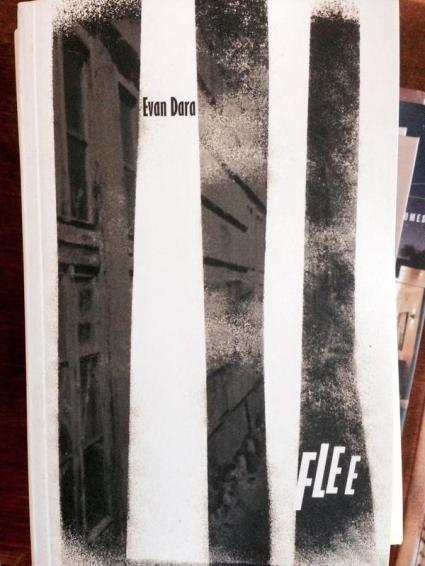
Some notes on beginning Evan Dara’s novel Flee

B8jFz0WCYAAghDz

A. What a cover on Evan Dara’s 2013 novel Flee, don’t you agree?

B. From the back cover:

IMG_5030

C. That’s all there is. Well, okay, there’s an ISBN too. But no blurbs, no other text.

D. “Something always going on—” is the first line of Flee. It’s also an apt description of Dara’s formal technique, a constantly-shifting series of dialogues, monologues, overlapping, cross-cutting, diverging—always out there ahead of the reader. That dash there—that dash is the simple summative signal of it all, a little typographic pole that simultaneously connects and interrupts.

E. The most obvious point of comparison for Dara’s technique (besides his amazing debut novel The Lost Scrapbook) is William Gaddis’s stuff, particularly J Rthe verbal dazzle, the few stray lines of poetic stage-setting in lieu of traditional exposition—the throw-the-reader-in-the-deep-end stuff. David Foster Wallace frequently attempted the same rhetorical mode, most successfully in §19 of The Pale King. (It’s entirely likely that The Lost Scrapbook could have had the same following that Infinite Jest achieved had Dara done anything to promote the book. But here I think of Gaddis in his Paris Review interview: “I’d go back to The Recognitions where Wyatt asks what people want from the man they didn’t get from his work, because presumably that’s where he’s tried to distill this ‘life and personality and views’ you speak of. What’s any artist but the dregs of his work: I gave that line to Wyatt thirty-odd years ago and as far as I’m concerned it’s still valid”).

F. The point of contrast though is Dara’s abrupt transition, sometimes it seems mid-sentence, from one speaker to the next. Just as we feel (nearly) comfortable with who this particular narrator might be, another voice interjects, or rather continues, or re-trajects the discourse—as in the second chapter of Flee (“38,842”), where a college student driving home in snowy weather to pick up a book by Paul Krugman gives over to a number of speakers all describing the closing of the local university, Pitkinson (this closing’s being the presumable, like, plot of Flee so far I suppose)—faculty and staff and townies and residents—until a grad student takes over to report the speech of one Professor Gray, himself bearing witness to the downfall of the school (Ghost Sociology is the issue)—and then of course the chapter gives over to more rumor, more speculation. “Something always going on—.”

G. So I’ve read the first three chapters (“38,839,” “38,842,” “36,551”). But wait: The next chapter (“35,717”–do the titles reflect the dwindling population of the town (Anderburg)?)—but wait the next chapter, I see by scanning, offers some new, perhaps, rhetorical gesture—a section in a different font? Chunkier paragraphs?

I have to go see about this. (More to come).

Jane Bowles’s novel Two Serious Ladies confounds with sinister humor and dark delight

Two Women, Gwen John

Here’s a short review of Jane Bowles’s only novel, Two Serious Ladies: The book is amazing, a confounding, energetic picaresque suffused with sinister humor and dark delight. I read it knowing nothing about the plot on the recommendation of Ben Marcus, who described it as “so insane, so beautiful, and in some sense, unknowable to me. On the surface, it’s not really about much, but the arrangement of words does something chemical to me.” My recommendation is to dispense with the rest of my review and read Bowles’s novel.

“Unknowable” is a fair description, and Two Serious Ladies was met with bewilderment when it was first published in 1943, as Negar Azimi points out in the comprehensive essay “The Madness of Queen Jane”:

Edith Walton, writing in the Times Book Review, called the book senseless and silly: “To attempt to unravel the plot of ‘Two Serious Ladies’ would be to risk, I am sure, one’s own sanity.” Another reviewer said, simply, “The book is about nothing.” Jane’s family, in the meantime, found it unseemly in its stark depiction of lesbianism. Its characters, who have goals and motivations that are hard to grasp, were difficult to relate to. Yet another critic wrote, “The only shocking thing about this novel is that it ever managed to find its way to print.” Jane was only twenty-four.

The notion that “The book is about nothing,” is corrected by Marcus’s qualifier about its “surface”: Two Serious Ladies moves through the phenomenological world that its characters experience, but it does not mediate the concrete contours of that world in a way that its characters can name for the reader. When the characters, those two serious ladies, do stumble into language that might name, pin down, or otherwise fix their experience, fix their consciousness into a stable relation with the world, Bowles spins the wheel again, flings her characters into new scenarios. Moments of epiphany are transitory and hard-purchased. A (perhaps) illustrating passage, offered without context:

Mrs. Copperfield started to tremble after the girl had closed the door behind her. She trembled so violently that she shook the bed. She was suffering as much as she had ever suffered because she was going to do what she wanted to do. But it would not make her happy. She did not have the courage to stop from doing what she wanted to do. She knew that it would not make her happy, because only the dreams of crazy people come true. She thought that she was only interested in duplicating a dream, but in doing so she necessarily became the complete victim of a nightmare.

The free indirect style here still hides so much from the reader, who must suss the characters’ unnamed desires from bewildering details alone. The passage above shows us fear and trembling, dream, nightmare—and crazy people. What does Copperfield want to do? One subtext here is a lesbian desire seemingly comprehended by everyone but Mrs. Copperfield herself. (In some of the book’s strangest moments, Mr. Copperfield leaves his near-mad wife in a dangerous part of a foreign city to encounter hookers of every stripe). Two Serious Ladies is about women searching for something, but something they can’t name, can’t conceive in language—but can perhaps imagine. Continue reading “Jane Bowles’s novel Two Serious Ladies confounds with sinister humor and dark delight”

(An Incomplete) List of Ridiculous Names in Charles Dickens Novels

Abel Garland

Abel Magwich

Adolphus Tetterby

Alfred Jingle

Affery Flintwinch

Anne Chickenstalker

Anthony Jeddler

Augustus Snodgrass

Barnaby Rudge

Bayham Badger

Bazzard

Bella Wilfer

Bentley Drummle

Betsy Prig

Betsy Quilp

Betsy Trotwood

Brownlow

Bucket

Bumble

Caroline “Caddy” Jellyby

Charity Pecksniff 

Clara Peggotty

Cleopatra Skewton

Clickett

Cornelia Blimber

Canon Crisparkle

Charles Cheeryble

Chevy Slyme

Clarence Barnacle

Clarriker

Creakle Continue reading “(An Incomplete) List of Ridiculous Names in Charles Dickens Novels”

Doc Sportello’s Interstellar Trip (Pynchon’s Inherent Vice)

It had all begun, apparently, some 3 billion years ago, on a planet in a binary star system quite a good distance from Earth. Doc’s name then was something like Xqq, and because of the two suns and the way they rose and set, he worked some very complicated shifts, cleaning up after a labful of scientist-priests who invented things in a gigantic facility which had formerly been a mountain of pure osmium. One day he heard some commotion down a semiforbidden corridor and went to have a look. Ordinarily sedate and studious personnel were running around in uncontrolled glee. “We did it!” they kept screaming. One of them grabbed Doc, or actually Xqq. “Here he is! The perfect subject!” Before he knew it he was signing releases, and being costumed in what he would soon learn was a classic hippie outfit of the planet Earth, and led over to a peculiarly shimmering chamber in which a mosaic of Looney Tunes motifs was repeating obsessively away in several dimensions at once in vividly audible yet unnamable spectral frequencies. . . . The lab people were explaining to him meanwhile that they’d just invented intergalactic time travel and that he was about to be sent across the universe and maybe 3 billion years into the future. “Oh, and one other thing,” just before throwing the final switch, “the universe? it’s been, like, expanding? So when you get there, everything else will be the same weight, but bigger? with all the molecules further apart? except for you—you’ll be the same size and density. Meaning you’ll be about a foot shorter than everybody else, but much more compact. Like, solid?”


“Can I walk through walls?” Xqq wanted to know, but by then space and time as he knew it, not to mention sound, light, and brain waves, were all undergoing these unprecedented changes, and next thing he knew he was standing on the corner of Dunecrest and Gordita Beach Boulevard, and watching what seemed to be an endless procession of young women in bikinis, some of whom were smiling at him and offering thin cylindrical objects whose oxidation products were apparently meant to be inhaled. . . .


As it turned out, he was able to go through drywall construction with little discomfort, although, not having X-ray vision, he did run into some disagreeable moments with wall studs and eventually curtailed the practice. His new hyperdensity also allowed him sometimes to deflect simple weapons directed at him with hostile intent, though bullets were another story, and he also learned to avoid those when possible. Slowly the Gordita Beach of his trip merged with the everyday version, and he began to assume that things were back to normal, except for when, now and then, he’d forget and lean against a wall and suddenly find himself halfway through it and trying to apologize to somebody on the other side.

From Thomas Pynchon’s novel Inherent Vice.

“An Inhabitant of Carcosa” by Ambrose Bierce

“An Inhabitant of Carcosa”

by

Ambrose Bierce

For there be divers sorts of death — some wherein the body remaineth; and in some it vanisheth quite away with the spirit. This commonly occurreth only in solitude (such is God’s will) and, none seeing the end, we say the man is lost, or gone on a long journey — which indeed he hath; but sometimes it hath happened in sight of many, as abundant testimony showeth. In one kind of death the spirit also dieth, and this it hath been known to do while yet the body was in vigor for many years. Sometimes, as is veritably attested, it dieth with the body, but after a season is raised up again in that place where the body did decay.

Pondering these words of Hali (whom God rest) and questioning their full meaning, as one who, having an intimation, yet doubts if there be not something behind, other than that which he has discerned, I noted not whither I had strayed until a sudden chill wind striking my face revived in me a sense of my surroundings. I observed with astonishment that everything seemed unfamiliar. On every side of me stretched a bleak and desolate expanse of plain, covered with a tall overgrowth of sere grass, which rustled and whistled in the autumn wind with heaven knows what mysterious and disquieting suggestion. Protruded at long intervals above it, stood strangely shaped and somber- colored rocks, which seemed to have an understanding with one another and to exchange looks of uncomfortable significance, as if they had reared their heads to watch the issue of some foreseen event. A few blasted trees here and there appeared as leaders in this malevolent conspiracy of silent expectation. Continue reading ““An Inhabitant of Carcosa” by Ambrose Bierce”

There is nothing sacred about literature, it is damned from one end to the other (William Carlos Williams)

There is nothing sacred about literature, it is damned from one end to the other. There is nothing in literature but change and change is mockery. I’ll write whatever I damn please, whenever I damn please and as I damn please and it’ll be good if the authentic spirit of change is on it.

From Kora in Hell: Improvisations by William Carlos Williams.

Ernest Hemingway vs. Wallace Stevens (David Markson)

Capture

Read Donald Barthelme’s short story “At the End of the Mechanical Age”

“At the End of the Mechanical Age”

by

Donald Barthelme

I went to the grocery store to buy some soap. I stood for a long time before the soaps in their attractive boxes, RUB and FAB and TUB and suchlike, I couldn’t decide so I closed my eyes and reached out blindly and when I opened my eyes I found her hand in mine.

Her name was Mrs. Davis, she said, and TUB was best for important cleaning experiences, in her opinion. So we went to lunch at a Mexican restaurant which as it happened she owned, she took me into the kitchen and showed me her stacks of handsome beige tortillas and the steam tables which were shiny-brite. I told her I wasn’t very good with women and she said it didn’t matter, few men were, and that nothing mattered, now that Jake was gone, but I would do as an interim project and sit down and have a Carta Blanca. So I sat down and had a cool Carta Blanca, God was standing in the basement reading the meters to see how much grace had been used up in the month of June. Grace is electricity, science has found, it is not like electricity, it is electricity and God was down in the basement reading the meters in His blue jump suit with the flashlight stuck in the back pocket.

“The mechanical age is drawing to a close,” I said to her.

“Or has already done so,” she replied.

“It was a good age,” I said. “I was comfortable in it, relatively. Probably I will not enjoy the age to come quite so much. I don’t like its look.”

“One must be fair. We don’t know yet what kind of an age the next one will be. Although I feel in my bones that it will be an age inimical to personal well-being and comfort, and that is what I like, personal well-being and comfort.”

“Do you suppose there is something to be done?” I asked her.

“Huddle and cling,” said Mrs. Davis. “We can huddle and cling. It will pall, of course, everything palls, in time…”

Then we went back to my house to huddle and cling, most women are two different colors when they remove their clothes especially in summer but Mrs. Davis was all one color, an ocher. She seemed to like huddling and clinging, she stayed for many days. From time to time she checked the restaurant keeping everything shiny-brite and distributing sums of money to the staff, returning with tortillas in sacks, cases of Carta Blanca, buckets of guacamole, but I paid her for it because I didn’t want to feel obligated.

There was a song I sang her, a song of great expectations.

Ralph is coming,” I sang, “Ralph is striding in his suit of lights over moons and mountains, over parking lots and fountains, toward your silky side. Ralph is coming, he has a coat of many colors and all major credit cards and he is striding to meet you and culminate your foggy dreams in an explosion of blood and soil, at the end of the mechanical age. Ralph is coming preceded by fifty running men with spears and fifty dancing ladies who are throwing leaf spinach out of little baskets, in his path. Ralph is perfect,” I sang, “but he is also full of interesting tragic flaws, and he can drink fifty running men under the table without breaking his stride, and he can have congress with fifty dancing ladies without breaking his stride, even his socks are ironed, so natty is Ralph, but he is also right down in the mud with the rest of us, he markets the mud at high prices for specialized industrial uses and he is striding, striding, striding, toward your waiting heart. Of course you may not like him, some people are awfully picky… Ralph is coming,” I sang to her, “he is striding over dappled plains and crazy rivers and he will change your life for the better, probably you will be fainting with glee at the simple touch of his grave gentle grizzled hand although I am aware that some people can’t stand prosperity, Ralph is coming, I hear his hoofsteps on the drumhead of history, he is striding as he has been all his life toward you, you, you.”

“Yes,” Mrs. Davis said, when I had finished singing, “that is what I deserve, all right. But probably I will not get it. And in the meantime, there is you.”

God then rained for forty days and forty nights, when the water tore away the front of the house we got into the boat. Mrs. Davis liked the way I maneuvered the boat off the trailer and out of the garage, she was provoked into a memoir of Jake.

Continue reading “Read Donald Barthelme’s short story “At the End of the Mechanical Age””

Selections from One-Star Amazon Reviews of Harper Lee’s To Kill a Mockingbird

[Ed. note: The following citations come from one-star Amazon reviews of Harper Lee’s novel To Kill a Mockingbird. (See also: Thomas Pynchon’s Mason & Dixon, Chinua Achebe’s Things Fall Apart, Mary Shelley’s Frankenstein, Thomas Pynchon’s Gravity’s RainbowGeorge Orwell’s 1984, Herman Melville’s Moby-Dick, James Joyce’s Ulysses and David Markson’s Wittgenstein’s Mistress). I’ve preserved the reviewers’ own styles of punctuation and spelling].

the prejudice part was good

A classic american piece of caca

A court case is hardly a thrilling idea.

It mainly compared people to Mockingbirds

it was just like any other book, nothing special.

It uses unutterable words and displeasing language.

I’m not rascist at all, so don’t make that assumption either.

Worst book ever written, a disgrace to American Liturature

Well, at least it was in my own language. Otherwise, it sucked.

I reckon this be anoth’r classic that doesn’t deserve that status.

I don’t like these kinds of books anyway, but I was assigned to read it! Yuk!

Simply put, this is a novel about racism written for people who received their knowledge about racism from this book!

If people would just leave old prejudices to heal themselves, it would all be better, and best of all, this book wouldn’t exist

In 1960 Harper Lee published To Kill A Mockingbird. About thrity years earlier William Faulkner had published the short story Dry September. ITS THE SAME STORY.

Although the author had some good points, I must say that this book sucked a big fat one star. I thought it was horribly thought out and it was considerably a snoozer. I seriously feel asleep readin this

I could write a novel that had notecard characters–even the narrator seemed a little hollow, and Boo Radley was just deus ex machina with a clever, sleepy-southern-town name–and no one would care.

this novel features the archetypal White hero with few flaws, his perfect children, the maid with just the right amount of “colored wisdom,” a black amn who is little more than a dullard, and the evil redneck who actually commited the crime!

It’s an uneven paste-job of short stories and pieces by Harper Lee promoted by her liberal New York publishing friends.

It is a very interesting and great book!!!!! I expecially liked how they talked of people standing up for what is right!! NOT!!!!!!!!!!!!!

I kept hoping that they would get to the point and give me some instructions, but I still don’t know how to kill a mockingbird.

Thanks to all my friends who had to tourchure threw reading this disgrace and supporting me in not likeing the book.

Who really cares about a little girl that goes around the neighborhood doing things like spying on her albino neighbor.

Dissgusting beyond belief. Harper Lee owes an apology to untold numbers of girs, women, and families.

The rednecks are evil, the blacks are victims, and the self-righteous Atticus is too good to be true.

In a just world Harper Lee and her acolytes would be forced to live in the Hell the helped create.

i know slavery was bad and judging blacks and all that is bad but like come on were over it

By the way, DO NOT BUY, because if i find it in your house i won’t think to kindly of you.

All the book consists of is a middle-class family in the south with a few weird neighbors.

Scout and her brother, Jem, grow up while some wierd stuff happens all around them.

the charecters were poorly developed and obviously fake

no excimet in besides when it was in the court spot

I find no point in writing a book about segregation

I don’t see why this book is so fabeulos.

This book is very nasty

“Sugar” — Gertrude Stein

SUGAR.

by Gertrude Stein

(From Tender Buttons).

A violent luck and a whole sample and even then quiet.

Water is squeezing, water is almost squeezing on lard. Water, water is a mountain and it is selected and it is so practical that there is no use in money. A mind under is exact and so it is necessary to have a mouth and eye glasses.

A question of sudden rises and more time than awfulness is so easy and shady. There is precisely that noise.

A peck a small piece not privately overseen, not at all not a slice, not at all crestfallen and open, not at all mounting and chaining and evenly surpassing, all the bidding comes to tea.

A separation is not tightly in worsted and sauce, it is so kept well and sectionally.

Put it in the stew, put it to shame. A little slight shadow and a solid fine furnace.

The teasing is tender and trying and thoughtful.

The line which sets sprinkling to be a remedy is beside the best cold.

A puzzle, a monster puzzle, a heavy choking, a neglected Tuesday.

Wet crossing and a likeness, any likeness, a likeness has blisters, it has that and teeth, it has the staggering blindly and a little green, any little green is ordinary.

One, two and one, two, nine, second and five and that.

A blaze, a search in between, a cow, only any wet place, only this tune.

Cut a gas jet uglier and then pierce pierce in between the next and negligence. Choose the rate to pay and pet pet very much. A collection of all around, a signal poison, a lack of languor and more hurts at ease.

A white bird, a colored mine, a mixed orange, a dog.

Cuddling comes in continuing a change.

A piece of separate outstanding rushing is so blind with open delicacy.

A canoe is orderly. A period is solemn. A cow is accepted.

A nice old chain is widening, it is absent, it is laid by.