“Retaliation” — The Marquis de Sade

“Retaliation”

by

The Marquis de Sade

A worthy citizen of Picardy, the descendant perhaps of one of those illustrious troubadours from the banks of the Oise or the Somme whose sluggish existence has only been rescued from the shadows some ten or twelve years ago by a great writer of our time, a brave and honest citizen, I repeat, lived in the town of Saint-Quentin so famous for the great men it has given to literature. He lived there in honorable estate, himself, his wife and a cousin thrice removed, a nun of a convent in the town. The cousin thrice removed was a little brunette, bright-eyed, with a mischievous little face, a turned-up nose and a slender figure; she suffered under the weight of twenty-two years, and had been a nun for four of them. Sister Petronilla, for such was her name, had in addition a pretty voice and a much greater disposition for love than for religion. As for M. d’Esclaponville, as our citizen was called, he was a fine jovial fellow of about twenty-eight, who loved his cousin supremely and Mme d’Esclaponville nothing like so well, since he had been sleeping with her for ten years already, and a habit of ten years’ standing is quite fatal to the fires of hymen. Mme d’Esclaponville — for it is necessary to depict her, a writer would be despised if he did not portray people in an age where only pictures are required, and where even a tragedy would not be received unless the canvas-mongers found at least half a dozen subjects in it — Mme d’Esclaponville, as I was saying, was a somewhat insipid blonde, slightly washed-out, but very white-skinned, with pretty eyes, well-fleshed, and with those great chubby checks that are commonly described by the world as “a good squeeze.” Continue reading ““Retaliation” — The Marquis de Sade”

“As books multiply to an unmanageable excess, selection becomes more and more a necessity for readers” (Thomas De Quincey)

As books multiply to an unmanageable excess, selection becomes more and more a necessity for readers, and the power of selection more and more a desperate problem for the busy part of readers. The possibility of selecting wisely is becoming continually more hopeless as the necessity for selection is becoming continually more pressing. Exactly as the growing weight of books overlays and stifles the power of comparison, pari passu is the call for comparison the more clamorous; and thus arises a duty correspondingly more urgent of searching and revising until everything spurious has been weeded out from amongst the Flora of our highest literature, and until the waste of time for those who have so little at their command is reduced to a minimum. For, where the good cannot be read in its twentieth part, the more requisite it is that no part of the bad should steal an hour of the available time; and it is not to be endured that people without a minute to spare should be obliged first of all to read a book before they can ascertain whether in fact it is worth reading. The public cannot read by proxy as regards the good which it is to appropriate, but it can as regards the poison which it is to escape. And thus, as literature expands, becoming continually more of a household necessity, the duty resting upon critics (who are the vicarious readers for the public) becomes continually more urgent — of reviewing all works that may be supposed to have benefited too much or too indiscriminately by the superstition of a name. The praegustatores should have tasted of every cup, and reported its quality, before the public call for it; and, above all, they should have done this in all cases of the higher literature — that is, of literature properly so called.

From Thomas De Quincey’s essay “The Literature of Knowlege and the Literature of Power,” part of The Poetry of Pope.

“The Voyage” — Katherine Mansfield

“The Voyage”

by

Katherine Mansfield

The Picton boat was due to leave at half-past eleven. It was a beautiful night, mild, starry, only when they got out of the cab and started to walk down the Old Wharf that jutted out into the harbour, a faint wind blowing off the water ruffled under Fenella’s hat, and she put up her hand to keep it on. It was dark on the Old Wharf, very dark; the wool sheds, the cattle trucks, the cranes standing up so high, the little squat railway engine, all seemed carved out of solid darkness. Here and there on a rounded wood-pile, that was like the stalk of a huge black mushroom, there hung a lantern, but it seemed afraid to unfurl its timid, quivering light in all that blackness; it burned softly, as if for itself.

Fenella’s father pushed on with quick, nervous strides. Beside him her grandma bustled along in her crackling black ulster; they went so fast that she had now and again to give an undignified little skip to keep up with them. As well as her luggage strapped into a neat sausage, Fenella carried clasped to her her grandma’s umbrella, and the handle, which was a swan’s head, kept giving her shoulder a sharp little peck as if it too wanted her to hurry… Men, their caps pulled down, their collars turned up, swung by; a few women all muffled scurried along; and one tiny boy, only his little black arms and legs showing out of a white woolly shawl, was jerked along angrily between his father and mother; he looked like a baby fly that had fallen into the cream.

Then suddenly, so suddenly that Fenella and her grandma both leapt, there sounded from behind the largest wool shed, that had a trail of smoke hanging over it, “Mia-oo-oo-O-O!” Continue reading ““The Voyage” — Katherine Mansfield”

How King Arthur Saw the Questing Beast — Aubrey Beardsley

“There were many towers, just as in this world there are many perfect books” (William T. Vollmann)

So he lent her books. After all, one of life’s best pleasures is reading a book of perfect beauty; more pleasurable still is rereading that book; most pleasurable of all is lending it to the person one loves: Now she is reading or has just read the scene with the mirrors; she who is so lovely is drinking in that loveliness I’ve drunk.

Amidst the other grey, red, greenish, black and orange volumes of various heights, this white book with the black lettering was perfectly proportioned in every way, neither showy nor insignificant. It was one of his favorite books (we can’t say his favorite since his life wasn’t over yet). He mentioned it, and she was willing to accept it; she was that kind, to read the book which he loved.

At the moment that it actually passed from his hand to hers they were sitting across from each other in one of the three or four restaurants where they usually met; and she, having gazed into his face with her usual richly intelligent seriousness, studied the book she now held with the same air of happy possession which he would have hoped to find had she been looking over his body before making love with him, which she would never, ever do no matter how long they both lived, a fact which made him want to utter a sound much softer and more leaden than any scream; and then, sitting within touching distance of her beautiful hands which he could not touch, he watched her open the book to the title page with its half-calligraphic brush-rendering by an unknown artist of a Buddhist pongmalai garland, probably of jasmine flowers, which was draped across a woman’s naked thigh. This was the most intimate moment that he and she would ever have (unless of course his one percent became a hundred, and she accepted him forever). He would not be at her side when she began to actually read the book; but from their frequent conversations he thought he could keep abreast of where she’d arrived each day. She’d promised to begin it that very night, when she was home with the other man, which meant that she would at least cross the frontier of the half-title page, followed by the dramatic double plant-stalks (connected by a leaf ), of the initial letter E. And now she saw before her those wide white margins and those generous white lines-between-the-lines which encouraged every word to preen itself like the treasure that it truly was.

I should mention that this beautiful volume, which was such a pleasure to hold, began its tale with a dazzling abruptness, as if the reader had just emerged from a dark tunnel into another world, a perfect world whose ground was a hot white plain of salt upon which the words lived their eternal lives.

I need say nothing about the plot, whose involutions (it’s a tale of obsessive love) progressed like the nested terraces on a Buddha-studded tower which narrows perfectly into nothingness. Once I visited a certain wat in Bangkok where although the day was exhaustingly hot and bright I grew enthralled by the sensation of wandering on a high place somewhere in the mist, a plateau exploding with ornately weathered crags. There were many towers, just as in this world there are many perfect books.

From William T. Vollmann’s novel Europe Central.

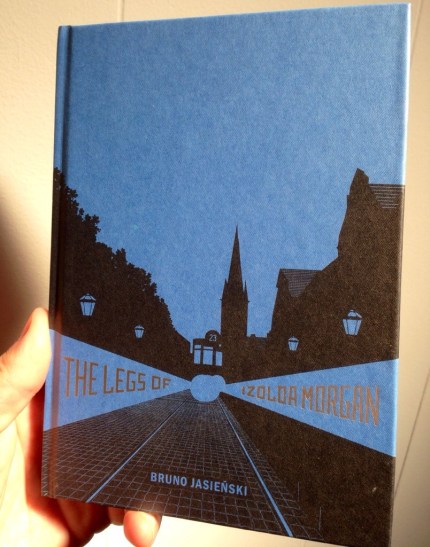
Bruno Jasieński’s The Legs of Izolda Morgan (Book Acquired, 5.01.2014)

20140516-102034.jpg

The recent publication of Bruno Jasieński’s The Legs of Izolda Morgan offers another strong argument that Twisted Spoon Press is publishing some of the most fascinating—and most beautiful—books available today. Clothbound and handsomely printed, Izolda Morgan collects several of Jasieński’s futurist manifestos, an essay, stories, and satires.

20140516-093921.jpg

Publisher’s blurb:

Considered the enfant terrible of the Polish avant-garde, lauded by critics and scorned by the public, Bruno Jasieński suddenly declared the end of Futurism in Poland soon after his short “novel” The Legs of Izolda Morgan appeared in 1923. An extraordinary example of Futurist prose, this fantastic tale cautions against the machine supplanting the human while the human body is disaggregated into fetishized constituent parts. As central to Jasieński’s oeuvre, the text is situated here between two seminal manifestoes and the important essay “Polish Futurism,” which signaled the movement’s end in the context of its confused reception in Poland, the towering influence of Mayakovsky, and what set it apart from the futurisms of Italy and Russia. The condensed story “Keys” displays Jasieński’s turn toward satire to lambaste the hypocrisies pervasive in powerful institutions, and this is further developed in the two longer grotesques from his time in the Soviet Union in the 1930s. Translated into English from the Russian for the first time, these two late stories expose the nefarious absurdity of racial persecution and warmongering and the lengths social and political structures will go to underpin them.


A manifesto:

20140516-102256.jpg

“Saint Cecilia; Or, The Power of Music” — Heinrich von Kleist

“Saint Cecilia; Or, The Power of Music”

by

Heinrich von Kleist

Towards the end of the sixteenth century, when iconoclasm was raging in the Netherlands, three young brothers, who all studied at Wittenberg, chanced to meet at Aix-la-Chapelle with a fourth, who had been appointed preacher at Antwerp. They wished to take possession of an inheritance, which had fallen to them by the death of an old uncle, perfectly unknown to all of them, and had turned into an inn, because no one was on the spot to whom they could apply. After the lapse of some days, which they had passed in listening to the preacher’s accounts of the remarkable occurrences that had taken place in the Netherlands, it chanced that the festival of Corpus Christi was just about to be solemnised by the nuns of St. Cecilia’s convent, which then stood before the city gates. The four brothers heated with fanaticism, youth, and the example of the Netherlands, determined to give the town of Aix-la-Chapelle a spectacle of image-breaking. The preacher, who had been more than once at the head of such enterprises, assembled in the evening preceding the festival a number of young tradesmen and students, devoted to the new doctrine, who spent the night in eating and drinking at the inn. Day had no sooner appeared over the battlements than they provided themselves with axes and all sorts of instruments of destruction, to begin their violent work. Exulting with delight, they agreed upon a signal at which they would begin to knock in the windows, which were painted over with biblical subjects, and, secure of finding a great number of followers among the people, they betook themselves to the cathedral, at the hour when the bells first rang, with the determination not to leave one stone upon another. The abbess, who, as early as daybreak, had been informed by a friend of the peril in which the convent stood, sent several times, but always in vain, to the imperial officer who held command in the town, requesting him to appoint a guard for the protection of the convent. The officer, who, clandestinely at least, was favorably imposed towards the new doctrine, refused her request, under the pretext that she was merely dreaming, and that not the slightest danger to her convent was to be apprehended. In the meanwhile the hour appointed for the commencement of the solemnities arrived, and the nuns prepared themselves for mass, praying and trembling with the apprehension of approaching events. The bailiff of the convent, an old man, aged seventy, with a troop of armed servants, whom he had posted at the entrance of the church, was their only protection. In nuns’ convents, it is well known, the sisters themselves, who are well practised in every sort of instrument, are their own musicians, and they play with a precision, a feeling, and an intelligence, which we often miss in orchestras of men, probably because there is something feminine in this mysterious art. Now it happened, to increase the embarrassment, that the conductress of the orchestra, Sister Antonia, had fallen sick of a nervous fever some days before, and the consequence was, that the whole convent was in the greatest tumult about the performance of a suitable piece of music, to say nothing of the fact that the four profane brothers were already visible, wrapped in mantles among the pillars of the church. The abbess who, on the evening of the preceding day, had ordered the performance of a very old Italian mass, by an unknown master, with which the greatest effect had always been produced on account of its peculiarly sacred and solemn character, and who was now more than ever bent on her purpose, sent again to sister Antonia to know how she was. The nun who took the message, returned with the intelligence that the sister lay in a perfectly unconscious condition and that all notion of her conducting the music must be entirely given up. In the meanwhile, there had already been several very critical scenes in the convent into which more than a hundred impious persons of all ranks and ages, armed with hatchets and crowbars, had gradually found their way. Some of the guards who stood at the portals had been shamefully annoyed, and the nuns, who, engaged in their holy offices, had from time to time appeared singly in the porticoes, were insulted by the most unseemly expressions. At last the bailiff retreated to the sacristy, and there upon his knees implored the abbess to stop the festival, and to seek the protection of the commander in the city. But the abbess was immoveable, insisting that the festival which had been instituted for the honour of the Deity must take its course. She reminded the bailiff that it was his duty to defend the mass, and all the solemnities of the cathedral with life and limb, and as the bell had rang, ordered the nuns, who surrounded her, shaking and trembling, to take an oratorium of some sort or other, and make a beginning by performing it. Continue reading ““Saint Cecilia; Or, The Power of Music” — Heinrich von Kleist”

“The Jilting of Granny Weatherall” — Katherine Anne Porter

“The Jilting of Granny Weatherall”

by

Katherine Anne Porter

She flicked her wrist neatly out of Doctor Harry’s pudgy careful fingers and pulled the sheet up to her chin. The brat ought to be in knee breeches. Doctoring around the country with spectacles on his nose! “Get along now. Take your schoolbooks and go. There’s nothing wrong with me.”

Doctor Harry spread a warm paw like a cushion on her forehead where the forked green vein danced and made her eyelids twitch. “Now, now, be a good girl, and we’ll have you up in no time.”

“That’s no way to speak to a woman nearly eighty years old just because she’s down. I’d have you respect your elders, young man.”

“Well, Missy, excuse me.” Doctor Harry patted her cheek. “But I’ve got to warn you, haven’t I? You’re a marvel, but you must be careful or you’re going to be good and sorry.”

“Don’t tell me what I’m going to be. I’m on my feet now, morally speaking. It’s Cornelia. I had to go to bed to get rid of her.”

Her bones felt loose, and floated around in her skin, and Doctor Harry floated like a balloon around the foot of the bed. He floated and pulled down his waistcoat, and swung his glasses on a cord. “Well, stay where you are, it certainly can’t hurt you.”

“Get along and doctor your sick,” said Granny Weatherall. “Leave a well woman alone. I’ll call for you when I want you…Where were you forty years ago when I pulled through milk-leg and double pneumonia? You weren’t even born. Don’t let Cornelia lead you on,” she shouted, because Doctor Harry appeared to float up to the ceiling and out. “I pay my own bills, and I don’t throw my money away on nonsense!” Continue reading ““The Jilting of Granny Weatherall” — Katherine Anne Porter”

“His romantic ancestor, his ancestor of the romantic death” | Bolaño and Borges

Jorge Luis Borges is first mentioned in the sixth paragraph of Roberto Bolaño’s masterful short story “The Insufferable Gaucho.” In this paragraph, the narrator tells us that the story’s hero, an ex-judge named Pereda, believed “the best Argentine writers were Borges and his son; any further commentary on that subject was superfluous.”

Several paragraphs later, Bolaño’s narrator explicitly references Borges’s short story “The South,” the precursor text for “The Insufferable Gaucho.” The reference to Borges is tied again to Pereda’s son, the writer Bebe.

Leaving tumultuous Buenos Aires, basically destitute from the Argentine Great Depression, Pereda heads to the countryside to take up residence in his family’s ancient ranch. Departing the train and arriving to a rural town, 

Inevitably, he remembered Borges’s story “The South,” and when he thought of the store mentioned in the final paragraphs his eyes brimmed with tears. Then he remembered the plot of Bebe’s last novel, and imagined his son writing on a computer, in an austere room at a Midwestern university. When Bebe comes back and finds out I’ve gone to the ranch . . . , he thought in enthusiastic anticipation.

Bolaño essentially appropriates the plot of “The South” for his tale “The Insufferable Gaucho” and inserts a version of himself into this revision. Bolaño is “Bebe” here, an author who “wrote vaguely melancholy stories with vaguely crime-related plots,” his name phonically doubling the series of mirrors and precursors that Bolaño, mystery man, leaves as clues: Bebe, B-B, Borges-Bolaño, Belano-Bolaño. (Is this too wild a conjecture, dear reader? Mea culpa). 

And Pereda then? A stand-in for Borges’s Juan Dahlmann (hero of “The South,” who “considered himself profoundly Argentinian”), surely, but also, maybe also—a stand-in for (a version of) Borges.

What I mean to say:

Bolaño, displaced Chilean, writes “The Insufferable Gaucho” as an intertextual love letter to his displaced father, the Argentine Jorge Luis Borges. Continue reading ““His romantic ancestor, his ancestor of the romantic death” | Bolaño and Borges”

“The Locket” — Kate Chopin

“The Locket”

by

Kate Chopin

I

One night in autumn a few men were gathered about a fire on the slope of a hill. They belonged to a small detachment of Confederate forces and were awaiting orders to march. Their gray uniforms were worn beyond the point of shabbiness. One of the men was heating something in a tin cup over the embers. Two were lying at full length a little distance away, while a fourth was trying to decipher a letter and had drawn close to the light. He had unfastened his collar and a good bit of his flannel shirt front.

“What’s that you got around your neck, Ned?” asked one of the men lying in the obscurity.

Ned—or Edmond—mechanically fastened another button of his shirt and did not reply. He went on reading his letter.

“Is it your sweet heart’s picture?”

“‘Taint no gal’s picture,” offered the man at the fire. He had removed his tin cup and was engaged in stirring its grimy contents with a small stick. “That’s a charm; some kind of hoodoo business that one o’ them priests gave him to keep him out o’ trouble. I know them Cath’lics. That’s how come Frenchy got permoted an never got a scratch sence he’s been in the ranks. Hey, French! aint I right?” Edmond looked up absently from his letter. Continue reading ““The Locket” — Kate Chopin”

Read “Der Kulterer,” a 1962 Thomas Bernhard Short Story, New in Translation

At his wonderful blog The Philosophical Worldview Artist, Douglas Robertson has posted his English translation of Thomas Bernhard’s 1962 story “Der Kulterer.”

Opening lines:

The closer he drew to the day of his release from the penal institution, the more Kulterer dreaded returning to his wife.  He led an existence that was completely withdrawn and completely unheeded by his fellow-inmates, and during his free time, which was often much too long, because in accordance with regulations they worked only five or six hours a day at the printing machines, he would write down his ideas, or as he termed them, “trifling thoughts,” which preoccupied him almost uninterruptedly. 

“Spotted Horses,” A Short Story by William Faulkner

“Spotted Horses”

by

William Faulkner

I

A little while before sundown the men lounging about the gallery of the store saw, coming up the road from the south, a covered wagon drawn by mules and followed by a considerable string of obviously alive objects which in the levelling sun resembled vari-sized and -colored tatters torn at random from large billboards-circus posters, say -attached to the rear of the wagon and inherent with its own separate and collective motion, like the tail of a kite.
“What in the hell is that?” one said.

“It’s a circus,” Quick said. They began to rise, watching the wagon. Now they could see that the animals behind the wagon were horses. Two men rode in the wagon.

“Hell fire,” the first man – his name was Freeman – said “It’s Flem Snopes.’ They were all standing when the wagon came up and stopped and Snopes got down and approached the steps. He might have departed only this morning. He wore the same cloth cap, the minute bow tie against the white shirt, the same gray trousers. He mounted the steps. Continue reading ““Spotted Horses,” A Short Story by William Faulkner”

To put it aphoristically, a human skeleton is not human (William T. Vollmann)

And now, a note for those of you who consider this a vulgarly supernatural tale: It may well be that ambitious people of any stripe find themselves compelled to schematize the subjects of their solicitude into, say, Jews to be liquidated, or Jews to be saved. There might not be might not be time to learn the name of every Esther or Isaac who falls within Operation Reinhard’s purview. And the further those subjects (I mean objects) get altered in accordance with the purpose, the more problematic it becomes to perceive their irrelevantly human qualities. I quote the testimony of Michal Chilczuk, Polish People’s Army (he’d participated in the liberation of Sachsenhausen): But what I saw were people I call humans, but it was difficult to grasp that they were humans. What did Chilczuk mean by this? To put it aphoristically, a human skeleton is not human. It frightens us because it proves the truth of that gravestone epitaph so common in the age of Holbein: What I once was, so you are. What I am now, so you will be. The gaze of those dark, sharp-edged eye-sockets seems implacable, and the many teeth, which haunted Edgar Allan Poe, snarl much too nakedly, bereft of those festive pink ribbons of flesh we call “lips,” whose convolutions and involutions can express mirth, friendliness, even tenderness. A human skull’s smile is as menacing as a crocodile’s. Since death itself is nothing, the best our minds can do to represent it is through that expressionless face of bone which one day will be ours, and to which we cannot help imparting an expression. Under such circumstances, how can that expression be reassuring?

From William T. Vollmann’s novel Europe Central.

“A Mother” — James Joyce

“A Mother”

by

James Joyce

MR HOLOHAN, assistant secretary of the Eire Abu Society, had been walking up and down Dublin for nearly a month, with his hands and pockets full of dirty pieces of paper, arranging about the series of concerts. He had a game leg and for this his friends called him Hoppy Holohan. He walked up and down constantly, stood by the hour at street corners arguing the point and made notes; but in the end it was Mrs. Kearney who arranged everything.

Miss Devlin had become Mrs. Kearney out of spite. She had been educated in a high-class convent, where she had learned French and music. As she was naturally pale and unbending in manner she made few friends at school. When she came to the age of marriage she was sent out to many houses where her playing and ivory manners were much admired. She sat amid the chilly circle of her accomplishments, waiting for some suitor to brave it and offer her a brilliant life. But the young men whom she met were ordinary and she gave them no encouragement, trying to console her romantic desires by eating a great deal of Turkish Delight in secret. However, when she drew near the limit and her friends began to loosen their tongues about her, she silenced them by marrying Mr. Kearney, who was a bootmaker on Ormond Quay.

He was much older than she. His conversation, which was serious, took place at intervals in his great brown beard. After the first year of married life, Mrs. Kearney perceived that such a man would wear better than a romantic person, but she never put her own romantic ideas away. He was sober, thrifty and pious; he went to the altar every first Friday, sometimes with her, oftener by himself. But she never weakened in her religion and was a good wife to him. At some party in a strange house when she lifted her eyebrow ever so slightly he stood up to take his leave and, when his cough troubled him, she put the eider-down quilt over his feet and made a strong rum punch. For his part, he was a model father. By paying a small sum every week into a society, he ensured for both his daughters a dowry of one hundred pounds each when they came to the age of twenty-four. He sent the older daughter, Kathleen, to a good convent, where she learned French and music, and afterward paid her fees at the Academy. Every year in the month of July Mrs. Kearney found occasion to say to some friend:

“My good man is packing us off to Skerries for a few weeks.”

If it was not Skerries it was Howth or Greystones. Continue reading ““A Mother” — James Joyce”

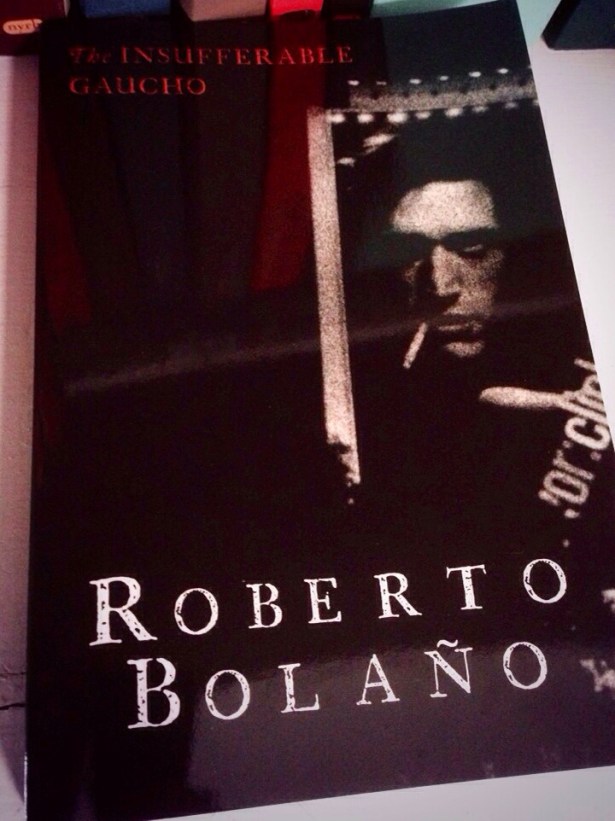
Roberto Bolaño’s The Insufferable Gaucho (Book Acquired, 05.05.2014)

20140509-130407.jpg

Roberto Bolaño’s The Insufferable Gaucho, which I’ve sort of saved for a few years—put off isn’t the right phrase, but sort of, knowing it as companion to Last Evenings on Earth, y’know, saved it for later—Roberto Bolaño’s The Insufferable Gaucho is very difficult to photograph. Very shiny.

Lolita, Reading — Stanley Kubrick

Selections from One-Star Amazon Reviews of Thomas Pynchon’s Gravity’s Rainbow

[Ed. note: The following citations come from one-star Amazon reviews of Thomas Pynchon’s novel Gravity’s Rainbow. Yes, I’ve done this a few times before (see also: George Orwell’s 1984, Melville’s Moby-Dick, Joyce’s Ulysses and Markson’s Wittgenstein’s Mistress) and to be clear, I think some of the one-star reviews of Gravity’s Rainbow make some interesting points–although most of the reviewers seem to be upset over the book’s reputation/status, and attack that (and by extension, postmodernism) instead of attempting to analyze what Pynchon was actually, y’know, trying to do. I’ve preserved the reviewers’ unique styles of punctuation and spelling].

Who put it into Pynchon’s head that he could write?

After reading over one hundred fifty pages, all I could believe was the story set during WWII, but I wasn’t sure.

This is not literature. 

After I finished reading this book twenty years ago, I left it in my apartment building’s laundry room for whomever might be interested in it. The book sat there for months and nobody was interested in it enough to take it home. Finally, it was ruined when a water pipe burst and, I presume, it is now landfill in Staten Island.

Tedious. 

There is not an ounce of humanity in this book.  I finally threw it against a wall in disgust.

Pynchon writes liberal, paranoid diatribes against any and all institutions, especially conservative ones 

I felt empty and used.

I’ve been told the nominating committee (made up mostly of book reviewers) nominated this for the Pulitzer Prize as best fiction. The awards committee (mostly book editors) rejected it as an unreadable piece of crap. I agree with the editors.

This book’s failings are in part a function of it’s time — the early 70’s – when culture was naively experimental, half-baked, vulgar, and exhibitionist.

When one contrasts Vonnegut’s Slaughterhouse Five with this book, it’s like comparing an Olympic sprinter with an obese man running for the bus with a hot dog in one hand and a soda in the other.

I honestly preferred J.G. Ballard’s Crash to this book.

It seems to me it’s very easy to be “a literary master” in this way. It’s much more difficult to write something very clear and simple that people can easily understand (and yet still be profound and say something new).

Woody Allen used to be funny. Monty Python was occasionally funny. 

Any author who uses “further” for “farther” (as Pynchon does, among many other errors) should never make anyone’s “best novelist” list.

To this reader, Pynchon sounds like the unabomber with a better thesaurus. 

One of those books that professors are constantly forcing students to read because the novelist can’t attract a following on his own merits and ability to entertain. 

I only finished it beacuse I was on jury duty. 

I thought this novel was a complete waste of my time and it amazes me to hear so many praise what I think was paranoid and resembles silly cult literature. My father had a book back in the fifties sponsored by an extreme right wing group that was equally paranoid and absurd.

Pynchon couldn’t write anything funny if his life depended upon it.

Pynchon is like a high school football bully who says “Okay, I’m gonna trow da ball as hard as I can–you see if you can catch it”. No thanks Spike.

I mean, even the first page of this book offends my sensibilities.

An entire novel centered on the unrealistic, flimsy idea that a man getting erections will attract missiles? Some missiles may be heat seaking but the temperature of blood found in the groin during erections is no longer near the degree it takes to attract heat seaking weaponry. Get your facts right, Pynchon. A scientist you ain’t.

Reminds me of John Coltrane’s Ascension album, which for the entire album sounds like the band is warming up but never gets to play, but the elitist snobs just adore it.

A good argument for a good old fashioned book burning. 

The majority of this book consists of sentence after sentence and paragraph after paragraph that don’t have any apparent correlation to each other.

wow, all the hard work that this man put in just to bore me! the effort alone is worth a star. gallant attempt mr pynchon.

This is one of those “university novels” (as opposed to “popular” novels that people actually read and love) that “you have to work hard at to appreciate”. 

It’s like viewing a `painting’ of a blank canvas titled Untitled. 

I lived in Germany a few years ago and found this book in a train station. Someone had just walked off and left it. After about ten pages, realizing that Pynchon was an intellectual rip-off artist, I secured it a trash can where no one could find it. I like to think I protect the public from pollution.

Maybe it’s entertaining if you take huge quantities of lsd, otherwise it’s a nightmare. 

It is terrible.

I cannot summarize the story, because I couldnt find one.

obviously written by some self-loving, over-indulged, hippie.

I tend to lump this book in with the rest of the general malaise surrounding the innate nihilism of Postmodernism. 

This book makes me a little sad, because I think that Pynchon, had he not gone over to the dark side, could have been a brilliant prose stylist, if not anything else.

feels like being flayed alive by words alone. I wanted to stab myself in the head just to relieve the pain.

This is like Ulysses. 

Add a star if you enjoy constant reference to penises and vulva and all kinds of deviant sex acts.

I should sue the author for migraine.

To sum it up: it is too much work to read this book.