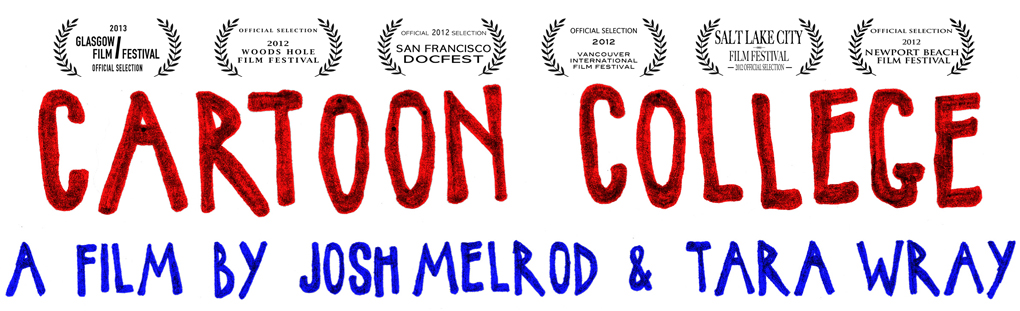
When I first read the press materials for Josh Melrod and Tara Wray’s documentary Cartoon College, I’ll admit that I was mostly interested in the prospect of seeing comix legends like Art Spiegelman, Charles Burns, Lynda Barry, Chris Ware, Scott McCloud, and Stephen Bissette discuss their craft. What Melrod and Wray deliver though is much more—an intimate and often very moving look at the lives of the young artists who attend the prestigious Center for Cartoon Studies. This is a film about passion, drive, commitment, and what it means to be an outsider.
In my review, I wrote: “Cartoon College offers an intriguing story about real people trying to do something that they love, and I enjoyed that. This is a film about the impetus, motivation, and hard, hard work that goes into the creative process. Great stuff.”
Josh was kind enough to talk to me about making the film over a series of emails.
Biblioklept: How did you begin the documentary Cartoon College? How did the project come about?
Josh Melrod: In 2006 my wife, then my girlfriend, Tara Wray, had just finished her first movie, Manhattan, Kansas, and was looking for her next project. She’s a huge fan of Chris Ware and she read an article about how he’d been a visiting lecturer at CCS, which had just opened a year earlier, and that was enough to get her thinking about a cartoon school documentary. She asked me if I’d consider moving to Vermont for a year–we were living in New York, and had been for a while–and I said ok. Then we had to convince James Sturm and Michelle Ollie, who founded the school, to let us film, which took several months of emails and a couple of face-to-face meetings and a trip or two to White River Junction. Once they gave us the green light we basically packed up and moved to Vermont. That was in August of 2007, and we’ve been here ever since.
Biblioklept: So you guys were shooting for like, three years? When you started did you have an idea of the kind of story you wanted to tell in Cartoon College?
JM: Our original conceit for the movie was a year in the life of a cartoon school. It was supposed to be more about the institution and how it was helping to revitalize White River Junction, which had been a town in decline for about a century. So we shot for the 2007-2008 academic year and then started working with an editor in New York that summer. It took about six months to get a rough cut put together, but when all was said and done we weren’t happy with what we had. Part of it was that the story of the school’s impact on the town didn’t quite come together–it was an arc that was unfolding too slowly to really be seen during the year we’d been filming. But we also realized that what really interested us, much more than the school itself, was documenting the creative lives of the students and witnessing these aspiring artists at a very pivotal time in their careers. We basically scrapped the rough cut, which was a pretty difficult decision, and went back to film for what turned out to be another year-and-a-half.
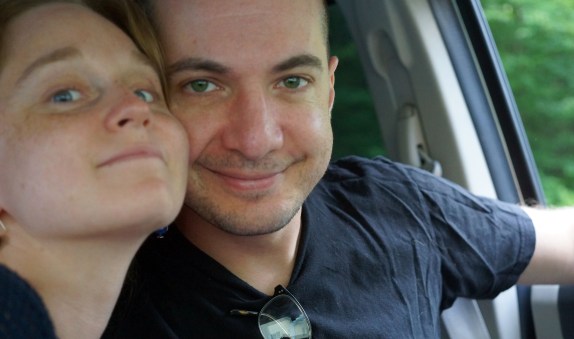
The filmmakers, Tara Wray and Josh Melrod
Biblioklept: Some of the students, like Blair Sterett and Jen Vaughn, for example, are on screen a lot more than others. Was this because they were more open to the cameras? Were there students who were reticent to talk to you?
JM: Jen is kind of a natural in front of the camera, so in a sense she was more open than some of the others. But there were only a very small handful of people during the entire production who told us they really didn’t want to be filmed. A lot of the cartoonists we spoke with are fairly introverted, and quite a few, both the younger and the more experienced artists, discussed how they express themselves best through their comics, but it doesn’t take too long for most people to begin to forget the camera is there.
Biblioklept: I like that the film is really about the career of cartooning, and that the film focuses on the arcs of these aspiring cartoonists. You’ve got all these great interviews with people like Chris Ware and Art Spiegelman and Charles Burns, but their comments ultimately work to illuminate or enrich, through their perspectives, what the students are going through. It seems like there’s a lot of restraint and wise editing on your end here. Can you talk about how you put the film together? I’m curious how intuitive the process of forming the narrative was . . .
JM: By the time we finished shooting we had something like 150 hours of footage. I don’t remember how it all broke down, but maybe forty percent was interviews. There was a lot to go through. But it was pretty clear what the character arcs were for Blair and Al and Jen. Actually, it’s kind of hard for me to remember the process in any great detail. I was just starting to work on the rough cut when Tara and I had our twins, so for the first six months of the edit I was working from around ten at night until six a.m., stopping every couple of hours to help with feedings and changing diapers, and getting a few hours of sleep here and there during the day. It’s all very blurry, and sort of miraculous that I finished the rough cut at all. My method of working was to cut the footage down from 150 hours to just 10, which is a manageable amount of material, and from there put together an assembly that had the basic structure of a movie, and then loosely refine that into a two-hour rough cut. Then I went to New York to work with another editor, Chris Branca, who came in with a ton of great ideas and further refined the story. As for the interviews serving to illuminate what the students were going through, that was pretty organic. The challenges that a person faces when they decide to become an artist are fairly universal–the self-doubt, managing your time, coming to terms with your own limitations, figuring how to make a living, etc.–so the experiences shared by the established artists were in-line with what we documented from the students.
Biblioklept: You brought up that Tara’s interest in Ware’s work kind of sparked the genesis of the documentary. Were you a fan of comics too? How much did you know about the cartooning world going into the filming process?
JM: As a kid I loved Calvin and Hobbes and Bloom County/Outland and The Far Side, but those all ended when I was in high school and I pretty much stopped reading comics at that point. Then, after Tara and I moved in together, I’d pick up some of the books she’d leave around the apartment–like Jimmy Corrigan and Hate, I remember in particular–but I knew virtually nothing about the cartooning world when we started the movie.
Biblioklept: Have you become a fan since then?
JM: I love comics, but I’m a very casual fan. I still gravitate towards non-graphic novels, and I’m not quite sure why that is. Comics certainly demand more attention from the reader, if the reader we’re talking about is me–the interplay between the pictures and the text require a level of focus that isn’t needed when you’re just reading words, although I’m not sure I ever noticed that when I was a kid–and so maybe it’s that I don’t always have the mental energy to pick up a heavy graphic novel. I am really interested in reading comics from the people in the movie–CCS graduates are doing just incredible work and a lot of the former students we followed are starting to put out books now. Katherine Roy just illustrated a book and has a couple of others coming out soon; Jen Vaughn released a book last week; Josh Rosen is going to start serializing the project he was working on while we were filming; Joe Lambert, who we interviewed but didn’t appear in the movie, although he designed the poster, made a book about Annie Sullivan and Helen Keller that’s just incredible.
Biblioklept: What kind of movie would you like to do next?
JM: I’m working on a short, a fiction movie, with a couple of guys who used to edit a literary magazine with me. It was called theLand-Grant College Review and we published for five or six years starting in about 2002. We wanted to work on something new, and I’m really interested in doing a narrative, and they’d been thinking of doing a screenplay, so that’s what we decided to do. We’re still writing, but we have some good advisers on board and the plan is to shoot next summer. And I’m in the development phase on a pair of new docs. They’re both about personalities, as opposed to being issue-based, which is a common denominator. One follows a semi-famous performer and the other involves a family on its summer vacation. It’s still pretty early to talk confidently about any of this stuff. I just have to keep plugging away and see what happens, but these are the projects I’d like to do next.
Biblioklept: The docs sound intriguing. I spent some time in the Land-Grant College Review archive just now—what a great collection of authors. Your little microfiction there is a good creepy laugh. What are you reading now?
JM: Thanks! We had a short but good run, and got to publish a lot of great writers. One of my most prized possessions is a postcard that David Foster Wallace sent me–in response to a letter I’d written asking him to send us a story–saying that he’s “just working on stuff that isn’t suitable for publication any place.”
As for what I’m reading, I just started [Erik Larson’s] The Devil In The White City, which I’d been hesitant to open for a few years since I do a lot of reading before bed and I thought it would mess with my sleep. So far so good.
Biblioklept: Have you ever stolen a book?
JM: No, never stolen a book, but I have gone a long time without paying for a book. A lot of the books on my shelf I picked out of piles left on the curb or at the recycling center near where we live now. Sometimes I like to let the universe decide what I read depending on what I find in front of me, which is how I got to read The Universe And Dr. Einstein, a lay readers guide to general relativity that I still managed not to understand.
When I moved to Port of Spain in Trinidad five years ago, there was a small Caribbean film festival on, which I went to see. They showed a documentary, A Hard Road To Travel(2001, directed by Chris Browne), on the making of The Harder they Come (1972, directed by Perry Henzell, Browne’s uncle), the classic film starring Jimmy Cliff. I realized that many people of a younger generation in Port of Spain had never seen The Harder They Come. As there’s no cinema in town that shows old films, I decided to screen it. It was a one-off idea, but it was popular, so we started the StudioFilmClub. I now run it with a Trinidadian artist, Che Lovelace. Initially we wanted to show films that we thought were appropriate to a Trinidadian audience, where the narrative might have some connection to the place, but in the end we realized that was somehow patronizing; instead, we decided to show films that we simply liked or thought important or interesting – we only do one film a week and jump around between genres and countries and directors, covering the spectrum from art-house to mainstream. For example, the second film we showed was Agnès Varda’s The Gleaners and I (2000), and after that Jim Jarmusch’s Ghost Dog: The Way of the Samurai (1999). I don’t think we’ve ever put on a bad film.
Nanni Balestrini’s novella Sandokan, in English translation from Melville House, tells the story of the rise of the Camorra crime syndicate in the small, poverty-stricken cities around Naples. Balestrini’s unnamed narrator occupies a fascinating insider-outsider perspective: one one hand, he, unlike many of his peers, does not join the gang, or “clan,” as its called–in fact, their behavior repulses him. On the other hand, he’s a native of the small town where Francesco Schiavone (aka Sandokan), Antonio Bardellino, and their henchman rule mercilessly, an eye-witness to the brutality and inhumanity of organized crime. The narrator is a sensitive young man who delineates clearly how the crime cartel was able to achieve such economic prosperity and power in the 70s, 80s, and 90s, detailing the various rackets the clan imposed upon the town, like stealing elections, peddling drugs, and manipulating the agribusiness that is the main source of income for average Neapolitan peasants. The narrator also explores why these small towns fall so easily into the terror of organized crime. The main reason: boredom stemming from little or nothing to do.
Balestrini’s narrator’s description of the Camorra is systematic, detailing the awful history and brutal practices of the syndicate in spare, concrete terms. His explications of the clan’s violence is not so much thrilling as it is ugly, as the narrator always shows how “normal people” (his words) are cheated, killed, or otherwise harmed by the Camorra. The narrator’s tone is often journalistic but never clinical; he always shows what’s at stake for the “normal people,” how they are affected by these crimes. At times the narrator is wryly funny, a tone that results in large part from his observation that the townspeople, the people he grew up around, begin to normalize the violence. It becomes part of their daily lives and affects them so directly that it becomes casual, and the sensitive narrator is one of only a few not to bow to it, ignore it, or take part in it–yet the violence and crime is so overwhelming that to live with it is to live with absurdity. Balestrini employs a punctuation-free rhetorical style in Sandokan that captures the breathless energy and frustration of the narrator. While many readers might balk at the lack of commas, periods, or semi-colons, I found the technique quite liberating. It enhances the immediacy of the narrator’s voice, the rushed sense of importance to his tale. It also promotes sustained readings of the text–I read most of Sandokan in three enthralled sittings.
Sandokan has its cinematic twin in the 2008 film Gomorra, directed by Matteo Garrone. The film, like the book, illustrates the affect that crime has on a range of “normal people,” mostly occupants of a housing project outside of Naples. As in Sandokan, the ordinary citizens find that they have no choice but to choose between sides as an absurd, petty gang war ravages their already decimated landscape. Where Balestrini’s punctuation-free rhetoric allows readers closer access to his narrator’s pathos-driven story, Garrone lets his camera wander freely over the grim landscape without ever imposing any clear narrative structure. It is not until the film’s final third that the five disparate stories he tells coalesce, and even then, it remains unclear who is on whose side. What is clear is that the violence and crime is quickly stealing–and killing–another generation.
In an age where violence is sensationalized and glamorized, particularly in gangster films and TV shows (do I really need to list them?), Sandokan and Gomorra both lay bare the Darwinian cost of crime. In both narratives, the violence is mundane and inescapable, meaningless yet awful, and very, very dark. Neither narrative is didactic in the least–or even hopeful, for that matter–but their is an implicit suggestion that if only there were some alternative to the Camorra–libraries, social clubs, movie houses–there might be another prospect for the young people in this area.
I highly recommend both Sandokan and Gomorra. As an end note, I’d love to see more of Nanni Balestrini’s work come into English translation, perhaps via Antony Shugaar and Melville House, who’ve done a lovely job here.
[Ed. note: Biblioklept published a version of this review in January of 2010]
Marvelous moment at 1:18:14 (in a film full of marvelous moments) worth transcribing here.
Frith says:
There’s not much that happens that wakes people up. People are very happy to receive all the time—information. This information is usually coming from central source, like a television station or a government. And people don’t question this at all, anymore. But there are some things you can do in cultural terms that will make people react in a different way. More–finding something in themselves that they didn’t know about. Because the kinds of concerts that we do, or theater events, or dance, or anything like this, when it works, it’s because it strikes a cord inside somebody, and they have to look at themselves, and they have to look at themselves in relation to the society that they’re in. And there aren’t many things that make people do that. Most of the time, people don’t even think about it.
Film footage of the first Bloomsday celebration (June 16, 1954)–a great find by Antoine Malette, who posted the video along with an account of the journey as told in Flann O’Brien: An Illustrated Biography. The film was shot by John Ryan, and shows an extremely inebriated Brian O’Nolan (aka Flann O’Brien) having to be helped around by pals Anthony Cronin and Patrick Kavanagh. We’re also treated to a scene of Kavanagh taking a piss with Joyce’s cousin Tom Joyce, a dentist who joined the merry band. (The scene will undoubtedly recall to you that marvelous moment in Ulysses when “first Stephen, then Bloom, in penumbra urinated“). The troupe didn’t quite finish their mission, getting sidetracked by booze and quarrels. Read the full account at Malette’s site.








 Biblioklept