You remember Harmony Korine, right? The scruffy auteur who gave us the nightmare white trash tornado-disaster cat-killing opus Gummo? The curb-dancing maniac who never got around to putting out that movie where he provoked strangers to beat him up? The guy who broke the Dogme 95 rules on Julien Donkey-Boy, a film featuring a pregnant Chloe Sevigny ice skating to Oval? The guy who stitched Trash Humpers together using VHS decks? The guy who wrote Kids? That guy?
So he has this new movie coming out called Spring Breakers. He wrote and directed the film. It stars James Franco, along with Disney alumni Vanessa Hudgens and Selena Gomez.
Here is the NSFW trailer for Spring Breakers:
I am baffled.
I do not know what to make of this.
Sure, there’s something of Kids in there, but the lurid, saturated cinematography by Benoît Debie (who has worked with Gaspar Noé in the past) has this nauseating MTV/Hype Williams feel to it that seems miles away from Larry Clark’s plain, unadorned style, or Korine’s own patchy VHS buzz.
The film also seems to be a fairly straightforward, character-oriented plot, likely with clear exposition, an arc—all that stuff that Korine was known to dismiss in the past. Now, I’m not saying that Korine should just keep making the same films again and again (not that he’s ever done that, to be clear)—I’m just surprised by the look and feel of Spring Breakers, and how it seems to be marketed.
My gut feeling, which might be entirely wrong, is that Spring Breakers is an expensive prank, a film shot entirely in ironic quotation marks that the viewer will never see because Korine will never call attention to them. (This potentially puts Spring Breakers in the same territory as masterpieces like Road House and RoboCop).
Lead actor James Franco, who is currently pursuing seven PhDs in irony studies and metawhatevers, would seem an ideal fit for such a prank. Additionally, Franco’s begrilled performance as Alien is clearly channeling wunderkind RiFF RaFF, (Mr. RaFF even has a song called “RAP GAME JAMES FRANCO” which contains the genius hook “Non-stop through desert / Salisbury steak sweater”). RiFF RaFF’s shtick is even more bewildering than Spring Breakers; it’s difficult to tell if he’s some kind of art genius doing the Andy Kaufman thing or just a white kid from Houston with a bizarre sense of humor. Or both. Or neither. Either way, there’s something endearingly intriguing about him, whether you’re watching him infiltrate an art show in Miami or claim that his underwear is “moccasins.”
But back to Spring Breakers—it looks awful—but so did the previews for Wild Things, so, you know. And, again, the marketing isn’t the film. Still, it’s hard to get excited about this one.
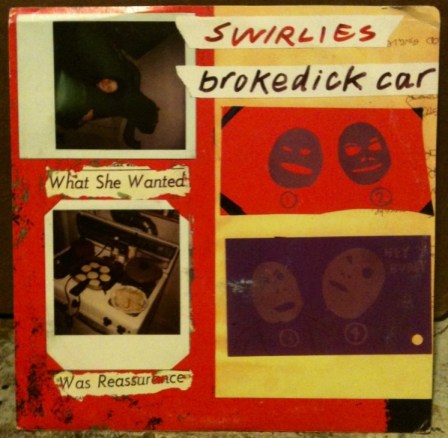
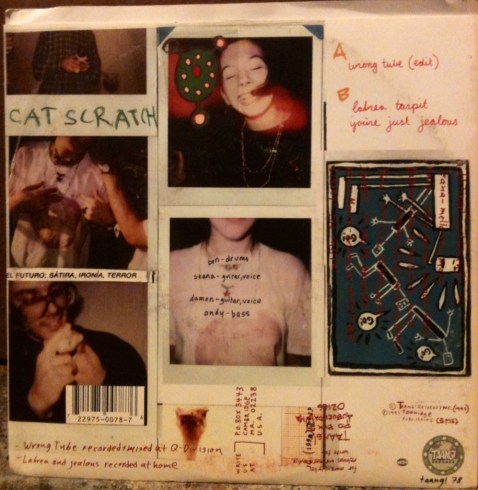
In my estimation, The Swirlies were the greatest indie rock band of the 1990s to never really make it big—and by “make it big” I mean indie rock big—Sebadoh big, Superchunk big. They made two stellar albums of shoegazed-influenced dream pop, Blonder Tongue Audio Baton (1993), and They Spent Their Wild Youthful Days in the Glittering World of the Salons (1996). These albums are crammed with fuzzy four-track recorder experiments, folky half-songs, and a handful of truly stellar, muscular, dream pop songs that would fit nicely on any mixtape between jams from My Bloody Valentine and Stereolab. One such song is “Wrong Tube,” the a-side to this Taang! Records 7″ purporting to be the Brokedick Car EP (it’s not the full EP, which has two other songs).
“Wrong Tube” was a staple in my ’86 Camry’s tape deck for years, and I still love it today. I haven’t listened to this 7″ in years—I almost certainly bought it because of the blue vinyl (and, ashamedly, certain completist tendencies). The guitars are crunchy, swerving, swirly, guitarists Seana Carmody and Damon Tutunjian attacking their tremolo bars with abandon and trading verses as the band crashed through in a high tempo. I still find the final moments of the song exhilarating, as one of the guitars hammers out a sweet melody in the highest register as Carmody harmonizes along. Somehow the entire version of the song doesn’t fit on the 7″, which is a shame I guess. B-sides “Labrea Tarpit” and “You’re Just Jealous” are a forgettable experiment followed by a forgettable ditty.
For me, the golden age of rock was cut short by the success of the Beatles, which could be dated either 1964 or 1966. UK artists had contributed important hits to the pop field—but the triumph of the Beatles formula shifted pop away from the breakthrough of the late Fifties. The Beatles were essentially a music-hall “kid” act, limited to a four-square, discrete-pitch vocabulary. (They knew American ethnic music only by rumor.) They found and crystallized the segment with the best numbers—early teens who wanted something more bland than actual rock. At this point, the regime of maximum sales backfired, as one might well have expected it to.
The “youth” craze of the Sixties became increasingly dubious (from flower power to Altamont), and the Beatles and their imitators morphed, leading their fans to a mystique of consumerist dissipation. (Carnaby Street and “Yellow Submarine.”) For me, the Beatles’ consummate song was “Revolution,” which begins “If you wanna make a revolution, count me out.” It served as the anthem for all the mediocrities who responsed to the stresses of the late twentieth century by embracing institutional co-optation.
After the Beatles seized the market, white pop ceased to interest me except for the flukes. When Bob Dylan added electric instruments and blues chops to his act for “Subterranean Homesick Blues,” that impelled me to my initial rock efforts of 1966 (with Walter De Maria on traps). Given my political engagement, I had been waiting for an impetus to try songs with “revolution” lyrics.
In general, the ascendancy of the Beatles, and the assassination of Martin Luther King, Jr., ended ethnic-rock—the ethnic impulses reverted to the segmented R&B and C&W markets. After the mid-Sixties, rock-pop no longer had ethnic chops—could I have been the only one who was musicological enough to realize that? Rock-pop became uniformly loud in a way which was vulgar, mechanical, and bloated. (There was no more of the profundity, and I mean profundity, of a Chuck Berry or of “Be-Bop-A-Lula.”)
From Henry Flynt’s essay “The Meaning of My Avant-Garde Hillbilly and Blues Music.”
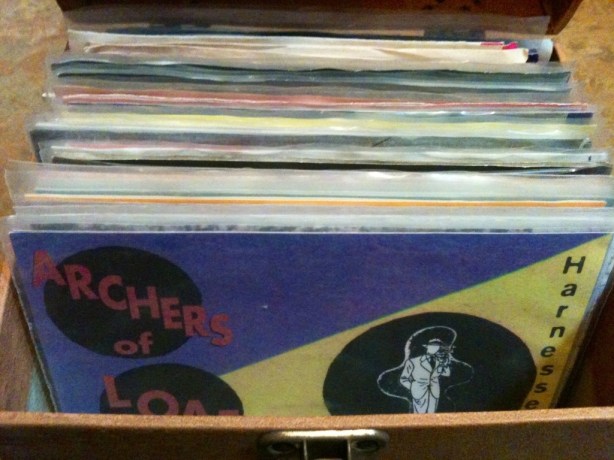
Before mp3s, we used to buy these things called seven-inches, small disks of vinyl, usually played at 45rpm, usually offering an a-side with the band or singer’s single, and backed with (b/w) a b-side offering a song (or songs!) that probably wouldn’t be on the album. A lot of times, 7″s would consist of songs that wouldn’t be on any album. Or that would be it for the band—just the one 7″. I bought many, many of these little disks between 1992 and 1999, and I still have three boxes full of them gathering dust in a utility room.
Anyway, new feature: I’ll pull out one each Sunday, listen to it, photograph it, share some thoughts on it, etc.
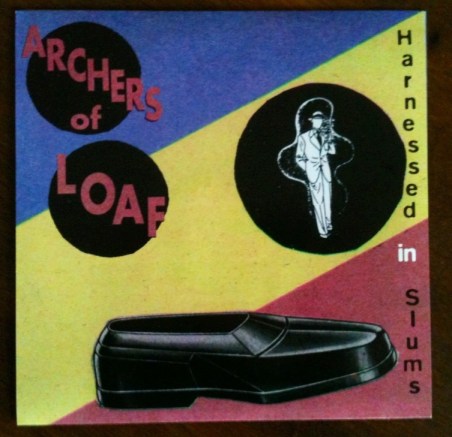
For this week, I pulled out the closest box and then pulled out the first 7″ in the stack: Archers of Loaf’s 1995 single for “Harnessed in Slums,” b/w “Telepathic Traffic.”
“Harnessed in Slums” is the second track from the band’s second album, 1996’s album Vee Vee.
Vee Vee came out shortly after the 1995 EP Vs. the Greatest of All Time, which I think might be the Archers’ best work—or at least, that’s how I remember it. Anyway, I loved this early arc of the band’s career, which kicked off with Icky Mettle, a basically perfect glob of nineties indie rock.
I haven’t listened to Archers of Loaf in years. I lost interest in what the band was doing by the late nineties, and like many of the albums I listened to thousands of times in my teens, I find their music too intertwined in intense memories and feelings to listen to again. I have a hard time extricating the psychic detritus of my youth from certain albums.
The crunchy warbled opening of “Harnessed in Slums” brought back a strange rush of the past. I remembered seeing the band—on a school night!—in support of Icky Mettle. My friend Wayne brought a paper headband to the show and guitarist Eric Johnson wore it through most of the set. They gave us the set list (on a paper plate) and autographed stuff. I wonder if they thought it was weird that we wanted their autographs—I think it’s weird now. (By the time I was 17 I had almost no interest in talking to anyone in a band, let alone getting an autograph).
“Harnessed in Slums” is a perfect Archers track, poppy, proggy, fake-sloppy, a punk anthem channeled through the crunchy trademark sound of the 1990s NC Triangle. Weirder and darker than Superchunk, tighter and more metallic than Pavement, Archers of Loaf hit a not-too-sweet spot somewhere between prog virtuosity and DIY punk aesthetic. The lyrics are bizarre, maybe meaningless, a shout-along that could have come from a Burroughs cut up (“I want waste / We want waste / They want waste / Slaves want waste”; “Strip the color from the meat of my eye”).
The b-side is “Telepathic Traffic,” a jam that swells with acoustic guitars and snaky, snarly guitar lines—there’s almost something crime noir about the song. It’s sinister anyway. Eric Bachmann’s opening barks are almost comical, as if he’s imitating some British post-punk hero, before clustering into a pogoing chorus. “Telepathic Traffic” bears a few too many conventions that can become tiresome over an album—the track slows and speeds up unnecessarily when it should plow straight ahead (or perhaps just get faster).
Listening to these tracks again doesn’t make me want to pull out Icky Mettle as much as it makes me want to check out Erich Bachmann’s latest stuff. Has he mellowed out? Added more/different instrumentation? Complicated or simplified his sound? I remember being perplexed by his 1995 solo album Barry Black, which I recall having chamber arrangements. Maybe I should check it out.




 Biblioklept