The Garden of Eden — Ernest Hemingway

In general, I dislike reviews that frontload context—get to the book, right? So here’s a short review of Ernest Hemingway’s The Garden of Eden: it is stranger than most of what Hemingway wrote, by turns pleasant, uncomfortable, bewildering, and beautiful. And readable. It’s very, very readable. Young people (or older folks; let’s not be prejudiced) working their way through Hemingway shouldn’t put The Garden of Eden on the back-burner in favor of his more famous works, and anyone who might have written off Hemingway as unreflective macho bravado should take a look at some of the strange gender games this novel has to offer. So, that’s a recommendation, okay?

Now on to that context, which I think is important here. See, The Garden of Eden is one of those unfinished novels that get published posthumously, put together by editors and publishers and other book folk, who play a larger role than we like to admit in the finished books we get from living authors anyway. For various reasons, cultural, historical, etc., we seem to favor the idea of the Singular Artistic Genius who sculpts beauty and truth out of raw Platonic forms that only he or she can access (poor tortured soul). The reality of how our books get to us is a much messier affair, and editors and publishers and even literary studies departments in universities have a large hand in this process, one we tend to ignore in favor of the charms of a Singular Artistic Genius. There’s a fascinating process there, but also a troubling one. Editing issues complicate our ideals of (quite literally) stable authority—is this what the author intended?, we ask (New Critics be damned!). David Foster Wallace and Michael Pietsch, Raymond Carver and Gordon Lish, Franz Kafka and Max Brod, Mary Shelley and Percy Shelley . . .  not to mention Shakespeare, Chaucer, Beowulf, The Bible, Homer, etc. etc. etc. But you’re here to read about The Garden of Eden, right gentle reader? Mea culpa. I’ve been blathering away. Let me turn the reins over to the estimable talents of E.L. Doctorow, who offers the following context in his 1986 review of the book in The New York Times

Since Hemingway’s death in 1961, his estate and his publishers, Charles Scribner’s Sons, have been catching up to him, issuing the work which, for one reason or another, he did not publish during his lifetime. He held back ”A Moveable Feast” out of concern for the feelings of the people in it who might still be alive. But for the novel ”Islands in the Stream” he seems to have had editorial misgivings. Even more deeply in this category is ”The Garden of Eden,” which he began in 1946 and worked on intermittently in the last 15 years of his life and left unfinished. It is a highly readable story, if not possibly the book he envisioned. As published it is composed of 30 short chapters running to about 70,000 words. A publisher’s note advises that ”some cuts” have been made in the manuscript, but according to Mr. Baker’s biography, at one point a revised manuscript of the work ran to 48 chapters and 200,000 words, so the publisher’s note is disingenuous. In an interview with The New York Times last December, a Scribners editor admitted to taking out a subplot in rough draft that he felt had not been integrated into the ”main body” of the text, but this cut reduced the book’s length by two-thirds.

So, yeah. The version we have of The Garden of Eden is heavily cut, and also likely heavily arranged. But that’s what editors do, and this is the book we have (for now, anyway—it seems like on the year of its 25th anniversary of publication, and the 50th anniversary of Hemingway’s death that Scribner should work toward putting out an unedited scholarly edition) — so I’ll talk about that book a bit.

The Garden of Eden tells the story of a few months in the lives of a young newlywed couple, David Bourne, an emerging novelist, and his wife Catherine, a trust fund baby flitting about Europe. The novel is set primarily on the French Riviera, in the thin sliver of high years between the two big wars. David and Catherine spend most of their days in this Edenic setting eating fine food and making love and swimming and riding bikes and fishing. And drinking. Lots and lots of drinking. Lots of drinking. It all sounds quite beautiful—h0w about a taste?

On this morning there was brioche and red raspberry preserve and the eggs were boiled and there was a pat of butter that melted as they stirred them and salted them lightly and ground pepper over them in the cups. They were big eggs and fresh and the girl’s were not cooked quite as long as the young man’s. He remembered that easily and he he was happy with his which he diced up with the spoon and ate with only the flow of the butter to moisten them and the fresh early morning texture and the bite of the coarsely ground pepper grains and the hot coffee and the chickory-fragrant bowl of café au lait.

Hemingway’s technique throughout the novel is to present the phenomenological contours of a heady world. It’s lovely to ride along with David and Catherine, rich and free and beautiful.

Their new life together is hardly charmed, however. See, Catherine gets a haircut—

Her hair was cropped as short as a boy’s. It was cut with no compromises. It was brushed back, heavy as always, but the sides were cut short and the ears that grew close to her head were clear and the tawny line of her hair was cropped close to her head and smooth and sweeping back. She turned her head and lifted her breasts and said, “Kiss me please.”  . . .

“You see, she said. “That’s the surprise. I’m a girl. But now I’m a boy too and I can do anything and anything and anything.”

“Sit here by me,” he said. “What do you want, brother.”

David’s playful response—calling his wife “brother”—covers up some of his shock and fear, but it also points to his underlying curiosity and gender confusion. And indeed, Catherine’s new haircut licenses her to “do anything and anything and anything” — beginning with some strange bed games that night—

He had shut his eyes and he could feel the long light weight of her on him and her breasts pressing against him and her lips on his. He lay there and felt something and then her hand holding him and searching lower and he helped with his hands and then lay back in the dark and did not think at all and only felt the weight and the strangeness inside and she said, “Now you can’t tell who is who can you?”

“No.”

“You are changing,” she said. “Oh you are. You are. Yes you are and you’re my girl Catherine. Will you change and be my girl and let me take you?”

“You’re Catherine.”

“No. I’m Peter. You’re my wonderful Catherine. You’re my beautiful, lovely Catherine. You were so good to change. Oh thank you, Catherine, so much. Please understand. Please know and understand. I’m going to make love to you forever.”

David, partial stand-in for Hemingway, transforms into a girl who feels “something” during sex with Catherine (or, ahem, Peter)—note that that “something” has no clear referent. As their gender inverting games continue (much to David’s horror), Hemingway’s usually concrete language retreats to vague proforms without referents, “it”s without antecedents; his usually precise diction dissolves in these scenes, much as the Bournes’ marriage dissolves each time Catherine escalates the gender inversion. David gives her the nickname “Devil,” as if she were both Eve and Serpent in their Garden. Catherine’s transformations continue as she cuts her hair back even more, and sunbathes all the time so that she can be as dark as possible. She dyes her hair a silver blonde and makes David get his hair cut and dyed the same.

The bizarre behavior (shades of Scott and Zelda?) culminates in Catherine introducing another woman into the marriage. Marita falls in love with both David and Catherine, but her lesbian sex with Catherine only accelerates the latter’s encroaching insanity. David is initially radically ambivalent to the ménage à trois proposed by his wife; he has the good sense to see that a three-way marriage is ultimately untenable and that his wife is going crazy. He vacillates between hostility and love for the two women, but eventually finds a support system in Marita as it becomes increasingly apparent (to all three) that Catherine is depressed and mentally unstable, enraged that David has ceased to write about the pair’s honeymoon adventures on the Riviera. Catherine has been bankrolling David; jealous of good reviews from his last novel, she insists that he write only their story, but David would rather write “the hardest story” he knows—the story of his childhood in East Africa with his father, a big game hunter.

In some of the most extraordinary passages of The Garden of Eden, David writes himself into his boyhood existence, trailing a bull elephant with his father through a jungle trek. David has spotted the elephant by moonlight, prompting his father and his father’s fellow tracker and gun bearer Juma to hunt the old beast. As they trail the animal, David begins to realize how horrible the hunt is, how cruel it is to kill the animal for sport. The passages are somewhat perplexing given Hemingway’s reputation as a hunter. Indeed, this is one of the major features of The Garden of Eden: it repeatedly confounds or complicates our ideas about Hemingway the man’s man, Hemingway the writer, Hemingway the hunter. David describes the wounded, dying elephant—

They found him anchored, in such suffering and despair that he could no longer move. He had crashed through the heavy cover where he had been feeding and crossed a path of open forest and David and his father had run along the heavily splashed blood trail. Then the elephant had gone on into thick forest and David had seen him ahead standing gray and huge against the trunk of a tree. David could only see his stern and then his father moved ahead of him and he followed and they came alongside the elephant as though he was a ship and David saw the blood coming from his flanks and running down his sides and then his father raised his rifle and fired and the elephant turned his head with the great tusks moving heavy and slow and looked at them and when his father fired the second barrel the elephant seemed to sway like a felled tree and came smashing down toward them. But he was not dead. He had been anchored and now he was down with his shoulder broken. He did not move but his eye was alive and looked at David. He had very long eyelashes and his eye was the most alive thing David had ever seen.

David succeeds in writing this “hard” story, and the passages are remarkable in their authenticity—David’s story is a good story, the highlight of the book perhaps; it’s not just Hemingway telling us that David wrote a great story, we actually get to experience the story itself as well as the grueling process by which it was made. Hemingway and his surrogate David show us—make us experience—how difficult writing really is, and then share the fruit of that labor with us. These scenes raise the stakes of The Garden of Eden, revealing how serious David is when he remarks (repeatedly) that the writing is the most important thing—that it outweighs love, it surpasses his marriage. These realizations freight the climax of the novel all the more heavily, but I will avoid anymore spoilers.

The Garden of Eden has some obvious flaws. Marita is underdeveloped at best for such an important character, and her love for David and Catherine remains unexplored, and in fact barely remarked upon. The biggest problem with the book is its conclusion, which feels too pat, too obvious for such a strange, amorphous book. It is here that the presence of an editorial hand seems clearest, to the extent that I wonder if the short little chapter that concludes the novel wasn’t cobbled together from a few stray sentences throughout the manuscript. But The Garden of Eden, despite some shortcomings, is a book well worth reading. The novel complicates not just Hemingway’s reputation, but also our sense of Hemingway’s sense of himself. Recommended.

Spurious — Lars Iyer

Lars Iyer’s début novel Spurious is about two would-be intellectuals, W., the book’s comic hero, and his closest friend, our narrator Lars. They bitch and moan and despair: it’s the end of the world, it’s the apocalypse; they find themselves incapable of original thought, of producing any good writing. The shadow of Kafka paralyzes them. They travel about Europe, seeking out knowledge and inspiration — or at least a glimpse of some beautiful first editions of Rosenzweig. They attend dreadful academic conferences; they write letters. They flounder and fail. In the meantime, a fungus of seemingly metaphysical proportions infects Lars’s apartment, soaking it through, compounding his desperation, as no one can figure out how to get rid of it—

No one understands the damp. It’s Talmudic. The damp is the enigma at the heart of everything. It draws into it the light of all explanation, all hope. The damp says: I exist, and that is all. I am that I am: so the damp. I will outlast you and outlast everything: so the damp.

The passage is a lovely example of Iyer’s humor, which pervades the book just as the damp creeps through his narrator’s home, absurd and bewildering. Iyer is willing to play with tropes of theology and philosophy in ways that are simultaneously absurd, hyperbolic, and deadly serious. “These are the End Times, but who knows it but us?” his hapless heroes wonder. W. is not without solutions though—-

Every conversation must be driven through the apocalyptic towards the messianic, that’s W.’s principle; the shared sense that it’s all at an end, it’s all finished. He loves nothing better than conversations of this kind, W. says, when everything’s at stake, when everything that could be said is said.

That’s when messianism begins, W. says, You have to wear out speech, to run it down. And then? And then, W. says, inanity begins, reckless inanity. The whole night opens up. You have to drink a great deal to get there. It’s an art.

The dialogue (or monologue pretending to be dialogue, more accurately) highlights the verbal slapstick of Spurious, its willingness to shift direction while retaining tone. “Both characters are mesmerised by a real disaster,” Iyer told me in a recent interview (the interview, by the way, makes a better case for reading Spurious than I can hope to here) . “And both — particularly W. — are mesmerised by their partial responsibility for this disaster. The ‘strained and unreasoning’ laughter of Spurious is a response to the grimness of the world that is of our making.”

W.’s response to our grim, apocalyptic world is a mix of absurd humor and real cruelty toward his friend Lars. And if W. is willing to mock and laugh at his friend, he also mocks and laughs at the world, and himself—only his laughter never absolves or forgives or otherwise deflects the cruelty and grimness of the world (or his own cruelty, in turn). When W. calls Lars fat or chastises his laziness or derides his intellect, there’s a recursive angle to his jabs, a sense that they will return to rest on his own brow. It’s all in good fun except when it’s not.

W. and Lars face the same trial that all thinking people face during the End Times, the inescapable, all-devouring nightmare of history, art, philosophy. Perhaps a passage will explicate better than I—

Kafka was always our model, we agree. How is it possible that a human being could write like that?, W. says, again and again. It’s always at the end of the night when he says this, after we’ve drunk a great deal and the sky opens above us, and it is possible to think of what is most important.

At the same time, we have Kafka to blame for everything. Our lives each took a wrong turn when we opened The Castle. It was quite fatal: there was literature itself! We were finished. What could we do, simple apes, but exhaust ourselves in imitation? We had been struck by something we could not understand. It was above us, beyond us, and we were not of its order.

If our heroes are disciples of literature (or the purity of “literature itself”), they are also its prisoners, its slaves, the tormented. W. attempts to find ways out through mathematics and Talmudic theology, but these disciplines entail their own weight and chains—and ultimately, W.’s own shortcomings in these areas only point back to his own reliance on literature (and, in turn, his own shortcomings there again). Still, W. (or Lars, or Iyer, I guess), is willing to share his citations with us, quoting or paraphrasing from a rich intellectual diet.

Although in some ways Spurious is fragmentary and elliptical, a series of riffs, vignettes, and skits, it is also in many ways a traditional novel, with emotionally drawn characters in Lars and W., whose friendship resounds with a deep reality and psychological honesty with which most readers will identify. W. suggests that companionship and friendship are reasons enough to continue existence in the face of despair and absurdity; he then turns around and accuses Lars of being a terrible friend. Iyer offers the kind of truth that has become a cliché, offers it perhaps without cynicism or irony, and then immediately punctures it, even as he reinforces its original truth. Spurious is full of such vacillations, reeling like its often-drunk heroes at times, but always unified by a consistent tone and tight prose. Funny and lively, even when it’s erudite and depressive, Spurious is a lovely little book for drinking and thinking. Read it and pass it on to a dear friend.

Spurious is available now from Melville House; I encourage you again, dear reader, to read my interview with Lars Iyer.

We Review John from Cincinnati, David Milch’s Metaphysical Surf Odyssey

Let’s be clear from the get go — John from Cincinnati probably isn’t for most people. I liked it, despite its many, many flaws, but it’s pretentious, willfully weird, and hides its shakiness and lack of direction under opaque philosophical mumbo jumbo. It’s also frequently brilliant and occasionally transcendent TV, powered by David Milch’s trademark Shakespearean (or, more accurately, Shakespearean-by-way-of-Melville) dialog and a stellar ensemble cast, including Ed O’Neill, Rebecca De Mornay, Luis Guzman, and Bruce Greenwood.

So, what’s it about? Here’s Milch on Craig Ferguson, back in 2007 when the show debuted on HBO (right after the series finale of The Sopranos, a spot that probably helped to kill it at birth)—

If you don’t feel like watching the segment (and, if so, why not? –Milch is fascinating), here’s the takeaway: “I don’t know what it’s about…I don’t know the bottom line. But, uh, if God were trying to reach out to us, right, and if he felt a certain urgency about it, that’s what it’s about. And if God were trying to reach out to us and teach us something about the deepest nature of man, uh, he might use some drugged out surfers.”

Those drugged out surfers are the Yosts, a clan that takes its dysfunction three generations deep. Mitch Yost (Bruce Greenwood) is the young grandfather, a one-time surf star who retreats to his tree house after a bad knee injury. He and his wife Cissy (De Mornay) raise their grandson Shaun, a quiet and centered boy of 15 whose surfing career is just now emerging—much to the chagrin of Mitch. You see, Bruce and Cissy kind of fucked up with their only child, Shaun’s dad Butchie, a one time bad-boy superstar of the surf circuit who’s since degenerated into heroin addiction and alcoholism, living in a dumpster of a hotel, and barely seeing his son. Multimillionaire surf promoter Linc Stark (Luke Perry) is partly to blame for Butchie’s fate, and now he wants to sign Shaun to his company.

Against this backdrop of familial toil, a stranger — John from Cincinnati (uh, JC, if you will) arrives. John is seemingly childlike and naïve; he parrots back the words that others say to him and seems incapable of answering questions directly. He also possesses strange powers, powers that unfold throughout the series’s ten episodes and extend into the bizarre community of Imperial Beach. There are the Yosts themselves—Mitch begins levitating, Shaun comes back from the dead, and Butchie no longer craves dope—but J of C’s powers also influence those in the Yosts’ circle, like ex-detective, Bill Jacks, who fights the despair at losing his dead wife by communicating telepathically with a parrot. Jacks is played by Ed O’Neill in a performance that deserves something better than an Emmy or whatever bullshit they give actors for TV series. Ed O’Neill + David Milch = fucking gold. Seriously. Here’s five seconds of Ed O’Neill’s Bill Jacks, context unimportant—-

Jacks is the highlight of a strange circle of weirdos and grotesques that elliptically orbit the Yosts, including a number of ringers from Milch’s Deadwood (Dayton Callie, Paula Malcolmson, and Garret Dillahunt) as well as other fantastic character actors like Guzman, Paul Ben-Victor, and Willie Garson. Over nine days,  J of C enters into the lives of these characters, transforming their dysfunction into a more unified, if still unstable community. This was the theme of Milch’s Deadwood, only in JfC it’s writ large and bold, if not obviously apparent.

Where Deadwood took a cold hard look at capitalism and our grand national myths, JfC explores the miraculous in the everyday. What would happen if we witnessed miracles? Could we credit them? Could we credit ourselves to understand them, or to even accept them—could we allow ourselves to be transformed by them? This is the dramatic thrust of JfC. The series is not so much about interpretation, then—it is not simply a reworking of the New Testament set in Southern California—rather it is a TV show about witnessing, what it would mean to see a miracle.

To this end, there are many, many scenes of characters witnessing and reacting to events that affect other characters in JfC. In any other world, such witnesses might be surrogates for the audience, allowing the producers to communicate their vision and meaning, but in JfC, witnessing is not a passive process, or even a matter of voyeurism: witnessing is just as important as the event that is witnessed; indeed, witnessing is what allows the event that is witnessed some measure of phenomenological reality. This is no small thing when set against the miraculous, against what our rational, scientific minds have told us to resist.

Because John from Cincinnati traffics in the inexplicable, it was bound to alienate its audience. The show was cancelled after one ten-episode run, and there’s a sense in the later episodes that the producers knew they would have to wrap up too much business without enough time. Thus: clunky exposition; new characters who show up for no reason and then disappear for no reason; major characters explained away with a simple voice over line or two; etc., etc., etc.

All of this is only frustrating though if one is seeking an explanation from JfC, when I think what the show is really offering is a view to a view of the inexplicable, to what it is to witness what we are told we cannot rationally witness. Like Twin Peaks, to which it bears considerable comparison, JfC is a study in dialog, mood, tone, and characterization. Those searching for story will likely be disappointed. That isn’t to say that JfC doesn’t have a good story—I think it does—but it hardly gels at the end. To put it another way, JfC lacks the central, galvanizing vision of Deadwood or other HBO shows like The Wire and Rome. Still, I think that fans of Milch’s dialog could hardly be disappointed with JfC, and the cast is marvelous (particularly Ed O’Neill). I’ll end by sharing what is likely the standout scene of JfC, an esoteric climax of sort from the sixth episode. It’s probably a riff on Jesus’ Sermon on the Mount—or maybe not—I don’t really want to analyze or interpret or even praise here—but it is a wonderful moment where Milch shows how community might happen. Recommended.

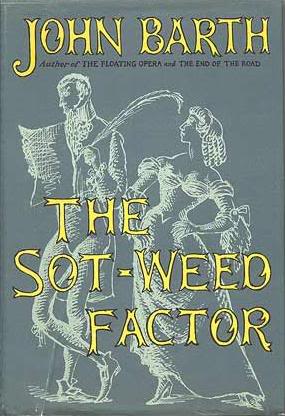
The Sot-Weed Factor — John Barth

I finished the audiobook version of John Barth’s novel The Sot-Weed Factor last week. I’d tried to read the novel a few times in the past, never getting past page 56 of my Bantam mass market edition, which runs to 819 pages. That’s a long book. The unabridged audiobook runs just over 36 hours. That’s a long time. Too long, really, for what Barth has to offer here, but before I get into that, I’ll give a tip of the hat to the excellent production values and the wonderful voice talent of Geoffrey Centlivre, who is by turns expressive, wry, pathetic, bathetic, or understated, depending on what Barth’s prose calls for. He understands the novel and does an estimable job translating it.

The Sot-Weed Factor enjoys the reputation of being Barth’s finest work (although let me just go ahead and disagree with this generalized assumption that I’ve attributed to no one in particular and say up front that the novel is ultimately a boring overlong drag and anyone interested in Barth is better off starting with Lost in the Funhouse). The novel parodies a number of literary styles — Bildungsromans, picaresques, Künstlerromans, adventure stories, histories, romances, and serialized narratives in general. Adopting the language (diction, tone, syntax, form and all) of 17th century prose, Barth tells the story of Ebenezer Cooke, a real historical figure whose 1708 poem “The Sotweed Factor, or A Voyage to Maryland, A Satyr” is considered by some literary historians to be the first American satire.

Barth’s Ebenezer is an innocent soul à la Voltaire’s Candide (hero of another picaresque that has the decency to be funnier, sharper, and, ahem, much, much shorter), a would-be poet whose spurious claims to being “Poet Laureate of Maryland” come constantly under fire. Ebenezer attributes his artistic powers (which are dubious at best) to the metaphysical virtue of his virginity; one of the major conflicts of the plot of The Sot-Weed Factor is poor Ebenezer defending his cherry from the various whores and ne’er-do-well who populate the book. And there are a lot of these whores and ne’er-do-wells: rascals and pirates and pimps and thieves and slavers and sluts of every stripe shuffle through The Sot-Weed Factor, underscoring several of Barth’s themes — innocence versus experience, perception versus reality, virtue versus vice, and stability versus flux.

In my reading, this last theme — the instability of identity, particularly American identity — is the major thrust of The Sot-Weed Factor. But before going into this idea, I suppose I should share at least some of the plot, or at least try to summarize it, which is almost impossible, as it shifts and slants and reverses in every chapter. In the interest of making a (very) long story short, dear reader, and making my job a bit easier, I’ll borrow from Don D’Ammassa’s summary (he’s got a great Barth page for those inclined)—

The story is set during the 17th Century.  Ebenezer Cooke is the son of a well-to-do British gentleman who owns property in the Maryland colony in the New World.  Ebenezer and his sister are tutored by Henry Burlingame until his sudden dismissal while they are in their late teens.  Ebenezer is sent off to boarding school, where he finds it difficult to form a bond between himself and his environment, eventually retreating into poetry.  He is also afflicted by an extreme form of indecisiveness in which he is literally frozen in place, some times for hours on end, incapable of making a decision.  His abstraction from the world is reminiscent of Jacob Horner and Todd Andrews, although exaggerated even further.

The plot grows rapidly more complicated.  Ebenezer is apprenticed in London, where he fails to prosper.  He becomes infatuated with a prostitute, despite his own militant virginity; his poor prospects are then conveyed to his father, who ships him off to the family holdings in the colonies.  Ebenezer decides to request a commission from Lord Calvert, governor of Maryland, to become its official Poet Laureate, believes that he has been awarded that honor, and sets out for the new world.  In the course of that journey, he rediscovers Henry Burlingame, who has taken on another identity, is kidnapped by pirates, walks the plank, and eventually reaches land.

The complexity and twisted humor that ensue cannot be adequately described in a few words.  Secret identities are revealed, coincidences flourish, absurd situations follow in rapid sequence.  Ebenezer is honored and disgraced, is captured by angry natives and threatened with death.  He discovers pieces of a secret journal of the adventures of John Smith and Pocahontas, and helps Henry Burlingame discover the truth about his own origins.  There is considerable bawdy content, much of it surrounding the mysterious process by which John Smith managed to sexually satisfy Pocahontas.

I’m impressed with D’Ammassa’s concision here—he neatly puts together the major elements of a sprawling, fat novel. As you may see from D’Ammassa’s summary, The Sot-Weed Factor is all about the instability of place, the lack of solid ground in swampy Maryland, the discontinuity of historical narrative, the inability of art to overcome reality, and the rapid reversals of fortune and identity that might occur in a New World. It’s all “assy-turvy,” to use one of the character’s terms. The Sot-Weed Factor here shows its post-modern bona fides; there’s a constant inconstancy, a doubling of people, places, things, and then a trebling. Ebenezer’s Old World romantic virtues—his insistence on the metaphysical value of his virginity and the power of his feeble poetry—are not just contested but obliterated (only poor Eb’s too blind to see this). Barth reworks American history, dismantling and satirizing the Pocahontas narrative, and emphasizing the plight of the native Americans, enslaved Africans, and indentured Europeans in this brave new world.

The book is also a dismantling of literary history, a jab at metaphysical poetry and identity narratives like Tom Jones or the work of Dickens. While Ebenezer spouts the loftiest supplications to his airy muse, Barth keeps his humor stuck sloppily in the toilet. The Sot-Weed Factor surpasses any ribald work I’ve ever read. The book is larded with dick jokes, fart jokes, jokes about diarrhea, jokes about sex and venereal diseases and so on—it culminates with (as D’Ammassa points out above) a riff on 17th century Viagra. In short, Bath focuses most of his keen literary powers on the kind of sophomoric japes that might keep Bevis and Butthead’s attention. Again, it’s all “assy-turvy.”

Barth’s toilet humor is at times funny, but it becomes tiresome over the book’s long duration, especially when it’s often the sole reward for long expanses of poorly-conceived exposition. I found myself bored to tears at times listening to The Sot-Weed Factor, and had to force myself to continue in its final third, a challenge that became easier when the narrative finally picked up a bit. Just a bit though. The book’s major problem is not its bloat though, or its saggy exposition, or even its redundant fart jokes. No, these feel more a symptom than a cause, and I think they are symptom of a too self-satisfied (or self-satisfying) author; over its 800+ pages (or 36+ hours), The Sot-Weed Factor reveals itself as the literary equivalent of a very bright writer jacking off to his own research. In what must be the worst case of unrestrained writing I’ve ever seen (or heard, I suppose), Barth allows two of his characters, catty women arguing, one English, one French, to trade insults with each other, all various euphemisms for “whore.” This process goes on for minutes in the audiobook version and for six goddamn pages in my Bantam edition and, like much of the details in this fat beast, does little or nothing to add to the narrative. It’s as if in his research Barth has dug up dozens and dozens of lovely little antiquated slurs and can’t bear to edit a single one. If  the process rewards Barth, it does little for the reader.

But if literary diarrhea is the mode of the book, then I guess it mirrors one of The Sot-Weed Factor’s many rude motifs. Personally, I wish I had my time back. There’s great value in reimagining the origin of America (I think immediately of Terence Malick’s The New World or Toni Morrison’s A Mercy or even some of William Blake’s work), but Barth’s narrative seems too self-indulgent and unrewarding to make any real claims to democratic (or, if I’m feeling harsh, artistic) insight. Perhaps The Sot-Weed Factor is the kind of novel that remains indivisible from its form, and perhaps to a contemporary reader like me this form is just too flabby and flaccid to spark spirit. As I’ve tried to communicate here, Barth has a sharp intellect and he’s more than capable of performing a wry, wise, and often funny analysis of early American history. But he indulges too much in his own sophomoric games and winks too often at the reader. It’s amazing that such a long book could feel so hollow.

New in the Stack: Werewolves and Angels and Faeries (Oh My)

As always, the stack overfloweth. Here are some of the more interesting looking titles to make their way to Biblioklept International Headquarters.

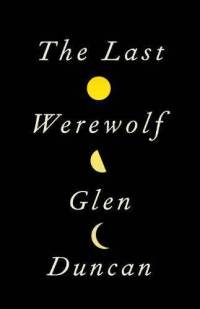
Glen Duncan’s new novel The Last Werewolf is a book about a werewolf. That’s kind of a terrible way to begin a write-up, but let’s state the obvious: you probably know if you want to read a werewolf book or not. Duncan’s hero Jake Marlowe skews more noir (as his name suggests) than twinky Twilight—he’s a hard-drinking , chain-smoking, 200-year-old rascal who’s just learned that the only other living werewolf has just died (hence, he’s like, the last werewolf, man); compounding matters, he’s more than ready to die himself. A sinister cabal called the World Organisation for the Control of Occult Phenomena is after Jake, testing the limits of his suicide wish. Duncan’s prose is harsh, visceral, and occasionally a bit purple, but horror genre fans looking for more, uh, bite (jeez, sorry) from their books may wish to check out The Last Werewolf, new in hardback from Knopf. You can read Justin Cronin’s (The Passage) take at The New York Times; in the meantime, a morsel—
Transformation woke me to the smell of rust and fuel and seaweed. I was lying on my spasming back on a metal table and the restraints were gone. So were my clothes. Shoulders, shins, head, hands and haunches shunted blood and hurried bone to meet the Curse’s metamorphic demand. My circus of consumed lives stirred. The world felt strangely undulant. I thought, Well, I hope you’re ready for this, kidnapping fuckers, whoever you are. Then, throbbing with hunger for living meat, I howled and rolled over onto my side.

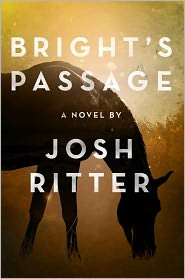
Bright’s Passage is the début novel from songwriter/musician Josh Ritter. This slim novel tells the story Henry Bright, a man who returns to the hills of West Virginia after the trauma of World War I only to have his wife (who is also his first cousin) die in childbirth. Bright buries her body and sets fire to their cabin, which sparks a massive forest fire. Bright then takes his infant son and flees, both from the fire and his unstable father-in-law, “The Colonel,” a vet of America’s adventures in the Philippines who still wears his uniform. The Colonel and his crazy sons pursue Bright, who is guided on the lam by the angel who talks to him—yeah, an angel directs Bright; in fact it was the angel’s idea that Bright marry his cousin, burn down his cabin, and run . . . also, the angel swears that Bright’s son is going to be, like, the new Messiah. Also, Bright’s horse talks. Ritter moves the action between Bright’s flight, his ordeal in WWI, and his youth in simple, concrete, declarative prose. There are echoes here of Chris Adrian’s angel stories (The Children’s Hospital and A Better Angel), and perhaps something of a Cormac McCarthy-lite vibe. Here’s an excerpt from obscure author Stephen King’s review in the Times
At its best, “Bright’s Passage” shines with a compressed lyricism that recalls Ray Bradbury in his prime. When Henry, his talking horse — a kind of holy Mr. Ed — and the Future King of Heaven leave the woods and enter a small town, Ritter writes: “It seemed a tidy place of dappled white houses and American flags. . . . Even the trees here seemed to have a kind of deep green and prepossessing prosperity that the trees of the forest could have no share in.” Recalling his mother’s death, Henry remembers “a windstorm that made the trees bow to one another like ballroom dancers.” More striking still are Henry’s memories of life in the trenches, some of which compare favorably to the prose in Mark Helprin’s “Soldier of the Great War”: “Artillery passed high above their heads in singsong trajectories that merged and lifted with one another into strange musical chords, like cats crossing pump organs.”

Bright’s Passage is new in hardback from Random House.

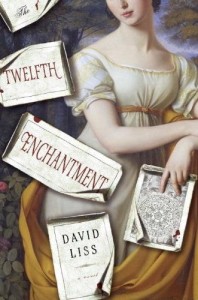
So we hit on the werewolves and angels, but what about those faeries? Honestly, that might have been a bit of a bait and switch, although David Liss’s new novel The Twelfth Enchantment does have faeries—but Romantic poets are slightly more prevalent in the book—only “Werewolves and Angels and Lord Byron and William Blake” sounds a bit clunky, doesn’t it? In any case, mea culpa. There are also Luddites and ghost dogs and alchemy and magic spells and all kinds of Gothic business going on in The Twelfth Enchantment, which gets a lot of mileage simply from its setting (the dawn of the Industrial Revolution), themes (the intersection of magick, alchemy, literature, and Gothic Romance), and characters (Byron, Blake, and Mary Crawford of Austen’s Mansfield Park). Our orphan heroine Lucy Derrick is in the clutches of her unsavory uncle who aims to marry her off until handsome, club-footed Lord Byron shows up at her house. He’s been hexed with a mystical curse and needs Lucy’s help; she soon finds herself snared in a web of dark intrigue, magic, and romance. The Twelfth Enchantment is a whimsical and lovingly crafted adventure story that will appeal to folks who dig literary mysteries (à la Jasper Fforde or pretty much any book that appropriates Jane Austen). The Twelfth Enchantment is new in hardback from Random House.
Humiliation — Wayne Koestenbaum

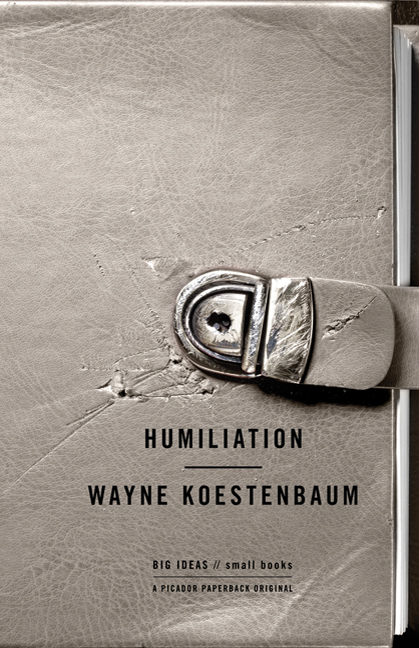
Wayne Koestenbaum’s Humiliation explores the ways that having a body (among other bodies, among a social body) might leave us humiliated or otherwise abject. To perform this exploration, Koestenbaum surveys a discursive range of subjects, including the humiliation of public figures, the sordid “private” lives of celebrities, the work of philosophers and cultural theorists, and the art, music, films, and writing of various artists and performers. The book’s central subject though is Koestenbaum himself, who shares his own humiliations in a way that surpasses ironic self-deprecation. The results are surprisingly moving, intelligent, and very funny. I’ll let Koestenbaum explain his project—

Not merely because I am tired, but because this subject, humiliation, is monstrous, and because it erodes the voice that tries to lay siege to its complexities, I will resign myself, in the fugues that follow, to set forth an open-ended series of paradoxes and juxtapositions. (I call these excursions “fugues” not only because I want the rhetorical license offered by invoking counterpoint but because a “fugue state” is a mentally unbalanced condition of dissociated wandering away from one’s own identity.) Some of my fugal juxtapositions are literal and logical, while others are figurative, meant merely to suggest the presence of undercurrents, sympathies, resonances shared between essentially unlike experiences. If there is any reward to be found in this exercise of juxtaposing contraries to detect the occasional gleam of likeness, that dividend lies in the apprehension of a singular prey: the detection of a whimpering beast inside each of us, a beast whose cries are micropitches, too faint for regular notation.

Koestenbaum composes these fugues, these thematized chapters of his book, in small blocks of text, numbered entries that range from single sentences to several pages. These are aphorisms, anecdotes, japes, jokes, riffs, prose poems, howls. The style recalls Nietzsche’s aphoristic work or Barthes’s short essays in Mythologies, although these comparisons seem inappropriately pretentious. In any case, Koestenbaum sets these short pieces against each other to achieve the fugue state he describes above, a willful wandering from topic to topic—all within the kingdom of humiliation.

So what is humiliation? Or, rather, how does Koestenbaum define humiliation? While the entire book addresses the subject, our author gives us a fairly succinct definition upfront—

Humiliation involves a triangle: (1) the victim, (2) the abuser, and (3) the witness. The humiliated person may also behold her own degradation, or may imagine someone else, in the future, watching it or hearing about it. The scene’s horror—its energy, its electricity—involves the presence of three. An infernal waltz.

Koestenbaum takes turns playing all three roles, both through personal, historical, and cultural memory, as well as through a profound imaginative capacity. It is worth remarking upon, or at least listing, some of his examples here: Joan of Arc, King Lear, Liza Minelli, Bill Clinton, Antonin Artaud, Jean Genet, Jean-Michael Basquiat, Larry Craig, American Idol, The Swan, Anita Bryant, Harriet Jacobs, Richard M. Nixon, various creeps trolling Craigslist for weird sex, the Marquis de Sade, Abu Ghraib, lynching postcards, Michael Jackson—and always Koestenbaum himself (as well as his family, his friends, his colleagues, his students . . . ).  Koestenbaum shuffles through his subjects, looking at the various ways that they might fall into his triangle of humiliation, and even when he tries on the hat of the abuser, he modulates this position by keeping his subject’s agency within his critical purview. Indeed, one of the great warnings that Koestenbaum has to offer concerns what he labels “the Jim Crow gaze” — the propensity and capacity that each person holds within himself at all times to look at another human without recognition that that person is a human being, an agent of his or her own desires, emotions, and intellect. Koestenbaum readily admits his own failings, times he has turned the Jim Crow gaze on others, a look that goes past “othering” to actually desubjectify the gaze’s object. Koestenbaum’s project pays great dividends here; by moving discursively from a range of subjects (including himself), he reveals the limitations of first-person consciousness when coming into contact with the social, the cultural, the political, the historical. Put another way, Humiliation is one of the few works of cultural studies I’ve ever read to actively show why cultural studies matters. Here’s Koestenbaum again—

The humiliation of a derided performer on American Idol is immeasurably different from the humiliation of a Palestinian under Israeli occupation. One plight is chosen, the other is not. But isn’t there present, in both situations, an underlying coldheartedness, a rock-bottom refusal to believe the worthiness of the person whose reputation (or house, or land, or ego, or self-esteem) is stolen, trashed, occupied, razed? Isn’t there present, in both situations, an underlying will to deracinate and desubjectify this other person? And, most insidiously—isn’t there an insistence on considering this process of desubjectification (with my laughter I take away your humanity) an entertaining process, even a cathartic exercise, therapeutic and energizing, like calisthenics?

This willingness to connect American Idol to the Israeli-Palestinian conflict dramatically highlights the underlying psychological conditions lurking under the phenomenological apparatuses we see (or choose not to see) on a daily basis. And just as ridicule or schadenfreude may be posited as cathartic for the victimizer, Koestenbaum also finds that “the aftermath of humiliation can be paradoxically relaxing. Tranquilizing to have undergone humiliation and then emerge on the other side.” Perhaps it is toward some sense of release or tranquility then that Koestenbaum shares so much of his own humiliation with us—snubbings, embarrassments, accusations, disavowals, and, of course, his penis (he even apologizes for the “phallic” nature of the book).

Koestenbaum is willing to consider other penises too. Humiliation is very much a study of bodies in general: what it means to have a body, what it means for others to look at your body, how what your body looks like (its shape, its color, its gender, its parts, its excess, its lack) matters to others. Working from Julia Kristeva’s theory of the abject (see: Powers of Horror), Koestenbaum writes—

Humiliation involves physical process: fluids , solids, organs, cavities, orifices, outpouring, ingestions, excrescences, spillages. Humiliation demands a soiling. Even if the ordeal is merely mental, the body itself gets dragged into the mess.

Our most abject moments then are when we realize that our body is not the impermeable fortress of self that we might imagine, but rather a dripping mess with ill-defined borders. We are constantly leaking. Private shame always lurks, is always susceptible to public scrutiny. Koestenbaum again—

An object that should be private and unseen is suddenly visible . . . My unseen experience has been forcibly ejected—thrust outside. The judge hears my secrets. My inner rottenness lies exposed. My skin has been turned inside out. This fold (the self become a seam) is the structure of revulsion.

Yet going through these trials is part of forming an individual, subjective identity. “Humiliation, an educating experience,  breeds identity,” writes Koestenbaum. Of course, this idea goes back to our oldest stories, yet it often remains unremarked (curiously, Koestenbaum does not write about Adam and Eve in Eden, that primal scene of triangular humiliation). And while Koestenbaum posits the educational (and even possibly therapeutic) dimensions of humiliation, he’s very clear about the deep pain repetitive, institutionalized humiliation can cause—

 I presume that as moral individuals we should work toward minimizing humiliation, toward not inflicting it. We should practice an ethics of abstention. Vow: I abstain from deliberately humiliating others. When I find myself involved in this abhorrent practice, I will immediately desist and try to reverse the process and remedy the crime. And yet is a world without humiliation possible.? It’s disenchanting to write about a horrible situation. About this subject, I can’t rhapsodize.

I’m happy to rhapsodize about Humiliation more, but I fear that this review teeters on becoming overlong any word now. I’ve yet to remark on Humiliation’s humor, which is abundant, weird, occasionally dark, but always warm and deeply human. In the interest of time, perhaps you’ll trust the director John Waters, who provides the following blurb for the book: “This literary ‘topping from the bottom’ is the funniest, smartest, most heartbreaking yet powerful book I’ve read in a long time.” I agree completely with Waters, and  looking over my review, I fear that I may have portrayed a very accessible, humorous, and loving book in terms that are too academic. Humiliation may be a work of philosophical inquiry, but it also functions as a sort of cultural memoir, and if it’s a narrative of pain and abjection, it also repeatedly offers solutions to this pain when it can, and consolation and sympathy when it cannot. Very highly recommended.

Humiliation, part of the BIG IDEAS // small books series, is new this month from Picador.

Midnight in Paris — Woody Allen

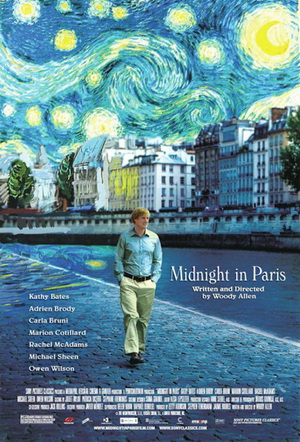
Woody Allen’s new film Midnight in Paris opens with a sumptuous montage of the City of Light, clearly establishing from the get-go that the movie is Allen’s love letter to Paris. The romantic overture idealizes Paris, just as the film’s protagonist Gil, played pitch perfect by Owen Wilson, idealizes the Lost Generation of writers and artists who populated the cafes and bars of Paris in the ’20s. Gil is on a working vacation with his fiancé and future in-laws; he’s a successful Hollywood screenwriter but dreams of becoming a great novelist. Only he’s struggling with his novel-in-progress, which features a protagonist who runs a nostalgia shop. Nostalgia, or the romance of nostalgia, is the primary idiom of Midnight in Paris, and Owen Wilson transcends the usual parameters of Woody-surrogate in bringing this idiom to life. Wilson’s breezy charisma propels the movie forward at all times; indeed, the entire plot rests on Wilson’s charm, which saves the film from falling into syrupy dreck or boring indie whimsy.

Midnight in Paris works to literally charm its viewers and its protagonist, transporting the narrative back into the ’20s via a magical motorcar, where Wilson’s Gil falls in with a host of notable writers, artists, dancers, and other personalities. There are Cole Porter and Salvador Dali, Man Ray and Luis Bunuel, Pablo Picasso and Josephine Baker—but the standouts are the Fitzgeralds, Gertrude Stein, and Ernest Hemingway. The Hemingway character is a marvelous parody of both Hemingway’s caricature and Hemingway’s prose—although I think the humor in his scenes was lost on more than a few of the audience members I watched the film with. On Hemingway’s advice, Gil submits his manuscript to Gertrude Stein for an honest critique. In the meantime, Gil engages in a romance with Adrianna, Picasso’s muse and mistress, who herself pines for the Belle Époque era. Through another magical transposition, Gil and Adrianna move again through time, heading back to the 1890s to meet Toulouse-Lautrec and Paul Gaugin. As Gil pursues a romance with Adrianna (and the nostalgia of an idealized past), his own fiancé seems to be spending a bit too much time with a windbaggish and pretentious American who is a visiting lecturer at the Sorbonne. The reality of this conflict pulls Gil into making dramatic choices about his own future.

Midnight in Paris falls squarely into Allen’s fantasy films like The Purple Rose of Cairo, A Midsummer Night’s Sex Comedy, Alice, and Shadows and Fog. The film has much to offer those who, like Gil, find themselves fascinated by the romance of the Lost Generation. Allen’s parodies of the Fitzgeralds, Hemingway, and the rest are loving and gentle, and will surely be appreciated by most English majors. At the same time, Midnight in Paris is a slight, ephemeral work, one that relies on beautiful cinematography and the charm of its lead character more than plot, insight, or even jokes. There is no risk or danger in Gil’s fantasy, no sense that his sanity is in jeopardy or that he might not come to realize the theme of the film, which he spells out clearly for the audience if they somehow missed it—the tendency to romanticize the past has more to do with a dissatisfaction with the present than with any objective evidence that the past was somehow better, and dissatisfaction with the present should be viewed positively, for dissatisfaction can be productive and meaningful if we engage it. Recommended.

We Review All Six Seasons of The Sopranos in a Relatively Short Post

1. The Sopranos is widely considered to be the best TV show of all time, but you already knew that, right? I watched all six seasons over the past few weeks; although I’d seen most of the episodes over the last decade, I was never a regular viewer, and I certainly didn’t evaluate the episodes I saw through any kind of critical lens. What follows is hardly an in-depth analysis, but rather my thoughts on the show. There are spoilers.

2. Tony Soprano is a vile character. Hard to relate to. He kills his friends and even family members; he lies to his family; he cheats on his wife. He’s a bad guy. He’s not a hero. He’s not an anti-hero. He’s both protagonist and villain of a series that begs us to identify with him, to see in him the expression of our own throbbing id. The gambit pays off at times, but over the duration of the series identifying with Tony becomes exhausting, painful, depressing.

3. I’ll go ahead and submit that I view the series as a study in existential nihilism against the backdrop of American-Dream-as-flow-of-capital. To put it in the series’ own terms, life is “all a big nothing.” In the series’ final scene in a diner, we’re reminded that the best we can hope for is to enjoy the “good times,” to focus on those moments of peace and happiness with our families. But ultimately, the series suggests nihilism, the “big nothing,” a void signaled in its famous closing shot of extended, abyssal blackness.

4. To be very clear, Tony dies at the end. I do not think that the ending is ambiguous. Any other reading is unsupported by the arc of not only the episode’s internal logic, but the arc of the sixth season, and indeed, the arc of the entire series. Any reading that allows Tony to live is wish fulfillment.

5. Pretty much everyone dies in The Sopranos. Again, “big nothing.”

6. There are lots of scenes of people eating sandwiches in The Sopranos.

7. The Sopranos is a commentary on and perhaps rejection of psychoanalysis as a mode of therapy, yet it uses the techniques of psychoanalysis to frame its stories.

8. The Sopranos is a Oedipal drama. I might submit that any drama about a family contains some kernel of Oedipal tension, but The Sopranos is formally Oedipal.

9. The Sopranos aired from 1999 to 2007. That’s a long time. When viewed successively over a short period, the series’ gaps and seams show prominently: characters appear from nowhere, story lines disappear, and key plot points often have to be explicated through clunky exposition.

10. A cultural value of The Sopranos: the series documents the Bush-era zeitgeist.

11. An easy criticism to make about The Sopranos: it’s ultimately an exercise in style and tone rather than plot and character development. Its themes and motifs build and simmer, but they are not enriched by this process. Rather, the series’ themes and motifs swell like thick plaster, obvious, concrete, depressing. Again, The Sopranos can only point to its own nihilism, to its “big nothing.”

12. The show is depressing. I mean, watching the show is a depressing process. It normalizes murders, lies, bullying, and violence—that’s pretty bad—but what becomes especially distressing is that the Sopranos are always fighting with each other. They are usually angry or sad. There aren’t really too many of those “good times”  to remember.

13. TVs are always on in The Sopranos, usually tuned to documentaries about war or war movies.

14. Some favorite episodes: “College,” “I Dream of Jeannie Cusamano” (season one), “Commendatori,” “Funhouse” (season two), “Mr. Ruggerio’s Neighborhood,” “University,” “Pine Barrens” (season three), “Calling All Cars,” “Whitecaps” (season four), “Rat Pack,” “Irregular around the Margins,” “The Test Dream,” “Long Term Parking” (season five), “Join the Club,” “Mayham,” “Live Free or Die,” “Soprano Home Movies,” “Made in America” (season six).

15. For years, I thought that the Comorra enforcer Furio Giunta, played by Federico Castelluccio, was played by Brent Spiner, who played Data on Star Trek: The Next Generation. Looking at pics of these actors, I do not understand my previous confusion. This comment is in no way germane to this “review.”

16. I don’t know if I’ve ever hated a character as much as I hate Paulie Walnuts.

17. Chris Moltisanti, played by actor Michael Imperioli, is probably my favorite character on the show. He too is vile—a drug addict, a thief, a woman-beater—but he’s also tender and funny. Maybe I just like Imperioli.

18. Steve Buscemi’s run on The Sopranos was pretty great, although it was part of a trope that the series leaned on too often—the guy-gets-out-of-prison-and-now-what? storyline.

19. Buscemi directed what might be the best episode of the series, “Pine Barrens.”

20. It’s easy to forget or overlook or understate the impact that The Sopranos had on HBO shows in particular and TV shows in general, but that impact should be noted here. Its formal elements either influenced or paved the way for the superior shows Deadwood and The Wire. It’s hard to imagine Mad Men without The Sopranos.

21. The early episodes of The Sopranos look and feel surprisingly cheap, perhaps in part due to the heavy use of canned music and an emphasis on longer takes. Plus, the need for exposition and character grounding leads to a kind of clunkiness. These episodes compensate with graphic violence and nudity.

22. Lots of strippers on The Sopranos.

23. You could argue that The Sopranos is a study in patriarchy, in patriarchy-as-capitalism.

24. One of the major themes of The Sopranos traces how women attempt to find agency within this strict patriarchy, a patriarchy that repeatedly objectifies, dehumanizes, uses, and discards women. Carmella, in particular, seeks to find voice in freedom, and her plan to do so invokes, again, the American Dream—the accumulation and sale of property. The flow of capital is freedom.

25. As a way of closing, I’ll return to the series’ final scene, probably one of the most remarked-upon moments in TV history (I cringe now at having written the execrable and odious phrase “TV history”). For me, the ending is unambiguous—the cut to black is a POV shift into Tony’s consciousness at the precise moment that he loses that consciousness forever. The ending is neither cheap nor gimmicky, but a formal masterstroke that corresponds to the series’ overarching themes of nihilism. This nihilism perhaps prevents the series achieving the cohesion of, say, The Wire, an equally dark series that takes capitalism as its major subject. The Wire proposes struggle itself as raison d’être. The Sopranos makes no argument for that struggle, finds no honor or humanity in it, instead shifting philosophical emphasis to “focus on the times that were good” against the face of a “big nothing.” The end of The Wire is a beautiful montage that suggests that even though history may be cyclical, this fact alone does not foreclose human agency. It is difficult to call the end of The Wire “happy,” but the series conclusion nevertheless suggests generative possibility: there might not be space for the viewer in that particular world, but David Simon suggests that that world will nevertheless continue without the viewer. In metaphorical terms, it lives. The formal device of the cycle-montage at the end of The Wire would feel cheap or even hackneyed had the series not earned it by establishing its threads years in advance. The end of The Wire shows us everything; it gives us the future. It is big everything, the perfect end for a show that attempt to measure the everything of one particular place. Similarly, the final shot of The Sopranos is formally and thematically appropriate. It gives us that “big nothing” that the series has repeatedly promised is ours to collect. The black thematizes the profound moral failures of its characters and dramatizes the loss of enlightenment and moral vision that permeates the family members in the final season. It’s a clever, elegant, and ugly way to end a very depressing show.

The Third Reich: Part II — Roberto Bolaño

Literature has a unique power to echo not just from the past into the future, but also backwards through time—later works can somehow cast shadows on earlier ones, and later details of a writer’s biography sometimes seep into fiction that the writer produced earlier. Take for example Edgar Allan Poe. He published his long poem “The Raven,” about a man mourning his lost love, two years before the death of his wife, yet the autobiographical detail nevertheless freights the work with deeper emotional weight. Poe was a hero to Roberto Bolaño (“The honest truth is that with Edgar Allan Poe we would all have more than enough good material to read”), whose own early death seems to haunt the writing that came before it. In turn, the late opus 2666 seems to cast a huge shadow over the rest of Bolaño’s fiction, which of course preceded it. I’ve argued before that 2666 is the labyrinthine culmination of the Bolañoverse, a mirror-world of dread and paranoia and violence and literary criticism and strange beauty. The Third Reich, one of Bolaño’s earliest novels, now in its second part of a four-part serialization from The Paris Review, continues to show Bolaño gesturing toward the beast that would become 2666.

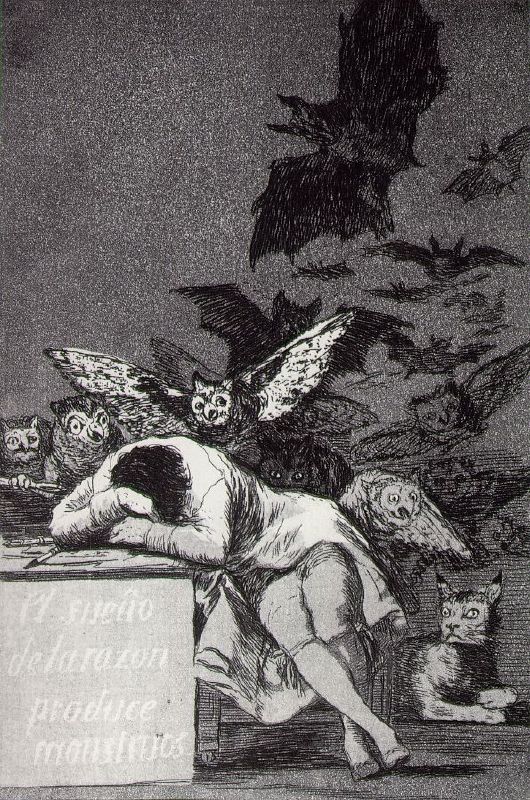
The Sleep of Reason Produces Monsters -- Goya (1797)

If 2666 impossibly haunts The Third Reich from the future, then paranoid Poe haunts it from the past. Last time we checked in, Udo Berger and his beautiful girlfriend Ingeborg had made tentative friends with another German couple while spending the summer at a seaside resort in Spain. Through this pair, they meet up with two nefarious locals, the Wolf and the Lamb; Udo also begins obsessing over a man named El Quemado, a burn victim who rents paddle boats to tourists. For Udo, the holiday is meant to be a working vacation—he’s a wargame enthusiast, and he plans to write a defining strategy for a new game called “The Third Reich” (implicitly, he plays the Nazi’s side). In the meantime, he’s also taken with the hotel’s owner, Frau Else, a German transplant who mysteriously disappears to take care of an ill husband who no one seems to see.

The first part of The Third Reich (published in the Spring ’11 issue) set the stage for dread, mystery, and extreme paranoia—all while on a sunny seaside holiday. The set-up recalls the seemingly innocuous first section of 2666, “The Part About the Critics,” where four European literature professors spend a vacation of sorts in sunny Mexico while ostensibly searching for a mysterious author. The Third Reich showcases the same sinister tension, describing—but never explaining—the stress between differing cultures, the radical alterity of “being on holiday,” of “vacating,” of being in a different place for a different purpose than what is usual, normal.

The second part of The Third Reich (in the new Summer ’11 issue) increases the dread and paranoia, all with a strange, mordant humor. The novel’s conceit is that the writing is Udo’s holiday’s journal; as such, he controls not only perspective and tone, but what details we learn—or don’t learn. It’s what Udo leaves out that becomes increasingly distressing and fascinating. Indeed, at a crucial point in the novel, Udo fails to explain to us why he remains in Spain after his holiday should be over, even as Ingeborg returns to Germany. There is an ostensible explanation—Charly has disappeared and Udo perhaps wants an answer to the mystery (I will withhold further details for fear of spoiling the plot). It seems more likely that Udo remains to work out his strategy for “The Third Reich”; he finds an unlikely gaming partner in El Quemado. Indeed, the wargame begins to define Udo’s perspective at all times—

When I saw from the balcony that the bathers were beating a mass retreat toward the hotels and campgrounds, I went down to the beach. It’s a sad time of day, and the bathers are sad: tired, sated with sun, they turn their gazes toward the line of buildings like soldier s already sure of defeat; with tired steps they cross the beach and the Paseo Maritimo, prudent but with a hint of scorn, of arrogance in the face of remote danger, their peculiar way of turning down side streets where they immediately seek out the shade leading them directly—they’re a tributue—toward the void.

German nihilism on holiday! Still, Udo finds perverse joy in his gaming sessions with El Quemado; in these episodes, his tone escalates to a manic pitch, reminiscent of some of Poe’s crazies (the narrator of “The Tell-Tale Heart” comes to mind in particular), as well as the mounting insanity of Oscar Amalfitano in 2666. And, just as in the early parts of 2666, The Third Reich begins to buzz with rumors of rape. Udo hints at these rumors, but is unwilling to explore them. Also mysterious is the identity of Frau Else’s husband, a pointedly Gothic conceit, of course, that nonetheless may be the beating heart of horror at the center of the story. He haunts Udo’s sleep—

I dreamed that someone was knocking at the door. It was nighttime and when I opened the door I saw someone slipping down the hall. I followed. Unexpectedly we came to a huge dark room filled with the outlines of heavy old furniture. The smell of mildew and dampness was strong. On a bed a shadowy figure was twisting and turning. At first I thought it was an animal. Then I recognized Frau Else’s husband. At last!

I’ve done my best to omit some of the sharp twists in this section of The Third Reich for fear of spoiling the book, but I will add that Part II ends with something of a subtle cliffhanger (as I write the term “subtle cliffhanger” I realize that it is pure oxymoron; mea culpa). In any case, I’m enjoying the serialization very much and look forward to reading Part III.

New in the Stack: Banana Republican, Ether, and The Oregon Experiment

As always, the stack overfloweth. Here are a few of the more interesting titles that have landed at Biblioklept International Headquarters recently.

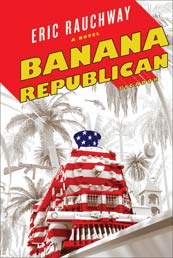
Banana Republican is the first novel by historian Eric Rauchway. The book is a send up of American Imperialism in the 1920s, satirizing the naked greed, corrupt capitalism, and ugly jingoism that infused the rise of the global economy. Fortunately, all of these ills have left American foreign policy forever, right? Satire! Seriously though, Banana Republican looks to the past to reveal that our current foreign debacles are merely an extension of policies that have been around for decades. The protagonist is Tom Buchanan (yes, that Tom Buchanan, the racist football-playing, mistress-slapping lout of The Great Gatsby). Rauchway sends Buchanan into the fiasco of American intervention in Nicaragua in the early 20th century. In an interview with The St. Petersburg Times, Rauchway points out how this scenario allows for an exploration of the American dream from a decidedly different viewpoint than the one we find in Fitzgerald—-
People always see Gatsby as the novel about the American dream. But the character who represents that dream of upward mobility ends up floating facedown in a swimming pool. Tom Buchanan represents the real American dream: having it all and not having to suffer the consequences. I wanted to get away from the somewhat suspect view of the narrator in Gatsby and let Tom speak for himself. . . .

I was interested in writing about the irresponsibility of American foreign policy, so if you take Tom Buchanan in the 1920s, where are we? We’re in Nicaragua. When you look at American foreign policy, in Europe we do pretty well. In South America, not so much. And there’s that tradition in places that are on the edges of empire: Dissolute people get to go there and act badly and no one calls them on it.

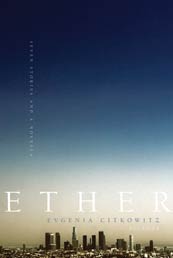
Evgenia Citkowitz’s Ether collects seven short stories and a novella, all united by psychological and emotional complexity. Citkowitz’s characters explore moral dilemmas as they quest for identity, and if that sounds like the stock of contemporary fiction (which it is), the prose, terse, often chilly, and darkly funny, is what set these apart. Here’s Ligaya Mishan, reviewing the hardback edition last year in The New York Times

Citkowitz’s book is peopled by mothers and fathers who are fumblers at best, unrepentant alcoholics at worst. A few are simply absentees, like the father of Beatty, the British schoolgirl in “Leavers’ Events,” who is omitted from family suppers, “disqualified by his status as a heroin addict.” The girl’s mother, a high-level fashion editor, is hardly more present. The only grown-up in Beatty’s life who actually behaves like one is, oddly enough, the rakish novelist she invites to the opera. After initiating a lazy seduction, he wisely thinks better of it. Again, Citkowitz flouts expectations: her heroine may be momentarily crushed, but soon she has moved to New York, ascended the editorial ladder at a chic magazine, landed her own office and effectively supplanted her mother — a modern-day Electra.

Ether and Banana Republican are both new in trade paperback from Picador.

In his promo vid (below) for The Oregon Experiment, author Keith Scribner suggests that, “It’s a novel that explores the ways in which the political, the social, the personal, the domestic are inseparable.” Those are some pretty grand claims, so here are the details: The Oregon Experiment recounts the story of Scanlon and Naomi Pratt, a couple who move from the East Coast to Oregon, where Scanlon begins his first tenure-track job as a professor who studies radical action mass movements. Naomi was once a “genius nose” who worked for perfume companies, but she’s lost her sense of smell; she’s also pregnant with the couple’s first child. Scanlon quickly becomes enamored of Oregon, and becomes particularly intrigued by local separatists and anarchists; Naomi’s nose returns, but she isn’t quite as thrilled as Scanlon about the new scene (particularly Scanlon’s enchantment with Sequoia, leader of the secessionists), although she does connect with Scanlon’s young subject Clay, an anarchist. Scribner propels his novel with ideas rendered in crisp, realistic dialogue. The Oregon Experiment is new from Knopf.
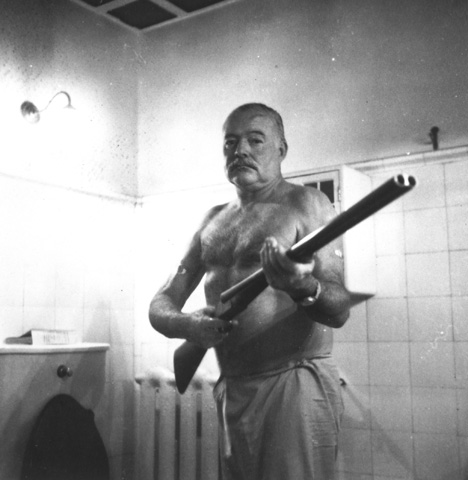
Ernest Hemingway’s Suicide Gun

Garden & Gun ran a short piece on Ernest Hemingway’s guns last year, and linked to a slideshow of the famous author (who killed himself 50 years ago today) with his guns. From the article—

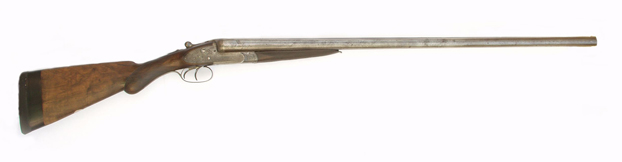
When Ernest Hemingway took his own life on July 2, 1961, it was reported in Life magazine that he had done so with a “double-barreled shotgun.” Further reports specified the gun was a Boss that he had purchased from Abercrombie & Fitch, and for years this has been widely accepted as fact. But a fascinating new book, Hemingway’s Guns, by Silvio Calabi, Steve Helsley, and Roger Sanger (Shooting Sportsman Books), makes the case that Hemingway never owned a Boss, and that the suicide gun was actually made by W. & C. Scott & Son. It was Hemingway’s pigeon gun, a long-barreled side-by-side that traveled with him from shooting competitions in Cuba to duck hunts in Italy to a safari in East Africa. By all accounts it was a favorite.

Not long after that tragic day in Ketchum, Idaho, the gun was given to a local welder to be destroyed. “The stock was smashed and the steel parts cut up with a torch,” the authors write. “The mangled remnants were then buried in a field.” Roger Sanger visited the welding shop, which is still in business and being run by the grandson of the original proprietor. Amazingly, the welder still had a few pieces of the gun in a matchbox, and Sanger’s immediate reaction to the evidence was, “This is no Boss.” After showing pictures to a number of experts and collectors, he confirmed that it was most likely Hemingway’s beloved W. & C. Scott that had been the suicide gun.

A W. & C. Scott & Son Monte Carlo B—Serial No. 60293, c. 1898

The Pale King — David Foster Wallace

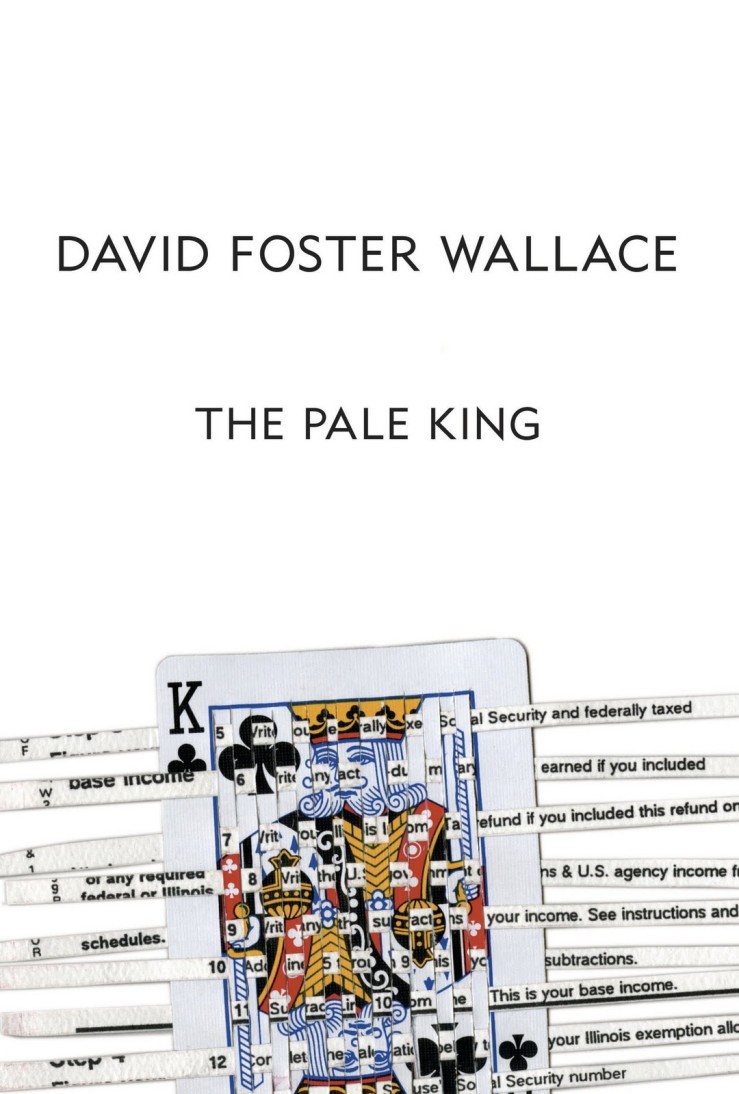
In one of the notes at the end of David Foster Wallace’s incomplete novel The Pale King, the author writes, “Plot a series of set-ups for stuff happening, but nothing actually happens.” This is a fairly precise summary of The Pale King—if you take “nothing actually happens” to mean an absence of recognizable character arcs defined through readily identifiable conflicts progressing along a linear narrative. The Pale King is not a traditional novel. Hell, it’s not even really a novel, unless you decide to really stretch your definition of what a novel is. Which is all fine and good and dandy. Infinite Jest is not a traditional novel either, but it is, I believe, clearly identifiable as a novel: it coheres; it completes; it concludes—which The Pale King does not.

You know the context of The Pale King, and if you don’t you can look it up—there’s a glut of hand-wringing and buzz and backlash out there (out there=internet) that I’ve spent the past three or four months doing my best to ignore. And while I haven’t read a review of The Pale King yet (I’ll read Tom McCarthy’ s write up in The New York Times as soon as I finish my piece), I would have to be deaf dumb blind not to have missed all the headlines, the links, the tweets, the weight people have sought to attach to this book. Anyway, I’m approaching hand-wringing here myself, which is not my aim. I want to try to review the book. But, like I said, there’s all that context. It’s unfinished. Incomplete. Posthumous.

We know the context. You know it’s incomplete, I know it’s incomplete, we know that going in. Which is why it’s a far more satisfying read, I believe, to treat The Pale King as a fragmentary piece, a novel-in-stories, a collection of themes, riffs, dialogues and monologues, vignettes, bits and pieces. It’s closer in many ways to Brief Interviews with Hideous Men or Oblivion than it is to Infinite Jest, although there are plenty of novelly-novel elements. There’s a setting: mostly a sweaty Peoria, Illinois in the mid 1980s, and although much of the novel centers around an IRS regional center there, there are also bits in Chicago, various college classrooms, suburban homes, sad motels, crowded highways, fringe communities, surveillance vans, bars, psych wards, etc. There are recurring characters, all of them IRS employees.

Perhaps a bit on those characters: Some of the best moments of the book center on the bizarre mind of Claude Sylvanshine, a fact psychic who can’t control the flow of data that surges into his mind. Sylvanshine works with his partner and sometime rival Reynolds to help lay the groundwork for the arrival of Merrill Errol Lehrl in Peoria, where Lehrl will continue to machinize the IRS or something like that. There’s Toni Ware, easily the coolest character in the book. There’s not enough Toni Ware in The Pale King. There’s Leonard Stecyk, a person so impossibly good that he drives everyone to despair. There’s Lane Dean, a Christian who may or may not be slowly losing faith. There’s Chris Fogle, who tells us basically his life story in a 100 page novella that may or may not be the center of the book (there is no center though). There’s David Wallace, who claims to be writing a memoir, who claims to be, like, the David Foster Wallace, the author, who claims that he worked for the IRS for a few years between other gigs. As if to prove he’s the real David Wallace, his sections are crammed with diverting, annoying footnotes that repeatedly interrupt any rhythm the reader (or this reader anyway) could get going. It’s difficult to summarize or even describe the relations between the characters, who are defined repeatedly not just through their own telling, but through each others’ eyes, which makes it even more difficult to unpack the plot of The Pale King.

The conflict of the book, or at least the surface conflict, the plot-level conflict, seems to be (or seems to have intended to have been) about a movement within the IRS to essentially change its mission from one of service, of doing a job that no one wants to do that nevertheless has to be done for the greater good of democracy, to a more nefarious and machine-like agency bent on generating revenue—like a corporation. Thus humanity vs. bureaucracy, religious-type calling vs. mercenary machinery, selfless duty vs. selfish will, etc. etc. etc. Chapter 19 (§19, in the book’s terms) lays out these themes beautifully in a civics lesson (the chapter is set in a stuck elevator, I think). The civics lesson has even more resonance in these times of rampant Teabaggery. Here’s a taste—-

Corporations aren’t citizens or neighbors or parents. They can’t vote or serve in combat. They don’t learn the Pledge of Allegiance. They don’t have souls. They’re revenue machines. I don’t have any problem with that. I think it’s absurd to lay moral or civic obligations on them. Their only obligations are strategic, and while they can get very complex, at root they’re not civic entities. With corporations, I have no problem with the government enforcement of statutes and regulatory policy serving a conscience function. What my problem is is the way it seems that we as individual citizens have adopted a corporate attitude. That our ultimate obligation is to ourselves. That unless it’s illegal or there are direct practical consequences for ourselves, any activity is okay.

The IRS gives Wallace a perfect backdrop to explore the tension between civic virtue and the American right to be a selfish asshole, but it’s the book’s themes of boredom and attention that have been remarked upon the most. Simply put, the theme is pervasive, perhaps overdetermined within the narrative, and at once both obvious and complex. Infinite Jest explored the consequences and existential fallout of a society conditioned to believe that it had to be entertained at all times; The Pale King seems to respond to the same existential problem in kind, only from a different angle. There’s so much of this theme of boredom and attention throughout the book that I’ll lazily go to Wallace’s end notes again, where he concisely lays it bare for us (or not for us really but probably for himself)—

It turns out that bliss—a second-by-second joy + gratitude at the gift of being alive, conscious—lies on the other side of crushing, crushing boredom. Pay close attention to the most tedious thing you can find (tax returns, televised golf), and, in waves, a boredom like you’ve never known will wash over you and just about kill you. Ride these out and it’s like stepping from black and white into color. Like water after days in the desert. Constant bliss in every atom.

Wallace finds a kind of transcendental out in the ability to concentrate attention on tasks of despair-invoking boredom. This type of attention obviously recalls the intensity of fervent, even monastic prayer (indeed, the IRS agents are often implicitly compared to monks), yet the Midwest America of The Pale King is deeply desacralized. Although Lane Dean provides a figure of religion in crisis (underexplored for the perhaps obvious reason that the book is unfinished), for the most part The Pale King  presents a post-Nietzschean world without an authorizing center. Wallace’s work then is to find some kind of metaphysical solace in a world where God seems absent at best, and he finds it in paying close attention to the tedium of life. For me, it’s The Pale King’s strange metaphysical moments that are the most intriguing (and frustrating) then. We have the aforementioned Sylvanshine, a fact psychic who can parse data, but cannot glean real meaning from it—

The fact psychic lives part-time in the world of fractious, boiling minutiae that no one knows or could be bothered to know even if they had the chance to know. The population of Brunei. The difference between mucus and sputum. How long a piece of gum has resided on the underside of the third-row fourth-from-left-seat of the Virginia Theater, Cranston, RI, but not who put it there or why. Impossible to predict what facts will intrude. Constant headaches.

In a world of information-overload, attending deeply and meaningfully to data becomes prohibitively difficult, if not impossible. Sylvanshine’s blessing/curse dramatizes the paralyzing post-20th century crisis of too much information (and therefore too many choices). The Pale King’s metaphysical elements manifest again in the ghosts Garrity and Blumquist, who kinda-sorta haunt the IRS center in Peoria; one of them shows up to explain the etymology of the word “boring” to Lane Dean. There’s a boy whose devotion to kissing every square inch of his body (clearly an impossible feat) takes on a spiritual dimension. There’s Chris Fogle, who experiences a religious-type epiphany in an accounting class. There’s also a “fierce infant” who seems to have some metaphysical powers, although I don’t know why I’m lumping him in here. Like I said, (didn’t I say?) I don’t really know how to review this book (I’ve also had a few beers at this point). The infant is one of those threads that goes nowhere, that fails to cohere, that might have a missing piece somewhere else, somewhere unwritten. A more complete picture of the transcendental bliss that prolonged attention might hold comes late in the book, in a longish piece (§46) that details a tête-à-tête between Meredith Rand, who is too-pretty, a little crazy, and ultimately both boring and alienating to almost any guy she actually talks to, and Drinion, an asexual man I take to be autistic. Drinion pays absolute, intense, true, human attention to Meredith Rand’s story of being admitted to a psychiatric hospital in her teens for cutting herself; there she meets her future husband. During their conversation, Drinion begins to levitate—via his attention, he literally transcends gravity. And yet the catch of it all is that Drinion’s autism and aesexuality somehow make it easier for him to attend others, to truly connect to this beautiful woman who simultaneously bores and alienates most of the men she bothers to speak with.

Still, Wallace posits in Drinion—and elsewhere in the book, but hey, let’s face it, this is getting pretty long for a blog review—Wallace posits some kind of answer to existential despair and boredom, an answer that goes beyond a trite commonplace like “empathy,” in that empathy is ultimately about self-identification: the answer in The Pale King seems to be selfless identification, in the most literal sense. There’s no cheat here—the narrative bits with Toni Ware especially dramatize the brutal ugliness of life, its essential Darwinian unfairness, the random cruelty that might be there. This is a book about death and taxes, and Wallace works to sanctify these costs of life, to make them count in a in a world that has largely abandoned the sacred, in a society where many people are incapable or unwilling to think empathetically about their relation to (via taxes and social institutions) other humans whom they do not personally know.

The Pale King is not as rich or funny or sad as Infinite Jest; it has nothing to match Don Gately nor does it have a Prince Hal Incandenza. But why hold that against it? It is, after all, an unfinished thing, but as incomplete as it may be, its ends not just loose but frayed, it is still a marvel of heart and intellect. Highly recommended.

Light in August — William Faulkner

I can’t unpack William Faulkner’s novel Light in August here. There’s too much in it. It’s too thick. Faulkner piles on his sentences in a gelatinous mass, smearing words on top of words into a deep swamp of meaning, motif, and symbol. The novel is archaeological, a deep dig into the South’s abject wounds. It is the most Faulkneresque Faulkner novel I have read, a heady strange brew that tries to suss out racism, misogyny, fear of paternity, the scars of the plantation system, the fallout of the Civil War, the cold comfort of religion, and so much more. Like any good modern text, you could say it’s about a quest for identity, and how the quester must come into conflict with the codes and terms of the dominant social order to find that solid identity. But in Faulkner there is no stable identity, and Light in August dramatizes this problem, even as it points to a possible inherent payoff.

A book review should give some sense of what happens in the book, but as in much of Faulkner’s work, explaining “what happens” in a Light in August would spoil the puzzle, the synthesis, the game, the shock of it all. But some outlines should suffice. The novel is set in the Jim Crow South, mostly in Jefferson, seat of Yoknapatawpha County, the Faulknerverse. It opens with Lena Grove walking “all the way from Alabama” into Mississippi; she’s in her third trimester of pregnancy and still has no ring on her finger, a sign that every Southerner knows how to read. Lena is looking for the father’s child, Lucas Burch; she hears tell that a Burch might work at the planing mill. It’s not Burch though, but Byron Bunch, who falls for Lena right away, plays Joseph to her Mary. Meanwhile, Lucas Burch is around—only the rascal’s taken up the false name Joe Brown. He’s also taken up with the novel’s tragic anti-hero, Joe Christmas, helping that strange man bootleg whiskey out of old servant quarters adjoining a decaying plantation house. Joe Christmas, an abandoned orphan, may have black blood in him. In Jim Crow Mississippi this makes him black, even worse than black—an unknown, unknowable something. Christmas (is there a more overdetermined name in fiction?) is accused of killing the woman who lives the old plantation house, a woman the community of Jefferson shunned for her family’s abolitionist, carpetbaggin’ past, yet now the community must exact the only kind of justice suitable for a black man accused of killing a white woman in Mississippi in the 1920s. JC, always estranged, must now keep on the run to avoid being lynched.

In any other novel, the two protagonists would have to meet, but Faulkner never allows a scene between Christmas and Lena. Yet they are undeniably tied together: somehow he is both the metaphysical father of her child and the child itself, Faulkner’s answer to the inescapable violent fatalism that curses the South. There is no exit from the wounded past, but there might be new possibilities, and we might find them in Lena’s baby. Lena provides a feminine antidote to Christmas’s abject fear of women, his utterly Faulknerian despair of genitalia and menstruation; at the same time, Christmas becomes the sacrificial lamb for the South’s sins, the totem whose ritualistic dismemberment will at once reaffirm the dominant social patriarchal order of the plantation system at the very same time it reveals that system’s deep hypocrisy and radical instability.

In Light in August, Faulkner shows us a world where social codes are rigid, inflexible, immutable, unspoken, and bear absolutely no relation to the concrete reality of the phenomenal, external world they pretend to govern. It’s the primal sin of the plantation system, which paradoxically separated and joined blacks and whites; which said that miscegenation was abomination yet created the optimal circumstances for racial mixing; which proscribed the very concept of a multiracial family while enforcing the Darwinian circumstances that would necessitate such a collective. It is a world where nothing fits together, nothing connects, yet Faulkner finds a place for his misfits, although he must find it by mixing up the system.

Here’s Lena talking to Hightower, the defrocked minister and ersatz medicine man (I will not even begin to discuss Hightower). Lena’s concern is over Christmas’s grandmother, who through a bizarre series of events is present at the baby’s birth—-

“She keeps on talking about—–She is mixed up someway. And sometimes I get mixed up too, listening, having to . . . . . . .” Her eyes, her words, grope, fumble.

“Mixed up?”

“She keeps on talking about him like his pa was that—–that one in jail, that Mr Christmas. She keeps on, and the I get mixed up and it’s like sometimes I can’t——like I am mixed up too and I think that his pa is that Mr—–Mr Christmas too—–” She watches him; it is as though she makes a tremendous effort of some kind. “But I know that aint so. I know that’s foolish. It’s because she keeps on saying it and saying it, and maybe I ain’t strong good yet, and I get mixed up too. But I am afraid . . . . . . .”

“Of what?”

“I don’t like to get mixed up. And I am afraid she might get me mixed up, like they say how you might cross your eyes and then you can’t uncross . . . . . . .”

But the eyes and the I’s (both are ways of seeing, of course) do get crossed in Light. Faulkner mixes up the system, crosses the wires as a way out of the ugly circuit, even as he paradoxically reconfirms the circuit’s contours. This is not a writer who flinches from history and all its despair, even as he tries to find a metaphysical answer outside of religious doctrine and conventional morality.

I feel like I’ve made, at best, some very broad, superficial scratches into the surface of a very dense, thick book; even worse, I’ve barely provided even a hint of Faulkner’s astounding prose. Mea culpa. I’ll take a second, more specific shot at Light in August in an upcoming post. For now: Very highly recommended.

Is American Psycho Profound, Artistic Nihilism or Stupid, Shallow Nihilism? — Bret Easton Ellis vs David Foster Wallace

Bret Easton Ellis’s controversial novel American Psycho turns 20 this year. The folks at Vintage were kind enough to send me a copy of the book to promote the anniversary, and despite a mounding stack of review copies, I took a few hours to re-read parts of Ellis’s third novel.

I’ve only read two Ellis books and I remember the reading of them distinctly, precisely; I remember how I picked them up and where I was and what I was doing and all that jazz. The first was Ellis’s début Less Than Zero, a slim, ugly little novel that I read in one night. I was fifteen, spending a summer with my aunt and uncle, living in my cousin’s old bedroom. Less Than Zero was part of a cache of books that included Hunter S. Thompson’s Fear and Loathing in Las Vegas, Anthony Scaduto’s Bob Dylan biography, some Hemingway and Fitzgerald novels, One Flew Over the Cuckoo’s Nest, and a Kurt Vonnegut starter kit. In short, a life changing library, and most of it went home with me in my Jansport (somewhat surreptitiously, although I’m sure if I had asked I would have received). Only I didn’t take Less Than Zero, despite reading it all in one sick night, and then reading it again in pieces over the summer. The book hurt my stomach. The drugs were not the Looney Tunes business in HST’s book—they were the symptom of a blank nihilism I simply couldn’t identify with. The scene where the kids casually watch a snuff film horrified me. And the rape scene. Well. It was the first time I read something that genuinely disturbed me in a non-child, non-Grimm’s way — in a way where I felt moral outrage from an adult-psyche-type-position (whatever that means). The book genuinely concerned me; I was afraid such people existed.

I read American Psycho in 2002. I was traveling through Thailand for a month, trading books at guest houses and shops as I went, and the only book I remember being more ubiquitous than American Psycho was Alex Garland’s The Beach (which, yes, I also read there). I had seen and quite enjoyed Mary Harron’s 2000 film adaptation of American Psycho, which had the good sense to treat the whole matter as a piece of cartoonish black comedy. In Harron’s hands, the hyperbolic exploits of Patrick Bateman are considerably less ambiguous than the book’s depiction; Harron  clearly marks the narrative violence as Bateman’s internal fantasies. Of course, one of literature’s greatest tools is ambiguity, and Ellis’s American Psycho revels in it. In a sense, this is the book’s defining nihilism: its total unwillingness to make a definitive judgment about its protagonist’s violence. Instead, American Psycho’s claims to satire rely on the implicit force of the reader’s sense of humanity and morality; like Less Than Zero before it, we have a flat narrative, an utter lack of self-reflection or internal psychology. Ellis gives us only concrete contours, cocaine, hydrochloric acid, chainsaws, and a laundry list of brand names. These are novels without interiors.

American Psycho, utterly concrete, deeply ironic, and occasionally funny, is a strange beach read, but a beach read nonetheless (although all that gristle and blood (and oh the rat!) won’t go down easy for many folks). When I read it in 2002 I found it neither shocking or enlightening, just precise and ugly and grotesque, a numbing progression of concrete descriptions of clothes and restaurants punctuated by ridiculous violence. Its one-note satire would find a better home in a short story. A short short story. I’ve spent the past few days reading through its sections again, trying to reassess it against the backdrop of my current literary estimations of Bret Easton Ellis, which I hate to admit are largely informed not only by his own acerbic personality, but also by (or perhaps more accurately against) his agon with David Foster Wallace.

BEE vs. DFW is not exactly news. Ellis (b. 1964) and Wallace (b. 1962) both published their first novels in the mid-eighties. Less Than Zero made 21-year-old Ellis a star, a likely “voice of his generation.” The Broom of the System didn’t exactly go gangbusters for Wallace, but its voluminous scope, Pynchonian silliness, and its willingness to pick up the postmodern games that Ellis and the other new minimalists seemed to reject announced a major new talent who was willing to both think and feel—to go beyond the surfaces. Indeed, Wallace’s entire project might be defined as setting himself apart from the cool, detached irony that characterizes Ellis’s ethos. In a 1993 interview with Larry McCaffery,Wallace decries fiction that devotes
“a lot of energy to creating expectations and then taking pleasure in disappointing them. You can see this clearly in something like Ellis’s American Psycho: it panders shamelessly to the audience’s sadism for a while, but by the end it’s clear that the sadism’s real object is the reader herself.” I think this is an apt criticism. American Psycho is torture porn encased in a thin veneer of social satire with no interior substance. Here’s Wallace at length—

 I think it’s a kind of black cynicism about today’s world that Ellis and certain others depend on for their readership. Look, if the contemporary condition is hopelessly shitty, insipid, materialistic, emotionally retarded, sadomasochistic, and stupid, then I (or any writer) can get away with slapping together stories with characters who are stupid, vapid, emotionally retarded, which is easy, because these sorts of characters require no development. With descriptions that are simply lists of brand-name consumer products. Where stupid people say insipid stuff to each other. If what’s always distinguished bad writing—flat characters, a narrative world that’s cliched and not recognizably human, etc.—is also a description of today’s world, then bad writing becomes an ingenious mimesis of a bad world. If readers simply believe the world is stupid and shallow and mean, then Ellis can write a mean shallow stupid novel that becomes a mordant deadpan commentary on the badness of everything. Look man, we’d probably most of us agree that these are dark times, and stupid ones, but do we need fiction that does nothing but dramatize how dark and stupid everything is? In dark times, the definition of good art would seem to be art that locates and applies CPR to those elements of what’s human and magical that still live and glow despite the times’ darkness. Really good fiction could have as dark a worldview as it wished, but it’d find a way both to depict this world and to illuminate the possibilities for being alive and human in it. You can defend Psycho as being a sort of performative digest of late-eighties social problems, but it’s no more than that.

Four years before the interview—and two years before the publication of American Psycho—Wallace mocked Ellis’s void, vacuous characters in “Girl with Curious Hair,” a story about a yuppie on LSD at a Keith Jarrett concert.  With no affective life, Sick Puppy (as his low life punk rock friends call him) feels nothing. He cannot enjoy his wealth, his position—not even his acid trip. He can’t even enjoy sex unless he can burn his partner as he’s being fellated. As Marshall Boswell points out in his study Understanding David Foster Wallace, “the story eerily forecasts . . . American Psycho . . . in a grisly and hilarious pastiche of Ellis’ preposterously benumbed prose.”

Perhaps Wallace’s greatest critique of nihilism — greatest in that it escapes the confines of Ellis and his ilk’s literary purview — is Don Gately, erstwhile hero of Infinite Jest, a recovering Demerol addict and small time thief whose painful day-to-day existence figures as the existential struggle against bleak, overwhelming nothingness. Gately is the heart and spirit of IJ, a big sad throbbing heart that, to quote Wallace out of context (from above), is the writer’s way “to depict this [dark] world and to illuminate the possibilities for being alive and human in it.”

Ellis perhaps perceives a character like Gately and his illuminating possibilities as simply too affected. Last summer, at a reading in Hackney, England, Easton offered the following—

Question: David Foster Wallace – as an American writer, what is your opinion now that he has died?

Answer: Is it too soon? It’s too soon right? Well I don’t rate him. The journalism is pedestrian, the stories scattered and full of that Midwestern faux-sentimentality, and Infinite Jest is unreadable. His life story and his battle with depression however is really quite touching . . .

Then there was this cryptic tweet a few months ago—

I’m not sure what Ellis’s tweet meant, and attendees of the Hackney reading claim that he was more considered and measured in his tone than the actual words of his response seem to entail. His end of the agon with Wallace is also rife with its own set of problems—his contemporary is dead, horribly dead, a suicide, (the kind of death that makes an essay like this one, an essay that claims to find affirmation of life in DFW and empty nihilism BEE, particularly hard to swallow, I suppose)—making it all the harder to respond. I read his “too soon” remark from the Hackney reading to be in earnest.

But Ellis’s tweets are not part of his literary corpus (even though they can be entertaining), and Wallace’s suicide is not part of his text. So, I return to those texts—

Wallace’s last effort, The Pale King, contrasts strongly with American Psycho. Wallace’s novel is fractured, heteroglossic, crammed with ideas, and at times purposefully taxing on its reader’s attention. American Psycho is concise (even if its plot is messy and episodic), imagistic, lacks even the pretense of allowing a controlling voice other than Bateman’s into the narrative, and, in its fetishistic, sexualized violence, is a work designed to lock its reader’s attention in a sensationalized vice grip. It’s id-bait par excellence, seductive and stylish. Its greatest achievement may be to fool some readers into believing that its violence is simply part and parcel of its intention of being a scathing satire. The book then relies heavily — too heavily — on an exterior morality system to weigh its flat, static characters, characters who face incredible trauma and yet never process it (or even attempt to process it). And I am not just speaking of Bateman. Consider the dry cleaner who repeatedly removes bloodstains, or the maid  who mops up brain bits without a single question. Then there are the faceless, indistinguishable alpha males who populate Bateman’s yuppie corporate world, and their requisite fiancées and mistresses, weak watery women the narrative repeatedly condemns. These characters lack meaning or depth; they are essentially probable replicants of Bateman, the implication being that psychopathic tendencies lurk everywhere, that the modern condition preempts empathy or human understanding or plain old common decency. The savvy reader is supposed to admire Ellis’s satire of capitalist vacuity, and admittedly, there are some very funny riffs (Bateman’s bits on popular music like Huey Lewis and the News and Whitney Houston, replicated in the film version, still hold up well). But I think Wallace is correct when he asserts that the real violence is ultimately inflicted on the reader. Ellis’s violence is not the same as Flannery O’Connor’s, who used the shock of murder in her stories to explore the possibility of awe, transcendence, and revelation in a desacralized world. Wallace’s The Pale King tries to sanctify the costs of life (death and taxes and the deep existential crisis these costs entail) in a world that has largely abandoned the sacred, in a society where many people are incapable or unwilling to think empathetically about their relation to (via taxes and social institutions) other humans whom they do not personally know. Ellis’s American Psycho is a cartoonish, lopsided distortion of a descralized world. Its affective power is purely externalized, generated from the reader’s moral core. It replaces feeling with violence; it replaces ideas with the illusion of ideas. Its closest claim to art is its satirical power, which is ultimately puddle-shallow (did we really need Ellis to tell us that yuppies are uncaring, shallow and materialistic?) Writers need not be morally instructive, but good books are guided by a vision. Ellis’s vision is pure, bleak nihilism, abyssal and unreflecting, asking little from its reader other than to play voyeur to murder and giving back nothing in return.

Hadji Murad — Leo Tolstoy

Like many readers of Leo Tolstoy’s final work, Hadji Murad, I read the novella based on Harold Bloom’s praise in his work The Western Canon, where he declares it “my personal touchstone for the sublime of prose fiction, to me the best story in the world, or at least the best I have ever read.” It wasn’t just Bloom’s praise that attracted me to Hadji Murad—I had just finished Jonathan Littell’s bizarre opus The Kindly Ones, which devotes a lengthy section to WWII’s Eastern front in the Caucus mountains; Littell’s chapter traces the fallout after decades of Russian incursions. Hadji Murad takes place in 1851 and 1852 as the Caucasian people resist the encroaching Russian Empire. Littell’s book piqued my curiosity about a part of the world that still seems strange and alien, a genuinely multicultural place that signals the traditional border of East and West.

I’ll also admit that I’ve never really read Tolstoy, and the prospect of beginning with a novella was intriguing.

Hadji Murad tells the story of the real-life Caucasian Avar general Hadji Murad who fought under Imam Shamil, the leader of the Muslim tribes of the Northern Caucuses; Shamil was Russia’s greatest foe. The story begins in media res as Hadji Murad and two of his lieutenants flee from Shamil’s camp. Because of a feud born from familial drama, Shamil decides that Hadji Murad must die. The Imam captures and imprisons the rebel’s family. Hadji Murad begins the process of going over to the Russians; he plans to defect and then head a Russian-backed army to defeat Shamil. This is the basic plot—I will spoil no more.

In his essay “Leo Tolstoy, Two Hussars” (collected in Why Read the Classics?), Italo Calvino suggests—

It is not easy to understand how Tolstoy constructs his narratives. What other fiction writers make explicit – symmetrical patterns, supporting structures, counterbalances, link sequences — all remain hidden in Tolstoy. But hidden does not mean non-existent: the impression Tolstoy conveys of transferring ‘life’ just as it is on to the page (‘life’, that mysterious entity to define which we have to start from the written page) is actually merely the result of his artistry, that is to say an artifice that is more sophisticated and complex than many others.

Although Calvino writes of Two Hussars, his remarks are equally true of Hadji Murad. Tolstoy’s radical realism at times so disorients that it becomes hard to pick up the themes of the novella. Tolstoy, the grand director, shifts the action from his hero Hadji Murad to train his camera on an apparently insignificant character—for example, Butler, a happy-go-lucky Russian soldier with a Romantic outlook and a gambling problem. Then Tolstoy might focus on Prince Vorontsov and his wife Maria, who command at the Russian fortress Vozdvizhenskaya. In a wonderful setpiece, Tolstoy shows us a state dinner bristling with gossip and mannered energy. In another section, Tolstoy lets his camera follow bulky Czar Nicholas I, a vain womanizer who cannot see how disconnected he is from his subjects. The Czar cannot fathom the visceral consequences of his decisions. Yet Tolstoy makes no effort to connect the bloodshed in a massacre of a Chechen village to the Czar’s ambivalence or the richness of the dinner party. These connections are left to the reader.

The novella is almost a puzzle: the chapters are distinct setpieces that the reader must connect in order to see a bigger picture. This analysis should not suggest, however, any murkiness or ambiguity in Tolstoy’s chapters (let alone sentences). Hadji Murad is lucid, clear, and very sober, even when it depicts violence, confusion, and drunkenness. As Calvino points out, Tolstoy’s art replicates the messiness of “real life” in a way that seems mimetically appropriate to “real life’s” complexity, and at the same time to allow the reader to intellectually engage the narrative. Calvino again—

That fullness of life which is so much praised in Tolstoy by experts on the author is in fact — in this tale as much as in the rest of his oeuvre — the acknowledgement of an absence. As in the most abstract of narrators, what counts in Tolstoy is what is not visible, not articulated, what could exist but does not.

Again, Hadji Murad should not be taken for a work of abstraction. It is crushingly literal and historically concrete. What Calvino refers to then is the abstraction of narrative construction, the apparent invisibility of motive and meaning. And this is why wise readers will enjoy Hadji Murad. It’s one of those texts that confronts its readers with a problem to puzzle out. It’s one of those books that one finishes, feels a little stunned—cheated even!—and then wakes up the next morning thinking about, possibly having dreamed about it that night. And what does one do then? Why, pick it up again of course. Highly recommended.

New in the Stack: Heinrich Böll, Vaclav & Lena, E.M. Forster, and Bob Mould

The stack overfloweth with new books—here are some of the more interesting ones:

Melville House continues reissuing Heinrich Böll’s books with the short novel The Train Was on Time (with a killer afterward by William Vollmann) and Irish Journal, an account of Böll’s travels in Ireland in the early 1950s. Compact, tense, and immediate, The Train Was on Time relates the journey of a young German infantryman traveling on a troop train to the Eastern Front. He realizes that the war is already lost, and that his trip is essentially the first step in a death sentence. Irish Journal is hardly so severe, yet it still bears the scars of WWII trauma. Like all the titles in The Essential Heinrich Böll, these books feature beautiful, elegant design.

Haley Tanner’s début novel Vaclav & Lena (new in hardback from The Dial Press) seems to pull off the tough act of balancing quirky romance and genuine depth. Tanner tells the tale of two Russian emigrés  who meet as kids in Brighton Beach. Verbose Vaclav dreams of becoming a magician; shy Lena soon becomes his assistant, finding comfort in his warm family—and his idealistic, romantic imagination. In a glowing review at The New York Times, Susannah Meadows writes—
Whimsical love stories are tough to pull off. But as in the film Eternal Sunshine of the Spotless Mind, vibrant characters, believable romance and dark undertones make for a moving tale. The book’s contrast between childhood fantasy and the grim world outside tamps down the cutesiness. It helps that Ms. Tanner is such a strong storyteller, and her distinctive voice — winsome without being dopey — engulfs you immediately.

New in trade paperback from PicadorA Great Unrecorded HistoryWendy Moffat’s biography of E.M. Forster, examines the life of the great British writer through the lens of his homosexuality. Forster published five classic novels between 1905 and 1924, and even though he wrote biographies and essays until his death in 1970, he never released another novel in his lifetime. Maurice was published in 1971. The novel, which Forster composed over decades, relates a homosexual love affair; Forster was determined that, contrary to convention, the love story should not be a tragedy and should indeed have a happy ending. Part of Moffat’s project seems to be to make a case for Forster as a progenitor of queer writing. From her prologue—

Though he burned great bonfires of ephemera, Morgan [Forster’s middle name] carefully preserved the record of his gay life. Thousands of unpublished pages of letters, diaries, essays, and photographs tell the story of the life he hid from public view. Some of the pages are scattered in archives. Some have been coaxed out into the world from remarkable hiding places — a vast oak cupboard in a London sitting room, a shoebox humbly nestled among mouse turds in a New England barn. Many of Morgan’s surviving friends have told their stories for the first time. Only in 2008 were the final entries in his private diary, restricted from view since his death, opened to readers. All his long life Morgan lived in a world imprisoned by prejudice against homosexuals. He was sixteen when Oscar Wilde was sent to prison, and he died the year after the Stonewall riots.

Almost a century ago, Forster dedicated Maurice to “a happier year.” Perhaps that time is now.

Bob Mould began playing his strange brand of frenzied, fuzzy punk rock in Hüsker Dü less than a decade after Forster’s death, and while it would be ridiculous to suggest that his life as a gay man (and teen) was easy, his new autobiography See a Little Light reveals that it is possible to work through pain, confusion, and negative public attitudes to a positive place. Mould’s homosexuality was an open secret, but he still felt protective of his personal life. However, a 1994 Spin magazine article by Dennis Cooper (yes, that Dennis Cooper) outed Mould. I’ll let him tell this part of the story—

For years I had lived in a fearful yet protective state. My parents were in a small town where people didn’t accept or understand homosexuality. I didn’t want to cause any undue stress in their lives by coming out. I remembered what happened to my high school acquaintance who ended up slaughtered in the woods. My coming out might create a hardship on my brother’s kids too—Syracuse, New York, where he now lived, was not a progressive bastion.

I had looped all the different possible fallouts and fears in my mind, a big one being that for fifteen years I had gender-neutralized my work so that it would be all-inclusive; as a result, my music was highly personal, and yet it affected a lot of people, whether they were gay or straight. But my fear was that 90 percent of my audience would have the meaning of my songs ripped out from underneath them. A song that straight people related to, now they find out it’s about two guys? The flip side, or what I now know to be the upside, was that I had a large audience who might not have known about my homosexuality, were very attached to the work, and could now see that love and loss and hope are universal emotions that can’t be owned, controlled, or denied by law or religion.

See a Little Light is not just a document of Mould’s struggles with homosexual identity, but that element is obviously indivisible from the rest of his life, which he writes about in deeply personal detail (with the aid of Michael Azerrad, who documented Hüsker Dü in a chapter of his book Our Band Could Be Your Life). There’s also plenty here on the Minneapolis-St. Paul scene, the early post-hardcore indie scene, analyses of Hüsker Dü songs, a history of Mould’s second band Sugar, thoughts on guitars, and touring, touring, touring. I’m hardly an unbiased reader here—Hüsker Dü and Sugar songs soundtracked a hefty chunk of my teen years and early twenties—but See a Little Light offers an emotional depth and level of insight absent from most musical biographies. See a Little Light is new in hardback from Little, Brown.

The Old, Weird America — Greil Marcus on The World of Bob Dylan’s Basement Tapes

This month, to celebrate Bob Dylan’s 70th birthday (which is, um, today), Picador is reissuing Greil Marcus’s Invisible Republic under the name The Old, Weird America. Marcus uses Dylan and The Band’s recording sessions at Big Pink in 1967 as the ultimate synthesis of “the old, weird America.” From these legendary sessions Marcus unpacks Moby-Dick and William Burroughs, Ralph Waldo Emerson and Jerry Lee Lewis, Puritans and cowboys, utopias and ranches, Harry Smith and Dock Boggs, the Reverend J.M. Gates and Jonathan Edwards’s “Sinners in the Hands of Angry God,” murder ballads and the Beats, Clint Eastwood and Frank Hutchison, and more, more, more.

While Bob Dylan and the guys in the Band–Levon Helm, Robbie Robertson, Rick Danko, Richard Manuel, and Garth Hudson–are the protagonists of Marcus’s pop history, Harry Smith is perhaps its signal hero. Marcus finds in Smith’s seminal work Anthology of American Folk Music a history of democracy and America “made by willful, ornery, displaced, unsatisfied, ambitious individuals.” Marcus figures Anthology as the direct antecedent for The Basement Tapes. And yet as he moves backward in time he also moves forward, tracing the spirit of the old, weird America through to Bruce Springsteen and Nirvana.

Marcus’s mission isn’t so much a to tell Dylan’s history (yet again) as it is to contextualize Dylan and The Band’s project against the backdrop of the American folk past. As such, Dylanphiles won’t exactly find a new version here of the narrative that they’re undoubtedly so familiar with (cantankerous Dylan goes electric and “betrays” the folkies). Instead, what we find in The Old, Weird America is a verbal attempt to match the discursive, rambling, reference-hopping spirit of those sessions in ’67, and if Marcus at times rumbles and tumbles all over the place, we can forgive him—his weirdness is merely an attempt to match the verve, audacity, and strangeness of The Basement Tapes.