
Seventeen-year-old Mari, the narrator and subject of Yoko Ogawa’s new novel Hotel Iris, is something of a Cinderella figure. Her dad dies a violent death when she is only eight years old and her grandparents soon pass on as well, leaving her in the sole custody of her money-grubbing mother who works poor Mari like a slave in the upkeep of their shabby hotel. The titular Iris is a crumbling structure with only one seaside view, frequented in the off-season by prostitutes and only bustling in the sweltering summer months. It’s in the off-season when Mari first spies the transformative figure in her life–a man fifty years her senior who gets into a raucous fight with a hooker in the hotel. Transfixed by his commanding voice, Mari follows the man the next day as he performs banal errands. When he confronts her, the two strike up a strange friendship (very strange, it will turn out). The man lives on a small island where he works translating mundane Russian texts like tourist pamphlets–although he is hard at work at a passion project, translating a strange Russian novel. The translator begins writing Mari letters and she eventually sneaks away to meet him. In the seaside town he treats her with quiet deference, but when Mari visits his small, austere home on the island she undergoes a bizarre, sadistic sexual awakening. To continue a proper review of Hotel Iris will necessitate some mild spoilers. I won’t reveal any major plot points, but those intrigued may wish to stop reading here. Otherwise, on to the aforementioned bizarre, sadistic sexual awakening.
It’s pretty simple, really. The translator, a sexual sadist, has found in Mari a perfect masochist, a young girl so alienated and lonely that she can only find pleasure in extreme pain, beauty in brutal ugliness, and freedom in bondage. Her initial attraction to the translator, his commanding voice, goes to extremes in his isolated house on the island, where he strips her naked, ties her up, and forces her into all sorts of sexual humiliations. In a strange mirror of her Cinderella-life at Hotel Iris, he forces her to clean his house while strapped to a chair. He takes thousands of degrading photographs of her. In a scene reminiscent of “Bluebeard” he hangs her from the ceiling of a tiny pantry and whips her with a riding crop. He never engages in direct coitus with her; in fact, he never even removes the suit and tie he wears even in the sweltering summer. In each scenario Mari expresses the true happiness and pleasure she finds in the translator’s torture. “Only when I was brutalized, reduced to a sack of flesh, could I know pure pleasure,” she tells us.
That young, naïve Mari should narrate the novel is the genius of Ogawa’s program. Her first-person immediacy communicates the confusion and despair of a neglected, overworked teen trapped in a dead-end job in a Podunk town. As the plot spirals it tempts the reader to endorse the “love” that Mari feels for the old man who tortures her. Just as Nabokov manipulates his readers via the charms of Humbert Humbert, Ogawa, writing her reverse-Lolita, repeatedly cons us into normalizing the relationship, in viewing it only from Mari’s perspective. It’s through the slipped, oblique details of Mari’s past that we construct a more coherent image of a long pattern of abuse. Her mother, always bragging about Mari’s beauty, tells the story of a sculptor who used Mari as a model (Mari, of course, believes herself ugly). “The sculptor was a pedophile who nearly raped me.” The only maid in the hotel repeatedly claims to be “like a mother” to Mari, yet she attempts to blackmail and humiliate the poor girl, and even tells her that she was Mari’s father’s “first lover.” Late in the novel, a drunken hotel guest gropes Mari’s breast and her mother brushes the abuse off, blaming implicitly on her daughter. The focused, purposeful sadism of the translator–a result of the man’s own painful past–is thus a form of love for Mari. Yet we see what Mari can’t see, even as we accept the savage doom of their romance.
Hotel Iris recalls the dread creepiness of David Lynch, as well as that director’s subversion of fairy tale structures (perhaps “subversion” is not the right word–aren’t fairy tales by nature subversive?). There are also obvious parallels between Mari’s story and The Story of O and Peter Greenaway’s fantastic film The Cook, the Thief, His Wife, & Her Lover. But these are perhaps lazy comparisons–I should talk about Ogawa’s deft writing, her supple, slippy sentences, her sharpness of details, the exquisite ugliness of her depictions of sex and eating. She’s a very good writer, and translator Stephen Snyder has done a marvelous job rendering Ogawa’s Japanese into smooth, rhythmic sentences that resist idiomatic placeholders. Hotel Iris is not for everyone, but if you’ve read this far you’ve probably figured that out already. Readers who venture into Ogawa’s dark world will find themselves rewarded with a complex text that warrants close re-reading. Recommended.
Hotel Iris, a Picador trade paperback original, is available today.
 In her debut novel, All the Living, C.E. Morgan tells the story of Aloma, a would-be pianist who forgoes her dreams of artistic freedom to play wifey to her young lover Orren who must take sole responsibility of running the family tobacco farm after his family dies in a car accident. Aloma knows nothing about farming and even less about the grief Orren suffers. She’s an orphan herself, but with no memory of her own parents, she finds it hard to connect to overworked Orren as he slowly slips away. A nearby minister who hires her to play church services paradoxically relieves and exacerbates Almoa’s despair when he enters her life. Morgan’s novel is a slow-burn, often painful, sometimes slow, but also guided by a poetic spirituality that resists easy interpretations. (Oh, and she’ll also make you run for a thesaurus every few pages). All the Living is new in trade paperback from
  Anne Michaels’s The Winter Vault begins in Egypt, in 1964, where Canadian engineer Avery Escher is part of a team trying to help the Nubians who will be displaced by the Aswan High Dam. He and his wife Jean share a houseboat on the Nile, but what might have been a year of romantic adventure devolves into the tragedy of a culture displaced and a family eroded. The pair separate and return to Canada, where Jean takes up with Lucjan whose stories of Nazi-occupied Warsaw inform the novel’s second half. The Winter Vault is poetically dense and often overly-lyrical, sometimes offering self-important and ponderous dialogues in place of concise plotting. And while Michaels treats the tragedies of the occupied Poles and Nubians with a certain sensitivity, her engagement veers awfully close to what Lee Siegel has termed “
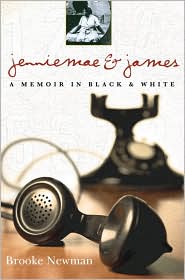 Jenniemae & James is Brooke Newman‘s new memoir about her father’s unlikely relationship with the family maid. James Newman was a brilliant mathematician (he coined the term “googol”); Jenniemae Harrington “was an underestimated, underappreciated, extremely overweight woman who was very religious, dirt poor, and illiterate.” Newman wants us to see a unique–and deep–friendship between the pair that defies 1940s/50s norms in Washington D.C., but it’s hard not to think that there’s at least some whitewashing going on here. Undoubtedly the two shared an affinity and connected through a love of numbers, but it’s hard to see more in this than an employer-employee relationship–and one still colored by the politics of the pre-Civil Rights era. Jenniemae, black mammy, sassy, Southern, larger-than-life, quick with folk wisdom and colorful quips–it all seems like a one-sided vision, a take on the
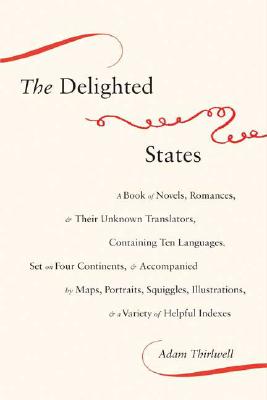 This weekend, I read and thoroughly enjoyed the first volume of Adam Thirlwell’s The Delighted States (new in a handsome trade paperback edition from
 In her novel Wealtheow, author Ashley Crownover retells Beowulf from Queen Wealtheow’s point of view. In the original epic poem, Wealtheow doesn’t have much of a voice. Her marriage to King Hrothgar is more a matter of politics than love, and her role in the poem is largely limited to an episode where she speaks up to secure her own genealogical futurity. Adopting a first-person voice, Crownover portrays Wealtheow as a young, somewhat naive bride thrown into a political marriage arranged to prevent war between the Danes and the Helmings. Wealtheow tries to fit into her new role as wife and queen, as well as her new culture, and strives to produce an heir for Hrothgar, suffering miscarriages and other adversities. Crownover parallels Wealthow’s plighted road to motherhood in the tale of Grendel and his mother (called Ginnar here). When Grendel is born deformed, his father rejects him and he is bound for infanticide–only Ginnar’s motherly instinct resists custom, and the pair become fugitives. Crownover’s technique here builds sympathy for Ginnar in echoing the narrative proper of Wealtheow. Ginnar in many ways is a far more sympathetic (and interesting) character than Wealtheow, and the counter-plot of her and her monster-spawn/beloved boy Grendel is the highlight of the book.