 In This Is Where We Live, Janelle Brown’s follow-up to her 2008 début All We Ever Wanted Was Everything, an artsy newly wed couple find their dreams and their marriage unraveling when the payments on their adjustable rate mortgage suddenly double. Claudia and Jeremy are happy at the novel’s outset, living comfortably in their Los Angeles bungalow. Her film Spare Parts garners a huge buzz at Sundance and he reforms a new band after the breakup of his old group The Invisible Spot; they envision their new neighborhood as a contemporary counterpart to the Laurel Canyon creative scene of the 1960s. But then their ARM adjusts and Spare Parts flops. Claudia has to take a job teaching (Gasp! Oh, the terror! In a particularly funny scene, she shows The Graduate to her film students and one of them raises her hand to declare that her father was one of the film’s executive producers). The couple soon has to take in a roommate. Complicating matters even more is the return of Aoki, Jeremy’s unstable–and now famous–ex-girlfriend, who manipulates him every chance she gets. Aoki, a cartoonishly unhinged avant-gardiste, serves as a foil to the more grounded figure of Claudia; as Claudia begins to mature into a more pragmatic, adult personality, Aoki’s siren song calls Jeremy to return to chaos. This Is Where We Live is timely, of course, and Brown takes pains to show how these two “creatives” could overlook such meaningful financial details when looking to buy a home. Some will find Brown’s sympathetic vision of the privileged L.A. art scene off-putting or even shallow, but the novel’s core exploration of a troubled young marriage will resonate with many readers. This Is Where We Live is available in hardback from Spiegel & Grau on June 15, 2010.
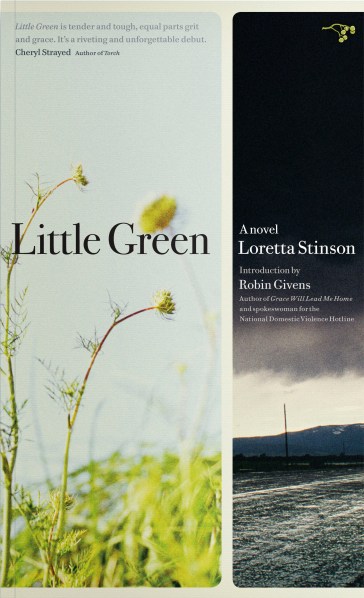 Little Green, Loretta Stinson’s début novel, tells the story of Janie, an orphan who runs away from her stepmother. Life on the road is tough, and Janie has to make money somehow, dancing in strip bars and even bartering for sex when necessary. When she meets a charmer named Paul who is ten years older than her, she feels instantly closer to him–and naturally hits the road again. Hitchhiking is never a good idea though, kids, especially in a loner’s van, and Janie is brutally beaten. She finds herself under the care of the man who owns the last bar she danced at, and in time, under the care of Paul, reiterating one of the novel’s major themes of cyclical violence and female dependence on a man. Paul is a small-time drug dealer whose habits extend beyond weed and acid into heroin and meth. As his drug addiction spirals, he tries to find some control by manipulating Janie; in time, he beats her so terribly that she has to go to the hospital. Janie leaves him but he stalks her wherever she goes, forcing her to find her own strength and self-reliance as the novel reaches its redemptive climax. Paul is probably the most interesting character in Little Green, and although it would be unfair to call Janie a flat character, she spends much of the novel as a victim. In contrast, Paul’s addiction and behaviors are studied with a psychological depth that attempts to understand–without ever rationalizing–his actions. While the novel is hardly sympathetic to him, Stinson resists painting Paul as a static monster; the payoff is a villain far-more frightening because of his authenticity. Authenticity is what keeps Little Green (for the most part) from verging into melodramatic Lifetime movie of the week territory. Stinson’s finely detailed evocation of the Pacific Northwest
  of the late 1970s explores how attitudes about gender roles, women’s rights, and drugs came to a seething breaking point a decade after the summer of love. Significantly (and sadly), the novel’s depiction of domestic violence reads with a wholly contemporary immediacy. Little Green is new in handsome trade paperback this month from Hawthorne Books, who will donate a portion of sales revenue to the National Domestic Violence Hotline.
Tracy Winn’s debut, Mrs. Somebody Somebody covers over half a century–from Korea to Iraq, in the book’s terms–in the lives of the regular folk of the mining town of Lowell, MA. The book comprises ten stories that can easily stand on their own, but combined together form a novel-in-stories, an evocative portrait of a working-class town under duress. Winn weaves blood lines through generational and political conflicts and re-examines her book’s themes through a variety of perspectives. The result is a layered, detailed reckoning with history and place, class and conflict, drawn in rich, resonant colors. Mrs. Somebody Somebody is new in trade paperback this month from Random House.
 On the heels of last year’s hugely successful first-time-in-English publication of Every Man Dies Alone, the good folks at Melville House have issued another of Hans Fallada’s epic novels,

 In his essay “Shakespeare in Bloom,” critic James Wood performs one of the strangest, most backhanded (and yet earnest) defenses I’ve ever read of Harold Bloom‘s aesthetic reaction to (what Bloom has called) “The School of Resentment” — deconstruction, Marxism, gender and queer theory, postcolonial theory, all that good stuff. Wood comes out strong, arguing, that in his prolific output, Bloom “has kidnapped the whole of the English literature and has been releasing his hostages, one by one, over a lifetime, on his own spirited terms.” Wood suggests that “this ceaselessness has produced some hurried, fantastical, and repetitive work,” before going on to throw around words like “garrulous” and “shallow.” Wood then takes Bloom to task over his famous (and improbable) claim that “Shakespeare invented us,” situating the claim against Bloom’s own most famous theory, the anxiety of influence. Wood says–
 As we bring up the term again, we should note that we consider it a bit pejorative and utterly reactionary, and, to borrow from (and perhaps misapply) Wood, shallow. Wood points out that “Deconstruction brings a generalized suspicion to bear on language and in particular on metaphor (or ‘rhetoric’), which it suspects of hiding something–namely, its own metaphoricity.” In short, literature always metaphorizes, and thus hides, some other impulse, one always politicized. Wood continues: “Political criticism, including cultural materialism, converts Freud’s analytical suspicions into political ones. . . . The poem is read as if it were covering something up, as if it were an alibi that is rather too fluent to be entirely trusted.” It must be interrogated to reveal its secret, the secret prejudices of its age. Wood continues, after a page or two–
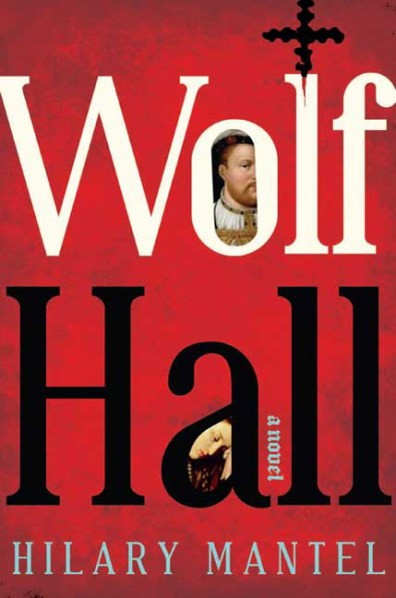 I’m coming to the end of Hilary Mantel’s brilliant treatment of the Tudor saga, Wolf Hall. Sign of a great book: when it’s finished, I will miss her characters, particularly her hero Thomas Cromwell, presented here as a self-made harbinger of the Renaissance, a complicated protagonist who was loyal to his benefactor Cardinal Wolsey even though he despised the abuses of the Church. Mantel’s Cromwell reminds us that the adjective “Machiavellian” need not be a pejorative, applied only to evil Iago or crooked Richard III. The Cromwell of Wolf Hall presages a more egalitarian–modern–extension of power. Cromwell here is not simply pragmatic (although he is pragmatic), he also has a purpose: he sees the coming changes of Europe, the rise of the mercantile class signaling economic power over monarchial authority. Yet he’s loyal to Henry VIII, and even the scheming Boleyns. “Arrange your face” is one of the book’s constant mantras; another is “Choose your prince.” Mantel’s Cromwell is intelligent and admirable; the sorrows of the loss of his wife and daughter tinge his life but do not dominate it; he can be cruel when the situation merits it but would rather not be. I doubt that many people wanted yet another telling of the Tudor drama–but aren’t we always looking for a great book? Wolf Hall demonstrates that it’s not the subject that matters but the quality of the writing. Highly recommended.
 Cromwell’s greatest foil in Wolf Hall is Thomas More, who is also the subject of the first essay in James Wood’s collection The Broken Estate. I got my review copy in the mail late last week, so it was pure serendipity that I should read “Sir Thomas More: A Man for One Season” after a full day of listening to Wolf Hall (did I neglect to mention that I listened to the audio book? Sorry). Wood is harsher on More than Mantel; whereas she lets us despise him within the logic and framework of the Tudor court, Wood aims to find a contemporary secular standard from which to judge him. He finds license to do so through the work of John Stuart Mill, citing the influential essay On Liberty. Wood writes:
 Loved loved loved Nick McDonell’s collection of reportage on the US Army in Iraq, The End of Major Combat Operations. It’s not the sort of thing that I’d normally pick up, so I’m glad that it showed up as half of
  Deirdre Madden’s novel Molly Fox’s Birthday takes place over the course of just one summer day in Dublin, Ireland. Perhaps that sounds a bit familiar, but Madden can’t be accused of trying to riff off Ulysses–even if her book is funny and erudite. Molly Fox, a famous stage actor, is abroad for a few months; in the interim her playwright friend, the unnamed narrator, takes residence in her home. The book opens with a strange dream sequence, full of joy and mystery, which ushers in a host of questions about the intertwined past of the narrator, Molly, and a TV art critic named Andrew. Madden’s book is a sustained investigation into how our friendships endure–and change–over the course of all the masks we wear. Molly Fox’s Birthday, a