
 In their introduction to J.M. Coetzee and Ethics, editors Anton Lesit and Peter Singer make the claim that the essays in the new collection “show the folly of Plato’s idea that literature has nothing to contribute to philosophical discussion. Instead they are an invitation to a dialogue that can sharpen the issues that literature raises while making philosophy more imaginative.” Lesit and Singer briefly review the philosophical tradition, from the time of Plato’s call to banish the poets to the current wars between pragmatists and postmodernists, specifically foregrounding the case for Coetzee’s literature as a legitimate source of philosophical inquiry. They identify three specific features of his works — reflectivity, truth seeking, and an exploration of social ethics — that merit critical attention. The essays in the volume address “the psychological and moral phenomenology of personal relationships; the consequences of human suffering, evildoing, and death for human rationality and reason; and the literary methods invoked to open areas of experience beyond the abstract language of philosophers.” The editors also point out that “Unsurprisingly, the ethics of animals looms large in this collection,” a concern that might attract animal ethicists and others interested in animal-human relationships who might not immediately turn to literature for answers (or questions). On the whole, J.M. Coetzee and Ethics, while obviously a specialty volume, strives to appeal to a wider audience, eschewing much of the acadamese that plagues (and obfuscates the arguments of) so many critical volumes. Fans of Coetzee will wish to take note. J.M. Coetzee and Ethics is new in hardback from Columbia University Press.
Category: Reviews
The Broom of the System — David Foster Wallace
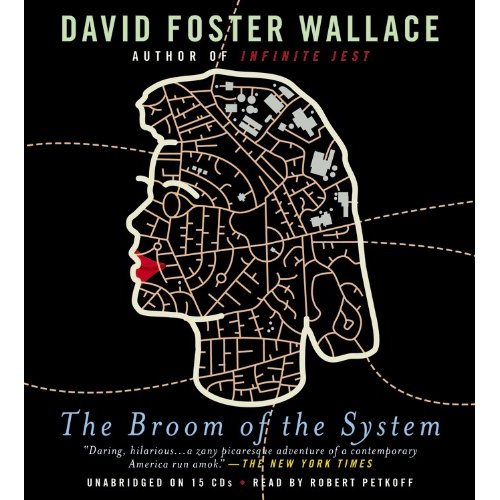
David Foster Wallace’s first novel The Broom of the System obsesses over language, words, storytelling and what it might mean to have our lives circumscribed in another person’s narrative. Hatchette Audio’s new audiobook version of Broom highlights the strength of Wallace’s dialogue, a feature of his writing perhaps overlooked, or at least overshadowed, by his complex diction and syntax and his innovative narrative structures. The Broom audiobook features the considerable talents of reader Robert Petkoff, who brings life to its many characters like protagonist Lenore Stonecipher Beadsman, a switchboard operator looking for her grandmother (and namesake) in the weird nooks and crannies of Wallace’s fictional Cleveland. Gramma Lenore (grammar Lenore; lost Lenore) is a former pupil of Wittgenstein, a conceit that allows Wallace to run wild with his own philosophical-linguistic concerns. I first read Broom as an undergrad–this was almost 15 years ago now–and I was pretty soaked in post-structuralist philosophy at the time, at least enough to think I was getting what many of Wallace’s mouthpieces were saying. There’s an obsession with Self and Other and whatever membrane might keep them separate; there’s the paranoia that language dictates our lives; there’s a sense that the postindustrial landscape has led to the need to engender new means of communion. Politicians create the Great Ohio Desert–or G.O.D. (subtle, I know) as a place for spiritual quests; psychiatrists prescribe bizarre ritual theaters for families to produce in front of a recording of a TV audience; a drugged bird develops speech abilities and is mistaken for a miracle. Broom is a dizzying satire of modernity, or more properly, postmodernity (the book was first published in 1987 but set in 1990).
Journeying through the book years later is a new experience, especially in light of how much Wallace and his literary followers have remapped the terrain of fiction. Many of Broom‘s experimental innovations, like the incorporation of TV transcripts, scholarly articles, medical documents, and other “found footage” are so normalized in contemporary fiction as to be almost clichéd in 2010. While these moments are never glaring or gauche in Broom, their inclusion lacks the finesse that Wallace would later demonstrate in Infinite Jest. Similarly, Wallace’s characters in Broom are too cartoonish to connect with. Read aloud, their punning names become a cavalcade of groans:Wang-Dang Lang, Peter Abbott, Candy Mandible, Judith Prietht, Biff Diggerance, and so on, as if Wallace can’t help himself. The Pynchonesque goofiness gets in the way of the reader-writer relationship that Wallace ultimately wants, the Wittgensteinian language game that would allow for identification beyond words. Purposeful bathos is still bathos. Lenore is an engaging character but, as she frequently worries and suspects, she is just that, a character, never transcending the page like Don Gately of Infinite Jest. But it’s cruel and stupid to fault Broom for not being Infinite Jest, especially when Broom is such a rewarding novel. Published when Wallace was just 24, it shows the grand strains of First Novel Syndrome, of a genius trying to push out too many ideas, too many characters, too many philosophical riffs at once. While Infinite Jest is hardly restrained, it shows Wallace’s powerful control over Too Much; it converts Too Much into Not Enough, into Give Me More.
The highlight of Broom is in its storytelling, in its capacity to explode clichés and expose the truth and energy stored within them. Rick Vigorous, Lenore’s would-be beau with literary aspirations, repeatedly shares stories with Lenore (and us, of course). They can be silly and maudlin and mawkish and downright awful, but also inspiring and sad and horrific, all at the same time, and Wallace engineers and comments on these stories (and the other stories that populate the book) in a way that somehow breaks with or goes past the postmodern tradition he’s otherwise relatively beholden to in Broom. And while Wallace’s first novel never achieves the exquisite sadness of Infinite Jest (although it would clearly like to), it does share the same rap-session humor, the same intimate narrative voice that welcomes the reader to laugh, to ponder, to play the game. Recommended.
C — Tom McCarthy

Tom McCarthy’s marvelous, confounding new novel C tells the life story of Serge Carrefax and his strange adventures at the beginning of the twentieth century. The novel begins with Serge’s birth on his parents’ estate Versoie; he’s born with a caul, a “veil around his head: a kind of web,” a mystic mark that both disconnects and, paradoxically, joins him to the world. At Versoie, Serge’s father Simeon experiments with wireless technology and runs a school for deaf children while Serge’s deaf mother farms bombyx mori moths for silk. Serge and big sis Sophie are left to the care of their tutor Mr. Clair, but they manage to get into trouble with their chemistry set when he’s not looking. In addition to offering the Carrefax kids a classical education, Mr. Clair, a proto-Marxist, teaches them a game akin to Monopoly. In a particularly inspired scene, they soon dispense with the game board to recreate the game on the real-live grounds of Versoie, eventually incorporating the aid of a wireless communication system. Then, when moving from wireless receiver to wireless receiver becomes too much hassle, they simply co-ordinate the game in their collective imagination, managing properties in the pure abstract. The game elegantly emphasizes the siblings’ development from playing via symbolic representation, to enacting those symbols on a one-to-one scale, to finally internalizing and encapsulating the real world. It’s as if they’ve swallowed Versoie into their very beings.
Versoie initiates and enacts its own strange culture and mythology, one that intertwines inextricably with Serge and Sophie’s childhood. It’s a rich, detailed world, at once magical and unsettling, bustling with bizarre pageants (part of Simeon’s curriculum), eclectic experiments, and visitors like Widsun, a British intelligence code-breaker/code-maker who serves as a mentor first to Sophie and later Serge. While Sophie delights in secret codes and chemistry (particularly poison-making), Serge experiments with wireless technology, spending late nights on his homemade wireless set with other “bugs.” In one scene, Serge listens to “an RXer in Lydium who calls himself ‘Wireworm’ [who] is tapping out his thoughts about the Postmaster General’s plans to charge one guinea per station for all amateurs.” Tech geeks with hyperbolic handles griping over minutiae in the wee hours–sound familiar? McCarthy describes Serge’s reaction: “Transcribing his clicks, Serge senses that Wireworm’s not so young: no operator under twenty would bother to tap out the whole word ‘fashion.’ The spacing’s a little awkward also: too studied, too self-conscious.” We get text messaging a century before text messaging, and as Serge searches between news reports and chess games and distress calls, we see that the world wide web is far older than we might have thought. Later in the novel Simeon writes a letter to his son where he describes a proto-internet, claiming his ambition is “to transmit moving pictures over distance, such that life in all its full, vibrant immediacy may be relayed without any delay.” This isn’t steampunk though, it’s simply a reminder that wireless technology isn’t an invention of our own time. C is an historical fiction deeply concerned with technological fact. It’s also a bildungsroman, too, so let’s return to young Serge, who soon ventures to a Bohemian spa with Clair as chaperon.
The adolescent Serge is ill. He perceives the world through a “guazy crepe” that blackens his vision, recalling the amniotic sac that webbed his head at birth. At the spa, Dr. Philip diagnoses Serge’s problem: “You . . . have got blockage. Jam, block, stuck. Instead of transformation, only repetition.” He accuses Serge of enjoying his illness, of enjoying “to feast on the mela chole, on the morbid matter, and to feast on it repeatedly, again, again, again, like it was lovely meat–lovely, black rotten meat.” The Burroughsian image of black meat pops up again and again in C, perhaps suggesting the human limitation to transcend–or in Philip’s words, transform–the mortal condition. However, Serge manages, through his own devices, to break through the blockage; if his epiphany is ultimately negative, at least it is real, a semi-Cronenbergian sexual awakening with a hunchback.
Like Versoie, the Bohemian spa is both a rich and alienating setting; McCarthy’s great gift to the reader is crafting enough detail in his set pieces to make them seem utterly real, yet to withhold enough so that the reader’s imagination fills in the gaps that might exist outside of Serge’s proximity. C is only 300 pages long yet feels much deeper–not longer, but deeper. This is most evident in the novel’s next milieu, the Great War, where Serge serves as a Royal Air Force aerial observer. War novels, histories, and movies have given us so much information about WWI that it would be easy for McCarthy to rely on stock tropes and received wisdom in communicating his set-piece, but instead he gives us something startlingly new. For example, how were the drugs in WWI, McCarthy asks. It’s in the Air Force that Serge first uses cocaine, rubbing it into his retinas to improve his eyesight while he’s spotting for German artillery batteries. He quickly moves to snorting mounds of the stuff before each take off. Here’s a lovely passage, where we see Serge’s nascent addiction blurring his perspective, ultimately leading to an autoerotic climax–
Higher up, the vapour trails of the SE5s form straight white lines against the blue, as though the sky’s surface were a mirror too. Scorch-marks and crater contours on the ground look powdery; it seems that if he swooped above them low enough, then he could breathe them up as well, snort the whole landscape into his head. The three hours pass in minutes. As they dip low to strafe the trenches on the way back, he feels the blood rush to his groin. He whips his belt off, leaps bolt upright and has barely got his trousers down before the seed shoots from him, arcs over the machine’s tail and falls in a fine thread towards the slit earth down below.
“From all the Cs!” he shouts. “The bird of Heaven!”
Serge doesn’t bother to reflect much on this episode and McCarthy’s third-person narrator is so effaced in the novel as to seem almost invisible. McCarthy shows and never tells, even when he allows some insight into Serge’s psyche. We learn that–
Of all the pilots and observers, Serge alone remains unhaunted by the prospect of a fiery airborne end. He’s not unaware of it: just unbothered. The idea that his flesh could melt and fuse with the machine parts pleases him. When they sing their song about taking cylinders out of of kidneys, he imagines the process playing itself out backwards: brain and connecting rod merging to form one, ultra-intelligent organ, his back quivering in pleasure as pumps and pistons plunge into it, heart and liver being spliced with valve and filter to create a whole new, streamlined mechanism.
Serge’s indifference toward death (or life) and his frequent drug-use aren’t the manifestations of a death-wish–although C does pull its hero to a mortal end, as a bildungsroman should–rather, we see in Serge’s cyborg fantasy a wish for transhumanist transcendence. Serge’s job as a flying observer grants him some measure of transcendence, reducing the landscape to a flat two-dimensional perspective that he can easily process and read. At the same time, the novel tropes against the motif of two-dimensional perspective, repeatedly pushing Serge into interior excavations, like a worm or beetle digging in to the earth. This happens in the most literal sense at the end of the Great War, when the Germans capture Serge and hold him as a P.O.W. Serge is fine though, happy to tunnel underground (as long as his morphine hookup remains unimpeded).
Serge’s drug addiction continues into his postwar years in London. Nominally an architecture student, he spends most of his time scoring heroin and coke and partying with would-be actresses. Serge’s inclination to two-dimensional perspective inhibits his architectural aptitude. He can only plan tombs. McCarthy’s evocation of 1920s London is dark and strange, a drug-addled fever dream riddled with ciphers and ghosts. The set-piece comes to a head when Serge’s girlfriend takes him to see a psychic medium who purports to channel the spirits of those who died in the war. An enraged Serge uses wireless technology to reveal the scam, but puncturing the fantasy effectively brings an end to his relationship.
Serge soon reconnects with his father’s friend Wisdun, who sends the young man to Egypt. Serge’s mission is to scout sites for the wireless pylons that will unite the world, but he’d really rather puzzle out the cultural, historical, and linguistic mishmash of Alexandria and explore unopened tombs in the desert with an archeologist’s sexy assistant. I’ve perhaps revealed too much of the book’s plot so far, and while I think I’ve avoided spoilers, I’ll hope that you simply take my word that the Egyptian set-piece at the end of C is a masterful, disturbing climax to a rich and rewarding book. C culminates by tying together its central juxtapositions of sex and death, connection and disconnection, excavation and total, flat perspective with its many motifs: bugs, tombs, art, drugs, language, time, communication, spirit. The book’s final pages are stunning; it’s the kind of linguistic storm that demands immediate rereading.
And you’ll want to reread the book: McCarthy gives us so much to unpack. There’s that enigmatic title, of course. What is the “C” in C for? C is for Carrefax, of course, but that’s too obvious. In his blurb, Luc Sante rightly points out that “C is for carbon and cocaine, Cairo and CQ.” I might also add that C is for see and sí and sea; C is for call and caul; C is for communicate and communion; C is for the c that slips from “insect” to “incest.” (I could go on of course; a third reading of the book will undoubtedly yield more). C seems to call to Thomas Pynchon’s V., a novel littered with historical episodes that dances with a bildungsroman’s structure. C also calls to Voltaire’s satirical bildungsroman Candide. And while I’m lazily name-dropping authors and books, I might as well favorably compare C with Joyce’s Portrait and much of J.G. Ballard and William Burroughs. It’s also thoroughly soaked in Freud and continental philosophy.
C is the best novel I’ve read in a long time, and the first novel I’ve immediately reread in full in a very long time. It will leave many readers cold (or even disgusted, perhaps), but isn’t this always the way for writers who push their audience? (Consider my lazy name-dropping above). You probably know by now if this is for you, but if I haven’t been clear — very highly recommended.
C is available in hardback in the UK on August 5, 2010 from Jonathan Cape, and available in hardback in the US on September 7, 2010 from Random House.
“An Archeology of Literature” — The Guardian Profiles Tom McCarthy
 The Guardian published a great profile of Tom McCarthy today. Topics include Freud, the avant-garde, archeology, and his forthcoming novel C. From the article, here’s McCarthy on his book’s setting:
“It’s the great period of emergent technology,” McCarthy explains. “The book is set between 1898 – when Marconi was doing some of his earliest experiments – and 1922, which is the year the BBC was founded, and also the great year of modernism: The Waste Land and Ulysses. I wanted C to be a kind of archaeology of literature. But I think all ‘proper’ literature always has been an archaeology of other literature. The task for contemporary literature is to deal with the legacy of modernism. I’m not trying to be modernist, but to navigate the wreckage of that project.”
The Guardian has also run a review of C. Biblioklept’s review runs tomorrow. It was a struggle to write–it’s always a struggle to review a book you absolutely love. You always end up sounding a bit too breathless.
Beyond Black — Hilary Mantel

In Hilary Mantel’s 2005 novel Beyond Black, a fat psychic named Alison endures the harrowing torment of a collective of ghosts she calls the Fiends, the spirits of cruel men from her childhood. When a young, aimless woman named Colette comes into Alison’s life and assumes managerial duties for her career, Alison’s bilious past comes to a head. Colette engineers more and better gigs for Alison (the death of Princess Diana causes a huge spike in business), who, despite her genuine psychic talents, must nonetheless run the kind of scam the “punters” in her audience crave. Colette and Alison soon move in together, buying a new house in a quiet, boring suburb outside of London; their prefab homestead is drawn in sharp contrast to the slums of Aldershot where Alison grew up–the novel’s second setting. As Beyond Black progresses, contemporary suburban Britain increasingly crumbles into Alison’s grim, greasy past in Aldershot. Alison’s chief tormentor is, ironically, her “spirit guide,” a mean little man named Morris, a one-time frequent customer for Alison’s prostitute mother. Alison, like many victims, has suppressed much of her grotesque childhood, but it’s hard to black out everything with psychic baggage like Morris weighing her down. In time, more and more of the Fiends reemerge, forcing Alison to confront her mother and the abuse they both suffered at the hands of those awful men. As the book lurches to its chilling climax, Alison asserts independence, casting out her metaphysical and psychological demons.
At its core, Beyond Black asks what it means to be haunted and how one might survive an abusive past whole and intact. A slim specter of a character named Gloria floats through the book. The Fiends, whose vile antics are sometimes compared to a gypsy circus, have dismembered Gloria with the old saw trick. In Alison’s memory, pieces of Gloria are scattered around her childhood home, parceled out, fed to dogs, transported in boxes at midnight, hidden. Alison’s awful mother frequently alludes to Alison herself being “sawed up,” a metaphor that dances on the literal as we come to realize that the old drunk has pimped out her daughter repeatedly. Mantel’s novel investigates the return of the repressed, and although she gives us something like a happy ending, the book’s central thesis seems to be that pain cannot be abandoned or hidden, but only mitigated through direct confrontation.
The book’s humor does nothing to lighten its grim subject–if anything it exacerbates and confounds the darkness at the heart of Beyond Black. Mantel’s gift for dialogue fleshes out her characters (even the spectral ones), and while the book aims for a satirical tone at times, its characters are too richly drawn to be mere cutouts in a stage production. Mantel’s satire of contemporary English life is sharp and bleak; you laugh a little and then feel bad for laughing and a page later you’re horrified. It’s a successful book in that respect. It’s one real weakness is in the character of Colette, whose voice gives way to Alison’s past by the book’s end. This is actually no problem, as Colette’s narrative life is not nearly as interesting as Alison’s psychic traumas; Colette is, however, catalyst for the changes in Alison’s life. It would’ve been nice to see more resolution here, but I suppose Beyond Black hews closer to real life here, with all its messy loose ends.
I chose to read Beyond Black because I enjoyed Mantel’s recent Booker Prize winner Wolf Hall so much. The books have little in common other than being well-written and tightly paced, and I think that anyone who wanted more Mantel after an introduction via Wolf Hall would do right to pick up Beyond Black. Recommended. Beyond Black is available in trade paperback from Picador.
Valhalla Rising — Nicolas Winding Refn

Things that happen in director Nicolas Winding Refn’s new film Valhalla Rising:
A one-eyed warrior (let’s just call him One Eye) gets revenge against the dudes who have enslaved him (they’ve been making him fight chained-to-a-pole gladiator-style for kicks).
(This is, by the way, likely set in some Scandinavian country during the Middle Ages, in case you need some context).
One Eye blood-eagles a dude.
One Eye does not kill the slave boy who brought him food when he was chained up. The boy becomes One Eye’s mouthpiece, because One Eye never talks. The boy names One Eye “One Eye.” In the film’s only moment of humor, the boy says “You need a name. And you do have only one eye.”
For some unclear reason, One Eye and the boy team up with a band of Christian Vikings who are planning to invade the Holy Land. Maybe they join the Christian Vikings because the bastards who enslaved them were pagans? No. I don’t think that’s it.
The Viking ship gets lost in an existential mist. Despair ensues.
They arrive somewhere. Are they in the Holy Land? They’re somewhere.
There’s no food. Some Vikings dissent. People are flipping out. They want to go home. Some Lord of the Flies-type craziness kicks in.
Valhalla Rising rumbles to an intense, surreal climax, which I will not spoil here.
Things that don’t happen in director Nicolas Winding Refn’s new film Valhalla Rising:
Lots of talking.
Any appearance by a woman.
Explicit context or exposition with respect to setting, plot, or character motivation.
Coherent or unproblematic resolution, clear and defined conflict, epiphanies, or other moments of transformation. (Hang on, maybe there is an epiphany, but it’s likely the viewer’s, not a character’s).
Some more thoughts on Valhalla Rising, in a non-list form:
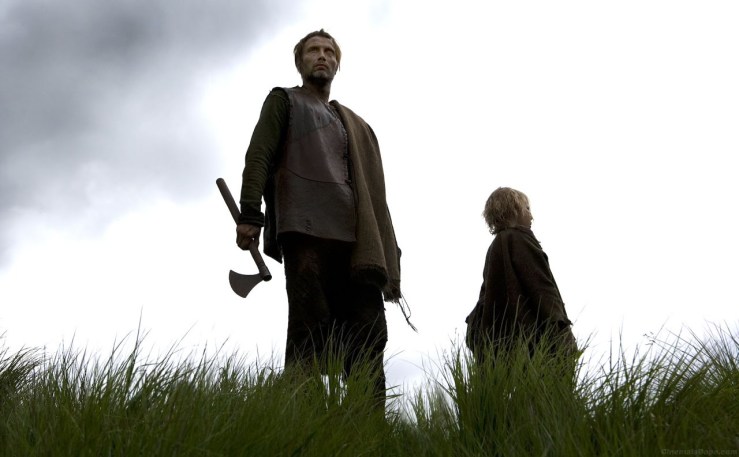
Valhalla Rising begins with a quotation asserting that before the introduction of monotheism, there’s just man and nature in the world. The film then goes about showing how cruel this relationship is and how the apparently assuaging claims of Christianity have no purchase on the world’s intrinsic, bloody Darwinism. There is no social contract in Valhalla Rising, only brain busting with axes, confounding weather, and a lack of easily available food. If there’s a religious commentary that links the fact that the Norse god Odin only had one eye to One Eye tenuously throwing in his lot with Christian marauders, I can’t find it. The film plays out like a version of King Lear where all sense of family, philosophy, and art has been stripped away, leaving only the cruel heath (and maybe the eye-gouging scene). Valhalla Rising may actually be closer to Ran, Akira Kurosawa’s version of Lear, with its unrelenting silence punctuated by moments of warrior violence. But hang on, Lear is a bad comparison altogether, isn’t it? Maybe better to say Valhalla Rising recalls Werner Herzog’s jungles and madmen, or Terrence Malick’s lonely vistas. But if Refn’s film recalls those greats, it also has a strong whiff of Jason Statham all over it. Not that its violence is cartoonish or that it’s a mere actioner, but it is a violent film that refuses to reflect on its violence, that posits violence not just as a necessity but as normal, as constituent of existence itself. In some ways the film recalls Cormac McCarthy’s novel The Road, only more meandering and aimless. One Eye and the slave boy are not “carrying the fire.”
Valhalla Rising was shot in the gorgeous highlands of Scotland, and director of photography Morten Soborg evokes expressionist depth in this landscape, balancing the natural deep browns, verdant greens, and grays of the setting with rich blues and bursts of fireblood red. Peter Peter and Peter Kyed’s soundtrack sounds at times like an arty death metal band’s extended druggy tune up, but when it starts chugging, it really works. Mads Mikkelsen’s silent performance as One Eye will likely strike a cultish cord for those who like their badassery served up cold and mean. It’s more nuanced than it has a right to be in a film that is, like the aforementioned Herzog and Malick’s films (as well as maybe Wong Kar Wai), more of a mood than a narrative. Valhalla Rising is not a film for everyone; those who want the swelling moral clarity of say, Braveheart, need not apply, and even though I’ve name dropped Herzog and Malick in this review, Refn’s film is something else. Whatever it is, I enjoyed it very much.
The Thousand Autumns of Jacob de Zoet — David Mitchell

At some point, almost every character in David Mitchell’s new novel, The Thousand Autumns of Jacob de Zoet tells a story. The book teems with storytellers and their stories, overflows with compact bildungsromans, wistful jeremiads, high adventures drawn in miniature, comic escapades, bizarre folk tales, and romantic myths, all pressed into the service of the book’s larger narrative, the story of Jacob de Zoet, a Dutchman in Shogunate era Japan. In 1799, the relative starting point for this massive novel, Japan limited economic trade with Europeans to the Dutch East India Company, who, with a few rare exceptions, were not permitted to touch Japanese soil. Instead, the Dutch were confined to the man-made isle of Dejima in the bay of Nagasaki. With its rich cultural mishmash, claustrophobic isolation, and strange hybrid nature, Dejima makes a fascinating platform for Mitchell’s tale.
Most reviews of Mitchell’s new book have squared it against his earlier novels, particularly his experimental opus Cloud Atlas (The Guardian‘s review even begins by asking “Does it matter what books a novelist has written before? Should readers need to know an author’s preceding works fully to grasp the new one?”). The reason for this is plain. By and large, Thousand Autumns is a conventional historical novel, a straightforward linear narrative that combines a forbidden love triangle story with elements of high adventure. There are good guys and bad guys, Enlightened thinkers and scheming crooks, warriors and spies, and even an evil monk who may or may not have supernatural powers. Thousand Autumns (like its main setting Dejima) is richly detailed but hermetically sealed; what leaks from that seal are its myriad stories, its capacity for storytelling. This effusion of stories also marks the novel, I believe, as something more than the conventional historical novel it is purported to be. Even more interesting though is the space the novel is occupying in a current literary debate–is The Thousand Autumns of Jacob de Zoet a postmodern novel or not? The rest of my review will discuss this issue, along with James Wood’s review at The New Yorker and Dave Eggers’s review at The New York Times. The simple answer, of course, is that it doesn’t matter whether the book is postmodern or something else–it’s a very good book, I enjoyed it very much, and you probably will too. I encourage you to read Wood’s precis, which I’ve excised here, and then pick up the book. Anyone else interested in the foolish minutiae of what may or may not make a book postmodern or post-postmodern or something else may wish to continue (or not).

Here’s James Wood, using Mitchell’s oeuvre to dither over the fact that “The serious literary novel is at an interesting moment of transition” —
If postmodernism came after modernism, what comes after postmodernism? For that is where we are. “Post-postmodernism” tends toward an infinite stutter. “After postmodernism” suggests a severance that has not occurred. We might settle for “late postmodernism,” a term that suggests the peculiar statelessness of contemporary fiction, which finds itself wandering—not unhappily—between tradition and novelty, realism and anti-realism, the mass audience and the élitist critic. Thus David Mitchell can follow a “postmodern” novel with a “traditional” comic bildungsroman, and then follow that with a conventional historical novel. It is hard to know whether this statelessness is difficult freedom or easy imprisonment, but the more ambitious contemporary fiction will often blend a bewildering variety of elements and historical techniques [. . .]
Dave Eggers, however, feels no need to look for machinations beyond straightforward storytelling. He claims that Thousand Autumns retains the
[. . .] narrative tendencies [of Mitchell’s earlier works] while abandoning the structural complexities often (and often wrongly) called postmodern. This new book is a straight-up, linear, third-person historical novel, an achingly romantic story of forbidden love and something of a rescue tale — all taking place off the coast of Japan, circa 1799. Postmodern it’s not.”
There’s a certain reticence in Eggers’s review to situate Thousand Autumns against anything but itself, including even the rest of Mitchell’s works. In contrast, Wood spends the first half of his review positioning Mitchell’s postmodernism, throughout both his novels (against each other), and as the oeuvre of one author (against other authors). For Wood, Thousand Autumns, because of “its self-enclosed quality [. . .] represents an assertion of pure fictionality.” He continues, arguing that “although the book contains no literary games, it is itself a kind of long game.” Wood would like to see in Thousand Autumns‘s discrete self-containedness a kind of literary gesture, perhaps a sort of conventional historical novel (in scare quotes) that is so conventional as to efface all signs of self-awareness (and thus erase the scare quotes around the gesture). At the same time, Wood recognizes the power of storytelling in the book, asserting that this feature is what makes it a “representative late-postmodern document.” Wood continues:
In place of the grave silence that was the great theme of early postmodernism (or late modernism, if you prefer), language announcing a postwar exhaustion, its own impossibility, as in the work of Beckett or Blanchot, there is a confident profusion of narratives, an often comic abundance of story-making. Never, when reading Mitchell, does the reader worry that language may not be adequate to the task, and this seems to me both a fabulous fortune and a metaphysical deficiency.
These last sentiments are where I strongly disagree with Wood (as perhaps my lede attests)–the greatest strength of Mitchell’s work here is the fabulous fortune of its abundant storytelling. Far from being a metaphysical deficiency, the characters in Thousand Autumns, major and minor, repeatedly transcend their social, spiritual, economic, psychological, and physical confinement via storytelling. Again and again language breaks characters away from their isolation or imprisonment, gives them access to adventure and romance–to spirit. Ultimately, Wood condemns the book for this “metaphysical deficiency,” arguing that “the reader wants a kind of moral or metaphysical pressure that is absent, and that has ceded all the ground to pure storytelling.” (In Wood’s critical body, it is always “the reader,” never “this reader”). I think that the pleasure and power of pure storytelling is its own end, and perhaps it is this recognition that leads Eggers to pronounce of the book simply that “Postmodern it’s not.” And while this declaration is ultimately a more reader-friendly take on Thousand Autumns, it’s also clear to see how the experimental nature of Mitchell’s previous work calls for Wood’s need to place the novel, to situate it against a developing canon (even if Wood chooses ultimately to deny its status).
Wood is perhaps right in his assertion that the term “post-postmodernism” leads to an “infinite stutter.” Still, post-postmodernism ultimately seems more fitting to describe Thousand Autumns than Wood’s “late postmodernism.” The Thousand Autumns of Jacob de Zoet cunningly sets the spiky traps of language and then gracefully leaps over them. Like David Foster Wallace and William Vollmann–two writers who I believe mark the beginnings of post-postmodernism–Mitchell wants to transcend postmodernism’s ironic vision, and storytelling–giving his characters voices–is a means to this end. Perhaps it is Mitchell’s earnestness in conveying the power of storytelling leads Wood to conclude Thousand Autumns “a kind of fantasy [. . .] Or, rather, it is a brilliant fairy tale; and even nightingales, as a Russian proverb has it, can’t live off fairy tales.” If, finally, Thousand Autumns is not a late postmodernist historical fiction but indeed a fairy tale, then it’s worth noting that it’s a particularly enjoyable and nourishing one. Highly recommended.
James Wood Summarizes David Mitchell’s The Thousand Autumns of Jacob de Zoet
I’m a few hours from the end of the audiobook version of David Mitchell’s new novel The Thousand Autumns of Jacob de Zoet. It’s fantastic stuff so far–engaging, imaginative, complex, and satisfying in its richness. Here’s a summary of the book from James Wood’s review of the book in The New Yorker, July 5, 2010:
Jacob de Zoet is a pious, pedantic, upright young clerk for the Dutch East Indies Company, newly arrived on the man-made island of Dejima, in the bay of Nagasaki. It is 1799. The Japanese, enforcing their policy of isolation, confined the Dutch to their post at Dejima, a kind of floating village connected by a bridge to the mainland, and strictly monitored them. The Dutch were effectively prohibited from entering the landmass of Japan, except for the purpose of making an annual visitation to the shogun, in Edo; religious services were banned, and books of Christian devotion were seized upon arrival. Jacob is quickly involved in two difficult narratives: as an employee of the utmost probity, he is tasked with auditing the company, and purging its corruption (various employees have been fiddling the books and stealing goods); unfortunately, the man who has bestowed that task, Unico Vorstenbosch, the chief of the Dejima trading station, is himself on the take. When Jacob confronts Vorstenbosch about his dishonesty, he is suddenly isolated, without allies.
The second struggle also isolates Jacob: he falls in love with Orito Aibagawa, an unusual Japanese woman who works as a midwife, and who has been taking medical instruction from a Dutch physician and intellectual, Dr. Marinus, long resident on Dejima. It is almost impossible for Jacob to advance his love; he is not even sure that Orito returns it, and, even if she did, how could a red-haired Dutchman and a wellborn Japanese woman form any serious bond? But, before anything might occur, Orito disappears. Her father has died, leaving large debts, and it seems that Orito’s family, in order to settle those debts, has “sold” the daughter into a kind of slavery: against her will, she is taken to a remote rural nunnery, run by a powerful and malevolent warlord, the Abbot Enomoto. Just as Jacob fought to unravel the corruptions of his company, so he now strives to unravel the corrupt potency of the Abbot Enomoto and his cultlike temple. As an English reviewer has remarked, the Abbot’s temple, where the enslaved nuns are drugged and impregnated by willing monks, is reminiscent of the world of Japanese anime.
This summary is really the best part of Wood’s review, which works overtime to find fault in what is a very good book. He spends a good deal of his review dithering over the space Mitchell occupies in the contemporary literary world–is Mitchell a postmodernist? A post-postmodernist? A late postmodernist? It’s all quite silly, and I’ll probably write about it in a later post.
The Thieves of Manhattan — Adam Langer

The literary hoax at the heart of Adam Langer’s new novel The Thieves of Manhattan explores the line between fiction and fact, asking readers to examine what kinds of truth they demand from their books. The novel’s outset finds protagonist/narrator Ian Minot working in a coffee shop, watching his too-good-for-him girlfriend Anya begin to succeed in a literary world that repeatedly rejects his own small, simple stories. Ian writes character-driven short stories that attempt to capture the banal truths that permeate ordinary, everyday existence. Publishers aren’t interested though, telling Ian that his characters don’t seem to live on after the last page. Aggravating matters, blatant phony Blade Markham sits atop the bestseller lists despite the fact that his memoir Blade by Blade seems too preposterously fantastical to hold up to even the flimsiest exercise in fact-checking. When Anya gets a book deal and leaves Ian for Blade, Ian hits bottom and agrees to work with a former editor named Roth on a literary con. After years of getting his crime-adventure novel A Thief of Manhattan rejected–it’s not realistic enough–Roth enlists Ian to rewrite the book as his own, real memoir. Working together, Ian and Roth revise Thief until it becomes Thieves, a book that weds Ian’s sense for character depth and dialogue with Roth’s crime noir adventure plot. As galleys arrive and it becomes clear that Thieves is poised to be a major hit, it also becomes clear that not all the details of Roth and Ian’s fake memoir are so fake after all. To reveal more of the plot would spoil the twists, turns, and snares of its brisk third act, so we’ll leave summary aside by simply noting that Thieves compels reading to its final page, a reading that you’ll likely complete in one sitting once that third act begins.
Thieves is a hybrid novel, a stylistic balancing act between Ian’s character-based, realist, psychological storytelling and Roth’s adventure-mystery tales. Langer draws his audience in to identify with Ian. It’s hard not to empathize with Ian, especially through his early embarrassments in Manhattan’s literary world, a world that Langer satirizes with equal parts vitriol and love. Ian mocks the successful literati who he feels have rejected him; to him, they’re poseurs, hacks, and shallow sycophants. One of the rewards of Thieves is watching Ian transform into one of the people he would once mock, and to do so through an act of fakery, one which he repeatedly defends (to himself) as a means to artistic expression. Langer’s groundwork in developing Ian’s character pays off tremendously in the novel’s aforementioned third act, which essentially finds Ian transforming into a character in a book that he (kinda sorta) wrote himself. Here, Thieves shifts gears into full-on noir adventure, yet retains its self-referential humor through its final spiky helix. It works because we still believe in the core veracity of Ian’s character. And while plenty of literary comparisons would be apt here, the last act of Thieves reminded me most of the final act of Spike Jonze and Charlie Kaufman’s marvelous film Adaptation, a film that at once enacts and comments on its own genre status without the pitfalls of academic dithering.
The signature literary device of Thieves is a strange kind of metonymy where the names of authors, characters, and other proper-noun literary references substitute for objects or actions with which they are closely associated–at least in Ian’s lit-soaked mind. An example: “I saw us agreeing to split the apartment down the middle, putting a divider between her proust and mine. I could hear her having wild chinaski in the next room with all of her new boyfriends, madly scrawling in her notebook, furiously typing on her laptop, while I sat alone with my hand on my portnoy.” Langer takes a risk here. His narrator’s ergot could have turned out too-precious (and thus eventually irritating); instead, Ian’s litspeak becomes the fitting jargon for a crime novel. In appropriating and recontextualizing other authors’ characters and names, Ian’s jargon underscores Thieves‘s themes of the tension between fact and fiction, the writer’s role in delivering truth, and the concept of the artist as a thief.
Literary hoaxes are hardly new, but in recent years there’s been a small explosion of memoirs revealed to be part or wholly false. Langer clearly has a love for literary hoaxes old and new, and it shows in his book, particularly through his narrator’s transformation from a writer of realist fiction to a fake memoirist to a character in a book of his own making. The Thieves of Manhattan is a tightly-plotted, character-driven adventure-crime noir-mystery-hoax-con game novel pretending to be a memoir (pretending to be a novel . . .) that, despite all its fun metafictional games, never falls into the trap of navel-gazing. Langer gives us a character we can care about and puts him in the middle of a plot we want to see through to its end, but the real testament to Thieves is how much we can still care about that character after the last page. Highly recommended.
The Thieves of Manhattan is available from Spiegel & Grau. For more, read Biblioklept’s interview with Adam Langer.
Yeah Yeah YA — New Novels from Laurence Gonzales and Simon Rich
Once upon a time, young people who were lucky enough to have the leisure to read what they wanted gravitated toward texts like Little Women, The Adventures of Tom Sawyer, and Great Expectations. These books weren’t necessarily written for or marketed to teenagers, but they found (and continue to find) a hungry audience in adolescents. The rise of the modern publishing industry saw a way to feed these voracious young readers, and Young Adult–YA–has since solidified into its own genre, complete with its own set of conventions and tropes, found in fantasies, romances, adventures, and sci-fi novels alike. YA tends to enlarge themes that predominate literature as a whole–alienation, isolation, shame, transformation, and (of course) identity. The best YA literature speaks to adolescent fear, channels it into thought experiments and fantasies that help teens to cope with their changing identities. However, YA, like any genre, puts a writer at risk of being ghettoized, of having her own work thrown in with a good many bad books. In recent years, established writers like Sherman Alexie and Nick Hornby have purposefully written YA books and worked to have their books marketed as such, but perhaps many writers don’t want to be pigeonholed into a genre by having their books directed squarely at teens.
 I was thinking about this problem today when I read Michiko Kakutani’s somewhat negative review of Laurence Gonzales’s new novel Lucy in the The New York Times. I received a review copy of Lucy back in March and breezed through it in a few afternoons. It’s an enjoyable read with a preposterous plot that somehow doesn’t come across as a gimmick. The eponymous Lucy, you see, is a genetic experiment, a humanzee born of a bonobo and raised in the middle of the jungle by a (not so) mad scientist named Stone until the age of 14, when insurgents murder her erstwhile dad/creator. Lucy is summarily adopted by another scientist, Jenny Lowe, who takes her to Americaland where she learns to be a normal teen. That is, until her super-chimp powers are revealed to the good American people, who come after her, mob-persecution style. Kakutani insists on reading Gonzales’s work as a Frankenstein story, and picks at it for not explaining its science as well as Michael Crichton’s Jurassic Park. What Kakutani is failing to see is that the novel is not really about scientific hubris–it’s about how hard it is to be a teenager; specifically, it’s about how hard it is to be a teenage girl with a teenage girl body. Kakutani, apparently mistaking books for gravy, also takes Lucy to task for being “lumpy.” If Lucy lacks the finesse, explication, or subtlety that Kakutani would like it to have, then perhaps that is because she misunderstands its audience (to be fair though, Kakutani seems to frequently forget that not all books should be written to her taste).
Again at The New York Times, Tom DeHaven made a similar, if less boorish mistake, earlier this summer in his review of Simon Rich’s début novel Elliot Allagash. Here’s his lede:
If I were in the eighth grade, I’m pretty sure I’d love Simon Rich’s first novel, “Elliot Allagash.” I might even press it on my friends. (“It’s about this 13-year-old evil genius who does whatever he wants because he’s, like, a billionaire. And it’s funny. And short.”) But since more than 45 years have passed since I took up space in a middle school, I simply like it, very much — while wishing this flippant little parable about the puerility of greed had a deeper, sharper bite.
DeHaven wishes Rich’s book had a “deeper, sharper bite” — like Kakutani’s quibble with Gonzales, he wants the kind of acuity that ultimately is not best suited for the eighth and ninth grade boys who will love this book, who will press it on their friends. In my own review of Elliot Allagash, I wrote: “I don’t think that Elliot Allagash is being promoted directly as a Young Adult novel, but it will have a ready audience in the same smart crowd who dig funny, bright novels like C.D. Payne’s Youth in Revolt and Sherman Alexie’s The Absolutely True Diary of a Part-Time Indian .” But even though Elliot Allagash and Lucy aren’t being promoted by their respective publishers Random House and Knopf as YA, that doesn’t mean that they don’t have a potential audience of young adults–and it seems impossible to me that seasoned critics like Kakutani and DeHaven could be ignorant of that. Older readers might enjoy Lucy or Elliot Allagash but young readers might love them; critics shouldn’t condescend authors for not overreaching. A pretentious book is a sin and neither of these books is pretentious.
Russian Ark — Aleksandr Sokurov
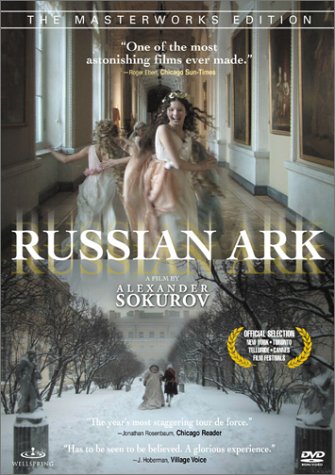
Before I get into the details of Aleksandr Sokurov’s 2002 film Russian Ark, I implore you to stop reading my review and simply get a hold of the film and watch it. It’s a marvelous, rewarding, dreamy experience. That’s not a very convincing argument of course, but I think that the best way to see this gorgeous film is with no preconceptions, with as little information as possible–not because there are plot twists that a review might give away, but rather because the pleasure of Russian Ark is its narrative immediacy–and any review will seek to mediate that immediacy. So I’ve hemmed and hawed. If you need further convincing, read on.
It’s hard to know where to begin, so I’ll let Don DeLillo do it for me. In his latest novella, Point Omega, his filmmaker protagonist describes it as an ideal for the kind of truth he’d like to capture in one of his own films:
There’s a Russian film, feature film, Russian Ark, Aleksandr Sokurov. A single extended shot, about a thousand actors and extras, three orchestras, history, fantasy, crowd scenes, ballroom scenes and then an hour into the movie a waiter drops a napkin, no cut, can’t cut, camera flying down hallways and around corners. Ninety-nine minutes.
That was enough for me to get hold of Russian Ark and watch it, or rather experience it (I think experience is the best verb here, corny as that sounds), but perhaps, gentle reader, you’d like some plot details. Let’s give it a shot. The film begins in darkness, with its unnamed/unseen protagonist describing the vague details of his last memory, a violent accident that he remembers little about. But before we go on, I should point out a few things: this protagonist is unseen because he is essentially the camera; his movement propels the film–is the film–and although he is his own character, he is also a surrogate for the audience. His first-person experience dictates the film, is the film, and although he has ghostly access to the characters who float through the gorgeous halls of the State Hermitage in St. Petersburg, they cannot see or hear him. There is one character who can see him however, an unnamed black-clad 19th-century French aristocrat who the protagonist comes to call “the European.” Neither the European or the protagonist understand why they are in the Hermitage or how they got there; the European is even more perplexed to find that he now speaks perfect Russian. Unlike the protagonist, the European can interact with the denizens of the Hermitage, and interact he does, by turns offending, menacing, or charming (or at least attempting to charm) the characters that the pair encounters as they drift through the ballrooms, galleries, and courtyards of this beautiful palace. Initially, the European repeatedly insults Russian culture, which he believes a pale imitation of European aesthetics. He even protests that one of the fine orchestras that they stumble upon must be manned with Italian players, as Russian musicians simply couldn’t be so skilled. But as they wander the halls, the European slowly succumbs to the rich beauty and opulence of the Hermitage; although he never states it outright, he relents his prejudice against Russian culture, and perhaps even learns a new way of seeing beauty.

And who wouldn’t be moved by the beauty here? Russian Ark functions in some way as a guided tour of the Hermitage, although that term, “guided tour” implies a stuffiness that’s antithetical to the looseness of this film. The camera lingers on a painting or statue; the protagonist offers his thoughts, the European his; perhaps an erstwhile docent steps in to explicate a point of technique or symbolism. It’s wonderful. In one stunning moment (scene would not be the right word for this movie which is of course one long scene), the European argues violently with a boy over a painting of the apostles Peter and Paul. The boy admits to knowing nothing of the scriptures, yet he’s deeply moved by the wisdom and promise that the painting connotes; the European cannot understand how the painting’s aura alone can transmit its meaning to the ignorant lad. The scene begins at 6:38 in the clip below:
The European’s clash with the boy echoes the larger (and yet subtle) clashes of the film, as characters, artworks, and musical styles of different epochs float into or burst out of or parade around in the grand rooms of the Hermitage. There’s Pushkin, Peter the Great, Catherine the Great, Anastasia. There’s an incredible scene where Tsar Nicholas I is offered an apology by the Shah of Iran for the death of an ambassador; there’s a wonderful ballroom dance that moves the European to great joy. In one of the film’s pockets of horror, a layman labors in a strange utility room building his coffin; it is the siege of Leningrad in WWII where over a million people died at the hands of the Nazis. The European, of course, has no knowledge of these events, being after his time, and the disjunction between the protagonist’s contemporary perspective of history and his own provides for a fascinating, if not wholly fleshed out, conflict.
Indeed, one of the greatest pleasures of Russian Ark is its refusal to narrativize or philosophize history beyond a first-person perspective walk through the halls of the Hermitage. The movie erupts into little pockets of exuberant joy or strange, desperate violence; sometimes the protagonist is drawn in, but just as often he’s repelled, and looks for another avenue, like a dreamer willing his own escape. To call the movie dream-like would be an understatement, and like a dream, Russian Ark‘s divergent set pieces overwhelm the senses in their rich splendor. Like the protagonist and the European, I found myself repeatedly entranced by a painting or a concert or a dance or a strange little moment, only to be interrupted by another character intruding into the frame, bearing new information, discordant news that disrupts the dream logic (while paradoxically ushering in a new set piece). Russian Ark distracts its audience, sending them inward; in contemplation, the viewer loses the thread–but is there a thread? Is real life a narrative? Are dreams even narratives? Some of my favorite moments of the film happened when my anxiety at having been distracted by some gorgeous detail was confirmed by the protagonist, who all of a sudden has lost the European, or who is startled by the bustling arrival of new people. But of course, in this film, the viewer is the protagonist.
But writing about Russian Ark is no good, not really. You have to just see it (but I already said that, right?) To quote again from DeLillo’s Point Omega, “The true life is not reducible to words spoken or written, not by anyone, ever.” Sokurov’s film collapses history and art and beauty into a beautiful, edifying, sometimes terrifying dream, a dream that, in its adherence to first-person perspective, is a marvelous approximation of true life. Highly recommended.
On Kindness — Adam Phillips and Barbara Taylor
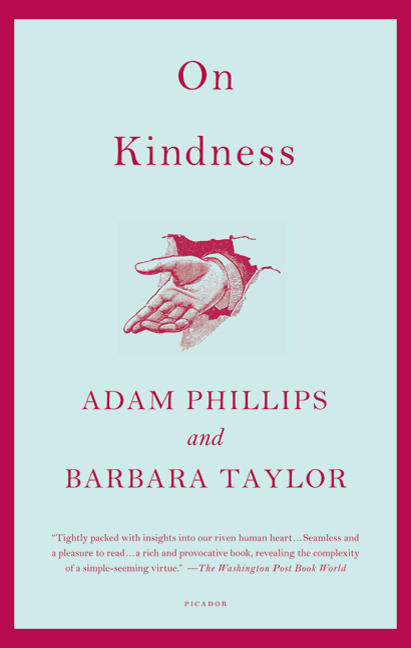
On Kindness seeks to answer why “It is now generally assumed that people are basically selfish and that fellow feeling is either a weakness or a luxury or a more sophisticated form of selfishness.” Psychoanalyst Adam Phillips and historian Barbara Taylor quickly demonstrate that up until the “so-called dawn of modernity” in the Enlightenment, people simply believed themselves to be naturally kind. The advent of the ideals of self-reliance and independence (along with the appeals of aggressive mercantile capitalism) led to a zeitgeist–one that still exists–in which kindness is a form or weakness, or a type of duty, like philanthropy, that negates its own purity. In short, Phillips and Taylor point to a general feeling that real kindness might not exist–and then argue, quite convincingly, against this general feeling.
The book’s second chapter, “A Short History of Kindness” outlines the philosophy and social practice of kindness from the time of Seneca through to Freud. Phillips and Taylor choose Jean-Jacques Rousseau as their champion, with Thomas Hobbes (and his famous dictum of bellum omnium contra omnes) as a recurring villain. But it’s Freud who dramatically problematizes modern attitudes toward kindness, with the radical idea that “aggression itself can be a form of kindness; that when aggression isn’t envious rage or the revenge born of humiliation, it contains the wish for a more intimate exchange, a profounder, more unsettling kindness between people. In short, psychoanalysis makes sentimentality and nostalgia, not hatred, the enemies of kindness.” This complicates the relationships between children and parents; psychoanalysis renders kindness unnatural. The resulting confusion leaves us open to the idea that acts of kindness might leave us radically exposed or otherwise in harm’s way. Even worse, modern society elevates and idealizes kindness into “a virtue so difficult to sustain that only the magically good can manage it” — this “destroys people’s faith in real or ordinary kindness.” But, Phillips and Taylor want to assure us, real and ordinary kindness does exist. “We depend on each other not just for our survival but for our very being,” they argue in their final chapter. “The self without sympathetic attachments is either a fiction or a lunatic.” So, what are the solutions? Philips and Taylor clearly argue that the pleasures of kindness they advocate cannot stem from “moral superiority or domineering beneficence or the protection racket of good feelings. Nor are acts of kindness to be seen as acts of will or effort or moral resolution.” Instead, our authors argue for “a revived awareness of something that is already felt and known.”
On Kindness is a compact, tightly-wound tract of 114 pages that can be read quickly by a general audience, but nevertheless takes some time to digest. Picador’s trade paperback edition (new this month) is handsome and small enough to fit into a cargo pocket, purse, or beach bag. It seems of a piece with Picador’s Big Ideas/Small Books series, erudite works that consider big subjects without ever falling into traps of academic solipsism. Recommended.
In Brief — Adam Langer, William H. Gass, David Foster Wallace, and Frank Meeink
I have terrible writer’s block. It’s not that I have nothing to say, it’s just that I can’t seem to say it. Or that I write sentences like the previous one and shudder at their awkward clunky artless awfulness. But I’m gonna press through it, write through it, and share a few thoughts on what I’ve read this week–
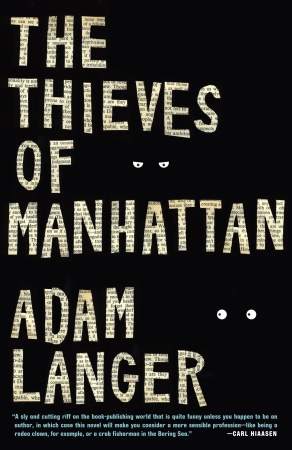 First up: Adam Langer’s new novel, The Thieves of Manhattan, a send-up of the publishing industry that sets its targets directly on the current swath of (faked) memoirs that have done gangbusters for publishers in the past few years. Ian Minot is a broke-assed barista one fuck-up away from an overdue firing, who moves from the Midwest to make it as a writer in the big city. Only he’s not doing so well–in contrast to his gorgeous Romanian girlfriend Anya whose literary star is on the rise. For Minot though, this isn’t the worst–that would be the rampant success of über-poseur Blade Markham, a wanna-be gangsta whose memoir Blade on Blade is a blatant fabrication (albeit a fabrication that no one but savvy schlemiel Minot seems to notice (or, at the least, be bothered by)). I read the first fifty-odd pages of the Thieves in one sitting–a good sign to be sure. Langer’s Minot’s voice is familiar territory, the boy who loves to mock the literati he would love to be a part of. In one of the signal moves of his patois, the names of famous authors (and characters) regularly replace common nouns–a bed becomes a proust, a full head of hair is a chabon, sex is chinaski and so on. Minot seems to be headed to running his own grift soon with the help of a man he appropriately calls the Confident Man–should be good stuff. Full review forthcoming. The Thieves of Manhattan is available July 13, 2010 from Spiegel & Grau.
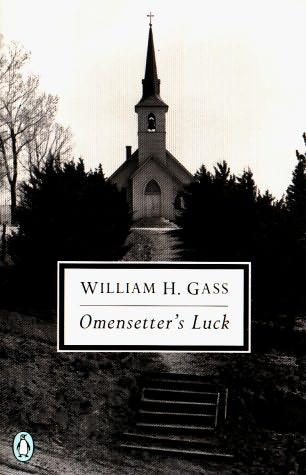 I’ve also been reading William H. Gass’s first novel, Omensetter’s Luck. It’s weird, wonderful, Faulknerish in its loose (but somehow layered and constructed) stream of consciousness. Omensetter’s Luck comprises three sections, each progressively longer; I finished the second one today, and so far the novel seems to dance around a description or accounting of its namesake, Brackett Omensetter who carts his family into the small sleepy town of Gilean, Ohio, and immediately perplexes the townsfolk with his amazing luck. As Frederic Morton put it in his contemporary 1966 New York Times review, “It quickly becomes apparent that as other people have green thumbs, [Omensetter] has a green soul. The cosmos and he live in mysterious congruity.” There’s much to commend and unpack in Gass’s writing here, but the pleasure of his musical rhythm are enough for me now (in my writer’s block, I retreat to aesthetic criticism [shudders]). Besides, do I really have to recommend this novel when David Foster Wallace already did so in his semi-famous list “Five Direly Underappreciated U.S. Novels > 1960”? No, I don’t, that’s right. Here’s Wallace on Omensetter’s Luck: “Gass’ first novel, and his least avant-gardeish, and his best. Basically a religious book. Very sad. Contains the immortal line ‘The body of Our Saviour shat but Our Saviour shat not.’ Bleak but gorgeous, like light through ice.”
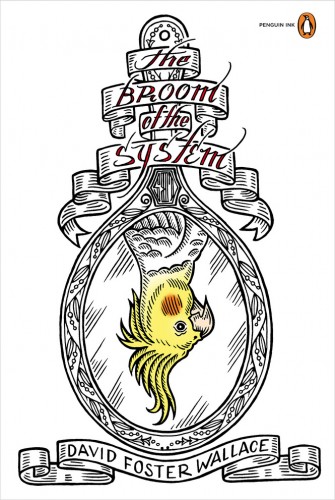 Speaking of Wallace and début novels, Richard Rayner at The Los Angeles Times has reviewed Wallace’s first book The Broom of the System, which is being republished at the end of this month with a cool new cover by tattoo artist Duke Riley. A considered, well-written review, one which prompted me to dig out (okay, bad verb phrase choice; no unearthing involved, my Wallace volumes are neatly aligned together on a shelf in my living room) my copy of Broom. I remember reading a friend’s copy in the burning humidity of a Gainesville summer, in ’98 or ’99, reading the book in long chunks. I tried to read it again after I finishing Infinite Jest but it seemed kinda sorta goofy (albeit purposely, Pynchonesquely goofy). Anyway, Rayner’s review makes a strong case for a re-reading.
 And, speaking of Wallace (again), or at least using him as a crutch–I’ve almost finished Autobiography of a Recovering Skinhead by Frank Meeink (“as told to” Jody M. Roy; they’ve sort of got the whole Malcolm X/Alex Haley thing going on there). So, yeah, why the Wallace segue? How to justify it? Well, reading Meeink’s story, the true story of an abused, battered Philadelphia kid who falls into the American neo-Nazi movement and its attendant violent crime and terrorism, who goes to prison and finds redemption and human connection and a new purpose for the nihilistic void of his life, who falls into alcoholism and drug addiction only to be redeemed again–reading Meeink’s story, even knowing its veracity (demonstrable to a point that would satisfy even Langer’s Ian Minot)–I couldn’t help but read his strong, immediate, gritty, and utterly real voice as something not unlike one of the creations in David Foster Wallace’s Brief Interviews with Hideous Men. It’s not just Meeink’s hideousness, his violence, or the grace that he works toward–all constituents of DFW’s collection–it’s that voice, the realness of the volume, surely the book’s greatest asset. Recovering Skinhead is an engrossing read, fascinating in the same way that an infected wound prompts our attention, our paradoxical compulsion and repulsion, but most of all it’s an exhilarating and exhausting performance of voice, of Meeink’s unrelenting, authentic telling of a tale, a telling that any novelist would thrill to channel. Only Meeink’s voice isn’t a novel creation: it’s real. Autobiography of a Recovering Skinhead is available now from Hawthorne Books.
Collected Prose — Paul Auster
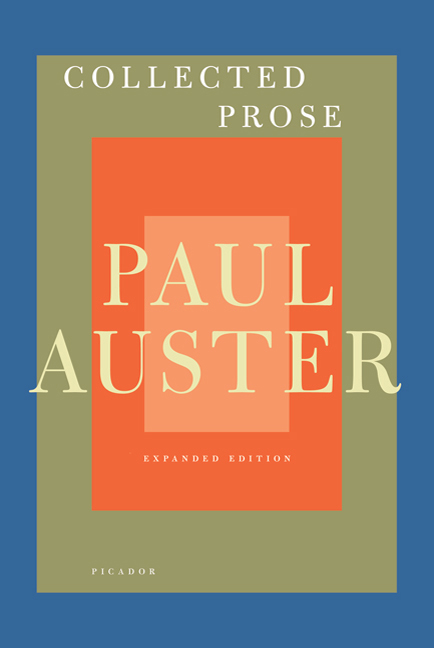
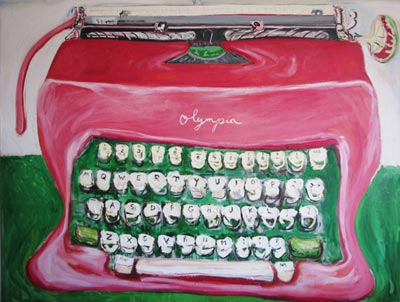
This month, the good folks at Picador are issuing an expanded edition of Paul Auster’s essays, memoirs, prefaces, true stories, anecdotes, and interviews. Inconspicuously titled Collected Prose and running to just under six hundred pages, the volume includes Auster’s début work The Invention of Solitude in its entirety. Solitude is a strange blend of personal memoir, an account of the young writer’s reaction to and relationship with the death (and life) of his father, as well as a philosophical meditation on the absurdity of family, art, and time. Collected Prose also includes the later memoir, Hand to Mouth, a reflective piece on Auster’s early failures as he tries to make it as a writer, including his time in Paris, his marriage to Lydia Davis, his hunger, and his poverty. While Solitude inaugurates many of the experimental structures and postmodern tropes that Auster would be identified with throughout his career as a novelist, the flatter, more direct style of Hand to Mouth is more indicative of the tone of much of Collected Prose. There’s a journalistic directness and keen earnestness to Auster’s essays that perhaps belie his postmodern bona fides. That’s a good thing, allowing Auster to communicate directly about his sometimes challenging subjects to a wider audience. Style aside, both of the book-length memoirs at the front end of Collected Prose neatly delineate the themes that preoccupy much of the rest of the book: art, language, writing, writers, poverty, absurdity, movement, New York City, and so on. And although the book turns away from Auster’s memoirs and true stories in its second half, presenting his essays, editorials, and prefaces, there’s still a sharp sense of Auster in each essay. These are personal essays. Auster writes about his friend Philippe Petite, the French high-wire artist; he writes about the literal hunger artists face, using Knut Hamsun and Franz Kafka as examples; he writes a vindication for Dada daddy Hugo Ball; he writes on over half a dozen relatively obscure poets to let us know why they matter. There are wonderful little moments, like “The Story of My Typewriter,” where Auster exclaims his love for his quiet Olympia (he buys 50 typewriter ribbons fearing the specie’s eventual extinction). The book reprints the Sam Messner paintings that originally accompanied Auster’s text (or, perhaps, vice versa).
Another great moment is the essay “Hawthorne at Home,” which takes a look at a little known piece by Nathaniel Hawthorne called Twenty Days with Julian & Little Bunny. Hawthorne’s piece is more or less a straightforward narrative account of Hawthorne alone with his five-year old son Julian and his pet rabbit for three weeks while wife Sophia visited the Peabodys. While Auster gives the reader a lesson on Hawthorne and his composition of The Scarlet Letter here, the essay focuses on the idyllic charm of a father and son, a rare subject in Hawthorne’s oeuvre. As a bonus, Herman Melville makes a cameo. “Hawthorne at Home” is the sort of essay that makes you want to go read the source material; it sent me hunting for a used copy of American Notebooks.
As one might imagine, Collected Prose is absolutely larded with writers, and lovingly so. Auster does not suffer from the inclination toward meanness that so many critics feel toward their peers, perhaps because he writes foremost from the perspective of an artist. Not that it’s difficult to praise Art Spiegelman (“The Art of Worry”) or pray for Salman Rushdie (um, “A Prayer for Salman Rushdie”) or speak to the genius of Samuel Beckett (“Remembering Beckett on His One Hundredth Birthday”) and Jim Jarmusch (“Night on Earth: New York”)–but Auster illuminates their work in a way that transcends the postmodern concerns of technique, place, and politics, and speaks directly to a certain aesthetic excellence. His love for storytellers extends beyond the pros, of course, evinced in his work with NPR’s National Story Project. He credits wife Siri with coming up with the idea of having NPR listeners write and submit their own original stories, but his enthusiasm for her idea resonates in his warm preface to the eventual book that collected the listeners’ submissions. Auster writes, “I learned that I am not alone in my belief that the more we understand of the world, the more elusive and confounding that world becomes.” The world becomes more “confounding” after the 9/11 attacks, of course, and like so many other writers Auster attempted to somehow measure the tragedy in words. “Random Notes–September 11, 2001–4:00 PM” is a scrap, a fragment, a shell-shocked missive that ends with the haunting words “And so the twenty-first century finally begins.”
It might be misleading to call Collected Prose a good introduction to Paul Auster’s nonfiction–can a work so comprehensive, so massive be a mere starting point?–but it is a great introduction, so there. It’s also a fantastic overview of critical, literary, and artistic theory, written from a deeply personal perspective. Let’s hope that fifteen years from now we’ll have another expanded edition of Auster’s prose; in the meantime, we can look forward to his new novel Sunset Park this November. Highly recommended.
A Very Short Review of a Very Good Book — Tom McCarthy’s C
Finished Tom McCarthy’s newest novel C last night. It doesn’t come out until this autumn–and I’ll post, y’know, a long, detailed review then–but for now–
The book is tremendous. You should start looking forward to it now. Great, great stuff. Loved it. Will read it again. Very highly recommended. You get the idea.
In Brief–New Novels by Janelle Brown, Loretta Stinson, and Tracy Winn
 In This Is Where We Live, Janelle Brown’s follow-up to her 2008 début All We Ever Wanted Was Everything, an artsy newly wed couple find their dreams and their marriage unraveling when the payments on their adjustable rate mortgage suddenly double. Claudia and Jeremy are happy at the novel’s outset, living comfortably in their Los Angeles bungalow. Her film Spare Parts garners a huge buzz at Sundance and he reforms a new band after the breakup of his old group The Invisible Spot; they envision their new neighborhood as a contemporary counterpart to the Laurel Canyon creative scene of the 1960s. But then their ARM adjusts and Spare Parts flops. Claudia has to take a job teaching (Gasp! Oh, the terror! In a particularly funny scene, she shows The Graduate to her film students and one of them raises her hand to declare that her father was one of the film’s executive producers). The couple soon has to take in a roommate. Complicating matters even more is the return of Aoki, Jeremy’s unstable–and now famous–ex-girlfriend, who manipulates him every chance she gets. Aoki, a cartoonishly unhinged avant-gardiste, serves as a foil to the more grounded figure of Claudia; as Claudia begins to mature into a more pragmatic, adult personality, Aoki’s siren song calls Jeremy to return to chaos. This Is Where We Live is timely, of course, and Brown takes pains to show how these two “creatives” could overlook such meaningful financial details when looking to buy a home. Some will find Brown’s sympathetic vision of the privileged L.A. art scene off-putting or even shallow, but the novel’s core exploration of a troubled young marriage will resonate with many readers. This Is Where We Live is available in hardback from Spiegel & Grau on June 15, 2010.
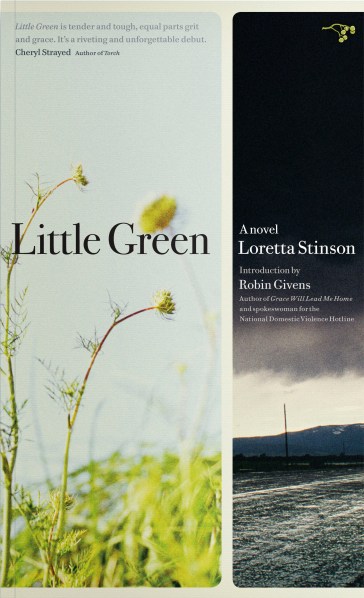 Little Green, Loretta Stinson’s début novel, tells the story of Janie, an orphan who runs away from her stepmother. Life on the road is tough, and Janie has to make money somehow, dancing in strip bars and even bartering for sex when necessary. When she meets a charmer named Paul who is ten years older than her, she feels instantly closer to him–and naturally hits the road again. Hitchhiking is never a good idea though, kids, especially in a loner’s van, and Janie is brutally beaten. She finds herself under the care of the man who owns the last bar she danced at, and in time, under the care of Paul, reiterating one of the novel’s major themes of cyclical violence and female dependence on a man. Paul is a small-time drug dealer whose habits extend beyond weed and acid into heroin and meth. As his drug addiction spirals, he tries to find some control by manipulating Janie; in time, he beats her so terribly that she has to go to the hospital. Janie leaves him but he stalks her wherever she goes, forcing her to find her own strength and self-reliance as the novel reaches its redemptive climax. Paul is probably the most interesting character in Little Green, and although it would be unfair to call Janie a flat character, she spends much of the novel as a victim. In contrast, Paul’s addiction and behaviors are studied with a psychological depth that attempts to understand–without ever rationalizing–his actions. While the novel is hardly sympathetic to him, Stinson resists painting Paul as a static monster; the payoff is a villain far-more frightening because of his authenticity. Authenticity is what keeps Little Green (for the most part) from verging into melodramatic Lifetime movie of the week territory. Stinson’s finely detailed evocation of the Pacific Northwest
  of the late 1970s explores how attitudes about gender roles, women’s rights, and drugs came to a seething breaking point a decade after the summer of love. Significantly (and sadly), the novel’s depiction of domestic violence reads with a wholly contemporary immediacy. Little Green is new in handsome trade paperback this month from Hawthorne Books, who will donate a portion of sales revenue to the National Domestic Violence Hotline.
Tracy Winn’s debut, Mrs. Somebody Somebody covers over half a century–from Korea to Iraq, in the book’s terms–in the lives of the regular folk of the mining town of Lowell, MA. The book comprises ten stories that can easily stand on their own, but combined together form a novel-in-stories, an evocative portrait of a working-class town under duress. Winn weaves blood lines through generational and political conflicts and re-examines her book’s themes through a variety of perspectives. The result is a layered, detailed reckoning with history and place, class and conflict, drawn in rich, resonant colors. Mrs. Somebody Somebody is new in trade paperback this month from Random House.
The Canal — Lee Rourke
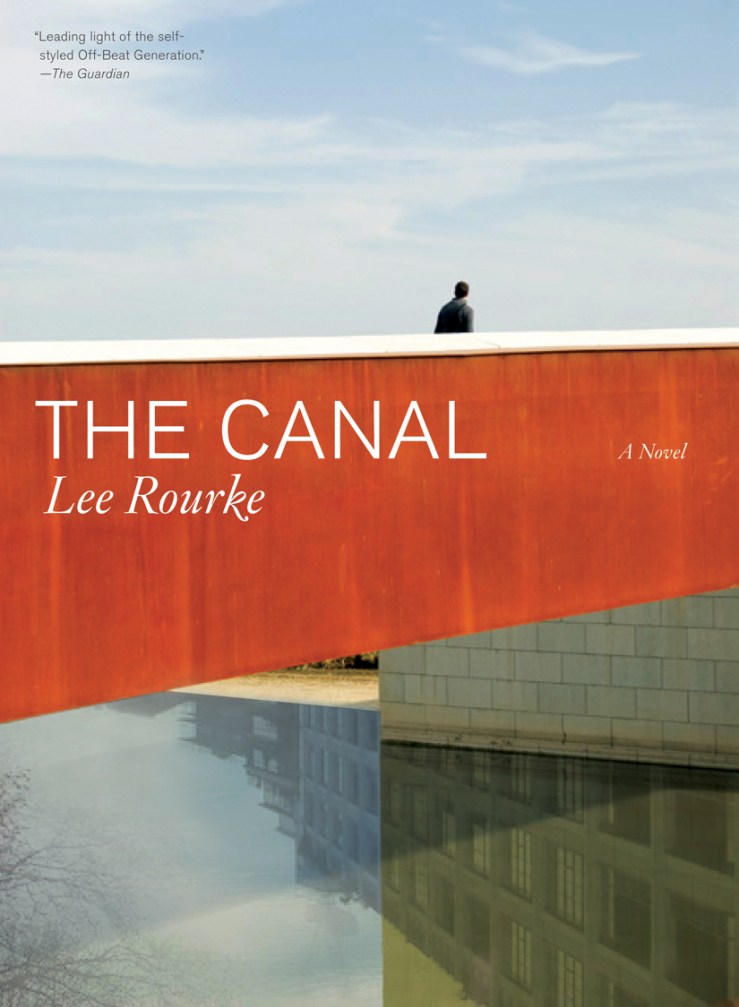
In Lee Rourke’s début novel The Canal, the unnamed narrator quits his job and begins walking to a canal everyday. Why? Out of boredom. At the titular canal, he watches (and describes in banal detail) the geese, swans, and coots that swim in the filthy water. He also keeps one eye on the drudges who go about emailing and faxing in the office building across from the bench on which he sits each day. A strange, icy young woman soon begins sharing the bench with the narrator; in time, she also shares her morbid secrets with him. Complicating the narrator’s paradise of boredom is a gang of youths who terrorize the area with random violence. The novel’s steady pace escalates to frantic tragedy as the narrator’s bored repose gives over to desperate obsession with his erstwhile bench mate and her horrific past.
The Canal takes boredom as its explicit subject. In the second paragraph of the book, the narrator tells us–
Some people think that boredom is a bad thing, that it should be avoided, that we should fill our lives with other stuff in order to keep it at bay. I don’t. I think boredom is a good thing: it shapes us; it moves us. Boredom is powerful. It should never be avoided. In fact, I think boredom should be embraced. It is the power of everyday boredom that compels people to do things–even if that something is nothing.
The canal seems (at first) the right place for the narrator to embrace his boredom, but it soon becomes a space–a “real” space, as the narrator eventually realizes–of transformation and excitement. This space quickly complicates the narrator’s will toward “nothing,” that pull toward nihilism. He’s keenly interested in the various birds that make the canal their home, and his obsessive derision toward the office workers highlights the fact (a fact he doesn’t seem to see) that his apathy is not as pure as he would like it to be. Rather, his “boredom” is a direct response to the apparent meaninglessness of 21st century life in general and, specifically, life in post-Blair London. His horror and fear at the four hoodied teens from a nearby estate (the English equivalent of an American housing project) who insult and attack him is grounded in a relatively conventional morality, one that belies his enduring belief in his own apathy.
The most dramatic challenge to his philosophy of boredom though is his unnamed female foil. Through cryptic, elliptical dialogues he soon becomes a bizarre confessor to her strange sins. Yet she’s remorseless in her unrepentant nihilism. In one conversation she tells him that “There’s nothing left to believe in anywhere. All is fiction. Somehow, we have to invent our own reality. We have to make the unreal real.” This cheerful little aphorism comes after she reveals her empathy for (and sexual attraction to) the perpetrators of the July 7, 2005 suicide bombings in London. Terrorism, particularly the 7/7 attacks and the 9/11 WTC attacks are a major motif of The Canal; the unnamed narrator obsesses about flight (both of airplanes and birds) and dwells on the image of the planes crashing into the towers. Although he never admits it, it seems that both flight and death are possible forms of escape from the very boredom he claims to embrace. At the same time, the violence of terrorism seems part and parcel of his philosophy of boredom–
“It is obvious to me now that most acts of violence are caused by those who are truly bored. And as our world becomes increasingly boring, as the future progresses into a quagmire of nothingness, our world will become increasingly more violent. It is an impulse that controls us. It is an impulse we cannot control.”
And yet the violent acts of the estate youths shock and disgust the narrator. In one of the book’s most stunning passages, he watches them in horror as they destroy a stolen motor scooter and then cast it into the creek while filming the whole business on a cell phone. The scooter upsets the resting birds and becomes one more piece of detritus clogging up the canal–part of the “quagmire of nothingness,” perhaps. Repeatedly in the novel, the narrator wishes that long-overdue dredges will come along to clean the canal, to restore it, an impulse to control the stochastic violence of life that doubles his horror at the teen gang’s violence. In short, despite what he tells us, the narrator cannot embrace his boredom–although he does wish to name it, recognize it, and perhaps treat it.
This treatment comes in the form of the anti-ingenue he meets with daily by the canal. His obsession with her soon gives way to outright stalking. For a man who claims to embrace boredom, he’s awfully interested in her. The narrator’s stalking feeds into the novel’s deft discourse on surveillance in the 21st-century world, where CCTV, mobile phone cameras, and live pictures of spectacular disaster make people feel alternately safe or horrified (or at least alleviate some of their boredom). The narrator’s relationship with the woman tests the bounds of his devotion to boredom and reveals to both him and the novel’s audience that opting out is not always opting out. Rourke uses a quote from Martin Heidegger – “We are suspended in dread” – as an epigraph to the novel; the narrator must learn how to live in that suspension.
What makes The Canal such a remarkable read is watching the disconnect between the narrator’s would-be solution to life-as-state-of-dread (“embrace boredom”) and his actual responses to the effects of boredom in the world around him (literal and figurative waste, violence). Although he seeks to mitigate the pain of his dread and boredom by submitting to it, the novel repeatedly finds him engaging–and resisting–the cruelty and inhumanity he perceives. While parts of The Canal occasionally seem forced or overdetermined, there is much to commend here and the novel clearly suggests Rourke as a rising talent to watch out for. Recommended.
The Canal is available from Melville House on June 15, 2010.
 Biblioklept