Bartram the lime-burner, a rough, heavy-looking man, begrimed with charcoal, sat watching his kiln, at nightfall, while his little son played at building houses with the scattered fragments of marble, when, on the hillside below them, they heard a roar of laughter, not mirthful, but slow, and even solemn, like a wind shaking the boughs of the forest.
“Father, what is that?” asked the little boy, leaving his play, and pressing betwixt his father’s knees.
“O, some drunken man, I suppose,” answered the lime-burner; “some merry fellow from the bar-room in the village, who dared not laugh loud enough within doors lest he should blow the roof of the house off. So here he is, shaking his jolly sides at the foot of Graylock.”
“But, father,” said the child, more sensitive than the obtuse, middle-aged clown, “he does not laugh like a man that is glad. So the noise frightens me!”
“Don’t be a fool, child!” cried his father, gruffly. “You will never make a man, I do believe; there is too much of your mother in you. I have known the rustling of a leaf startle you. Hark! Here comes the merry fellow now. You shall see that there is no harm in him.”
Bartram and his little son, while they were talking thus, sat watching the same lime-kiln that had been the scene of Ethan Brand’s solitary and meditative life, before he began his search for the Unpardonable Sin. Many years, as we have seen, had now elapsed, since that portentous night when the IDEA was first developed. The kiln, however, on the mountain-side stood unimpaired, and was in nothing changed since he had thrown his dark thoughts into the intense glow of its furnace, and melted them, as it were, into the one thought that took possession of his life. It was a rude, round, towerlike structure, about twenty feet high, heavily built of rough stones, and with a hillock of earth heaped about the larger part of its circumference; so that the blocks and fragments of marble might be drawn by cart-loads, and thrown in at the top. There was an opening at the bottom of the tower, like an oven-mouth, but large enough to admit a man in a stooping posture, and provided with a massive iron door. With the smoke and jets of flame issuing from the chinks and crevices of this door, which seemed to give admittance into the hillside, it resembled nothing so much as the private entrance to the infernal regions, which the shepherds of the Delectable Mountains[2] were accustomed to show to pilgrims.
There are many such lime-kilns in that tract of country, for the purpose of burning the white marble which composes a large part of the substance of the hills. Some of them, built years ago, and long deserted, with weeds growing in the vacant round of the interior, which is open to the sky, and grass and wild flowers rooting themselves into the chinks of the stones, look already like relics of antiquity, and may yet be overspread with the lichens of centuries to come. Others, where the lime-burner still feeds his daily and night-long fire, afford points of interest to the wanderer among the hills, who seats himself on a log of wood or a fragment of marble, to hold a chat with the solitary man. It is a lonesome, and, when the character is inclined to thought, may be an intensely thoughtful, occupation; as it proved in the case of Ethan Brand, who had mused to such strange purpose, in days gone by, while the fire in this very kiln was burning.
The man who now watched the fire was of a different order, and troubled himself with no thoughts save the very few that were requisite to his business. At frequent intervals he flung back the clashing weight of the iron door, and, turning his face from the insufferable glare, thrust in huge logs of oak, or stirred the immense brands with a long pole. Within the furnace were seen the curling and riotous flames, and the burning marble, almost molten with the intensity of heat; while without, the reflection of the fire quivered on the dark intricacy of the surrounding forest, and showed in the foreground a bright and ruddy little picture of the hut, the spring beside its door, the athletic and coal-begrimed figure of the lime-burner, and the half-frightened child, shrinking into the protection of his father’s shadow. And when again the iron door was closed, then reappeared the tender light of the half-full moon, which vainly strove to trace out the indistinct shapes of the neighboring mountains; and, in the upper sky, there was a flitting congregation of clouds, still faintly tinged with the rosy sunset, though thus far down into the valley the sunshine had vanished long and long ago. Continue reading “Read Nathaniel Hawthorne’s story “Ethan Brand””→
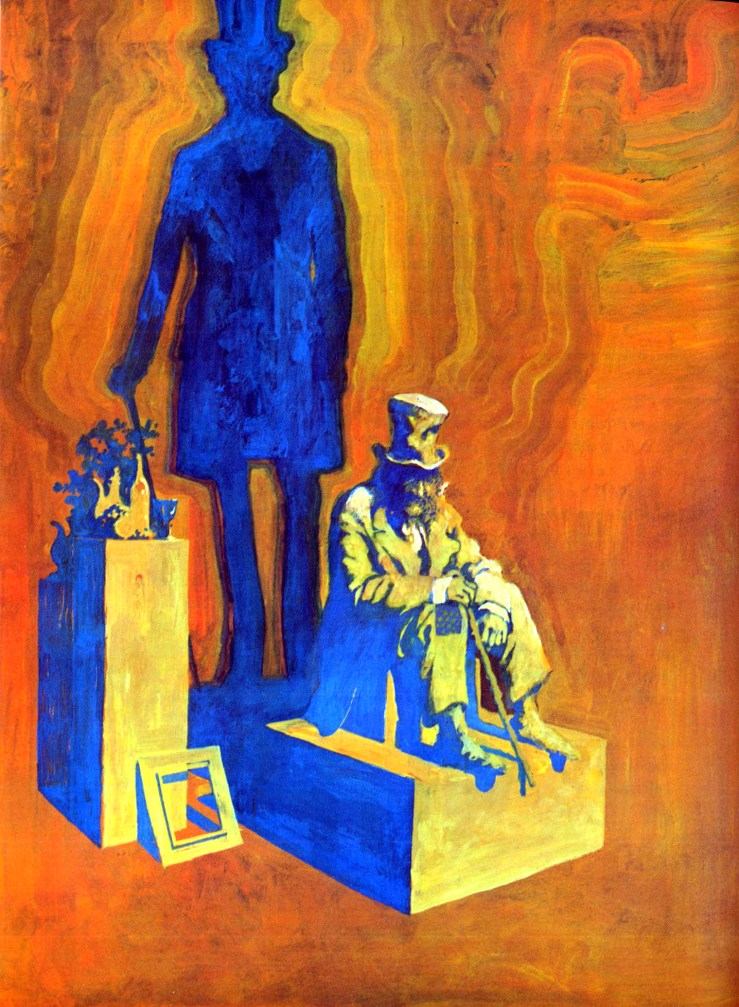
James Hill’s illustration for “The Model Millionaire” by Oscar Wilde. From The Short Stories of Oscar Wilde, Heritage Press, 1968.
“The Model Millionaire”
by
Oscar Wilde
Unless one is wealthy there is no use in being a charming fellow. Romance is the privilege of the rich, not the profession of the unemployed. The poor should be practical and prosaic. It is better to have a permanent income than to be fascinating. These are the great truths of modern life which Hughie Erskine never realised. Poor Hughie! Intellectually, we must admit, he was not of much importance. He never said a brilliant or even an ill-natured thing in his life. But then he was wonderfully good-looking, with his crisp brown hair, his clear-cut profile, and his grey eyes. He was as popular with men as he was with women, and he had every accomplishment except that of making money. His father had bequeathed him his cavalry sword, and a History of the Peninsular War in fifteen volumes. Hughie hung the first over his looking-glass, put the second on a shelf between Ruff’s Guide and Bailey’sMagazine, and lived on two hundred a year that an old aunt allowed him. He had tried everything. He had gone on the Stock Exchange for six months; but what was a butterfly to do among bulls and bears? He had been a tea-merchant for a little longer, but had soon tired of pekoe and souchong. Then he had tried selling dry sherry. That did not answer; the sherry was a little too dry. Ultimately he became nothing, a delightful, ineffectual young man with a perfect profile and no profession.
To make matters worse, he was in love. The girl he loved was Laura Merton, the daughter of a retired Colonel who had lost his temper and his digestion in India, and had never found either of them again. Laura adored him, and he was ready to kiss her shoe-strings. They were the handsomest couple in London, and had not a penny-piece between them. The Colonel was very fond of Hughie, but would not hear of any engagement.
It was morning and Belacqua was stuck in the first of the canti in the moon. He was so bogged that he could move neither backward nor forward. Blissful Beatrice was there, Dante also, and she explained the spots on the moon to him. She shewed him in the first place where he was at fault, then she put up her own explanation. She had it from God, therefore he could rely on its being accurate in every particular. All he had to do was to follow her step by step. Part one, the refutation, was plain sailing. She made her point clearly, she said what she had to say without fuss or loss of time. But part two, the demonstration, was so dense that Belacqua could not make head or tail of it. The disproof, the reproof, that was patent. But then came the proof, a rapid shorthand of the real facts, and Belacqua was bogged indeed. Bored also, impatient to get on to Piccarda. Still he pored over the enigma, he would not concede himself conquered, he would understand at least the meanings of the words, the order in which they were spoken and the nature of the satisfaction that they conferred on the misinformed poet, so that when they were ended he was refreshed and could raise his heavy head, intending to return thanks and make formal retraction of his old opinion.
He was still running his brain against this impenetrable passage when he heard midday strike. At once he switched his mind off its task. He scooped his fingers under the book and shovelled it back till it lay wholly on his palms. The Divine Comedy face upward on the lectern of his palms. Thus disposed he raised it under his nose and there he slammed it shut. He held it aloft for a time, squinting at it angrily, pressing the boards inwards with the heels of his hands. Then he laid it aside.
He leaned back in his chair to feel his mind subside and the itch of this mean quodlibet die down. Nothing could be done until his mind got better and was still, which gradually it did and was. Then he ventured to consider what he had to do next. There was always something that one had to do next. Three large obligations presented themselves. First lunch, then the lobster, then the Italian lesson. That would do to be going on with. After the Italian lesson he had no very clear idea. No doubt some niggling curriculum had been drawn up by someone for the late afternoon and evening, but he did not know what. In any case it did not matter. What did matter was: one, lunch; two, the lobster; three, the Italian lesson. That was more than enough to be going on with. Continue reading ““Dante and the Lobster,” a short story by Samuel Beckett”→
And me on a buckskin pony with eyes like blue electricity and a mane like tangled fire, galloping up the hill and right off into the high heaven of the world. His skeleton lay still. Perhaps it was thinking about this.
Anyway, after a time it groaned. But it said nothing, which is certainly not like you he thought you are not like yourself, but I can’t say that a little quiet is not pleasant
He lay beneath an unrolled strip of tarred roofing made of paper. All of him that is, save that part which suffered neither insects nor temperature and which galloped unflagging on the destinationless pony, up a piled silver hill of cumulae where no hoof echoed nor left print, toward the blue precipice never gained. This part was neither flesh nor unflesh and he tingled a little pleasantly with its lackful contemplation as he lay beneath the tarred paper bedclothing.
So were the mechanics of sleeping, of denning up for the night, simplified. Each morning the entire bed rolled back into a spool and stood erect in the corner. It was like those glasses, reading glasses which old ladies used to wear, attached to a cord that rolls onto a spindle in a neat case of unmarked gold; a spindle, a case, attached to the deep bosom of the mother of sleep. He lay still, savoring this. Beneath him Rincon followed.
Beyond its fatal, secret, nightly pursuits, where upon the rich and inert darkness of the streets lighted windows and doors lay like oily strokes of broad and overladen brushes. From the docks a ship’s siren unsourced itself. For a moment it was sound, then it compassed silence, atmosphere, bringing upon the eardrums a vacuum in which nothing, not even silence, was. Then it ceased, ebbed; the silence breathed again with a clashing of palm fronds like sand hissing across a sheet of metal.
Still his skeleton lay motionless. Perhaps it was thinking about this and he thought of his tarred paper bed as a pair of spectacles through which he nightly perused the fabric of dreams: Across the twin transparencies of the spectacles the horse still gallops with its tangled welter of tossing flames. Forward and back against the taut roundness of its belly its legs swing, rhythmically reaching and over-reaching, each spurning over-reach punctuated by a flicking limberness of shod hooves. He can see the saddlegirth and the soles of the rider’s feet in the stirrups. The girth cuts the horse in two just back of the withers, yet it still gallops with rhythmic and unflagging fury and without progression, and he thinks of that riderless Norman steed which galloped against the Saracen Emir, who, so keen of eye, so delicate and strong the wrist which swung the blade, severed the galloping beast at a single blow, the several halves thundering on in the sacred dust where him of Bouillon and Tancred too clashed in sullen retreat; thundering on through the assembled foes of our meek Lord, wrapped still in the fury and the pride of the charge, not knowing that it was dead. Continue reading “William Faulkner’s short story “Carcassonne””→
When fresh it looks like caviar, sounds like broken glass, like someone chewing ice.
I’d chew ice when the lemonade was finished, swaying with my grandmother on the porch swing. We gazed down upon the chain gang paving Upson Street. A foreman poured the macadam; the convicts stomped it down with a heavy rhythmic beat. The chains rang; the macadam made the sound of applause.
The three of us said the word often. My mother because she hated where we lived, in squalor, and at least now we would have a macadam street. My grandmother just so wanted things clean — it would hold down the dust. Red Texan dust that blew in with gray tailings from the smelter, sifting into dunes on the polished hall floor, onto her mahogany table.
I used to say macadam out loud, to myself, because it sounded like the name for a friend.
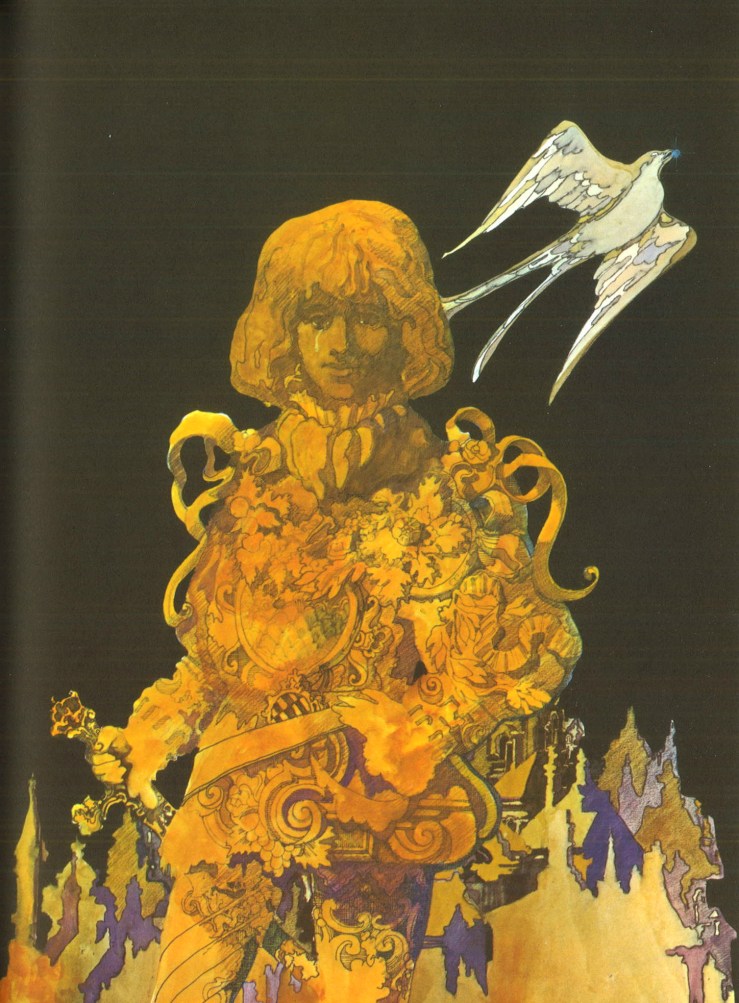
James Hill’s illustration for “The Happy Prince” by Oscar Wilde. From The Short Stories of Oscar Wilde, Heritage Press, 1968.
“The Happy Prince”
by
Oscar Wilde
High above the city, on a tall column, stood the statue of the Happy Prince. He was gilded all over with thin leaves of fine gold, for eyes he had two bright sapphires, and a large red ruby glowed on his sword-hilt.
He was very much admired indeed. “He is as beautiful as a weathercock,” remarked one of the Town Councillors who wished to gain a reputation for having artistic tastes; “only not quite so useful,” he added, fearing lest people should think him unpractical, which he really was not.
“Why can’t you be like the Happy Prince?” asked a sensible mother of her little boy who was crying for the moon. “The Happy Prince never dreams of crying for anything.”
“I am glad there is some one in the world who is quite happy,” muttered a disappointed man as he gazed at the wonderful statue.
“He looks just like an angel,” said the Charity Children as they came out of the cathedral in their bright scarlet cloaks and their clean white pinafores.
“How do you know?” said the Mathematical Master, “you have never seen one.”
“Ah! but we have, in our dreams,” answered the children; and the Mathematical Master frowned and looked very severe, for he did not approve of children dreaming.
One night there flew over the city a little Swallow. His friends had gone away to Egypt six weeks before, but he had stayed behind, for he was in love with the most beautiful Reed. He had met her early in the spring as he was flying down the river after a big yellow moth, and had been so attracted by her slender waist that he had stopped to talk to her. Continue reading “Illustration for Oscar Wilde’s “The Happy Prince” — James Hill”→
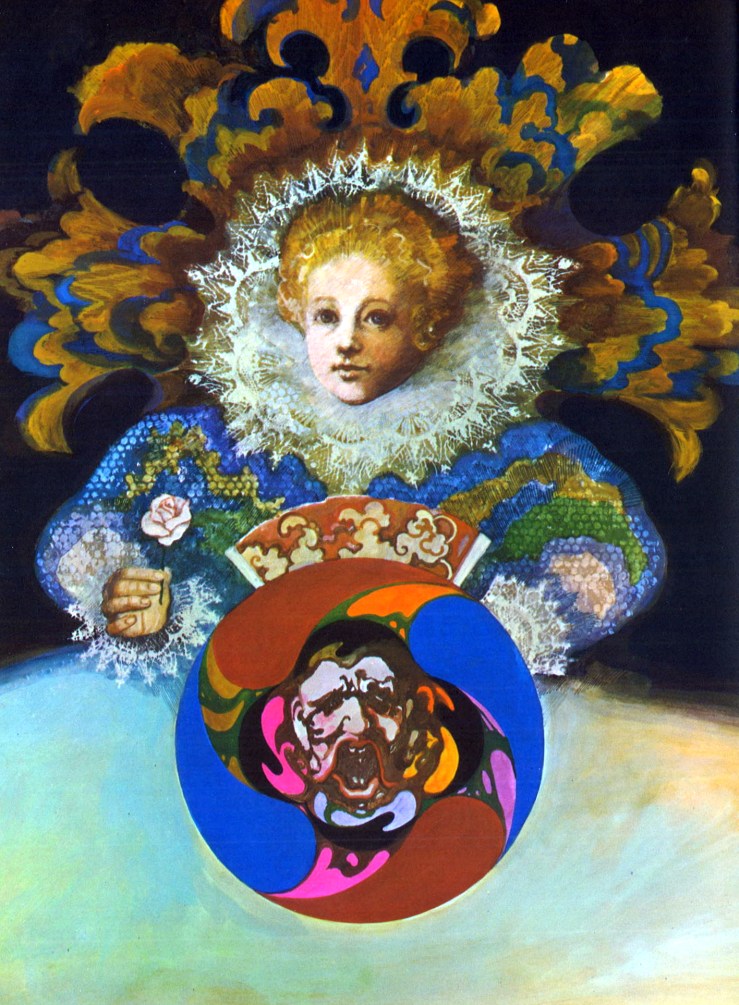
James Hill’s illustration for “The Birthday of the Infanta” by Oscar Wilde. From The Short Stories of Oscar Wilde, Heritage Press, 1968.
“The Birthday of the Infanta”
by
Oscar Wilde
It was the birthday of the Infanta. She was just twelve years of age, and the sun was shining brightly in the gardens of the palace.
Although she was a real Princess and the Infanta of Spain, she had only one birthday every year, just like the children of quite poor people, so it was naturally a matter of great importance to the whole country that she should have a really fine day for the occasion. And a really fine day it certainly was. The tall striped tulips stood straight up upon their stalks, like long rows of soldiers, and looked defiantly across the grass at the roses, and said: ‘We are quite as splendid as you are now.’ The purple butterflies fluttered about with gold dust on their wings, visiting each flower in turn; the little lizards crept out of the crevices of the wall, and lay basking in the white glare; and the pomegranates split and cracked with the heat, and showed their bleeding red hearts. Even the pale yellow lemons, that hung in such profusion from the mouldering trellis and along the dim arcades, seemed to have caught a richer colour from the wonderful sunlight, and the magnolia trees opened their great globe-like blossoms of folded ivory, and filled the air with a sweet heavy perfume.
The little Princess herself walked up and down the terrace with her companions, and played at hide and seek round the stone vases and the old moss-grown statues. On ordinary days she was only allowed to play with children of her own rank, so she had always to play alone, but her birthday was an exception, and the King had given orders that she was to invite any of her young friends whom she liked to come and amuse themselves with her. There was a stately grace about these slim Spanish children as they glided about, the boys with their large-plumed hats and short fluttering cloaks, the girls holding up the trains of their long brocaded gowns, and shielding the sun from their eyes with huge fans of black and silver. But the Infanta was the most graceful of all, and the most tastefully attired, after the somewhat cumbrous fashion of the day. Her robe was of grey satin, the skirt and the wide puffed sleeves heavily embroidered with silver, and the stiff corset studded with rows of fine pearls. Two tiny slippers with big pink rosettes peeped out beneath her dress as she walked. Pink and pearl was her great gauze fan, and in her hair, which like an aureole of faded gold stood out stiffly round her pale little face, she had a beautiful white rose.
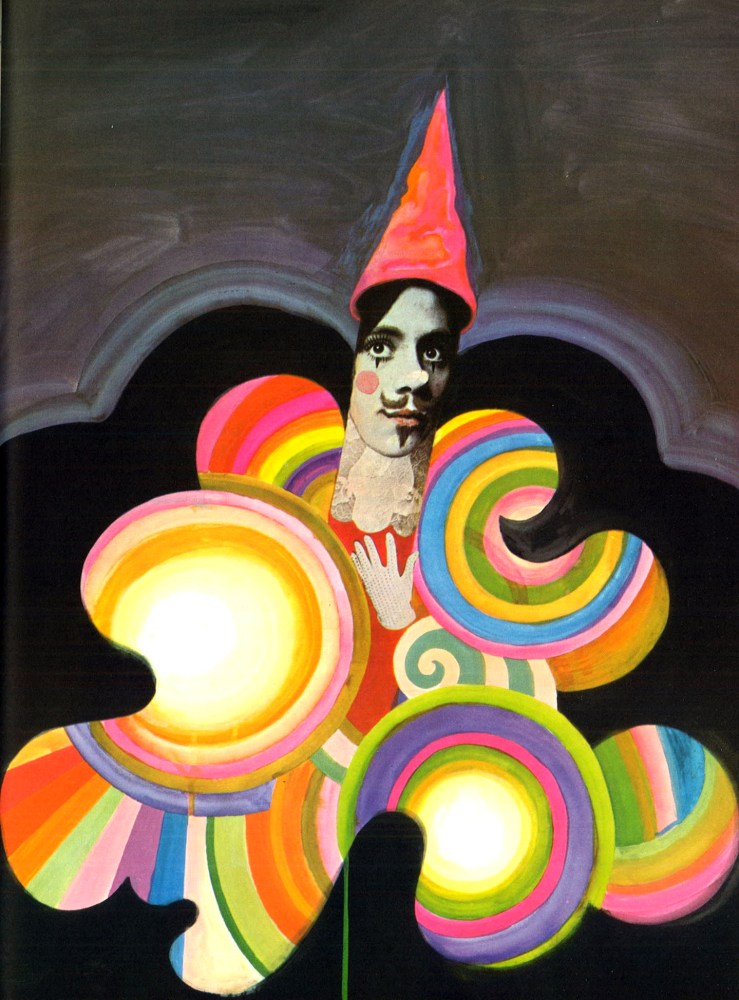
James Hill’s illustration for “The Remarkable Rocket” by Oscar Wilde. From The Short Stories of Oscar Wilde, Heritage Press, 1968.
“The Remarkable Rocket”
by
Oscar Wilde
The King’s son was going to be married, so there were general rejoicings. He had waited a whole year for his bride, and at last she had arrived. She was a Russian Princess, and had driven all the way from Finland in a sledge drawn by six reindeer. The sledge was shaped like a great golden swan, and between the swan’s wings lay the little Princess herself. Her long ermine cloak reached right down to her feet, on her head was a tiny cap of silver tissue, and she was as pale as the Snow Palace in which she had always lived. So pale was she that as she drove through the streets all the people wondered. ‘She is like a white rose!’ they cried, and they threw down flowers on her from the balconies.
At the gate of the Castle the Prince was waiting to receive her. He had dreamy violet eyes, and his hair was like fine gold. When he saw her he sank upon one knee, and kissed her hand.
‘Your picture was beautiful,’ he murmured, ‘but you are more beautiful than your picture;’ and the little Princess blushed.
‘She was like a white rose before,’ said a young Page to his neighbour, ‘but she is like a red rose now;’ and the whole Court was delighted.
For the next three days everybody went about saying, ‘White rose, Red rose, Red rose, White rose;’ and the King gave orders that the Page’s salary was to be doubled. As he received no salary at all this was not of much use to him, but it was considered a great honour, and was duly published in the Court Gazette.
When the three days were over the marriage was celebrated. It was a magnificent ceremony, and the bride and bridegroom walked hand in hand under a canopy of purple velvet embroidered with little pearls. Then there was a State Banquet, which lasted for five hours. The Prince and Princess sat at the top of the Great Hall and drank out of a cup of clear crystal. Only true lovers could drink out of this cup, for if false lips touched it, it grew grey and dull and cloudy.
Then she looked at me. I thought that she was looking at me for the first time. But then, when she turned around behind the lamp and I kept feeling her slippery and oily look in back of me, over my shoulder, I understood that it was I who was looking at her for the first time. I lit a cigarette. I took a drag on the harsh, strong smoke, before spinning in the chair, balancing on one of the rear legs. After that I saw her there, as if she’d been standing beside the lamp looking at me every night. For a few brief minutes that’s all we did: look at each other. I looked from the chair, balancing on one of the rear legs. She stood, with a long and quiet hand on the lamp, looking at me. I saw her eyelids lighted up as on every night. It was then that I remembered the usual thing, when I said to her: ‘Eyes of a blue dog.’ Without taking her hand off the lamp she said to me: ‘That. We’ll never forget that.’ She left the orbit, sighing: ‘Eyes of a blue dog. I’ve written it everywhere.’
Upon the pleasant veranda of Père Antoine’s cottage, that adjoined the church, a young girl had long been seated, awaiting his return. It was the eve of Easter Sunday, and since early afternoon the priest had been engaged in hearing the confessions of those who wished to make their Easters the following day. The girl did not seem impatient at his delay; on the contrary, it was very restful to her to lie back in the big chair she had found there, and peep through the thick curtain of vines at the people who occasionally passed along the village street.
She was slender, with a frailness that indicated lack of wholesome and plentiful nourishment. A pathetic, uneasy look was in her gray eyes, and even faintly stamped her features, which were fine and delicate. In lieu of a hat, a barege veil covered her light brown and abundant hair. She wore a coarse white cotton “josie,” and a blue calico skirt that only half concealed her tattered shoes.
As she sat there, she held carefully in her lap a parcel of eggs securely fastened in a red bandana handkerchief.
Twice already a handsome, stalwart young man in quest of the priest had entered the yard, and penetrated to where she sat. At first they had exchanged the uncompromising “howdy” of strangers, and nothing more. The second time, finding the priest still absent, he hesitated to go at once. Instead, he stood upon the step, and narrowing his brown eyes, gazed beyond the river, off towards the west, where a murky streak of mist was spreading across the sun.
“It look like mo’ rain,” he remarked, slowly and carelessly.
“We done had ’bout ‘nough,” she replied, in much the same tone.
“It’s no chance to thin out the cotton,” he went on.
“An’ the Bon-Dieu,” she resumed, “it’s on’y to-day you can cross him on foot.”
“You live yonda on the Bon-Dieu, donc?” he asked, looking at her for the first time since he had spoken.
“PAVEL VASSILITCH!” cries Pelageya Ivanovna, waking her husband. “Pavel Vassilitch! You might go and help Styopa with his lessons, he is sitting crying over his book. He can’t understand something again!”
Pavel Vassilitch gets up, makes the sign of the cross over his mouth as he yawns, and says softly: “In a minute, my love!”
The cat who has been asleep beside him gets up too, straightens out its tail, arches its spine, and half-shuts its eyes. There is stillness. . . . Mice can be heard scurrying behind the wall-paper. Putting on his boots and his dressing-gown, Pavel Vassilitch, crumpled and frowning from sleepiness, comes out of his bedroom into the dining-room; on his entrance another cat, engaged in sniffing a marinade of fish in the window, jumps down to the floor, and hides behind the cupboard.
“Who asked you to sniff that!” he says angrily, covering the fish with a sheet of newspaper. “You are a pig to do that, not a cat. . . .”
From the dining-room there is a door leading into the nursery. There, at a table covered with stains and deep scratches, sits Styopa, a high-school boy in the second class, with a peevish expression of face and tear-stained eyes. With his knees raised almost to his chin, and his hands clasped round them, he is swaying to and fro like a Chinese idol and looking crossly at a sum book. Continue reading ““Shrove Tuesday,” a tale by Anton Chekhov”→
This thing is the most difficult for a person to understand. Keep trying. Don’t get discouraged. It will seem obvious. But it is extremely difficult to know about it. For it involves time.
We divide time when in reality it is not divisible. It is always immutable. But we need to divide it. And to that end a monstrous thing was created: the clock.
I am not going to speak of clocks. But of one particular clock. I’m showing my cards: I’ll say up front what I have to say and without literature. This report is the anti-literature of the thing.
The clock of which I speak is electronic and has an alarm. The brand is Sveglia, which means “awake.” Awake to what, my God? To time. To the hour. To the instant. This clock is not mine. But I took possession of its infernal tranquil soul.
It is not a wristwatch: Therefore it is freestanding. It is less than an inch tall and stands upon the surface of the table. I would like its actual name to be Sveglia. But the owner of the clock wants its name to be Horácio. No matter. Because the main thing is that it is time.
We are little critters who live in the black earth beneath the desert. The people on Mother Earth can’t imagine such a large expanse of fertile humus lying dozens of meters beneath the boundless desert. Our race has lived here for generations. We have neither eyes nor any olfactory sense. In this large nursery, such apparatus is useless. Our lives are simple, for we merely use our long beaks to dig the earth, eat the nutritious soil, and then excrete it. We live in happiness and harmony because we have abundant resources in our home town. Thus, we can all eat our fill without a dispute arising. At any rate, I’ve never heard of one.
In our spare time, we congregate to recall anecdotes of our forebears. We begin by remembering the oldest of our ancestors and then run through the others. The remembrances are pleasurable, filled with outlandish salty and sweet flavours, as well as some crispy amber – the immemorial turpentine. In our recollections, there is a blank passage that is difficult to describe. Broadly speaking, as one of our elders (the one with the longest beak) was digging the earth, he suddenly crossed the dividing line and vanished in the desert above. He never returned to us. Whenever we remembered this, we fell silent. I sensed that everyone was afraid.
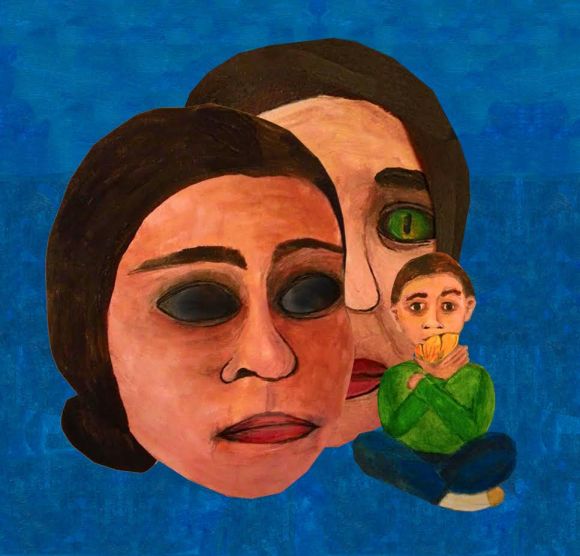
This is the 2nd part of my conversation with Ilan Stavans about The Plain in Flames, his translation of Juan Rulfo’s short story collection El Llano en Llamas. Catch up with part 1 here. Lauren Flinner made the artwork below. (Editor’s note: “Schade” is George D. Schade, who did the first English translation of Juan Rulfo’s short stories as The Burning Plain.)
The goal of putting these stories out in English is to say, “I can’t see the world without them.” I believe that I can dress the stories in a way that is truthful to the original. But now that they’re there, it is up to whomever comes to the text to be able to synchronize with the stories.
Rulfo said, upon finishing Pedro Paramo, “I couldn’t make head nor tail of it, which signaled to me that it was finished.” When did you know you were finished?
I take after Walt Whitman – I know that I am finished when I have finally forced myself to send it to the editor and begin the editorial process, and when (or if) I open it again – as you are making me do right now [laughs] – there is always a feeling of discomfort, “mm, maybe I should have done this slightly different,” because the Ilan Stavans that is sitting with you is not the Ilan Stavans of a year ago, who had the text and was reacting to life in a particular way.
A text is finished the moment the text reaches the page. There is always the temptation to retouch it. There is always the sense, in my view, that one should move forward, and what you did then is an expression of that time, and you should do other projects.
In the introduction you mention that Rulfo’s Mexican Spanish includes countless peasantisms, and that it would seem very jarring if you tried to mimic them in this era. Why did you not include them and what made them so jarring?
It is jarring because… let me transpose it just for a second into the slice of a culture that I think you will understand better. If I tried to translate a rap song from English into Spanish, I will find very quickly that there is no easy referent to the exact same culture in the Spanish speaking world, and that slang in one culture works in one way that doesn’t work in others. If I use the word “chota” in Spanish to describe police, there is no word in English that will make me convey the sense of fear of the degradation, of abuse, of disgust that chota has. “Cops” doesn’t quite work…
Pigs?
But that already brings an animalistic view here that you don’t have in Spanish. So, slang or speech that connects particularly with a region, localisms, or with a class, are very difficult to convey and you don’t want to have the wrong impression. It would have been very easy to use, for instance, language of farmers in the Midwest to recreate certain words that the peasants in Mexico in the 1950s are using. But if I had done that, what people would have thought in those words would be to connect it with Midwest America. The context would have totally been destroyed. And so you have to sometimes sacrifice geographical or cultural contexts in order to creatively convey the content of a word. You can translate words, but culture does not easily translate.
In most of those cases, would you keep the original Spanish, instead of using the jarring word?
I would keep the Spanish because I felt that the Spanish was no longer foreign. Take the word campesino. Campesino is a word that, in 1967, for Schade, might have meant “peasant”. But today if you say campesino, it is clearly a term that is used in certain parts of Mexico and Central America to denote somebody who is illiterate, who has no access to power, who has been alienated from urban society, for decades and decades. “Peasant” has a very different connotation. The word patrón is probably even a better example. Patrón could be simply “boss,” or “leader.” But the word patrón in Spanish means really… when you use “no patrón,” you really mean you are inferior to the person you are connected to. Inferior not only in a momentary way, but in terms of class, in terms of humanity, you consider yourself below that other individual. It is very difficult to look for an equivalent to patrón. And yet, the word patrón is so established that I chose to leave it in several places, because I believe that the English language readers have been exposed to it for long enough to react to it, to get the sensibility.
Reading your translation of “Luvina,” you use the poetic phrase “rumor of wind.” I read The Burning Plain to see how Schade took it – “noise” – and clearly you see this as an issue of translation.
I can tell you in general that the choice had to do with the fact that I wanted to recreate the poetry of the original, el rumor del aire, and simply “noise” wouldn’t have done it. Even though it is less clear in English, the poetry in Spanish is unavoidable.
And if you see the title… I’ll tell you. The title in Spanish has the alliteration – El Llano en Llamas. Llano. Llamas. In English, the first translation was The Burning Plain, which is so dull, so plain, so uninteresting. I immediately said I’ll do it, but it has to be The Plain in Flames, which plays with the alliteration. The Juan Rulfo Foundation said “we love it.” The publisher said “we can’t do it” – because people have already connected The Burning Plain with Rulfo, and if you change the title, you can lose readers. And I said I’m not doing that. If we don’t have“The Plain in Flames,” I won’t do it. And finally we were able to convince them. So they resisted for marketing reasons. That’s something that translators often have to deal with.
Lauren Flinner – Macario
I noticed in The Burning Plain, the titles of the stories are extremely different – “No Dogs Bark” as opposed to “You Don’t Hear Dogs Barking” in your translation – which is striking.
The Spanish title – “¿No oyes ladrar los perros?” “You don’t hear the dogs bark.” That was a perfect story! The Spanish is so challenging. You see, in Spanish, it could mean it doesn’t have a question mark. But it could almost implicitly suggest that there is a question there. “Don’t you hear the dogs barking?” And this is the story of a father who is carrying his son… it’s an astonishing story, my God, that enough would have given Rulfo a place in the history of literary classics…The father is taking the son [who is wounded]. The father really doesn’t want to take the son because he is so ambivalent at the life the son has led. He believes that the son actually killed the mother because of his behavior. But he has to take him. The son is covering his ears, and he can’t hear for that reason, and the son is supposed to be the one that would hear the dogs barking when they approach the town where they will find the doctor. But you have the impression that the father might be walking in circles, to prolong the agony. And so it could be, “Don’t you hear the dogs barking?” “You don’t hear the dogs barking.”
I would send my translation to Harold [Augenbraum, co-translator], and he would say, “are you sure of this? What has Schade done? What other options do we have here?” We would have five or six options and I would go back to my original one, try to defend it, until we finally had the one that worked best.
In the story, the father still carries the son. And the father takes some joy, I think, about making his son cry about his mother.
I have to tell you of an experience that transformed my life. Last November [2012] when the book came out, I got an invitation from a high-security prison in upstate New York. The inmates were all reading, in a class, The Plain in Flames. They wanted me to come and talk about the translation. I have never had such a rapt, passionate audience, and we spent a long time discussing that particular story. It has been said that no one understands Hamlet better than a person who has committed a crime, who has actually murdered. And in this particular case, I can tell you that this, between twenty-five and sixty year olds, all of them criminals in one way or another reading the story, transformed my way of seeing the story. They had either the burden of having killed someone, or understood that condition… and they felt the ambivalence of the father’s duty in a way that I had never seen before. It’s as if the story had been written for them.
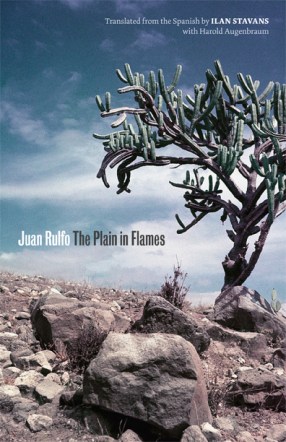
I see immense differences in the design in both translations. First, with the illustrations and the very stylized text for the story titles in The Burning Plain. One of Rulfo’s photographs graces the cover of The Plain in Flames, and it strikes me as being very similar to his writing, as you say “realismo crudo,” interested with the rawness of life. The Burning Plain almost looks like a collection of fairy tales because of this sort of design. Did you have any say in the use of font, whether or not there would be illustrations, or any other matters of design?
I admire Rulfo as a writer without reservations, even though not everything that he wrote is superb and supreme, enough of it is to put him, in my view, in that shelf of classics that ought to be read for generations. I admire him not in equal measure, but almost, as a photographer as well. His photographs, when you see them, you will realize, are about those silences, and about that sense of desolation and isolation that exists in the Mexican countryside.
I wanted, and thus I petitioned to the Juan Rulfo Foundation, to use more than one photograph, and to see if one or two, or maybe more, could be used in the interior. They told us right away no, and you can only use one on the cover. I was at first disappointed – I thought it would be beautiful for the reader to see the photographs in connection with the book, because this a visual window, by the author himself, to his own stories, unfiltered, untarnished by a translator. Photography doesn’t have a translation, it comes as you see it. But they denied it, and now I think that I am grateful that they did, because the stories are read as stories, and that’s the way Rulfo wrote them. He did not write them to be accompanied by the photographs – they are published in separate volumes.
I am thrilled that I chose the one on the cover. If I have a reservation – and my editor and I claim that reservation – it’s that the font is a little too small. I wish it was a little larger, but I did not have any control on how the book was designed in its interior. I like the spareness, the big spaces of white; I like that we didn’t have any folksy type of imagery. But the stories live or die on their own merit. The same thing is true for the translation.
The complaint that I have about the font has to do with my aging. When I was younger I could read this in an easier way. Now I still can but I can perfectly sympathize with somebody who would say, “Oh, I’m sure those are great stories but the font is too small and I can’t read them.” And I think they should be accessible also to readers who might have that challenge.
I want to ask how that makes you feel as a writer and a translator. The design of the book has an immense impact on your reading. With The Burning Plain, the book itself is such an odd shape…
You have to think, also, in the 1960’s, Latin America was seen as a factory of folklore, much more connected to that kind of mythical past than the United States, which was already moving so fast into a post-capitalist stage of society. So, this style, this design of The Burning Plain reflects the way publishers and translators were looking at Latin America in that period, and here, with The Plain in Flames, I’m happy to say that, if this is a reflection of how we see it, Latin Americans have become contemporaries with the rest of the world, and we don’t need to turn it into folk stories – we can read them as legitimate, authentic, wonderful stories the way we would read them from an author from Russia or from Italy or Egypt or any other part of the world.
I grew up in Mexico and I came at age twenty-five to the United States. It was much easier for me to translate from English into Spanish, because Spanish was a language in which I had grown up in. English is my fourth language. And so it took me years to feel comfortable in English. I have reached a certain point in my life, linguistically, that there is a symmetry between the comfort that I have in Spanish and the comfort that I have in English. For that reason, if the same invitation by an editor had come to me fifteen years ago, when Spanish was much more a powerful force in my linguistic life and English was coming second, I would have had to say no, I don’t think I’m capable of translating Rulfo into English. In 2011, this symmetry was such that I thought I could do a service to Rulfo, that probably somebody who is a native English language speaker cannot do, because for me now the two languages are balanced.
Did that symmetry with English and Spanish come in any way from reading English literature?
It comes from literally having my life cut in two. Half of my life was spent outside the United States, and half of my life now has been spent within the United States, meaning I’ve lived my life inside and outside of English. And after twenty-five years the language becomes you, and you become the language. It comes from reading, it comes from being exposed to the language, it comes from becoming that culture – I am now an American, and a Mexican… I don’t know which is which.
What was your favorite story to translate? And which is your favorite story to read?
“It’s Because We’re So Poor,” the first one that I translated, it’s the story of a boy who is sitting next to his sister and their cow is carried away by the flooded river and he’s describing how their world has collapsed and how the reputation of the family is now in question… I adore that story. I adore “You Don’t Hear Dogs Barking.” If I had to choose ten stories from any writer and do an anthology for the future where only these ten stories would be read… that story would be there.
This is the moment to say that a good short story writer has ten, fifteen, maybe less, five stories to write, and that he or she spends his or her time trying to find which of those stories are going to be final… and many of them are exercises. Many of them are rehearsals for the big crime that will be committed in the defining story. I think some of the stories come as preparations for the great stories that you have in the book. But even a not-fully-developed story by Rulfo is an incredible story.
I am in the minority in not thinking that Pedro Paramo is a better book than this. There are many who think that Pedro Paramo is his greatest contribution. I believe El Llano en Llamas is the greatest contribution. I think some stories here are eternal.
First off–yes, the entire list could be comprised of Dylan songs. I choose this one simply because it’s one of my favorites, and also from the first Dylan album I ever bought. Dylan visits a psychiatrist and tells him about the awful dreams he’s been having. Dylan is “down in the sewer with some little lover” when the bomb goes off; upon surfacing he discovers a post-apocalyptic world where the survivors aren’t to friendly–in fact, he’s even accused of being a Commie at one point. Even the abandoned Cadillac he finds–a “good car to drive after a war”–brings him no pleasure, and in his loneliness, he takes to calling the automated time update service, but it’s no longer being updated. The doctor cuts him off, saying that he’s been having similar dreams, only he was the only one left alive in his dreams. Dylan ends the song by declaring “I’ll let you be in my dreams if I can be in yours,” the subtlest anti-war slogan I’ve ever heard.
2. Stephen Malkmus, “Jenny and the Ess-Dog”
The tragic story of Jennifer, an 18 year “rich girl,” and her 31 year old boyfriend, “the Ess-dog, or Sean if you wish.” The Ess-Dog plays in a 60s cover band, drives a Volvo, and loves to play frisbee with their dog Trey (um, shades of Malkmus himself?) They love to make out to Dire Straits’ Brothers in Arms and do cocaine (Trey observes their “baby talk voices and post Class-A nasal drip”). Of course, such a romance can’t last: Jenny heads up to college in Boulder and pledges Kappa; the poor Ess-Dog starts waiting tables and even “sells his guitar.” Sad, sad, sad.
3. Roy Orbison, “Running Scared”
In just three verses and under two and a half minutes, Orbison captures all of the paranoia, fear, and triumph of teenage romance. The narrator is always “running scared, feeling low,” afraid that his girl’s ex might show up and try to get her back. Sure enough, his shaky confidence is put to the test: the ex shows up, “so sure of himself, his head up in the air.” The poor narrator’s heart is breaking, but in the final glorious moments, his girl chooses to stay with him. Classic.
4. Kate Bush, “Wuthering Heights”
So you’ve always wanted to read Emily Brontë’s Gothic romance Wuthering Heights but you just don’t have the time? And you don’t even have time to read the Sparknotes version? Or even the Wikipedia entry? Well, never fear–singer-songwriter/space alien Kate Bush recorded a chilling version of the story (okay a tiny little fragment of the story), told from the perspective of poor dead Cathy, pining for Heathcliff–the adoptive brother she spurned (ooh! Incest! uh…sorta). Even if it’s just a take on one part of the novel, it’s still a good story, a great song, and a truly ethereal vocal.
Pretty much every song by my favorite band Fiery Furnaces is some kind of zany adventure narrative, full of places and names and numbers. Blueberry Boat in particular has any number of good narratives–the title track, “Chris Michaels,” “Quay Cur”–but my personal favorite is the rivalry between two brothers at the end of “Chief Inspector Blancheflower.” “Blancheflower,” like many Furnaces’ songs, is a suite; the final segment of the suite is cleverly framed within the rest of the narrative as part of a story told over a “Woodpecker cider with a local fratricider” to the previous narrator. Despite “Mom’s oxycontin and the Amstel light,” the narrator finds that he’s doing all of the talking during a visit to his “younger brother Michael,” prompting him to get “both remotes and turn off the DVD” and confront his brother. It turns out that little Michael is now dating the narrator’s ex, Jenny. “My Jenny?” he asks, dumbfounded, to which little brother replies: “You know damn well she ain’t your Jenny no more.” He confronts Jenny the next day outside her “dad’s bakery,” accusing her of messing with Michael’s head as “some kind of revenge” against him. In the end though, it’s futile. He winds up at a bar, telling the story to the previous narrator.
6. De La Soul, “Millie Pulled a Pistol on Claus”
Dillon, the seemingly benevolent social worker who mentors the fellas in De La Soul, is actually a monster who molests his teenage daughter Millie. She takes her revenge at the local mall, coldly executing her pop who is volunteering as Santa Claus: “Millie bucked him with the quickness/ It was over.” Classic track, classic album.
Unfortunately, no vid for “Millie,” but you can still enjoy “A Rollerskating Jam Named “Saturdays”” (with a sweet Chicago sample, to boot):
7. Public Enemy, “Black Steel in the Hour of Chaos”
“I got a letter from the government the other day/ I opened and read it/ It said they were suckers/ They wanted me for their army or whatever/ Picture me givin’ a damn–I said never.” This is possibly the best opening in the history of rap, but Chuck D only keeps upping the ante: the narrator soon realizes that “the suckers had authority,” and before you can blink, he’s “sittin’ in the state pen,” planning his escape. He attacks a “C-O,” steals his gun, and goes on a prison rampage, “52 brothers” behind him. The faithful S1Ws arrive (with bazookas!) to escort the escapees to northern freedom. Great stuff.
Tricky’s version is pretty good too:
8. Leonard Cohen, “The Partisan”
Cohen adapted “The Partisan” from an old WWII French Resistance song, “La Complainte du Partisan” by Emmanuel D’Astier de la Vigerie and Anna Marly. The historical significance only adds to the song’s haunting melody and diffident spirit. “The Partisan” recounts the sad story of a freedom fighter who has lost his wife and children, but keeps on fighting. “There were three of us this morning,” he says, ominously adding, “I’m the only one this evening.” Grim stuff.
9. Johnny Cash, “Cocaine Blues”
“Cocaine Blues” begins with narrator Willy Lee telling us: “I took a shot of cocaine and I shot my woman down” for messing around on him. He sleeps on the murder, then wakes up the next morning and “takes a shot of cocaine” before taking off. Unfortunately, the cops catch up with him down in Juarez, Mexico. He’s sent to trial, and the “little judge” hands him his sentence “in about five minutes”–“99 years in the Folsom pen.” He laments that he can’t forget the day he “shot that bad bitch down,” warning the listener to “lay off that whiskey, and let that cocaine be.”
I couldn’t find footage of Cash doing the song, but this isn’t so bad:
And if you insist on seeing Cash sing a narrative song:
10. Tom Waits, “Christmas Card from a Hooker in Minneapolis”
The saddest Christmas song ever begins with a junkie whore’s plaintive salutation to her ex-lover: “Hey Charlie I’m pregnant.” She goes on to explain that life now isn’t so bad: her old man, who “works out at the track” knows that the kid isn’t his but promises to “raise him up like he would his own son”; he even gives her a ring that was “worn by his mother” and takes her out dancing “every Saturday night.” Still though, things aren’t great. The hapless narrator delivers one of the saddest lines in any song I’ve ever heard: “I still have that record of Little Anthony and the Imperials/ But someone stole my record player/ How do you like that?” Things get even sadder when the narrator laments: “I wish I had all the money we used to spend on dope.” By the end of the song she comes clean, admitting that she doesn’t have a husband, and that she’s writing because she needs to borrow money. It turns out she’s in prison, and she’ll be “eligible for parole come Valentine’s Day.”
11. New Order, “Love Vigilantes”
“Love Vigilantes” is now over twenty years old and just as relevant as it ever was. This is a love song, a protest song, and a ghost story all in one. The biggest irony isn’t the O. Henry-by-way-of-Poe twist ending, it’s the discrepancy between the ebullient rhythm and pop melody of the music clashing against the mournful lyrics.
12. Belle and Sebastian, “Jonathan David”
On the surface, “Jonathan David” appears to be a song about two guys who like the same girl: “I know you like her/ Well I like her too/ I know she likes you.” However, pick up the Biblical allusion to find the subtext. The narrator says, “I was Jonathan to your David/ You’re still king.” In the Old Testament Book of Samuel, Jonathan takes an extreme liking to future-king David, pledging his undying service to the handsome young hero. For centuries, whether the relationship was platonic, romantic, or sexual has been under debate. Read more here. In the light of the Book of Samuel, Belle and Sebastian’s “Jonathan David” is still about a friendship split by a girl, only it becomes clear now that the narrator is really in love with his friend. In typical B&S fashion, the narrator wavers between hope and despair, declaring at one point that “It’s not like we’ll be parted/ It’s not like we’ll never know love,” before ending on a melancholy note: “You and her in the local newspaper/ You will be married and you’ll be gone.” In the end, his adolescent homosexual infatuation has to give way to public expectation (“local newspaper”), and the simple fact that his friend digs girls.



 Biblioklept