“One of These Days” — Gabriel García Márquez

“One of These Days”

by Gabriel García Márquez

translated by J.S. Bernstein


Monday dawned warm and rainless. Aurelio Escovar, a dentist without a degree, and a very early riser, opened his office at six. He took some false teeth, still mounted in their plaster mold, out of the glass ease and put on the table a fistful of instruments which he arranged in size order, as if they were on display. He wore a collarless striped shirt, closed at the neck with a golden stud, and pants held up by suspenders. He was erect and skinny, with a look that rarely corresponded to the situation, the way deaf people have of looking.

When he had things arranged on the table, he pulled the drill toward the dental chair and sat down to polish the false teeth. He seemed not to be thinking about what he was doing, but worked steadily, pumping the drill with his feet, even when he didn’t need it.

After eight he stopped for a while to look at the sky through the window, and he saw two pensive buzzards who were drying themselves in the sun on the ridgepole of the house next door. He went on working with the idea that before lunch it would rain again. The shrill voice of his eleven-year-old son interrupted his concentration.

“Papá”

“What?”

“The Mayor wants to know if you’ll pull his tooth.”

“Tell him I’m not here.”

He was polishing a gold tooth. He held it at arm’s length, and examined it with his eyes half closed. His son shouted again from the little waiting room.

“He says you are, too, because he can hear you.”

The dentist kept examining the tooth. Only when he had put it on the table with the finished work did he say:

“So much the better.”

He operated the drill again. He took several pieces of a bridge out of a cardboard box where he kept the things he still had to do and began to polish the gold.

“Papá.”

“What?”

He still hadn’t changed his expression.

“He says if you don’t take out his tooth, he’ll shoot you.”

Without hurrying, with an extremely tranquil movement, he stopped pedaling the drill, pushed it away from the chair, and pulled the lower drawer of the table all the way out. There was a revolver. “O.K.,” he said. “Tell him to come and shoot me.”

He rolled the chair over opposite the door, his hand resting on the edge of the drawer. The Mayor appeared at the door. He had shaved the left side of his face, but the other side, swollen and in pain, had a five-day-old beard. The dentist saw many nights of desperation in his dull eyes. He closed the drawer with his fingertips and said softly:

“Sit down.”

“Good morning,” said the Mayor.

“Morning,” said the dentist.

While the instruments were boiling, the Mayor leaned his skull on the headrest of the chair and felt better. His breath was icy. It was a poor office: an old wooden chair, the pedal drill, a glass case with ceramic bottles. Opposite the chair was a window with a shoulder-high cloth curtain. When he felt the dentist approach, the Mayor braced his heels and opened his mouth.

Aurelio Escovar turned his head toward the light. After inspecting the infected tooth, he closed the Mayor’s jaw with a cautious pressure of his fingers.

“It has to be without anesthesia,” he said.

“Why?”

“Because you have an abscess.”

/>   The Mayor looked him in the eye. “All right,” he said, and tried to smile. The dentist did not return the smile. He brought the basin of sterilized instruments to the worktable and took them out of the water with a pair of cold tweezers, still without hurrying. Then he pushed the spittoon with the tip of his shoe, and went to wash his hands in the washbasin. He did all this without looking at the Mayor. But the Mayor didn’t take his eyes off him.

It was a lower wisdom tooth. The dentist spread his feet and grasped the tooth with the hot forceps. The Mayor seized the arms of the chair, braced his feet with all his strength, and felt an icy void in his kidneys, but didn’t make a sound. The dentist moved only his wrist. Without rancor, rather with a bitter tenderness, he said:

“Now you’ll pay for our twenty dead men.”

The Mayor felt the crunch of bones in his jaw, and his eyes filled with tears. But he didn’t breathe until he felt the tooth come out. Then he saw it through his tears. It seemed so foreign to his pain that he failed to understand his torture of the five previous nights.

Bent over the spittoon, sweating, panting, he unbuttoned his tunic and reached for the handkerchief in his pants pocket. The dentist gave him a clean cloth.

“Dry your tears,” he said.

The Mayor did. He was trembling. While the dentist washed his hands, he saw the crumbling ceiling and a dusty spider web with spider’s eggs and dead insects. The dentist returned, drying his hands. “Go to bed,” he said, “and gargle with salt water.” The Mayor stood up, said goodbye with a casual military salute, and walked toward the door, stretching his legs, without buttoning up his tunic.

“Send the bill,” he said.

“To you or the town?”

The Mayor didn’t look at him. He closed the door and said through the screen:

“It’s the same damn thing.”

“The Nose,” an absurd tale by Nikolai Gogol

“The Nose”

by

Nikolai Gogol

translated by Claud Field


I

On the 25th March, 18—, a very strange occurrence took place in St Petersburg. On the Ascension Avenue there lived a barber of the name of Ivan Jakovlevitch. He had lost his family name, and on his sign-board, on which was depicted the head of a gentleman with one cheek soaped, the only inscription to be read was, “Blood-letting done here.”

On this particular morning he awoke pretty early. Becoming aware of the smell of fresh-baked bread, he sat up a little in bed, and saw his wife, who had a special partiality for coffee, in the act of taking some fresh-baked bread out of the oven.

“To-day, Prasskovna Ossipovna,” he said, “I do not want any coffee; I should like a fresh loaf with onions.”

“The blockhead may eat bread only as far as I am concerned,” said his wife to herself; “then I shall have a chance of getting some coffee.” And she threw a loaf on the table.

For the sake of propriety, Ivan Jakovlevitch drew a coat over his shirt, sat down at the table, shook out some salt for himself, prepared two onions, assumed a serious expression, and began to cut the bread. After he had cut the loaf in two halves, he looked, and to his great astonishment saw something whitish sticking in it. He carefully poked round it with his knife, and felt it with his finger.

“Quite firmly fixed!” he murmured in his beard. “What can it be?”

He put in his finger, and drew out—a nose!

Ivan Jakovlevitch at first let his hands fall from sheer astonishment; then he rubbed his eyes and began to feel it. A nose, an actual nose; and, moreover, it seemed to be the nose of an acquaintance! Alarm and terror were depicted in Ivan’s face; but these feelings were slight in comparison with the disgust which took possession of his wife.

“Whose nose have you cut off, you monster?” she screamed, her face red with anger. “You scoundrel! You tippler! I myself will report you to the police! Such a rascal! Many customers have told me that while you were shaving them, you held them so tight by the nose that they could hardly sit still.”

But Ivan Jakovlevitch was more dead than alive; he saw at once that this nose could belong to no other than to Kovaloff, a member of the Municipal Committee whom he shaved every Sunday and Wednesday.

“Stop, Prasskovna Ossipovna! I will wrap it in a piece of cloth and place it in the corner. There it may remain for the present; later on I will take it away.”

“No, not there! Shall I endure an amputated nose in my room? You understand nothing except how to strop a razor. You know nothing of the duties and obligations of a respectable man. You vagabond! You good-for-nothing! Am I to undertake all responsibility for you at the police-office? Ah, you soap-smearer! You blockhead! Take it away where you like, but don’t let it stay under my eyes!”

Ivan Jakovlevitch stood there flabbergasted. He thought and thought, and knew not what he thought.

“The devil knows how that happened!” he said at last, scratching his head behind his ear. “Whether I came home drunk last night or not, I really don’t know; but in all probability this is a quite extraordinary occurrence, for a loaf is something baked and a nose is something different. I don’t understand the matter at all.” And Ivan Jakovlevitch was silent. The thought that the police might find him in unlawful possession of a nose and arrest him, robbed him of all presence of mind. Already he began to have visions of a red collar with silver braid and of a sword—and he trembled all over.

At last he finished dressing himself, and to the accompaniment of the emphatic exhortations of his spouse, he wrapped up the nose in a cloth and issued into the street.

He intended to lose it somewhere—either at somebody’s door, or in a public square, or in a narrow alley; but just then, in order to complete his bad luck, he was met by an acquaintance, who showered inquiries upon him. “Hullo, Ivan Jakovlevitch! Whom are you going to shave so early in the morning?” etc., so that he could find no suitable opportunity to do what he wanted. Later on he did let the nose drop, but a sentry bore down upon him with his halberd, and said, “Look out! You have let something drop!” and Ivan Jakovlevitch was obliged to pick it up and put it in his pocket.

A feeling of despair began to take possession of him; all the more as the streets became more thronged and the merchants began to open their shops. At last he resolved to go to the Isaac Bridge, where perhaps he might succeed in throwing it into the Neva.

But my conscience is a little uneasy that I have not yet given any detailed information about Ivan Jakovlevitch, an estimable man in many ways.

Like every honest Russian tradesman, Ivan Jakovlevitch was a terrible drunkard, and although he shaved other people’s faces every day, his own was always unshaved. His coat (he never wore an overcoat) was quite mottled, i.e. it had been black, but become brownish-yellow; the collar was quite shiny, and instead of the three buttons, only the threads by which they had been fastened were to be seen. Continue reading ““The Nose,” an absurd tale by Nikolai Gogol”

“The Christmas Banquet” — Nathaniel Hawthorne

“The Christmas Banquet”

by

Nathaniel Hawthorne

from Mosses from an Old Manse


In a certain old gentleman’s last will and testament there appeared a bequest, which, as his final thought and deed, was singularly in keeping with a long life of melancholy eccentricity. He devised a considerable sum for establishing a fund, the interest of which was to be expended, annually forever, in preparing a Christmas Banquet for ten of the most miserable persons that could be found. It seemed not to be the testator’s purpose to make these half a score of sad hearts merry, but to provide that the stern or fierce expression of human discontent should not be drowned, even for that one holy and joyful day, amid the acclamations of festal gratitude which all Christendom sends up. And he desired, likewise, to perpetuate his own remonstrance against the earthly course of Providence, and his sad and sour dissent from those systems of religion or philosophy which either find sunshine in the world or draw it down from heaven.

The task of inviting the guests, or of selecting among such as might advance their claims to partake of this dismal hospitality, was confided to the two trustees or stewards of the fund. These gentlemen, like their deceased friend, were sombre humorists, who made it their principal occupation to number the sable threads in the web of human life, and drop all the golden ones out of the reckoning. They performed their present office with integrity and judgment. The aspect of the assembled company, on the day of the first festival, might not, it is true, have satisfied every beholder that these were especially the individuals, chosen forth from all the world, whose griefs were worthy to stand as indicators of the mass of human suffering. Yet, after due consideration, it could not be disputed that here was a variety of hopeless discomfort, which, if it sometimes arose from causes apparently inadequate, was thereby only the shrewder imputation against the nature and mechanism of life. Continue reading ““The Christmas Banquet” — Nathaniel Hawthorne”

Read “Nackles,” Donald E. Westlake’s horror story about the Anti-Claus

“Nackles”

by

Donald E. Westlake


Did God create men, or does Man create gods? I don’t know, and if it hadn’t been for my rotten brother-in-law the question would never have come up. My late brother-in-law? Nackles knows.

It all depends, you see, like the chicken and the egg, on which came first. Did God exist before Man first thought of Him, or didn’t He? If not, if Man creates his gods, then it follows that Man must create the devils, too.

Nearly every god, you know, has his corresponding devil. Good and Evil. The polytheistic ancients, prolific in the creation (?) of gods and goddesses, always worked up nearly enough Evil ones to cancel out the Good, but not quite. The Greeks, those incredible supermen, combined Good and Evil in each of their gods. In Zoroaster, Ahura Mazda, being Good is ranged forever against the Evil one, Ahriman. And we ourselves know God and Satan.

But of course it’s entirely possible I have nothing to worry about. It all depends on whether Santa Claus is or is not a god. He certainly seems like a god. Consider: He is omniscient; he knows every action of every child, for good or evil. At least on Christmas Eve he is omnipresent, everywhere at once. He administers justice tempered with mercy. He is superhuman, or at least non-human, though conceived of as having a human shape. He is aided by a corps of assistants who do not have completely human shapes. He rewards Good and punishes Evil. And, most important, he is believed in utterly by several million people, most of them under the age of ten. Is there any qualification for godhood that Santa Claus does not possess?

And even the non-believers give him lip-service. He has surely taken over Christmas; his effigy is everywhere, but where are the manger and the Christ child? Retired rather forlornly to the nave. (Santa’s power is growing, too. Slowly but surely he is usurping Chanukah as well.)

Santa Claus is a god. He’s no less a god than Ahura Mazda, or Odin, or Zeus. Think of the white beard, the chariot pulled through the air by a breed of animal which doesn’t ordinarily fly, the prayers (requests for gifts) which are annually mailed to him and which so baffle the Post Office, the specially-garbed priests in all the department stores. And don’t gods reflect their creators’ society? The Greeks had a huntress goddess, and gods of agriculture and war and love. What else would we have but a god of giving, of merchandising, and of consumption? Secondary gods of earlier times have been stout, but surely Santa Claus is the first fat primary god.

And wherever there is a god, mustn’t there sooner or later be a devil?

Which brings me back to my brother-in-law, who’s to blame for whatever happens now. My brother-in-law Frank is – or was – a very mean and nasty man. Why I ever let him marry my sister I’ll never know. Why Susie wanted to marry him is an even greater mystery. I could just shrug and say Love is Blind, I suppose, but that wouldn’t explain how she fell in love with him in the first place.

Frank is – Frank was – I just don’t know what tense to use. The present, hopefully. Frank is a very handsome man in his way, big and brawny, full of vitality. A football player; hero in college and defensive line-backer for three years in pro ball, till he did some sort of irreparable damage to his left knee, which gave him a limp and forced him to find some other way to make a living.

Ex-football players tend to become insurance salesmen; I don’t know why. Frank followed the form, and became and insurance salesman. Because Susie was then a secretary for the same company, they soon became acquainted.

Was Susie dazzled by the ex-hero, so big and handsome? She’s never been the type to dazzle easily, but we can never fully know what goes on inside the mind of another human being. For whatever reason, she decided she was in love with him.

So they were married, and five weeks later he gave her her first black eye. And the last, though it mightn’t have been, since Susie tried to keep me from finding out. I was to go over for dinner that night, but at eleven in the morning she called the auto showroom where I work, to tell me she had a headache and we’d have to postpone the dinner. But she sounded so upset that I knew immediately something was wrong, so I took a demonstration car and drove over, and when she opened the front door there was the shiner.

I got the story out of her slowly, in fits and starts. Frank, it seemed, had a terrible temper. She wanted to excuse him because he was forced to be an insurance salesman when he really wanted to be out there on the gridiron again, but I want to be President and I’m an automobile salesman and I don’t go around giving women black eyes. So I decided it was up to me to let Frank know he wasn’t to vent his pique on my sister any more.

Unfortunately, I am five feet seven inches tall and weigh one hundred thirty-four pounds, with the Sunday Times under my arm. Were I just to give Frank a piece of my mind, he’d surely give me a black eye to go with my sister’s. Therefore, that afternoon I bought a regulation baseball bat, and carried it with me when I went to see Frank that night.

He opened the door himself and snarled, “What do you want?”

In answer, I poked him with the end of the bat, just above the belt, to knock the wind out of him. Then, having unethically gained the upper hand, I clouted him five or six times more, and then stood over him to say, “The next time you hit my sister I won’t let you off so easy.” After which I took Susie home to my place for dinner.

And after which I was Frank’s best friend.

People like that are so impossible to understand. Until the baseball bat episode, Frank had nothing for me but undisguised contempt. But once I’d knocked the stuffing out of him, he was my comrade for life. And I’m sure it was sincere; he would have given me the shirt off his back, had I wanted it, which I didn’t.

(Also, by the way, he never hit Susie again. He still had the bad temper, but he took it out on throwing furniture out windows or punching dents in walls or going downtown to start a brawl in some bar. I offered to train him out of maltreating the house and furniture as I had trained him out of maltreating his wife, but Susie said no, that Frank had to let off steam and it would be worse if he was forced to bottle it all up inside him, so the baseball bat remained in retirement.)

Then came the children, three of them in as many years. Frank Junior came first, and then Linda Joyce, and finally Stewart. Susie had held the forlorn hope that fatherhood would settle Frank to some extent, but quite the reverse was true. Shrieking babies, smelly diapers, disrupted sleep, and distracted wives are trials and tribulations to any man, but to Frank they were – like everything else in his life – the last straw.

He became, in a word, worse. Susie restrained him I don’t know how often from doing some severe damage to a squalling infant, and as the children grew toward the age of reason Frank’s expressed attitude toward them was that their best move would be to find a way to become invisible. The children, of course, didn’t like him very much, but then who did? Continue reading “Read “Nackles,” Donald E. Westlake’s horror story about the Anti-Claus”

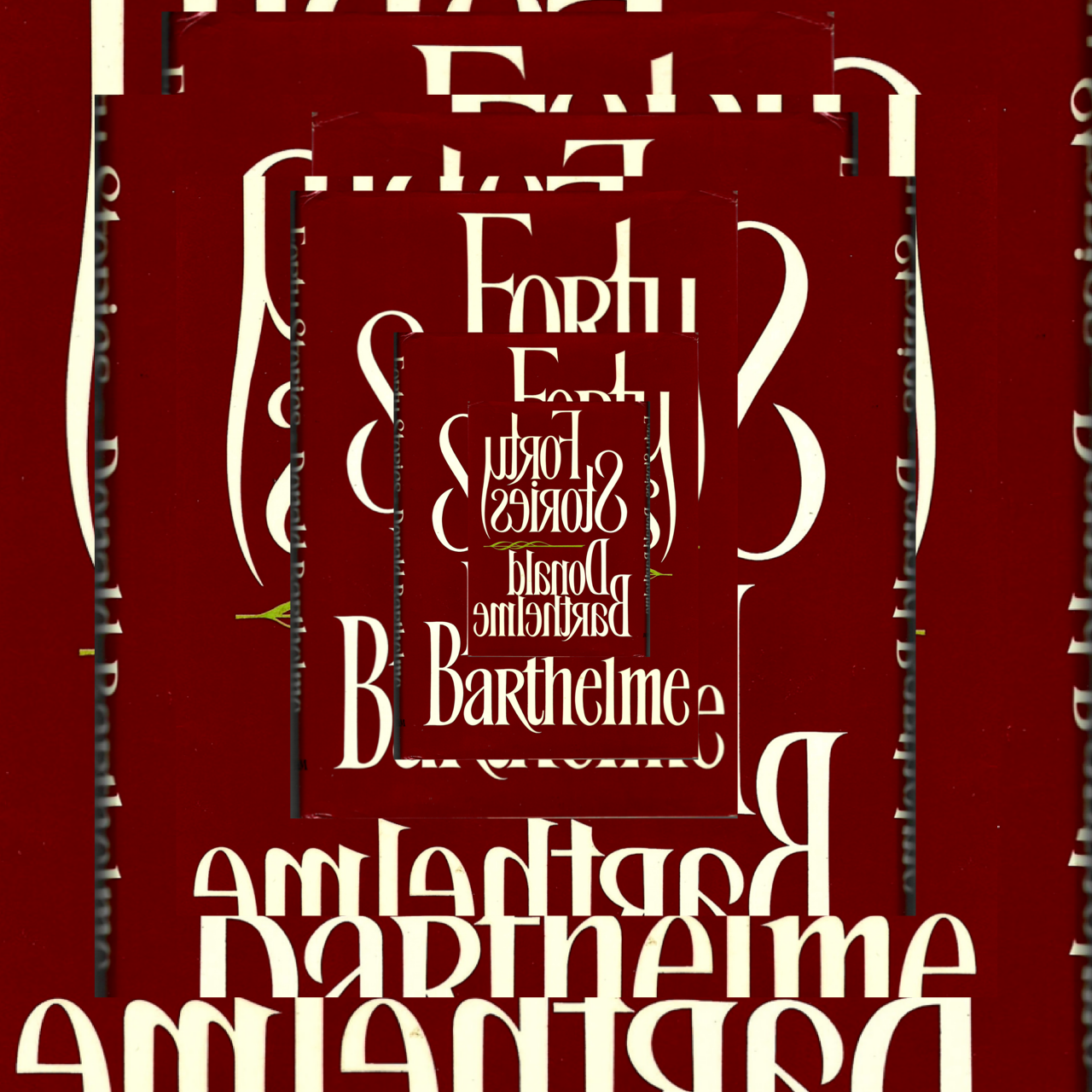
Donald Barthelme’s Forty Stories in reverse, Part IV

Previously,

Stories 40-36

Stories 35-32

Stories 31-28

27. “Some of Us Had Been Threatening Our Friend Colby” (Amateurs, 1976)

This is probably the first essential story in Forty Stories—maybe at the end of this silly project I’ll put together something like Fifty Stories, whittling down Sixty Stories and Forty Stories. Here are the first few sentences:

Some of us had been threatening our friend Colby for a long time, because of the way he had been behaving. And now he’d gone too far, so we decided to hang him. Colby argued that just because he had gone too far (he did not deny that he had gone too far) did not mean that he should be subjected to hanging. Going too far, he said, was something everybody did sometimes. We didn’t pay much attention to this argument. We asked him what sort of music he would like played at the hanging. He said he’d think about it but it would take him a while to decide.

Colby finally settles on Ive’s Fourth Symphony.

“Some of Us” showcases in a non-showy way the best of Barthelme—absurdity balanced by syntactic restraint; surreal humor weighted in the visceral specter of impending violence. It’s a very, very funny story, and while I think it resists simple allegorical interpretation, it’s nevertheless a little parcel of domestic fascism in practice. Great stuff. Read “Some of Us Had Been Threatening Our Friend Colby”  here.

26. “Pepperoni” (first published in The New Yorker, 23 Nov. 1980)

Published over four decades ago, “Pepperoni” is a depressingly prescient riff on what happens when capital decides to take over journalism. Newspapers become just another widget, a slice of pepperoni, a trifle, a nothing to sell and sell and resell:

Financially, the paper is quite healthy. The paper’s timber-lands, mining interests, pulp and paper operations, book, magazine, corrugated-box, and greeting-card divisions, film, radio, television, and cable companies, and data-processing and satellite-communications groups are all flourishing, with overall return on invested capital increasing at about eleven percent a year.

Despite the vertical integration, all is not well: “But top management is discouraged and saddened, and middle management is drinking too much.” Barthelme’s hyperbole is jaunty in 1980, where the paper’s “editorials have been subcontracted to Texas Instruments, and the obituaries to Nabisco, so that the staff will have ‘more time to think.'” But in 2024 it reads as a grim warning about the gross intersection of capital and journalism. Read “Pepperoni” here.

25. “Sentence” (City Life, 1970)

I mean what if I just…

Or a long sentence moving at a certain pace down the page aiming for the bottom-if not the bottom of this page then some other page-where it can rest, or stop for a moment to think out the questions raised by its own (temporary) existence, which ends when the page is turned, or the sentence falls out of the mind that holds it (temporarily) in some kind of embrace, not necessarily an ardent one, but more perhaps the kind of embrace enjoyed (or endured), by a wife who has just waked up and is on her way to the bathroom in the morning to wash her hair, and is bumped into by her husband, who has been lounging at the breakfast table reading the newspaper, and doesn’t see her coming out of the bedroom, but, when he bumps into her, or is bumped into by her, raises his hands to embrace her lightly, transiently, because he knows that if he gives her a real embrace so early in the morning, before she has properly shaken the dreams out of her head, and got her duds on, she won’t respond, and may even become slightly angry, and say something wounding, and so the husband invests in this embrace not so much physical or emotional pressure as he might, because he doesn’t want to waste anything-with this sort of feeling, then, the sentence passes through the mind more or less, and there is another way of describing the situation too, which is to say that the sentence crawls through the mind like something someone says to you while you are listening very hard to the FM radio, some rock group there, with its thrilling sound, and so, with your attention or the major part of it at least already rewarded, there is not much mind room you can give to the remark, especially considering that you have probably just quarreled with that person, the maker of the remark, over the radio being too loud, or something like that, and the view you take, of the remark, is that you’d really rather not hear it, but if you have to hear it, you want to listen to it for the smallest possible length of time, and during a commercial, because immediately after the commercial they’re going to play a new rock song by your favorite group, a cut that has never been aired before, and you want to hear it and respond to it in a new way, a way that accords with whatever you’re feeling at the moment, or might feel, if the threat of new experience could be (temporarily) overbalanced by the promise of possible positive benefits, or what the mind construes as such, remembering that these are often, really, disguised defeats (not that such defeats are not, at times, good for your character, teaching you that it is not by success alone that one surmounts life, but that setbacks, too, contribute to that roughening of the personality that, by providing a textured surface to place against that of life, enables you to leave slight traces, or smudges, on the face of human history-your mark) and after all, benefit-seeking always has something of the smell of raw vanity about it, as if you wished to decorate your own brow with laurel, or wear your medals to a cookout, when the invitation had said nothing about them, and although the ego is always hungry (we are told) it is well to remember that ongoing success is nearly as meaningless as ongoing lack of success, which can make you sick, and that it is good to leave a few crumbs on the table for the rest of your brethren, not to sweep it all into the little beaded purse of your soul but to allow others, too, part of the gratification, and if you share in this way you will find the clouds smiling on you, and the postman bringing you letters, and bicycles available when you want to rent them, and many other signs, however guarded and limited, of the community’s (temporary) approval of you, or at least of it’s willingness to let you believe (temporarily) that it finds you not so lacking in commendable virtues as it had previously allowed you to think, from its scorn of your merits, as it might be put, or anyway its consistent refusal to recognize your basic humanness and its secret blackball of the project of your remaining alive, made in executive session by its ruling bodies, which, as everyone knows, carry out concealed programs of reward and punishment, under the rose, causing faint alterations of the status quo, behind your back, at various points along the periphery of community life, together with other enterprises not dissimilar in tone, such as producing films that have special qualities, or attributes, such as a film where the second half of it is a holy mystery, and girls and women are not permitted to see it, or writing novels in which the final chapter is a plastic bag filled with water, which you can touch, but not drink: in this way, or ways, the underground mental life of the collectivity is botched, or denied, or turned into something else never imagined by the planners, who, returning from the latest seminar in crisis management and being asked what they have learned, say they have learned how to throw up their hands; the sentence meanwhile, although not insensible of these considerations, has a festering conscience of its own, which persuades it to follow its star, and to move with all deliberate speed from one place to another, without losing any of the “riders” it may have picked up just being there, on the page, and turning this way and that, to see what is over there, under that oddly-shaped tree, or over there, reflected in the rain barrel of the imagination, even though it is true that in our young manhood we were taught that short, punchy sentences were best (but what did he mean? doesn’t “punchy” mean punch-drunk? I think he probably intended to say “short, punching sentences,” meaning sentences that lashed out at you, bloodying your brain if possible, and looking up the word just now I came across the nearby “punkah,” which is a large fan suspended from the ceiling in India, operated by an attendant pulling a rope-that is what I want for my sentence, to keep it cool!) we are mature enough now to stand the shock of learning that much of what we were taught in our youth was wrong, or improperly understood by those who were teaching it, or perhaps shaded a bit, the shading resulting from the personal needs of the teachers, who as human beings had a tendency to introduce some of their heart’s blood into their work, and sometimes this may not have been of the first water, this heart’s blood, and even if they thought they were moving the “knowledge” out, as the Board of Education had mandated, they could have noticed that their sentences weren’t having the knockdown power of the new weapons whose bullets tumble end-over-end (but it is true that we didn’t have these weapons at that time) and they might have taken into account the fundamental dubiousness of their project (but all the intelligently conceived projects have been eaten up already, like the moon and the stars) leaving us, in our best clothes, with only things to do like conducting vigorous wars of attrition against our wives, who have now thoroughly come awake, and slipped into their striped bells, and pulled sweaters over their torsi, and adamantly refused to wear any bras under the sweaters, carefully explaining the political significance of this refusal to anyone who will listen, or look, but not touch, because that has nothing to do with it, so they say; leaving us, as it were, with only things to do like floating sheets of Reynolds Wrap around the room, trying to find out how many we can keep in the air at the same time, which at least gives us a sense of participation, as though we were Buddha, looking down at the mystery of your smile, which needs to be investigated, and I think I’ll do that right now, while there’s still enough light, if you’ll sit down over there, in the best chair, and take off all your clothes, and put your feet in that electric toe caddy (which prevents pneumonia) and slip into this permanent press hospital gown, to cover your nakedness-why, if you do all that, we’ll be ready to begin! after I wash my hands, because you pick up an amazing amount of exuviae in this city, just by walking around in the open air, and nodding to acquaintances, and speaking to friends, and copulating with lovers, in the ordinary course (and death to our enemies! by and by)-but I’m getting a little uptight, just about washing my hands, because I can’t find the soap, which somebody has used and not put back in the soap dish, all of which is extremely irritating, if you have a beautiful patient sitting in the examining room, naked inside her gown, and peering at her moles in the mirror, with her immense brown eyes following your every movement (when they are not watching the moles, expecting them, as in a Disney nature film, to exfoliate) and her immense brown head wondering what you’re going to do to her, the pierced places in the head letting that question leak out, while the therapist decides just to wash his hands in plain water, and hang the soap! and does so, and then looks around for a towel, but all the towels have been collected by the towel service, and are not there, so he wipes his hands on his pants, in the back (so as to avoid suspicious stains on the front) thinking: what must she think of me? and, all this is very unprofessional and at-sea looking! trying to visualize the contretemps from her point of view, if she has one (but how can she? she is not in the washroom) and then stopping, because it is finally his own point of view that he cares about and not hers, and with this firmly in mind, and a light, confident step, such as you might find in the works of Bulwer-Lytton, he enters the space she occupies so prettily and, taking her by the hand, proceeds to tear off the stiff white hospital gown (but no, we cannot have that kind of pornographic merde in this majestic and high-minded sentence, which will probably end up in the Library of Congress) (that was just something that took place inside his consciousness, as he looked at her, and since we know that consciousness is always consciousness of something, she is not entirely without responsibility in the matter) so, then, taking her by the hand, he falls into the stupendous white puree of her abyss, no, I mean rather that he asks her how long it has been since her last visit, and she says a fortnight, and he shudders, and tells her that with a condition like hers (she is an immensely popular soldier, and her troops win all their battles by pretending to be forests, the enemy discovering, at the last moment, that those trees they have eaten their lunch under have eyes and swords) (which reminds me of the performance, in 1845, of Robert-Houdin, called The Fantastic Orange Tree, wherein Robert-Houdin borrowed a lady’s handkerchief, rubbed it between his hands and passed it into the center of an egg, after which he passed the egg into the center of a lemon, after which he passed the lemon into the center of an orange, then pressed the orange between his hands, making it smaller and smaller, until only a powder remained, whereupon he asked for a small potted orange tree and sprinkled the powder thereupon, upon which the tree burst into blossom, the blossoms turning into oranges, the oranges turning into butterflies, and the butterflies turning into beautiful young ladies, who then married members of the audience), a condition so damaging to real-time social intercourse of any kind, the best thing she can do is give up, and lay down her arms, and he will lie down in them, and together they will permit themselves a bit of the old slap and tickle, she wearing only her Mr. Christopher medal, on its silver chain, and he (for such is the latitude granted the professional classes) worrying about the sentence, about its thin wires of dramatic tension, which have been omitted, about whether we should write down some natural events occurring in the sky (birds, lightning bolts), and about a possible coup d’etat within the sentence, whereby its chief verb would be-but at this moment a messenger rushes into the sentence, bleeding from a hat of thorns he’s wearing, and cries out: “You don’t know what you’re doing! Stop making this sentence, and begin instead to make Moholy-Nagy cocktails, for those are what we really need, on the frontiers of bad behavior!” and then he falls to the floor, and a trap door opens under him, and he falls through that, into a damp pit where a blue narwhal waits, its horn poised (but maybe the weight of the messenger, falling from such a height, will break off the horn)-thus, considering everything very carefully, in the sweet light of the ceremonial axes, in the run-mad skimble-skamble of information sickness, we must make a decision as to whether we should proceed, or go back, in the latter case enjoying the pathos of eradication, in which the former case reading an erotic advertisement which begins, How to Make Your Mouth a Blowtorch of Excitement (but wouldn’t that overtax our mouthwashes?) attempting, during the pause, while our burned mouths are being smeared with fat, to imagine a better sentence, worthier, more meaningful, like those in the Declaration of Independence, or a bank statement showing that you have seven thousand kroner more than you thought you had-a statement summing up the unreasonable demands that you make on life, and one that also asks the question, if you can imagine these demands, why are they not routinely met, tall fool? but of course it is not that query that this infected sentence has set out to answer (and hello! to our girl friend, Rosetta Stone, who has stuck by us through thick and thin) but some other query that we shall some day discover the nature of, and here comes Ludwig, the expert on sentence construction we have borrowed from the Bauhaus, who will-“Guten Tag, Ludwig!”-probably find a way to cure the sentence’s sprawl, by using the improved way of thinking developed in Weimer-“I am sorry to inform you that the Bauhaus no longer exists, that all of the great masters who formerly thought there are either dead or retired, and that I myself have been reduced to constructing books on how to pass the examination for police sergeant”-and Ludwig falls through the Tugendhat House into the history of man-made objects; a disappointment, to be sure, but it reminds us that the sentence itself is a man-made object, not the one we wanted of course, but still a construction of man, a structure to be treasured for its weakness, as opposed to the strength of stones

Is good if not great.

24. “The Temptation of St. Anthony” (Sadness, 1972)
After rereading this one, the thought that dominated my stupid brain was, How the fuck did an editor allow DB to use the word “ineffable” four times in this short story? He uses a version of the word here, in this nice little excerpt in which one of the things that St. Anthony did was the passive doing of being mugged:

 There was the ineffableness I’ve already mentioned, and there were certain things that he did. He was mugged, for example. That doesn’t happen too often here, but it happened to him. It was at night, somebody jumped on him from behind, grabbed him around the neck and began going through his pockets. The man only got a few dollars, and then he threw St. Anthony down on the sidewalk (he put one leg in front of the saint’s legs and shoved him) and then began to run away. St. Anthony called after him, held up his hand, and said, “Don’t you want the watch?” It was a good watch, a Bulova. The man was thunderstruck. He actually came back and took the watch off St. Anthony’s wrist. He didn’t know what to think. He hesitated for a minute and then asked St. Anthony if he had bus fare home. The saint said it didn’t matter, it wasn’t far, he could walk. Then the mugger ran away again.

If not essential, “St. Anthony” is a robust and colorful example of DB riffing in his prime. Read “The Temptation of St. Anthony” here.

Read “What a Thought,” a short story by Shirley Jackson

“What a Thought”

by

Shirley Jackson


Dinner had been good. Margaret sat with her book on her lap and watched her husband digesting, an operation to which he always gave much time and thought. As she watched he put his cigar down without looking and used his free hand to turn the page of his paper. Margaret found herself thinking with some pride that unlike many men she had heard about, her husband did not fall asleep after a particularly good dinner.

She flipped the pages of her book idly; it was not interesting. She knew that if she asked her husband to take her to a movie, or out for a ride, or to play gin rummy, he would smile at her and agree; he was always willing to do things to please her, still, after ten years of marriage. An odd thought crossed her mind: she would pick up the heavy glass ashtray and smash her husband over the head with it.

“Like to go to a movie?” her husband asked.

“I don’t think so, thanks,” Margaret said. “Why?”

“You look sort of bored,” her husband said.

“Were you watching me?” Margaret asked. “I thought you were reading.”

“Just looked at you for a minute.” He smiled at her, the smile of a man who is still, after ten years of marriage, very fond of his wife.

The idea of smashing the glass ashtray over her husband’s head had never before occurred to Margaret, but now it would not leave her mind. She stirred uneasily in her chair, thinking: what a terrible thought to have, whatever made me think of such a thing? Probably a perverted affectionate gesture, and she laughed. Continue reading “Read “What a Thought,” a short story by Shirley Jackson”

Read “The White People,” a supernatural tale by Arthur Machen

“The White People”

by

Arthur Machen


PROLOGUE

‘Sorcery and sanctity,’ said Ambrose, ‘these are the only realities. Each is an ecstasy, a withdrawal from the common life.’

Cotgrave listened, interested. He had been brought by a friend to this mouldering house in a northern suburb, through an old garden to the room where Ambrose the recluse dozed and dreamed over his books.

‘Yes,’ he went on, ‘magic is justified of her children. There are many, I think, who eat dry crusts and drink water, with a joy infinitely sharper than anything within the experience of the “practical” epicure.’

‘You are speaking of the saints?’

‘Yes, and of the sinners, too. I think you are falling into the very general error of confining the spiritual world to the supremely good; but the supremely wicked, necessarily, have their portion in it. The merely carnal, sensual man can no more be a great sinner than he can be a great saint. Most of us are just indifferent, mixed-up creatures; we muddle through the world without realizing the meaning and the inner sense of things, and, consequently, our wickedness and our goodness are alike second-rate, unimportant.’

‘And you think the great sinner, then, will be an ascetic, as well as the great saint?’

‘Great people of all kinds forsake the imperfect copies and go to the perfect originals. I have no doubt but that many of the very highest among the saints have never done a “good action” (using the words in their ordinary sense). And, on the other hand, there have been those who have sounded the very depths of sin, who all their lives have never done an “ill deed.”‘

He went out of the room for a moment, and Cotgrave, in high delight, turned to his friend and thanked him for the introduction.

‘He’s grand,’ he said. ‘I never saw that kind of lunatic before.’

Ambrose returned with more whisky and helped the two men in a liberal manner. He abused the teetotal sect with ferocity, as he handed the seltzer, and pouring out a glass of water for himself, was about to resume his monologue, when Cotgrave broke in—

‘I can’t stand it, you know,’ he said, ‘your paradoxes are too monstrous. A man may be a great sinner and yet never do anything sinful! Come!’

‘You’re quite wrong,’ said Ambrose. ‘I never make paradoxes; I wish I could. I merely said that a man may have an exquisite taste in Romanée Conti, and yet never have even smelt four ale. That’s all, and it’s more like a truism than a paradox, isn’t it? Your surprise at my remark is due to the fact that you haven’t realized what sin is. Oh, yes, there is a sort of connexion between Sin with the capital letter, and actions which are commonly called sinful: with murder, theft, adultery, and so forth. Much the same connexion that there is between the A, B, C and fine literature. But I believe that the misconception—it is all but universal—arises in great measure from our looking at the matter through social spectacles. We think that a man who does evil to us and to his neighbours must be very evil. So he is, from a social standpoint; but can’t you realize that Evil in its essence is a lonely thing, a passion of the solitary, individual soul? Really, the average murderer, quâ murderer, is not by any means a sinner in the true sense of the word. He is simply a wild beast that we have to get rid of to save our own necks from his knife. I should class him rather with tigers than with sinners.’

‘It seems a little strange.’

‘I think not. The murderer murders not from positive qualities, but from negative ones; he lacks something which non-murderers possess. Evil, of course, is wholly positive—only it is on the wrong side. You may believe me that sin in its proper sense is very rare; it is probable that there have been far fewer sinners than saints. Yes, your standpoint is all very well for practical, social purposes; we are naturally inclined to think that a person who is very disagreeable to us must be a very great sinner! It is very disagreeable to have one’s pocket picked, and we pronounce the thief to be a very great sinner. In truth, he is merely an undeveloped man. He cannot be a saint, of course; but he may be, and often is, an infinitely better creature than thousands who have never broken a single commandment. He is a great nuisance to us, I admit, and we very properly lock him up if we catch him; but between his troublesome and unsocial action and evil—Oh, the connexion is of the weakest.’

It was getting very late. The man who had brought Cotgrave had probably heard all this before, since he assisted with a bland and judicious smile, but Cotgrave began to think that his ‘lunatic’ was turning into a sage.

‘Do you know,’ he said, ‘you interest me immensely? You think, then, that we do not understand the real nature of evil?’ Continue reading “Read “The White People,” a supernatural tale by Arthur Machen”

Read “Bitterness for Three Sleepwalkers,” a short story by Gabriel García Márquez

“Bitterness for Three Sleepwalkers”

by

Gabriel García Márquez

translated by Gregory Rabassa


Now we had her there, abandoned in a corner of the house. Someone told us, before we brought her things – her clothes which smelled of newly cut wood, her weightless shoes for the mud – that she would be unable to get used to that slow life, with no sweet tastes, no attraction except that harsh, wattled solitude, always pressing on her back. Someone told us – and a lot of time had passed before we remembered it – that she had also had a childhood. Maybe we didn’t believe it then. But now, seeing her sitting in the corner with her frightened eyes and a finger placed on her lips, maybe we accepted the fact that she’d had a childhood once, that once she’d had a touch that was sensitive to the anticipatory coolness of the rain, and that she always carried an unexpected shadow in profile to her body.

All this – and much more – we believed that afternoon when we realized that above her fearsome subworld she was completely human. We found it out suddenly, as if a glass had been broken inside, when she began to give off anguished shouts; she began to call each one of us by name, speaking amidst tears until we sat down beside her; we began to sing and clap hands as if our shouting could put the scattered pieces of glass back together. Only then were we able to believe that at one time she had had a childhood. It was as if her shouts were like a revelation somehow; as if they had a lot of remembered tree and deep river about them. When she got up, she leaned over a little and, still without covering her face with her apron, still without blowing her nose, and still with tears, she told us:

‘I’ll never smile again.’

We went out into the courtyard, the three of us, not talking: maybe we thought we carried common thoughts. Maybe we thought it would be best not to turn on the lights in the house. She wanted to be alone – maybe – sitting in the dark corner, weaving the final braid which seemed to be the only thing that would survive her passage toward the beast.

Outside, in the courtyard, sunk in the deep vapor of the insects, we sat down to think about her. We’d done it so many times before. We might have said that we were doing what we’d been doing every day of our lives.

Yet it was different that night: she’d said that she would never smile again, and we, who knew her so well, were certain that the nightmare had become the truth. Sitting in a triangle, we imagined her there inside, abstract, incapacitated, unable even to hear the innumerable clocks that measured the marked and minute rhythm with which she was changing into dust. ‘If we only had the courage at least to wish for her death,’ we thought in a chorus. But we wanted her like that: ugly and glacial, like a mean contribution to our hidden defects.

We’d been adults since before, since a long time back. She, however, was the oldest in the house. That same night she had been able to be there, sitting with us, feeling the measured throbbing of the stars, surrounded by healthy sons. She would have been the respectable lady of the house if she had been the wife of a solid citizen or the concubine of a punctual man. But she became accustomed to living in only one dimension, like a straight line, perhaps because her vices or her virtues could not be seen in profile. We’d known that for many years now. We weren’t even surprised one morning, after getting up, when we found her face down in the courtyard, biting the earth in a hard, ecstatic way. Then she smiled, looked at us again; she had fallen out of the second-story window onto the hard clay of the courtyard and had remained there, stiff and concrete, face down on the damp clay. But later we learned that the only thing she had kept intact was her fear of distances, a natural fright upon facing space. We lifted her up by the shoulders. She wasn’t as hard as she had seemed to us at first. On the contrary, her organs were loose, detached from her will, like a lukewarm corpse that hadn’t begun to stiffen.

Her eyes were open, her mouth was dirty with that earth that already must have had a taste of sepulchral sediment for her when we turned her face up to the sun, and it was as if we had placed her in front of a mirror. She looked at us all with a dull, sexless expression that gave us – holding her in my arms now – the measure of her absence. Someone told us she was dead; and afterward she remained smiling with that cold and quiet smile that she wore at night when she moved about the house awake. She said she didn’t know how she got to the courtyard. She said that she’d felt quite warm, that she’d been listening to a cricket, penetrating, sharp, which seemed – so she said – about to knock down the wall of her room, and that she had set herself to remembering Sunday’s prayers, with her cheek tight against the cement floor.

We knew, however, that she couldn’t remember any prayer, for we discovered later that she’d lost the notion of time when she said she’d fallen asleep holding up the inside of the wall that the cricket was pushing on from outside and that she was fast asleep when someone, taking her by the shoulders, moved the wall aside and laid her down with her face to the sun.

That night we knew, sitting in the courtyard, that she would never smile again. Perhaps her inexpressive seriousness pained us in anticipation, her dark and willful living in a corner. It pained us deeply, as we were pained the day we saw her sit down in the corner where she was now; and we heard her say that she wasn’t going to wander through the house any more. At first we couldn’t believe her. We’d seen her for months on end going through the rooms at all hours, her head hard and her shoulders drooping, never stopping, never growing tired. At night we would hear her thick body noise moving between two darknesses, and we would lie awake in bed many times hearing her stealthy walking, following her all through the house with our ears. Once she told us that she had seen the cricket inside the mirror glass, sunken, submerged in the solid transparency, and that it had crossed through the glass surface to reach her. We really didn’t know what she was trying to tell us, but we could all see that her clothes were wet, sticking to her body, as if she had just come out of a cistern. Without trying to explain the phenomenon, we decided to do away with the insects in the house: destroy the objects that obsessed her.

We had the walls cleaned; we ordered them to chop down the plants in the courtyard and it was as if we had cleansed the silence of the night of bits of trash. But we no longer heard her walking, nor did we hear her talking about crickets any more, until the day when, after the last meal, she remained looking at us, she sat down on the cement floor, still looking at us, and said: ‘I’m going to stay here, sitting down,’ and we shuddered, because we could see that she had begun to look like something already almost completely like death.

That had been a long time ago and we had even grown used to seeing her there, sitting, her braid always half wound, as if she had become dissolved in her solitude and, even though she was there to be seen, had lost her natural faculty of being present. That’s why we now knew that she would never smile again; because she had said so in the same convinced and certain way in which she had told us once that she would never walk again. It was as if we were certain that she would tell us later: ‘I’ll never see again,’ or maybe ‘I’ll never hear again,’ and we knew that she was sufficiently human to go along willing the elimination of her vital functions and that spontaneously she would go about ending herself, sense by sense, until one day we would find her leaning against the wall, as if she had fallen asleep for the first time in her life. Perhaps there was still a lot of time left for that, but the three of us, sitting in the courtyard, would have liked to hear her sharp and sudden broken-glass weeping that night, at least to give us the illusion that a baby … a girl baby had been born in the house. In order to believe that she had been born renewed.

Read “Among the Beanwoods,” a short story by Donald Barthelme

“Among the Beanwoods”

by

Donald Barthelme


The already-beautiful do not, as a rule, run.

I am, at the moment, seated.

Ireland and Scotland are remote; Wales fares little better. Here in this forest of tall, white beanwoods, the already-beautiful saunter. Some of them carry plump red hams, already cooked.

I am, at the moment, seated. On a chair in the forest, listening. I will rise, shortly, to hold the ladder for you. Every beanwood will have its chandelier scattering light on my exercise machine, which is made of cane. The beans you have glued together are as nothing to the difficulty of working with cane, at night, in the dark, in the wind, watched by insects. I will not allow my exercise machine to be photographed. It sings, as I exercise, like an unaccompanied cello. I will not allow my exercise machine to be recorded.

Tombs are scattered through the beanwoods, made of perfectly ordinary gray stone. All are empty. The chandeliers, at night, scatter light over the tombs, little houses in which I sleep, from time to time, with the already-beautiful, and they with me. We call to each other, at night, saying “Hello, hello” and “Who, who, who?” That one has her hips exposed, for rubbing.

Holding the ladder, I watch you glue additional chandeliers to appropriate limbs. You are tiring, you have worked very hard. Iced beanwater will refresh you, and these wallets made of ham. I have been meaning to speak to you. I have set bronze statues of alert, crouching Indian boys around the periphery of the forest, for ornamentation. Each alert, crouching Indian boy is accompanied by a large, bronze, wolf-like dog, finely polished.

I have been meaning to speak to you. I have many pages of notes. I have a note about cameras, a note about recorders, a note about steel wool, a note about the invitations. On weightier matters I will speak without notes, freely and passionately, as if inspired, at night, in a rage, slapping myself, great tremendous slaps to the brow which will fell me to the earth. The already-beautiful will stand and watch, in a circle, cradling, each, an animal in mothering arms — green monkey, meadow mouse, tucotuco. That one has her hips exposed, for study. I make careful notes. You snatch the notebook from my hands.

The pockets of your smock swinging heavily with the lights of chandeliers. Your light-by-light, bean-by-bean career.

I am, at this time, prepared to dance. The already-beautiful have, historically, danced. The music made by my exercise machine is, we agree, danceable. The women partner themselves with large bronze hares, which have been cast in the attitudes of dancers. The beans you have glued together are as nothing to the difficulty of casting hares in the attitudes of dancers, at night, in the foundry, the sweat, the glare. Thieves have been invited to dinner, along with the deans of the great cathedrals. The thieves will rest upon the bosoms of the deans, at dinner, among the beanwoods. Soft benedictions will ensue.

I am privileged, privileged, to be able to hold your ladder.

Pillows are placed in the tombs, together with pot holders and dust cloths. The already-beautiful strut. England is far away, and France is scarcely nearer. I am, for the time being, reclining. In a warm tomb, with Concordia, who is beautiful. Mad with bean wine she has caught me by the belt buckle and demanded that I hear her times tables. Her voice enchants me. Tirelessly you glue. The forest will soon exist on some maps, a tribute to the quickness of the world’s cartographers. This life is better than any life I have lived, previously. I order more smoke, which is delivered in heavy glass demi-johns, twelve to a crate. Beautiful hips abound, bloom. Your sudden movement toward red kidney beans has proved, in the event, masterly. Everywhere we see formal gowns of red kidney beans, which have been polished to the fierceness of carnelians. No ham hash does not contain two beans, polished to the fierceness of carnelians.

Spain is distant, Portugal wrapped in an impenetrable haze. These noble beans, glued by you, are mine. Thousand-pound sacks are off-loaded at the quai, against our future needs. The thieves are willing workers, the deans, straw bosses of extraordinary tact. I polish hares, dogs, Indian boys in the chill of early morning. Your weather reports have been splendid. The fall of figs you predicted did in fact occur. There is nothing like ham in fig sauce, or almost nothing. I am, at the moment, feeling very jolly. Hey hey, I say. It is remarkable how well human affairs can be managed, with care.

“Phosphates,” a short story by Hob Broun

img_9613

“Phosphates”

by

Hob Broun


CONLAN BOUNCED IN THE Ford and his fresh cigarette rolled under the pedals. He tried to stamp out the coal and lurched. How could the road be so muddy and still bounce him? Conlan was no scientist, that he’d grant. Breath plumed out of his mouth, made a milky blue patch on the windshield. His tongue was dry. It wanted to taste raspberry.

“Mutual trust,” Mr. Tunbridge said every September. “That’s what makes the stars come out.”

And then he gave Conlan something in advance.

“MULLED cider, cocoa, herb teas,” the brother said in answer to the question of how he could keep his soda fountain open through the winter.

Conlan looked up and down the street, which had only two summers ago been paved. “Herb teas,” he repeated. “You’re dreaming.”

“People need a wholesome place to come,” the brother said. “After the sleigh ride, after the skaters’ party. And the community sing. That’s every week.”

“You’re a bloody public servant now?” Conlan spat with finesse. “You’ll put bloody marshmallows in the cocoa, and no extra charge.”

The brother was waiting for the Syracuse truck that brought him gassed water.

“And what would you have me do, then? Go out on the lake with you and fish through the ice?”

“Nah, you’d find a way to drown.”

Conlan felt his nose going red in the sun. The street was giving up vapors.

EVERYTHING was bare, except for the oaks, always the last to let go. The birches were right without leaves, their black limbs striping the white sky, their white paper bark mottled black. Conlan viewed uncreased gray water through them, the lake, Racquet Lake, which the Tunbridges could have named after themselves, but hadn’t, which they owned in some different way than their ore mountains and smelters and ships. More intimately, more seriously. Conlan went into the boathouse. He looked at the racked canoes, smelled varnish. His palms felt cold; his fingers tingled and twitched as if he had just held someone under, fatally.

FOR a living, the brother had cut wood and shot quail and hung windows and so on. People in the town liked his thrift. Then he wooed and won Miss Loretta Frame, who had served eight years as governess to the younger Tunbridge children, and they liked his sand. The brother had foresight, and was not ashamed. His fountain had a veined marble counter, checkered floor tiles, filigreed taps and faucets, an etched blue mirror, and in their season, fresh flowers at every table. Father Voss, the Lutheran, who liked a tulip sundae, said the brother’s place was so comfortable it made him think about retirement. The brother had to have new dentures, he smiled so much. Conlan wasn’t exactly jealous; but he was irritated. It was weak to take the money. He told Loretta the children wept whenever her name was mentioned.

THE Tunbridge family carried history the way soda carried the colors of syrup. They knew things by instinct.

Riker, the in-law whose cups of tea were always laced, lectured on eugenics at Cornell. While the rest of the family was under sail, racing one another from cove to cove, Riker stayed uncoaxable in shade, painting the wicker.

“I read in this morning’s paper,” he said, “of Mrs. Elise Winch of Oneida being bitten by an owl. She was only thirty-four.”

Inside the house, in the hexagonal library on the third floor, where planets were painted in color on the ceiling, the skull of Garrison Tunbridge, Sr., who found copper in Wyoming and guano in Peru, was displayed under glass.

“One must expand or go mad,” said Auntie Vera, who could dance in Italian.

Conlan imagined the nests of hair under her arms.

THUNDER rolled away across the northern scarp. Hat brims dripped and shingles glistened. Inside the rain-battered cups of columbine and tiger lily, bees died of exhaustion.

“Lemon phosphate.”

“Cherry phosphate.”

The twins exchanged looks in the blue mirror. Their faces were as identical as their coifs, bicycles, leg-of-mutton sleeves.

“With ice, please,” they said.

The temperature swing brought on by the storm made the brother ill. His skin was clammy and he trembled. With disagreeable vividness came recollection of the home left near forty years ago, tea and treacle by a peat fire.

“And extra straws.”

The matched white faces looming, dead white under freckles.

AS Conlan swept the porch, he heard stones click in the lapping water. The lake at its deepest was said to be twelve hundred feet. It was terribly cold there and all the fish were blind. The music room and parlor, as Conlan peered through the windows, seemed deep in that forbidding way. He shivered, imagining the piano keys’ slick cold like some ancient ice unpleasantly preserved. Red-brown geometries floated up. He turned away, mouth curling around the taste of foreign carpet.

LORETTA said, “This is the weekend I go to New York.”

The brother understood about interest on a loan.

“I’ll need new pajamas,” he said.

He took his wife to the station with an hour to spare. Alone on the platform, they watched and were watched by a murder of crows.

“Your brother,” Loretta began.

Desperately inspired, her husband emptied his pockets of change, fell on his knees to retrieve it, and she pointed out coins with the triangular toe of her boot.

“Phone me tonight,” he said.

She smiled from the compartment window, pretending not to hear, subtle as tailings.

“HELP yourself, Conlan,” said G.T., Jr.

The squash were enormous, the cucumbers ready to explode. Tunbridge, in pressed green overalls and striped engineer’s hat, enhanced a proprietary gleam. He was proud of the family fertilizer, a secret blend. Knowing the invitation as otherwise meant—he was free to take, but invisibly, please—Conlan still bit a tomato, inhaling seed clumps like frog eggs, only warm. Tunbridge caught the gesture, but maintained his gleam, sharpened it.

“We used to call them love apples,” he said. “A member of the nightshade family.”

OBSESSIVELY, the brother thought about sherbet. He stared out the bay window, past his backwards name in gold paint shaded with black. The street stayed empty, the main street without a policeman to patrol it. Azalea sherbet? Rosemary? Mushroom? French monks had recipes, and sultans did. Knowledge was money, history was money, and so on. The brother wiped the marble counter until he could see himself wiping. The veins in the marble, unlike the veins in the body, wer
e confused and led nowhere. Blue veins in orderly fashion shipped blood the color of sherbet, an essence. If fact was fact and the street was empty, why not a supernatural sherbet? One that removed the power of speech and made music.

IT felt safest to enter by the kitchen. The Ford refused to turn over in the falling chill, and now Conlan was inside the house, drawn to white surfaces—cupboards, stove, and sink—which made the most of last light. But he heard things like dance steps on the lake and voices from under the carpet. Conlan had always understood the way of being alone, and to lose that would leave him with nothing. When he stole something from the house last summer, it had been a little picture book that no one would miss; it had been a gesture for himself alone. Pictures had nothing behind them, were only themselves. We would miss you, Conlan. He began searching every drawer for candles.

“The Ghost Ships: A Christmas Story” by Angela Carter

“The Ghost Ships: A Christmas Story”

by

Angela Carter


Therefore that whosoever shall be found observing any such day as Christmas or the like, either by forebearing of labor, feasting, or any other way upon any such account aforesaid, every person so offending shall pay for every offense five shillings as a fine to the county.

Statute enacted by the General Court of
Massachusetts, May 1659, repealed 1681

‘Twas the night before Christmas. Silent night, holy night. The snow lay deep and crisp and even. Etc. etc. etc.; let these familiar words conjure up the traditional anticipatory magic of Christmas Eve, and then — forget it.

Forget it. Even if the white moon above Boston Bay ensures that all is calm, all is bright, there will be no Christmas as such in the village on the shore that now lies locked in a precarious winter dream.

(Dream, that uncensorable state. They would forbid it if they could.)

At that time, for we are talking about a long time ago, about three and a  quarter hundred years ago, the newcomers had no more than scribbled their signatures on the blank page of the continent that was, as it lay under the snow, no whiter nor more pure than their intentions.

They plan to write more largely; they plan to inscribe thereon the name of God.

And that was why, because of their awesome piety, tomorrow, on Christmas Day, they will wake, pray and go about their business as if it were any other day.

For them, all days are holy but none are holidays.

New England is the new leaf they have just turned over; Old England is the dirty linen their brethren at home have just — did they not recently win the English Civil War? — washed in public.

Back home, for the sake of spiritual integrity, their brothers and sisters have broken the graven images in the churches, banned the playhouses where men dress up as women, chopped down the village Maypoles because they welcome in the spring in altogether too orgiastic a fashion.

Nothing particularly radical about that, given the Puritans’ basic premises. Anyone can see at a glance that a Maypole, proudly erect upon the village green as the sap is rising, is a godless instrument. The very thought of Cotton Mather, with blossom in his hair, dancing round the Maypole makes the imagination reel. No. The greatest genius of the Puritans lay in their ability to sniff out a pagan survival in, say, the custom of decorating a house with holly for the festive season; they were the stuff of which social anthropologists would be made!

And their distaste for the icon of the lovely lady with her bonny babe — Mariolatry, graven images! — is less subtle than their disgust at the very idea of the festive season itself. It was the festivity of it that irked them.

Nevertheless, it assuredly is a gross and heathenish practice, to welcome the birth of Our
Saviour with feasting, drunkenness, and lewd displays of mumming and masquerading.

We want none of that filth in this new place.

No, thank you.


As midnight approached, the cattle in the byres lumbered down upon their knees in homage, according to the well-established custom of over sixteen hundred English winters when they had mimicked the kneeling cattle in the Bethlehem stable; then, remembering where they were in the nick of time, they hastily refrained from idolatry and hauled themselves upright.

Boston Bay, calm as milk, black as ink, smooth as silk. And suddenly, at just the hour when the night spins on its spindle and starts to unravel its own darkness, at what one could call, elsewhere, the witching hour —

I saw three ships come sailing in,
Christmas Day, Christmas Day,
I saw three ships come sailing in
On Christmas Day in the morning.

Three ships, silent as ghost ships; ghost ships of Christmas past.

And what was in those ships all three? Continue reading ““The Ghost Ships: A Christmas Story” by Angela Carter”

Walton Ford’s illustration for Joy Williams’ story “The Last Generation”

Walton Ford’s illustration for Joy Williams’ story “The Last Generation.” The story appeared in the 1 April 1989 issue of Esquire.

Read “All Hallows,” a spooky short story by Walter de la Mare

“All Hallows”

by

Walter de la Mare


And because time in itselfe…can receive no alteration, the hallowing…must consist in the shape or countenance which we put upon the affaires that are incident in these days.

—Richard Hooker


It was about half-past three on an August afternoon when I found myself for the first time looking down upon All Hallows. And at glimpse of it, fatigue and vexation passed away. I stood ‘at gaze’, as the old phrase goes—like the two children of Israel sent in to spy out the Promised Land. How often the imagined transcends the real. Not so All Hallows. Having at last reached the end of my journey—flies, dust, heat, wind—having at last come limping out upon the green sea-bluff beneath which lay its walls—I confess the actuality excelled my feeble dreams of it.

What most astonished me, perhaps, was the sense not so much of its age, its austerity, or even its solitude, but its air of abandonment. It lay couched there as if in hiding in its narrow sea-bay. Not a sound was in the air; not a jackdaw clapped its wings among its turrets. No other roof, not even a chimney, was in sight; only the dark-blue arch of the sky; the narrow snowline of the ebbing tide; and that gaunt coast fading away into the haze of a west over which were already gathering the veils of sunset.

We had met, then, at an appropriate hour and season. And yet—I wonder. For it was certainly not the ‘beauty’ of All Hallows, lulled as if into a dream in this serenity of air and heavens, which was to leave the sharpest impression upon me. And what kind of first showing would it have made, I speculated, if an autumnal gale had been shrilling and trumpeting across its narrow bay—clots of wind-borne spume floating among its dusky pinnacles—and the roar of the sea echoing against its walls! Imagine it frozen stark in winter, icy hoar-frost edging its every boss, moulding, finial, crocket, cusp!

Indeed, are there not works of man, legacies of a half-forgotten past, scattered across this human world of ours from China to Peru, which seem to daunt the imagination with their incomprehensibility? Incomprehensible, I mean, in the sense that the passion that inspired and conceived them is incomprehensible. Viewed in the light of the passing day, they might be the monuments of a race of demi-gods. And yet, if we could but free ourselves from our timidities, and follies, we might realize that even we ourselves have an obligation to leave behind us similar memorials—testaments to the creative and faithful genius not so much of the individual as of Humanity itself.

However that may be, it was my own personal fortune to see All Hallows for the first time in the heat of the Dog Days, after a journey which could hardly be justified except by its end. At this moment of the afternoon the great church almost cheated one into the belief that it was possessed of a life of its own. It lay, as I say, couched in its natural hollow, basking under the dark dome of the heavens like some half-fossilized monster that might at any moment stir and awaken out of the swoon to which the wand of the enchanter had committed it. And with every inch of the sun’s descending journey it changed its appearance.

That is the charm of such things. Man himself, says the philosopher, is the sport of change. His life and the life around him are but the flotsam of a perpetual flux. Yet, haunted by ideals, egged on by impossibilities, he builds his vision of the changeless; and time diversifies it with its colours and its ‘effects’ at leisure. It was drawing near to harvest now; the summer was nearly over; the corn would soon be in stook; the season of silence had come, not even the robins had yet begun to practice their autumnal lament. I should have come earlier. Continue reading “Read “All Hallows,” a spooky short story by Walter de la Mare”

“Faith of Our Fathers” — Philip K. Dick

“Faith of Our Fathers”

by

Philip K. Dick


On the streets of Hanoi he found himself facing a legless peddler who rode a little wooden cart and called shrilly to every passer-by. Chien slowed, listened, but did not stop; business at the Ministry of Cultural Artifacts cropped into his mind and deflected his attention: it was as if he were alone, and none of those on bicyles and scooters and jet-powered motorcycles remained. And likewise it was as if the legless peddler did not exist.

“Comrade,” the peddler called however, and pursued him on his cart; a helium battery operated the drive and sent the cart scuttling expertly after Chien. “I possess a wide spectrum of time-tested herbal remedies complete with testimonials from thousands of loyal users; advise me of your malady and I can assist.”

Chien, pausing, said, “Yes, but I have no malady.” Except, he thought, for the chronic one of those employed by the Central Committee, that of career opportunism testing constantly the gates of each official position. Including mine.

“I can cure for example radiation sickness,” the peddler chanted, still pursuing him. “Or expand, if necessary, the element of sexual prowess. I can reverse carcinomatous progressions, even the dreaded melanomae, what you would call black cancers.” Lifting a tray of bottles, small aluminum cans and assorted powders in plastic jars, the peddler sang, “If a rival persists in trying to usurp your gainful bureaucratic position, I can purvey an ointment which, appearing as a dermal balm, is in actuality a desperately effective toxin. And my prices, comrade, are low. And as a special favor to one so distinguished in bearing as yourself I will accept the postwar inflationary paper dollars reputedly of international exchange but in reality damn near no better than bathroom tissue.” Continue reading ““Faith of Our Fathers” — Philip K. Dick”

“The Father,” a very short story by Raymond Carver

“The Father”

by

Raymond Carver


The baby lay in a basket beside the bed, dressed in a white bonnet and sleeper. The basket had been newly painted and tied with ice-blue ribbons and padded with blue quilts. The three little sisters and the mother, who had just gotten out of bed and was still not herself, and the grandmother all stood around the baby, watching it stare and sometimes raise its fist to its mouth. He did not smile or laugh, but now and then he blinked his eyes and flicked his tongue back and forth through his lips when one of the girls rubbed his chin.

The father was in the kitchen and could hear them playing with the baby.

“Who do you love, baby?” Phyllis said and tickled his chin.

“He loves us all,” Phyllis said, “but he really loves Daddy because Daddy’s a boy too!”

The grandmother sat down on the edge of the bed and said, “Look at its little arm! So fat. And those little fingers! Just like its mother.”

“Isn’t he sweet?” the mother said. “So healthy, my little baby.” And bending over, she kissed the baby on its forehead and touched the cover over its arm. “We love him too.”

“But who does he look like, who does he look like?” Alice cried, and they all moved up closer around the basket to see who the baby looked like.

“He has pretty eyes,” Carol said.

“All babies have pretty eyes,” Phyllis said.

“He has his grandfather’s lips,” the grandmother said. “Look at those lips.”

“I don’t know . . .” the mother
said. “I wouldn’t say.”

“The nose! The nose!” Alice cried.

“What about his nose?” the mother asked.

“It looks like somebody’s nose,” the girl answered.

“No, I don’t know,” the mother said. “I don’t think so.”

“Those lips . . .” the grandmother murmured. “Those little fingers . . .” she said, uncovering the baby’s hand and spreading out its fingers.

“Who does the baby look like?”

“He doesn’t look like anybody,” Phyllis said. And they moved even closer.

“I know! I know!” Carol said. “He looks like Daddy!” Then they looked closer at the baby.

“But who does Daddy look like?” Phyllis asked.

“Who does Daddy look like?” Alice repeated, and they all at once looked through to the kitchen where the father was sitting at the table with his back to them.

“Why, nobody!” Phyllis said and began to cry a little.

“Hush,” the grandmother said and looked away and then back at the baby.

“Daddy doesn’t look like anybody!” Alice said.

“But he has to look like somebody,” Phyllis said, wiping her eyes with one of the ribbons. And all of them except the grandmother looked at the father, sitting at the table.

He had turned around in his chair and his face was white and without expression.

Read “Old Mr. Marblehall,” a short story by Eudora Welty

“Old Mr. Marblehall”

by

Eudora Welty


Old Mr. Marblehall never did anything, never got married until he was sixty. You can see him out taking a walk. Watch and you’ll see how preciously old people come to think they are made—the way they walk, like conspirators, bent over a little, filled with protection. The
y stand long on the corners but more impatiently than anyone, as if they expect traffic to take notice of them, rear up the horses and throw on the brakes, so they can go where they want to go. That’s Mr. Marblehall. He has short white bangs, and a bit of snapdragon in his lapel. He walks with a big polished stick, a present. That’s what people think of him. Everybody says to his face, “So well preserved!” Behind his back they say cheerfully, “One foot in the grave.” He has on his thick, beautiful, glowing coat—tweed, but he looks as gratified as an animal in its own tingling fur. You see, even in summer he wears it, because he is cold all the time. He looks quaintly secretive and prepared for anything, out walking very luxuriously on Catherine Street.

His wife, back at home in the parlor standing up to think, is a large, elongated old woman with electric-looking hair and curly lips. She has spent her life trying to escape from the parlor-like jaws of self-consciousness. Her late marriage has set in upon her nerves like a retriever nosing and puffing through old dead leaves out in the woods. When she walks around the room she looks remote and nebulous, out on the fringe of habitation, and rather as if she must have been cruelly trained—otherwise she couldn’t do actual, immediate things, like answering the telephone or putting on a hat. But she has gone further than you’d think: into club work. Surrounded by other more suitably exclaiming women, she belongs to the Daughters of the American Revolution and the United Daughters of the Confederacy, attending teas. Her long, disquieted figure towering in the candlelight of other women’s houses looks like something accidental. Any occasion, and she dresses her hair like a unicorn horn. She even sings, and is requested to sing. She even writes some of the songs she sings (“O Trees in the Evening”). She has a voice that dizzies other ladies like an organ note, and amuses men like a halloo down the well. It’s full of a hollow wind and echo, winding out through the wavery hope of her mouth. Do people know of her perpetual amazement? Back in safety she wonders, her untidy head trembles in the domestic dark. She remembers how everyone in Natchez will suddenly grow quiet around her. Old Mrs. Marblehall, Mr. Marblehall’s wife: she even goes out in the rain, which Southern women despise above everything, in big neat biscuit-colored galoshes, for which she “ordered off.” She is only looking around—servile, undelighted, sleepy, expensive, tortured Mrs. Marblehall, pinning her mind with a pin to her husband’s diet. She wants to tempt him, she tells him. What would he like best, that he can have?

There is Mr. Marblehall’s ancestral home. It’s not so wonderfully large—it has only four columns—but you always look toward it, the way you always glance into tunnels and see nothing. The river is after it now, and the little back garden has assuredly crumbled away, but the box maze is there on the edge like a trap, to confound the Mississippi River. Deep in the red wall waits the front door—it weighs such a lot, it is perfectly solid, all one piece, black mahogany…. And you see—one of them is always going in it. There is a knocker shaped like a gasping fish on the door. You have every reason in the world to imagine the inside is dark, with old things about. There’s many a big, deathly-looking tapestry, wrinkling and thin, many a sofa shaped like an S. Brocades as tall as the wicked queens in Italian tales stand gathered before the windows. Everything is draped and hooded and shaded, of course, unaffectionate but close. Such rosy lamps! The only sound would be a breath against the prisms, a stirring of the chandelier. It’s like old eye-lids, the house with one of its shutters, in careful working order, slowly opening outward. Then the little son softly comes and stares out like a kitten, with button nose and pointed ears and little fuzz of silky hair running along the top of his head. Continue reading “Read “Old Mr. Marblehall,” a short story by Eudora Welty”

“The Duel That Was Not Fought” — Stephen Crane

“The Duel That Was Not Fought”

by

Stephen Crane


Patsy Tulligan was not as wise as seven owls, but his courage could throw a shadow as long as the steeple of a cathedral. There were men on Cherry Street who had whipped him five times, but they all knew that Patsy would be as ready for the sixth time as if nothing had happened.

Once he and two friends had been away up on Eighth Avenue, far out of their country, and upon their return journey that evening they stopped frequently in saloons until they were as independent of their surroundings as eagles, and cared much less about thirty days on Blackwell’s.

On Lower Sixth Avenue they paused in a saloon where there was a good deal of lamp-glare and polished wood to be seen from the outside, and within, the mellow light shone on much furbished brass and more polished wood. It was a better saloon than they were in the habit of seeing, but they did not mind it. They sat down at one of the little tables that were in a row parallel to the bar and ordered beer. They blinked stolidly at the decorations, the bar-tender, and the other customers. When anything transpired they discussed it with dazzling frankness, and what they said of it was as free as air to the other people in the place.

At midnight there were few people in the saloon. Patsy and his friends still sat drinking. Two well-dressed men were at another table, smoking cigars slowly and swinging back in their chairs. They occupied themselves with themselves in the usual manner, never betraying by a wink of an eyelid that they knew that other folk existed. At another table directly behind Patsy and his companions was a slim little Cuban, with miraculously small feet and hands, and with a youthful touch of down upon his lip. As he lifted his cigarette from time to time his little finger was bended in dainty fashion, and there was a green flash when a huge emerald ring caught the light. The bar-tender came often with his little brass tray. Occasionally Patsy and his two friends quarrelled. Continue reading ““The Duel That Was Not Fought” — Stephen Crane”