
Tin House #45, out in September, focuses on “Class in America.” You can read Gerald Howard’s essay from that issue, “Never Give an Inch,” in full now. The essay discusses shifting ideas of the social class of the American novelist, with an emphasis on “working class” writers. Howard discusses Raymond Carver and Russell Banks at some length, as well as Richard Price and Dorothy Allison (he also mentions Gilbert Sorrentino, whose work seems to be enjoying a late reappraisal). From the essay–
I don’t suppose anyone has ever done an in-depth study of that interesting form of literary ephemera, the author dust jacket biography. But if they did, I’m sure they would notice a distinct sociological shift over the past decades. Back in the forties and fifties, the bios, for novelists at least, leaned very heavily on the tough and colorful professions and pursuits that the author had had experience in before taking to the typewriter. Popular jobs, as I recall, were circus roustabout, oil field roughneck, engine wiper, short-order cook, fire lookout, railroad brakeman, cowpuncher, gold prospector, crop duster, and long-haul trucker. Military experiences in America’s recent wars, preferably combat-related, were also often mentioned. The message being conveyed was that the guy (and they were, of course, guys) who had written the book in your hand had really been around the block and seen the rougher side of life, so you could look forward to vivid reading that delivered the authentic experiential goods.
It’s been a long time since an author has been identified as a one-time circus roustabout. These days such occupations have become so exotic to the average desk-bound American that they serve as fodder for cable television reality shows—viz., The Deadliest Catch, Dirty Jobs, and Ice Road Truckers. Contemporary dust jacket biographies tend to document the author’s long march through the elite institutions, garnering undergraduate and postgraduate and MFA degrees, with various prizes and publications in prestigious literary magazines all duly noted. Vocational experiences generally get mentioned only when pertinent to the subject of the novel at hand—e.g., assistant DA or clerk for a Federal judge if the book deals with crime or the intricacies of the law. Work—especially the sort of work that gets your hands dirty and that brands you as a member of the working class—no longer seems germane to our novelists’ apprenticeships and, not coincidentally, is no longer easy to find in the fiction they produce. Whether one finds this scarcity something to worry about or simply a fact to be noted probably says a lot about one’s class origins and prejudices.


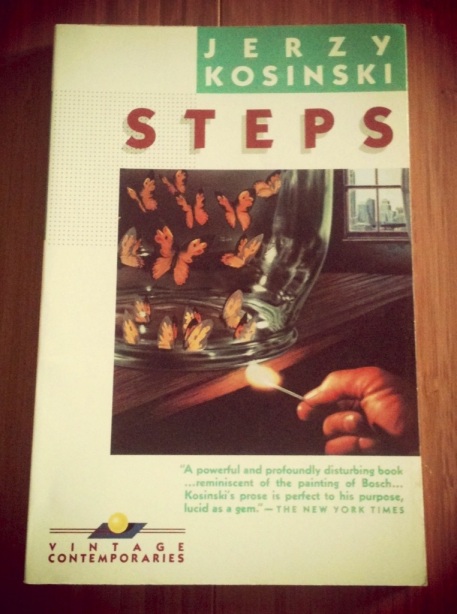
 Nearly a year after earning
 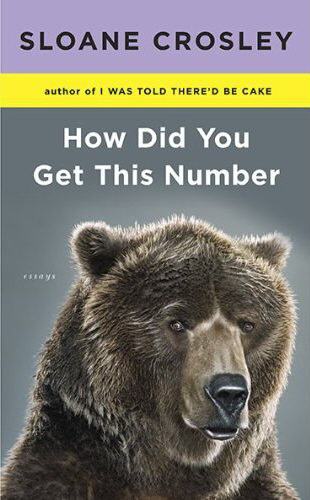 Sloane Crosley’s new collection of memory essays, How Did You Get This Number, finds the witty, observational young lass being witty and observational in and out of New York City–but mostly in. There are trips to Portugal and Paris, and a weird wedding in Alaska. There’s a remembrance of all the childhood pets that didn’t make it. There’s a story about buying furniture of questionable origin off the back of a truck. At times Crosley’s archness can be grating, as dry observations pile one upon the other, but her gift for exacting, sharp detail and her willingness to let her guard down at just the right moment in most of the selections make for a funny and compelling read. I’m still not sure why there’s no question mark in the title, though. How Did You Get This Number is new in hardback from Riverhead Books.
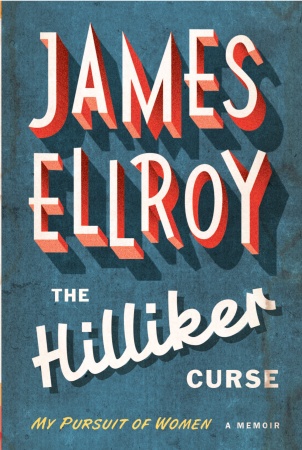 I just got my advance review copy of James Ellroy’s forthcoming memoir The Hilliker Curse, so I haven’t had time to read much of it, but the story so far is morbidly fascinating (like, you know, an Ellroy novel. But this is real. Because it’s a memoir). In 1958, James’s mother Jean Hilliker had divorced her husband and begun binge drinking. When she hit him one night, the ten year old boy wished that she would die. Three months later she was found murdered on the side of the road–the case remains unsolved. The memoir details Ellroy’s extreme guilt; his sincere belief that he had literally cursed his mother pollutes his life, particularly in his complex relationships with women. Full review forthcoming. The Hilliker Curse is available September 7th, 2010 from Knopf.


 The Vanishing of Katharina Linden, Helen Grant’s debut novel, negotiates the razor’s edge between childhood’s rich fantasy world and the grim reality of adult life. When young girls start disappearing in her small German village, eleven year old protagonist Pia sets out to investigate, armed with her powers of imagination–an imagination fueled by the Grimmish tales spun by her elderly friend Herr Schiller for the pleasure of Pia and her only friend, StinkStefan. Like poor Stefan, Pia is ostracized by the town after her grandmother spontaneously combusts on Christmas. She takes to playing detective, but as she investigates the girls’ disappearances, the illusions of her fantasy life cannot protect her. As the story builds to its sinister climax, it reminds us that most of the folktales we grew up with are far darker than we tend to remember.
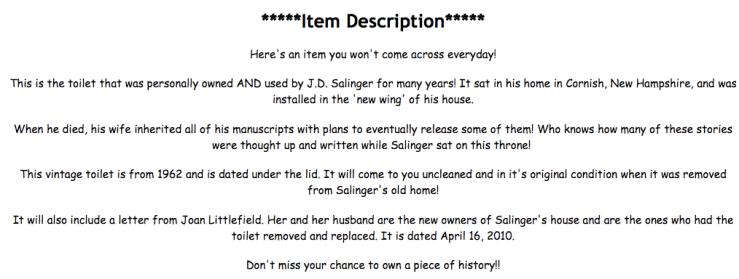 “It will come to you uncleaned”? Wow.
 Time
Time 
