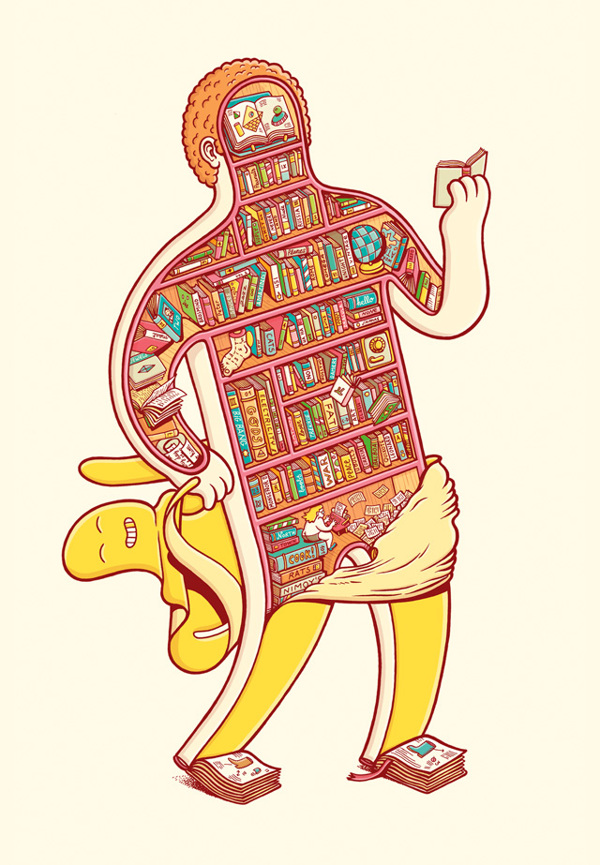
What’s Inside? #18 (Library Man) — Brosmind

whats-inside-18

(More).

theNewerYork, a Worthy Alternative to Your iPhone

20130709-154848.jpg

Like many (maybe most) Americans, my first impulse when I have to wait somewhere is to pull out my smart phone and dick around. I like to dick around on Twitter, which often leads me to stuff that I scan or gaze or graze through, with a kind of distracted, even half-hearted, attention. Because I’m also attending to something else—the waiting.

I had to wait, or be patient, or be a patient, or what have you several times last month, and each time I brought with me the newest or forthcomingest issue of theNewerYork—issue 3 (or III, depending on press materials). It fits neatly in my pocket and most of the pieces are a page at most—a perfect alternative to my iPhone, with none of the eye-deadening numbness that so often happens with long binges on a tiny screen.

theNewerYork describes itself as

a weird sort of literary mag. Our rule: no short stories, no poetry, no essays. We want to play around with literary form and narration, we want to screw with your mind! There will be personal letters, flash-fictions, glossaries, aphorisms, manuals, lists and other absurdities. We received over 600 submissions from all over the world. We’ve got flash fictions of sex and drugs, teenage romances, philosophical treatises, pretentious definitions, web forums, silly, sappy, scary stuff.

That’s a pretty apt description. To hijack and cannibalize my write-up of the last issue, theNewerYork’s “willingness to showcase experimentation in what goes on paper for people to look at and read is both a strength and a weakness.” This third issue sees an all-around increase in quality, from the production design, to the art, to the writing.

Highlights include Panayotis Pakos’s “Les Innumerables (A Binary Tale),” a Calvinoesque flash that imagines the dream-life of numbers, and Shane Jesse Christmass’s “My Delicate Response to a Child’s Writing Prompt Website” (quick sample: “If there were no television I’d beach my television set down within the dunes…”). Zach Davidson’s “Unstandardized Testing” claims (truthfully?) to present a set of scrambled questions from a trash bin; the testtaker is tasked with creating proper order (sample: “too lazy to do lazy something you are if you are still?”)

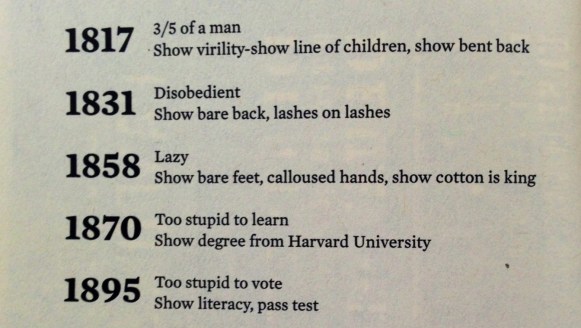
The most affecting piece in the collection is Anton Nimblett’s “Show & Tell: An American Game,” an analysis posing as a chronology. I’ll share only the nineteenth century portion, and, at the risk of spoiling, let you know that the story ends with the line “Show birth certificate (again, again, again).”

20130807-130214.jpg

The list-form, along with (or combined with) the second-person POV seems a favorite for “experimental” fiction, which can occasionally be grating (but only when it doesn’t work)—but most of the pieces here work. And if they don’t, there’s something coming up that does.

Despite the disparate tones, approaches, and geographies of its contributors, theNewerYork coheres—the little magazine has a clear (if discursive vision). Good stuff. Check out their website for more. 

“Indifference” — Edna St. Vincent Millay

ind

Son of a Gun (Book Acquired, 8.5.2013)

20130806-162848.jpg

Son of a Gun, Justin St. Germain’s memoir, explores the life and death of his mother, who was killed by her fifth husband. Here’s publisher Random House’s blurb:

Tombstone, Arizona, September 2001. Debbie St. Germain’s death in her remote trailer, apparently at the hands of her fifth husband, is a passing curiosity. “A real-life old West murder mystery,” the local TV announcers intone before the commercial break, while barroom gossips snicker cruelly. But for her twenty-year-old son, Justin St. Germain, the tragedy marks the line that separates his world into before and after.

Justin decides to confront people from his past and delve into the police records in an attempt to make sense of his mother’s life and death. All the while he tries to be the type of man she would have wanted him to be. Brutally honest and beautifully written, Son of a Gun is a brave, unexpected and unforgettable memoir.

Here’s Publishers Weekly’s write-up:

A young man wrestles with his heartache over his mother’s murder in this lacerating memoir of family dysfunction. St. Germain was a 20-year-old college student when his mother Debbie was shot to death in 2001 by her fifth husband in a desolate trailer in the Arizona desert, a disaster that threw into sharp relief the chaos of his working-class background. St. Germain revisits Debbie’s unstable life as an Army paratrooper and businesswoman, the string of men she took up with (some physically abusive), and his own boyhood resentment at their presence and at incessant domestic upheaval. Intertwined is a jaundiced, somewhat self-conscious meditation on St. Germain’s claustrophobic hometown of Tombstone—all sun-bleached ennui, arid hardpan, and tourist kitsch—and its presiding spirit, Wyatt Earp, archetype of the violent, trigger-happy machismo that he blames for killing his mother, yet feels drawn to as a touchstone of manhood. St. Germain makes harsh judgments of the men in his past (as well as of his sullen, callous adolescent self), but as he seeks them out later, he arrives, almost against his will, at a subtler appreciation of their complexities. At times his trauma feels more dutiful than deeply felt, but his memoir vividly conveys the journey from youthful victimization toward mature understanding.


Eight Notes from Nathaniel Hawthorne’s Note-Books

  1. Would it not be wiser for people to rejoice at all that they now sorrow for, and vice versa? To put on bridal garments at funerals, and mourning at weddings? For their friends to condole with them when they attained riches and honor, as only so much care added?
  2. If in a village it were a custom to hang a funeral garland or other token of death on a house where some one had died, and there to let it remain till a death occurred elsewhere, and then to hang that same garland over the other house, it would have, methinks, a strong effect.
  3. No fountain so small but that Heaven may be imaged in its bosom.
  4. Fame! Some very humble persons in a town may be said to possess it,–as, the penny-post, the town-crier, the constable,–and they are known to everybody; while many richer, more intellectual, worthier persons are unknown by the majority of their fellow-citizens. Something analogous in the world at large.
  5. The ideas of people in general are not raised higher than the roofs of the houses. All their interests extend over the earth’s surface in a layer of that thickness. The meeting-house steeple reaches out of their sphere.
  6. Nobody will use other people’s experience, nor have any of his own till it is too late to use it.
  7. Two lovers to plan the building of a pleasure-house on a certain spot of ground, but various seeming accidents prevent it. Once they find a group of miserable children there; once it is the scene where crime is plotted; at last the dead body of one of the lovers or of a dear friend is found there; and, instead of a pleasure-house, they build a marble tomb. The moral,–that there is no place on earth fit for the site of a pleasure-house, because there is no spot that may not have been saddened by human grief, stained by crime, or hallowed by death. It might be three friends who plan it, instead of two lovers; and the dearest one dies.
  8. Comfort for childless people. A married couple with ten children have been the means of bringing about ten funerals.

Notations from Nathaniel Hawthorne’s American Note-Books.

Heretic/Hanging (Books Acquired, Sometime Last Week)

20130806-162835.jpg

I was out of town when these showed up last week.

First, Susan Ronald’s Heretic Queen: Publisher St. Martin’s Griffin’s blurb:

Acclaimed biographer Susan Ronald delivers a stunning account of Elizabeth I that focuses on her role in the Wars on Religion—the battle between Protestantism and Catholicisim that tore apart Europe in the 16th Century

Elizabeth’s 1558 coronation procession was met with an extravagant outpouring of love. Only twenty-five years old, the young queen saw herself as their Protestant savior, aiming to provide the nation with new hope, prosperity, and independence from the foreign influence that had plagued her sister Mary’s reign. Given the scars of the Reformation, Elizabeth would need all of the powers of diplomacy and tact she could summon.

Extravagant, witty, and hot-tempered, Elizabeth was the ultimate tyrant. Yet at the outset, in religious matters, she was unfathomably tolerant for her day. “There is only one Christ, Jesus, one faith,” Elizabeth once proclaimed. “All else is a dispute over trifles.” Heretic Queen is the highly personal, untold story of how Queen Elizabeth I secured the future of England as a world power. Susan Ronald paints the queen as a complex character whose apparent indecision was really a political tool that she wielded with great aplomb.

And: The Hanging of Samuel Ash by Sheldon Russell, from Minotaur. Publishers Weekly blurb:

A compelling lead compensates only in part for the relatively weak plot of Russell’s fourth mystery featuring one-armed Santa Fe railroad bull Hook Runyon (after 2012’s Dead Man’s Tunnel), set during WWII against a backdrop of labor unrest. When Runyon checks out a nonworking signal on a remote stretch of track, he discovers a man’s corpse hanging from the signal’s cantilever. The only clue to the dead man’s identity is a Bronze Star inscribed with the name Samuel Ash. Not wanting the war hero to be buried in a pauper’s grave, Runyon takes custody of the body and embarks on a quest to find Ash’s relatives and the truth about his death. A dose of humor lightens the gloom—pickpockets steal Runyon’s wallet and badge while he’s hunting pickpockets—but the mystery itself never picks up much steam. Fans will hope for a return to form next time.


“Translations are always disgusting / But they brought me a lot of money” (Thomas Bernhard)

tb

From Thomas Bernhard’s play Der Weltverbesserer (The World-Fixer). The translation here is by Gitta Honegger and appears as an illustrating example in her fantastic essay “Language Speaks. Anglo-Bernhard: Thomas Bernhard in Translation,” collected in A Companion to the Works of Thomas Bernhard (ed. Matthias Konzett). At the time of Companion’s first publication, Der Weltverbesserer had yet to be released in an English edition; Ariadne released one in 2005.


“Von Kempelen and His Discovery ” — Edgar Allan Poe

“Von Kempelen and His Discovery ” by Edgar Allan Poe

AFTER THE very minute and elaborate paper by Arago, to say nothing of the summary in ‘Silliman’s Journal,’ with the detailed statement just published by Lieutenant Maury, it will not be supposed, of course, that in offering a few hurried remarks in reference to Von Kempelen’s discovery, I have any design to look at the subject in a scientific point of view. My object is simply, in the first place, to say a few words of Von Kempelen himself (with whom, some years ago, I had the honor of a slight personal acquaintance), since every thing which concerns him must necessarily, at this moment, be of interest; and, in the second place, to look in a general way, and speculatively, at the results of the discovery.

It may be as well, however, to premise the cursory observations which I have to offer, by denying, very decidedly, what seems to be a general impression (gleaned, as usual in a case of this kind, from the newspapers), viz.: that this discovery, astounding as it unquestionably is, is unanticipated.

By reference to the ‘Diary of Sir Humphrey Davy’ (Cottle and Munroe, London, pp. 150), it will be seen at pp. 53 and 82, that this illustrious chemist had not only conceived the idea now in question, but had actually made no inconsiderable progress, experimentally, in the very identical analysis now so triumphantly brought to an issue by Von Kempelen, who although he makes not the slightest allusion to it, is, without doubt (I say it unhesitatingly, and can prove it, if required), indebted to the ‘Diary’ for at least the first hint of his own undertaking.

The paragraph from the ‘Courier and Enquirer,’ which is now going the rounds of the press, and which purports to claim the invention for a Mr. Kissam, of Brunswick, Maine, appears to me, I confess, a little apocryphal, for several reasons; although there is nothing either impossible or very improbable in the statement made. I need not go into details. My opinion of the paragraph is founded principally upon its manner. It does not look true. Persons who are narrating facts, are seldom so particular as Mr. Kissam seems to be, about day and date and precise location. Besides, if Mr. Kissam actually did come upon the discovery he says he did, at the period designated—nearly eight years ago—how happens it that he took no steps, on the instant, to reap the immense benefits which the merest bumpkin must have known would have resulted to him individually, if not to the world at large, from the discovery? It seems to me quite incredible that any man of common understanding could have discovered what Mr. Kissam says he did, and yet have subsequently acted so like a baby—so like an owl—as Mr. Kissam admits that he did. By-the-way, who is Mr. Kissam? and is not the whole paragraph in the ‘Courier and Enquirer’ a fabrication got up to ‘make a talk’? It must be confessed that it has an amazingly moon-hoaxy-air. Very little dependence is to be placed upon it, in my humble opinion; and if I were not well aware, from experience, how very easily men of science are mystified, on points out of their usual range of inquiry, I should be profoundly astonished at finding so eminent a chemist as Professor Draper, discussing Mr. Kissam’s (or is it Mr. Quizzem’s?) pretensions to the discovery, in so serious a tone. Continue reading ““Von Kempelen and His Discovery ” — Edgar Allan Poe”

“The Double” — Jorge Luis Borges

“The Double” by Jorge Luis Borges (From Book of Imaginary Beings)

Suggested or stimulated by reflections in mirrors and in water and by twins, the idea of the Double is common to many countries. It is likely that sentences such as A friend is another self by Pythagoras or the Platonic Know thyself were inspired by it. In Germany this Double is called Doppelgänger, which means ’double walker’. In Scotland there is the fetch, which comes to fetch a man to bring him to his death; there is also the Scottish word wraith for an apparition thought to be seen by a person in his exact image just before death. To meet oneself is, therefore, ominous. The tragic ballad ‘Ticonderoga’ by Robert Louis Stevenson tells of a legend on this theme. There is also the strange picture by Rossetti (‘How They Met Themselves’) in which two lovers come upon themselves in the dusky gloom of a wood. We may also cite examples from Hawthorne (‘Howe’s Masquerade’), Dostoyevsky, Alfred de Musset, James (‘The Jolly Corner’), Kleist, Chesterton (‘The Mirror of Madmen’), and Hearn (Some Chinese Ghosts).

The ancient Egyptians believed that the Double, the ka, was a man’s exact counterpart, having his same walk and his same dress. Not only men, but gods and beasts, stones and trees, chairs and knives had their ka, which was invisible except to certain priests who could see the Doubles of the gods and were granted by them a knowledge of things past and things to come.

To the Jews the appearance of one’s Double was not an omen of imminent death. On the contrary, it was proof of having attained prophetic powers. This is how it is explained by Gershom Scholem. A legend recorded in the Talmud tells the story of a man who, in search of God, met himself.

In the story ‘William Wilson’ by Poe, the Double is the hero’s conscience. He kills it and dies. In a similar way, Dorian Gray in Wilde’s novel stabs his portrait and meets his death. In Yeats’s poems the Double is our other side, our opposite, the one who complements us, the one we are not nor will ever become.

Plutarch writes that the Greeks gave the name other self to a king’s ambassador.


“Reindeer discovered again their ancient powers of flight,” and other Tunguska effects (Pynchon’s Against the Day)

FOR A WHILE after the Event, crazed Raskol’niki ran around in the woods, flagellating themselves and occasional onlookers who got too close, raving about Tchernobyl, the destroying star known as Wormwood in the book of Revelation. Reindeer discovered again their ancient powers of flight, which had lapsed over the centuries since humans began invading the North. Some were stimulated by the accompanying radiation into an epidermal luminescence at the red end of the spectrum, particularly around the nasal area. Mosquitoes lost their taste for blood, acquiring one instead for vodka, and were observed congregating in large swarms at local taverns. Clocks and watches ran backward. Although it was summer, there were brief snowfalls in the devastated taiga, and heat in general tended to flow unpredictably for a while. Siberian wolves walked into churches in the middle of services, quoted passages from the Scriptures in fluent Old Slavonic, and walked peaceably out again. They were reported to be especially fond of Matthew 7:15, “Beware of false prophets, which come to you in sheep’s clothing, but inwardly they are ravening wolves.” Aspects of the landscape of Tierra del Fuego, directly opposite the Stony Tunguska on the globe, began to show up in Siberia—sea ernes, gulls, terns, and petrels landing in the branches of fir trees, swooping to grab fish out of the streams, taking a bite, screaming with distaste, and throwing them back. Granite cliffs rose sheer and unexpected out of the forest. Oceangoing ships unmanned by visible crews, attempting to navigate the shallow rivers and creeks, ran aground. Entire villages came to the conclusion that they were not where they ought to be, and without much advance planning simply packed up what they had, left behind what they couldn’t carry, and headed off together into the brush, where presently they set up villages no one else could see. Or not very clearly.

And from everywhere in the taiga, all up and down the basins of the Yenisei, came reports of a figure walking through the aftermath, not exactly an angel but moving like one, deliberately, unhurried, a consoler. Accounts differed as to whether the outsize figure was man or woman, but all reported having to look steeply upward when trying to make out its face, and a deep feeling of fearless calm once it had passed.

Some thought it might be some transfigured version of the shaman Magyakan, whose whereabouts had been puzzling folks along the Stony T. No one had seen him since the Event, his izba was empty, and the magical force that had kept it from sinking, like everyone else’s dwelling in Siberia, into the summer-thawed earth, had abated, so that the cabin now tilted at a thirty-degree angle, like a ship at sea about to slide beneath the waves.

None of the strange effects lasted long, and as the Event receded in memory, arguments arose as to whether this or that had even happened at all. Soon the forest was back to normal, green underbrush beginning to appear among the dead-white trunks, the animals fallen speechless again, tree-shadows again pointing in their accustomed directions, and Kit and Prance continued to make their way through it with no idea what this meant for their mission out here.

—Another citation from Thomas Pynchon’s Against the Day.

“Your whole history in America has been one long religious war, secret crusades, disguised under false names” (Pynchon’s Against the Day)

“Not quite how it sorts out. Differences among the world religions are in fact rather trivial when compared to the common enemy, the ancient and abiding darkness which all hate, fear, and struggle against without cease”— he made a broad gesture to indicate the limitless taiga all around them— “Shamanism. There isn’t a primitive people anywhere on Earth that can’t be found practicing some form of it. Every state religion, including your own, considers it irrational and pernicious, and has taken steps to eradicate it.”

“What? there’s no ‘state religion’ in the U.S.A., pardner, we’ve got freedom of worship, it’s guaranteed in the Constitution—keeps church and state separate, just so’s we don’t turn into something like England and keep marching off into the brush with bagpipes and Gatling guns, looking for more infidels to wipe out. Nothing personal o’ course.”

“The Cherokee,” replied Prance, “the Apache, the massacre of the Sioux Ghost Dancers at Wounded Knee, every native Red Indian you’ve found, you people have either tried to convert to Christianity or you’ve simply killed.”

“I suggest it was about the fear of medicine men and strange practices, dancing and drug-taking, that allow humans to be in touch with the powerful gods hiding in the landscape, with no need of any official church to mediate it for them. The only drug you’ve ever been comfortable with is alcohol, so you went in and poisoned the tribes with that. Your whole history in America has been one long religious war, secret crusades, disguised under false names. You tried to exterminate African shamanism by kidnapping half the continent into slavery, giving them Christian names, and shoving your peculiar versions of the Bible down their throats, and look what happened.”

“The Civil War? That was economics. Politics.”

“That was the gods you tried to destroy, waiting their hour, taking their revenge. You people really just believe everything you’re taught, don’t you?”

Another passage from Thomas Pynchon’s enormous novel Against the Day. Context unimportant to content here.


Seven Notes on Humanity from Samuel Butler’s Note-Books

  1. We are like billiard balls in a game played by unskilful players, continually being nearly sent into a pocket, but hardly ever getting right into one, except by a fluke.
  2. We are like thistle-down blown about by the wind – up and down, here and there – but not one in a thousand ever getting beyond seed-hood.
  3. A man is a passing mood coming and going in the mind of his country; he is the twitching of a nerve, a smile, a frown, a thought of shame or honour, as it may happen.
  4. How loosely our thoughts must hang together when the whiff of a smell, a band playing in the street, a face seen in the fire, or on the gnarled stem of a tree, will lead them into such vagaries at a moment’s warning.
  5. When I was a boy at school at Shrewsbury, old Mrs. Brown used to keep a tray of spoiled tarts which she sold cheaper.  They most of them looked pretty right till you handled them.  We are all spoiled tarts.
  6. He is a poor creature who does not believe himself to be better than the whole world else.  No matter how ill we may be, or how low we may have fallen, we would not change identity with any other person.  Hence our self-conceit sustains and always must sustain us till death takes us and our conceit together so that we need no more sustaining.
  7. Man must always be a consuming fire or be consumed.  As for hell, we are in a burning fiery furnace all our lives – for what is life but a process of combustion?

—From Samuel Butler’s Note-Books.

“You All Know the Story of the Other Woman” — Anne Sexton

as1

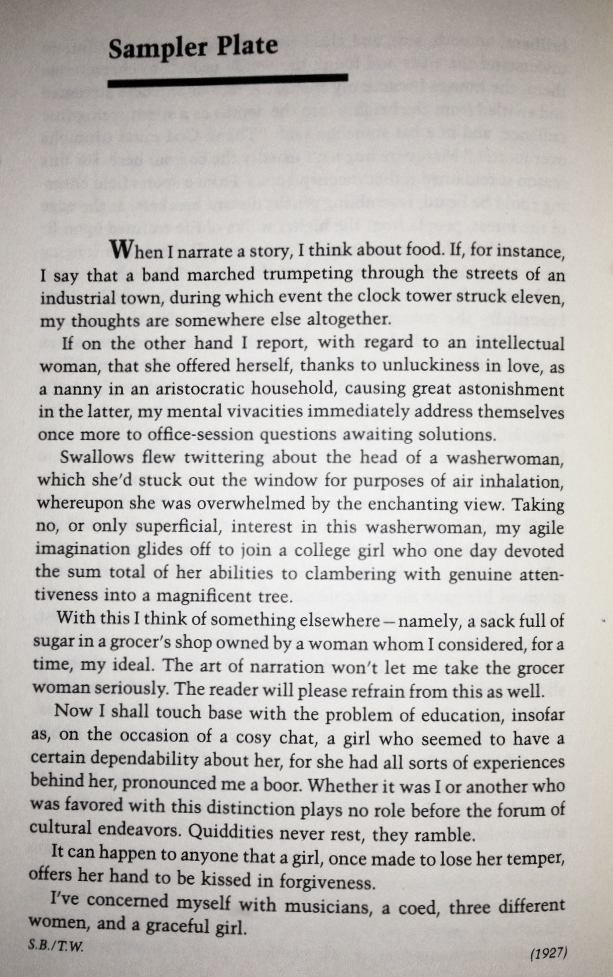
“Sampler Plate” — Robert Walser

sp

The Garden of Eden, Ernest Hemingway’s Tale of Doomed Polyamory

In general, I dislike reviews that frontload context—get to the book, right? So here’s a short review of Ernest Hemingway’s The Garden of Eden: it is stranger than most of what Hemingway wrote, by turns pleasant, uncomfortable, bewildering, and beautiful. And readable. It’s very, very readable. Young people (or older folks; let’s not be prejudiced) working their way through Hemingway shouldn’t put The Garden of Eden on the back-burner in favor of his more famous works, and anyone who might have written off Hemingway as unreflective macho bravado should take a look at some of the strange gender games this novel has to offer. So, that’s a recommendation, okay?

Now on to that context, which I think is important here. See, The Garden of Eden is one of those unfinished novels that get published posthumously, put together by editors and publishers and other book folk, who play a larger role than we like to admit in the finished books we get from living authors anyway. For various reasons, cultural, historical, etc., we seem to favor the idea of the Singular Artistic Genius who sculpts beauty and truth out of raw Platonic forms that only he or she can access (poor tortured soul). The reality of how our books get to us is a much messier affair, and editors and publishers and even literary studies departments in universities have a large hand in this process, one we tend to ignore in favor of the charms of a Singular Artistic Genius. There’s a fascinating process there, but also a troubling one. Editing issues complicate our ideals of (quite literally) stable authority—is this what the author intended?, we ask (New Critics be damned!). David Foster Wallace and Michael Pietsch, Raymond Carver and Gordon Lish, Franz Kafka and Max Brod, Mary Shelley and Percy Shelley . . . not to mention Shakespeare, Chaucer, Beowulf, The Bible, Homer, etc. etc. etc. But you’re here to read about The Garden of Eden, right gentle reader? Mea culpa. I’ve been blathering away. Let me turn the reins over to the estimable talents of E.L. Doctorow, who offers the following context in his 1986 review of the book in The New York Times

Since Hemingway’s death in 1961, his estate and his publishers, Charles Scribner’s Sons, have been catching up to him, issuing the work which, for one reason or another, he did not publish during his lifetime. He held back ”A Moveable Feast” out of concern for the feelings of the people in it who might still be alive. But for the novel ”Islands in the Stream” he seems to have had editorial misgivings. Even more deeply in this category is ”The Garden of Eden,” which he began in 1946 and worked on intermittently in the last 15 years of his life and left unfinished. It is a highly readable story, if not possibly the book he envisioned. As published it is composed of 30 short chapters running to about 70,000 words. A publisher’s note advises that ”some cuts” have been made in the manuscript, but according to Mr. Baker’s biography, at one point a revised manuscript of the work ran to 48 chapters and 200,000 words, so the publisher’s note is disingenuous. In an interview with The New York Times last December, a Scribners editor admitted to taking out a subplot in rough draft that he felt had not been integrated into the ”main body” of the text, but this cut reduced the book’s length by two-thirds.

So, yeah. The version we have of The Garden of Eden is heavily cut, and also likely heavily arranged. But that’s what editors do, and this is the book we have (for now, anyway—it seems like on the year of its 25th anniversary of publication, and the 50th anniversary of Hemingway’s death that Scribner should work toward putting out an unedited scholarly edition) — so I’ll talk about that book a bit.

The Garden of Eden tells the story of a few months in the lives of a young newlywed couple, David Bourne, an emerging novelist, and his wife Catherine, a trust fund baby flitting about Europe. The novel is set primarily on the French Riviera, in the thin sliver of high years between the two big wars. David and Catherine spend most of their days in this Edenic setting eating fine food and making love and swimming and riding bikes and fishing. And drinking. Lots and lots of drinking. Lots of drinking. It all sounds quite beautiful—h0w about a taste?

On this morning there was brioche and red raspberry preserve and the eggs were boiled and there was a pat of butter that melted as they stirred them and salted them lightly and ground pepper over them in the cups. They were big eggs and fresh and the girl’s were not cooked quite as long as the young man’s. He remembered that easily and he he was happy with his which he diced up with the spoon and ate with only the flow of the butter to moisten them and the fresh early morning texture and the bite of the coarsely ground pepper grains and the hot coffee and the chickory-fragrant bowl of café au lait.

Hemingway’s technique throughout the novel is to present the phenomenological contours of a heady world. It’s lovely to ride along with David and Catherine, rich and free and beautiful.

Their new life together is hardly charmed, however. See, Catherine gets a haircut—

Her hair was cropped as short as a boy’s. It was cut with no compromises. It was brushed back, heavy as always, but the sides were cut short and the ears that grew close to her head were clear and the tawny line of her hair was cropped close to her head and smooth and sweeping back. She turned her head and lifted her breasts and said, “Kiss me please.” . . .

“You see, she said. “That’s the surprise. I’m a girl. But now I’m a boy too and I can do anything and anything and anything.”

“Sit here by me,” he said. “What do you want, brother.”

David’s playful response—calling his wife “brother”—covers up some of his shock and fear, but it also points to his underlying curiosity and gender confusion. And indeed, Catherine’s new haircut licenses her to “do anything and anything and anything” — beginning with some strange bed games that night—

He had shut his eyes and he could feel the long light weight of her on him and her breasts pressing against him and her lips on his. He lay there and felt something and then her hand holding him and searching lower and he helped with his hands and then lay back in the dark and did not think at all and only felt the weight and the strangeness inside and she said, “Now you can’t tell who is who can you?”

“No.”

“You are changing,” she said. “Oh you are. You are. Yes you are and you’re my girl Catherine. Will you change and be my girl and let me take you?”

“You’re Catherine.”

“No. I’m Peter. You’re my wonderful Catherine. You’re my beautiful, lovely Catherine. You were so good to change. Oh thank you, Catherine, so much. Please understand. Please know and understand. I’m going to make love to you forever.”

David, partial stand-in for Hemingway, transforms into a girl who feels “something” during sex with Catherine (or, ahem, Peter)—note that that “something” has no clear referent. As their gender inverting games continue (much to David’s horror), Hemingway’s usually concrete language retreats to vague proforms without referents, “it”s without antecedents; his usually precise diction dissolves in these scenes, much as the Bournes’ marriage dissolves each time Catherine escalates the gender inversion. David gives her the nickname “Devil,” as if she were both Eve and Serpent in their Garden. Catherine’s transformations continue as she cuts her hair back even more, and sunbathes all the time so that she can be as dark as possible. She dyes her hair a silver blonde and makes David get his hair cut and dyed the same.

The bizarre behavior (shades of Scott and Zelda?) culminates in Catherine introducing another woman into the marriage. Marita falls in love with both David and Catherine, but her lesbian sex with Catherine only accelerates the latter’s encroaching insanity. David is initially radically ambivalent to the ménage à trois proposed by his wife; he has the good sense to see that a three-way marriage is ultimately untenable and that his wife is going crazy. He vacillates between hostility and love for the two women, but eventually finds a support system in Marita as it becomes increasingly apparent (to all three) that Catherine is depressed and mentally unstable, enraged that David has ceased to write about the pair’s honeymoon adventures on the Riviera. Catherine has been bankrolling David; jealous of good reviews from his last novel, she insists that he write only their story, but David would rather write “the hardest story” he knows—the story of his childhood in East Africa with his father, a big game hunter.

In some of the most extraordinary passages of The Garden of Eden, David writes himself into his boyhood existence, trailing a bull elephant with his father through a jungle trek. David has spotted the elephant by moonlight, prompting his father and his father’s fellow tracker and gun bearer Juma to hunt the old beast. As they trail the animal, David begins to realize how horrible the hunt is, how cruel it is to kill the animal for sport. The passages are somewhat perplexing given Hemingway’s reputation as a hunter. Indeed, this is one of the major features of The Garden of Eden: it repeatedly confounds or complicates our ideas about Hemingway the man’s man, Hemingway the writer, Hemingway the hunter. David describes the wounded, dying elephant—

They found him anchored, in such suffering and despair that he could no longer move. He had crashed through the heavy cover where he had been feeding and crossed a path of open forest and David and his father had run along the heavily splashed blood trail. Then the elephant had gone on into thick forest and David had seen him ahead standing gray and huge against the trunk of a tree. David could only see his stern and then his father moved ahead of him and he followed and they came alongside the elephant as though he was a ship and David saw the blood coming from his flanks and running down his sides and then his father raised his rifle and fired and the elephant turned his head with the great tusks moving heavy and slow and looked at them and when his father fired the second barrel the elephant seemed to sway like a felled tree and came smashing down toward them. But he was not dead. He had been anchored and now he was down with his shoulder broken. He did not move but his eye was alive and looked at David. He had very long eyelashes and his eye was the most alive thing David had ever seen.

David succeeds in writing this “hard” story, and the passages are remarkable in their authenticity—David’s story is a good story, the highlight of the book perhaps; it’s not just Hemingway telling us that David wrote a great story, we actually get to experience the story itself as well as the grueling process by which it was made. Hemingway and his surrogate David show us—make us experience—how difficult writing really is, and then share the fruit of that labor with us. These scenes raise the stakes of The Garden of Eden, revealing how serious David is when he remarks (repeatedly) that the writing is the most important thing—that it outweighs love, it surpasses his marriage. These realizations freight the climax of the novel all the more heavily, but I will avoid anymore spoilers.

The Garden of Eden has some obvious flaws. Marita is underdeveloped at best for such an important character, and her love for David and Catherine remains unexplored, and in fact barely remarked upon. The biggest problem with the book is its conclusion, which feels too pat, too obvious for such a strange, amorphous book. It is here that the presence of an editorial hand seems clearest, to the extent that I wonder if the short little chapter that concludes the novel wasn’t cobbled together from a few stray sentences throughout the manuscript. But The Garden of Eden, despite some shortcomings, is a book well worth reading. The novel complicates not just Hemingway’s reputation, but also our sense of Hemingway’s sense of himself. Recommended.

[Ed. note: Biblioklept originally published a version of this review in August of 2011]
“Counterparts” — James Joyce

“Counterparts” by James Joyce

THE bell rang furiously and, when Miss Parker went to the tube, a furious voice called out in a piercing North of Ireland accent:

“Send Farrington here!”

Miss Parker returned to her machine, saying to a man who was writing at a desk:

“Mr. Alleyne wants you upstairs.”

The man muttered “Blast him!” under his breath and pushed back his chair to stand up. When he stood up he was tall and of great bulk. He had a hanging face, dark wine-coloured, with fair eyebrows and moustache: his eyes bulged forward slightly and the whites of them were dirty. He lifted up the counter and, passing by the clients, went out of the office with a heavy step.

He went heavily upstairs until he came to the second landing, where a door bore a brass plate with the inscription Mr. Alleyne. Here he halted, puffing with labour and vexation, and knocked. The shrill voice cried:

“Come in!”

The man entered Mr. Alleyne’s room. Simultaneously Mr. Alleyne, a little man wearing gold-rimmed glasses on a cleanshaven face, shot his head up over a pile of documents. The head itself was so pink and hairless it seemed like a large egg reposing on the papers. Mr. Alleyne did not lose a moment:

“Farrington? What is the meaning of this? Why have I always to complain of you? May I ask you why you haven’t made a copy of that contract between Bodley and Kirwan? I told you it must be ready by four o’clock.”

“But Mr. Shelley said, sir——”

“Mr. Shelley said, sir…. Kindly attend to what I say and not to what Mr. Shelley says, sir. You have always some excuse or another for shirking work. Let me tell you that if the contract is not copied before this evening I’ll lay the matter before Mr. Crosbie…. Do you hear me now?”

“Yes, sir.”

“Do you hear me now?… Ay and another little matter! I might as well be talking to the wall as talking to you. Understand once for all that you get a half an hour for your lunch and not an hour and a half. How many courses do you want, I’d like to know…. Do you mind me now?” Continue reading ““Counterparts” — James Joyce”