A messy bright drunken satire on academia and parties involving academics and pseudointellectuals in general. It opens with assholery, with unnecessary incorrect corrections:
I went to a party and corrected a pronunciation. The man whose voice I had adjusted fell back into the kitchen. I praised a Bonnard. It was not a Bonnard. My new glasses, I explained, and I’m terribly sorry, but significant variations elude me, vodka exhausts me, I was young once, essential services are being maintained.
Essential services are being maintained cracked me up this go around. (I too have been sometimes exhausted by vodka.)
King Kong shows up at the party! Barthelme pulls a few Robert Coover moves, but is less comfortable parodying film than he is parodying modern art (or Modern Art, I mean).
I Don’t Like to Look at Him, Jack by Walton Ford
“The Party” is a sad story, a bad scene with some good cruel jokes. Near the end, our narrator—some ironic extrapolation of Barthelme his own damn self—internally remarks:
What made us think that we could escape things like bankruptcy, alcoholism, being disappointed, having children?
Yuck.
29. “Daumier” (Sadness, 1972)
Probably my favorite story so far in this reverse re-read. “Daumier” is the best sort of metafictional postmodernism: wry, occasionally mean, and fun with a tight little heart, the story never displays its plumage or winks at the reader.
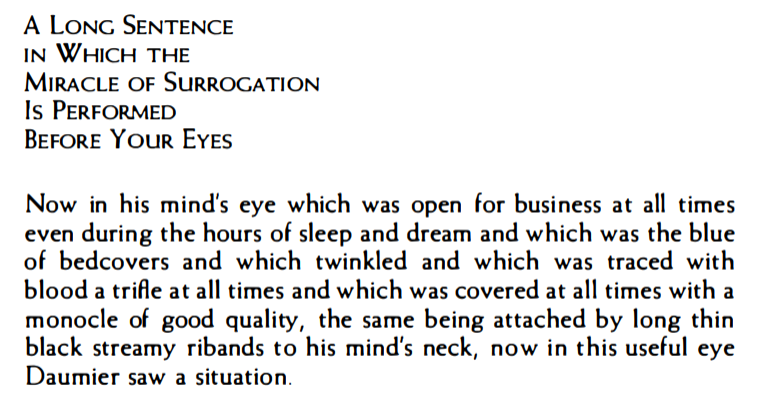
On the outside of “Daumier” is the ostensible narrator who is playing around with a psychological gadget he calls surrogation, a concept the rest of us would identify as identifying with characters we create, avatars we write into being. He causes to be, via surrogation, in his mind’s narrative eye, a Western scene. A band of misunderstood rustlers are herding a herd of French au pairs across the Western plains. There are chili dogs and villainous priests and at least one muskateer. In case we get confused, Barthelme’s narrator offers a resume of the plot:
Ignatius Loyola XVIII, with a band of hard-riding fanatical Jesuits under his command, has sworn to capture the herd and release the girls from the toils so-called of the Traffic, in which Daumier, Mr. Hawkins, and Mr. Bellows are prominent executives of long standing. Daumier meanwhile has been distracted from his proper business by a threat to the queen, the matter of the necklace (see Dumas, The Queen’s Necklace, pp. 76-1 05).
“Daumier” sees Barthelme quick switching between genres, moods, and registers. The story showcases some of the best bits of his midseventies ironic-epic mode. When his metatextual narrative moves back to the “ordinary,” contemporary world, Barthelme paints the scene with heroic bravado:
Immature citizens in several sizes were massed before a large factorylike structure where advanced techniques transformed them into true-thinking right-acting members of the three social classes, lower, middle, and upper middle. Some number of these were engaged in ludic agon with basketballs, the same being hurled against passing vehicles producing an unpredictable rebound. Dispersed amidst the hurly and burly of the children were their tenders, shouting. lnmixed with this broil were ordinary denizens of the quarter-shopmen, rentiers, churls, sellers of vicious drugs, stum-drinkers, aunties, girls whose jeans had been improved with applique rose blossoms in the cleft of the buttocks, practicers of the priest hustle, and the like.
The image of the children “engaged in ludic agon with basketballs” made me laugh aloud.
A penultimate section parodying modern food production surpasses this section, but also ends in a sweet if weird resolution—Barthelme’s surrogate commits to sweet marriage with a character. The last section, simply labeled “Conclusion” blows the phantasy apart. The narrator assures us that he has folded and wrapped up his characters and stuffed them tidily into desk drawers. He will take them out again in the future when he needs them again, “someday when my soul is again sickly and full of sores.” It is the exact same ending of Barthelme’s most-anthologized story, “The Balloon,” wherein the titular balloon is sent off to, what is it, West Virginia, to be stored for a future time, etc. etc. But this later story — “Daumier,” I mean — concludes in a strangely sadly depressive affirmation of life as doing, despite the pain of being:
The self cannot be escaped, but it can be, with ingenuity and hard work, distracted. There are always openings, if you can find them, there is always something to do.
“A City of Churches” is one of Barthelme’s more straightforward satires. A woman named Cecelia plans to move to a new city where she hopes to open a car rental place. The name of the city, Prester, is likely an allusion to Prester John, the mythical Christian king of a lost Christian city. A certain Mr. Phillips shows Cecelia around, informing her that not only do all the citizens of Prester live in churches, but also all businesses are housed in churches. Irreligious Cecelia realizes that she cannot fit into such conformist confines.
An essentially sad story in a book called Sadness, “The Rise of Capitalism” begins cryptically:
The first thing I did was make a mistake. I thought I had understood capitalism, but what I had done was assume an attitude — melancholy sadness — toward it. This attitude is not correct.
What follows is a pastiche of critical essay and parodic riffs; there’s no real plot but there are plenty of gags. In one memorable passage, capitalism becomes personified and literally rises, presumably to work. But the narration gives way to lamenting the alienation we feel under late capitalism, before shifting into absurdity:
Capitalism arose and took off its pajamas. Another day, another dollar. Each man is valued at what he will bring in the marketplace. Meaning has been drained from work and assigned instead to remuneration. Unemployment obliterates the world of the unemployed individual. Cultural underdevelopment of the worker, as a technique of domination, is found everywhere under late capitalism. Authentic self-domination by individuals is thwarted. The false consciousness created and catered to by mass culture perpetuates ignorance and powerlessness. Strands of raven hair floating on the surface of the Ganges…Why can’t they clean up the Ganges? If the wealthy capitalists who operate the Ganges wig factories could be forced to install sieves, at the mouths of their plants….And now the sacred Ganges is choked with hair, and the river no longer knows where to put its flow, and the moonlight on the Ganges is swallowed by the hair, and the water darkens. By Vishnu! This is an intolerable situation! Shouldn’t something be done about it?
I think something should be done about it.
26. “Träumerei” (Sadness, 1972)
Calling them “the most formally complex pieces” in Sadness, Barthelme’s biographer Tracy Daugherty notes that both “Träumerei” and “Sandman” were rejected by The New Yorker. I read “Träumerei” twice (reread, I suppose) and have no idea what it’s “about.” Formally, it’s a sort of monologue, a tirade even, addressed to “Daniel”:
So there you are, Daniel, reclining, reclining on the chaise, a lovely picture, white trousers, white shirt, red cummerbund, scarlet rather, white suede jacket, sunflower in buttonhole, beard neatly combed, let’s have a look at the fingernails. Daniel, your fingernails are a disgrace. Have a herring. We are hungry, Daniel, we could eat the hind leg off a donkey.
The narrator continues on and on, riffing on music and film and art, dropping composer names (Hadyn, Spontini, Glazunov), and decrying “the damned birds singing.” The title “Träumerei” is perhaps a reference to Schumann’s piece from Scenes from Childhood, as well as an invocation of the word’s translation as dream or reverie. It’s enjoyable as an accretion of images, but a bit frustrating if approached as a puzzle to figure out, which is not how one should necessarily approach it, but which, nevertheless, I did.
25. “The Sandman” (Sadness, 1972)
Another monologue, this time in epistolary form. The unnamed narrator writes a contempt-laden letter to his girlfriend’s psychoanalyst; she wants to terminate the analysis and buy a piano, but the shrink can only see this desire as a displacement. The narrator assures him that sometimes a piano is just a piano. In Hiding Man, Daugherty calls “The Sandman” an “unusually autobiographical story,” noting that the tale reflects Barthelme’s own disenchantment with analysis. The story also includes a scene cribbed from Barthelme’s early days writing for The Houston Post back in the mid-fifties. In it, the narrator describes police brutality:
There was a story that four black teenagers had come across a little white boy, about ten, in a vacant lot, sodomized him repeatedly and then put him inside a refrigerator and closed the door…and he suffocated. I don’t know to this day what actually happened, but the cops had picked up some black kids and were reportedly beating the shit out of them in an effort to make them confess.
The narrator makes a number of calls and finally gets enough pressure on the police force to hold them accountable:
So the long and short of it was that the cops decided to show the four black kids at a press conference to demonstrate that they weren’t really beat all to rags, and that took place at four in the afternoon. I went and the kids looked OK, except for one whose teeth were out and who the cops said had fallen down the stairs.
He concedes that “we all know the falling-down-the-stairs story,” but ultimately decides that,
Now while I admit it sounds callous to be talking about the degree of brutality being minimal, let me tell you that it was no small matter, in that time and place, to force the cops to show the kids to the press at all. It was an achievement, of sorts.
Barthelme’s work rarely—rarely is too big a word—almost never directly addressed the Civil Rights Movement in the same way that it engaged the Youth Movement, the Vietnam War, and second wave feminism. The notations here read almost like a mea culpa, a “this is the best we could do.” There’s no rage there (although there’s little rage in Barthelme—mostly melancholy). The only other story I recall directly addressing racial issues in America is the first story in the collection, “Margins” (which I should be getting to soon).
Another autobiographical detail that Daugherty unpacks in his biography Hiding Man comes from Karen Kennerly, a writer whom Barthelme had an affair with, “Don’s story ‘The Sandman’ is all true. I’m the woman in that story.” In the story, the woman receives a late-night call from another man she was seeing. Kennerly claims that that man was Miles Davis, whom she claimed to be involved with between 1966-1979. She describes an awkward meeting between the two at Elaine’s in NYC. Davis’s nickname for Barthelme was “Texas.” I don’t think it was affectionate.
Ultimately, the narrator of “The Sandman” realizes that the “world is unsatisfactory,” and that depressions are a fine response to this problem. There are solutions, including this one: “Put on a record.”
Summary thoughts: The weakest story here is “Träumerei.” “A City of Churches” would be a nice starting point for anyone interested in Barthelme, but it’s a bit on-the-nose for me. Both “The Rise of Capitalism” and “The Sandman” seem like attempts at oblique mission statements. “Daumier” is the best of the bunch.
Going forward (in reverse): One more from “Sadness” (maybe the saddest one in the collection—and also an autobiographical jam, for sure), and then we get into 1970’s City Life.
I know a painter who feels the same way about being a painter. Every morning he gets up, brushes his teeth, and stands before the empty canvas. A terrible feeling of being de trop comes over him. So he goes to the corner and buys the Times, at the corner newsstand He comes back home and reads the Times. During the period in which he’s coupled with the Times he is all right. But soon the Times is exhausted. The empty canvas remains. So (usually) he makes a mark on it, some kind of mark that is not what he means. That is, any old mark, just to have something on the canvas. Then he is profoundly depressed because what is there is not what he meant. And it’s time for lunch. He goes out and buys a pastrami sandwich at the deli. He comes back and eats the sandwich meanwhile regarding the canvas with the wrong mark on it out of the corner of his eye. During the afternoon, he paints out the mark of the morning. This affords him a measure of satisfaction. The balance of the afternoon is spent in deciding whether or not to venture another mark. The new mark, if one is ventured, will also, inevitably, be misconceived. He ventures it. It is misconceived. It is, in fact, the worst kind of vulgarity. He paints out the second mark. Anxiety accumulates. However, the canvas is now, in and of itself, because of the wrong moves and the painting out, becoming rather interesting-looking. He goes to the A&P and buys a TV Mexican dinner and many bottles of Carta Blanca. He comes back to his loft and eats the Mexican dinner and drinks a couple of Carta Blancas, sitting in front of his canvas. The canvas is, for one thing, no longer empty. Friends drop in and congratulate him on having a not-empty canvas. He begins feeling better. A something has been wrested from the nothing. The quality of the something is still at issue-he is by no means home free. And of course all of painting-the whole art-has moved on somewhere else, it’s not where his head is, and he knows that, but nevertheless he-
-How does this apply to trombone playing? Hector asked.
-1 had the connection in my mind when I began, Charles said.
-As Goethe said, theory is gray, but the golden tree of life is green.
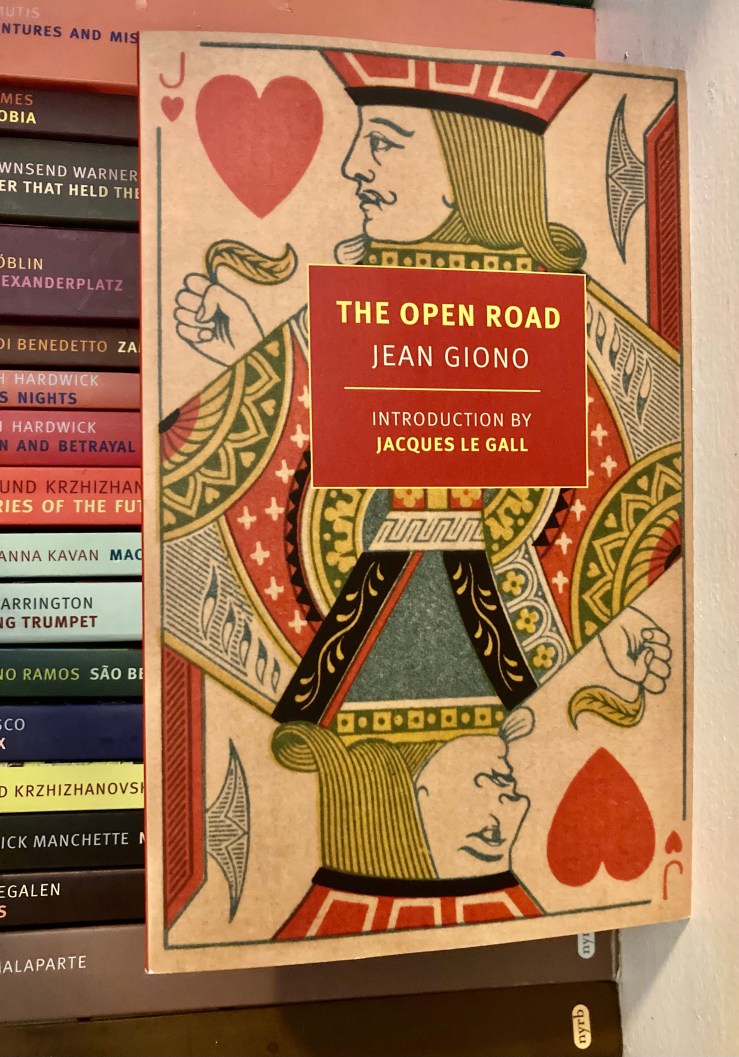
I’m a big fan of picaresque novels about con artists. Jean Giono’s The Open Road is forthcoming in translation by Paul Eprile from NYRB. Their blurb:
The south of France, 1950: A solitary vagabond walks through the villages, towns, valleys, and foothills of the region between northern Provence and the Alps. He picks up work along the way and spends the winter as the custodian of a walnut-oil mill. He also picks up a problematic companion: a cardsharp and con man, whom he calls “the Artist.” The action moves from place to place, and episode to episode, in truly picaresque fashion. Everything is told in the first person, present tense, by the vagabond narrator, who goes unnamed. He himself is a curious combination of qualities—poetic, resentful, cynical, compassionate, flirtatious, and self-absorbed.
While The Open Road can be read as loosely strung entertainment, interspersed with caustic reflections, it can also be interpreted as a projection of the relationship of author, art, and audience. But it is ultimately an exploration of the tensions and boundaries between affection and commitment, and of the competing needs for solitude, independence, and human bonds. As always in Jean Giono, the language is rich in natural imagery and as ruggedly idiomatic as it is lyrical.
We are left, I submit, with the problem of her depressions. They are, I agree, terrible. Your idea that I am not “supportive” enough is, I think, wrong. I have found, as a practical matter, that the best thing to do is to just do ordinary things, read the newspaper for example, or watch basketball, or wash the dishes. That seems to allow her to come out of it better than any amount of so-called “support. ” (About the chasmus hystericus or hysterical yawning I don’t worry any more. It is masking behavior, of course, but after all, you must allow us our tics. The world is waiting for the sunrise.) What do you do with a patient who finds the world unsatisfactory? The world is unsatisfactory; only a fool would deny it. I know that your own ongoing psychic structuralization is still going on-you are thirty-seven and I am forty-one-but you must be old enough by now to realize that shit is shit. Susan’s perception that America has somehow got hold of the greed ethic and that the greed ethic has turned America into a tidy little hell is not, I think, wrong. What do you do with such a perception? Apply Band-Aids, I suppose. About her depressions, I wouldn’t do anything. I’d leave them alone. Put on a record.
From Donald Barthelme’s short story “The Sandman.”
Simultaneously creepy and funny, “The Captured Woman“ is narrated by an unnamed man who has, as the title suggests, captured a woman. The story begins with a double capturing: “The captured woman asks if I will take her picture.” The narrator shoots four rolls of film and develops them in his darkroom. He and the woman have consensual sex. She demands to go to church. She writes a letter to her husband, offering him a once-in-a-lifetime chance to rescue her on a white horse. The husband refuses, and the angered captured woman commands the narrator to “Take me to my room and tie me up…I’m going to hate him for a while.”
In the meantime, the narrator commiserates with his pals who have also captured women. He lays out their techniques:
It is true that Q. will never get one. His way of proceeding is far too clumsy. He might as well be creeping about carrying a burlap sack.
P. uses tranquilizing darts delivered by a device which resembles the Sunday New York Times.
D. uses chess but of course this limits his field of operations somewhat.
S. uses a spell inherited from his great-grandmother.
F. uses his illness.
T. uses a lasso. He can make a twenty-foot loop and keep it spinning while he jumps in and out of it in his handmade hundred-and-fifty-dollar boots — a mesmerizing procedure.
C. has been accused of jacklighting, against the law in this state in regard to deer. The law says nothing about women.
X. uses the Dionysiac frenzy.
L. is the master. He has four now, I believe.
I use Jack Daniels.
Is “The Captured Woman” a faintly-sexist satire? Barthelme’s metaphor for his own repeated failures with women? No clue, but one of the story’s late punchlines suggest a depressive view of relationships: “The trouble with capturing one is that the original gesture is almost impossible to equal or improve upon.”
“Rebecca” is another melancholy “love story.” It begins with poor Rebecca Lizard “trying to change her ugly, reptilian, thoroughly unacceptable last name.” She then visits a dermatologist who can’t help her skin’s greenish hue, before going home to her girlfriend, Hilda:
Hilda is a very good-looking woman. So is Rebecca. They love each other–an incredibly dangerous and delicate business, as we know. Hilda has long blond hair and is perhaps a shade the more beautiful. Of course Rebecca has a classic and sexual figure which attracts huge admiration from every beholder.
Hilda’s been out for a drink with another woman—just a friend—spiking an argument between the pair that’s not ameliorated by drinking too many busthead cocktails. The resolution is simple and domestic—unusually sweet by Barthelme’s standards. He punctures it with a final note:
The story ends. It was written or several reasons. Nine of them are secrets. The tenth is that one should never cease considering human love, which remains as grisly and golden as ever, no matter what it tattooed upon the warm tympanic page.
Like“Our Work and Why We Do It,” another story from Amateurs, “At the End of the Mechanical Age” is another riff on Walter Benjamin’s seminal essay “The Work of Art in the Age of Mechanical Reproduction.” Both stories are successful, but “Mechanical Age” is divine—a phantasy-romance that turns the mundane into the heroic. The narrator meets Mrs. Davis, who owns a Mexican restaurant, in a supermarket. The pair takes up with each other, becoming first lovers, and then married partners. Meanwhile, God is in the basement, measuring the electric meter. There’s a flood, but our heroic couple survive it. They sing songs to each other recounting enormous mythical figures to come—giants with the mundane names Ralph and Maude. Like “Rebecca,” this story is a love story, but a melancholy one:
“The mechanical age is drawing to a close,” I said to her.
“Or has already done so,” she replied.
“It was a good age,” I said. “I was comfortable in it, relatively. Probably I will not enjoy the age to come quite so much. I don’t like its look.”
“One must be fair. We don’t know yet what kind of an age the next one will be. Although I feel in my bones that it will be an age inimical to personal well-being and comfort, and that is what I like, personal well-being and comfort.”
“Do you suppose there is something to be done?” I asked her.
“Huddle and cling,” said Mrs. Davis. “We can huddle and cling. It will pall, of course, everything palls, in time…”
Huddle and cling is an elegant, simple, and perhaps sad solution.
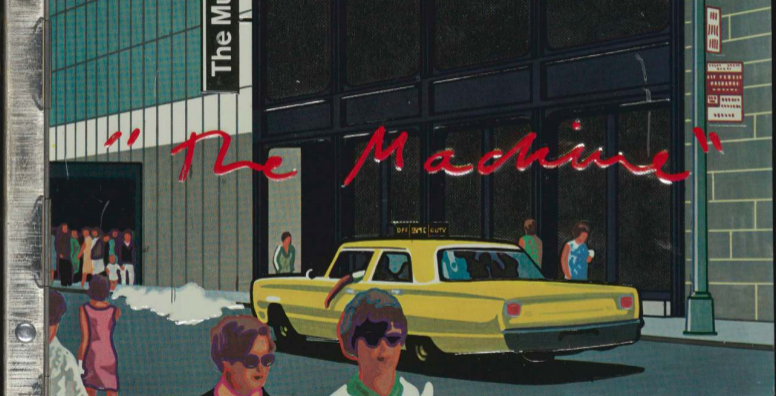
In Hiding Man, his Barthelme biography, Tracy Daugherty points out that Barthelme viewed an exhibition at the MoMA in 1968 called “The Machine, as Seen at the End of the Mechanical Age,” which likely influenced the title and content of the story.
33. “A Manual for Sons” (The Dead Father, 1975)
“A Manual for Sons” is the second-longest piece in Sixty Stories (after “The Emerald”), and reads like an oddity among oddities. It’s an excerpt from The Dead Father, but feels ancillary to that novel (possibly Barthelme’s best). And yet, like its progenitor novel, “A Manual for Sons” is a big fat webbed up concretization of the oedipal anxieties that course through so much of Barthelme’s work. There’s a section with three “sample” voices of fathers, all stern, cruel even. One of these fathers enlists his son’s aid in building a deck—an echo perhaps of Barthelme’s architect father:
Now run me a line down that form with the pencil. I gave you the pencil. What’d you do with the goddamn pencil? Jesus Christ kid find the pencil. OK go in the house and get me another pencil. Hurry up I can’t stand here holdin’ this all day. Wait a minute here’s the pencil. OK. I got it. Now hold it straight and run me a line down that form. Not that way dummy, on the horizontal. You think we’re buildin’ a barn? That’s right. Good. Now run the line. Good. OK, now go over there and fetch me the square. Square’s the flat one, looks like a L. Like this, look. Good. Thank you. OK now hold that mother up against the form where you made the line. That’s so we get this side of it square, see? OK now hold the board and lemme just put in the stakes. HOLD IT STILL DAMN IT. How you think I can put in the stakes with you wavin’ the damn thing around like that? Hold it still. Check it with the square again. OK, is it square? Now hold it still. Still. OK. That’s got it. How come you’re tremblin’? Nothin’ to it, all you got to do is hold one little bitty piece of one-by-six straight for two minutes and you go into a fit? Now stop that. Stop it. I said stop it. Now just take it easy. You like heppin’ me with the patio, don’tcha? Just think ’bout when it’s finished and we be sittin’ out here with our drinks drinkin’ our drinks and them jackasses ‘cross the street will be havin’ a hemorrhage. From green envy. Flee from the wrath to come, boy, flee from the wrath to come. He he.
The chuckle after the line Flee from the wrath to come is particularly menacing. For the most part though, “A Manual for Sons” balances the seriousness of its subject with humorous absurdity and swelling rhetoric:
Fathers are teachers of the true and not-true, and no father ever knowingly teaches what is not true. In a cloud of unknowing, then, the father proceeds with his instruction. Tough meat should be hammered well between two stones before it is placed on the fire, and should be combed with a hair comb and brushed with a hairbrush before it is placed on the fire. On arriving at night, with thirsty cattle, at a well of doubtful character, one deepens the well first with a rifle barrel, then with a pigsticker, then with a pencil, then with a ramrod, then with an icepick, “bringing the well in” finally with needle and thread. Do not forget to clean your rifle barrel immediately. To find honey, tie a feather or straw to the leg of a bee, throw him into the air, and peer alertly after him as he flies slowly back to the hive.
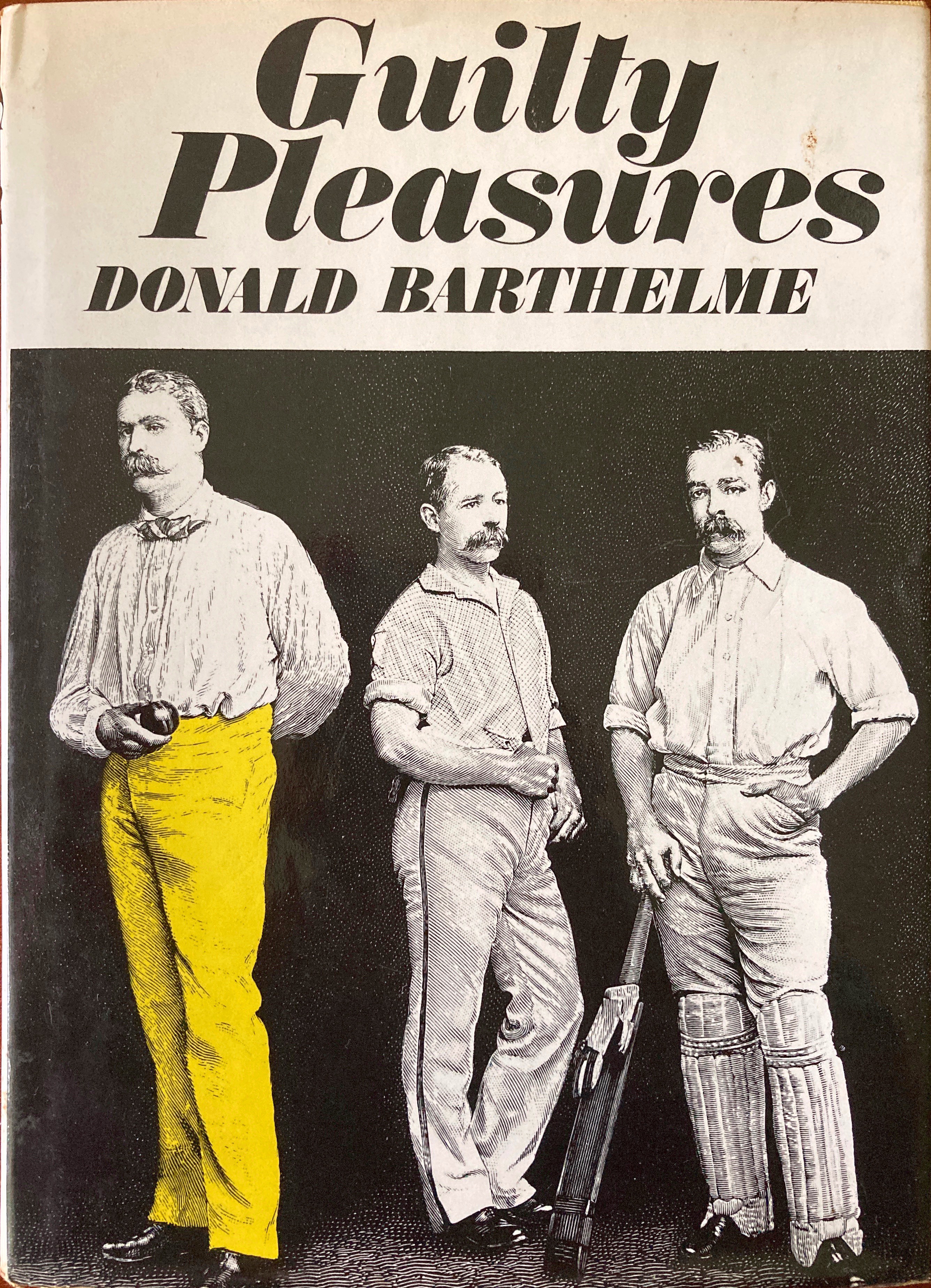
32. “Nothing: A Preliminary Account” (Guilty Pleasures, 1974)
In a 1982 interview, Barthelme described using this story in his writing classes:
Occasionally I’ll read something that has some pedagogic value. For example, there’s a story called “Nothing,” which I also use as an assignment. When somebody is stuck, I’ll say, well, do me a piece that describes “nothing.” Sometimes if I give that to a whole class, when they’re finished reading theirs, I’ll read mine just to show how I dealt with it.
“Nothing” is a list that tries to describe “nothing.” It begins thus:
It’s not the yellow-curtains. Nor curtain rings. Nor is it bran in a bucket, nor bran, nor is it the large, reddish farm animal eating the bran from the bucket, the man who placed the bran in the bucket, his wife, or the raisin-faced banker who’s about to foreclose on the farm. None of these is nothing.
The list is a mix of absurd fun, a few great punchlines (“Nor is it lobster protected from its natural enemies by its high price”), and a heavy dose of Barthelme’s beloved existentialists:
Heidegger points us toward dread. Having borrowed a cup of dread from Kierkegaard, he spills it, and in the spreading stain he finds (like a tea-leaf reader) Nothing.
Like much of Barthelme’s seventies stuff, “Nothing” is a piece that strives to find meaning in failure:
But if we cannot finish, we can at least begin. If what exists is in each case the totality of the series of appearances which manifests it, then nothing must be characterized in terms of its nonappearances, no-shows, incorrigible tardiness. Nothing is what keeps us waiting (forever).
31. “Eugénie Grandet” (Guilty Pleasures, 1974)
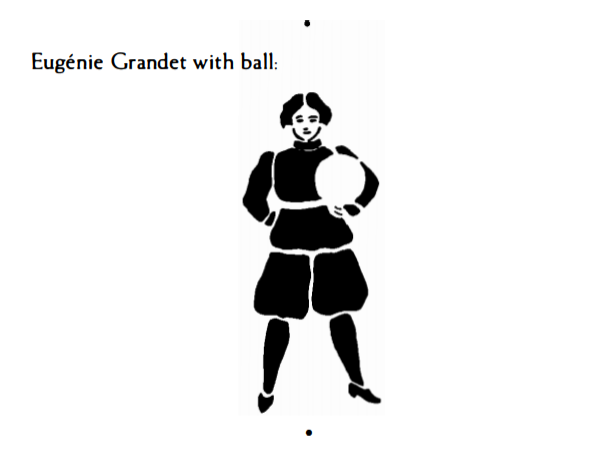
“Eugénie Grandet” is the only story included in Sixty Stories that uses literal images—photographs and drawings—incorporating them into a collage distillation of Balzac’s 1833 novel of the same name. The story offers a parodic summary of a 200-page novel in just a few paragraphs, including this notorious one:
Here, the conflict between Eugénie and her miserly father over Eugénie’s using too much butter in preparing her cousin’s eclairs is compressed into 78 butters.
“Eugénie Grandet” isn’t just a parodic summary though. It’s also a send-up of middle-twentieth century values. In Hiding Man, Daugherty spends two whole pages on the story, arguing that it should be read within the context of its composition—namely, after the fall out of May ’68.
Daugherty writes,
In parodying this particular novel in the context of May 1968, [Barthelme] composed a potent political document. It not only touched on the rebellion’s seminal issues, but invoked the reinvigorated Sartre…[the story], firmly attached to modernist history, and appearing, as it did, in a mainstream weekly, tucked among ads for glittering cars, watches, and diamonds, is a remarkable American artifact.”
Ultimately though, “Eugénie Grandet” is a strong enough story that one can appreciate it without any knowledge of Balzac or May ’68.
Summary thoughts: “The Captured Woman” is apt for misreading and “Rebecca” is a bit of a trifle, but it’s a tender trifle. “At the End of the Mechanical Age” is as good as anything Barthelme ever wrote. “A Manual for Sons” is wonderful, and I guess I’m glad it’s included in Sixty Stories, but it does feel out of place–but maybe that’s just because I’ve read The Dead Father. “Nothing” might make a great starting place for anyone interested in Barthelme.” “Eugénie Grandet” is great stuff.
Going forward (in reverse): The next six stories are all from 1972’s Sadness—including a favorite of mine, “Daumier.”

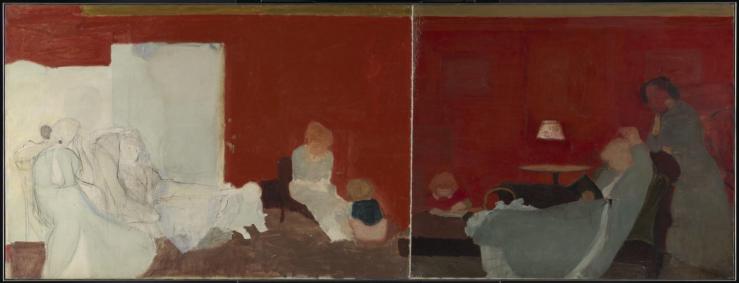 Interior with Reclining Women, 1946 by Victor Pasmore (1908-1998)
















 Biblioklept