Studio Conversation I — John Wonnacott

Studio Conversation I, 1994 by John Wonnacott (b. 1940)

Man Lying in Grass — Tim Eitel

Man Lying in Grass, 2018 by Tim Eitel (b. 1971)

“The Shirt” — Robert Pinsky

“The Shirt”

by

Robert Pinsky


The back, the yoke, the yardage. Lapped seams,
The nearly invisible stitches along the collar
Turned in a sweatshop by Koreans or Malaysians

Gossiping over tea and noodles on their break
Or talking money or politics while one fitted
This armpiece with its overseam to the band

Of cuff I button at my wrist. The presser, the cutter,
The wringer, the mangle. The needle, the union,
The treadle, the bobbin. The code. The infamous blaze

At the Triangle Factory in nineteen-eleven.
One hundred and forty-six died in the flames
On the ninth floor, no hydrants, no fire escapes—

The witness in a building across the street
Who watched how a young man helped a girl to step
Up to the windowsill, then held her out

Away from the masonry wall and let her drop.
And then another. As if he were helping them up
To enter a streetcar, and not eternity.

A third before he dropped her put her arms
Around his neck and kissed him. Then he held
Her into space, and dropped her. Almost at once

He stepped to the sill himself, his jacket flared
And fluttered up from his shirt as he came down,
Air filling up the legs of his gray trousers—

Like Hart Crane’s Bedlamite, “shrill shirt ballooning.”
Wonderful how the pattern matches perfectly
Across the placket and over the twin bar-tacked

Corners of both pockets, like a strict rhyme
Or a major chord. Prints, plaids, checks,
Houndstooth, Tattersall, Madras. The clan tartans

Invented by mill-owners inspired by the hoax of Ossian,
To control their savage Scottish workers, tamed
By a fabricated heraldry: MacGregor,

Bailey, MacMartin. The kilt, devised for workers
To wear among the dusty clattering looms.
Weavers, carders, spinners. The loader,

The docker, the navvy. The planter, the picker, the sorter
Sweating at her machine in a litter of cotton
As slaves in calico headrags sweated in fields:

George Herbert, your descendant is a Black
Lady in South Carolina, her name is Irma
And she inspected my shirt. Its color and fit

And feel and its clean smell have satisfied
Both her and me. We have culled its cost and quality
Down to the buttons of simulated bone,

The buttonholes, the sizing, the facing, the characters
Printed in black on neckband and tail. The shape,
The label, the labor, the color, the shade. The shirt.

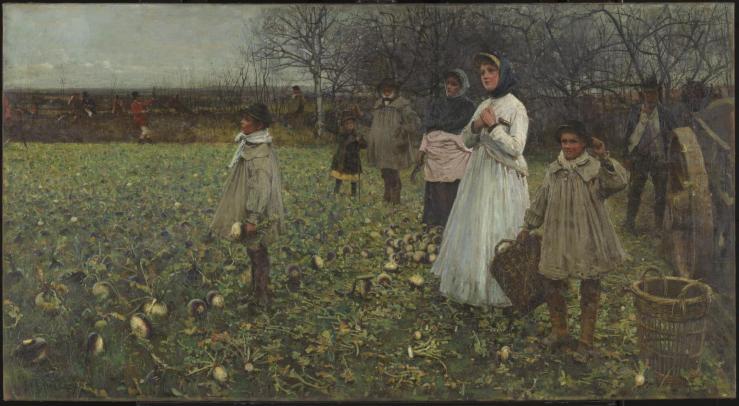
Toil and Pleasure — John Robertson Reid

Toil and Pleasure, 1879 by John Robertson Reid (1851-1926)

A gathering impossible/General merriment (From Pynchon’s Against the Day)

A DAY OR TWO LATER, Lew went up to Carefree Court. The hour was advanced, the light failing, the air heated by the Santa Ana wind. Palm trees rattled briskly, and the rats in their nests up there hung on for dear life. Lew approached through a twilit courtyard lined with tileroofed bungalows, stucco archways, and the green of shrubbery deepening as the light went. He could hear sounds of glassware and conversation.

From the swimming pool came sounds of liquid recreation—feminine squeals, deep singlereed utterances from high and low divingboards. The festivities here this evening were not limited to any one bungalow. Lew chose the nearest, went through the formality of ringing the doorbell, but after waiting a while just walked in, and nobody noticed.

It was a gathering impossible at first to read, even for an old L.A. hand like Lew—society ladies in flapper-rejected outfits from Hamburger’s basement, real flappers in extras’ costumes—Hebrew headdresses, belly-dancing outfits, bare feet and sandals—in from shooting some biblical extravaganza, sugar daddies tattered and unshaven as street beggars, freeloaders in bespoke suits and sunglasses though the sun had set, Negroes and Filipinos, Mexicans and hillbillies, faces Lew recognized from mug shots, faces that might also have recognized him from tickets long cold he didn’t want to be reminded of, and here they were eating enchiladas and hot dogs, drinking orange juice and tequila, smoking cork-tip cigarettes, screaming in each others’ faces, displaying scars and tattoos, recalling aloud felonies imagined or planned but seldom committed, cursing Republicans, cursing police federal state and local, cursing the larger corporate trusts, and Lew slowly began to get a handle, for weren’t these just the folks that once long ago he’d spent his life chasing, them and their cousins city and country? through brush and up creek-beds and down frozen slaughterhouse alleyways caked with the fat and blood of generations of cattle, worn out his shoes pair after pair until finally seeing the great point, and recognizing in the same instant the ongoing crime that had been his own life—and for achieving this self-clarity, at that time and place a mortal sin, got himself just as unambiguously dynamited.

He gradually understood that what everybody here had in common was having survived some cataclysm none of them spoke about directly—a bombing, a massacre perhaps at the behest of the U.S. government. . . .

“No it wasn’t Haymarket.”

“It wasn’t Ludlow. It wasn’t the Palmer raids.”

“It was and it wasn’t.” General merriment.

—Thomas Pynchon’s novel Against the Day.


Fakir — Vasily Vereshchagin

Fakir, c. 1875 by Vasily Vereshchagin (1842-1904)

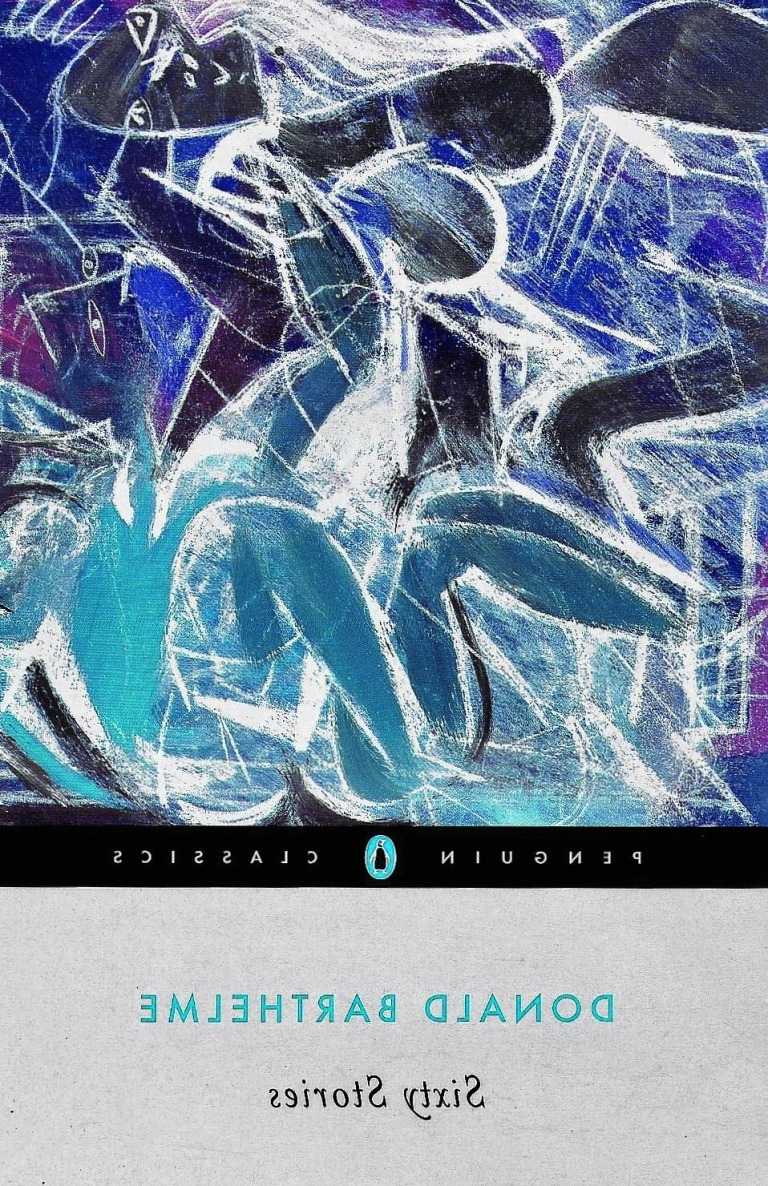
Donald Barthelme’s Sixty Stories in reverse, Part III

I am rereading Donald Barthelme’s Sixty Stories, starting with the sixtieth story and working my way to the first. I wrote about stories 60-55 here and stories 54-49 here,

This post covers stories 48-43.

48. “The Death of Edward Lear” (Great Days, 1979)

Like many of the stories culled from Great Days, the humor in “The Death of Edward Lear” is tinged with melancholy. Perhaps it’s because of its subject matter, or perhaps it’s knowing that Great Days was the last collection of originals Barthelme would write, but “The Death of Edward Lear” feels like the work of a much older man. In fact, it was first published in The New Yorker in 1971, when Barthelme was forty, barely middle aged. (For whatever reasons, Barthelme didn’t include the piece in his collections Sadness (1972) or Amateurs (1976.))

The story begins in the most straightforward manner:

The death of Edward Lear took place on a Sunday morning in May 1888. Invitations were sent out well in advance. The invitations read:

Mr. Edward LEAR
Nonsense Writer and Landscape Painter
Requests the Honor of Your Presence
On the Occasion of his DEMISE.
San Remo 2:20 a.m.
The 29th of May Please reply

One can imagine the feelings of the recipients. Our dear friend! is preparing to depart! and such-like. Mr. Lear! who has given us so much pleasure! and such-like. On the other hand, his years were considered. Mr. Lear! who must be, now let me see… And there was a good deal of, I remember the first time I (dipped into) (was seized by)…But on the whole, Mr. Lear’s acquaintances approached the occasion with a mixture of solemnity and practicalness…

Lear treats his many guests to a strange spectacle of rants, rhymes, and mandolin-playing. He also delivers a “short homily on the subject of Friendship.” Then he dies.

His audience is initially confused, before realizing that Lear had crafted his death into a piece of absurdist art:

People who attended the death of Edward Lear agreed that, all in all, it had been a somewhat tedious performance. Why had he seen fit to read the same old verses, sing again the familiar songs, show the well-known pictures, run through his repertoire once more? Why invitations? Then something was understood: that Mr. Lear had been doing what he had always done and therefore, not doing anything extraordinary. Mr. Lear had transformed the extraordinary into its opposite. He had, in point of fact, created a gentle, genial misunderstanding.

And Lear’s performance engenders future performances:

The death of Edward Lear can still be seen, in the smaller cities, in versions enriched by learned interpretation, textual emendation, and changing fashion. One modification is curious; no one knows how it came about. The supporting company plays in the traditional way, but Lear himself appears shouting, shaking, vibrant with rage.

That final angry image is sad, haunting even. It recalls that other Lear, mad on the heath, as well as Dylan Thomas’s most famous villanelle.

In his biography Hiding Man, Tracy Daugherty speculates that the idea for “Lear” might be attributed in part to the “farewell parties” Susan Sontag hosted in the mid-seventies when she thought she might die from cancer. There’s a human reality coursing under the story’s apparent absurdity that makes it a memorable, enjoyable tale about making art out of life and death.

Edward Lear’s actual death sounds much sadder. According to the Edward Lear Society, “Lear’s funeral was said to be a sad, lonely affair by the wife of Dr. Hassall, Lear’s physician, not one of Lear’s many lifelong friends being able to attend.”

47. “Morning” (Great Days, 1979)

In Hiding Man, Daugherty claims that “Morning” is about “the limits of the educational system,” but I don’t see it. It’s an absurdist dialogue, almost impenetrable in its obliquity—which would be fine if the sentences were better. There had to have been better stories in Great Days than “Morning” — the superior “Concerning the Bodyguard” is from that collection, and eventually ended up in Forty Stories—but I’m sure Barthelme had his reasons for including it. Those reasons, like the story, are inscrutable to me.

46. “The King of Jazz” (Great Days, 1979)

A great little ditty told (almost) entirely in dialogue, “The King of Jazz” takes place over the first few minutes of Hokie Mokie’s reign as the new, um, king of jazz. Hokie’s tenure comes under threat almost immediately when Hideo Yamaguchi, a stranger from Tokyo, appears seemingly from nowhere to challenger the new king. A musical duel ensues, helpfully described by one of the musicians in attendance:

“What’s that sound coming in from the side there?”

“Which side?”

“The left.”

“You mean that sound that sounds like the cutting edge of life? That sounds like polar bears crossing Arctic ice pans? That sounds like a herd of musk ox in full flight? That sounds like male walruses diving to the bottom of the sea? That sounds like fumaroles smoking on the slopes of Mt. Katmai? That sounds like the wild turkey walking through the deep, soft forest? That sounds like beavers chewing trees in an Appalachian marsh? That sounds like an oyster fungus growing on an aspen trunk? That sounds like a mule deer wandering a montane of the Sierra Nevada? That sounds like prairie dogs kissing? That sounds like witchgrass tumbling or a river meandering? That sounds like manatees munching seaweed at Cape Sable? That sounds like coatimundis moving in packs across the face of Arkansas? That sounds like – ”

“Good God, it’s Hokie! Even with a cup mute on, he’s blowing Hideo right off the stand!”

Barthelme here and elsewhere excels at pushing and pulling language in ways with which we are unfamiliar. There’s a synesthetic quality to his best writing, writing which so frequently attempts to engage with and evoke other arts—visual, arts, poetry.

“The King of Jazz” also continues the thread of Oedipal anxiety that courses throughout Barthelme’s work. That anxiety here is not necessarily father-son oriented, but rather the anxiety of the outsider who becomes established, the experimenter who succeeds—and then finds his work challenged by new comers.

45. “The Zombies” (Great Days, 1979)

“The Zombies” is another fun story—and one of the rare late stories not told entirely in dialogue. I’m not really sure if “The Zombies” is a specific parody or just a goof, but it makes me laugh:

In a high wind the leaves fall from the trees. The zombies are standing about talking. “Beautiful day!” “Certainly is!” The zombies have come to buy wives from the people of this village, the only village around that will sell wives to zombies. “Beautiful day!” “Certainly is!” The zombies have brought many cattle. The bride price to a zombie is exactly twice that asked of an ordinary man. The cattle are also zombies and the zombies are in terror lest the people of the village understand this.

There are good zombies and bad zombies. Gris Grue is the hero of the good zombies. There’s a Bishop involved. Watch out: “The kiss of a dying animal, a dying horse or dog, transforms an ordinary man into a zombie.”

And watch out too for bad zombies: “If a bad zombie gets you, he will scarify your hide with chisels and rakes. If a bad zombie gets you, he will make you walk past a beautiful breast without even noticing.”

44. “The New Music” (Great Days, 1979)

“The New Music”: Another dialogue, another synesthetic excursion into Oedipal territories—this time focused on the mother:

–She had a lot on her mind. The chants. And Daddy of course.

–Let’s not do Daddy today.

Two brothers discuss “the new music,” which both is and is not music. As in much of Barthelme’s work, elements of art and culture might be patched and pasted in new designs, new collages.

–The new music burns things together, like a welder. The new music says, life becomes more and more exciting as there is less and less time.

–Momma wouldn’t have ‘lowed it. But Momma’s gone.

With their disallowing mother out of the way, the boys can now move forward into the new music.

43. “Cortés and Montezuma” (Great Days, 1979)

“Cortés and Montezuma” is the strongest tale in this batch. The story tells a version of the “friendship” between the Spanish conquistador and the Aztec emperor. Unlike the quippy, often absurd dialogue pieces, “Cortés and Montezuma” is told in a simple, direct (even flat) third-person voice. Here’s how the story opens:

Because Cortés lands on a day specified in the ancient writings, because he is dressed in black, because his armor is silver in color, a certain ugliness of the strangers taken as a group-for these reasons, Montezuma considers Cortés to be Quetzacoatl, the great god who left Mexico many years before, on a raft of snakes, vowing to return.

Montezuma gives Cortés a carved jade drinking cup.

Cortés places around Montezuma’s neck a necklace of glass beads strung on a cord scented with musk.

Montezuma offers Cortés an earthenware platter containing small pieces of meat lightly breaded and browned which Cortés declines because he knows the small pieces of meat are human fingers.

The story repeats the image of Cortés and Montezuma walking and holding hands, exchanging gifts, and not really trusting each other. There is plenty of intrigue and paranoia. Cortés is sleeping with his translator, but she’s also taken a high-ranking Aztec for a lover. The nobles are starting to turn on Montezuma. Various folks employ detectives to trail other folks. Assassination plots loom.

Much of the strength of “Cortés and Montezuma” derives from Barthelme’s decision to tactically employ the occasional anachronism. Consider the “powdered wigs” and “limousines” here:

Montezuma writes, in a letter to his mother: “The new forwardness of the nobility has come as a welcome relief. Whereas formerly members of the nobility took pains to hide among the general population, to pretend that they were ordinary people, they are now flaunting themselves and their position in the most disgusting ways. Once again they wear scarlet sashes from shoulder to hip, even on the boulevards; once again they prance about in their great powdered wigs; once again they employ lackeys to stand in pairs on little shelves at the rear of their limousines. The din raised by their incessant visiting of one another is with us from noon until early in the morning.”

These anachronisms highlight language’s inability to accurately translate reality. Barthelme gives us images that we identify with wealth and power — “powdered wigs” and “limousines” — but they do not fit within the historical context of Montezuma’s Aztec Empire, and they do not square historically with each other. The anachronisms do offer the contemporary reader an idea of the power of the Aztec aristocracy, and at the same time, their inclusion highlights how incomplete our picture of historical reality is—absurdly incomplete.

Indeed, Barthelme was working from a translation when he crafted “Cortés and Montezuma.” His fourth (and final) wife, the writer Marion Knox, had brought home a copy of Bernal Diaz del Castillo book about Spain’s invasion of the Aztec Empire. Barthelme translated that translation into a new translation, adding a postmodern wink to his story in the process: “Bernal Diaz del Castillo, who will one day write The True History of the Conquest of New Spain, stands in a square whittling upon a piece of mesquite.”

Behind the metatextual cleverness and intentionally-flat tone though, there is a strong, sympathetic core to “Cortés and Montezuma,” a deep sorrow summed up in the final line:

The pair walking down by the docks, hand in hand, the ghost of Montezuma rebukes the ghost of Cortés. “Why did you not throw up your hand, and catch the stone?”

Summary thoughts: It was a bit of an unexpected relief to get out of the dialogue stories. I appreciate what Barthelme did with them, but they are too often constrained but their form, despite highlights like “The Emerald,” “The Leap,” and “The King of Jazz,” which is the strongest dialogue in this batch. I found “Morning” an ugly irritation, some sub-Gertrude-Stein stuff, and “The New Music,” while better, is not especially strong. “Cortés and Montezuma” was the highlight of the six for me.

Going forward (in reverse): One last Great Days stories, and we get into the (stronger) collection Amateurs. 

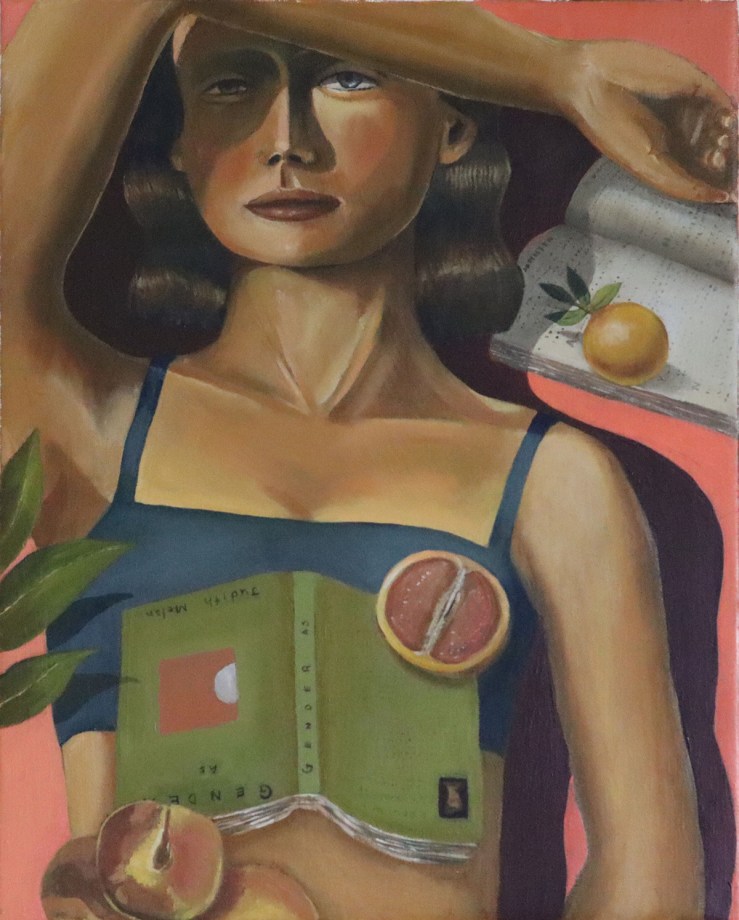
Give My Body Back — Skyler Chen

Give My Body Back, 2021 by Skyler Chen (b. 1982)

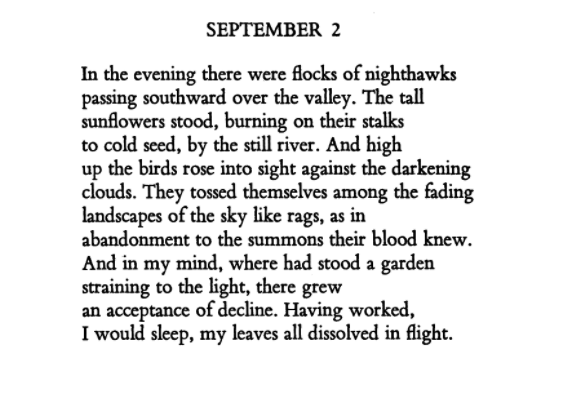
“September 2” — Wendell Berry

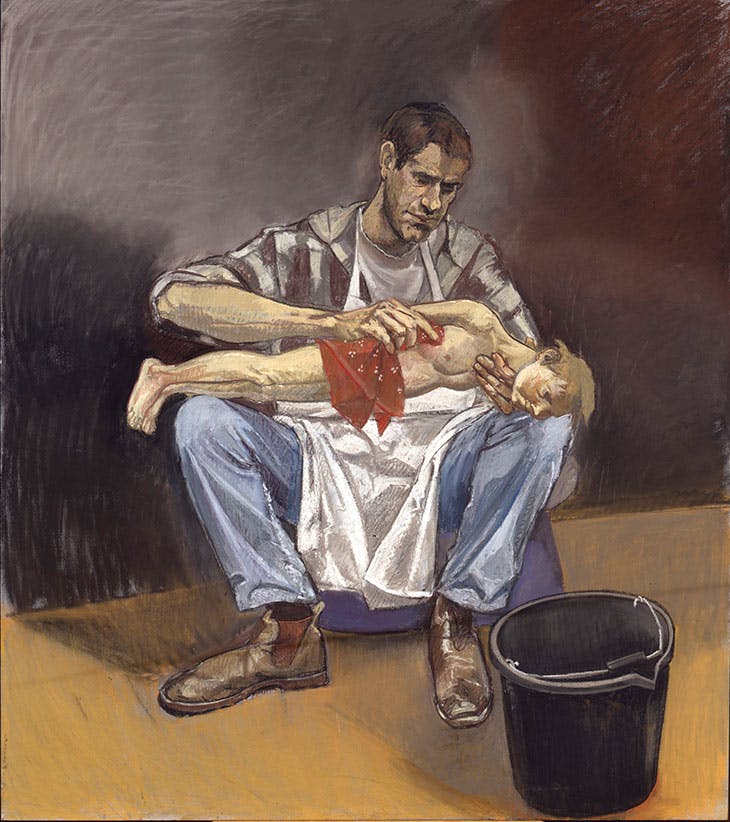
Geppetto Washing Pinocchio — Paula Rego

Geppetto Washing Pinocchio, 1996 by Paul Rego (b. 1935)

The Wolf — He Duoling

The Wolf, 1999 by He Duoling (b. 1948)


Donald Barthelme’s Sixty Stories in reverse, Part II

I am rereading Donald Barthelme’s Sixty Stories, starting with the sixtieth story and working my way to the first. I wrote about stories 60-55 here, stories collected in 1981.

This post covers stories 54-49.

54. “How I Write My Songs” (previously uncollected, 1981)

Like his postmodernist contemporaries Robert Coover and William H. Gass, many of Donald Barthelme’s stories are, on at least some level, about the act of writing itself. “How I Write My Songs,” is, as its title suggests, a story about writing. Our narrator the songwriter offers tips and advice, most of it pretty straightforward, and he peppers his monologue with recitations of his own songs. Each time he offers up a song though, we’re treated to copyright notice at the end—little interjections from a faceless corporate voice. The copyright notices are ironic, especially given that the narrator’s songs are clearly based in folk traditions like blues and Appalachian music. The narrator acknowledges these traditions, positing his writing as a synthesis:

Songs are always composed of both traditional and new elements. This means that you can rely on the tradition to give your song “legs” while also putting in your own experience or particular way of looking at things for the new.

In the end, the story’s ironies don’t bite too hard—it it’s a parody of teaching creative writing, it’s loving, and full of practical advice. The narrator’s revelation of his name—Bill B. White—is also a nice punchline.

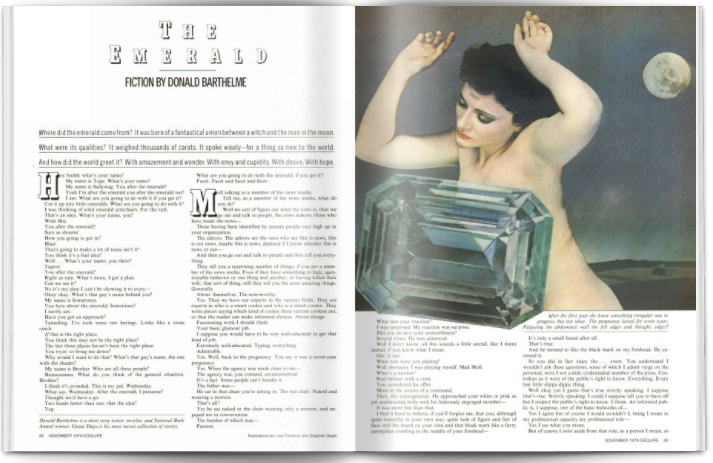
53. “The Emerald” (previously uncollected, 1981)

I love “The Emerald.”

It’s the longest story in Sixty Stories, a 29-page epic that Barthelme culled from an aborted novel, according to Tracy Daugherty’s biography Hiding Man. Unless I’m wrong, it’s the only piece Barthelme published in Esquiremost of his stories showed up in The New Yorker, whose editor Roger Angell was an early champion of Barthelme. Angell rejected “The Emerald” though. In his biography, Daugherty points out that Angell initially did not like Barthelme’s turn toward stories composed entirely in dialogue.

“The Emerald” (and the other stories discussed in this riff) is such a story. Barthelme adeptly commands the various voices here, but without exposition or stage directions of any kind, the story is challenging the first time around. Repeated readings reveal a rich, funny, strange fable.

Here’s what happens: Our hero Mad Moll, a bearded witch, is impregnated by “the man in the moon,” Deus Luna (she has a three-hour orgasm). After a seven-year pregnancy, she gives birth to a sentient emerald. This strange birth attracts the attention of the news media as well as hordes of would-be kidnappers who are after the emerald. Most of the bandits after the emerald want him because, well, he’s an enormous emerald. The emerald understands that they “want to cut me up and put little chips of me into rings and bangles.” When the emerald asks Moll if she values him, she replies that he’s “Equivalent I would say to a third of a sea.” However, our villain, a mage named Vandermaster, has different designs. Vandermaster wants to imbibe the emerald to obtain a second life: “Emerald dust with soda, emerald dust with tomato juice, emerald dust with a dash of bitters, emerald dust with Ovaltine.” He’s discovered a formula, “Plucked from the arcanum,” which will let him live again—and hopefully, find love. Oh, and Vandermaster has a secret weapon: The Foot, a sentient reliquary with devastating powers.

The final moments of “The Emerald” are lovely. Hero Moll gives an exit interview to Lily (“a member of the news media”) in which the young witch states that the gods are not done with us yet:

But what is the meaning of the emerald?  asked Lily.  I mean overall?  If you can say.

I have some notions, said Moll.  You may credit them or not.

Try me.

It means, one, that the gods are not yet done with us.

Gods not yet done with us.

The gods are still trafficking with us and making interventions of this kind and that kind and are not dormant or dead as has often been proclaimed by dummies.

Still trafficking.  Not dead.

Just as in former times a demon might enter a nun on a piece of lettuce she was eating so even in these times a simple Mailgram might be the thin edge of the wedge.

Thin edge of the wedge.

Two, the world may congratulate itself that desire can still be raised in the dulled hearts of the citizens by the rumor of an emerald.

Desire or cupidity?

I do not distinguish qualitatively among the desires, we have referees for that, but he who covets not at all is a lump and I do not wish to have him to dinner.

Positive attitude toward desire.

Yes.  Three, I do not know what this Stone portends, whether it portends for the better or portends for the worse or merely portends a bubbling of the in-between but you are in any case rescued from the sickliness of same and a small offering in the hat on the hall table would not be ill regarded.

Moll’s final questioner though is her child the emerald:

And what now?  said the emerald.  What now, beautiful mother?

We resume the scrabble for existence, said Moll.  We resume the scrabble for existence, in the sweet of the here and now.

52. “Aria” (previously uncollected, 1981)

Another monologue, this time in two paragraphs. Like “Grandmother’s House,” (story #60), “Aria” is an oblique reflection on parenting. In a 1982 interview, Barthelme claimed that the story was a mother’s monologue, but it could just as easily be a father. The monologue condenses the parent’s experience of parenting after the children have left home into an often absurd catalog of pleas, mixed metaphors, and bits of received wisdom. Like a lot of the later work, there are tinges of an empty nester’s melancholy here.

51. “The Leap” (Great Days, 1979)

Another dialogue–however, I think that this piece can actually be read as an internal dialogue–a central consciousness engaging in self-debate. That debate centers (“centers” is a very loose verb here) on whether or not to take the titular leap of faith. As David Gates points out in his explanatory notes for Sixty Stories,

In his Concluding Unscientific Postscript to the Philosophical Fragments (1846),
Kierkegaard rejects the notion of a ladder of logical steps to spiritual certainty in favor of a “leap of faith” toward the Absolute.

Those familiar with Barthelme will know his early deep engagement with existentialism, and with Kierkegaard in particular. (In his biography Hiding Man, Tracy Daugherty makes a strong case that it was not just Kierkegaard’s ideas that informed Barthelme’s work, but Kierkegaard’s style as well—disparate voices, pseudonyms, juxtapositions, aesthetic and literary references deployed ironically, etc.)

The interlocutor(s) of “The Leap” begin by trying to catalog the glories of the creator before realizing that the task is impossible. They eventually work themselves into the existential crises of the day (some of which seem dated, and dare I say, downright lovely compared to our current, ahem, climate).

In the final moments of the story, one of the speakers—or, in my estimation, one of the singular speaker’s internal voices—declares “Can’t make it, man.” What can’t he make? The leap. And again: “Can’t make it. I am a double-minded man.” (The latter phrase underlines the notion that a single voice authors this dialogue.) And so well: “What then?” Barthelme echoes lines of one of his other heroes, Samuel Beckett:

–Keep on trying?

–Yes. We must.

The conclusion is sad and beautiful, a list of earthly consolations that can inspire the leap:

-Try again another day?

-Yes. Another day when the plaid cactus is watered, when the hare’s-foot fern is watered.

-Seeds tingling in the barrens and veldts.

-Garden peas yellow or green wrinkling or rounding.

-Another day when locust wings are baled for shipment to Singapore, where folks like their little hit of locust-wing tea.

-A jug of wine. Then another jug.

-The Brie-with-pepper meeting the toasty loaf.

-Another day when some eighty-four-year-old guy complains that his wife no longer gives him presents.

-Small boys bumping into small girls, purposefully.

-Cute little babies cracking people up.

-Another day when somebody finds a new bone that proves we are even ancienter than we thought we were.

-Gravediggers working in the cool early morning.

-A walk in the park.

-Another day when the singing sunlight turns you every way but loose.

-When you accidentally notice the sublime.

-Somersaults and duels.

-Another day when you see a woman with really red hair. mean really red hair.

-A wedding day.

-A plain day.

-So we’ll try again? Okay?

-Okay.

-Okay?

-Okay.

50. “On the Steps of the Conservatory” (Great Days, 1979)

I initially started rereading Sixty Stories in reverse order as a fluke, but I quickly found it interesting to think about Barthelme’s development as a thinker and writer by going backwards instead of forwards. I think I would have enjoyed “The Farewell” (story #55) much more if I had read it after “On the Steps of the Conservatory,” to which it is the sequel. It’s a neat little parody, but I think the sequel is even funnier, even meaner.

49. “The Abduction from the Seraglio” (Great Days, 1979)

A postmodern riff on Mozart’s opera Abduction from the Seraglio. Barthelme told an interviewer the story originated from an assignment he gave to his writing class that he ended up doing himself. We have pure monologue here; the speaker seems to be a sculptor. He crafts “welded-steel four-thousand-pound artichokes” and plays around on his “forty-three-foot overhead traveling crane which is painted bright yellow.” He occasionally breaks into song.

There are a number of references to architecture and architects in “Abduction.” Again, it’s tempting to read for autobiographical traces here. Barthelme’s father, Donald Barthelme Sr., was a modernist architect who cast a large shadow over his son’s life. But I’m not too tempted by those traces—or, rather, I’m not sure what to make of them, just as I’m not sure of what to make of “Abduction.”

Summary thoughts: “The Emerald” is a fabulous late-period Barthelme–the best in this batch for sure. It’s much, much longer than most of Barthelme’s stories though, so my other pick would be “The Leap.” I didn’t remember “The Abduction from the Seraglio” even as I was rereading it, and I reread it once more before writing about it, and I don’t really think Barthelme pulls it off here.

I’ve enjoyed these late-period dialogue stories, but I’m also looking forward to some new (older) flavors ahead (behind).

I will keep going forward (in reverse) and resume the scrabble for existence, in the sweet of the here and now.

Leda — Dorothy Webster Hawksley

Leda by Dorothy Webster Hawksley (1884-1970)

Couple of Ghost Dances, I begin to look up and take notice | A cocktail from Donald Barthelme

Mrs. Vandermaster.
Yes.
Please be seated.
Thank you.
The red chair.
You’re most kind.
Can I get you something, some iced tea or a little hit of Sanka?
A Ghost Dance is what I wouldn’t mind if you can do it.
What’s a Ghost Dance?
That’s one part vodka to one part tequila with half an onion.  Half a regular onion.
Wow wow wow wow wow.
Well when you’re eighty-one, you know, there’s not so much.  Couple of Ghost Dances, I begin to take an interest.
I believe I can accommodate you.
Couple of Ghost Dances, I begin to look up and take notice.
Mrs. Vandermaster, you are aware are you not that your vile son has, with the aid of various parties, abducted my emerald?  My own true emerald?
I mighta heard about it.
Well have you or haven’t you?
‘Course I don’t pay much attention to that boy myself.  He’s bent.
Bent?
Him and his dog.  He goes off in a corner and talks to the dog.  Looking over his shoulder to see if I’m listening.  As if I’d care.
The dog doesn’t–
Just listens.  Intently.
That’s Tarbut.
Now I don’t mind somebody who just addresses an occasional remark to the dog, like “Attaboy, dog”, or something like that, or “Get the ball, dog”, or something like that, but he confides in the dog.  Bent.
You know what Vandermaster’s profession is.
Yes, he’s a mage.  Think that’s a little bent.
Is there anything you can do, or would do, to help me get my child back?  My sweet emerald?
Well I don’t have that much say-so.
You don’t.
I don’t know too much about what-all he’s up to.  He comes and goes.
I see.
The thing is, he’s bent.
You told me.
Wants to live twice.
I know.
I think it’s a sin and shame.
You do.
And your poor little child.
Yes.
A damned scandal.
Yes.
I’d witch his eyes out if I were you.
The thought’s appealing.
His eyes like onions…

From Donald Barthelme’s story “The Emerald.”

If any one is inclined to try a Ghost Dance, let me know how it goes.

The Tear — Michaël Borremans

The Tear, 2016 by Michaël Borremans (b. 1963)

Donald Barthelme’s Sixty Stories in reverse, Part I

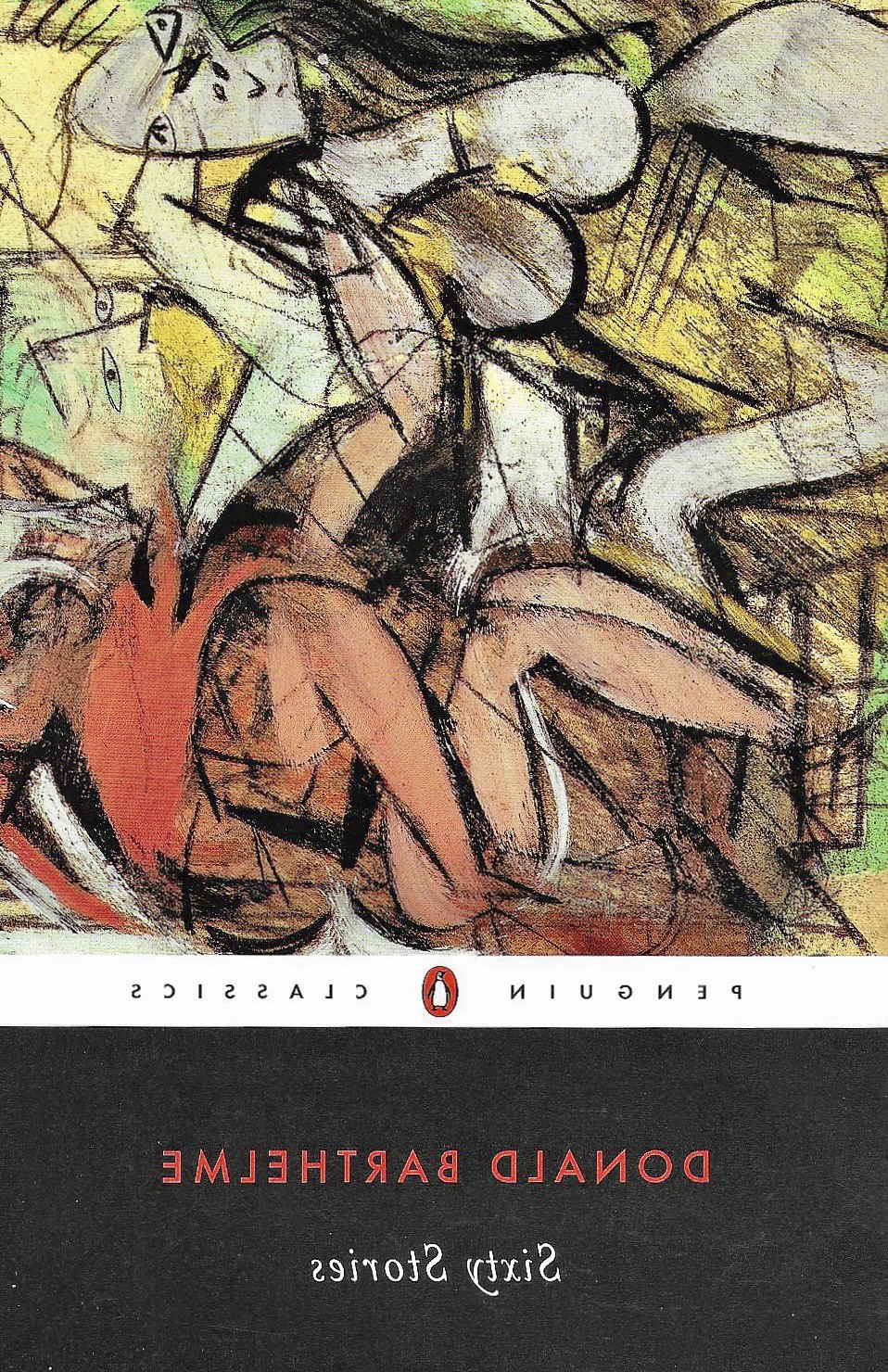
I am rereading Donald Barthelme’s 1981 collection Sixty Stories.

I am reading the stories in reverse chronological order.

This reverse reading came about in this way: I read an intense, shocking, horrifying novel, and then I read it again. Then I tried to get into three or maybe four novels with no luck.

So I picked up the Barthelme book, a perfect book, a palate cleanser. Inside was a bookmark from a Catholic book store in St. Augustine, Florida; the bookmark marked the beginning of the final story in Sixty Stories, “Grandmother’s House.”

I recalled almost nothing about it. I read it, and kept going in reverse.

So here we go–thoughts on the last six stories in Sixty Stories:

60. “Grandmother’s House” (previously uncollected, 1981)

Like many of Barthelme’s late stories, “Grandmother’s House” consists entirely of dialogue. And, like many of Barthelme’s late stories, there’s an elegiac tone–mock-elegiac at times, but still tinged with a soft melancholy. The story begins in the by-now-traditional-postmodern mode of invoking fairy tales. One of the speakers alludes to figures from “Little Red Riding Hood” and “Beauty and the Beast.” They then move on to another trope of fairy tales—changelings, child thefts: “…we could steal a kid. A child. A kid. Steal one. Grab it and keep it. Raise it for our very own.” The dialogue is filled with non sequitur and oblique shifts, evoking the collage work of Barthelme’s prime work while also trundling along a more realistic course. The story ultimately conflates raising children with the creative arts; there’s something slightly sad about the two speakers’ desire to steal children so that they can start again, take a mulligan, improve on past failures. They want a new newness: “Of course this is not to say that what has been demystified cannot be remystified.”

59. “Bishop” (previously uncollected, 1981)

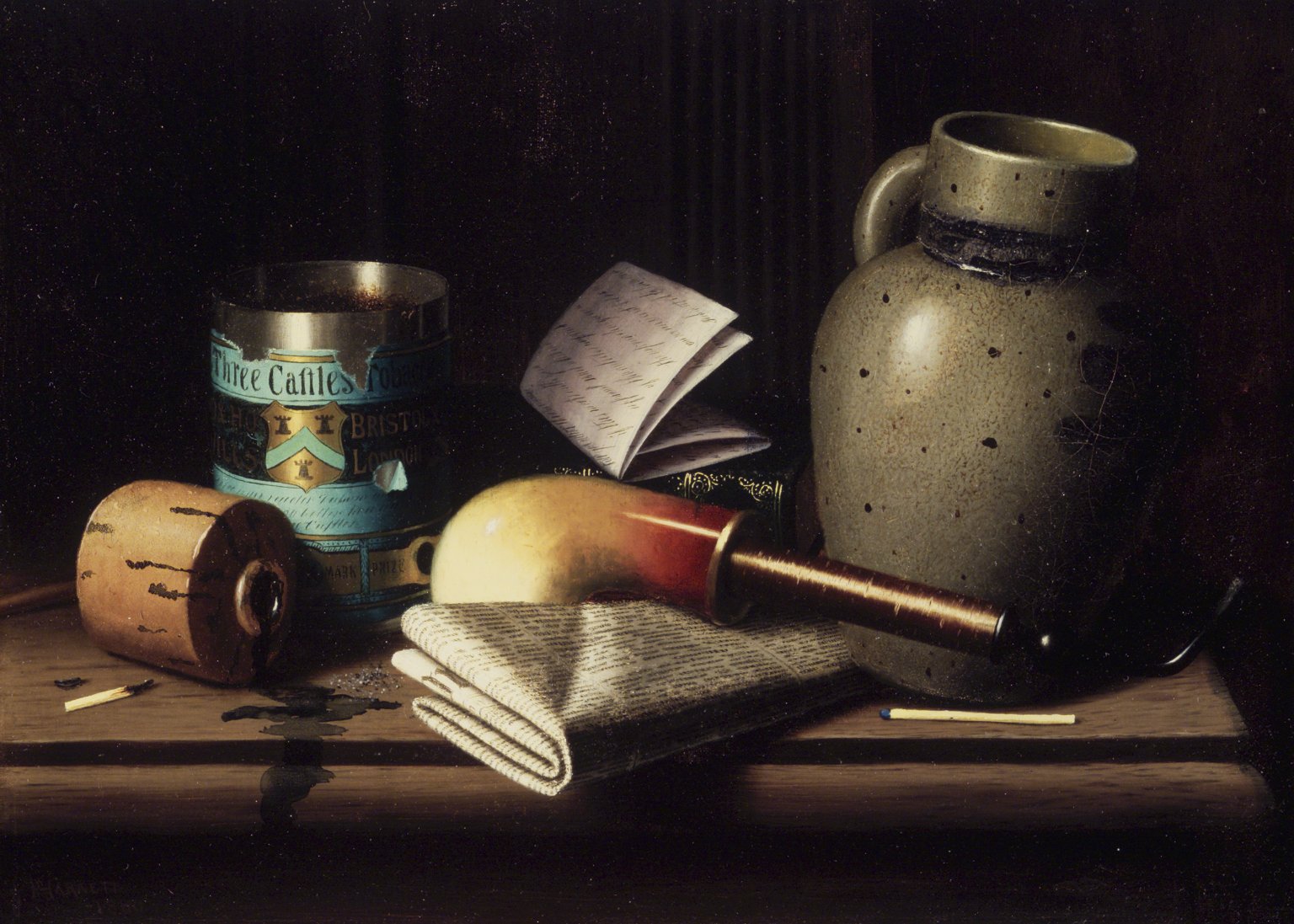
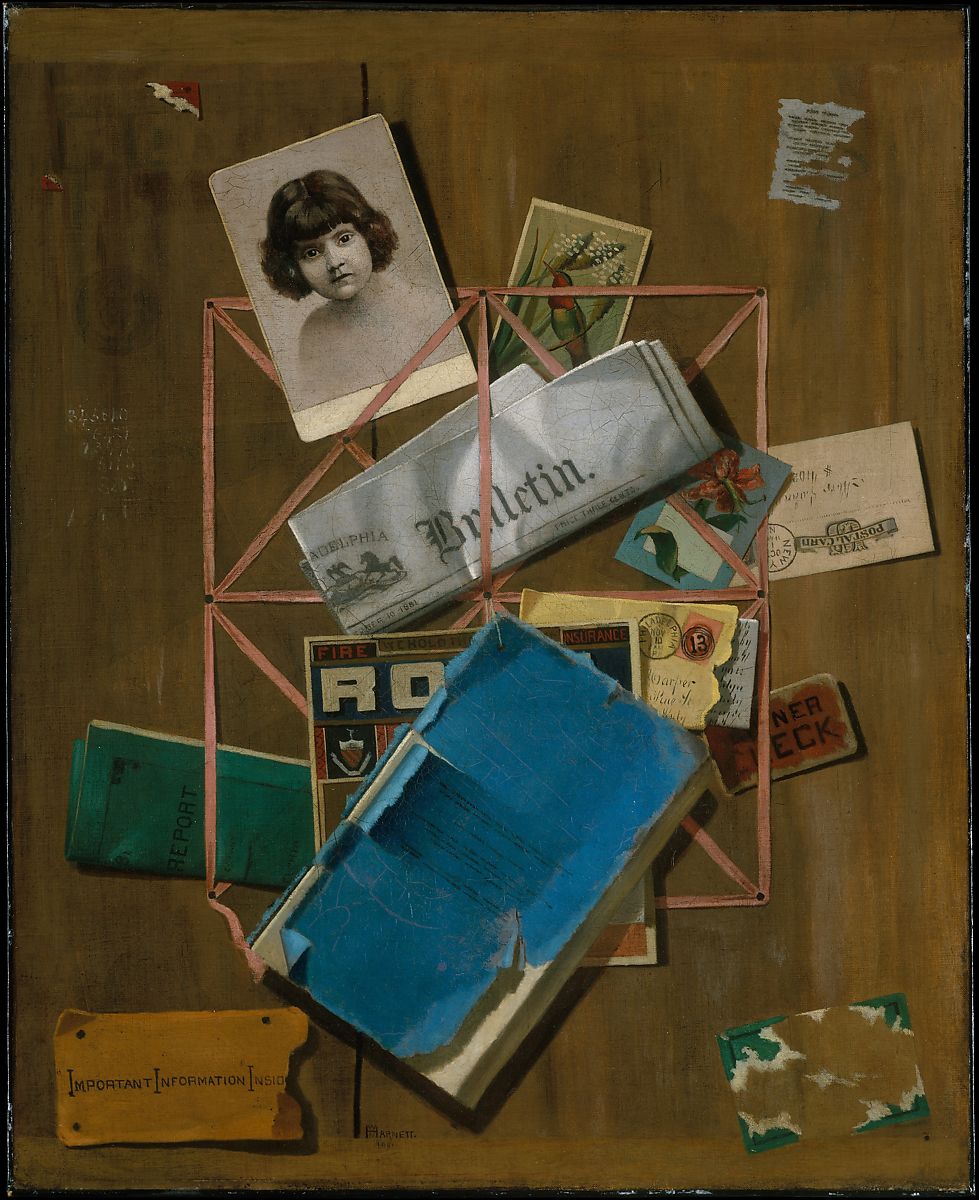
“Bishop” feels like it should be the last story in Sixty Stories. It’s a miniature portrait of an alcoholic writer, the titular Bishop who, in the course of writing a biography of the painter William Michael Harnett, discovers another painter,  John Frederick Peto.

Still Life with Three Castles Tobacco, 1880 by William Michael Harnett (1848-1892).

The story is easily one of Barthelme’s most straightforward, “realistic” pieces, employing very little of the rhetorical arsenal he’d built over the past two decades.

Old Souvenirs, c. 1881–1901 by John Frederick Peto (1854-1907)

However, his collage technique is on display throughout “Bishop,” where sentences jut brusquely against each other without the protection of transitions. Consider the economy of this opening salvo:

Bishop’s standing outside his apartment building.

An oil struck double-parked, its hose coupled with the sidewalk, the green-uniformed driver reading a paperback called Name Your Baby.

Bishop’s waiting for Cara.

The martini rule is not before quarter to twelve.

Eyes go out of focus. He blinks them back again.

He had a beer for breakfast, as usual, a Pilsner Urquell.

Imported beer is now ninety-nine cents a bottle at his market.

The oil truck’s pump shuts off with a click. The driver tosses his book into the cab and begins uncoupling.

Cara’s not coming.

The painter John Frederick Peto made a living Playing cornet in a camp meeting for the last twenty years of his life, according to Alfred Frankenstein.

Bishop goes back inside the building and climbs one flight of stairs to his apartment.

His bank has lost the alimony payment he cables twice a month to his second wife, in London. He switches on the FM, dialing past two classical stations to reach Fleetwood Mac.

Bishop’s writing a biography of the nineteenth-century American painter William Michael Harnett. But today he can’t make himself work.

Cara’s been divorced, once.

At twenty minutes to twelve he makes himself a martini.

Hideous bouts of black anger in the evening. Then a word or a sentence in the tone she can’t bear. The next morning he remembers nothing about it.

As Tracy Daugherty notes in Hiding Man, his biography of Barthelme, “it’s impossible to miss the parallels between author and character” in “Bishop”: “…same age, same physical appearance, same home city, same general profession.”

Barthelme himself protested the comparison in his 1981 Paris Review Interview:

…when [“Bishop”] appeared I immediately began getting calls from friends, some of whom I hadn’t heard from in some time and all of whom were offering Tylenol and bandages. The assumption was that identification of the author with the character was not only permissible but invited. This astonished me. One uses one’s depressions as one uses everything else, but what I was doing was writing a story. Merrily merrily merrily merrily.

There is nothing merry about “Bishop,” but there’s a lot of beauty in its odd realism.

58. “Heroes” (previously uncollected, 1981)

Another piece composed entirely in dialogue, this time between two dudes riffing on the relationship between the media, information, politics, democracy, and the average citizen. There’s a clever bit on TV screens as a “clear glass” through which we now see “darkly,” but the piece seems terribly dated in 2021.

57. “Thailand” (previously uncollected, 1981)

“Thailand” isn’t exactly a dialogue, but it’s again a piece with two speakers, an “old soldier” who served in the “Krian War” and the young man who listens to him—or, more to the point, doesn’t really listen to him. He’s introduced as “his hearer.” Instead of truly listening to the sweet old sergeant’s story about serving along the Thai military, the young hearer speaks to himself, his fragmented inner monologue intermixing with the vet’s exterior monologue, all along a similar vein: “I am young, thought the listener, young, young, praise the Lord I am young.” Again, it’s tempting to read autobiography into the story. Barthelme was drafted into the U.S. Army in 1953, but didn’t really see any action in his sixteen months there. And “Thailand” reflects that—it isn’t an old war story, but a gentle appreciation of time spent in another culture. In one memorable moment, the old soldier recalls a “golden revel” featuring thirty-seven washtubs of curry: “Beef curry, chicken curry, the delicate Thai worm curry, all your various fish curries and vegetable curries.” All the while, the young would-be interlocutor dismisses the old “demento,” culminating in the young man’s cruel final line: Requiescat in pace. The old man gets the punchline though: “They don’t really have worm curry, said the sergeant. I just made that up to fool you.” In my estimation, Thailand” isn’t so much a reminiscence of Barthelme’s army days as it is a story about an aging storyteller. Barthelme was a teacher, and while I’m sure most of his students were rapt, the older author had to know how that old Oedipal thing works.

56. “The Emperor” (previously uncollected, 1981)

A nice, precise little story of nine paragraphs. On one hand, it’s an accumulation of historical details (and some speculation) about China’s first emperor Ch’in Shih
Huang Ti, and his mad quest toward an unattainable perfection. At the same time, the story can be read as a take on the creative imagination at work, striving toward an ideal that the physical world can never quite accumulate. It can be read as a story about writing—writing as a means to attain immortality. Here’s Barthelme on the story, in his 1981 Paris Review interview:

I’ve just done a piece about a Chinese emperor, the so-called first emperor, Ch’in Shih Huang Ti. This came directly from my wife’s research for a piece she was doing on medical politics in Chinatown—she had accumulated all sorts of material on Chinese culture, Chinese history, and I began picking through it, jackdaw-like. This was the emperor who surrounded his tomb with that vast army of almost full-scale terra-cotta soldiers the Chinese discovered just a few years ago. The tomb, as far as I know, has yet to be fully excavated, but the scale of the discovery gives you some clear hints as to the size of the man’s imagination, his ambition. As I learned more about him—“learned” in quotation marks, much of what I was reading was dubious history—I got a sense of the emperor hurrying from palace to palace, I gave him two hundred some-odd palaces, scampering, almost, tending to his projects, intrigues, machinations. He’s horribly, horribly pressed for time, both actually and in the sense that many of his efforts are strategies against mortality. The tomb itself is a strategy, as is the imposition of design on the lives of his people, his specifications as to how wide hats shall be, how wide carriages shall be, and so forth.

55. “The Farewell” (previously uncollected, 1981)

A minor if entertaining dialogue between Maggie and Hilda, “The Farewell” is a sequel to “On the Steps of the Conservatory” (Great Days, 1979), and like that tale, it satirizes hierarchy in academia (and pseudo-intellectualism in general). And as silly as the whole thing is, there’s a kernel of pathos there in the story’s (off-centered center). Poor Hilda (who cannot for some reason see that she should tell her snooty snobby toxic friend Maggie to Fuck off) has finally made into the Conservatory, only to find that it’s old hat—it’s the Institution that folks are flocking to get into. And why not? As Maggie boasts, “The teachers are more dedicated, twice as dedicated or three times as dedicated.” The boasts continues. At the Institution,

Savory meals are left in steaming baskets outside each wickiup door. All meals are lobster, unless the student has indicated a preference for beautifully marbled beef. There are four Olympic-sized pool tables for every one student.

In the end though, poor Hilda comes up with that classic solution: Well, fuck it.

Summary thoughts: These late and previously-uncollected stories are tinged with melancholy and even resignation at time, and generally follow the same rhetorical mode of a two-person dialogue. Notable themes include anxiety over parenthood, writing, and one’s legacy. The weakest of the six is “Heroes” and the strongest is “Bishop.”

I will keep going (in reverse).

Take Your Choice — John Frederick Peto

Take Your Choice, 1885 by John Frederick Peto (1854-1907)