
From The Masterpiece Part 4 – A Weekend In The Country, 2005 by Olivia Plender (b. 1977)

From The Masterpiece Part 4 – A Weekend In The Country, 2005 by Olivia Plender (b. 1977)
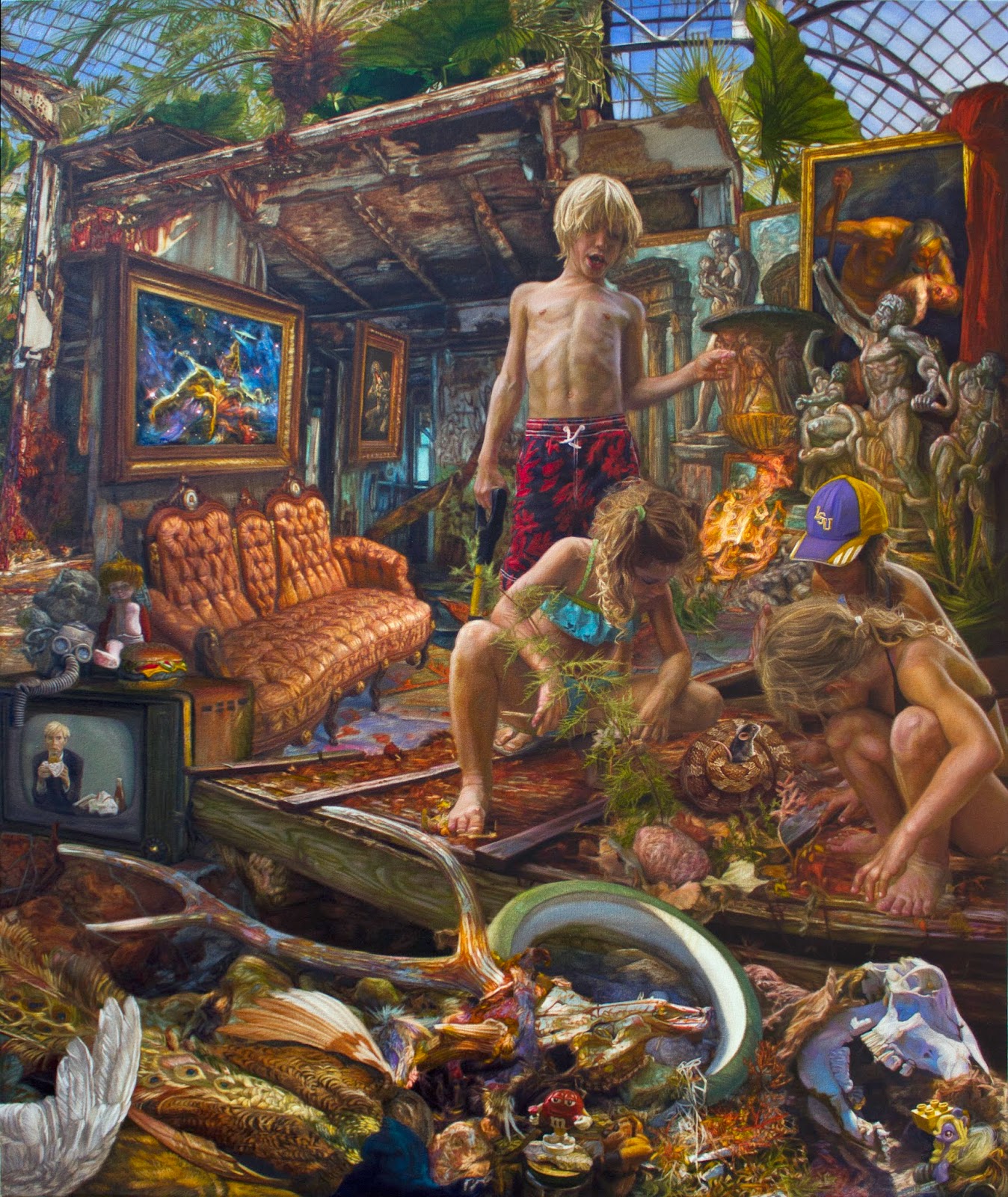 Spectacularly Dying, 2014 by Isaac McCaslin (b. 1989)

The Settlement, 2016 by Peter Martensen (b. 1953)
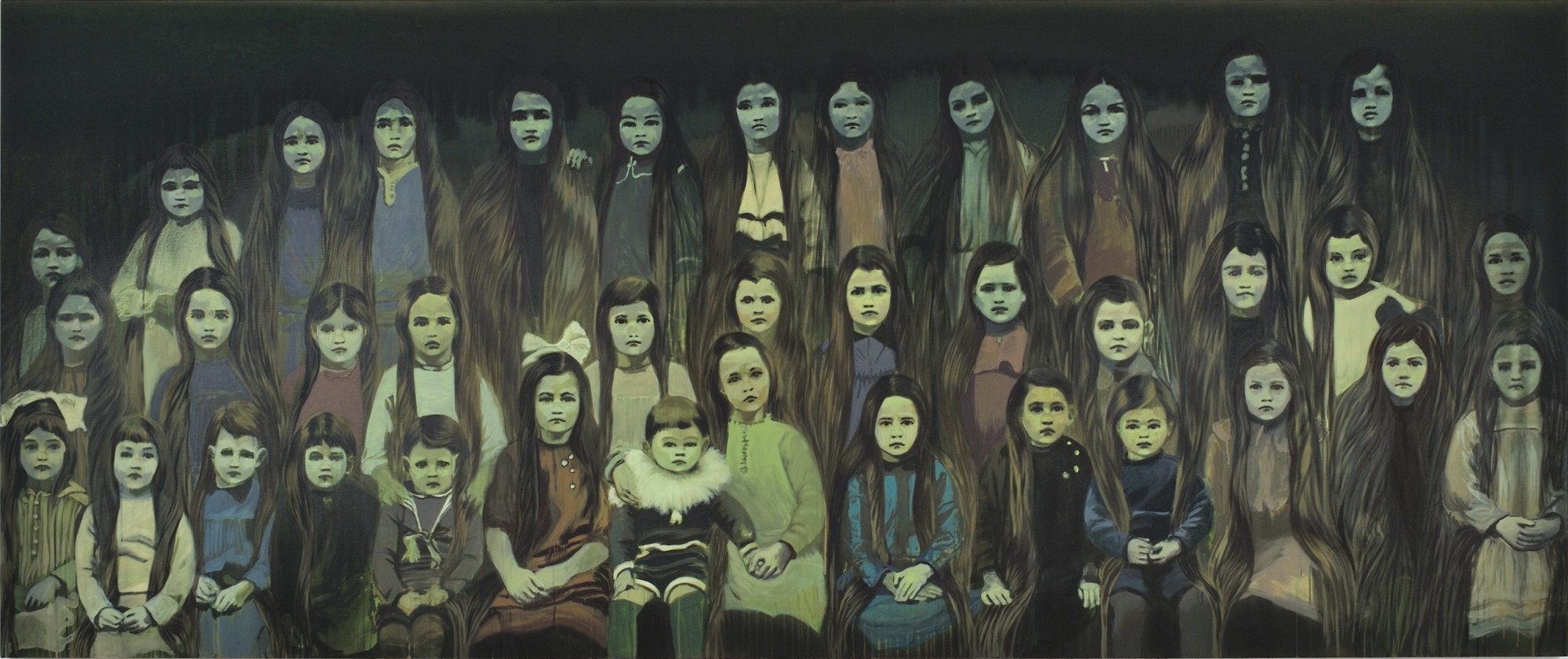
Les Sorcières (The Witches), 2013 by Claire Tabouret (b.1981)

I did not set out to write forty riffs on Herman Melville’s 1851 novel Moby-Dick but that’s where I ended up. I don’t think what I’ve done here is a resource of any worth, but I do hope to encourage people to read this funny, humane, poetic, and devastating novel.
Here are links by chapter to the riffs I riffed on Moby-Dick in 2021.
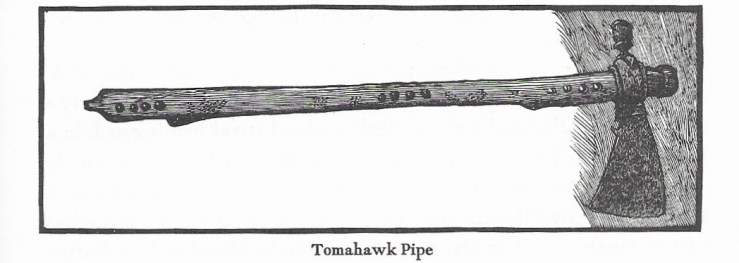
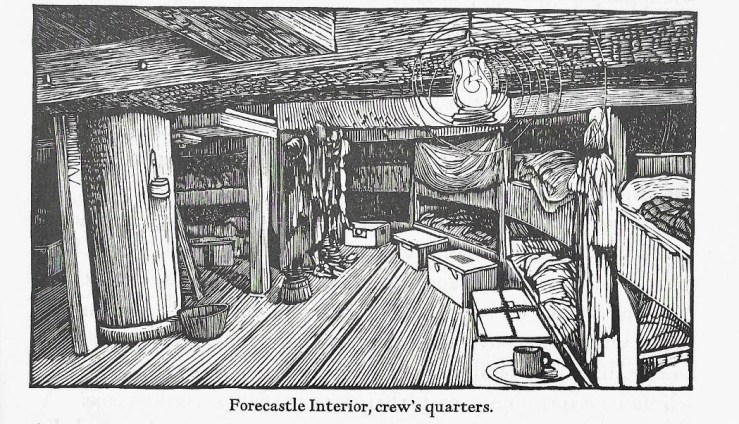
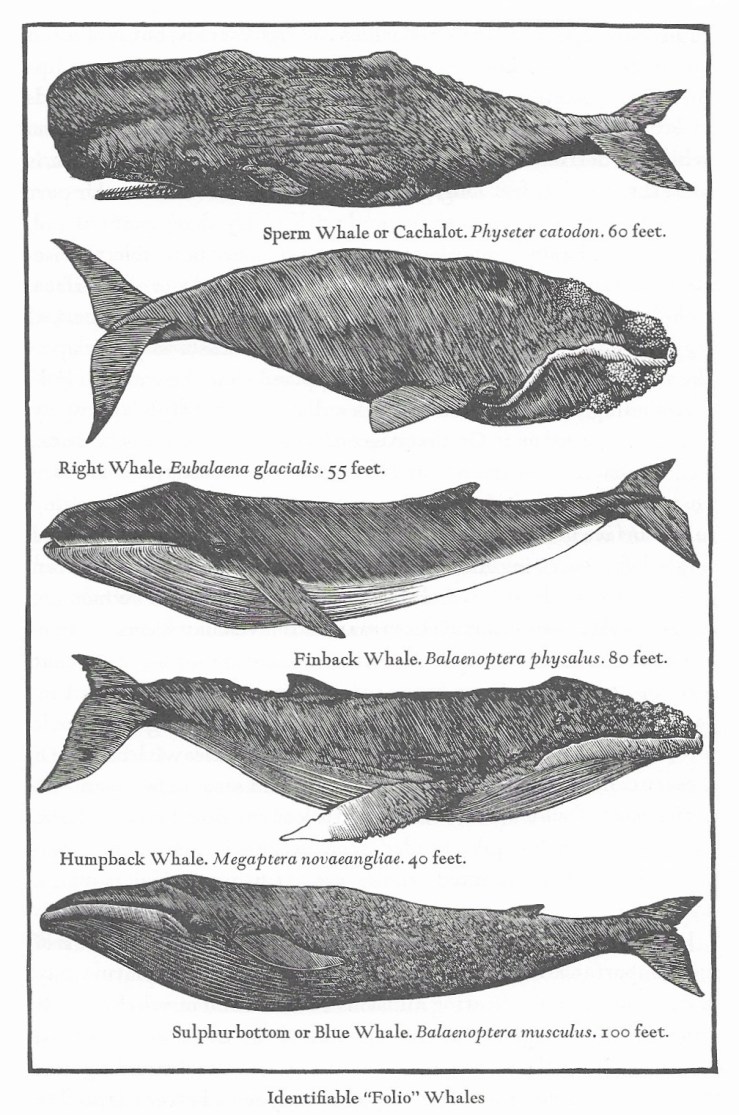
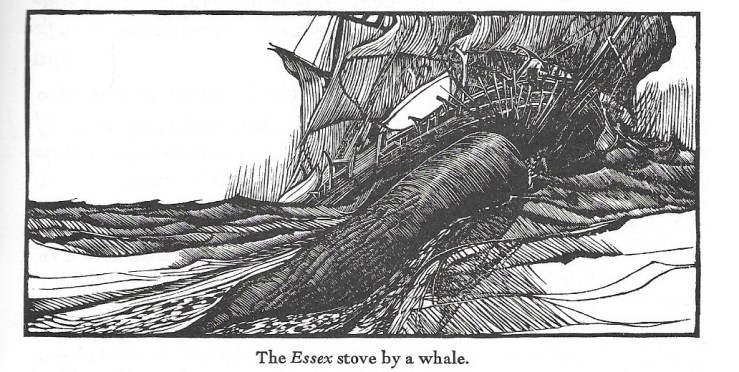
Illustrations in this post are by the American artist Barry Moser.
Ch. 1 (The great flood-gates of the wonder-world swung open)
Ch. 2-4 (Nameless, unimaginable, silent form or phantom)
Ch. 5-8 (All these things are not without their meanings)
Ch. 9-13 (No more my splintered heart and maddened hand were turned against the wolfish world)
Ch. 14-16 (Oblique hints)
Ch. 17-19 (Humbug or bugbear)
Ch. 20-22 (First kick)
Ch. 23-27 (Whaling may well be regarded as that Egyptian mother who bore offspring themselves pregnant from her womb)
Ch. 28-32 (God keep me from ever completing anything)
Ch. 33-35 (Your identity comes back in horror)
Ch. 36 (Talk not to me of blasphemy, man; I’d strike the sun if it insulted me)
Ch. 37-48 (And of all these things the Albino whale was the symbol. Wonder ye then at the fiery hunt?)
Ch. 49-54 (Certain queer times and occasions in this strange mixed affair we call life)
Ch. 55-57 (The great Leviathan is that one creature in the world which must remain unpainted to the last)
Ch. 58-60 (A certain wondrous, inverted visitation of one of those so called judgments of God which at times are said to overtake some men)
Ch. 61-73 (The mystic-marked whale remains undecipherable)

Ch. 74-75 (Why then do you try to “enlarge” your mind? Subtilize it.)
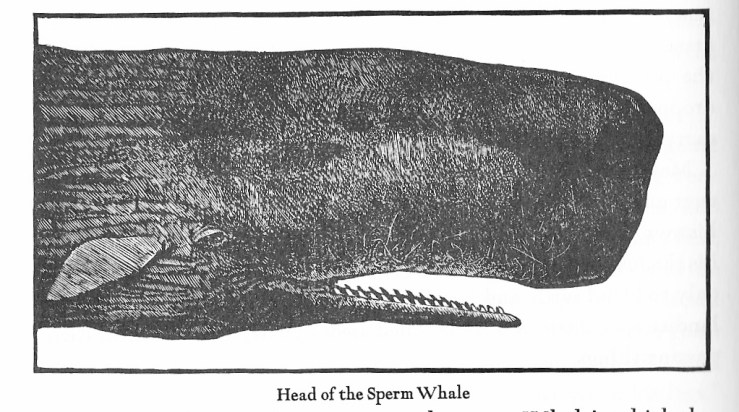
Ch. 76-80 (A very precious perishing)
Ch. 81-83 (There are some enterprises in which a careful disorderliness is the true method)
Ch. 84-86 (Doubts of all things earthly, and intuitions of some things heavenly)
Ch. 87 (There is no folly of the beasts of the earth which is not infinitely outdone by the madness of men)

Ch. 88-90 (Loose-fish/fast-fish)
Ch. 91-93 (The intense concentration of self in the middle of such a heartless immensity, my God! who can tell it?)
Ch. 94-98 (Let us squeeze ourselves universally into the very milk and sperm of kindness)
Ch. 99 (“I look, you look, he looks; we look, ye look, they look”)
Ch. 100 (Face set like a flint)
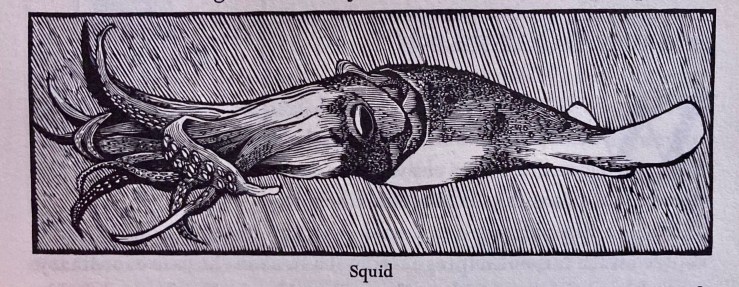
Ch. 101-05 (Horror-struck at this antemosaic, unsourced existence of the unspeakable terrors of the whale)
Ch. 106-08 (The ineffaceable, sad birth-mark in the brow of man, is but the stamp of sorrow in the signers)
Ch. 109-11 (Millions of mixed shades and shadows, drowned dreams, somnambulisms, reveries)
Ch. 112 (Death is only a launching into the region of the strange Untried)
Ch. 113-17 (Our souls are like those orphans whose unwedded mothers die in bearing them)
Ch. 118-19 (Thy incommunicable riddle, thy unparticipated grief)
Ch. 120-22 (All of us are Ahabs)
Ch. 123 (Wild nights)
Ch. 124-26 (Human sort of wail)
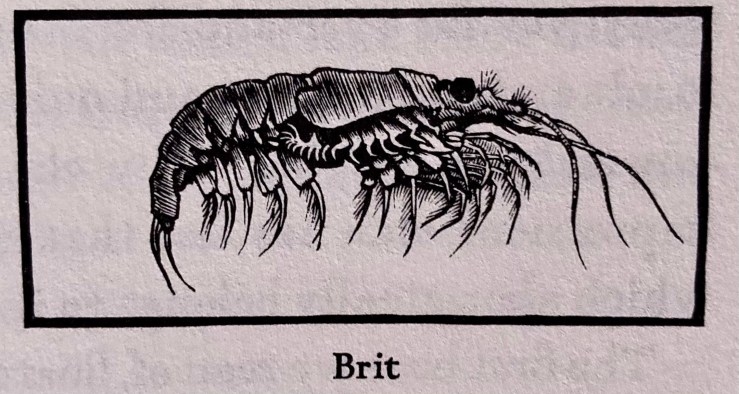
Ch. 127-29 (A life-buoy of a coffin! Does it go further?)
Ch. 130-32 (The least heedful eye seemed to see some sort of cunning meaning in almost every sight)
Ch. 133-34 (That wild simultaneousness of a thousand concreted perils)
Ch. 135-Epilogue (The drama’s done)
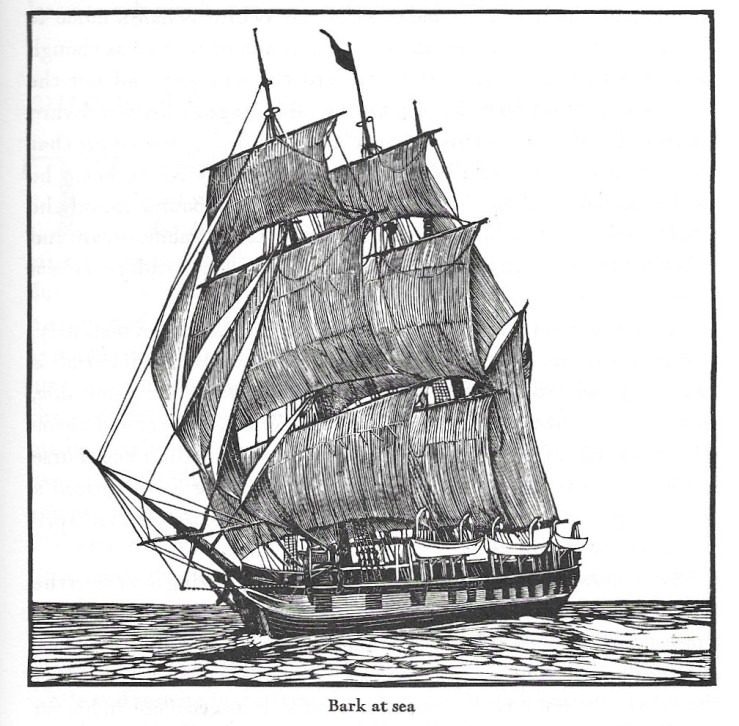
And because I landed (or drowned?) at forty, here’s Ahab, near the end of the novel, wailing on forty:
Oh, Starbuck! it is a mild, mild wind, and a mild looking sky. On such a day—very much such a sweetness as this—I struck my first whale—a boy-harpooneer of eighteen! Forty—forty—forty years ago!—ago! Forty years of continual whaling! forty years of privation, and peril, and storm-time! forty years on the pitiless sea! for forty years has Ahab forsaken the peaceful land, for forty years to make war on the horrors of the deep! Aye and yes, Starbuck, out of those forty years I have not spent three ashore. When I think of this life I have led; the desolation of solitude it has been; the masoned, walled-town of a Captain’s exclusiveness, which admits but small entrance to any sympathy from the green country without—oh, weariness! heaviness! Guinea-coast slavery of solitary command!—when I think of all this; only half-suspected, not so keenly known to me before—and how for forty years I have fed upon dry salted fare—fit emblem of the dry nourishment of my soil!—when the poorest landsman has had fresh fruit to his daily hand, and broken the world’s fresh bread to my mouldy crusts—away, whole oceans away, from that young girl-wife I wedded past fifty, and sailed for Cape Horn the next day, leaving but one dent in my marriage pillow—wife? wife?—rather a widow with her husband alive! Aye, I widowed that poor girl when I married her, Starbuck; and then, the madness, the frenzy, the boiling blood and the smoking brow, with which, for a thousand lowerings old Ahab has furiously, foamingly chased his prey—more a demon than a man!—aye, aye! what a forty years’ fool—fool—old fool, has old Ahab been! Why this strife of the chase? why weary, and palsy the arm at the oar, and the iron, and the lance? how the richer or better is Ahab now?
(I feel richer now after the re-read.)
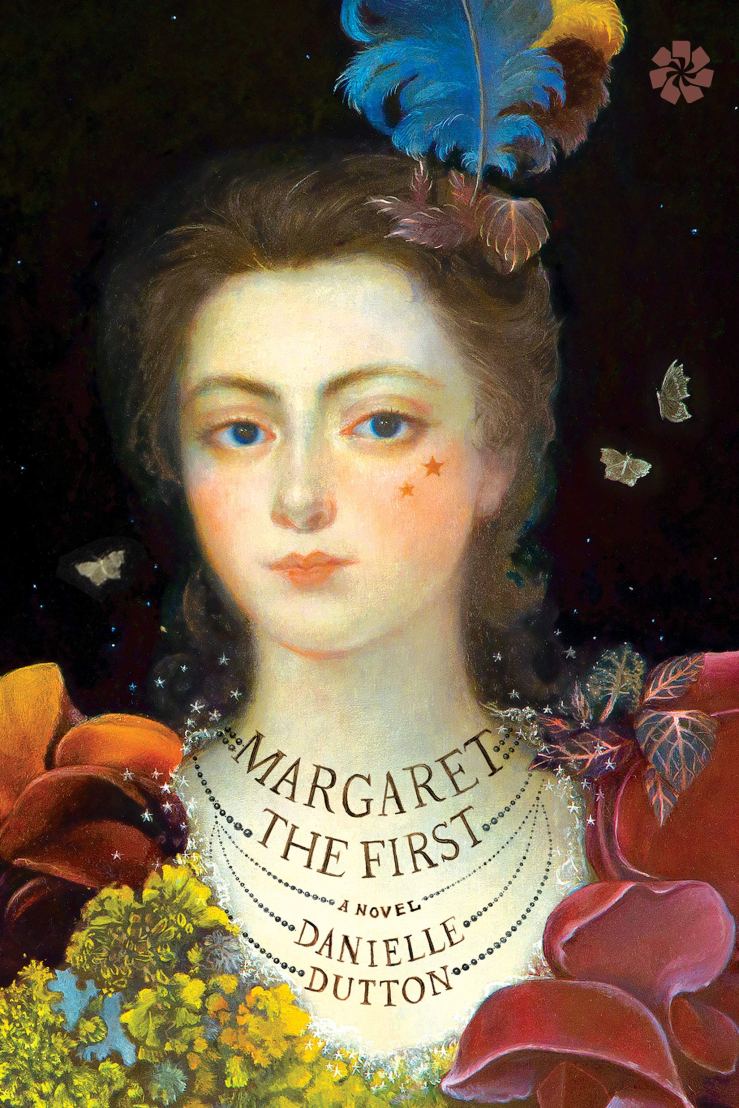
Margaret Lucas Cavendish, Duchess of Newcastle-upon-Tyne was born to a wealthy aristocratic family who took the royalist side in the English Civil War. She spent her teen years attending the exiled Queen Henrietta Maria as a handmaiden. She soon married William Cavendish, the Marquess of Newcastle (and a steadfast royalist), and lived with him in exile in Antwerp. During this time, she began writing and publishing strange volumes on various topics—science, fashion, language, wit, and the act of writing itself. Her eccentric writing mirrored her eccentric habits. Simultaneously shy and fame-hungry, often depressed or elated and manic, Cavendish earned and maintained a notorious reputation over her lifetime.
Danielle Dutton somehow condenses Cavendish’s starbright life into a slim 160 pages in her novel Margaret the First. This imaginative near-biography borrows from Cavendish’s own writings as well as an essay on Cavendish by Virginia Woolf. Woolf thought Cavendish a cautionary tale. In A Room of One’s Own, Woolf describes her as a brilliant but uneducated woman who “frittered her time away scribbling nonsense and plunging ever deeper into obscurity and folly.” Dutton captures that reputation early in the novel: “Mad Madge,” goes the cry among a crowd of onlookers at the novel’s outset (the crowd includes the diarist Samuel Pepys). However, Dutton is far more sympathetic toward Margaret, conjuring for us a natural composer. Consider these lines from Margaret the First’s opening paragraph:
She made the world her book, took a piece of coal and marked a blank white wall. Later, she made sixteen smaller books: untitled, sewn with yarn. Her girlhood heroes were Shakespeare, Ovid, Caesar. She wrote them in beside thinking-rocks and humming-shoes and her favorite sister, Catherine, who starred in all but five. Snow fell fast as she sat by the nursery fire; ink to paper, then she sewed. The last book told a tale of hasty gloom, teeming with many shades of green: emerald, viridian, a mossy black. In it we meet a miniature princess who lives in a seashell castle and sleeps in sheets woven from the eyelids of doves.
Dutton roped me in with “tale of hasty gloom,” but the images in that last sentence—sheets woven from the eyelids of doves!—propelled my reading on.
We see here Cavendish as a creator of both books and her own world. Dutton’s narrator notes Cavendish—or shall I use Margaret here?—Dutton’s narrator notes that our protagonist not only writes her books, but sews them. The image of creation as fashion—as literally fashioning objects and ideas—repeats throughout Margaret the First. Margaret tells her patient older husband William that “dressing is the poetry of women.” She finds near-epiphanic inspiration in a masquerade costume worn by Christina, Queen of Sweden, who dresses as an Amazon warrior, baring her breasts to the entire court. Later she wonders, “why must grammar be like a prison for the mind? Might not language be as a closet full of gowns? Of a generally similar cut, with a hole for the head and neck to pass, but filled with difference and a variety of trimmings so that we don’t grow bored?”
Critics of Cavendish attacked her spelling and grammar; Woolf declared her “crack-brained and bird-witted.” Dutton’s portrait though gives us something closer to Emily Dickinson or William Blake. Margaret’s an eccentric who turns her eccentricity into a strange new art that resisted grammar that would be “a prison for the mind.”
And yet Dutton is never too-beholden to her subject. We are never told that Margaret is a genius; rather, Dutton attunes us to Margaret’s own singular perceptions—we feel flashes of genius, but also feel Margaret’s frustrated inability to harness that genius into a form that seventeenth-century England can recognize. She is always at the margin of the circle, too eccentric to orbit neatly with the intellectual luminaries whom she encounters.
We also feel the tinges of Margaret’s melancholic mental instability. Alone in a carriage, she retreats into her mind’s eye:
I found myself in an unknown universe, whirling far into space. African servants, dogs in hats, platonic ideals, sparkling conversation, and ivy-coated quadrangles with womanizing captains, dueling earls, actors. I met Father Cyprien de Gamache, her majesty’s wily confessor; William, a poet, who claimed to be Shakespeare’s son; and a giggling dwarf called Jeffry, who’d been presented to the queen in a pie. I met the ladies-in-waiting, too, who hardly looked my way, busy as they were, bickering over who went where and when, who wore what and when, who fetched what and why, who said what and to whom, and who gave her the right to say that.
Tellingly, the cluttered images in Margaret’s fantasy dissolve into the too-banal reality of the grammar of manners: who can wear what, who can say what, and so on. To cop a phrase from Blake, those “mind-forg’d manacles” are hard to break. Indeed, mind-forg’d manacles tend to break those who resist them. “Much Madness is divinest Sense,” Emily Dickinson noted, but also pointed out that those who resist the grammar of manners are “straightway dangerous -/ And handled with a Chain.”
Margaret avoids the chain, and if the world is a bit too much for her to bear at time, she fashions it into Something Else. This is the joy of Margaret the First. Dutton could have crafted the tale as a tragedy, but instead she gives us something else—something rich, generative, imagistic, occasionally unsettling, and ultimately deeply endearing. Highly recommended.

Caught Fire and Fury, 2019 by Jesse Mockrin (b. 1981)
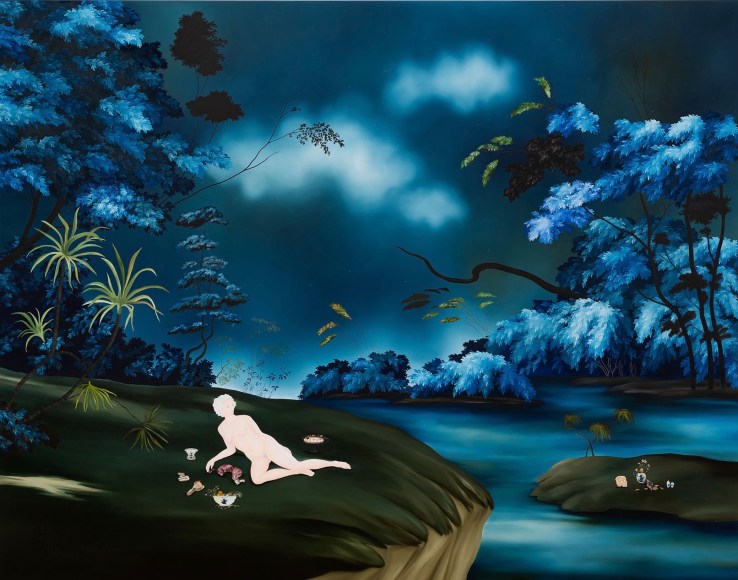
This Is the Beast with a Thousand Mouths That Must Be Fed Twice a Day, 2017 by Sanam Khatibi (b. 1979)
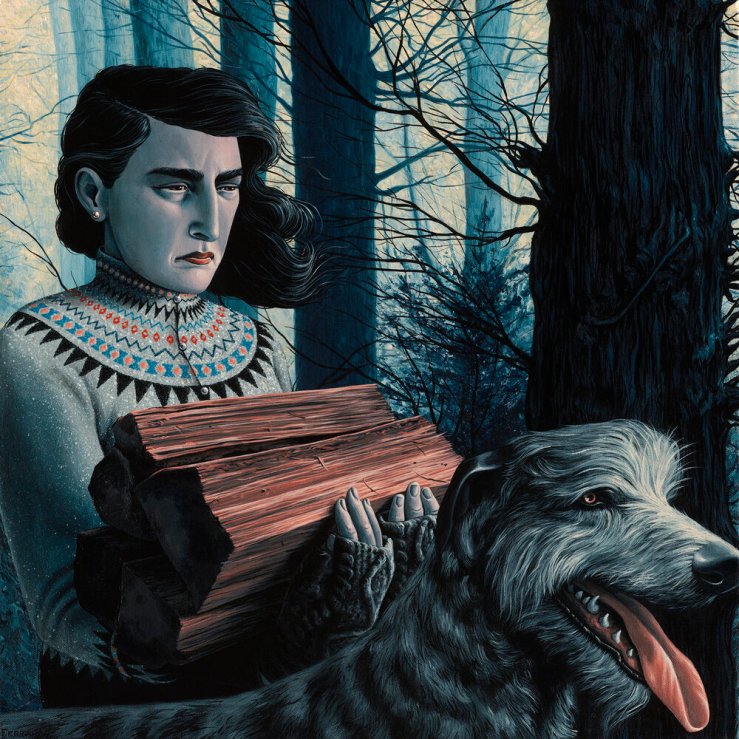
We Had Different Plans, 2020 by Gregory Ferrand (b. 1975)
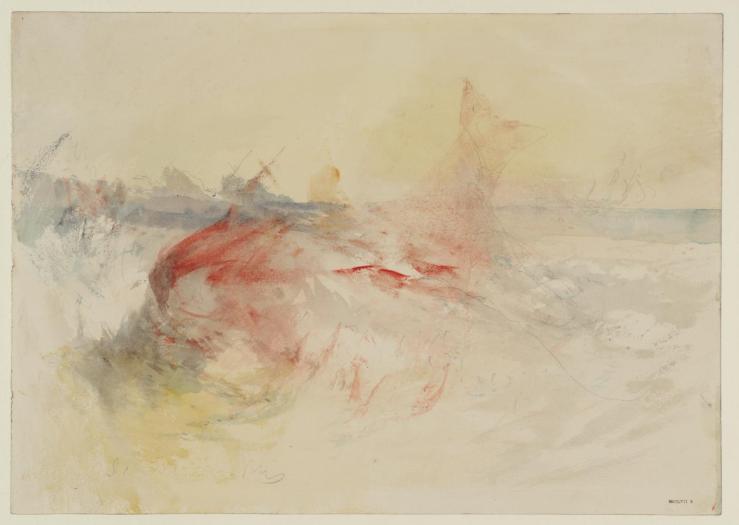
A Harpooned Whale, 1845 by Joseph Mallord William Turner (1775-1851)

I. In this riff, Chapter 135, “The Chase—Third Day” and the Epilogue of Moby-Dick.
The beginning of the end begins, “The morning of the third day dawned fair and fresh” — we are in the tranquil pacified Pacific, beautiful blue, the calm site of a coming calamity.
II. After calling for news of the White Whale, Ahab riffs to himself on the wind. The wind is an apparently concrete force that operates with abstract agency. The wind is a kind of fate, an invisible entity that both propels and repels objects of the phenomenal world:
Would now the wind but had a body; but all the things that most exasperate and outrage mortal man, all these things are bodiless, but only bodiless as objects, not as agents. There’s a most special, a most cunning, oh, a most malicious difference! And yet, I say again, and swear it now, that there’s something all glorious and gracious in the wind.
III. Ahab glimpses his folly: “I’ve oversailed him,” he mutters about Moby Dick, continuing, “How, got the start? Aye, he’s chasing me now; not I, him—that’s bad; I might have known it, too. Fool!”
The fool there is of course a bit of self-talk Ahab directs to his self-same self.
IV. This final chapter is full of self-talk. Starbuck’s inner monologue turmoils, “I misdoubt me that I disobey my God in obeying him!” Ahab swears to meet Moby Dick, “Forehead to forehead…this third time”; we enter the final private thoughts of Stubb and Flask (but never the pagan harpooneers).
As always, my question remains—
How does Ishmael bear witness to these voices?
V. In a potent soliloquy, Ahab’s sentimentality takes over. He addresses the vast ocean, “the same to Noah as to me.” He seems to portend his own demise, and is distracted momentarily by the “lovely leewardings” that “must lead somewhere—to something else than common land, more palmy than the palms.” But he won’t escape: “Leeward! the white whale goes that way; look to windward, then; the better if the bitterer quarter. But good bye, good bye, old mast-head!”
By the end of the soliloquy Ahab is again convinced — or maybe not wholly convinced, but nevertheless affirming — of his impending victory. He addresses the masthead anew: “We’ll talk to-morrow, nay, to-night, when the white whale lies down there, tied by head and tail.”
VI. Ahab rejects two final calls to remain and retreat. The first is Starbuck’s:
“Some men die at ebb tide; some at low water; some at the full of the flood;—and I feel now like a billow that’s all one crested comb, Starbuck. I am old;—shake hands with me, man.”
Their hands met; their eyes fastened; Starbuck’s tears the glue.
Starbuck’s tears the glue! What a line!
The second entreaty I take to be Ahab’s other first mate, the mad cabinboy Pip:
“Oh, my captain, my captain!—noble heart—go not—go not!—see, it’s a brave man that weeps; how great the agony of the persuasion then!”
“Lower away!”—cried Ahab, tossing the mate’s arm from him. “Stand by the crew!”
“The sharks! the sharks!” cried a voice from the low cabin-window there; “O master, my master, come back!” But Ahab heard nothing; for his own voice was high-lifted then; and the boat leaped on.
Ahab rejects all fellow-feeling here. His monomaniacal voice overtakes all bandwidth, drowning out any sensation of otherness.
VII. The sharks follow Ahab’s boat like “vultures hover over the banners of marching regiments in the east”; as usual, Melville is not shy about slathering on the foreshadowing. He enlists Starbuck’s help; the Christian mate remarks that this, “the third evening,” be “the end of that thing—be that end what it may.”
VIII. Meanwhile, Ahab repeats pagan Fedallah’s pagan prophecy: “Drive, drive in your nails, oh ye waves! to their uttermost heads drive them in! ye but strike a thing without a lid; and no coffin and no hearse can be mine:—and hemp only can kill me! Ha! ha!”
Those dashes, those exclamations—that madness!
IX. Moby Dick then resurfaces, all veils, rainbows, milk:
A low rumbling sound was heard; a subterraneous hum; and then all held their breaths; as bedraggled with trailing ropes, and harpoons, and lances, a vast form shot lengthwise, but obliquely from the sea. Shrouded in a thin drooping veil of mist, it hovered for a moment in the rainbowed air; and then fell swamping back into the deep. Crushed thirty feet upwards, the waters flashed for an instant like heaps of fountains, then brokenly sank in a shower of flakes, leaving the circling surface creamed like new milk round the marble trunk of the whale.
Our boy Moby Dick sets to violence, dashing the boats of Daggoo and Queequeg.
X. The violent spectacle culminates in the most gruesome imagery within Moby-Dick. We learn the fated fate of fated Fedallah:
Lashed round and round to the fish’s back; pinioned in the turns upon turns in which, during the past night, the whale had reeled the involutions of the lines around him, the half torn body of the Parsee was seen; his sable raiment frayed to shreds; his distended eyes turned full upon old Ahab.
XI. Ahab commands his sailors to remain rowing after the White Whale, despite the downed lieutenants and zombified harpooneer. He threatens them:
Down, men! the first thing that but offers to jump from this boat I stand in, that thing I harpoon. Ye are not other men, but my arms and my legs; and so obey me.—
Ahab, who has repeated the idea that his mates are but mechanical things throughout the novel, here spells out his distance from human sympathy, his complete fascistic capitulation. “Ye are not other men” is the exact opposite of the Gospels’ injunction to do unto others. Ahab fails Starbuck’s moral test—and Ishmael’s.
XII. Ahab sees his pagan harpooneers and wrecked mates return to The Pequod to repair boats and rearm:
…he saw Tashtego, Queequeg, and Daggoo, eagerly mounting to the three mast-heads; while the oarsmen were rocking in the two staved boats which had but just been hoisted to the side, and were busily at work in repairing them. One after the other, through the port-holes, as he sped, he also caught flying glimpses of Stubb and Flask, busying themselves on deck among bundles of new irons and lances. As he saw all this; as he heard the hammers in the broken boats; far other hammers seemed driving a nail into his heart. But he rallied. And now marking that the vane or flag was gone from the main-mast-head, he shouted to Tashtego, who had just gained that perch, to descend again for another flag, and a hammer and nails, and so nail it to the mast.
I’ve quoted at length because I think our eyes should be trained on Tashtego, the Native American twice now denied his proper place. He was the first to raise a whale on The Pequod’s voyage (denied by Stubb), and the first to raise Moby Dick (denied by Ahab). Tash will be the last to go down with the ship, nailing a new banner to its highest mast.
XIII. Meanwhile, the sharks chew and chomp at the oarsmen’s oars in Ahab’s whaleboat, to the point “that the blades became jagged and crunched, and left small splinters in the sea, at almost every dip.”
They row on.
XIV. Ahab’s boat comes about and he darts “his fierce iron, and his far fiercer curse into the hated whale.” Three of his oarsmen are knocked from the boat, and only two return, although the one who bobs asea is reported “still afloat and swimming.”
This third castaway is Ishmael.
XV. Moby Dick then attacks The Pequod, “bethinking it—it may be—a larger and nobler foe.”
(“‘The whale! The ship!’ cried the cringing oarsmen.”)
XVI. The White Whale destroys The Pequod, and Melville takes us into the last lungfuls of language from the three mates, Starbuck, Stubb, and Flask. These are mini-monologues that Moby Dick’s ensuing vortex will swamp to oblivion.
“My God, stand by me now!” beseeches Starbuck; “Stand not by me, but stand under me, whoever you are that will now help Stubb,” Stubb non-prays, before praying against this “most mouldy and over salted death”— he’d prefer “cherries! cherries! cherries!” And Flask? “Cherries? I only wish that we were where they grow.” Poor Flask then think of his dear mama, before the ship fails.
XVII. Moby Dick wrecks The Pequod. The crew (in Ishmael’s telling) bears witness:
…all their enchanted eyes intent upon the whale, which from side to side strangely vibrating his predestinating head, sent a broad band of overspreading semicircular foam before him as he rushed. Retribution, swift vengeance, eternal malice were in his whole aspect, and spite of all that mortal man could do, the solid white buttress of his forehead smote the ship’s starboard bow, till men and timbers reeled. Some fell flat upon their faces. Like dislodged trucks, the heads of the harpooneers aloft shook on their bull-like necks. Through the breach, they heard the waters pour, as mountain torrents down a flume.
XVIII. As Ahab watches the disaster, he comes to understand Fedallah’s prophecy: “The ship! The hearse!—the second hearse!” cried Ahab from the boat; “its wood could only be American!”
XIX. And then—
Ahab’s final speech:
Oh, now I feel my topmost greatness lies in my topmost grief. Ho, ho! from all your furthest bounds, pour ye now in, ye bold billows of my whole foregone life, and top this one piled comber of my death! Towards thee I roll, thou all-destroying but unconquering whale; to the last I grapple with thee; from hell’s heart I stab at thee; for hate’s sake I spit my last breath at thee. Sink all coffins and all hearses to one common pool! and since neither can be mine, let me then tow to pieces, while still chasing thee, though tied to thee, thou damned whale! Thus, I give up the spear!
Ahab is knocked from the boat, and hanged in hemp and hate.
XX. The Pequod sinks, but
the pagan harpooneers still maintained their sinking lookouts on the sea. And now, concentric circles seized the lone boat itself, and all its crew, and each floating oar, and every lance-pole, and spinning, animate and inanimate, all round and round in one vortex, carried the smallest chip of the Pequod out of sight.
The final image is devastating: Tashtego nails a seahawk to the mast. Again, forgive me for quoting at length:
…as the last whelmings intermixingly poured themselves over the sunken head of the Indian at the mainmast…a red arm and a hammer hovered backwardly uplifted in the open air, in the act of nailing the flag faster and yet faster to the subsiding spar. A sky-hawk that tauntingly had followed the main-truck downwards from its natural home among the stars…now chanced to intercept its broad fluttering wing between the hammer and the wood; and simultaneously feeling that ethereal thrill, the submerged savage beneath, in his death-gasp, kept his hammer frozen there; and so the bird of heaven, with archangelic shrieks, and his imperial beak thrust upwards, and his whole captive form folded in the flag of Ahab, went down with his ship, which, like Satan, would not sink to hell till she had dragged a living part of heaven along with her, and helmeted herself with it.
What an image!
(I have nothing to add here.)
XXI (Excepting, I would add: I think Melville loads so much in this near-final image of his big book. There are only two paragraphs after this one: a scant sentence that’s basically an exhalation from the image of a submerged Tashtego nailing a hawk to the mast of the sinking Pequod—and then the Epilogue. The Pequod takes its name from an extinct Native American tribe. Tashtego is doubly-denied his due as the First to raise whale. Melville seems to point back to America’s founding as a genocidal project here. I probably need to reread the book again, I now realize. Or maybe read some commenters on this matter that I’ve yet to read. I hate to stick this thought in parentheses, as it’s the thing that interests me the most at the end of this reread—Tashtego the Indian, I mean.)
XXII. And so well the end of the end, the Epilogue.
Here it is in the Arion Press edition I read this time through:

XXIII. Ishmael survives, “floating on the margin of the ensuing scene, and in full sight of it.”
What a position! To be both marginal and omnipresent, both at edge and center to the drama, comedy, tragedy of it all!
The notation from the Book of Job is everything here—the disaster is only a disaster if there is one to bear witness to it. Otherwise, disaster is simply a phenomenological event in nature—random, stochastic, energy, mass, and matter moving without meaning.
Ahab pretends at a great searcher for meaning, but he fixes his search on vengeance. “Madness!” Starbuck chides (if Starbuck could chide) — “To be enraged with a dumb thing, Captain Ahab, seems blasphemous.” Ahab has read too deep, read too twisted—he’s a bad reader, a mutant reader, an overreader—but he’s failed repeatedly to read the souls and faces of his fellows.
XXIV. The final curse and blessing is upon Ishmael though. He names himself at the novel’s famous outset — “Call me Ishmael” — a call that likens him to Hagar’s outcast son. At its end, he likens himself to another outcast, “another Ixion,” all the while circling into a vortex of nature, meaning, language—all the forces that would swallow him. (He’s Melville’s maddened howl here.)
Ishmael floats on “a soft and dirgelike main,” bobbing alive on Queequeg’s coffin, the strange lifebuoy of his strange bedfellow, until he’s saved by The Rachel—the ship Ahab had earlier denied—which still cruises for a lost son. He is not the lost son, but he has been lost, and is here saved by The Rachel’s “retracing search after her missing children” — a retracing, a rereading, a rewriting — one that surfaces the wailing of only another orphan.

Tea, 2020 by Salman Toor (b. 1983)
“Nomad Exquisite”
by
Wallace Stevens
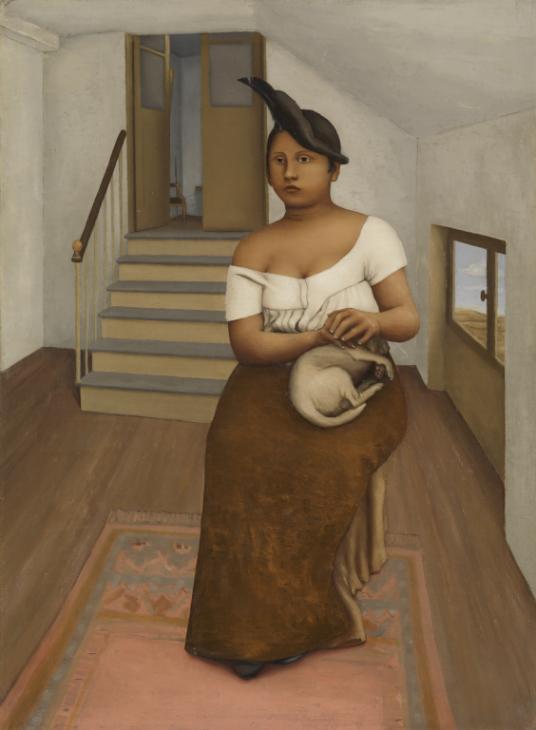
Seated Woman with Small Dog, c.1939 by Meraud Guevara (1904-1993)

I. In this riff, Chapters 133-134 of Moby-Dick.
II. Ch. 133, “The Chase—First Day.”
We finally get there.
Ahab has posed one question throughout the book: “Hast seen the White Whale?”
That is the only viewpoint that matters to him—a viewpoint that can point him toward vengeance.
He gets to answer his own question:
“There she blows!—there she blows! A hump like a snow-hill! It is Moby Dick!”
And then the chase begins.
III. Ahab demands of his lookouts whether or not they sighted Moby Dick first. Tashtego claims that he, “saw him almost that same instant, sir, that Captain Ahab did,” but Ahab denies this (much as Stubb takes credit for the first whale The Pequod sights much earlier in the novel).
Ahab is ever-dominant: “Not the same instant; not the same—no, the doubloon is mine, Fate reserved the doubloon for me. I only; none of ye could have raised the White Whale first.”
Ahab’s “I only” condenses his monomania to three syllables.
Ahab’s monomania turns his rhetoric into a series of repetitions through which he tunes himself to the rhythm of the whale:
“There she blows!—there she blows!—there she blows! There again!—there again!” he cried, in long-drawn, lingering, methodic tones, attuned to the gradual prolongings of the whale’s visible jets.
IV. Ahab and his mates set to their boats to chase the White Whale—only Starbuck remains, as previously commanded by Ahab. Omnipresent Ishmael, shows us Ahab seeing Moby Dick: “He saw the vast, involved wrinkles of the slightly projecting head beyond.” And then, in a remarkable passage, we get what I think is Ishmael seeing Moby Dick, or Ishmael seeing Moby Dick as he wished Ahab could see Moby Dick:
A gentle joyousness—a mighty mildness of repose in swiftness, invested the gliding whale. Not the white bull Jupiter swimming away with ravished Europa clinging to his graceful horns; his lovely, leering eyes sideways intent upon the maid; with smooth bewitching fleetness, rippling straight for the nuptial bower in Crete; not Jove, not that great majesty Supreme! did surpass the glorified White Whale as he so divinely swam.
The whale here is godlike. But remember that Ahab would strike the sun, would cast down the Titans.
V. Ahab and his men continue to hunt the godlike whale “through the serene tranquillities of the tropical sea”; Moby Dick ducks and dives, refusing them the sight of “the full terrors of his submerged trunk.”
Soon though, eagle-eyed Tashtego spies the sign of the whale’s re-emergence:
“The birds!—the birds!” cried Tashtego.
In long Indian file, as when herons take wing, the white birds were now all flying towards Ahab’s boat; and when within a few yards began fluttering over he water there, wheeling round and round, with joyous, expectant cries. Their vision was keener than man’s; Ahab could discover no sign in the sea.
Melville seems to underline a few points here—Tashtego raises a whale for the third time—here, by spying the herons, which our author notes travel in “Indian file” and by noting that this “Indian file” sounds the alarm for the whale. They can see more deeply than Ahab.
VI. But Ahab soon does see something, but only because it rises up to meet him from the ocean’s depths: “It was Moby Dick’s open mouth and scrolled jaw.”
But it’s just the first day of the chase in this novel of tripled trios. Ahab’s not done yet, even though “The glittering mouth yawned beneath the boat like an open-doored marble tomb.” There’s some foreshadowing for you!
VII. Ahab escapes on this first day, although his boat does not—Moby Dick chomps it to pieces. All sailors are saved too, although Ahab shows more concern for the harpoon he forged earlier aboard The Pequod (it’s saved too).
Moral Starbuck declares the business of the wrecked boat an ill omen, but Ahab won’t read the signs that way:
Omen? omen?—the dictionary! If the gods think to speak outright to man, they will honorably speak outright; not shake their heads, and give an old wives’ darkling hint.—Begone! Ye two are the opposite poles of one thing; Starbuck is Stubb reversed, and Stubb is Starbuck; and ye two are all mankind; and Ahab stands alone among the millions of the peopled earth, nor gods nor men his neighbors!
VIII. Ch. 134, “The Chase—Second Day.”
And so the second day.
It starts out with an enthusiastically-received mistake. The lookout calls out that he’s sighted Moby Dick, rousing the crew into a kind of mad fury; Ahab’s monomania inspirits them all:
The hand of Fate had snatched all their souls; and by the stirring perils of the previous day; the rack of the past night’s suspense; the fixed, unfearing, blind, reckless way in which their wild craft went plunging towards its flying mark; by all these things, their hearts were bowled along. The wind that made great bellies of their sails, and rushed the vessel on by arms invisible as irresistible; this seemed the symbol of that unseen agency which so enslaved them to the race.
“They were one man, not thirty,” notes Ishmael, in another satanic inversion of the earlier oversoul blending the men have experienced. We are now in the mode of blood, a reversal of “the very milk and sperm of kindness.”
IX. But Ahab chastises the men: “ye have been deceived; not Moby Dick casts one odd jet that way, and then disappears.” Ahab ascends the rigging himself, and quickly sights the White Whale again. “Aye, breach your last to the sun, Moby Dick!” he brags, setting out again in a restored boat (and again leaving Starbuck on The Pequod).
X. A complex battle ensues. All three harpooneers manage to lance Moby Dick, but “in his untraceable evolutions, the White Whale so crossed and recrossed, and in a thousand ways entangled the slack of the three lines now fast to him, that they foreshortened, and, of themselves, warped the devoted boats towards the planted irons in him.” The image evokes to me a kind of elegant wild writing. Moby Dick crossing and recrossing the lines, warping and weaving the material of which he is the unknowable center.
Moby Dick rewrites the violence Ahab seeks to wreak upon him. The men’s lances become “corkscrewed in the mazes of the line,” and Ahab’s only recourse is to edit. He takes a knife to the lines attached to his boat. But Ahab causes an unintended effect—although he’s freed from the whale, the other boats are not, and “the more involved boats of Stubb and Flask” are dashed…together like two rolling husks on a surf-beaten beach.”
XI. Moby Dick then destroys Ahab’s second boat. The particular paragraph is an astounding piece of rhetoric, a single sentence of 141 words, fourteen commas, seven em dashes, and four semicolons. And it begins with While—Melville tries to make his rhetoric do what film does, to situate his sentences as movement, sound, simultaneity. His goal is to set a scene impossible for an eye to take in and comprehend in a simple glance—the wreck of the boats, the struggle of Stubb, Flask, and their men—condensed perhaps most neatly in the phrase which occurs right in the middle of the paragraph—
—in that wild simultaneousness of a thousand concreted perils,—
(Those dashes do so much work, forcefully connecting and separating the elements of Melville’s tangled, disastrous paragraph of a sentence.)
XII. And well so what happened in that wild simultaneousness of a thousand concreted peril?
—Ahab’s yet unstricken boat seemed drawn up towards Heaven by invisible wires,—as, arrow-like, shooting perpendicularly from the sea, the White Whale dashed his broad forehead against its bottom, and sent it, turning over and over, into the air; till it fell again—gunwale downwards—and Ahab and his men struggled out from under it, like seals from a sea-side cave.
XIII. The men, including Ahab, are returned to The Pequod. But Ahab’s “ivory leg had been snapped off, leaving but one short sharp splinter.”
Ahab then musters the men and finds Fedallah missing; Stubb attests that the Parsee was dragged down in the tangles of Ahab’s lines. Ahab is the author of Fedallah’s death. He goes full King Lear:
My line! my line? Gone?—gone? What means that little word?—What death-knell rings in it, that old Ahab shakes as if he were the belfry. The harpoon, too!—toss over the litter there,—d’ye see it?—the forged iron, men, the white whale’s—no, no, no,—
(Etc.)
Ahab’s “line” here points in multiple directions—the concrete harpoon line, the genealogical futurity of his familial line; his “line” as an author.
XIV. Ahab’s mad monologue pushes Starbuck over the edge. “Great God! but for one single instant show thyself,” Starbuck implores, perhaps echoing Melville’s own metaphysical misgivings. “In Jesus’ name no more of this,” he implores, ending his own rejoining monologue by declaiming it, “Impiety and blasphemy to hunt him more!”
XV. Ahab’s ego overwhelms in the end though. He concedes that “of late” he’s felt “strangely moved” to Starbuck’s thinking, but then trips into his own fury:
Ahab is for ever Ahab, man. This whole act’s immutably decreed. ’Twas rehearsed by thee and me a billion years before this ocean rolled. Fool! I am the Fates’ lieutenant; I act under orders. Look thou, underling! that thou obeyest mine.—Stand round me, men. Ye see an old man cut down to the stump; leaning on a shivered lance; propped up on a lonely foot. ’Tis Ahab—his body’s part; but Ahab’s soul’s a centipede, that moves upon a hundred legs. I feel strained, half stranded, as ropes that tow dismasted frigates in a gale; and I may look so. But ere I break, ye’ll hear me crack; and till ye hear that, know that Ahab’s hawser tows his purpose yet. Believe ye, men, in the things called omens? Then laugh aloud, and cry encore! For ere they drown, drowning things will twice rise to the surface; then rise again, to sink for evermore. So with Moby Dick—two days he’s floated—tomorrow will be the third. Aye, men, he’ll rise once more,—but only to spout his last! D’ye feel brave men, brave?
So do you feel brave?
 Biblioklept