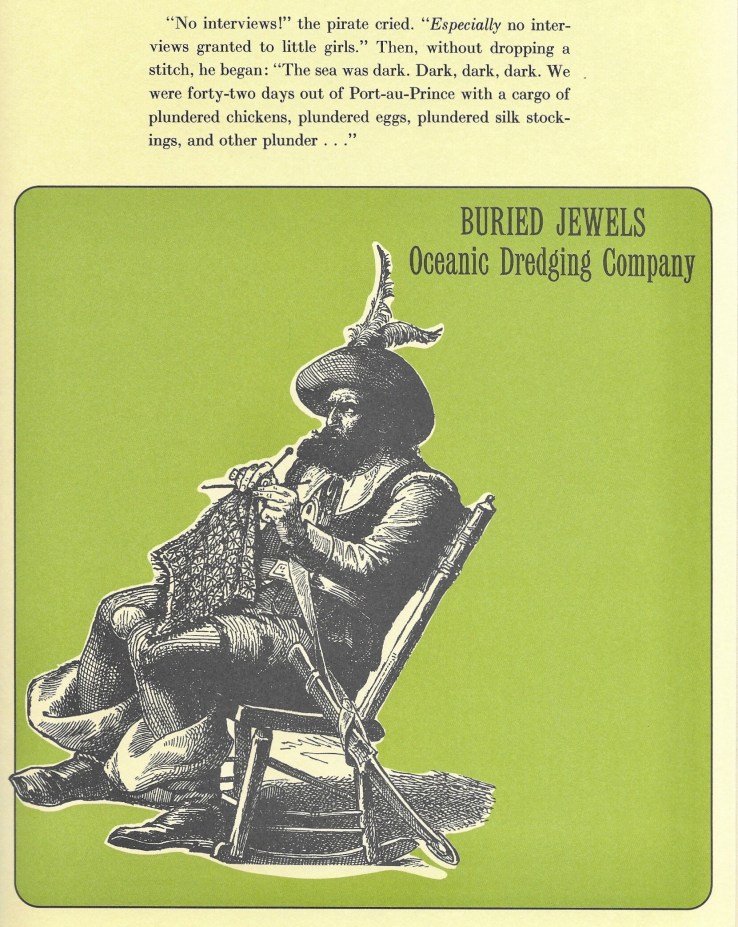
From Donald Barthelme’s children’s book The Slightly Irregular Fire Engine; or The Hithering Thithering Djinn.

From Donald Barthelme’s children’s book The Slightly Irregular Fire Engine; or The Hithering Thithering Djinn.

Woman Reading, 1884 by Susan Macdowell Eakins (
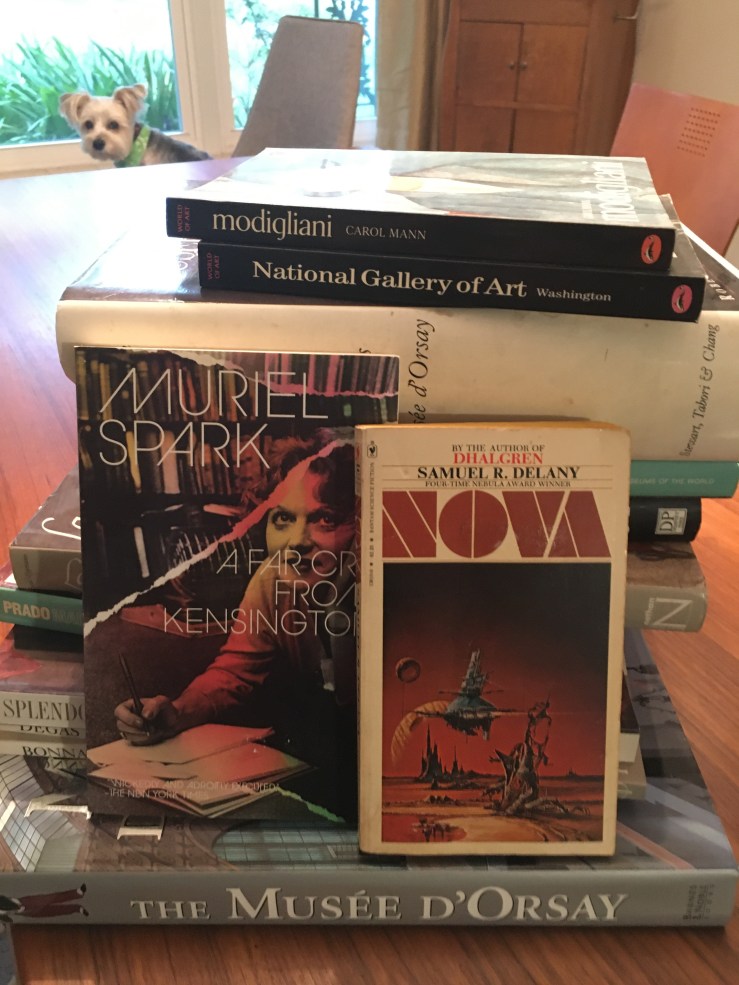
Purged some shelves and brought a box of old books to my favorite spot earlier this week. I was looking for books by William Melvin Kelley and Clarence Major but no luck. I picked up yet another Muriel Spark title (I am still hungry for this flavor), and also picked up Samuel Delany’s Nova. I failed Delany’s cult novel Dhalgren, but maybe this earlier novel will work for me. Or I will work for it. Or…you know. Also: Got a bunch of art books today from a neighbor leaving the country. Good for her. (That’s my boy Coyote in the upper left.)

Travelers by Katia Lifshin
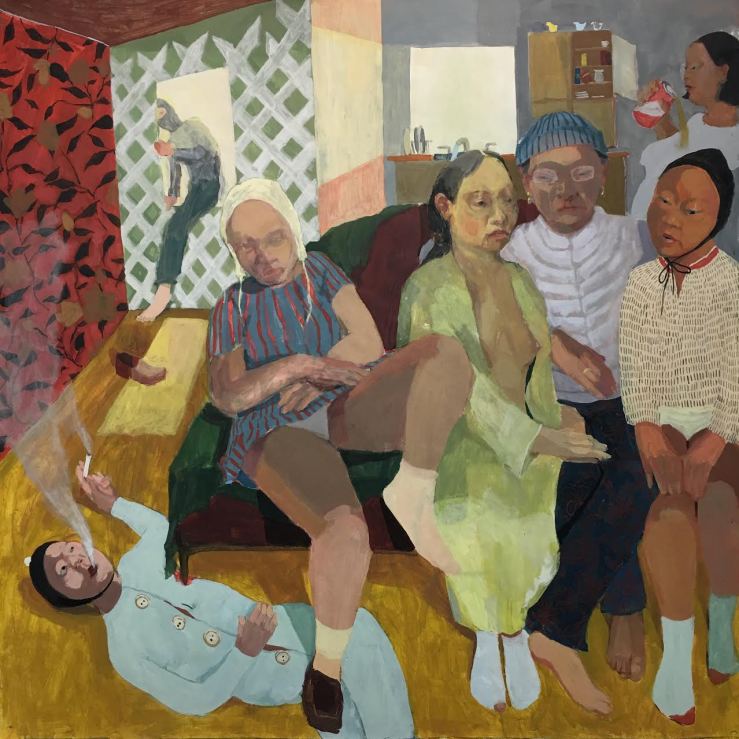
Homage to Balthus and Freud, 2017 by Sasha Gordon (b. 1998)
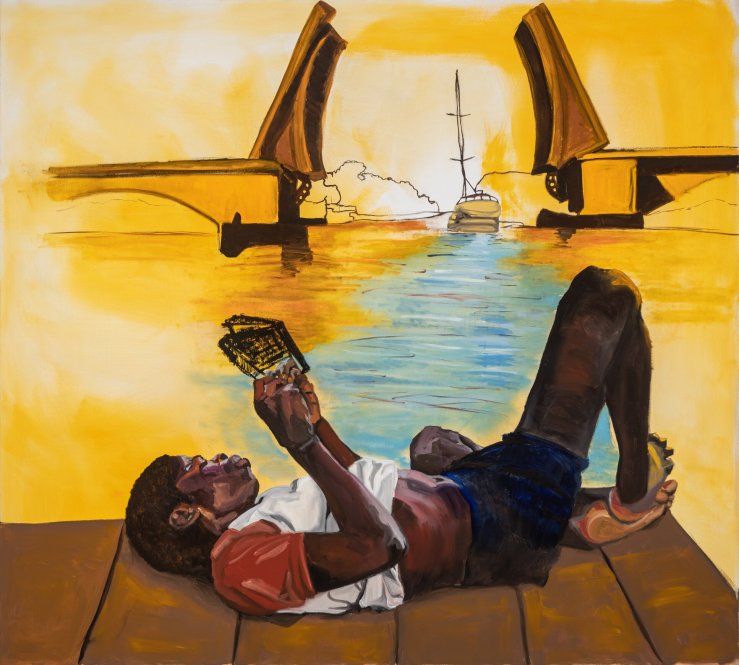
Top Down, 2019 by Jerrell Gibbs (b. 1985)

Virtual Reality, 2015 by Laurie Lipton (b. 1960)

Lines!, 2019 by Samplerman (Yvan Guillo)
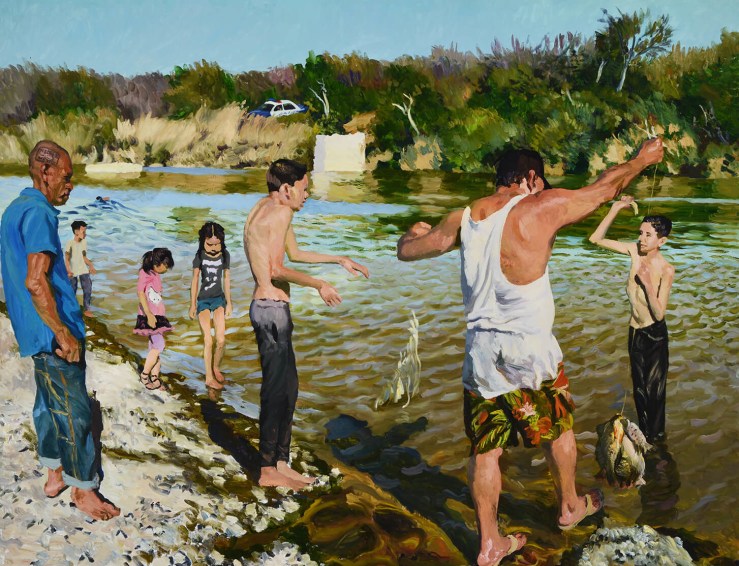
Boundary River, 2019 by Liu Xiaodong (b. 1963)
From Citizen by Claudine Rankine
/
The new therapist specializes in trauma counseling. You have only ever spoken on the phone. Her house has a side gate that leads to a back entrance she uses for patients. You walk down a path bordered on both sides with deer grass and rosemary to the gate, which turns out to be locked.
At the front door the bell is a small round disc that you press firmly. When the door finally opens, the woman standing there yells, at the top of her lungs, Get away from my house. What are you doing in my yard?
It’s as if a wounded Doberman pinscher or a German shepherd has gained the power of speech. And though you back up a few steps, you manage to tell her you have an appointment. You have an appointment? she spits back. Then she pauses. Everything pauses. Oh, she says, followed by, oh, yes, that’s right. I am sorry.
I am so sorry, so, so sorry.
/

The Room of Flowers, 1894 by Childe Hassam (1859-1935)

Lear and Cordelia in Prison, c.1779 by William Blake (1757–1827)

My Father, 1868 by George Adolphus Storey (1834–1919)
They found the Dead Father standing in a wood, slaying. First he slew a snowshoe rabbit cleaving it in twain with a single blow and then he slew a spiny anteater and then he slew two rusty numbats and then whirling the great blade round and round his head he slew a wallaby and a lemur and a trio of ouakaris and a spider monkey and a common squid. Then moving up and down the green path in his rage he dispatched a macaque and a gibbon and fourscore innocent chinchillas who had been standing idly by watching the great slaughter. Then he rested standing with the point of his sword stuck in the earth and his two hands folded upon the hilt. Then he again as if taken by a fit set about the bloody work slaying a prairie dog and a beaver and a gopher and a dingo and a honey badger and an otter and a house cat and a tapir and a piglet. Then his anger grew and he called for a brand of even greater weight and length which was brought him by a metaphorically present gillie and seizing it with his two fine-formed and noble hands he raised it above his head, and every living thing within his reach trembled and every dead thing within his reach remembered how it got that way, and the very trees of the wood did seem to shrink and step away. Then the Dead Father slew a warthog and a spotted fawn and a trusting sheep and a young goat and a marmoset and two greyhounds and a draghound. Then, kicking viciously with his noble and shapely foot at the piles of the slain, raw and sticky corpses drenching the earth in blood on every side, he cleared a path to a group of staring pelicans slicing the soft white thin necks of them from the bodies in the wink of an eye. Then he slew a cassowary and a flamingo and a grebe and a heron and a bittern and a pair of ducks and a shouting peacock and a dancing crane and a bustard and a lily-trotter and, wiping the sacred sweat from his brow with one ermine-trimmed sleeve, slew a wood pigeon and a cockatoo and a tawny owl and a snowy owl and a magpie and three jackdaws and a crow and a jay and a dove. Then he called for wine. A silver flagon was brought him and he downed the whole of it in one draught looking the while out of the corner of his ruby eye at a small iguana melted in terror against the limb of a tree. Then he tossed the silver flagon into the arms of a supposititious cupbearer sousing the cupbearer’s hypothetical white tunic with the red of the (possible) wine and split the iguana into two halves with the point of his sword as easily as one skilled in the mystery fillets a fish. Then the Dead Father resumed his sword work in earnest slaying diverse small animals of every kind, so that the heaps mounted steaming to the right and to the left of him with each passionate step. A toad escaped.
From Donald Barthelme’s novel The Dead Father.

Smartphones, 2016 by Chen Danqing (b. 1953)

I finally made some time this afternoon to dip into Rédoine Faïd’s memoir-in-interviews, Outlaw: Armed and Dangerous. It’s a propulsive, fast read so far–I put away the first 60 pages in one reading. Faïd, fresh out of prison, tells his life story to journalist Jérôme Pierrat. The book is newly-translated by John Galbraith Simmons and J.G. Barque, and available from Contra Mundum Press. Their blurb:
Memoirs of celebrated criminals purvey vivid personal stories while spawning sharp questions about the cultures that produced them. In Outlaw: Author Armed & Dangerous, Rédoine Faïd, of Algerian immigrant parents, born and raised in the housing projects surrounding Paris, recounts his career as an infamous and renowned bandit. Drawing inspiration and instruction from a host of films and television series, Faïd styled himself and was known to friends and accomplices as “Doc” — after Steve McQueen in the legendary suspense thriller, The Getaway.
With self-discipline and a striking ability to learn from experience, Faïd carried off his first robberies while still a teenager. He soon graduated from petty thievery to armed robbery, targeting computer component suppliers, jewelry stores, banks, and most memorably, armored trucks. A master of disguise, with bulletproof vest and a .357 Magnum as a prop to encourage compliance, he led a crew that operated with careful planning but eschewed bloodshed and physical violence.
In imitation of Michael Mann’s Heat, Faïd and his cohorts donned hockey masks for one job, sometimes even quoting from other famous heist films during their capers. When bold plans went wrong, he reacted with fast thinking that served him well — until it didn’t, and he was arrested and imprisoned in 1998.
Outlaw was first published in France in 2009, after which Faïd was imprisoned again. Subsequently, his dramatic escapes from jail, in 2013 and 2018, made front-page news in France and around the world.
Interviewed by journalist Jérôme Pierrat, who specializes in crime and investigative reportage, Rédoine Faïd tells his own story with panache and humor, darkened by introspection and cautionary tales. His story, like that of a character out of a Jean-Pierre Melville film or Dassin’s Rififi, is not only intriguing, it is also as compelling as any high-grade thriller. Three months after his daring helicopter escape from Réau Prison in 2018, Faïd was captured again. He currently remains in jail.
 Biblioklept