
A Charles Portis miscellany, a signed Stanley Elkin oddity, and Rudolph Wurlitzer’s cult novel Nog (Books acquired, 21 Feb. 2020)

img_5024

I went to my beloved used bookstore the first three Fridays in February, searching for a few things: novels by Rudolph Wurlitzer (no luck); Titus Alone, the last novel in Mervyn Peake’s “Gormenghast” trilogy (no luck; might have to order it); the penultimate Harry Potter novel (for my nine-year-old; plenty of copies—apparently his sister never made it that far).

did pick up Escape Velocity, a compendium of the late great Charles Portis’s journalism, essays, and short stories. There’s also a three-act play, Delray’s New Moon, which The Arkansas Repertory Theatre performed in 1996, and a 2001 interview with Portis that was part of The Gazette Project, which comprised a series of interviews with staff of the now-defunct Arkansas Gazette.

Portis worked for the Gazette early in his career, but it’s Civil Rights reporting for The New York Herald Tribune that’s more immediately compelling. Stories on the Klan rallies, Birmingham terror, and the assassination of Medgar Evers seem to add a new complexity and dimension to the South of Portis’s novels Norwood and The Dog of the South.

The essays in Escape Velocity seem especially promising, and also seem to inform the novels—at least the first one I read, “That New Sound from Nashville,” did. There’s something almost-gonzo about Portis’s technique (some of his early journalism vibrates with local color and ironic editorializing, too).

I’ve only read two of the five short stories in the collection. All are quite short, and the two I read feel like sketches, to be honest. Still, I’m interested in the fiction that Portis produced after his last novel Gringos, and three of the stories are from that era, along with the play Delray’s New Moon, which I hope will be richer than the stories I’ve read so far.
img_5025

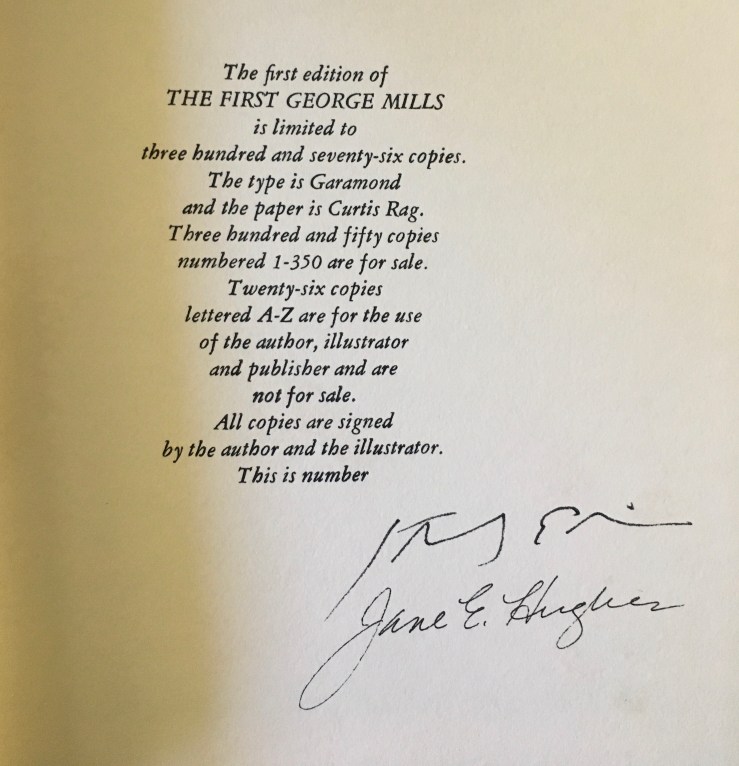
At the bookstore, I spied the gilt spine of The First George Mills, a 1980 oddity that comprises the first part (roughly 50 pages) of Stanley Elkin’s 1982 novel George Mills. The spine struck me as odd—so thin, so irregularly-shaped, etc. The book itself seemed like a novelty almost, and I was surprised to find Elkin’s signature at the end. I was even more surprised to find the signature of Jane Hughes, the apparent illustrator of this volume, whose illustrations do not appear in my copy. A bit of internet browsing seems to suggest that Hughes’s illustrations—of horses—were glued insets. Still, I was happy to forgo five bucks of my trade credit for Elkin’s signature.

When I got home from the bookstore a copy of Rudolph Wurlitzer’s cult classic 1969 novel Nog had arrived in the mail from Two Dollar Radio (along with a sticker and a bookmark and a thank you note—godbless indie publishers). I will be reading this book next, starting tonight. Here is the Thomas Pynchon blurb that made me interested in Wurlitzer:

Wow, this is some book, I mean it’s more than a beautiful and heavy trip, it’s also very important in an evolutionary way, showing us directions we could be moving in — hopefully another sign that the Novel of Bullshit is dead and some kind of re-enlightenment is beginning to arrive, to take hold. Rudolph Wurlitzer is really, really good, and I hope he manages to come down again soon, long enough anyhow to guide us on another one like Nog.

I did not go to the bookstore on this day, the last Friday of February 2020. I finished Gormenghast instead.

This Must Be the Place — Audun Grimstad

image-asset-1

This Must Be the Place, 2015 by Audun Grimstad (b. 1985)

Reification #49 — Dario Maglionico

image1415

Reification #49, 2018 by Dario Maglionico (b. 1986)

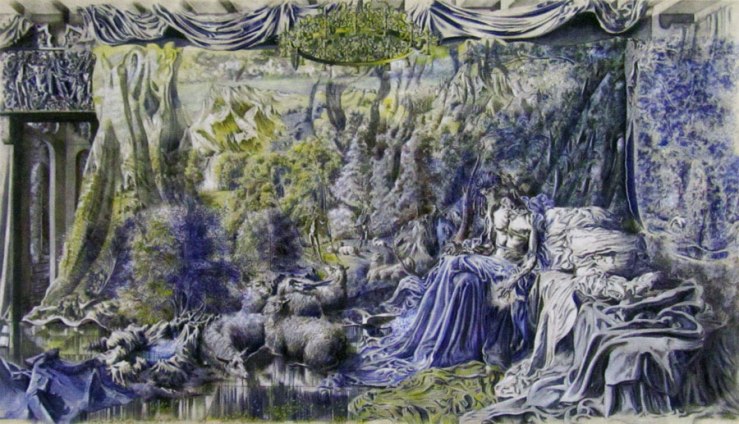
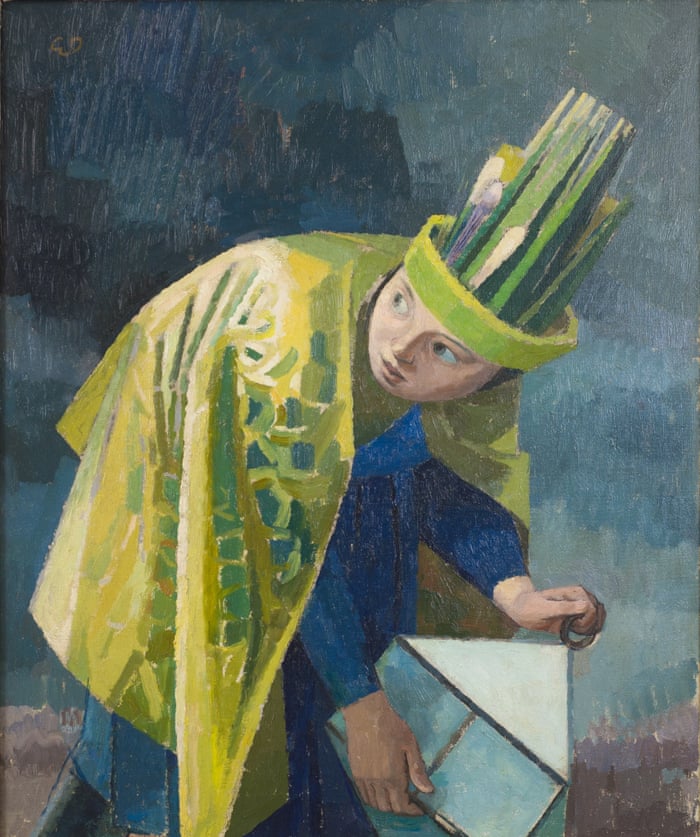
The Tapestry — Robin Ironside

03_lg

The Tapestry, c. 1944 by Robin Ironside (1912-1965)

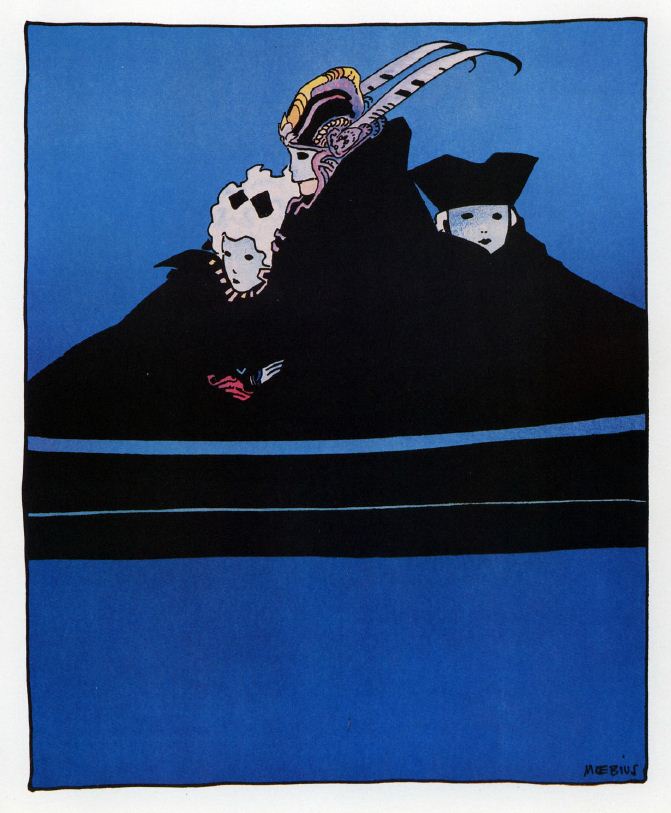
Venetian Carnival — Moebius

venetian moebius

Venetian Carnival by Moebius (Jean Giraud, 1938-2012)

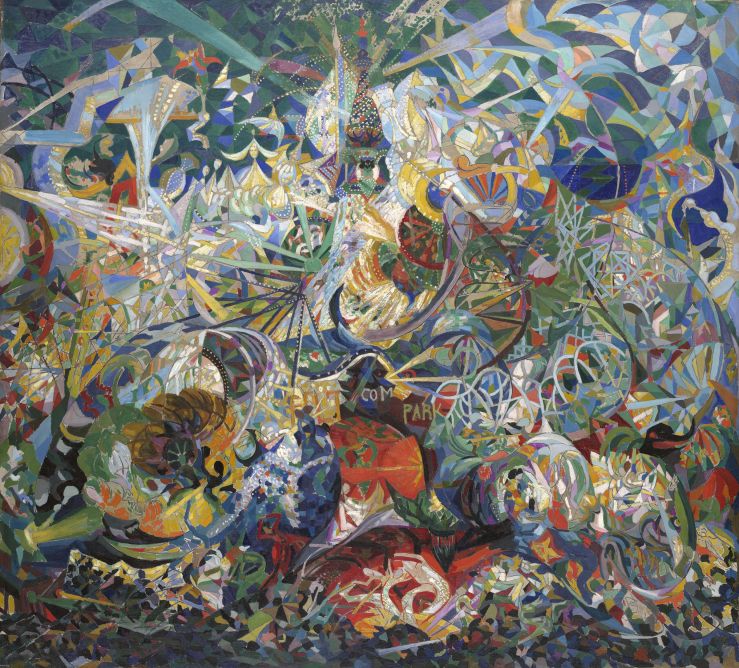
Battle of Lights, Coney Island, Mardi Gras — Joseph Stella

a459db121a3c3d9671c23e26e28d1d73

Battle of Lights, Coney Island, Mardi Gras, 1914 by Joseph Stella (1877–1946)

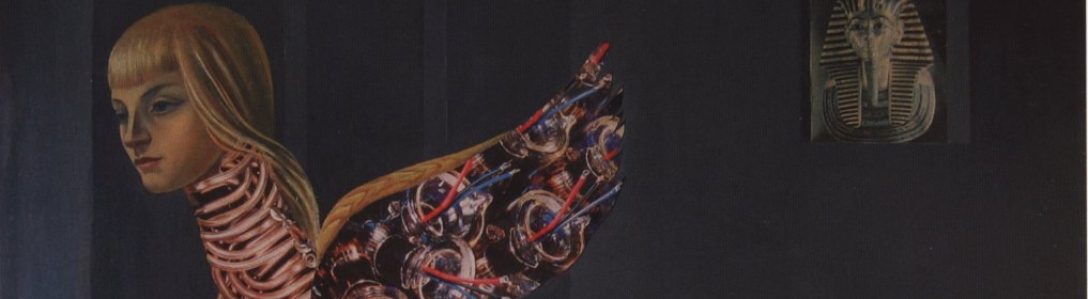
Self-Portrait as Fat King — Julie Heffernan

a823d58c4ffb78ba-jh-6274-web

Self-Portrait as Fat King, 2017 by Julie Heffernan (b. 1956)

Posted in Art

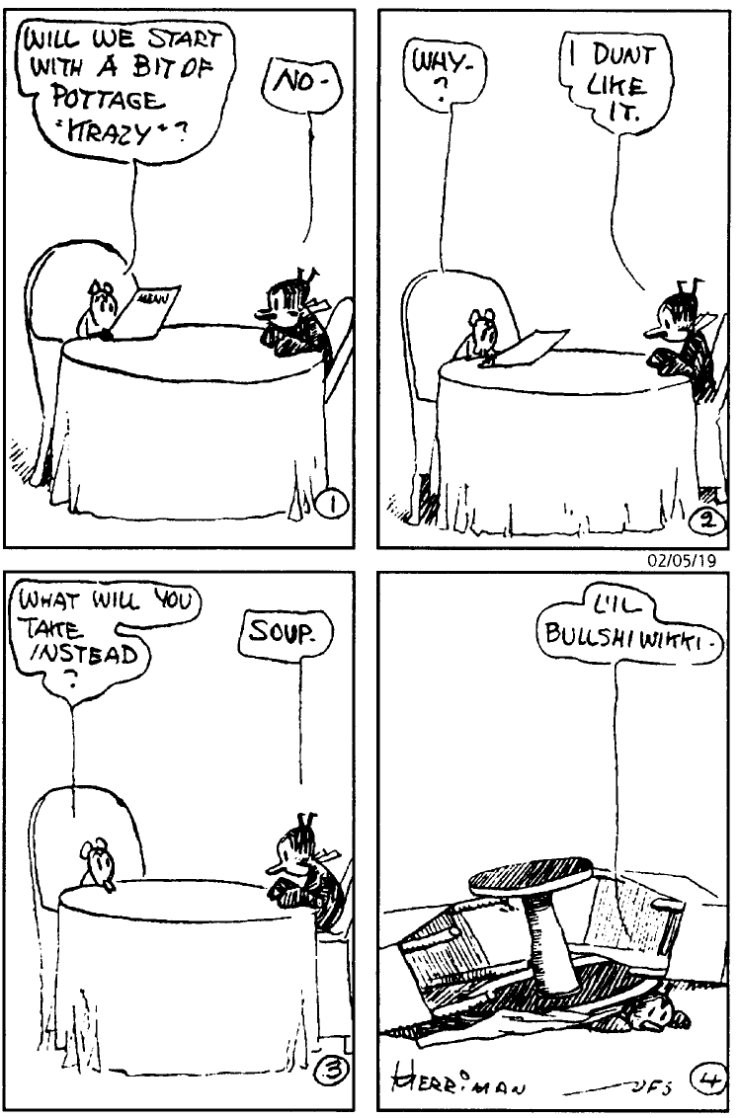
L’il Bullshiwikki (George Herriman’s Krazy Kat)

krazy-kat-19190205-s

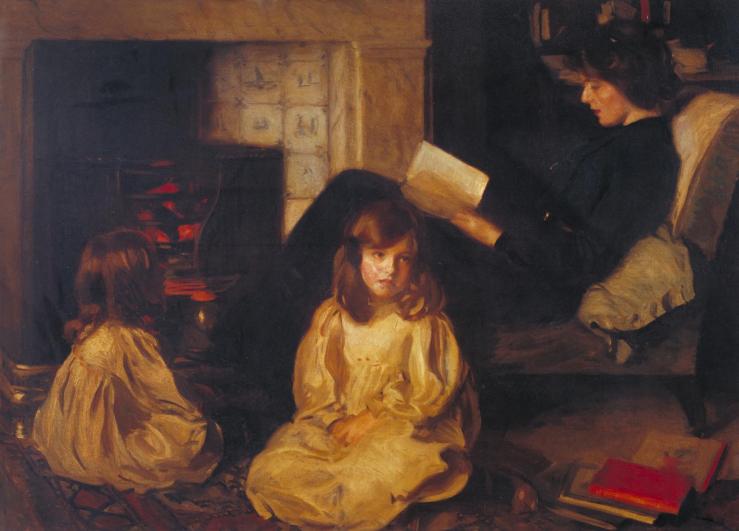
The Fairy Tale — Harrington Mann

The Fairy Tale 1902 by Harrington Mann 1864-1937

The Fairy Tale, 1902 by Harrington Mann (1864–1937)

Endless Energy for Limitless Living — Rockwell Kent

635931193246669925-laf-rockwell-kent-05-copy

Endless Energy for Limitless Living, 1946 by Rockwell Kent (1882-1971)

Two Books (Books acquired, 7 and 14 Feb. 2020)

2020-02-23_113226

Robinson by Muriel Spark. Penguin Books, 1964. Cover drawing by Terence Greer.

I have not yet read Muriel Spark, but I’ve noted she’s been compared to Ann Quin and Anna Kavan. Robinson looked more interesting to me (and shorter) than her more famous novels The Prime of Miss Jean Brodie and Memento Mori, and I love this cover.

2020-02-23_113226_1

Alchemy by Titus Burckhardt. Penguin Books,1974. Cover design by Walter Brooks, using a drawing from Basilius Valentinus’s “Aurelia Occulta Philosophorum” in Theatrum Chemicum, Argentoratie, 1614. vol. IV. Chocked full of glorious black and white images.

Read “I Don’t Talk Service No More,” a short story by Charles Portis

“I Don’t Talk Service No More”

by

Charles Portis


Once you slip past that nurses’ station in the east wing of D-3, you can get into the library at night easy enough if you have the keys. They keep the phone locked up in a desk drawer there but if you have the keys you can get it out and make all the long-distance calls you want to for free, and smoke all the cigarettes you want to, as long as you open a window and don’t let the smoke pile up so thick inside that it sets off the smoke alarm. You don’t want to set that thing to chirping. The library is a small room. There are three walls of paperback westerns and one wall of windows and one desk.

I called up Neap down in Orange, Texas, and he said, “I live in a bog now.” I hadn’t seen him in forty-odd years and I woke him up in the middle of the night and that was the first thing out of his mouth. “My house is sinking. I live in a bog now.” I told him I had been thinking about the Fox Company Raid and thought I would give him a ring. We called it the Fox Company Raid, but it wasn’t a company raid or even a platoon raid, it was just a squad of us, with three or four extra guys carrying pump shotguns for trench work. Neap said he didn’t remember me. Then he said he did remember me, but not very well. He said, “I don’t talk service no more.”

We had been in reserve and had gone back up on the line to relieve some kind of pacifist division. Those boys had something like “Live and Let Live” on their shoulder patches. When they went out on patrol at night, they faked it. They would go out about a hundred yards and lie down in the paddies, and doze off, too, like some of the night nurses on D-3. When they came back, they would say they had been all the way over to the Chinese outposts but had failed to engage the enemy. They failed night after night. Right behind the line the mortar guys sat around in their mortar pits and played cards all day. I don’t believe they even had aiming stakes set up around their pits. They hated to fire those tubes because the Chinese would fire right back. Continue reading “Read “I Don’t Talk Service No More,” a short story by Charles Portis”

February — Evelyn Dunbar

aefa208a-417a-4e77-bce6-b3329ab85b96-1707x2040-1

February, 1938 by Evelyn Dunbar (1906-1960)

The Sisters — Ralph Peacock

The Sisters 1900 by Ralph Peacock 1868-1946

Screenshot 2020-02-21 at 11.53.31 PM

The Sisters, 1900 by Ralph Peacock (1868–1946)

The first three paragraphs of Rudolph Wurlitzer’s cult novel Nog

Yesterday afternoon a girl walked by the window and stopped for sea shells. I was wrenched out of two months of calm. Nothing more than that, certainly, nothing ecstatic or even interesting, but very silent and even, as those periods have become for me. I had been breathing in and out, out and in, calmly, grateful for once to do just that, staring at the waves plopping in, successful at thinking almost nothing, handling easily the three memories I have manufactured, when that girl stooped for sea shells. There was something about her large breasts under her faded blue tee shirt, the quick way she bent down, her firm legs in their rolled-up white jeans, her thin ankles – it was her feet, actually; they seemed for a brief, painful moment to be elegant. It was that thin-boned brittle movement with her feet that did it, that touched some spot that I had forgotten to smother. The way those thin feet remained planted, yet shifting slightly in the sand as she bent down quickly for a clam shell, sent my heart thumping, my mouth dry, no exaggeration, there was something gay and insane about that tiny gesture because it had nothing to do with her.

I went to Smitty’s, a roadhouse a quarter of a mile down the beach. When I came back, she was gone. I could not sit in my room. The walls closed in on me. I could see the walls closing in on me, and my situation, if that is what it is, a situation, seemed suddenly so dull and hopeless; this cheap thrown-together guest house of imitation redwood on the California coast with its smell of mold and bad plumbing, the inane view from my window of driftwood and seaweed, flat predictable waves, corny writings in the sand, pot-bellied fishermen and bronzed godlike volleyball players. I had to pull out, I thought, I was beginning to notice things, lists were forming, comparisons were on the way. And now I don’t have the octopus. I suppose that is what there is to tell about. Then I’ll move on. Last night there was a storm, and I abandoned the octopus. I didn’t really abandon the octopus, it’s still in the bathysphere on the truck bed, and the truck bed is still up on blocks, but it’s not the same any more. I’m going to move on alone.

I have money and I can make money. I want to say that now. I’m no reprobate, nor am I a drain on anyone. My great aunt left me two thousand a year, and I have, or had, an octopus and a truck. A man sold me the octopus and truck in Oregon. I met him in a bar in one of those logging towns on the Coast where the only attractive spot is the village dump, which at least has the advantage of facing the sea. Nog, he was apparently of Finnish extraction, was one of those semi-religious lunatics you see wandering around the Sierras on bread and tea, or gulping down peyote in Nevada with the Indians. He was dressed in black motorcycle boots, jeans and an old army shirt with sergeant chevrons still on the sleeves. His face was lean and hatchet-edged, with huge fuzzy eyes sunk deep in his skull like bullet holes. He kept complaining about a yellow light that had lately been streaming out of his chest from a spot the size of a half dollar. We drank and talked about the spot and the small burning sensation it gave him early in the morning and about his octopus. He had become disillusioned about traveling with the octopus and had begun having aggressive dreams about it. He wanted to sell it. We bought a bottle and walked out beyond the town into logged-off hills that looked like old battlefields. A low mist hung over a struggling second growth of redwood and Douglas fir. The tracks of giant caterpillar tractors wound everywhere. Pits and ditches were scattered about like shell holes. Thousands of frogs croaked and salamanders hung suspended between lids of green slime and rotting logs. I felt vaguely elated, like a witness to some ancient slaughter.

From Rudolph Wurlitzer’s cult novel Nog. Reprinted from Two Dollar Radio.

Wells Tower remembers Charles Portis

Author Wells Tower (who, come on and finish a novel or another story collection or something, please) has a nice obituary in The New Yorker today for the novelist Charles Portis. From Tower’s essay:

 “Only a mean person won’t enjoy it” is something a critic once wrote about True Grit. In part, I love Portis because I feel less mean when I read him. It’s not just that his novels are gentle and funny; it’s that Portis’s books have a way of conscripting the reader into their governing virtues—punctuality, automotive maintenance, straight talk, emotional continence. Puny virtues, as Portis himself once put it, yet it is a great and comforting gift (in these days especially) to offer readers escape into a place where such virtues reign.

It’s hard to know whether Portis’s work ushered much comfort into his own life. My sense is that he was lonely. I imagine he had a fair bit in common with Jimmy Burns, described in Gringos as a “hard worker,” “solitary as a snake,” and, yes, “punctual.” Portis never married and had no children. He never published another novel after Gringos, from 1991. The closest he gets to self-portraiture comes in his short memoir “Combinations of Jacksons,” the essay published in The Atlantic. Toward the essay’s close, the author spots an “apparition” of his future self in the form of a geezer idling his station wagon alongside Portis at a traffic light in Little Rock. He wore “the gloat of a miser,” Portis writes. “Stiff gray hairs straggled out of the little relief hole at the back of his cap. . . . While not an ornament of our race, neither was he, I thought, the most depraved member of the gang.”

Read the whole thing here.

Read Tower’s review of Portis’s final novel Gringos here.


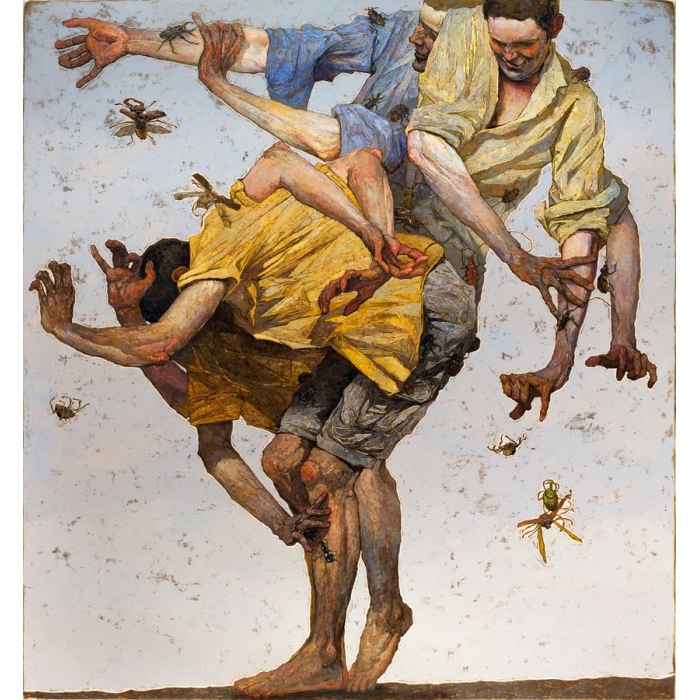
Do Bugs Feel Fear? — Denis Sarazhin

do-bugs-feel-fear

Do Bugs Feel Fear?, 2016 by Denis Sarazhin (b. 1982)