Untitled from The Democratic Forest, 1983-1986 by William Eggleston (b. 1939)

Untitled from The Democratic Forest, 1983-1986 by William Eggleston (b. 1939)
Let me recommend a novel for you.
The novel is Antonio di Benedetto’s Zama.
Zama was first published in Argentina in 1956.
NYRB published Esther Allen’s English translation in 2016. It is excellent.
What is Zama about?
Zama tells the brutally funny and often sad story of Don Diego de Zama, a bored and horny americano wasting away in the provincial backwaters of Paraguay. It’s the end of the world at the end of the 18th century, and there’s not a lot to do. Zama fills his time with schemes of lust and petty pride, shirking his job as a nominal governmental authority. He longs to be reunited with his wife and family in Buenos Aires, but seems to sabotage every opportunity to get back to them. He also longs for his glory days as a corregidor, putting down “the native rebellion” in the service of Spain’s imperial project. Zama is a confusing and confused character, frequently frustrating but also oddly sympathetic. He is a loser who does not seem to see that he is a loser, although life gives him every opportunity to come to this conclusion. As South African novelist J.M. Coetzee’s puts it in his excellent in-depth review of the novel:
[Zama] is vain, maladroit, narcissistic, and morbidly suspicious; he is prone to accesses of lust and fits of violence, and endowed with an endless capacity for self-deception.
He is also the author of himself, in a double sense. First, everything we hear about him comes from his own mouth, including such derogatory epithets as “swaggering” and “dogslayer,” which suggest a certain ironic self-awareness. Second, his day-to-day actions are dictated by the promptings of his unconscious, or at least his inner self, over which he makes no effort to assert conscious control. His narcissistic pleasure in himself includes the pleasure of never knowing what he will get up to next, and thus of being free to invent himself as he goes along.
Coetzee captures the joy of reading Zama in those last few lines: It’s the joy in watching a first-person perspective invent itself in shambling picaresque adventures born of sheer boredom. It’s the pleasure of seeing an asshole who refuses to acknowledge that he is an asshole try to pretend that he is not an asshole—all in a kind of language that is simultaneously romantic and flat.
Let me give you a taste of that language, reader. Here are the opening bars of the novel:
I left the city and made my way downriver alone, to meet the ship I awaited without knowing when it would come.
I reached the old wharf, that inexplicable structure. The city and its harbor have always been where they are, a quarter-league farther upriver.
I observed, among its pilings, the writhing patch of water that ebbs between them.
A dead monkey, still whole, still undecomposed, drifted back and forth with a certain precision upon those ripples and eddies without exit. All his life the water at forest’s edge had beckoned him to a journey, a journey he did not take until he was no longer a monkey but only a monkey’s corpse. The water that bore him up tried to bear him away, but he was caught among the posts of the decrepit wharf and there he was, ready to go and not going. And there we were.
There we were: Ready to go and not going.
The ship that won’t come in, the floating dead monkey, the state of unknowing—these abject and negative motifs are the paradoxical genesis of the novel. The clipped repetitions, culminating in “Ready to go and not going” recall Samuel Beckett, whom translator Esther Allen acknowledges as “a perfect counterpoint to the prose voice of Zama” in her introduction.
In addition to Beckett, easy points of comparison are Dostoevsky, Camus, Borges, and especially Kafka. In his perceptive analysis of Zama, critic Benjamin Kunkel points out the novel’s existential core, absurdist peripheries, and realistic contours:
As with novels by Kafka, Camus, Sartre, and Beckett, the story’s preoccupation is the tension between human freedom and constraining circumstance. Zama, a man as impetuous as he is stuck, resembles other existentialist antiheroes as he swings between spellbound passivity and sudden lunges into action. But Don Diego never seems like a figure in an allegory, like K. in The Castle; or an ambulatory philosophical argument, like Roquentin in Nausea. Zama induces a rare feeling—to put it as naïvely as possible—of the main character’s realness. Don Diego is consistently surprised by his own behavior, but not as much as he would like. His abrupt acts and swerving meditations have an air of unplotted inevitability about them. He is a character more convincing than coherent, and more persuasive than intelligible.
These lifelike moments of “unplotted inevitability” are enthralling. Di Benedetto doesn’t just show us Zama seeing, he shows us Zama seeing what he is seeing. He shows us consciousness at work—or rather, consciousness in distress. In a representative passage which can stand alone as a bizarre parable in search of a moral, Zama, having lost all his money betting on horses, awakes from a drunken stupor to witness a spider crawling on a fellow drunkard:
The spider approached the drunk. From a quarter vara away, these spiders can leap and bite so that if taken by surprise, even a man who’s awake has no time to defend himself. I had no wish to move. I could crush it with my boot but would postpone until the last.
The spider moved toward the sleeping head and I watched to see whether anything out of the ordinary would transpire. Would the man—obedient to some mysterious warning instinct—suddenly awaken and kill it? He did not. Now the insect was crawling in his hair. I didn’t see it climb up; I saw it there on him and then I was quite certain I should do nothing.
The episode continues in this way, building in tension as the large spider crawls over the man’s face while Zama remains inert and fascinated by his own inertia—until the drunken man absently bats the spider from his face. Zama is paradoxically stunned by this anticlimax:
I reviewed the episode. At no point had I felt any emotion, except when I imagined the man had wakened and was about to deliver himself of an entirely justified diatribe against me.
The passage is representative of Di Benedetto’s rhetorical skill—he gives us a deceptively lucid first-person narrator who articulately elides key information, both from the reader and himself. Zama refuses to name his intense desire to see the spider bite the man. Additionally, his emotional identification is bound to righteous anger, the righteous anger appropriate to the would-be-bitten drunkard. Instead of genuine pathos, Zama would usurp this man’s self-righteous anger, the anger that he feels all the time at his (literal and figurative) position in life. But the spider bite that would license self-righteousness never comes. Basically, Zama just wants something to happen.
And that’s the plot of Zama, more or less. Our (anti-)hero’s picaresque jabs at adventure and romance are sent awry or thwarted, usually by his own loutish passions. Zama’s would-be escapades unravel, that is, until the book’s final section, 1799—
–Okay, let me digress momentarily: Zama, a slim 200 pages, is structured into three sections: 1790, 1794, and 1799. The connective tissue between these sections hangs transparent, nearly invisible, but nevertheless accessible via small clues, motifs, scant threads. Di Benedetto gives us modernism in the last decade of the 18th century, boredom that tiptoes around the abyss of insanity. Rereading the three sections is a joy. But let me return to the central thread—
Zama’s would-be adventures unravel or collapse until the book’s final section, 1799, when Di Benedetto puts our hero in genuine harm’s way (and cunningly exfiltrates any opportunity for overt heroism on Zama’s part). The novel earns its drive toward what I take to be its central question: “Do you want to live?”
Di Benedetto hides his answer to this question not so much in the central figure Zama, but rather in Zama’s put-upon secretary, his mozo Manuel Fernández. Fernández is, at least for me, the secret star of the novel. When we first meet Fernández, Zama joins in gently mocking him at the lead of their boss, the governor. They tease Fernández when he tells them that he is writing a novel. “Make sons, Manuel, not books,” admonishes the governor, but the clerk replies: “I want to realize myself in myself…Children realize themselves, but whether for good or ill we don’t know. Books are made only for truth and beauty.” Later, Zama, in more of a ruse than in good faith, asks Fernández to read some of his book. He finds the “entangled” prose “incomprehensible,” to which Fernández replies: “the first man and the first lizard were each incomprehensible, as well, to all those who surrounded them.” Fernández declares that he writes for “no master.” If he has no audience today, his pages will be understood by his “grandchildren’s grandchildren…Things will be different then.” Later, Fernández reveals that he’s given away his manuscript to an old man, a stranger suffering boredom while waiting for a delayed ship to take him somewhere other than the end of the world.
Fernández sees himself as an author doomed to obscurity in the present, an author who awaits a future that will catch up to his originary vision. Perhaps it’s a bit much to suggest he’s a stand-in for Di Benedetto, but there are traces here. Above, I cited Benjamin Kunkel’s essay on Zama, “A Neglected South American Masterpiece,” and J.M. Coetzee’s review, “A Great Writer We Should Know.” Those titles point to the novel’s obscurity, an obscurity which I sense is now being (if in increments) reversed. Esther Allen’s English translation obviously opens Zama to an even wider audience, and Argentine director Lucrecia Martel is apparently adapting the novel to film. But it’s perhaps Roberto Bolaño, a writer who time caught up to, however too late, who helped guide new readers—however obscurely—to Zama. In Bolaño’s 1997 short story “Sensini,” the titular character is a clear transposition of Di Benedetto, a cult author, a writer’s writer:
The novel was the kind of book that circulates by word of mouth. Entitled Ugarte, it was about a series of moments in the life of Juan de Ugarte, a bureaucrat in the Viceroyalty of the Rio de la Plata at the end of the eighteenth century. Some (mainly Spanish) critics had dismissed it as Kafka in the colonies, but gradually the novel had made its way, and by the time I came across Sensini’s name in the Alcoy anthology, Ugarte had recruited a small group of devoted readers, scattered around Latin America and Spain, most of whom knew each other, either as friends or as gratuitously bitter enemies.
Thank goodness, or thank evil, or thank boredom: thanks for word of mouth, for friends and enemies alike (as long as they have good taste); thanks for writer’s writers (and writer’s writer’s writers) and the cult books they transmit to us—like Zama.
Zama is a cult novel that deserves a larger cult. After two false starts (I admit I misread the voice, missing the humor), I read Di Benedetto’s novel in a kind of hunger. Then I read it again. Then I wrote this thing, to tell you, dear reader, that you should read it too. Very highly recommended.
[Ed. note–Biblioklept originally ran this review in April, 2017.]

I can’t remember which particular Surrealist I was googling when I learned about Gisèle Prassinos. I do know that it was just a few weeks ago, and I’ve had an interest in Surrealist art and literature since I was a kid, so I was a bit stunned that I’d never heard of her before now—strange, given the origin of her first publication. In 1934, when she was 14, Prassinos was “discovered” by André Breton, and the Surrealists delighted in what they called her “automatic writing.” (Prassinos would later reject that label, and go as far as to declare that she had never been a surrealist). Her first book, La Sauterelle arthritique (The Arthritic Grasshopper) was published just a year later.

I somehow found a .pdf of one of her stories, “A Nice Family,” a bizarre little tale that runs on its own surreal mythology. The story struck me as simultaneously grandiose and miniature, dense but also skeletal. It was impossible. Surreal. I wanted more.
Luckily, just this spring Wakefield Press released The Arthritic Grasshopper: Collected Stories, 1934-1944, a new English translation of a 1976 compendium of Prassinos’s tales, Trouver sans checher. The translation is by Henry Vale and Bonnie Ruberg, whose introduction to the volume is a better review and overview than I can muster here. Ruberg offers a miniature biography, and shares details from her letters and visits with Prassinos. She situates Prassinos within the Surrealists’ gender biases: “For a young writer such as Prassinos, being involved with the surrealists would have meant gaining access to resources like publishers, but it also would have meant being fetishized and marginalized.” Ruberg characterizes Prassinos’s tales eloquently and accurately—no simple feat given the material’s utter strangeness:
Taken collectively, their effect is a piercing cackle, a complete disorientation, rather than an ethical lesson. The politics of these stories are absurdist. They upend the world by making children dangerous, by reanimating the dead, by letting the carefully tended domestic deform, foam, and melt. No social structure holds power in the world of these stories—not on the basis of gender, or nationality, or class. The force that reigns is chaos.
Let’s look at that reigning chaos.
In “The Sensitivity of Others,” one of the earliest tales in the volume, we get the sparest narrative action seemingly possible: A speaker walks forward. And yet dream-nightmare touches impinge on all sides and on all senses. The opening line shows a world that is never stable, and if monsters and other dangers lurk just on the margins of our narrator’s shifting path, so do wonders and the promise of strange knowledge. Here’s the tale in full:

I still have no idea what to make of the punchline there at the end, but those final images—a father, a faulty library, a power failure—hang heavy against the narrator’s trembling walk.
Many of Prassinos’s anti-fables conclude with such apparent non sequiturs, and yet the final lines can also cast a weird light back over the previous sentences. In “Photogenic Quality,” a dream-tale about the act of writing itself, the final line at first appears as sheer absurdity. A man receives a pencil from a child, whittles it into powder, blots the powder on paper, and throws the paper in the river (more things happen, too). The tale concludes with the man declaring, “Brass is made from copper and tin.” It’s possible to enjoy the absurdity here on its own; however, I think we can also read the last line as a kind of Abracadabra!, magic words that describe an almost alchemical synthesis—a synthesis much like the absurd modes of transformative writing that “Photogenic Quality” outlines.
You’ll see above one of Allan Kausch’s illustrations for The Arthritic Grasshopper. Kausch’s collages pointedly recall Max Ernst’s surreal 1934 graphic novel Une semaine de bonté (A Week of Kindness). Kausch’s work walks a weird line between horror and whimsy; images from old children’s books and magazines become chimerical figures, sometimes cute, sometimes horrific, and sometimes both. They’re lovely.

Surreal figures shift throughout the book—monks and kings, daughters and mothers, deep sea divers and knights and salesmen and talking horses—all slightly out of place, or, rather, all making new places. Even when Prassinos establishes a traditional space we might think we recognize—often a fairy trope—she warps its contours, shaping it into something else. “A Marriage Proposal,” with its unsuspecting title, opens with “Once upon a time” — but we are soon dwelling in impossibility: “the garter snake appeared in the doorway, arm in arm with the snail, who was slobbering with happiness.” Other stories, like “Tragic Fanaticism,” immediately condense fairy tales into pure images, leaving the reader to suss out connections. Here is that story’s opening line: “A black hole, a little old woman, animals.” At five pages, “Tragic Fanaticism” is one of the collection’s longer stories. It ends with a four line poem, sung by five red cats to the old woman: “Go home and burn / Darling / You’re the only one we’ll love / Trash Bin.”
I still have a number of stories to read in The Arthritic Grasshopper. I’ve enjoyed its tales most when taken as intermezzos between sterner (or compulsory) reading. There’s something refreshing in Prassinos’s illogic. In longer stretches, I find that I tire, get lazy—Prassinos’s imagery shifts quickly—there’s something even picaresque to the stories—and keeping up with its veering rhythms for tale after tale can be taxing. Better not to gobble it all up at once. In this sense, The Arthritic Grasshopper reminds me strongly of another recently-published volume of surreal, imagistic stories that I’ve been slowly consuming this year: The Complete Stories of Leonora Carrington. In their finest moments, both of these writers can offer new ways of looking at art, at narrative, at the world itself.
I described Prassinos’s tales as “anti-fables” above—a description that I think is accurate enough, as literary descriptions go—but that doesn’t mean there isn’t something that we can learn from them (although, to be very clear, I do not think literature has to offer us anything to learn). What Prassinos’s anti-fables do best is open up strange impossible spaces—there’s a kind of radical, amorphous openness here, one that might be neatly expressed in the original title to this newly-translated volume—Trouver sans checher—To Find without Seeking.
In her preface (titled “To Find without Seeking”) Prassinos begins with the question, “To find what?” Here is a question that many of us have been taught we must direct to all the literature we read—to interrogate it so that it yields moral instruction. Prassinos answers: “The spot where innocence rejoices, trembling as it first meets fear. The spot where innocence unleashes its ferocity and its monsters.” She goes on to describe a “true and complete world” where the “earth and water have no borders and each us can live there if we choose, in just the same way, without changing our names.” Her preface concludes by repeating “To find what?”, and then answering the question in the most perfectly (im)possible way: “In the end, the mind that doesn’t know what it knows: the free astonishing voice that speaks, faceless, in the night.” Prassinos’s anti-fables offer ways of reading a mind that doesn’t know what it knows, of singing along with the free faceless astonishing voice. Highly recommended.
[Ed. note–Biblioklept originally ran this review in August of 2017.]

Siren, 2015 by Scott Greene

The Watschenmann at the Viennese Prater (The Punching Bag Man), 1956 by Henry Koerner (1915-1991)

Zora Neale Hurston’s 1931 book Barracoon: The Story of the Last “Black Cargo” has finally been published. The book is based on Hurston’s 1927 interviews with Cudjo Lewis, the last known survivor of the transatlantic slave trade. Barracoon went previously unpublished due in part to Hurston’s refusal to revise the prose into a “standard” English. Hurston wrote Barracoon in a phonetic approximation of Cudjo’s voice. While this vernacular style may pose (initial) challenges for many readers, it is the very soul of the book in that it transmits Cudjo’s story in his own voice, tone, and rhythm. Hurston used vernacular diction throughout her work, but Cudjo’s voice is singular; it bears a distinctly different sound than the characters of Their Eyes Were Watching God, Hurston’s most famous novel. It is hard to conceive a more compelling version of Barracoon than this one, the one Hurston refused to compromise, with its intense, vital orality.
What is Barracoon about? I shall liberally borrow my summary from the book’s introduction, penned by Hurston scholar and biographer Deborah G. Plant:
On December 14, 1927, Zora Neale Hurston took the 3:40 p.m. train from Penn Station, New York, to Mobile, to conduct a series of interviews with the last known surviving African of the last American slaver—the Clotilda. His name was Kossola, but he was called Cudjo Lewis. He was held as a slave for five and a half years in Plateau-Magazine Point, Alabama, from 1860 until Union soldiers told him he was free. Kossola lived out the rest of his life in Africatown (Plateau). Hurston’s trip south was a continuation of the field trip expedition she had initiated the previous year.
Oluale Kossola had survived capture at the hands of Dahomian warriors, the barracoons at Whydah (Ouidah), and the Middle Passage. He had been enslaved, he had lived through the Civil War and the largely un-Reconstructed South, and he had endured the rule of Jim Crow. He had experienced the dawn of a new millennium that included World War I and the Great Depression. Within the magnitude of world events swirled the momentous events of Kossola’s own personal world.
Zora Neale Hurston, as a cultural anthropologist, ethnographer, and folklorist, was eager to inquire into his experiences. “I want to know who you are,” she approached Kossola, “and how you came to be a slave; and to what part of Africa do you belong, and how you fared as a slave, and how you have managed as a free man?” Kossola absorbed her every question, then raised a tearful countenance. “Thankee Jesus! Somebody come ast about Cudjo! I want tellee somebody who I is, so maybe dey go in de Afficky soil some day and callee my name and somebody say, ‘Yeah, I know Kossula.’”
Those final sentences should give you a quick taste of Barracoon’s central rhetorical conceit. After her own introductory chapter (which details the historical circumstances of the Clotilda’s illegal journey to West Africa), Hurston lets Cudjo inspirit the text, telling his own story in his own voice. Hurston, who spent three months with Cudjo, initially interposes herself in the story, as we see early in the book’s first chapter:
“My grandpa, he a great man. I tellee you how he go.”
I was afraid that Cudjo might go off on a tangent, so I cut in with, “But Kossula, I want to hear about you and how you lived in Africa.”
He gave me a look full of scornful pity and asked, “Where is de house where de mouse is de leader? In de Affica soil I cain tellee you ’bout de son before I tellee you ’bout de father; and derefore, you unnerstand me, I cain talk about de man who is father (et te) till I tellee you bout de man who he father to him, (et, te, te, grandfather) now, dass right ain’ it?
This brief “cutting in” is one of the last moments in the narrative that Hurston attempts to steer Cudjo in a particular direction. Instead, she befriends the old man, bringing him watermelons, hams, peaches, and other treats. These little gifts serve to frame Cudjo’s narrative as he moves from one episode to the next. Otherwise, Hurston disappears into the background, an ear for Cudjo’s voice, a witness for his story.
Cudjo’s story is astounding. He describes life in his own West African village and the terrible slaughter of his people at the hands of “de people of Dahomey,” a tribe that eventually sells Cudjo and the other young people of his village to white men. Cudjo describes his early enslavement in Alabama, which took place in secret until the Civil War, and his eventual freedom from bondage. He tells Hurston about the founding of Africatown, a community of West Africans. He describes his life after capture and slavery—his marriage, his children, his near-fatal railroad accident. Cudjo’s life and his children’s lives were incredibly difficult. They were always othered:
“All de time de chillun growin’ de American folks dey picks at dem and tell de Afficky people dey kill folks and eatee de meat. Dey callee my chillun ig’nant savage and make out dey kin to monkey.
“Derefo’, you unnerstand me, my boys dey fight. Dey got to fight all de time. Me and dey mama doan lak to hear our chillun call savage. It hurtee dey feelings. Derefo’ dey fight. Dey fight hard. When dey whip de other boys, dey folks come to our house and tellee us, ‘Yo’ boys mighty bad, Cudjo. We ’fraid they goin’ kill somebody.”
Somehow most devastating in a narrative full of devastation are the deaths of Cudjo’s children. After his daughter dies in infancy, his namesake is killed by a sheriff, a scene that resonates with terrible pain in 2018:
Nine year we hurtee inside ’bout our baby. Den we git hurtee again. Somebody call hisself a deputy sheriff kill de baby boy now.
He say he de law, but he doan come ’rest him. If my boy done something wrong, it his place come ’rest him lak a man. If he mad wid my Cudjo ’bout something den he oughter come fight him face to face lak a man. He doan come ’rest him lak no sheriff and he doan come fight him lak no man.
Another of his sons is decapitated in a railroad accident. A third son, angry with the injustice of the world, simply disappears: “My boy gone. He ain’ in de house and he ain’ on de hill wid his mama. We both missee him. I doan know. Maybe dey kill my boy. It a hidden mystery.”
Cudjo, ever the survivor, went on to outlive his wife and all of his children. In her foreword to Barracoon, Alice Walker captures the pain and pathos of this remarkable position:
And then, the story of Cudjo Lewis’s life after Emancipation. His happiness with “freedom,” helping to create a community, a church, building his own house. His tender love for his wife, Seely, and their children. The horrible deaths that follow. We see a man so lonely for Africa, so lonely for his family, we are struck with the realization that he is naming something we ourselves work hard to avoid: how lonely we are too in this still foreign land: lonely for our true culture, our people, our singular connection to a specific understanding of the Universe. And that what we long for, as in Cudjo Lewis’s case, is gone forever. But we see something else: the nobility of a soul that has suffered to the point almost of erasure, and still it struggles to be whole, present, giving.
I cannot improve on Walker’s phrase here. Hurston brings that “nobility of soul” to life via Cudjo’s own rich language.
While Barracoon is of a piece with Hurston’s anthropological collections Mules and Men and Tell My Horse, it does not read like an autoethnography. It is rather a compelling first-person narrative. Hurston collecteed stories from Cudjo–fables, parables, games—but these are included as an appendix, a wise narrative choice as any attempt to integrate them into the main narrative would hardly be seamless. The appendix adds to the text’s richness without imposing on it, and links it to Hurston’s work as a folklorist.
I’ve noted some of the additional material already—Walker’s foreword, the appendix of folklore, as well as Plant’s introduction. Included also is an afterword by Plant that contextualizes Barracoon within Hurston’s academic career, a list of the original residents of Africatown, a glossary, a bibliography, and a lengthy compendium of endnotes. This editorial material frames the historic and academic importance of Barracoon, and will be of great interest to anyone who wishes to study the subject more. However, Cudjo’s narrative stands on its own as a sad, compelling, essential story. It’s amazing it took this long to reach a wider audience. Recommended.
[Ed. note–this review originally ran in May, 2018.]

Time, Gentlemen Please, 1972 by Oskar Kokoschka (1886–1980)

The Florist, 1937 by André Marchand (1907–1997)
There was a children’s party in progress on the sloping wide lawn facing the estate of Mr Teyte and easily visible from there despite the high hedge. A dozen school-aged children, some barely out of the care and reach of their nursemaids, attended Mrs Aveline’s birthday party for her son Rupert. The banquet or party itself was held on the site of the croquet grounds, but the croquet set had only partially been taken down, and a few wickets were left standing, a mallet or two lay about, and a red and white wood ball rested in the nasturtium bed. Mr Teyte’s Jamaican gardener, bronzed as an idol, watched the children as he watered the millionaire’s grass with a great shiny black hose. The peonies had just come into full bloom. Over the greensward where the banquet was in progress one smelled in addition to the sharp odour of the nasturtiums and the marigolds, the soft perfume of June roses; the trees have their finest green at this season, and small gilt brown toads were about in the earth. The Jamaican servant hardly took his eyes off the children. Their gold heads and white summer clothing rose above the June verdure in remarkable contrast, and the brightness of so many colours made his eyes smart and caused him to pause frequently from his watering. Edna Gruber, Mrs Aveline’s secretary and companion, had promised the Jamaican a piece of the ‘second’ birthday cake when the banquet should be over, and told him the kind thought came from Mrs Aveline herself. He had nodded when Edna told him of this coming treat, yet it was not the anticipation of the cake which made him so absent-minded and broody as it was the unaccustomed sight of so many young children all at once. Edna could see that the party had stirred something within his mind for he spoke even less than usual to her today as she tossed one remark after another across the boundary of the privet hedge separating the two large properties.
More absent-minded than ever, he went on hosing the peony bed until a slight flood filled the earth about the blooms and squashed onto his open sandals. He moved off then and began sprinkling with tempered nozzle the quince trees. Mr Teyte, his employer and the owner of the property which stretched far and wide before the eye with the exception of Mrs Aveline’s, had gone to a golf tournament today. Only the white maids were inside his big house, and in his absence they were sleeping most of the day, or if they were about would be indifferently spying the Jamaican’s progress across the lawn, as he laboured to water the already refreshed black earth and the grass as perfectly green and motionless as in a painted backdrop. Yes, his eyes, his mind were dreaming today despite the almost infernal noise of all those young throats, the guests of the birthday party. His long black lashes gave the impression of having been dampened incessantly either by the water from the hose or some long siege of tears.
Mr Teyte, if not attentive or kind to him, was his benefactor, for somehow that word had come to be used by people who knew both the gardener and the employer from far back, and the word had come to be associated with Mr Teyte by Galway himself, the Jamaican servant. But Mr Teyte, if not unkind, was undemonstrative, and if not indifferent, paid low wages, and almost never spoke to him, issuing his commands, which were legion, through the kitchen and parlour maids. But once when the servant had caught pneumonia, Mr Teyte had come unannounced to the hospital in the morning, ignoring the rules that no visits were to be allowed except in early evening, and though he had not spoken to Galway, he had stood by his bedside a few moments, gazing at the sick man as if her were inspecting one of his own ailing riding horses.
But Mrs Aveline and Edna Gruber talked to Galway, were kind to him. Mrs Aveline even ‘made’ over him. She always spoke to him over the hedge every morning, and was not offended or surprised when he said almost nothing to her in exchange. She seemed to know something about him from his beginnings, at any rate she knew Jamaica, having visited there three or four times. And so the women – Edna and Mrs Aveline – went on speaking to him over the years, inquiring of his health, and of his tasks with the yard, and so often bestowing on him delicacies from their liberal table, as one might give tidbits to a prized dog which wandered in also from the great estate.
The children’s golden heads remained in his mind after they had all left the banquet table and gone into the interior of the house, and from thence their limousines had come and taken them to their own great houses. The blonde heads of hair continued to swim before his eyes like the remembered sight of fields of wild buttercups outside the great estate, stray flowers of which occasionally cropped up in his own immaculate greensward, each golden corolla as bright as the strong rays of the noon sun. And then the memory came of the glimpsed birthday cake with the yellow centre. His mouth watered with painful anticipation, and his eyes again filled with tears.

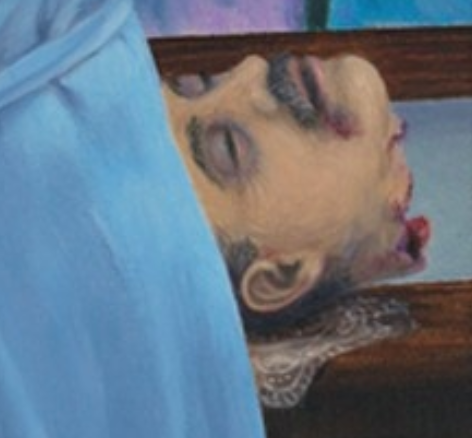
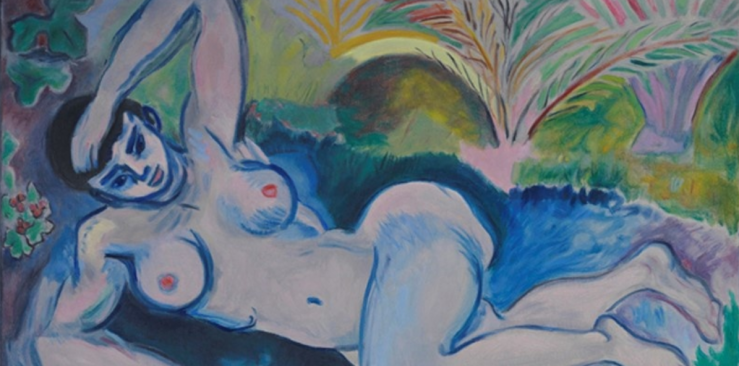
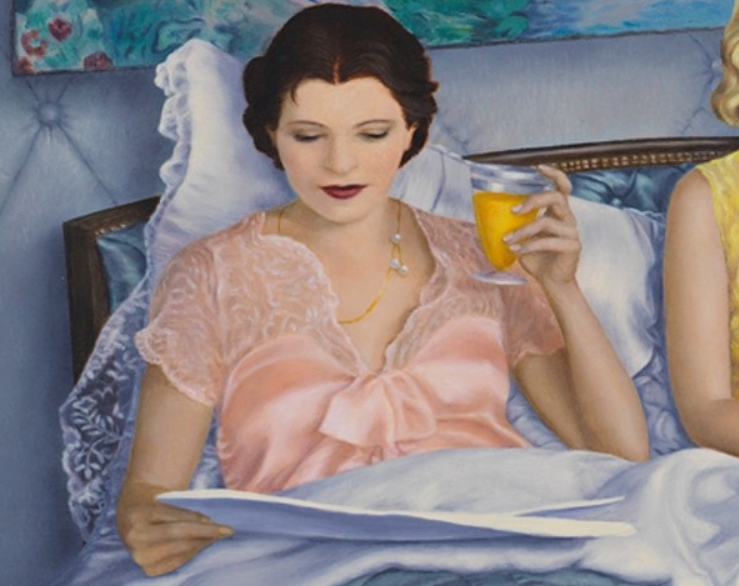
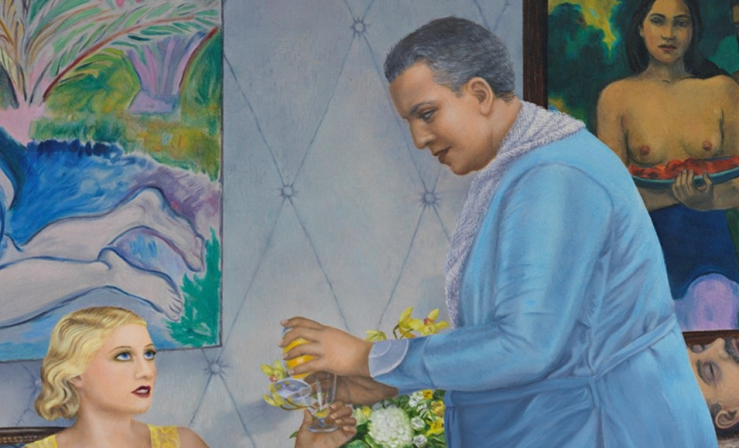
It’s for You, Dear by Danny Galieote (b. 1968)

Anna Burns’s third novel Milkman won the 2018 Man Booker Prize and was reviewed in a number of prominent publications. It hardly needs my recommendation at this point, but I do recommend it: It’s artful, horrific, endearing, and troubling, a claustrophobic, unrelenting depiction of terror and paranoia. It’s also really funny.
Scattershot snippets I’d heard about Milkman indicated that the novel was “difficult” and even “confusing” or “challenging,” in large part because of the novel’s major stylistic trope—the first-person narrator refuses to ascribe clear, “stable” names to the characters in the book.
Our narrator, an eighteen-year-old woman in Northern Ireland, is referred to variously as “daughter,” “middle sister,” and “maybe-girlfriend” (among other titles) depending on whom she is interacting with. Similarly, most other characters are referred to in such terms: “oldest friend,” “third brother-in-law,” or simply “neighbour,” a nebulous catchall. (There are “named’ characters of a sort though: “chef,” “tablets girl,” “nuclear boy,” “real milkman,” and, of course, the horrific titular character “milkman.”) This narrative device might disarm some readers initially, but I found it easy to sink into our first-person narrator’s distinctive, brave, funny voice, a voice that emerges into new states of knowing and new states of consciousness as the novel unfolds.
Naming, or rather not naming is especially rhetorically significant given the setting and context of Milkman. It is the late 1970s, and the strange hot cold silent loud civil war in Northern Ireland has been going on for the entirety of our narrator’s lifetime. It has fully colonized her consciousness, shaped her language. Significantly, the conflict itself cannot be named except obliquely, nebulously. When our narrator tries to describe this zeitgeist, she employs the vague term “political problems”; her third brother-in-law replies, “Are you referring to the sorrows, the losses, the troubles, the sadnesses?”
Similarly, phrases like Protestant or Catholic are never employed, let alone anything as specific as the British army and the IRA, or unionists and nationalists. There’s just “their side” and “our side.” The sides don’t ultimately matter in Milkman. Rather this is a novel about what a constant state of their side-our side does to a person.
Our narrator, bound since birth in this state of their side-our side, has difficulty clearly communicating the central conflict of Milkman. She finds herself the strange victim of the milkman, an older married man who is a top level operative of the renouncers, anti-government paramilitaries who essentially run her district. (To be clear, he is not a real milkman. There is a real milkman though, and he’s a good guy.) Milkman stalks the narrator, creeping up next to her in his white van as she walks home reading 19th-century novels (a habit that marks her as “beyond the pale,” an outsider in her community) or waylaying her as she runs in the park. He’s a nightmare force of patriarchal ideology, a creeper at the edge, but utterly empowered.
Milkman isn’t the narrator’s only stalker. No, there’s also Somebody McSomebody, who we meet, sort of, in the novel’s astonishing opening sentence: “The day Somebody McSomebody put a gun to my breast and called me a cat and threatened to shoot me was the same day the milkman died.” Somebody McSomebody is a poseur though. He’s a pretend renouncer, a would-be hardman also inscribed in the violent ideology of the the Troubles. The narrator calls him her “amateur stalker.”
The narrator uses variations of the word “stalk” in Milkman, but this word is meant to convey meaning to us, to a readership that might now better understand the term. (This effect of an older voice imposing its wisdom on a younger perceiver persists in Milkman.) What’s clear though is that nobody, or at least nobody in authority, can help the narrator from her stalkers:
That was the way it worked. Hard to define, this stalking, this predation, because it was piecemeal. A bit here, a bit there, maybe, maybe not, perhaps, don’t know. It was constant hints, symbolisms, representations, metaphors. He could have meant what I thought he’d meant, but equally, he might not have meant anything.
Our narrator lives in a constant state of maybe, a trope underscored by her relationship with “maybe-boyfriend” (himself something of an oddball). Maybe-boyfriend is a compelling character in Milkman, and perhaps something of tragic-absurd one as well. (One of the strangest details in the novel: maybe-boyfriend and his brothers are abandoned by his parents so that they can become world champion ballroom dancers—which they do (become world champion ballroom dancers, that is.)) In a particularly strong section of the book, maybe-boyfriend, a mechanic and car enthusiast, brings home the supercharger of a Bentley and shows it off to his neighbors. The jovial atmosphere slowly slides into a tense then paranoid exchange—Bentleys are English after all—which eventually erupts into violence. It’s a remarkably controlled episode that describes the ideology of the Troubles in a way that a historical textbook never could.
Even though our narrator lives in a perpetual maybe, she still understands her community and can describe it for us. She is intelligent and perceptive, and much of the humor in Milkman evinces from moments where she gets on a rhetorical roll, as when she describes her home as “our intricately coiled, overly secretive, hyper-gossipy, puritanical yet indecent, totalitarian district.” Horror and comedy conjoin in her absurd description of a run-in with the milkman as “talking to a sinister man while holding the head of a cat that had been bombed to death by Nazis.”
Radical horror, violence, and uncertainty percolate in Milkman. Paranoia rules on all levels, but by focusing primarily on the narrator’s being stalked by milkman, Burns offers a concrete portrait of a malevolent force that might otherwise be too sinister and abstract to properly convey in a fictional novel. At the same time, our narrator is able to extrapolate beyond her concrete circumstances to other injustices—
those big ones, the famous ones, the international ones – witch-burnings, footbindings, suttee, honour killings, female circumcision, rape, child marriages, retributions by stoning, female infanticide, gynaecological practices, maternal mortality, domestic servitude, treatment as chattels, as breeding stock, as possessions, girls going missing, girls being sold and all those other worldwide cultural, tribal and religious socialisations and scandalisations, also the warnings given against things throughout patriarchal history that were seen as uncommon for a woman to do or think or say.
Milkman is full of moments like this, rhetorical flights that help weave a richer picture of our narrator’s psychic state.
Milkman also shows us how that psychic state deteriorates. Our narrator was always an outsider, reading novels while walking or going on long runs as a way to tune out reality. Our narrator is aware of this tuning-out; indeed, it is her primary practice. However, as gossip and lies spread about her and the milkman, her consciousness begins to crumble–
Thing was though, before I’d gained the understanding of what was happening, my seemingly flattened approach to life became less a pretence and more and more real as time went on. At first an emotional numbness set in. Then my head, which initially had reassured with, ‘Excellent. Well done. Successfully am I fooling them in that they do not know who I am or what I’m thinking or what I’m feeling,’ now began itself to doubt I was even there. ‘Just a minute,’ it said. ‘Where is our reaction? We were having a privately expressed reaction but now we’re not having it. Where is it?’ Thus my feelings stopped expressing. Then they stopped existing. And now this numbance from nowhere had come so far on in its development that along with others in the area finding me inaccessible, I, too, came to find me inaccessible. My inner world, it seemed, had gone away.
This is a sad, remarkable, and genuinely horrifying passage. We get the horror of un-becoming, a kind of un-becoming that we might find in many other horror-tinged feminist works, from Charlotte Perkins Gilman’s “The Yellow Wallpaper” to Margaret Atwood’s The Handmaid’s Tale to Anna Kavan’s Ice to Marge Piercy’s Woman on the Edge of Time.
Not only is our heroine emotionally and psychologically drained, she also finds herself physically exhausted by the duress of being stalked—stalked now not only by the milkman, but also by the whispering community. No longer able to take the walks and runs that replenished her, she languishes. The horror and absurdity culminates when she is poisoned, for no real reason, by tablets girl, “our district poisoner” and must recover without the aid of professional medical care. (Nobody in the district can go to the hospital without fear of being thought an informant.)
After a serious bout of purging, the narrator recovers. While recovering, her triumvirate of “wee sisters” asks her to read them a story. Tellingly, they purloin their ma’s copy of The Exorcist. Milkman is a novel of possession and purging, of being inscribed in a preexisting symbolic order and forging a consciousness strong enough to resist and endure that order.
Milkman is a maybe-horror, but also a maybe-comedy (it even ends in a maybe-laugh), and like many strong works that showcase the intense relationship between horror and comedy (Kafka, Brazil, The King of Comedy, “Young Goodman Brown,” Twin Peaks, Goya, Bolaño, Get Out, Candide, Curb Your Enthusiasm, Funny Games, etc.)—like many strong works that showcase the intense relationship between horror and comedy, Milkman exists in a weird maybe-space, a queasy wonderful freaky upsetting maybe-space that, in its finest moments, makes us look at something we thought we might have understood in a wholly new way. Highly recommended.

Catherine, 2016 by Jansson Stegner (b. 1972)

Visit, 2012 by Susanne Kühn (b. 1969)

Tia Peltz (1923-1999)

Three Women in a Courtyard, 2018 by Kent Monkman (b. 1965)

In the Intermission, 1932 by Vasily Meshkov (1867-1946)