
L’Eau mystérieuse (The Mysterious Water), 1911 by Ernest Biéler (1863–1948)
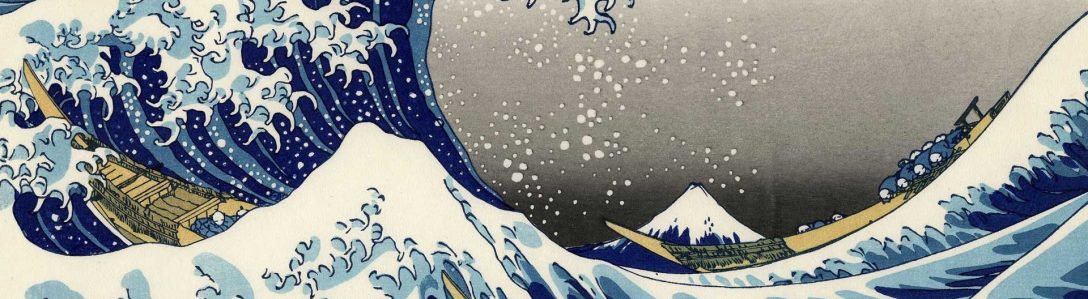
L’Eau mystérieuse (The Mysterious Water), 1911 by Ernest Biéler (1863–1948)
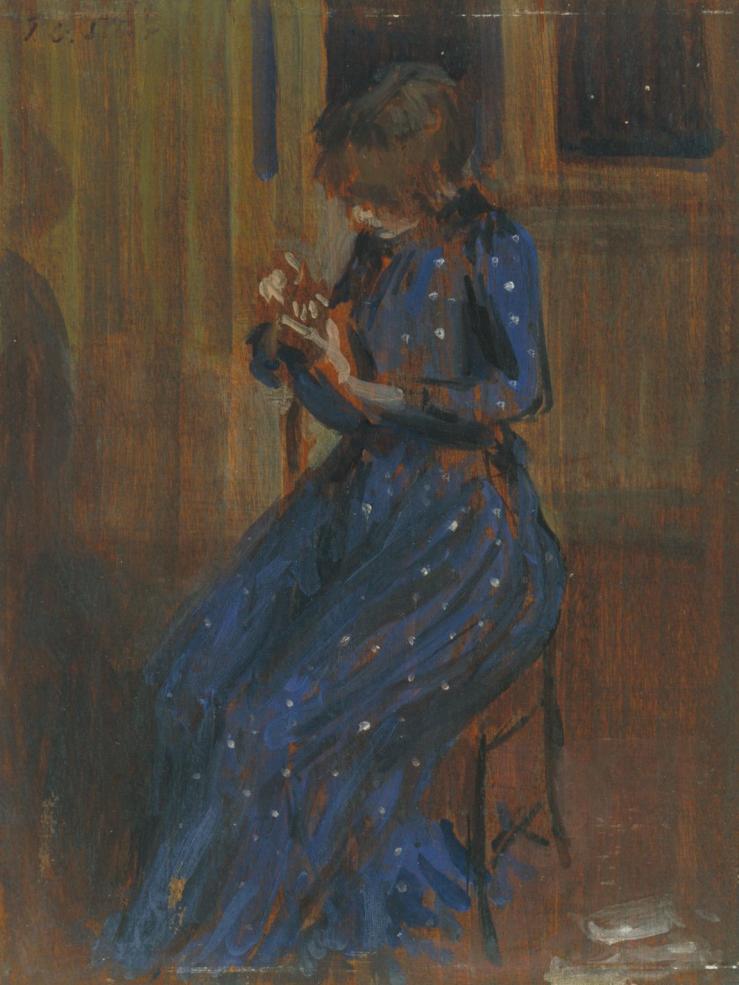
Girl in a Blue Dress, c. 1891 by Philip Wilson Steer (1860–1942)
Andrei gazed at Chachua’s nose. Immense and hooked, with a web of crimson veinlets covering its bridge and bunches of coarse black hairs protruding from its nostrils, this nose lived a life of its own, apart from Chachua. It obviously just didn’t want to know about the concerns of Investigator Chachua. It wanted everyone around it to quaff ice-cold Kakhetian wine out of large glasses, following it down with juicy kebabs and moist, crunchy green herbs and salads; it wanted everyone to dance, clutching the hems of their sleeves in their fingers, with passionate cries of “Ássa!” It wanted to bury itself in fragrant blonde hair and hover above sumptuous naked breasts . . . Oh, it wanted many things, that magnificent, life-loving hedonist of a nose, and its multitudinous desires were all candidly expressed in its various independent movements and changes of color, and the range of sounds that it emitted!
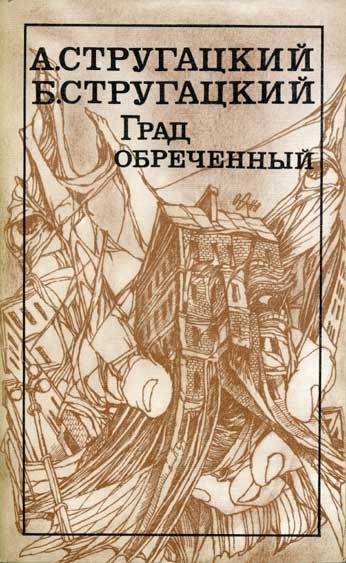
From Andrew Bromfield’s translation of Arkady Strugatsky and Boris Strugatsky’s novel The Doomed City.
This nose description has little if anything to do with the plot. It simply amused me. This is the original 1989 cover:
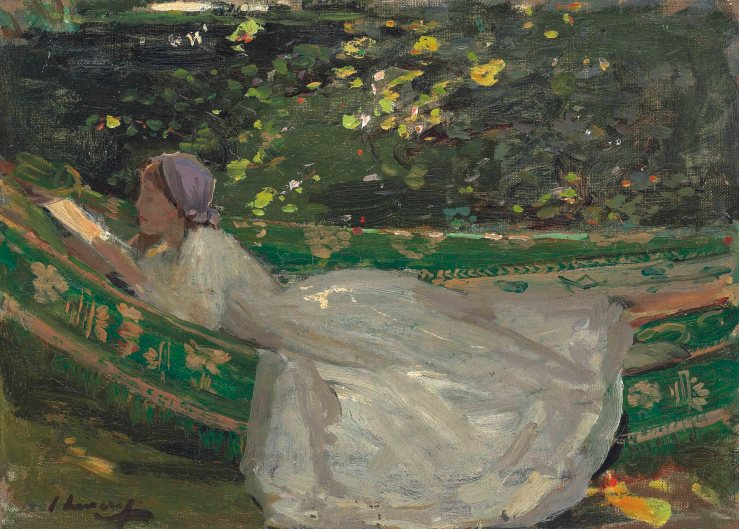
The Green Hammock, c. 1905 by John Lavery (1856–1941)
“Ex Cathedra”
by
Joaquim Maria Machado de Assis
translated by
Rhett McNeil
“Godfather, you’ll go blind from that, sir.”
“What?”
“You’re going to go blind. Reading is so sad. No sir, give me that book.”
Caetaninha took the book out of his hands. Her godfather paced around and then went into his study, where there was no lack of books. He closed the door behind him and kept reading. That was his vice. He read excessively; he read morning, noon, and night, during lunch and dinner, before going to sleep, after bathing; he read as he walked, read standing up, read in his house and in his barn; he read before reading and he read after reading; he read all sorts of books, but especially books on law (in which he’d received his degree), mathematics, and philosophy. Lately, he’d also been reading up on the natural sciences.
Worse than going blind, he went crazy. It was near the end of 1873, in Tijuca, when he started to show signs of mental disturbance; but, since the episodes were minor and few, his goddaughter only started to notice the difference in March or April of 1874. One day, over lunch, he interrupted his reading to ask her:
“What’s my name again?”
“What’s your name, godfather?” she repeated, astonished. “Your name is Fulgencio.”
“From this day forth, my name will be Fulgencius.”
And, burying his face in the book, he went on reading. Caetaninha mentioned the episode to the slave women, who admitted that they’d had their doubts about him for some time, that he hadn’t seemed well. Just imagine how fearful she was; but her fear soon passed, leaving only compassion behind, which increased her affection for him. His mania was also limited and docile, and was only related to books. Fulgencio lived for the written word, the printed word, doctrines, abstract thought, principles, and formulas. He eventually passed from mere superstition to true hallucination of the theoretical. One of his maxims was that liberty would not die, so long as there was a single piece of paper on which to declare it. So one day, waking up with the idea of improving the condition of the Turks, he wrote a constitution for them and sent it to the British diplomat in Petrópolis as a gift. On another occasion, he set about studying the eyes in anatomy books to verify whether they were really able to see, and concluded that they were.
Tell me, readers, whether, under such conditions, Caetaninha’s life could have been a happy one? It’s true that she wanted for nothing, because her godfather was rich. He had been the one who’d raised her, from the age of seven, when he lost his wife. He had taught her to read and write, French, and a little bit – so as not to say almost nothing – of history and geography, and had charged the domestic slaves with teaching her embroidery, lace-making, and sewing. There’s no denying any of that. But Caetaninha had turned fourteen and, if, in the early years, her toys and the slaves were enough to entertain her, she was now at an age when toys go out of style and slaves hold no interest, when no amount of reading or writing can transform a solitary house in Tijuca into a paradise. She went out sometimes, but rarely, and always in a rush. She never went to the theater or to dances, never made or received visits. Whenever she saw a cavalcade of men and women on horseback out in the street, her soul would ride pillion on one of the horses and ride off with them, leaving only her body behind, right next to her godfather, who kept on reading. Continue reading ““Ex Cathedra” — Joaquim Maria Machado de Assis”
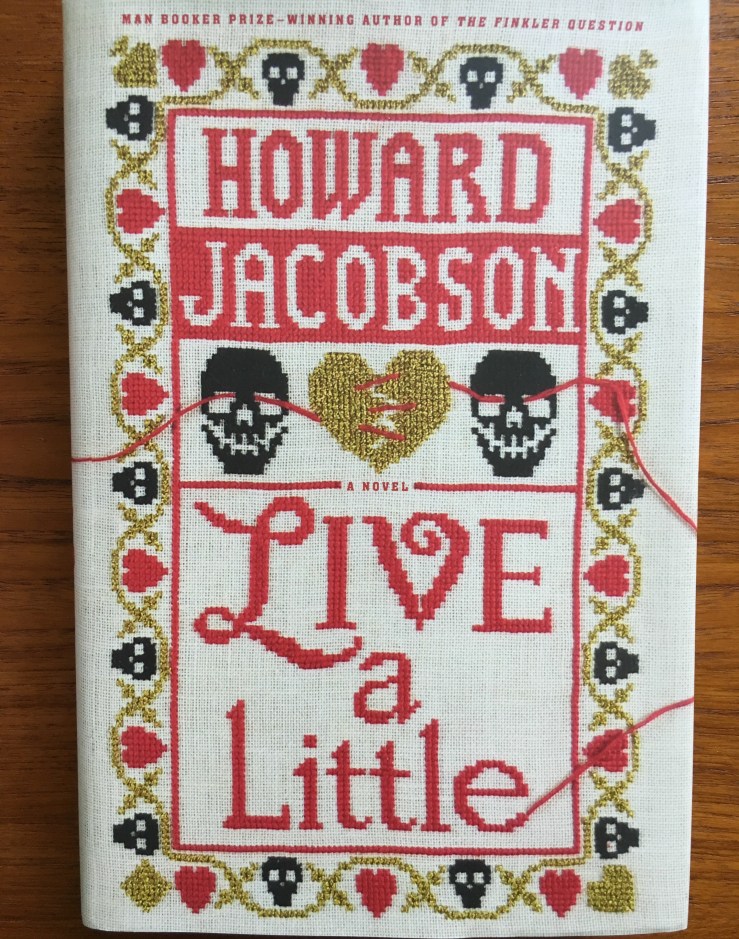
Howard Jacobson’s Live a Little is new in hardback in the US this month from Penguin Random House. Their blurb–
At the age of ninety-something, Beryl Dusinbery is forgetting everything – including her own children. She spends her days stitching morbid samplers and tormenting her two long-suffering carers, Nastya and Euphoria, with tangled stories of her husbands and love affairs.
Shimi Carmelli can do up his own buttons, walks without the aid of a frame and speaks without spitting. Among the widows of North London, he’s whispered about as the last of the eligible bachelors. Unlike Beryl, he forgets nothing – especially not the shame of a childhood incident that has hung over him ever since.
There’s very little life remaining for either of them, but perhaps just enough to heal some of the hurt inflicted along the way, and find new meaning in what’s left. Told with Jacobson’s trademark wit and style, Live a Little is equal parts funny, irreverent and tender – a novel to make you consider all the paths not taken, and whether you could still change course.
I had not intended to pick up any more books.
I’d been cooped up all week, or kinda sorta cooped, with a very mild cabin fever. This cooping and fever were the fault of Hurricane Dorian, which was slowly slowly slowly heading our way, although in the end, at least for us, not really. I’m deeply thankful and also very sorry for the many people who did meet Dorian. It fucking sucks.
We kept power and internet and everything though, and we also kept our kids, as school and work was cancelled, and everything closed down. We enjoyed a few rare 73 degree bike rides and pretended it was fall. We played card games and pretended like the power had gone out, although our air was coolly conditioned. We invented chores. I culled some books, a whole bankers box full. And I think the four of us (moi, wife, daughter, son) grated on each other after four days of this.
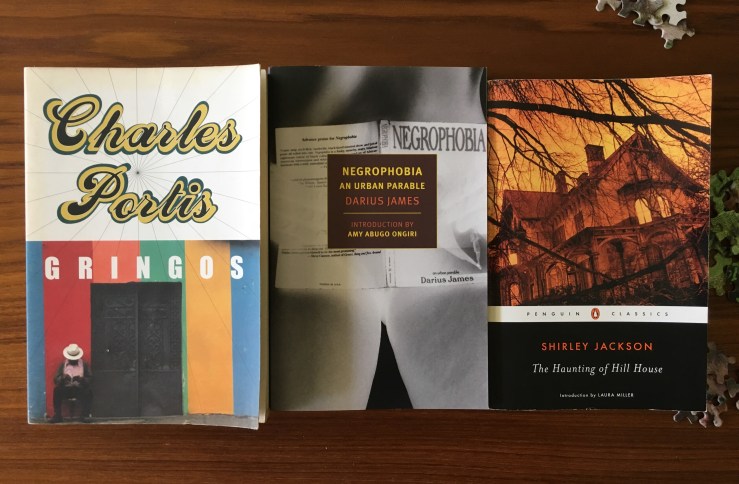
I got out for a bit on Thursday to do some made-up errands, including dropping off the culled books box. I said to myself, We will just drop off the box of books and then drive to the Publix to pick up our meds. We will not browse. I dropped off the books, and then I said to myself, We will browse, but we will not acquire. So I browsed, sticking at first to the weird margins I rarely visit of this big sprawling used books—travel writing and food writing, historical fiction and short story anthologies—before saying, Hey, maybe they have a copy of Charles Portis’s Gringos. They had a copy of Charles Portis’s Gringos. I said to myself, You will regret it if you don’t pick this up. (That same morning, I had tried to make a go at John Kennedy Toole’s A Confederacy of Dunces in the hopes of getting more Portis flavors, after finishing True Grit a few days ago. Alas, it didn’t take. Maybe later? I don’t know. I want to read Gringos.)
As I was picking up Portis I overheard a mother and her daughter trying to find Nathaniel Hawthorne’s The Scarlet Letter. They were not in the right place. They were in the westerns, an aisle or two over. The daughter was telling the mother how much anxiety the book produced in her. They turned into my aisle, still struggling against the alphabet, when the mother said to the daughter, We just need to find somebody who works here. I do not work there but I said, Hawthorne is down there, and pointed roughly east, where only a few meters away were literally hundreds and hundreds of copies of The Scarlet Letter. This indication was too vague though, and a few steps in the general direction were needed. The mother and daughter team found their way to Hawthorne though, and I lingered in the Js, where I remembered that I’d been meaning to read Shelly Jackson for years now. I had wanted to read We Have Always Lived in the Castle but there were no copies. There were two copies of The Haunting of Hill House. I got the one without the Netflix logo on it.
My eye is very good at scanning NYRB spines, and, while picking at Jacksons, I spied a book called Negrophobia by Darius James. I had never heard of Negrophobia, but the title alone warranted a pull. I opened the book up somewhere in the middle, flicked through—visually wild, cut up and strange, it reminded me a bit of Burroughs or later avant garde stuff, like Kathy Acker. I flipped it over. Kathy Acker blurbed it. Paul Beatty blurbed it. Kara Walker blurbed it! (More visual artists should blurb books.)
I picked up all three books of course. Then I went home and read another chapter of Sylvia Warner Townsend’s The Corner That Held Them.

Big Mouth, 2018 by James Rieck (b. 1965)
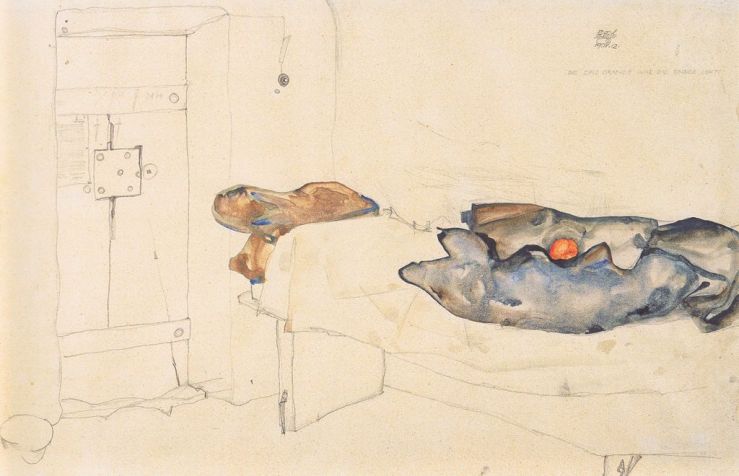
The Single Orange Was the Only Light, 1912 by Egon Schiele (1890-1918)
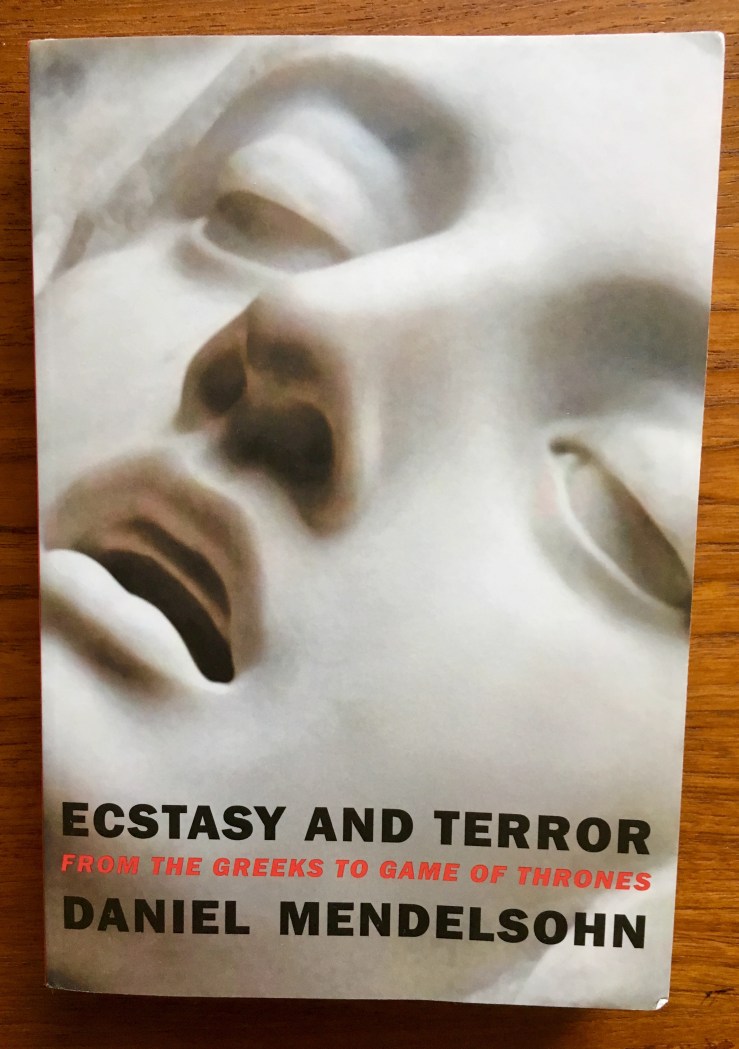
I got a review copy of Daniel Mendelsohn’s collection Ecstasy and Terror some time early last week. I’ve read a few of the pieces in here before (“A Critic’s Manifesto” is one that I recalled in particular). Ecstasy and Terror is out in October from NYRB. Their blurb:
This collection of essays exemplifies the range, depth, and erudition that have made Daniel Mendelsohn “required reading for anyone interested in dissecting culture” (The Daily Beast). Here Mendelsohn once again casts an eye at literature, film, television, and the personal essay, filtering his insights through his training as a scholar of classical antiquity in surprising and illuminating ways.
Many of these essays examine how we continue to look to the Greeks and Romans as models: some argue for the surprising modernity of canonical works (Bacchae, the Aeneid), while others detect a “Greek DNA” in our responses to the Boston Marathon bombings and the assassination of JFK. Modern topics are treated, too, from the “aesthetics of victimhood” in Hanya Yanagihara’sA Little Life to the novels of Karl Ove Knausgaard, and from Game of Thrones to recent films about artificial intelligence—a subject, Mendelsohn reminds us, that was already of interest to Homer.
The collection also brings together for the first time a number of Mendelsohn’s personal essays, including his “critic’s manifesto” and a touching memoir of his boyhood correspondence with the historical novelist Mary Renault.

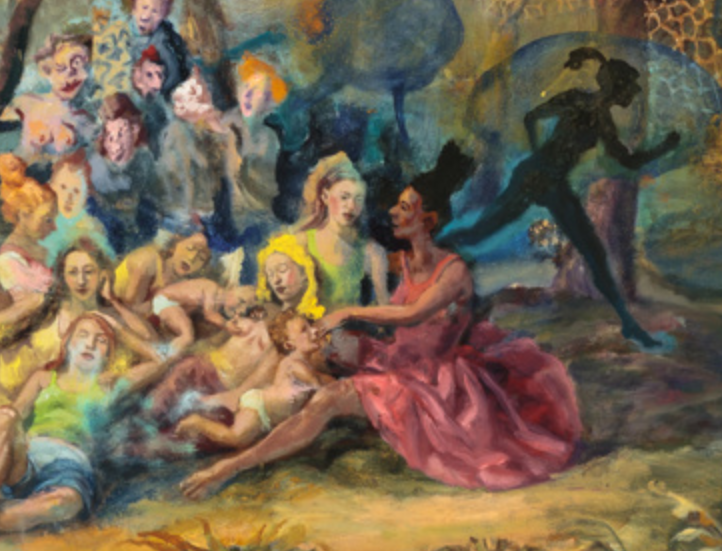
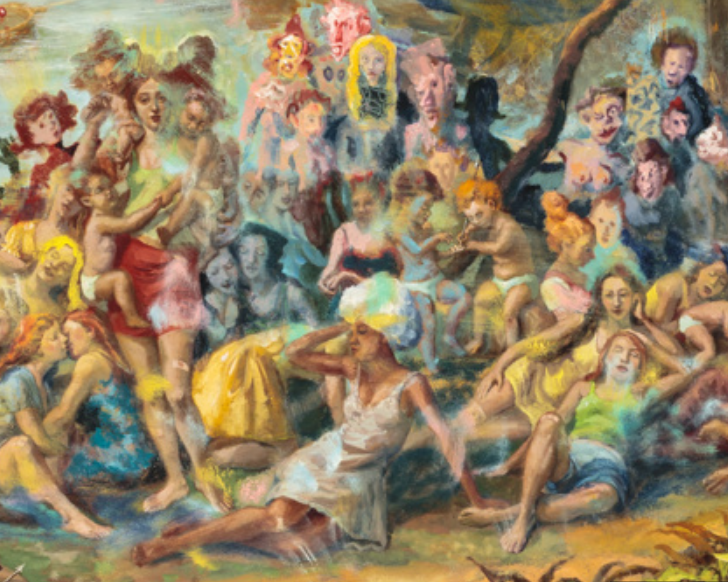
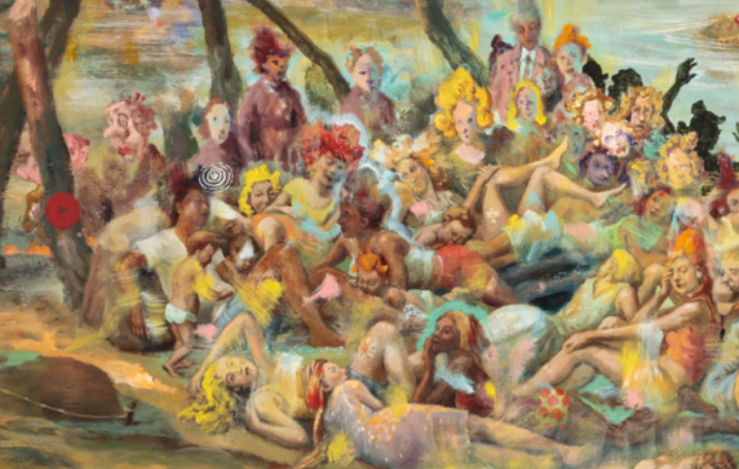
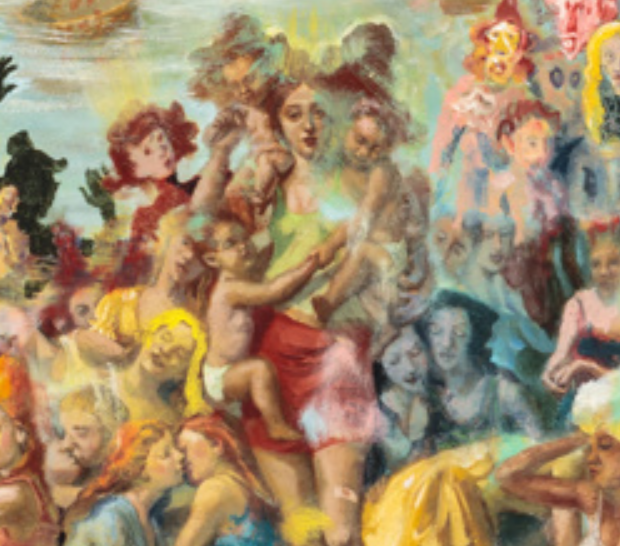
Simulacra, 2015 by Agostino Arrivabene (b. 1967)

I am on my second or maybe third dark and stormy and I have cleaned the house twice from top to bottom two days in a row now and I am ready for my kids to go back to school, which was cancelled through Thursday for Hurricane Dorian. My own school, by which I mean my employer, cancelled classes throughout the week, but I’ve been emailing students and trying to maintain some kind of continuity after this weird disruption. We have power here in NE Florida and all seems well. This ride has been a lot easier than Irma.
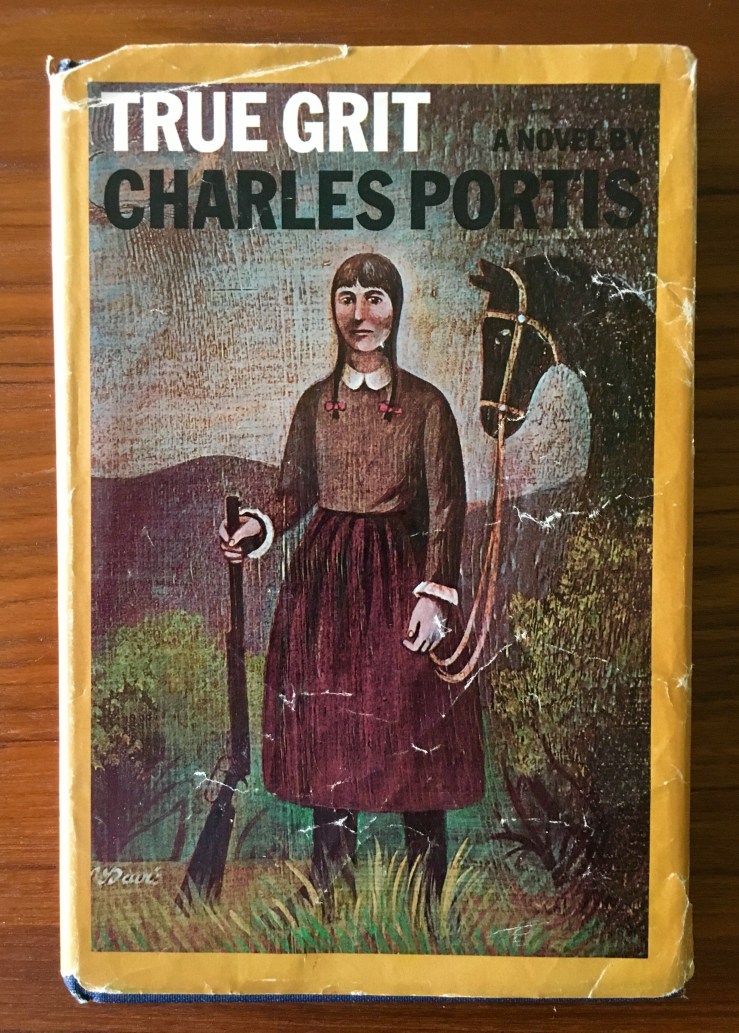
I finished Charles Portis’s famous novel True Grit this afternoon and I must confess it might be my favorite of the four I’ve read by the maestro. I shed a little tear for Little Blackie at the end, and also maybe for Rooster Cogburn. My thought is that I wish I’d read the book years ago, before I’d seen the two film adaptations, both of which are, like, fine, but neither of which capture the pure voice of Mattie Ross. Great stuff. I need to read Gringos next, but maybe I’ll wait a bit.
I have been switching between True Grit and Sylvia Townsend Warner’s nuns-in-the-English-fens-in-the-age-of-the-Black-Death The Corner That Held Them and I love both—both are funny, dry (and wet when they need to be). The Corner That Held Them packs in so much storytelling; pages go on for decades with a sprightly and imaginative and droll clip. I’ve been enjoying it so much I went up to my favorite used bookstore, big box of old books in tow, to find more. I picked up Lolly Willowes, which I understand is excellent, and which I will get to posthaste.
I had burned up most of my credit at this particular bookstore, but the box I done brung afforded me enough trade to not only pick up Lolly Willowes but also a first-edition hardback of Kurt Vonnegut’s Slaughterhouse Five.

I also got copies of Antoine Volodine’s Writers and Bardo or Not Bardo in the in the mail this week. I don’t rightly recall buying them online, but I know that after finishing In the Time of the Blue Ball by Volodine’s pseudo-pseudonym Manuela Draeger, I went through my Volodines for references to Draeger. I found references in Post-Exoticism in Ten Lessons, Lesson Eleven, but couldn’t find my copy of Writers and then remembered that I gave it to a friend who seemed to promptly move a hundred miles away afterward. (He said he thought it was good.) Anyway: Bardo soon or not soon.
I read Keiler Roberts’ graphic memoir Rat Time yesterday and loved it so much I wrote about it immediately.

The hurricane is not so bad for us.

Let’s start with the title. Rat Time is a great title.
What is Rat Time? Rat Time is a graphic novel—or graphic autofiction, or graphic discursive memoir—I’m not really sure what genre it fits into, nor does that matter—Rat Time is a very funny and often moving book by cartoonist Keiler Roberts.
And so what is “rat time”? Rat time is the time that Keiler shares with her daughter Xia and their rats Sammy and Mateo Too. “We eat dinner, then rat time, then bed time,” Xia explains to her classmates during show and tell.

When poor Sammy dies though, “rat time” takes on a different meaning. “It’s not a time of day,” Xia declares. “It’s the time when had rats.” Keiler optimistically points out that “We still have Mateo Too.” (Care to guess what happened to Mateo One?)
The early vignettes in Rat Time intersplice rat time with riffs from Keiler’s therapy sessions, calls and visits with her parents, and child memories. Although Rat Time’s structure might be at times oblique and discursive, Roberts’ pacing and pages are often surprisingly traditional and darkly comic, as in this little episode, in which Keiler recalls a pet’s death:

Initially, Rat Time appears to have an elliptical structure. Vignettes and riffs and one-pagers succeed each other without the usual narrative linking devices we might expect from a traditional graphic novel. Roberts’ humor is so dry too that for the first few pages the tone of Rat Time may be difficult to comprehend. The more I read though, the more I laughed, and the more I cared about Keiler and her daughter.
Roberts’ mines her life for material, and the material is often painful, coming out in unexpected ways. We learn that rat time originated as a coping mechanism, a response to a recent diagnosis of multiple sclerosis:

Rat Time features scenes of Keiler going to the hospital for blood work, or visiting a chiropractor for treatment, all with a wonderfully droll humanity that resonates with just how damn specific the moments are. We also see Keiler in her therapist’s office, and see how her friends and family react to her bipolar disorder, as well as how she manages it. Making oatmeal seems to provide Keiler a lot of comfort, and while I’m not a fan of oatmeal myself, I deeply relate to her feelings on breakfast:

Some of my favorite parts of Rat Time hover around Keiler’s experiences as an art instructor. There’s an intense pathos to Keiler-as-teacher, even when she seems mean:

Keiler’s teaching vignettes are balanced with her own memories of teachers past. Roberts frames these moments with the clarity of detail that telegraphs raw honesty. There’s the gym teacher who humiliated her on the bus to the bowling alley, the art teacher who showed the class a cadaver, and the political science professor who earned Keiler’s admiration for “stating a truth so plainly” (namely, “I know this would be more interesting if I were entertaining, but it’s worse if I try.”)

Roberts’ spare, plain style is effective in achieving her punchlines, but it can also affect the reader with a strange poignancy:

At one point, Roberts includes a polished piece in Rat Time, which creates a wonderful moment of narrative dissonance, a strange reverberation between Keiler the hero-narrator of Rat Time and Roberts the author-illustrator of Rat Time.

Indeed, a major theme of Rat Time is storytelling itself. Keiler wants to be a writer of fiction, but it seems like her own life is far more interesting than the ideas she brainstorms. Rat Time is perhaps Roberts’ way of sussing out why her genre is ultimately autobiographical.

Rat Time, like any good autobiography, is crammed with life, brimming with vivid moments that feel authentic and real. Often funny and sometimes painful, Roberts’ book is sweet without sentimentality, sour without caustic meanness, and generous to both its subjects and its readers. Highly recommended.
Rat Time is new from Koyama Press.
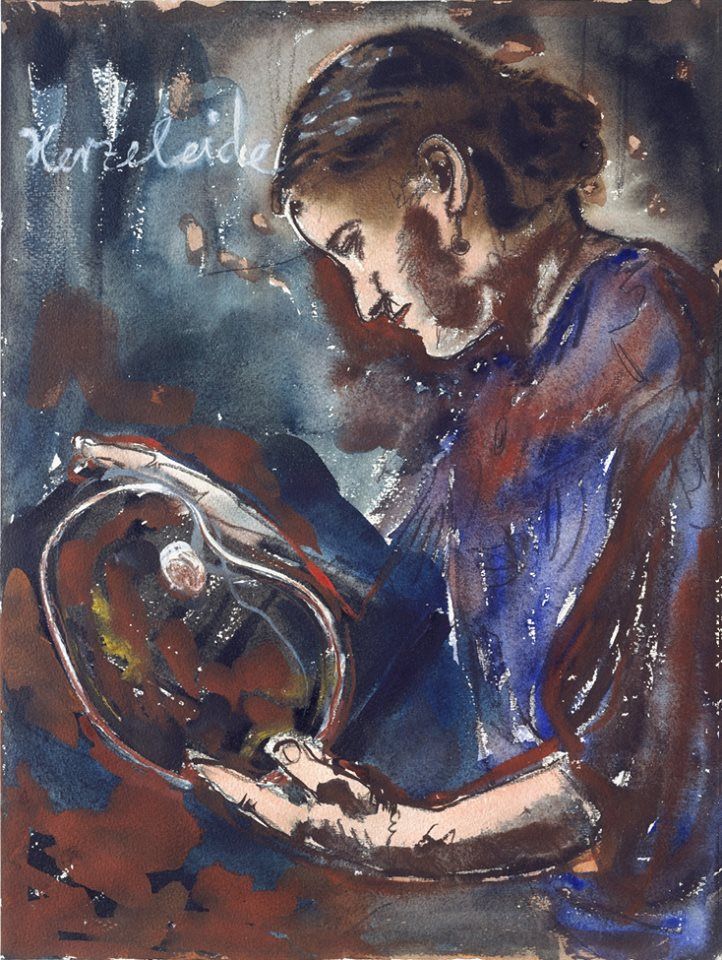
Herzeleide,1979 by Anselm Kiefer (b. 1945)
If Sanford T.’s daddy hadn’t got killed that night I guess we’d still be with the carnival. What we was doing was hauling old man McClerkin around the country claiming he was Jesse James and charging fifty cents a head to come in and see him. We had to pay Mr Mooney thirty per cent of the take to travel around with his carnival but we was making good money anyway. That all come to an end the night Jesse got drunk and fell out of the Ferris wheel on top of a cotton candy stand. We tried for awhile having Sanford T. billed as Bob Ford but he wasn’t old enough to fool anybody and we had to close up. Mr Mooney kept us on to bark for the freak show but you talk about some hard folks to get along with, that’s freaks. We was about ready to quit anyhow when the alligator boy busted Sanford T.’s leg with a crow bar, something you might or might not expect out of a alligator boy. The carnival left us stranded in Montezuma, Arkansas, where Sanford T. was in the hospital and I guess that was the best thing that ever happened to us. The reason for that initial is that he’s got an older brother named Sanford too. His folks just liked the name I guess.
I was setting on a bench in front of the courthouse reading Billboard when this old, weasel-eyed man comes up and sets down beside me.
“I hear you’re a carny,” he said.
“Well, you hear right, old man. Only I’m not working right now.”
“You got any money?”
I reached in my pocket and held out a half-dollar.
“Naw, naw,” he said, “I didn’t mean nothing like that. I’m the one what ought to be giving you a half. I want to talk business.”
“All right, start talking.”
“You innarested in making some money?”
“Now look, if you’re some kind of con man you ain’t talking to no farmer.’’
I finally pulled it out of him. He had a little place just outside of town where he bottled patent medicine and he wanted to sell out because his health was failing him and his doctor told him he better move out west if he wanted to live.
“How come you don’t take this medicine and save yourself a trip?” I asked him.
“Well, you see, that’s what’s wrong with me now. This is liver emulsifier, that’s what I call it, ‘Bethel Liver Emulsifier’, and my liver is so stout now that it’s overworking my other organs. I’ve got the liver of a 21-year-old boy, believe it or not. Of course you’re a layman and wouldn’t understand all about how it works. Has to do with bile flow and all that.”
“You got me there all right,” I said.
“And besides, my daughter out in California is about to worry me to death to move in with her. I’m willing to take a big loss on a quick deal.”
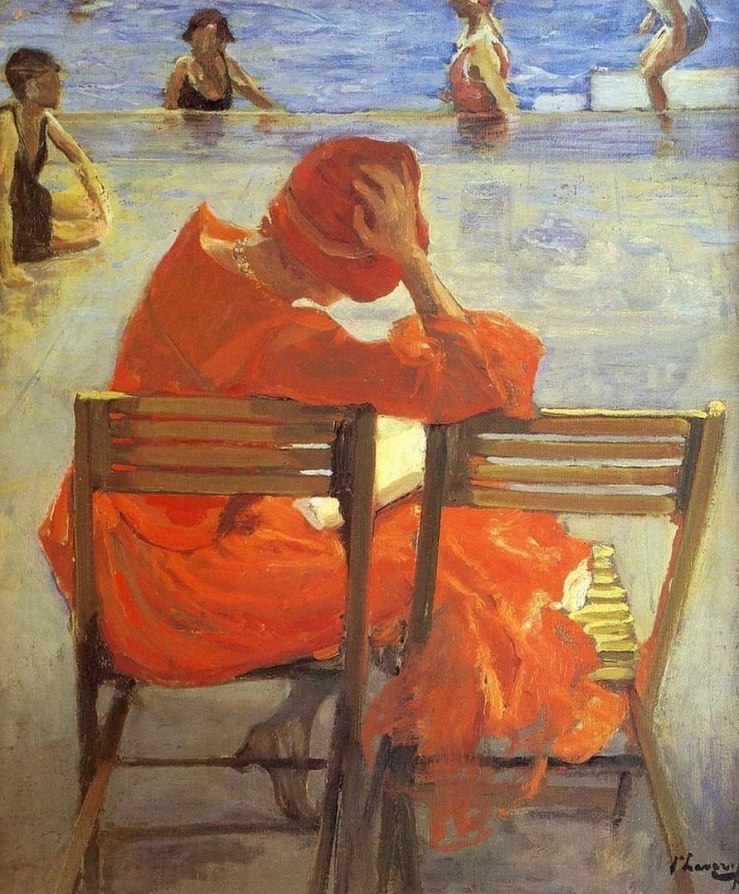
Girl in a Red Dress Reading by a Swimming Pool, 1887 by John Lavery (1856–1941)
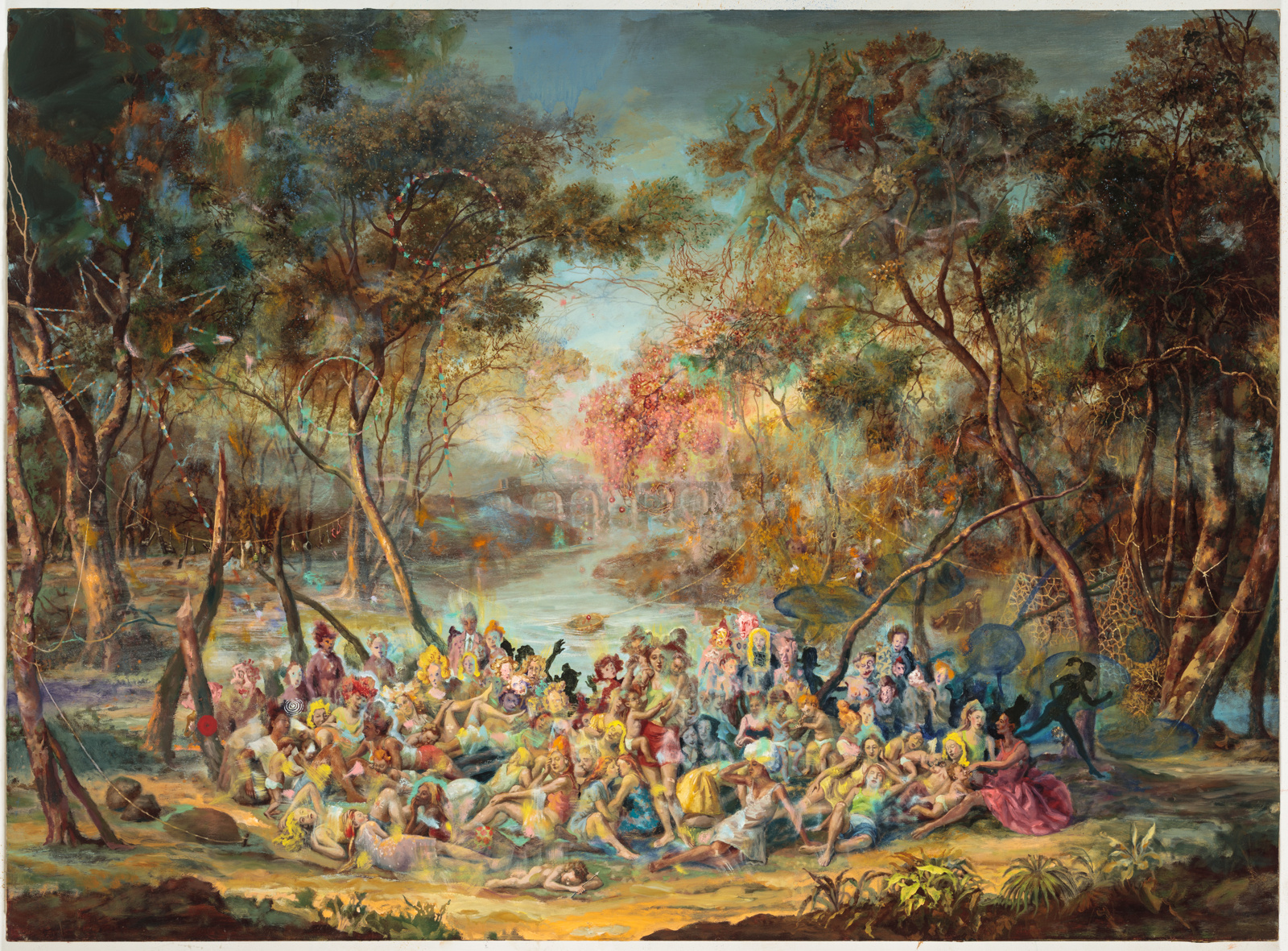
 Biblioklept