July 10th.–A fishing excursion, last Saturday afternoon, eight or ten miles out in the harbor. A fine wind out, which died away towards evening, and finally became quite calm. We cooked our fish on a rock named “Satan,” about forty feet long and twenty broad, irregular in its shape, and of uneven surface, with pools of water here and there, left by the tide,–dark brown rock, or whitish; there was the excrement of sea-fowl scattered on it, and a few feathers. The water was deep around the rock, and swelling up and downward, waving the seaweed. We built two fires, which, as the dusk deepened, cast a red gleam over the rock and the waves, and made the sea, on the side away from the sunset, look dismal; but by and by up came the moon, red as a house afire, and, as it rose, it grew silvery bright, and threw a line of silver across the calm sea. Beneath the moon and the horizon, the commencement of its track of brightness, there was a cone of blackness, or of very black blue. It was after nine before we finished our supper, which we ate by firelight and moonshine, and then went aboard our decked boat again,–no safe achievement in our ticklish little dory. To those remaining in the boat, we had looked very picturesque around our fires, and on the rock above them,–our statues being apparently increased to the size of the sons of Anak. The tide, now coming up, gradually dashed over the fires we had left, and so the rock again became a desert. The wind had now entirely died away, leaving the sea smooth as glass, except a quiet swell, and we could only float along, as the tide bore us, almost imperceptibly. It was as beautiful a night as ever shone,–calm, warm, bright, the moon being at full. On one side of us was Marblehead light-house, on the other, Baker’s Island; and both, by the influence of the moonlight, had a silvery hue, unlike their ruddy beacon tinge in dark nights. They threw long reflections across the sea, like the moon. There we floated slowly with the tide till about midnight, and then, the tide turning, we fastened our vessel to a pole, which marked a rock, so as to prevent being carried back by the reflux. Some of the passengers turned in below; some stretched themselves on deck; some walked about, smoking cigars. I kept the deck all night. Once there was a little cat’s-paw of a breeze, whereupon we untied ourselves from the pole; but it almost immediately died away, and we were compelled to make fast again. At about two o’clock, up rose the morning-star, a round, red, fiery ball, very comparable to the moon at its rising, and, getting upward, it shone marvelously bright, and threw its long reflection into the sea, like the moon and the two light-houses. It was Venus, and the brightest star I ever beheld; it was in the northeast. The moon made but a very small circuit in the sky, though it shone all night. The aurora borealis shot upwards to the zenith, and between two and three o’clock the first streak of dawn appeared, stretching far along the edge of the eastern horizon,–a faint streak of light; then it gradually broadened and deepened, and became a rich saffron tint, with violet above, and then an ethereal and transparent blue. The saffron became intermixed with splendor, kindling and kindling, Baker’s Island lights being in the centre of the brightness, so that they were extinguished by it, or at least grew invisible. On the other side of the boat, the Marblehead light-house still threw out its silvery gleam, and the moon shone brightly too; and its light looked very singularly, mingling with the growing daylight. It was not like the moonshine, brightening as the evening twilight deepens; for now it threw its radiance over the landscape, the green and other tints of which were displayed by the daylight, whereas at evening all those tints are obscured. It looked like a milder sunshine,–a dreamy sunshine,–the sunshine of a world not quite so real and material as this. All night we had heard the Marblehead clocks telling the hour. Anon, up came the sun, without any bustle, but quietly, his antecedent splendors having gilded the sea for some time before. It had been cold towards morning, but now grew warm, and gradually burning hot in the sun. A breeze sprang up, but our first use of it was to get aground on Coney Island about five o’clock, where we lay till nine or thereabout, and then floated slowly up to the wharf. The roar of distant surf, the rolling of porpoises, the passing of shoals of fish, a steamboat smoking along at a distance, were the scene on my watch. I fished during the night, and, feeling something on the line, I drew up with great eagerness and vigor. It was two of those broad-leaved sea-weeds, with stems like snakes, both rooted on a stone,–all which came up together. Often these sea-weeds root themselves on mussels. In the morning, our pilot killed a flounder with the boat-hook, the poor fish thinking himself secure on the bottom.
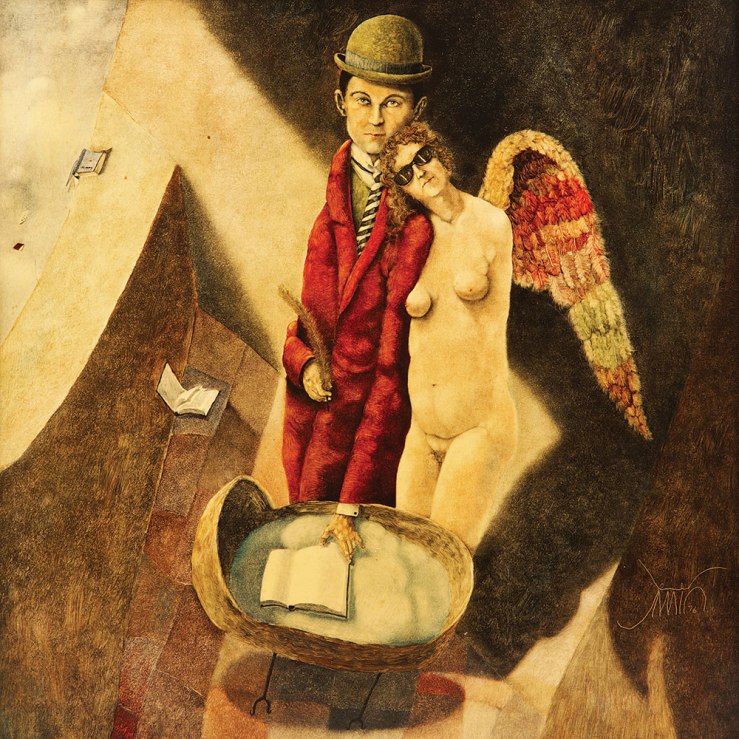
As a huge fan of Remedios Varo’s art, I was thrilled last year when Wakefield Press published Margaret Carson’s Letters, Dreams and Other Writings.I reached out to Margaret, who was kind enough to talk to me about her translation in detail over a series of emails.
In addition to Letters, Dreams and Other Writings Margaret Carson’s translations include Sergio Chejfec’s Baroni, A Journeyand My Two Worlds. She is Assistant Professor in the Modern Languages Department at Borough of Manhattan Community College, The City University of New York.
Margaret Carson
Biblioklept: When did you first see Remedios Varo’s art?
Margaret Carson: I first heard of Remedios Varo in the mid-80s, when I was living in Madrid. But it was by reading Janet Kaplan’s biography, Remedios Varo: Unexpected Journeys, that I learned more about her life and first saw many images of her paintings. That was in the 90s. On a trip to Mexico City at that same time, I was surprised to find in a bookstore a small collection of her writings, Cartas, sueños y otros textos, and I brought it home with me. I started translating parts of it and later heard about an exhibit of her paintings at the National Museum of Women in the Arts in Washington D.C., in 2000: The Magic of Remedios Varo. That was my first experience seeing her paintings up close, and it blew me away. Nothing compares to standing in front of one of her paintings to see the meticulous details, the true color, and the actual scale (her artworks can be much smaller than you imagine). Since then, I’ve seen other paintings, includingMimetismo/Mimicry andLa creación de las aves/The Creation of the Birds, at theMuseo de Arte Moderno in Mexico City, which has over thirty of her paintings—the largest collection in the world.
Creation of the Birds, 1957
Exciting news for Varo fans in the New York area: MoMA has acquired one of her most extraordinary works,The Juggler, which will be put on display when the museum re-opens in October 2019. Can’t wait to see it!
Biblioklept: I’ve yet to see one of Varo’s pieces in a museum, unfortunately—just reproductions in books and online. But I love them. I think the first time I saw one of her works was in Women, Art, and Society by Whitney Chadwick, sometime in the late 1990s. There’s a tiny black and white reproduction of Celestial Pablum in there, next to a reproduction of a Dorothea Tanning painting. Leonor Fini also gets a black and white reproduction in that chapter, while Leonora Carrington’s Self-Portrait gets a larger, full-color reproduction. All of these painters, with the notable exception of Varo, also show up in another of Thames & Hudson’s World of Art series that was important to me when I was younger, Sarane Alexandrian’s Surrealist Art. While internet archives have made images of Varo’s works easily available to those who search for them, she is still something of a comparatively obscure figure, at least next to other Mexican artists like Frida Kahlo or Leonora Carrington. Have you noticed any change in her prominence as an artist since you first encountered her work?
MC: You brought up Whitney Chadwick, which reminds me of her essential book, Women Artists and the Surrealist Movement, first published in 1985 and still in print. If you don’t know it, take a look. That’s where many readers have had their first encounter with women surrealists. Chadwick devotes several pages to Varo and includes three color reproductions and many black and white images of her work. As to how well known Varo is, it’s hard to tell what causes an artist to move up or down in the fame game. Varo seems to have a solid core of admirers who had an encounter with her work, almost always in reproduction, and the images stick. Why is that? What is it about her paintings? Their inherent narrative quality, their mystical elements, their humor? The simple pleasure of looking at her meticulously composed scenes? I think she’s still fairly unknown, but did you know that in the first chapter of Pynchon’s The Crying of Lot 49 there’s a fascinating description of Varo’s Embroidering the Earth’s Mantle? I just met a young bookseller who told me that that’s how she first heard of Varo. And did you know that in chapter 9 of Amulet, Roberto Bolaño imagines that the main character, Auxilio Lacouture, visits Remedios Varo in her house? So Varo has already popped up in ways that go beyond her artwork.
Embroidering the Earth’s Mantle, 1961
Biblioklept: I’m a huge fan of Bolaño, and I read Amulet eight or nine years ago, but I’d honestly forgotten about the Varo episode! I just went back and reread the chapter, and there’s this wonderful strange moment where Varo shows Auxilio a landscape painting, the “last one,” or maybe the “second-to-last one” she’ll paint, and the painting causes an anxiety in Auxilio that manifests in the vision of “a man made of ice cubes, who will come and kiss” her on the mouth. I love the line because it’s so strange; it shows a kind of poetic rivalry on Bolaño’s part with Varo’s own imagery.
I’m also a huge Pynchon fan. I remember that I wasn’t able to find a reproduction of Embroidering the first time I read The Crying of Lot 49—like in the late nineties—but when I reread it a few years ago it was as easy as a simple internet search. So I think the internet is making her work more accessible. Pynchon apparently actually got to see Emboidering at a retrospective of Varo’s work in Mexico City in 1964, and, as Bill Brown notes, Pynchon essentially reinterprets the painting’s details from memory. He probably didn’t have a reproduction of it. Again, the author enters into a kind of rivalry with the poet.
Letters, Dreams & Other Writings contains a section that features Varo’s own descriptions of her paintings, comments intended for her family back in Spain. She describes Embroidering the Earth’s Mantle like this: “Under the orders of the Great Master, they’re embroidering the earth’s mantle, seas, mountains, and living things. Only the girl has woven a ruse in which she is seen beside her beloved.”
I’m curious about your translation here, particularly of the word “Only,” and the singular “girl,” which seems to contrast the “they” referenced in the previous sentence. Varo seems to describe two parts of the triptych, the second and the third panels. Can you talk a little bit about translating this description?
Toward the Tower, 1960
MC: Varo has a description for each of the paintings in the triptych (her descriptions, of course, shouldn’t close off other interpretations). That singular “girl” is introduced in the first painting,Toward the Tower, which shows a group of convent school girls riding fanciful bicycles made in part from their capes. Varo writes that while the eyes of the other girls are “as if hypnotized,” only the girl in front “resists the hypnosis.” (Sólo la muchacha del primer término se resiste a la hipnosis.) The girl clearly has a mind of her own. Varo follows her into the second painting, Embroidering the Earth’s Mantle. The original is: “Bajo las órdenes del Gran Maestro, bordan el manto terrestre, mares, montañas y seres vivos. Sólo la muchacha ha tejido una trampa en la que se le ve junto a su bienamado.” There’s a repetition in the Spanish, “Sólo la muchacha….” that I picked up in the translation “Only the girl has woven a ruse….” She’s the exception—she stands out from the other girls (“they”) who are under the influence and control of the Great Master and are embroidering what he commands. I could have said “Except that the girl has woven a ruse in which she is seen beside her beloved.” to underscore her act of rebellion more clearly, but then the parallelism would have been lost.
Getting back to the Bolaño, I’d like to re-read Amulet and think about how he works Varo into the narrative and whether he’s referencing any of her paintings or making them up — from your description, I suspect the latter. But more importantly, what did Varo represent to Bolaño? How did he come to know about her work? Did she have some sort of underground fame in Mexico City while he was living there?
I’m also fascinated by the fact that Auxilio visits Varo at her house, which I always make a point of passing by when I’m in Mexico City. (Again, Bolaño’s description is not based on reality.) Varo lived in Colonia Roma on Avenida Álvaro Obregón in a four-story building that’s now boarded up—someone told me it was damaged in an earthquake. But lights are on at night behind windows covered with newspapers, so someone’s living there. Is there any memory in the neighborhood that Varo lived there? It’s where she painted her most famous works. To me, it has a special aura, even in its dilapidated and boarded-up state.
Biblioklept: I’m pretty sure Bolaño made the painting up, although I did spend quite a bit of time looking for a real-world corollary for it. He definitely had a penchant for invention, often taking cult or outsider artists and then attributing works to them that don’t always exist. It seems possible that he could’ve been aware of the location of her house, but I’m guessing he was living in Spain and had been away from Mexico for ages when he wrote Amulet.
On of my favorite pieces in Letters, Dreams & Other Writings is “On Homo rodans,” a Borgesian send-up of scientific monographs. (Varo attributes the monograph to one “Hälikcio von Fuhrängschmidt”). While its style isn’t a huge departure from that of the letters or even fragments in the collection, it stands out a bit. Can you tell us a bit about translating “On Homo rodans,” and a bit about the piece itself?
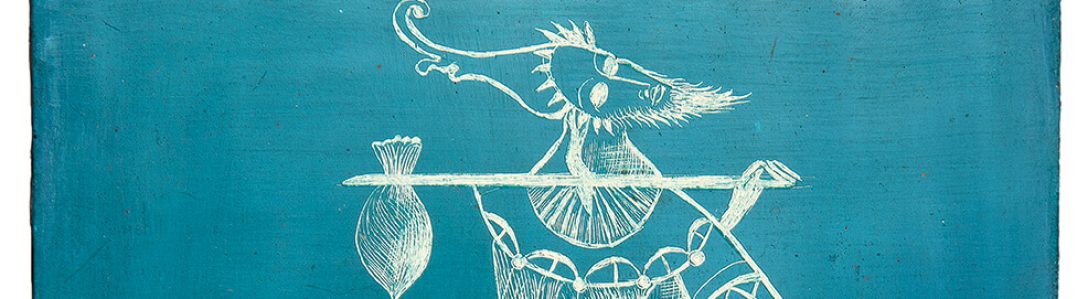
Facsimile manuscript of “On Homo radans“
MC: Homo rodans is one of Varo’s oddest creations. It has two parts: first, the “fossil find” of the humanoid figure with one big wheel instead of legs, which she crafted out of chicken and turkey neck bones and fish vertebrae. The second part is a pseudo-scientific treatise she wrote to accompany the “fossil,” which purports to explain its origin and the great significance it has—it’s basically a missing chapter in human evolution, a predecessor to Homo sapiens that depicts a road not taken: before evolving into a biped, humans were creatures on a monowheel. (That sort of figure is a recurring leitmotiv in her work—seeTransmisión ciclista con cristales from 1943,Caminos tortuosos from 1957.) I’d now like to clear up a misunderstanding that’s arisen with the English translation. To an English-speaking reader, “rodans” might look like a corrupted version of “rodents.” It’s a similarity that exists only in English. To Varo, rodans was a creative spin on rota, the Latin word for wheel, from which the Spanish rueda descends (in English we have rotate, rotary, rodeo). Varo wasn’t suggesting humankind descended from rats; she was imagining a wheeled ancestor and giving it a suitably Latinate name.
The “fossil” in question
Varo wrote “On Homo rodans” by hand, in the style of an old illuminated manuscript (see attached photo), and gave its narrator the farfetched but seemingly authoritative name of Hälikcio von Fuhrängschmidt, an anthropologist who sets out to correct a colleague’s error about bones discovered on the southern slopes of the Carpathians. I think this was all for the sake of fun, like a lot of her writings. She probably never imagined that anyone would be interested in buying the sculpture and the treatise. It was just by accident, apparently, that someone happened to see it when she was showing it at a bookstore and acquired it for his boss, who was none other than the President of the Republic, Adolfo López Mateos. That was in 1959.
On an investigative level, I’d love to find out who owns Homo rodans now—the sculpture and original manuscript (does the López Mateos family still own it?). I’d also like to do some sleuthing to discover how it was that a small facsimile edition of the treatise was published a few years after Varo’s death. What called that into existence? Who read it? Was it reviewed? It’s because of that edition that we have the text in Spanish.
As to the translation itself, something that helped me catch the antiquated tones of the pedantic von Fuhrängschmidt were nineteenth-century bulletins on scientific expeditions and fossil excavations you can easily find using Google Books. But on the whole it was a wild ride. You’ll notice that the Homo rodans itself only comes up once, toward the end of the piece, after countless disquisitions on unrelated subjects (Babylonian wet nurses, the universal tendency toward hardening and softening (wink-wink), the transcendence of canes, the pterodactyl-turned-first-umbrella…), interspersed with quotes by ancient sages in nonsense Latin. Before I translated it, I thought “On Homo rodans” would mostly be about the one-wheeled fossil. It was only after I got into the translation that I realized the fossil find was just one stop on an extended absurdist romp.
Biblioklept: It’s interesting to me that you used old pieces of science writing as reference points. Was this to help convey the flavor of Varo’s prose, and to give an aural sense of what she’s parodying? Did you use similar techniques elsewhere in this translation, or in other translations of yours?
MC: The Edinburgh Encylopaedia, published in 1832, was an excellent resource to mine for old-fashioned scientific prose. Some of it rubbed off on the translation. “Osseous,” for example, referring to bones, was a word that peaked in the nineteenth century, according to Google Ngram, and it fit in perfectly.
For Varo’s recipes “To Induce Erotic Dreams” and “To Dream You Are King of England,” I consulted cookbooks such as Julia Child’s Mastering the Art of French Cooking to see how the instructions were worded. As strange as the recipes are, I had to keep to the conventions of the cookbook genre: “Set hens to boil.” “Reserve feathers.” “Take the four kilos of honey and with a spatula spread on the bedsheets.” It’s one example of how translators often look at companion texts in the language they’re translating into—some text that shares some stylistic feature with whatever is being translated, or that treats a similar topic. In a previous translation I did, Sergio Chejfec’s Baroni, a Journey, there’s a scene in which a cockfight takes place. Knowing nothing about cockfighting, I looked at Nathaniel West’s The Day of the Locust, where there’s a play-by-play of a cockfight in progress. I pilfered some of the language and phrasing there to help make the translation ring true in English.
The Lovers, 1963
Biblioklept: Varo’s “recipes” are a great example the tension between a conventional form and a kind of, I don’t know, absurd pivot in the language that creates a surreal image. Her letters, too, are infused with vivid and surreal images. She describes raising a “supernatural puppy,” details enclosing a “small volcano” and turning it into a kitchen, and tells one unidentified painter that he may be interested in her “residence in a piece of quartz.” Can you tell us a little bit about translating the letters? Were there letters of Varo’s that were perhaps more conventional that aren’t collected in Letters, Dreams & Other Writings?
MC: The original Cartas, sueños y otros textos contains only eight letters, but I’m sure Varo wrote many more. She had a genius for letter-writing, too—it was simply another medium she excelled at. As you say, the letters are infused with all sorts of surreal images and absurd scenarios, such as the “small volcano” that begins to rise on its own in the courtyard of someone’s house, throwing off lava that her friend Leonor Carrington is allergic to. That’s in my favorite letter, no. 7, “To Mr. Gardner,” i.e. Gerald Gardner, the great British popularizer of Wicca in the 1950s. It’s completely over-the-top! The most notorious is Letter 5, a kind of Surrealist prank, in which she picks a person’s name from the phone book and invites him to a New Year’s Eve party. (See Varo’s “Letter to a Stranger”). What comes next is left to your imagination: did the stranger show up, and if so, what happened?
As to other letters being published elsewhere, I’m aware of a few additional ones, to her mother and to some friends from her schooldays back in Spain, which were included in a personal memoir written by her niece, Beatriz Varo. I suppose you could call those letters more conventional, but they’re equally amusing to read, even when she’s telling her friends about her arduous ocean journey to Mexico in 1941, when she sailed from Europe on the Serpa Pinta with many other refugees who had been granted asylum in Mexico.
I was enchanted by all the letters and I’m hoping more of her correspondence turns up. I’d be especially interested in her side of the correspondence with Benjamin Péret after he returned to France in 1948. His letters to Varo are collected in his Oeuvres complètes, but no one seems to know where hers are…
Biblioklept: It’s a shame that we don’t have Varo’s letters to Péret. It seems like a lot of the work by the women surrealists of the twentieth century was perhaps at the time not seen as important as the work by the men. (I think of The New York Times’s obituary for Frida Kahlo, which opened with this line: “Frida Kahlo, wife of Diego Rivera, the noted painter, was found dead in her home today”). I think that your work, the work of Wakefield Press in general, and the work of other independent publishers is helping to bring the work of people like Varo, Leonora Carrington, Gisèle Prassinos, Unica Zürn and others to a wider audience though. What other women writers and artists would you like to see gain a wider audience?
MC: What writings are out there, out of print, or unknown, hidden in archives, uncatalogued, untranslated? The French poet and artist Alice Rahon, who also lived in Mexico City and moved in the same artistic circles as Varo, should be better known. She published a few books of poetry during her lifetime, and there’s an archive of unpublished work in Mexico City in both French and Spanish to be explored. A few poems in translation appear in Mary Ann Caws’s The Milk Bowl of Feathers, an anthology of surrealist writing published last year by New Directions, and I believe Mary Ann has been translating more of Rahon’s work. The Spanish artist Maruja Mallo, who was slightly older than Remedios Varo, also deserves more attention. Like Varo, she graduated from the prestigious Academia de Bellas Artes in Madrid and also lived in exile, in her case in Uruguay and Argentina, before returning to Spain in the 1960s. They both spent time in Paris in the 1930s, and I’m fairly sure they knew one another. Mallo has gotten some renewed interest lately—there was a recent gallery show in New York—and she has a short text “Surrealism as Manifest in My Work” in Penelope Rosemont’sSurrealist Women: An International Anthology. The artworks clearly take the lead for all three women, but their writings give a window into their strange art (and vice-versa), or maybe, can even stand independently, as do Leonora Carrington’s writings.
Biblioklept: Thanks for that list! I’m curious if you know how much of Carrington’s fiction Varo might have read. Was Carrington a stylistic influence? I’m also curious about other influences you detect in her writing, which seems so strange and original. “On Homo rodans” is definitely Borgesian, and Varo mentions reading Borges’s story “Deutsches Requiem” in one of the “Dreams” in the collection…who and what was Varo reading? How might it have influenced her writing?
The Street of Hidden Presences, 1956
MC:It’s hard to talk about influence because there must have always been a back-and-forth between Varo and Carrington and an intense sharing of mutual passions. They collaborated on a play, El santo cuerpo grasoso (“The Holy Oily Body”), written in the late 1940s and as far as I know, never performed for the general public. The original manuscript shows that they composed it in alternating lines, one hand followed by the other and back again, somewhat like a cadaver exquisit. They appear to have written it as a private amusement, to be performed by a small circle of friends. Carrington has a Varo-like character in The Hearing Trumpet, Carmella Velazquez, who, just as Varo did in the letter mentioned above, wrote letters to complete strangers she picked out of the phone book. She was the one who introduced Varo to Gerald Gardner, the Wicca popularizer. She may also have introduced her friend to Frank Sherwood Taylor, the British author of The Alchemists. A Spanish translation of this book was in Varo’s library.The heroine of Varo’s story “Mistress Thrompston Discovers by Accident the Source of the Tremendous Humidity that Reigns in the County of Kent” seems to be modeled on Carrington. There are other appearances by Carrington in the translation. Varo’sMimicry (Mimesis) makes an obvious nod to Carrington’sSelf-Portrait.
Mimicry, 1960
About their writings, keep in mind that Varo, unlike Carrington, never published her work during her lifetime, and it’s not clear she would have done so if offered the chance. Most of the texts I translated were found in Varo’s notebooks after her death. And don’t forget her long relationship with Benjamin Péret. A comparison of Varo’s and Péret’s writings would also be interesting. Her automatic writings probably date back to the time they were together. In Letters, Dreams Péret appears in the Felina Caprino-Mandrágora story as Benjamin Pérez, an avid bicyclist and the owner of a carrier-pigeon business. It’s a funny little scene, perhaps Péret-like in how it unfolds. All speculation, because I don’t know his work that well.
At a recent exhibition at the Museo de Arte Moderno in Mexico City of items from Remedios Varo’s archive, there were a few shelves of books from her library. I saw titles (in the original French, Spanish or English or in translation) by Jean Ray, H. P. Lovecraft, Rodney Collin (a British writer influenced by the mystics Pyotr Ouspensky and Gurdjieff), Orwell, Aldous Huxley, Katherine Mansfield, Simone Weil. That gives you an idea of other directions her reading took besides Borges. No way of knowing, though, all the books she read, or what her earliest reading was like growing up.
Some titles from Varo’s shelves
Biblioklept: Varo clearly read works of literature both in translation as well as in their original languages. In our own era, it’s very easy to quickly access all kinds of media from around the globe, including media that might not be as challenging to understand as literature might be. Why is reading literature in translation still important?
MC: You’re right—there’s more “content” than ever before and you can find it in a split second via Google. But if you’re asking, is there still a place for literature given the glut of writing, etc. on the Internet, I’d say yes, because it’s not an either/or. At the same time, I don’t think reading literature in translation is something meritorious in itself. It’s simply a natural consequence of being curious about what’s being written in other places: fiction, poetry, essays, plays, graphic novels, comics. It’s inevitable: a lot of it has to come to you in translation.
Biblioklept: One of the longer pieces in Letters, Dreams & Other Writings is titled “Project for a Theater Piece,” which you note was likely to be a collaboration with Leonora Carrington. For me, “Project for a Theater Piece” is simultaneously rich and frustrating. It opens with a character list that includes characters that we never get to meet (and omits characters we actually do meet), and has like a dozen plot openings that remain unresolved. This is what we might expect from a surrealist text: aporia, incongruity, dream logic (and some wonderful humor). At the same time, Varo’s writing strikes me as not bound to any kind of genre expectations.
MC: “Project for a Theater Piece” is indeed fragmentary and puzzling. Leonora (Carrington) and Eva (Sulzer) are inspirations for the Ellen Ramsbottom character. Daphne Fitz is inspired by Edward James, the eccentric Scottish arts patron who was a close friend of Leonora Carrington’s. He also seems to be the inspiration for the Poltergeist, who appears in the story wearing a short plaid skirt, sneakers and ankle socks, and is mistaken at first for a woman. I have no idea why it’s called “Project for a Theater Piece,” since it’s basically a cast of characters followed by two unconnected short stories. I’m assuming the editor of the original book, Isabel Castells, gave it that name. All the texts are said to be from Varo’s notebooks, so everything needed to be transcribed: in her introduction, Castells says that Varo’s last partner, Walter Gruen, did the transcription. I’m not sure if Castells saw the original; she may have been working only with Gruen’s transcription. Did the order in the book follow the order of the texts in Varo’s notebooks? Or was there some editorial intervention by Gruen and/or Castells linking them together? I don’t know. Castells also suggests that Leonora Carrington may have written parts that are missing, in a kind of surrealist chain story. If that’s true, it would be interesting to read “Project for a Theater Piece” against the collaborative play I mentioned above, El santo cuerpo grasoso/The Holy Oily Body, for stylistic similarities. Whatever the case, I wouldn’t read it as a finished text. It’s open to all sorts of speculations about the context in which it was written and about the editorial interventions that occurred later on in preparing the original edition of Cartas, sueños y otros textos for publication.
The Call, 1961
Biblioklept: I’m curious about the samples of automatic writing in the collection—specifically, I’m curious about how you approached translating them. Translating strikes me as a hyper-conscious art, a practice that involves a precision and command of tone, diction, rhythm, etc.—but automatic writing is, ostensibly, writing without consciousness.
MC: These texts seemed like prose poems to me, wonderful bizarre and disconnected, which led to some head scratching, and yes, a hyper-conscious translation. The text starts off with what seems to be a list of ingredients, like a recipe… or is it for some kind of magical spell? Each “ingredient” then becomes the lead word for a short sequence of images that often evoke Varo’s art: the egg, the crevice that widens (Harmony/Armonía), the raw silk being spun, which reminded me of the delicate lines crisscrossingFellow Feeling/Simpatía). The sequences in themselves don’t make much sense, but the words themselves are very clear and simple. Sometimes there’s some wordplay, such as “trasto trastorno, torno” in Incense (literally, “dish upset/overturned, turned”) which I translated as “dish depraved, lathe” to get some of the sound effects of the original and suggest the spindle in the next line. We don’t, unfortunately, have Varo’s description of the conditions under which she wrote these texts, or anything that tells us how she understood “automatic writing.” (Also, remember that she didn’t label these writings as such— it was the book’s editor.) She may not have been a purist. Whatever the case, this section is one of my favorites in the book. I love her random scattering of images and the lack of narrative direction. For me, the more nonsensical, the better.
Biblioklept: The issue of the editor’s hand is of course interesting. The “Automatic Writings” do feel…I don’t know, more automatic than some of the project ideas and fragments, which have narrative properties. There’s something wildly imagistic about the “Automatic Writings,” something cinematic really, mental imagery that seems like it couldn’t be painted. But then you read Varo’s descriptions of her own paintings, and you realize that her imaginative vision could realize seemingly impossible images in both paint and words.
MC: Yes, you wonder what her jumping-off points were. There are a couple of clues. In her “Unpublished Interview” at the beginning of the book, for example, she talks about how a painting develops: “I visualize it before I begin painting, and try to make it conform to the image I’ve already fashioned” (“lo visualizo antes de comenzar a pintar y trato de ajustarlo a la imagen que me he formado”). That’s about as close as she comes to describing her process explicitly. (By the way, it’s very possible that she created this interview herself. It was in one of her notebooks, undated, with both the questions and answers in her handwriting. A published version has never been found.)
Varo’s manuscript notebook
I read the comments she made on her paintings a bit differently, though. She wrote these on the back of photos she sent to family in Spain after the paintings were finished, so she had her brother, mother and other family members in mind as she wrote. The wild creative impulses that went into the act of painting them have calmed down now. Still, she’s not giving away any of their secrets. Of course, when you’re reading the descriptions, you should also be looking at the images, just as her family was. She talks about things you notice in the paintings, but not about all of them.Her descriptions of Harmony and Talleur pour dames (p. 102) are little gems, in my opinion.
Varo’s manuscript description of Woman Leaving the PsychoanalystWoman Leaving the Psychoanalyst, 1960
Biblioklept: Can you tell us anything about your next possible translation project?
MC: No projects at the moment and I’m not sure when I’ll pick up a new translation. Right now I’m doing some investigations around Remedios Varo and her circle of friends. I want to put her writings more in context, for example, that play she collaborated on with Leonora Carrington, or the Homo rodans piece. Or widen the lens to write about the “Surrealists of Calle Gabino Barreda,” the street in Mexico City where Varo and Péret lived in the 1940s. It seems to have been the center for a lot of creative and collaborative activity among the European surrealists in exile.
Biblioklept: Have you ever stolen a book?
MC: I’ve taken books people leave in laundry rooms or out on their front stoops, which happens a lot in brownstone neighborhoods in New York City. I also pass by a “Little Free Library” box on my way to work. I’m usually not tempted to take anything, but one day I saw a volume of Virginia Woolf’s Diaries and grabbed it!
Every day I peruse the box scores for hours
Sometimes I wonder why I do it
Since I am not going to take a test on it
And no one is going to give me money
The pleasure’s something like that of codes
Of deciphering an ancient alphabet say
So as brightly to picturize Eurydice
In the Elysian Fields on her perfect day
Within this black hive to-night
There swarm a million bees;
Bees passing in and out the moon,
Bees escaping out the moon,
Bees returning through the moon,
Silver bees intently buzzing,
Silver honey dripping from the swarm of bees
Earth is a waxen cell of the world comb,
And I, a drone,
Lying on my back,
Lipping honey,
Getting drunk with that silver honey,
Wish that I might fly out past the moon
And curl forever in some far-off farmyard flower.
The copy I ordered of Fernando A. Flores’ novel Tears of the Trufflepig arrived today and I finished the first three chapters before putting on the USA-ENG World Cup game—sort of a noir sci-fi tone so far (Flores’ novel, not the World Cup match).
Now, about the plot. Drugs have been made legal, so the cartels have taken to trafficking “filtered” animals, bio-engineered exotics brought back from extinction and served at black market dinners for the incredibly rich and extraordinarily vacuous. The death (by filtered ostrich, no less) of El Gordo Pacheco, the leader of the world’s most powerful cartel, has led to a global turf war for control of the filtering syndicates. Australia, Helsinki, Tangiers, New Hampshire: They all want in. Enter Leone McMasters, the silver-mustached head of McM Imports, a shadowy multinational corporation. Think Pynchon’s Golden Fang. Think Monsanto.
Also, there is a thriving black market for the shrunken heads of the Aranaña Indians, a fictional tribe of indigenous people at the heart of Trufflepig’s mystery. Having been vanished for over 400 years, their sudden reappearance portends something. Perhaps it’s doom, but perhaps it’s nothing at all, simply the passing of time. Still, tokens of their existence have led to a Möbius strip of tragedy, “with Indians now killing other Indians for their heads, because they are left out on the margins of the modern world and have few recourses to feed their families.”
I finished Anna Kavan’s novel Ice a few days ago (I wrote about it here, here, and here). I realized after having written about Ice that I’d neglected to compare it favorably to a number of other novels and stories. By compare—well, what I want to say is that reading Ice feels a particular way; it’s disorienting, a bit upsetting, and truly strange. I had meant to compare it to Georg Büchner’s novella Lenz, the novels of João Gilberto Noll, Kazuo Ishiguro’s “A Village after Dark,” plenty of Poe, and the films of David Lynch.
After Ice I read a bit of Anna Burns’ recent novel Milkman, but it didn’t stick for whatever reason—I’ll give it a proper effort soon though. I ended up pulling a collection of Angela Carter from the shelf and rereading some of the tales in The Bloody Chamber (specifically, Carter’s riffs on Bluebeard and Beauty and the Beast). I think maybe it was the lingering Kavan flavors—the fable-making psychosexual thrust of it all—that prompted rereading a bit of Carter, which served as almost a palate cleanser. I’ll probably read a few more tales from it after I finish Trufflepig. But now back to the soccer match, which just tied up at 2-2.
Bondage by Leonor Fini. Part of Fini’s illustrations for a 1962 edition of Pauline Réage’s novel The Story of O.
I wrote about the first third of Anna Kavan’s 1967 novel Ice here and then wrote about the second third here. This third blog will discuss, sort of, the novel’s final third. If you want a very short review though, here goes: If you like novels that disrupt our conventional sense of how a novel should “work” and challenge the very process by which we understand narrative, you will like Ice. Like is maybe not the right verb here, but I’ll let it stand. Ice is simultaneously claustrophobic and expansive, personal and alienating, small and epic. Kavan conjures an apocalypse that refuses the promise of revelation that an apocalypse entails, leaving her readers and characters in a state of radical unknowing. Kavan’s strangeness is Kafkaesque, yes, but hardly imitative, instead drawing from the same wells of modern absurdity, but also sculpting that absurdity into something new, something postmodern, a tale that deconstructs its own telling with gothic earnestness. If you “like” weird ones, Ice might be for you.
Now then.
So I finished reading Ice the other afternoon. I then made the mistake of reading Kate Zambreno’s marvelous afterword to the novel (originally published as “Anna Kavan” in Context N°18). Zambreno’s essay is fantastic. She reads Kavan’s novels and contextualizes them within and against the novelist’s life. If Zambreno’s essay were not a work rooted in biographical reality, it would be a highly-achieved short story. Kavan’s life was fascinating.
I used the noun “mistake” in the second sentence of the previous paragraph; what I mean to say is: I should have let myself write this third blog before I had any context about Kavan’s biography. I’m glad I initially skipped Jonathan Lethem’s foreword to the Penguin Classics 50th Anniversary Edition of Ice that I read, which would have done me the disservice of coloring the lens through which I read Ice. Zambreno’s essay is excellent, and I don’t begrudge it (Lethem’s is, like, fine), but the fact that Penguin felt the need to wedge Ice into such a contextual frame perhaps attests to the novel’s wonderful estranging weirdness.
At Her Feet by Leonor Fini. Part of Fini’s illustrations for a 1962 edition of Pauline Réage’s novel The Story of O.
Where was I? Ok. The last third of Ice.
Kavan structures her novel (structure is not the right verb) around three persons, all unnamed: the narrator, the girl, and the warden. The narrator and the warden pursue the girl, a cipher who is placed, displaced, replaced, and displaced again throughout Ice. But as the narrative progresses, it seems that this unstable menage a trois might simply be the narrator’s projection—indeed, Ice is a monomaniac narrative. Projection in the previous sentence is not the right word—I think it implies too much a level of psychological introspection that Ice subverts. There are objects and subjects and analyses in Kavan’s novel, but they never quite meet up.
The ever-shifting setting of the novel is apocalypse in the form of (of course) the titular ice. We never quite learn the specific cause of this apocalypse, although we do know that it is humanity itself that has engendered its own permanent victimhood. Beyond this slim explanation, Ice is a novel that defers, derails, and deconstructs our traditional notions of cause and effect. While there’s often a Ballardian tone to Kavan’s apocalyptic narrative, there’s none of the connective tissue that we might expect from even the strangest science fiction. There’s instead push and pull, contraction and expansion.
We see these oppositions at the beginning of Ch. 11, which initiates the novel’s final third. Our narrator somehow arrives at a safe harbor, a small paradise subsisting on illusions and borrowed time—
The past was forgotten, the long, hard, dangerous voyage and the preceding nightmare. Nothing but the nightmare had seemed real while it was going on, as if the other lost world had been imagined or dreamed. Now that world, no longer lost, was here the one solid reality. There were theatres, cinemas, restaurants and hotels, shops where goods of all sorts were sold freely, without coupons. The contrast was staggering. The relief overwhelming. The reaction too great. A kind of delirium was induced, a mad gaiety.
The passive voice our narrator employs here highlights his arcing agency as he moves from nightmare to a “solid reality” that will, in due time, disintegrate. And everything in Ice disintegrates, only to re-integrate into new textual territories.
It would be too easy to read Ice as a prescient allegory for our own stark era of impending ecological disaster (the poet picked fire, although he noted that ice would suffice). Still, it’s hard not to nod in recognition at a passage like this one—
The festivities went on and on: carnivals, battles of flowers, balls, regattas, concerts, processions. Nobody wanted to be reminded of what was happening in other parts of the world. Rumours coming from outside were suppressed by order of the consul, who had assumed responsibility for the maintenance of law and order, ‘pending the restoration of the status quo’. To speak of the catastrophe was an offence under the new regulations. The rule was to choose not to know.
“The rule was to choose not to know,” but our narrator’s delusions of grandeur won’t permit him to party nonstop at the threshold of apocalypse (even if he has the girl with him)—
I could not remain isolated from the rest of the world. I was involved with the fate of the planet, I had to take an active part in whatever was going on. The endless celebrations here seemed both boring and sinister, reminiscent of the orgies of the plague years. Now, as then, people were deluding themselves; they induced a false sense of security by means of self-indulgence and wishful thinking. I did not believe for one moment they had really escaped.
And so our narrator departs, leaving the girl (who must always be abandoned, found again, imprisoned, and stolen in endless deferrals of victimhood). He heads out in search of the indris, large lemurs who reside in Madagascar (the country is never named of course). These lemurs, whom the narrator claims sing sweetly, are absurd symbols of peace, a world that suspends the very predation and violence that the narrator has participated in and will continue to participate in.
In time he joins a guerrilla force—does it matter which one?—and finds his way back to the warden, a powerful warlord here in the end of days. The warden is horrified to learn that the narrator has abandoned the girl. He chides the narrator, underscoring Ice’s Sadean themes—
‘You don’t know how to handle her,’ he stated coldly. ‘I’d have licked her into shape. She only needs training. She has to be taught toughness, in life and in bed.’
The narrator though is not upset at this idea; rather, he is mortified that his sense of identification with the warden has been sundered:
At that moment I was more concerned with him, linked to him so closely, as if we shared the same blood. I could not bear to be alienated from him. ‘Why are you so angry?’ I went a step closer, tried to touch his sleeve, but he moved out of my reach. ‘Is it only because of her?’ I could not believe this, the bond between him and myself seemed so strong. Just then she was nothing to me by comparison, not even real. We could have shared her between us…’
But of course that sharing has happened throughout the novel, in the most cruel and sadistic way. The girl, a trace, the decenterd center, slips between narrator and warden, all three agents of the same narrative force.
Submission by Leonor Fini. Part of Fini’s illustrations for a 1962 edition of Pauline Réage’s novel The Story of O.
As Ice approaches its apocalyptic conclusion, the narrator continues to contend with his disintegrating perception of reality. Perhaps the greatest strength of Kavan’s novel is the way in which it reckons with how a first-person perspective is always under duress, always under the pressure to witness to and account for a world that will not stand still, a world to which we can never fully acclimate—
I should have been inured to climatic changes; but I again felt I had moved out of ordinary life into an area of total strangeness. All this was real, it was really happening, but with a quality of the unreal; it was reality happening in quite a different way.
The final paragraphs of Ice give way to insular, speeding destruction, the narrator and the girl (and the warden, implicitly always with them) in a heated car shuttling through a dying world. Indeed, the narrator remarks near the very end that, “The world seemed to have come to an end already. It did not matter.” The final moments of Ice are sinister and a bit heartwarming, the final phallic image an ironic spike to the narrator’s conciliatory tone. And the apocalypse? Well, the narrative ends, and the world of Ice ends with it—much as it began, with a narrative voice, lost in the cold. Very highly recommended.