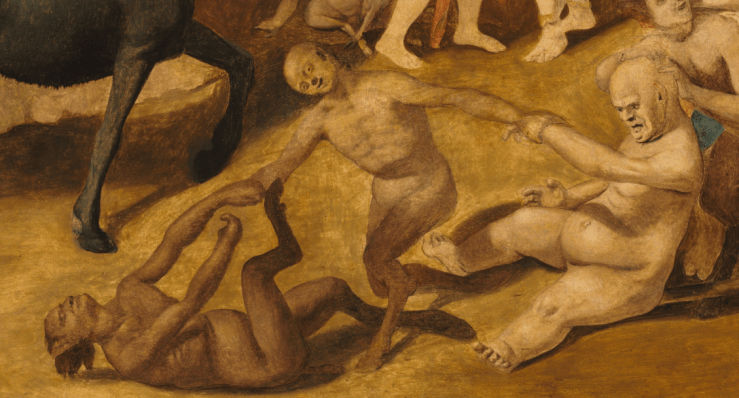
The Misfortunes of Silenus (detail), c. 1500 by Pierro di Cosimo (1462-1522)

The Misfortunes of Silenus (detail), c. 1500 by Pierro di Cosimo (1462-1522)
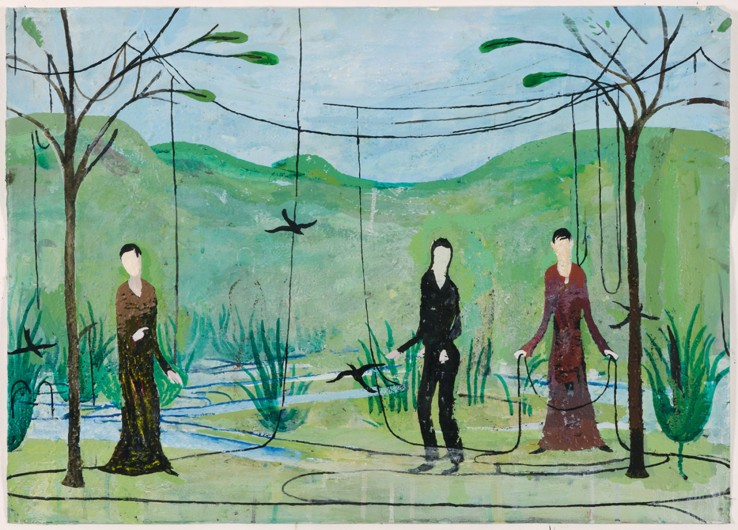
Untitled, 2014 by Valentin Just (b. 1983)
In Chapter 4 of F. Scott Fitzgerald’s The Great Gatsby, narrator Nick Carraway recounts the names of the rich, shallow, parasitic guests who attended Gatsby’s parties. Nick tells us the list comes from “an old time-table” of names he originally recorded in July 5th—significantly, the day after Independence Day: the day after the hopes and dreams of a new country. From the chapter—-
Once I wrote down on the empty spaces of a time-table the names of those who came to Gatsby’s house that summer. It is an old time-table now, disintegrating at its folds, and headed “This schedule in effect July 5th, 1922.” But I can still read the gray names, and they will give you a better impression than my generalities of those who accepted Gatsby’s hospitality and paid him the subtle tribute of knowing nothing whatever about him.
From East Egg, then, came the Chester Beckers and the Leeches, and a man named Bunsen, whom I knew at Yale, and Doctor Webster Civet, who was drowned last summer up in Maine. And the Hornbeams and the Willie Voltaires, and a whole clan named Blackbuck, who always gathered in a corner and flipped up their noses like goats at whosoever came near. And the Ismays and the Chrysties (or rather Hubert Auerbach and Mr. Chrystie’s wife), and Edgar Beaver, whose hair, they say, turned cotton-white one winter afternoon for no good reason at all.
Clarence Endive was from East Egg, as I remember. He came only once, in white knickerbockers, and had a fight with a bum named Etty in the garden. From farther out on the Island came the Cheadles and the O. R. P. Schraeders, and the Stonewall Jackson Abrams of Georgia, and the Fishguards and the Ripley Snells. Snell was there three days before he went to the penitentiary, so drunk out on the gravel drive that Mrs. Ulysses Swett’s automobile ran over his right hand. The Dancies came, too, and S. B. Whitebait, who was well over sixty, and Maurice A. Flink, and the Hammerheads, and Beluga the tobacco importer, and Beluga’s girls.
From West Egg came the Poles and the Mulreadys and Cecil Roebuck and Cecil Schoen and Gulick the state senator and Newton Orchid, who controlled Films Par Excellence, and Eckhaust and Clyde Cohen and Don S. Schwartze (the son) and Arthur McCarty, all connected with the movies in one way or another. And the Catlips and the Bembergs and G. Earl Muldoon, brother to that Muldoon who afterward strangled his wife. Da Fontano the promoter came there, and Ed Legros and James B. (“Rot-Gut.”) Ferret and the De Jongs and Ernest Lilly — they came to gamble, and when Ferret wandered into the garden it meant he was cleaned out and Associated Traction would have to fluctuate profitably next day.
A man named Klipspringer was there so often and so long that he became known as “the boarder.”— I doubt if he had any other home. Of theatrical people there were Gus Waize and Horace O’donavan and Lester Meyer and George Duckweed and Francis Bull. Also from New York were the Chromes and the Backhyssons and the Dennickers and Russel Betty and the Corrigans and the Kellehers and the Dewars and the Scullys and S. W. Belcher and the Smirkes and the young Quinns, divorced now, and Henry L. Palmetto, who killed himself by jumping in front of a subway train in Times Square.
Benny McClenahan arrived always with four girls. They were never quite the same ones in physical person, but they were so identical one with another that it inevitably seemed they had been there before. I have forgotten their names — Jaqueline, I think, or else Consuela, or Gloria or Judy or June, and their last names were either the melodious names of flowers and months or the sterner ones of the great American capitalists whose cousins, if pressed, they would confess themselves to be.
In addition to all these I can remember that Faustina O’brien came there at least once and the Baedeker girls and young Brewer, who had his nose shot off in the war, and Mr. Albrucksburger and Miss Haag, his fiancee, and Ardita Fitz-Peters and Mr. P. Jewett, once head of the American Legion, and Miss Claudia Hip, with a man reputed to be her chauffeur, and a prince of something, whom we called Duke, and whose name, if I ever knew it, I have forgotten.
All these people came to Gatsby’s house in the summer.

Untitled (Man in Chair Aiming Gun, American Flag), 1963–71, printed 1980 by Larry Clark (b. 1943)
July 4th.–A very hot, bright, sunny day; town much thronged; booths on the Common, selling gingerbread, sugar-plums, and confectionery, spruce beer, lemonade. Spirits forbidden, but probably sold stealthily. On the top of one of the booths a monkey, with a tail two or three feet long. He is fastened by a cord, which, getting tangled with the flag over the booth, he takes hold and tries to free it. He is the object of much attention from the crowd, and played with by the boys, who toss up gingerbread to him, while he nibbles and throws it down again. He reciprocates notice, of some kind or other, with all who notice him. There is a sort of gravity about him. A boy pulls his long tail, whereat he gives a slight squeak, and for the future elevates it as much as possible. Looking at the same booth by and by, I find that the poor monkey has been obliged to betake himself to the top of one of the wooden joists that stick up high above. There are boys going about with molasses candy, almost melted down in the sun. Shows: A mammoth rat; a collection of pirates, murderers, and the like, in wax. Constables in considerable number, parading about with their staves, sometimes conversing with each other, producing an effect by their presence, without having to interfere actively. One or two old salts, rather the worse for liquor: in general the people are very temperate. At evening the effect of things rather more picturesque; some of the booth-keepers knocking down the temporary structures, and putting the materials in wagons to carry away; other booths lighted up, and the lights gleaming through rents in the sail-cloth tops. The customers are rather riotous, calling loudly and whimsically for what they want; a young fellow and a girl coming arm in arm; two girls approaching the booth, and getting into conversation with the folks thereabout. Perchance a knock-down between two half-sober fellows in the crowd: a knock-down without a heavy blow, the receiver being scarcely able to keep his footing at any rate. Shoutings and hallooings, laughter, oaths,–generally a good-natured tumult; and the constables use no severity, but interfere, if at all, in a friendly sort of way. I talk with one about the way in which the day has passed, and he bears testimony to the orderliness of the crowd, but suspects one booth of selling liquor, and relates one scuffle. There is a talkative and witty seller of gingerbread holding forth to the people from his cart, making himself quite a noted character by his readiness of remark and humor, and disposing of all his wares. Late in the evening, during the fire-works, people are consulting how they are to get home,–many having long miles to walk: a father, with wife and children, saying it will be twelve o’clock before they reach home, the children being already tired to death. The moon beautifully dark-bright, not giving so white a light as sometimes. The girls all look beautiful and fairy-like in it, not exactly distinct, nor yet dim. The different characters of female countenances during the day,–mirthful and mischievous, slyly humorous, stupid, looking genteel generally, but when they speak often betraying plebeianism by the tones of their voices. Two girls are very tired,–one a pale, thin, languid-looking creature; the other plump, rosy, rather overburdened with her own little body. Gingerbread figures, in the shape of Jim Crow and other popularities.
In the old burial ground, Charter Street, a slate gravestone, carved round the borders, to the memory of “Colonel John Hathorne, Esq.,” who died in 1717. This was the witch-judge. The stone is sunk deep into the earth, and leans forward, and the grass grows very long around it; and, on account of the moss, it was rather difficult to make out the date. Other Hathornes lie buried in a range with him on either side. In a corner of the burial-ground, close under Dr. P—-‘s garden fence, are the most ancient stones remaining in the graveyard; moss-grown, deeply sunken. One to “Dr. John Swinnerton, Physician,” in 1688; another to his wife. There, too, is the grave of Nathaniel Mather, the younger brother of Cotton, and mentioned in the Magnalia as a hard student, and of great promise. “An aged man at nineteen years,” saith the gravestone. It affected me deeply, when I had cleared away the grass from the half-buried stone, and read the name. An apple-tree or two hang over these old graves, and throw down the blighted fruit on Nathaniel Mather’s grave,–he blighted too. It gives strange ideas, to think how convenient to Dr. P—-‘s family this burial-ground is,–the monuments standing almost within arm’s reach of the side windows of the parlor,–and there being a little gate from the back yard through which we step forth upon those old graves aforesaid. And the tomb of the P. family is right in front, and close to the gate. It is now filled, the last being the refugee Tory, Colonel P—-, and his wife. M. P—- has trained flowers over this tomb, on account of her friendly relations with Colonel P—-.
It is not, I think, the most ancient families that have tombs,–their ancestry for two or three generations having been reposited in the earth before such a luxury as a tomb was thought of. Men who founded families, and grew rich, a century or so ago, were probably the first.
There is a tomb of the Lyndes, with a slab of slate affixed to the brick masonry on one side, and carved with a coat of arms.
Nathaniel Hawthorne’s journal entry for July 4th, 1838. From Passages from the American Note-Books.

Untitled (from The Democratic Forest) by William Eggleston (b. 1939)
July has been a strange month. The other day I went to the beach and I saw a woman of about thirty, pretty, wearing a black bikini, who was reading standing up. At first I thought she was about to lie down on her towel, but when I looked again she was still standing, and after that I didn’t take my eyes off her. For two hours, more or less, she read standing up, walked over to the water, didn’t go in, let the waves lap her shins, went back to her spot, kept reading, occasionally put the book down while still standing, leaned over a few times and took a big bottle of Pepsi out of a bag and drank, then picked up the book again, and, finally, without ever bending a knee, put her things away and left. Earlier the same day, I saw three girls, all in thongs, gorgeous, one of them had a tattoo on one buttock, they were having a lively conversation, and every once in a while they got in the water and swam and then they would lie down again on their mats, basically a completely normal scene, until all of a sudden, a cell phone rang, I heard it and thought it was mine until I realized it had been a while since I had a cell phone, and then I knew the phone belonged to one of them. I heard them talking. All I can say is that they weren’t speaking Catalan or Spanish. But they sounded deadly serious. Then I watched two of them get up, like zombies, and walk toward some rocks. I got up too and pretended to brush the sand off my trunks. On the rocks, I watched them talk to a huge, hideously ugly man covered in hair, in fact one of the hairiest men I’ve ever seen in my life. They knelt before him and listened attentively without saying a word, and then they went back to where their friend was waiting for them and everything went on as before, as if nothing had happened. Who are these women? I asked myself once it was dark and I had showered and dressed. One drank Pepsi. The others bowed down to a bear. I know who they are. But I don’t really know.
From Roberto Bolaño’s Between Parentheses: Essays, Articles and Speeches, 1998-2003.
Saturday, July 1st.–We had our first dish of green peas (a very small one) yesterday. Every day for the last week has been tremendously hot; and our garden flourishes like Eden itself, only Adam could hardly have been doomed to contend with such a ferocious banditti of weeds.
Nathaniel Hawthorne’s journal entry for July 1st, 1843. From Passages from the American Note-Books.

Reading Girl, 1840, by Franz Eybl (1806–1880)
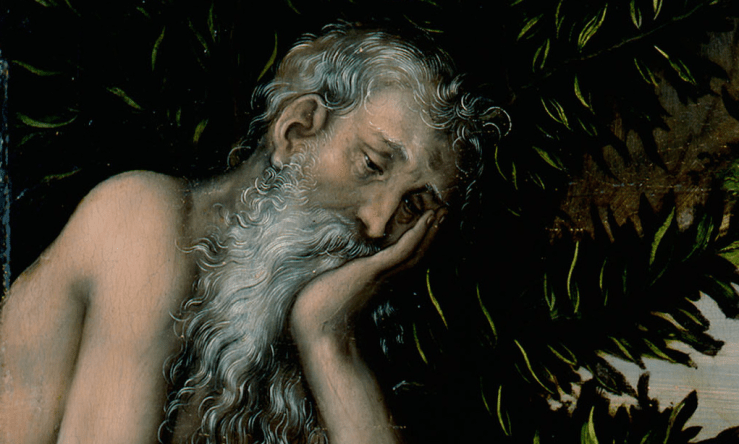
Hercules and Atlas (detail), c. 1537 by the Workshop of Lucas Cranach the Elder
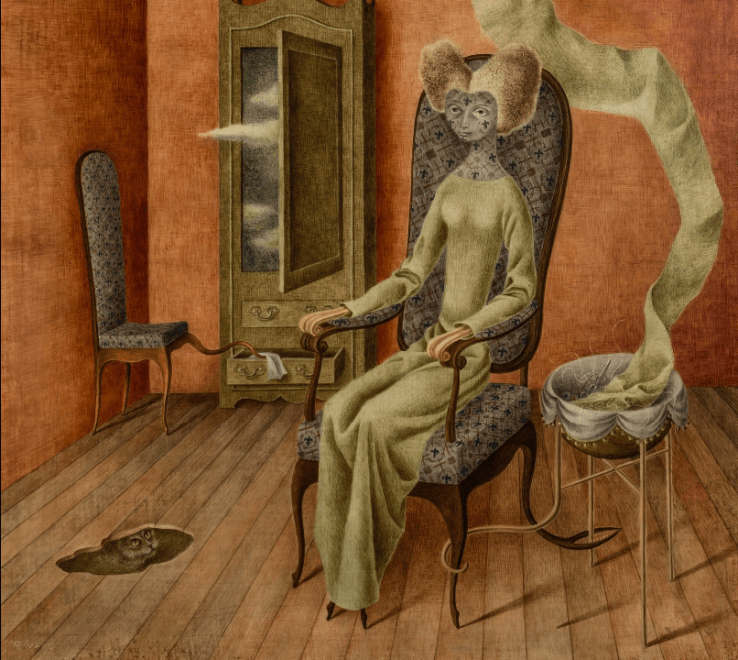
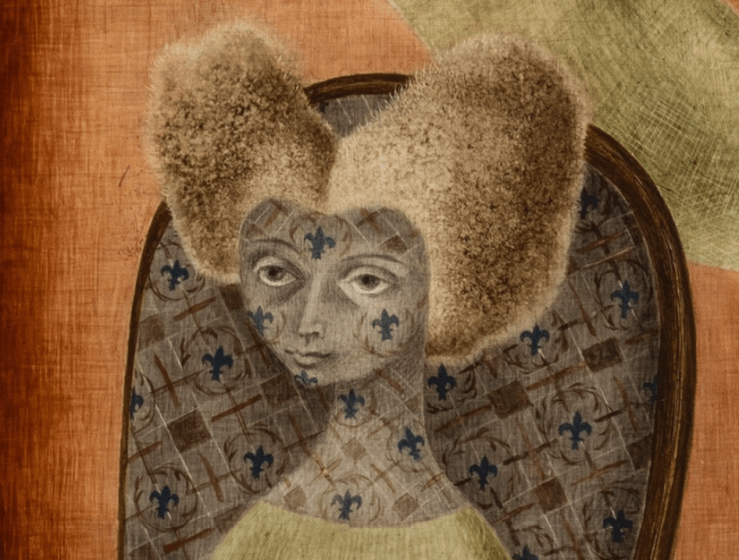
Mimesis, 1960 by Remedios Varo (1908-1963)



Night Lights, 2007 by Leonard Koscianski (b. 1952)
I had no intention of getting another book when I went to the bookstore yesterday. Swear. I had a few boxes of books my uncle gave me, and I was going to trade most of them in. Even this Carl Hiaasen novel that had a cool Charles Burns cover:

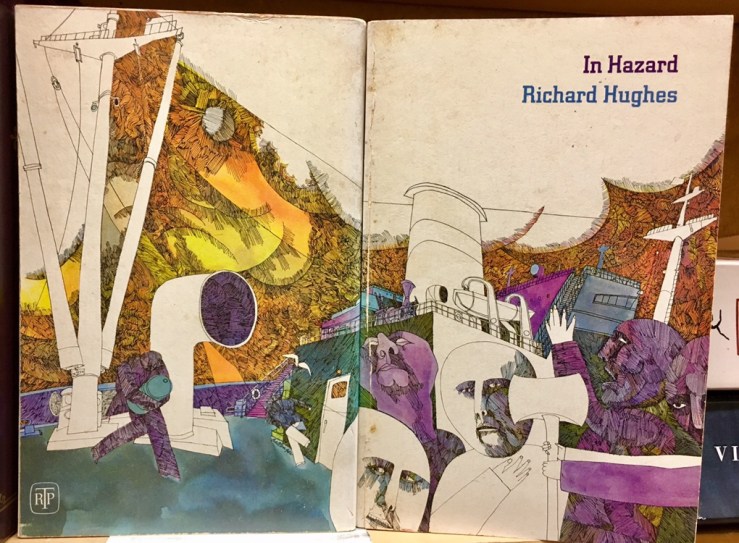
Anyway, I browsed the store a bit, killing half an hour before I had to pick my kids up, and I was tempted by a Richard Hughes’ novel called In Hazard simply because of its magnificent cover (here, I put two copies together—the back is on the left, the front is on the right):
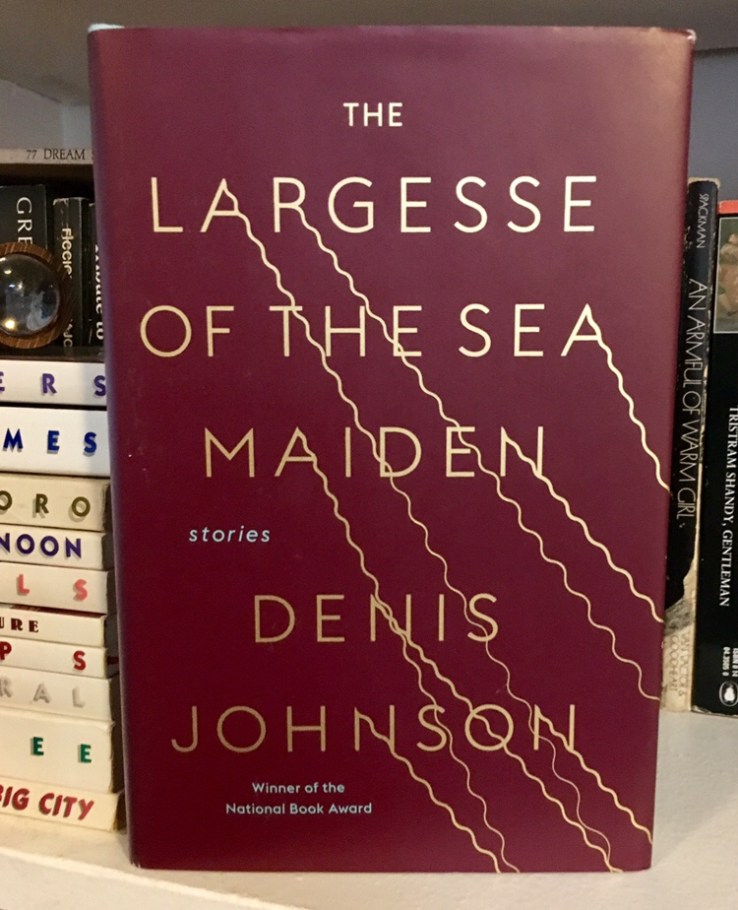
As an afterthought, I went through the new fiction section—something I hardly ever do—looking for Helen DeWitt’s new collection Some Trick, just to thumb through it. They didn’t have it, but they did have Denis Johnson’s posthumous collection The Largesse of the Sea Maiden (in hardback and for half price). I ended up reading the first little vignette in the first story in the collection, and then remembered that I’d read the story (the title track) a few years ago in The New Yorker. In particular I remembered the vignette called “Accomplices,” a near-perfect two-paragraph punch that features a Mardsen Hartley painting and too much bourbon. Here it is:
“Accomplices”
by
Denis Johnson
Another silence comes to mind. A couple of years ago, Elaine and I had dinner at the home of Miller Thomas, formerly the head of my agency in Manhattan. Right—he and his wife, Francesca, ended up out here, too, but considerably later than Elaine and I—once my boss, now a San Diego retiree. We finished two bottles of wine with dinner, maybe three bottles. After dinner, we had brandy. Before dinner, we had cocktails. We didn’t know one another particularly well, and maybe we used the liquor to rush past that fact. After the brandy, I started drinking Scotch, and Miller drank bourbon, and, although the weather was warm enough that the central air-conditioner was running, he pronounced it a cold night and lit a fire in his fireplace. It took only a squirt of fluid and the pop of a match to get an armload of sticks crackling and blazing, and then he laid on a couple of large chunks that he said were good, seasoned oak. “The capitalist at his forge,” Francesca said.
At one point we were standing in the light of the flames, I and Miller Thomas, seeing how many books each man could balance on his out-flung arms, Elaine and Francesca loading them onto our hands in a test of equilibrium that both of us failed repeatedly. It became a test of strength. I don’t know who won. We called for more and more books, and our women piled them on until most of Miller’s library lay around us on the floor. He had a small Marsden Hartley canvas mounted above the mantel, a crazy, mostly blue landscape done in oil, and I said that perhaps that wasn’t the place for a painting like this one, so near the smoke and heat, such an expensive painting. And the painting was masterful, too, from what I could see of it by dim lamps and firelight, amid books scattered all over the floor. . . . Miller took offense. He said he’d paid for this masterpiece, he owned it, he could put it where it suited him. He moved very near the flames and took down the painting and turned to us, holding it before him, and declared that he could even, if he wanted, throw it in the fire and leave it there. “Is it art? Sure. But listen,” he said, “art doesn’t own it. My name ain’t Art.” He held the canvas flat like a tray, landscape up, and tempted the flames with it, thrusting it in and out. . . . And the strange thing is that I’d heard a nearly identical story about Miller Thomas and his beloved Hartley landscape some years before, about an evening very similar to this one, the drinks and wine and brandy and more drinks, the rowdy conversation, the scattering of books, and, finally, Miller thrusting this painting toward the flames and calling it his own property, and threatening to burn it. On that previous night, his guests had talked him down from the heights, and he’d hung the painting back in its place, but on our night—why?—none of us found a way to object as he added his property to the fuel and turned his back and walked away. A black spot appeared on the canvas and spread out in a sort of smoking puddle that gave rise to tiny flames. Miller sat in a chair across the living room, by the flickering window, and observed from that distance with a drink in his hand. Not a word, not a move, from any of us. The wooden frame popped marvellously in the silence while the great painting cooked away, first black and twisted, soon gray and fluttering, and then the fire had it all.
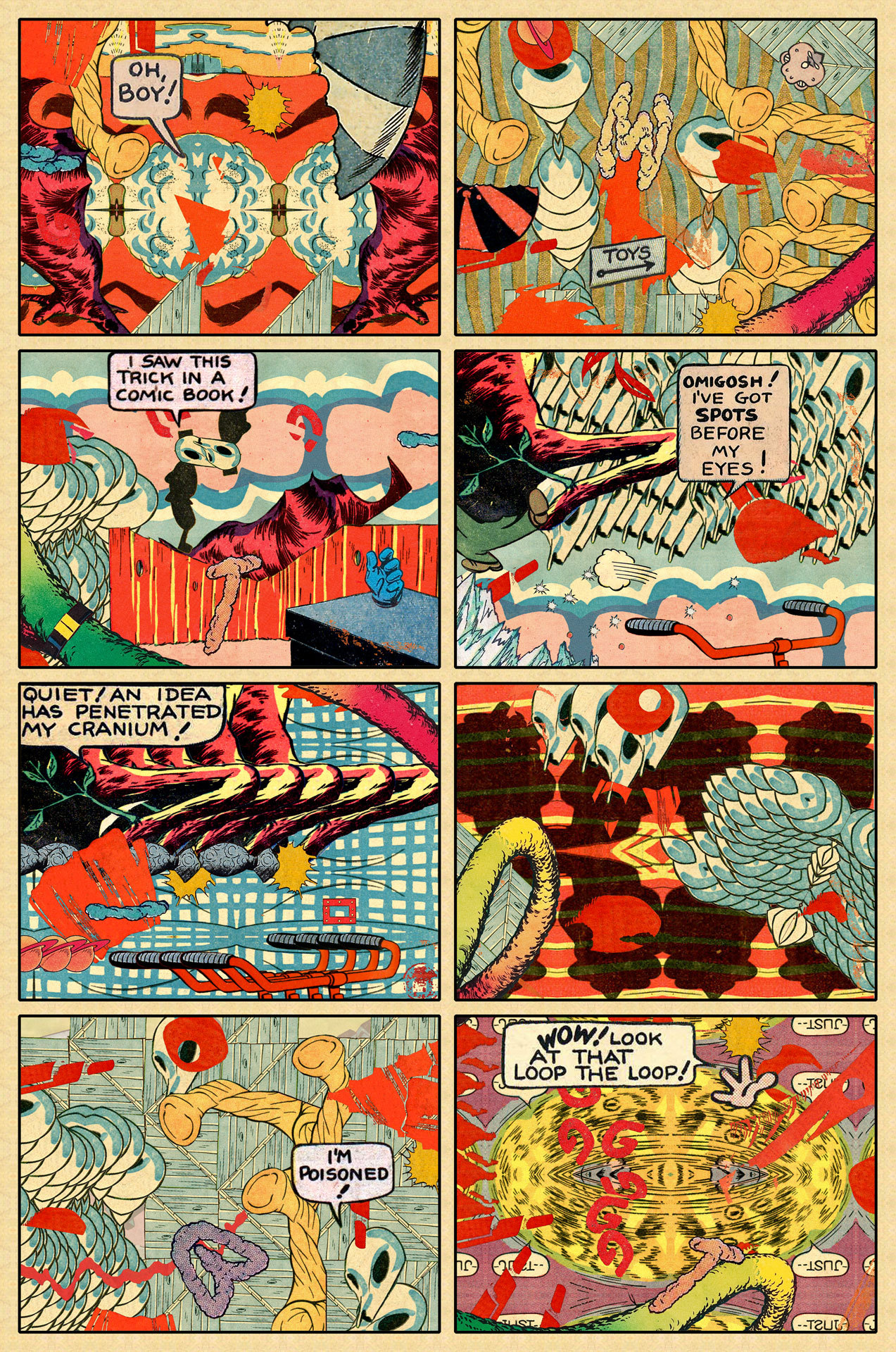
#434 Loop the Loop by Samplerman (Yvan Guillo)
 Biblioklept