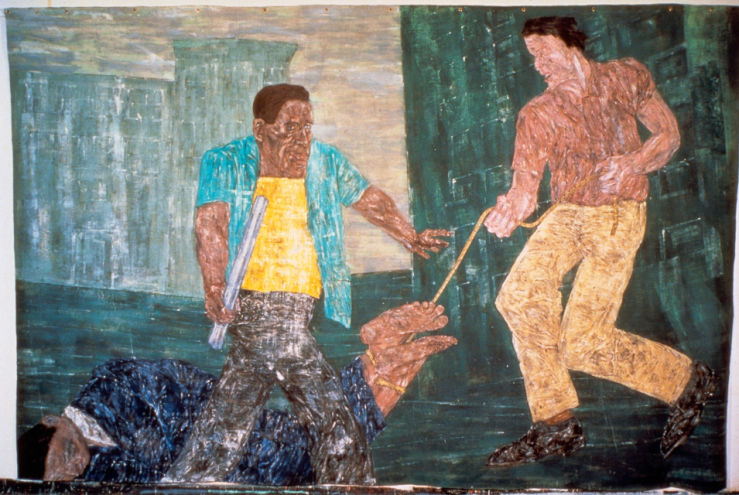
Riot IV — Leon Golub

Screenshot 2018-06-27 at 6.36.55 PM

Riot IV, 1983 by Leon Golub (1922–2004)

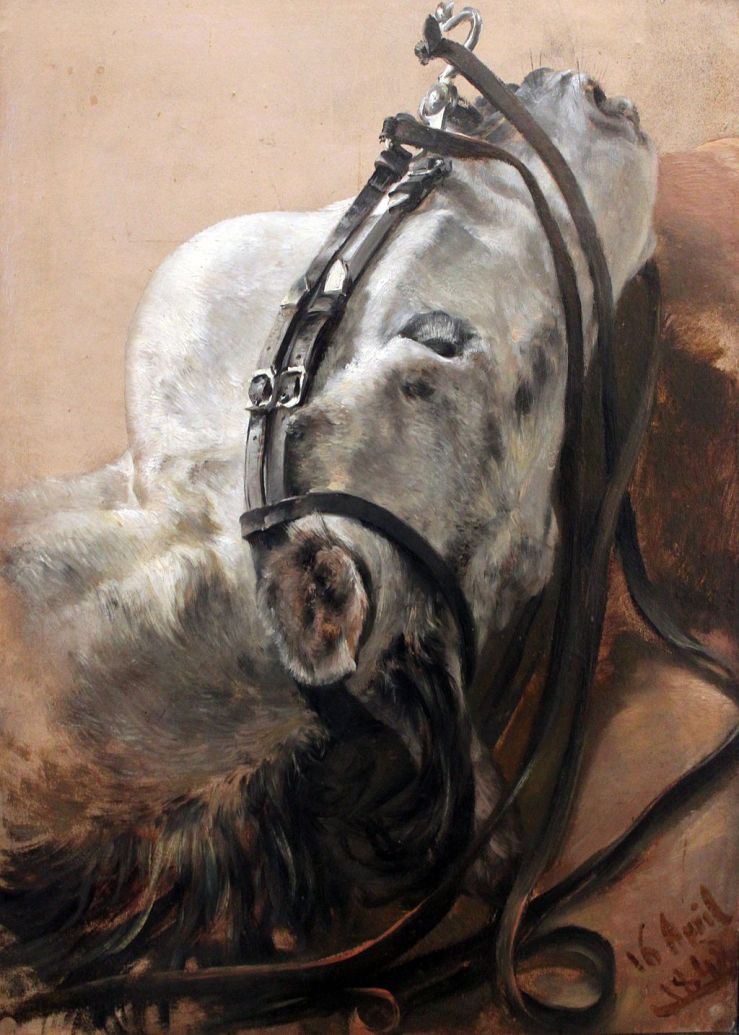
Study of a Horse’s Head — Adolph Menzel

86faa214c0c51d030888ef6dc38a4f92

Study of a Horse’s Head, 1848 by Adolph Menzel (1815-1905)

George Saunders’ “Little St. Don” and the limits of contemporary satire

Screenshot 2018-06-27 at 6.48.39 PM

George Saunders has a new story called “Little St. Don” in this week’s New Yorker. A satirical hagiography of Donald Trump, “Little St. Don” is a pastiche told in little vignettes, parables roughly allegorical to today’s horrorshow headlines. Here’s an example from early in the story:

Little St. Don was once invited to the birthday party of his best friend, Todd. As the cake was being served, a neighbor, Mr. Aryan, burst in, drunk, threw the cake against the wall, insulted Todd’s mother, and knocked a few toddlers out of their seats, requiring them to get stitches. Then Todd’s dad pushed Mr. Aryan roughly out the front door. Again, Little St. Don mounted a chair, and began to speak, saying what a shame it was that those two nice people had both engaged in violence.

Here, Saunders transposes the racist rally at Charlottesville into a domestic affair, a typical move for the writer. Saunders’ heroes are often hapless fathers besieged by the absurdities of a postmodern world. These figures try to work through all the violence and evil and shit toward a moral redemption, a saving grace or mystical love. Collapsing history and myth into the personal and familiar makes chaos more manageable.

The vignettes in “Little St. Don” follow a somewhat predictable pattern: Little St. Don incites racial violence, Little St. Don makes up juvenile nicknames for his enemies, Little St. Don radically misreads Christ’s central message. Etc.

The story’s ironic-parable formula is utterly inhabited by Donald Trump’s verbal tics and rhythms. Here is Saunders’ Little St. Don channeling Donald Trump:

Gentle, sure, yeah, that’s great. Jesus sounds like a good guy. Pretty famous guy. Huh. Maybe kind of a wimp? Within our school, am I about as famous as Jesus was when alive? Now that he’s dead, sure, he’s super-famous. But, when alive, how did he do? Not so great, I bet. Anyway, I like Saviours who weren’t crucified.

We all know these terrible tics and rhythms too well by now—indeed they have ventriloquized the discourse. In repeating Trump’s rhetorical style, Saunders attempts to sharpen the contrast between the narrative’s hagiographic style and the amorality of the narrative’s central figure. Saunders inserts this absurd language into a genre usually reserved for moral instruction to achieve his satire. The reader is supposed to note the jarring disparity between our culture’s moral ideals and our current political reality. The result though is simply another reiteration of Trump’s rhetoric. George Saunders is not the ventriloquist here. He is being ventriloquized. “Little St. Don” redistributes the very rhetoric it seeks to deride. It spreads the virus.

“Little St. Don” exemplifies just how limited contemporary literature’s toolkit is when it comes to acutely skewering our zeitgeist. Trump’s rhetoric purposefully surpasses absurdity; indeed, Trump’s rhetoric is nihilistically absurd, the ur-huckster’s argot that distills over two centuries of American con-artist culture for a 21st-century mass media environment. Ahistorical and amoral, Trump’s rhetoric oozes outside the bounds of allegorical satire. His rhetoric is already kitsch, part and parcel of a self-ironizing aesthetic that is always only-joking-but-hey-not-really-joking. This rhetorical aesthetic is post-postmodern, and Saunders’ postmodern techniques in “Little St. Don” cannot lance it, deflate it, or expose it—Trump’s rhetoric is already exposed. Saunders here is simply describing it, repeating it, and reframing it within  preëxisting literary genres.

Mashing up these genres is a typical 20th-century postmodernist move, one that Saunders’ audience in The New Yorker could expect. Indeed, it seems that connecting with an audience is Saunders’ main concern. But he’s preaching to the choir. The story is like a mediocre cover band’s copy of a terrible greatest hits record. In his mash-up we already know all the tunes, all the rhythms, and all the tones. Hell, we even know the mash-up’s not-so-secret formula. Saunders simply confirms the emotional and intellectual gestures that  preëxist in his New Yorker audience. His story is there to assure us of our own moral rectitude.

Screenshot 2018-06-27 at 6.48.07 PM

There is nothing wrong with a writer writing to please his audience. However, Saunders, who won the Booker Prize last year for his novel Lincoln in the Bardo, is frequently praised as the greatest satirist of his generation. “Little St. Don” is not great satire, but that is not exactly Saunders’ fault. Again, what the little story does well (and why I find it worth writing about) is show us the limitations of literary fiction’s power to satirize our ultra-absurd age. Reality runs a lap or two on fiction, trampling it a little.

This is not to say that fiction is (or has been) powerless to properly target absurd demagoguery and creeping fascism. A number of fiction writers in the late 20th century anticipated, diagnosed, and analyzed our current zeitgeist. Philip K. Dick, JG Ballard, Don DeLillo, Thomas Pynchon, Octavia Butler, Ishmael Reed, and Margaret Atwood all come easily to mind. To be fair, these writers were anticipating a new zeitgeist and not always specifically tackling one corroded personality, which is what Saunders is doing in “Little St. Don.” Thomas Pynchon had 700 pages or so of Gravity’s Rainbow to get us to Richard Nixon, night manager of the Orpheus Theater—that’s a pretty big stage of context to skewer the old crook. But Pynchon’s satire is far, far sharper, and more indelible in its strangeness than “Little St. Don.” Pynchon’s satire offers no moral consolation. Similarly, Ishmael Reed’s sustained attack on a postmodern presidency in The Terrible Twos never tries to comfort its audience by suggesting that the reader is in a position of moral superiority to any of the characters. And I don’t know how anyone can top JG Ballard’s “Why I Want to Fuck Ronald Reagan.”

It might be more fair to look at another short piece from The New Yorker which engaged with the political horrors of its own time. I’m thinking here of Donald Barthelme’s 1968 story “The Indian Uprising.”  Barthelme creates his own rhetoric in this weird and unsettling story. While “The Indian Uprising” is “about” the Vietnam War and the Civil Rights movement, it is hardly a simple allegory. To match the chaos and disruption of his time, Barthelme repeatedly disorients his audience, making them feel a host of nasty, contradictory, and often terrible feelings. The story requires critical participation, and its parable ultimately refuses to comfort the reader. None of this is particularly easy.

If Saunders’ “Little St. Don” is particularly easy, perhaps that’s because the moral response to Trump’s rhetoric should be particularly easy. That a moral response (and not a rhetorical response anchored in “civility”) is somehow not easy for certain people—those in power, say—is the real problem here. Saunders tries to anchor Trump’s rhetoric to a ballast that should have a moral force, but the gesture is so self-evident that it simply cannot pass for satire, let alone political commentary. Saunders offers instead a kind of mocking (but ultimately too-gentle) scolding. He doesn’t try to disrupt the disruptor, but rather retreats to the consolations of good old-fashioned postmodern literature.

But postmodern perspectives have thoroughly soaked our culture (whether we recognize this our not), and good old-fashioned postmodernism-by-numbers isn’t going to work. “Little St. Don” reveals nothing new to its audience, it simply amplifies what they already know and believe, and does so in the very rhetoric that we need to overpower. Literary satire needs to do more than confirm our own morality while lambasting those who perpetrate evil—it needs to invent its own rhetoric, its own form, its own new language.

Ultimately, Saunders’ genre distortions end up doing the opposite of what I think he intends to do. He wants the reader to look through a lens that turns history into fable, but that perspective assuages through distance, rather than alarming us. The ironic lens detaches us from the immediacy of the present—it mediates what should be slippery, visceral, ugly, vital, felt. Separating children from their parents and detaining them in concentration camps, banning entire groups of people from entering the country, fostering reckless xenophobia and feeding resurgent nativism—logging these atrocities as events that “happened” in a hagiographical history—no matter how ironic—promises a preëxisting, preordained history to come.

There’s a teleological neatness to this way of thinking (History will record!) that is wonderfully comforting in the face of such horror. Throughout his career George Saunders has moved his characters through horror and pain to places of hope and redemption. He loves the characters, and he wants us to love them too. And here, I think, is perhaps the biggest failure of “Little St. Don” — Saunders loves his reader too much. The story wants to make us feel comfortable now, comfortable, at minimum, in our own moral agency and our own moral righteousness. But comfort now will not do.

Screenshot 2018-06-27 at 6.48.21 PM

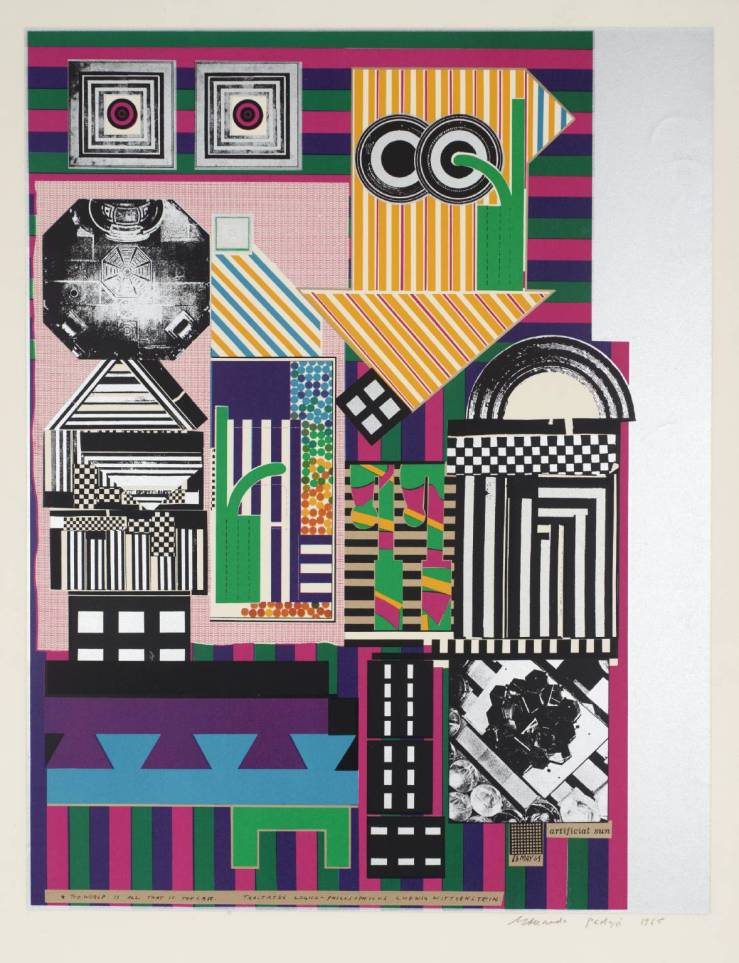
Artificial Sun — Eduardo Paolozzi

Artificial Sun 1964 by Sir Eduardo Paolozzi 1924-2005

Artificial Sun, 1964 by Eduardo Paolozzi (1924–2005)

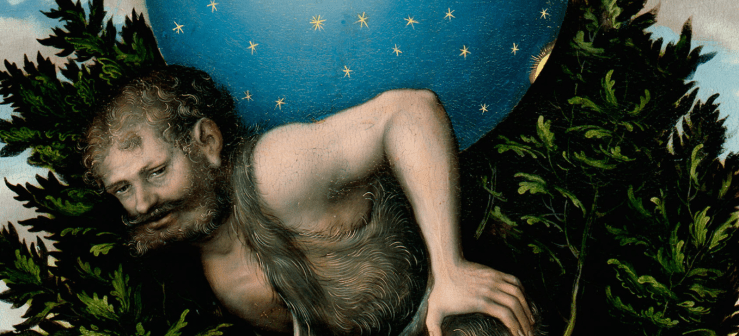
Hercules and Atlas (detail) — Workshop of Lucas Cranach the Elder

Screenshot 2018-06-26 at 1.30.26 PM

Hercules and Atlas (detail), c. 1537 by the Workshop of Lucas Cranach the Elder

Arboles Petrificados — Santiago Caruso

arboles-petrificados-santiago-caruso

Arboles Petrificados, 2018 by Santiago Caruso (b. 1982)

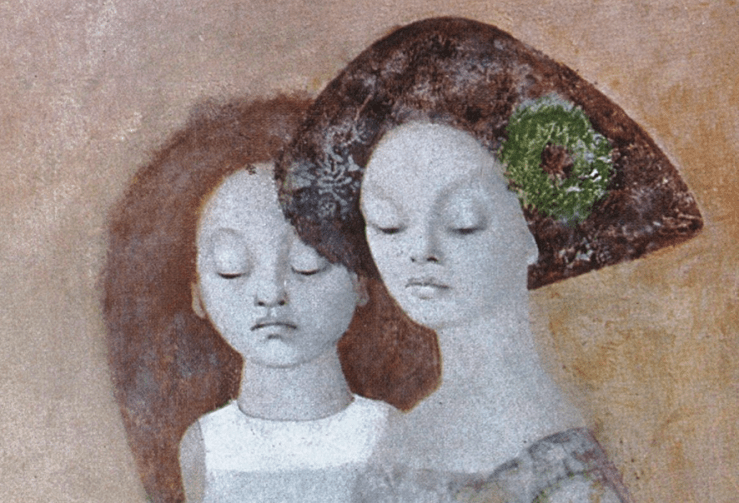
Anatomy Lesson — Leonor Fini

Screenshot 2018-06-25 at 6.34.56 PM

Anatomy Lesson, 1966 by Leonor Fini (1908-1996)

Screenshot 2018-06-25 at 6.35.39 PMScreenshot 2018-06-25 at 6.35.59 PMScreenshot 2018-06-25 at 6.35.23 PM

Maps to the Stars (Summer Film Log)

uk

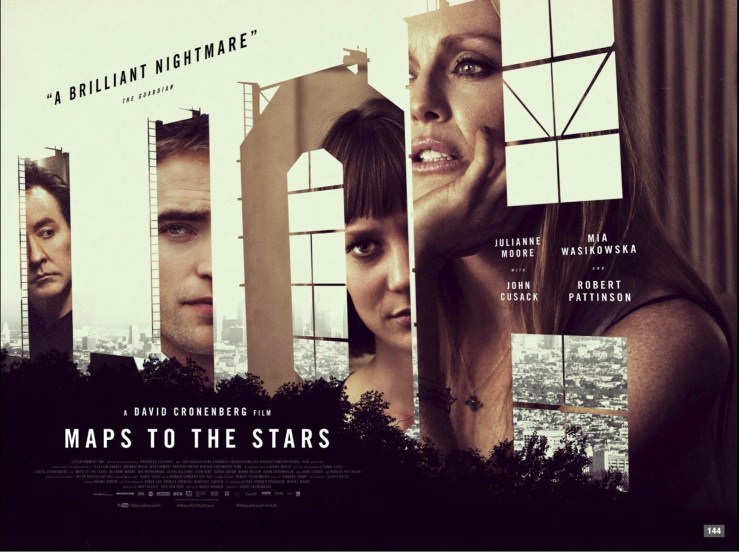
Surreal and often grotesque, David Cronenberg’s film Maps to the Stars (2014) attempts to merge a satire of the film industry with a riff on haunted Hollywood. The title, with its double meaning, suggests a cartography that might pinpoint the connections between larger-than-life screen avatars and the mythological figuration our culture has lent to them.

Maps to the Stars presents a large stage then for its host of strange characters to play upon. Center stage is the (ironically-named) Weiss family. Dr. Stafford Weiss (John Cusack) is a TV psychologist who manipulates his celebrity patients with psychobabble quackery. He’s emotionally-estranged from his wife Cristina (Olivia Williams), who plays stage-mother to their son Benjie (Evan Bird), an improbably gangly teen heartthrob trying to get his film career back on track after a stint in drug rehab. The Weiss family finds their not-so-blissful life terribly disrupted when daughter Agatha (Mia Wasikowska) shows up again after years in a mental hospital. She’s a schizophrenic with pyromaniac tendencies. Meanwhile, aging actress Havana Segrand (Julianne Moore) pines for a role playing her own mother’s role in a remake of a film called Stolen Waters. Segrand resents that her mother’s fame exceeds her own. Alleging that she was sexually abused by her mother as a child, Segrand receives treatment (in her lingerie) from Dr. Weiss. Agatha eventually takes a job as Segrand’s “chore whore,” more firmly linking the two plots. There’s also a limo driver named Jerome Fontana (Robert Pattison), who wants to both write and act in Hollywood. Oh, and a bunch of ghosts.

The various plot points double and triple each other: actors hope to gain coveted roles, family members hope to convert their pain into love and forgiveness, people try to escape their past. The film kneads themes of child predation, infanticide, ageism, Hollywood-as-vampirism, and incest into the plot, along with fire and water motifs. Throughout, characters repeat lines from Paul Éluard’s 1942 poem Liberté, as if the mantra’s force might grant them liberty from all these evils.

Cronenberg’s keen visual sensibilities are a highlight of Maps to the Stars. The film sparkles with a glossy Pop Art appeal which Cronenberg delights in griming up with occasional Cronenbergian touches. Still, Maps to the Stars, while thoroughly thematically abject, is not Cronenberg’s most visually Cronenbergian film.

The performances are very Cronenbergian though—stylized, affected, warped, weird. Mia Wasikowska and Julianne Moore are particularly good, and John Cusack leans into his role with unexpected menace. As surreal as these characters are though, there’s a ballast of reality underneath—sometimes and ultra-real reality, as when Carrie Fisher, daughter of a famous actress, plays her self in a bit role. The whole affect is unnerving.

Maps to the Star’s unnerving tone generates in part from its divergent trajectories. The film strives to be both a biting satire of Hollywood and a familial drama with mythological undertones. There’s no reason that these trajectories might intertwine successfully, but they don’t in Maps to the Stars. The tonal elements never fully cohere, and the plot careens to its climax with a pace that upsets the film’s earlier mood of slow-burning menace. The rushed ending is probably the worst part about Maps to the Stars. There’s plenty of promise in its first hour that the last 45 minutes fails to deliver. The film might have made a better limited series, even, giving Cronenberg more time to weave the threads together.

Bruce Wagner, who wrote Maps to the Stars‘ screenplay, found more room to expand in his 2012 novel Dead Stars, which ran just over 650 pages in paperback. Wagner’s novel predates the film, and is based at least in part on an earlier version of the screenplay for Maps to the Stars. (This is all a bit confusing, I know). In interviews, Wagner has rejected critics’ characterization of Maps to the Stars as a satire, declaring it rather an elegiac family melodrama. (Cronenberg himself didn’t outright reject the idea that the film was satirical though). While it’s unlikely that Wagner is being disingenuous when he claims Maps to the Stars isn’t satirical, he and Cronenberg have nevertheless produced a satire—yet one that strives to be an elegiac family melodrama, and also a take on the old haunted Hollywood stuff. And yet all this material feels pretty hollow.

The specters and doppelgangers haunting the background of Maps to the Stars remain disappointingly underexplored by the film’s end. Worse, the film suffers from a comparison to David Lynch’s far superior Mulholland Drive (2001). Lynch’s film is richer and more expansive, evoking more with far less.

Maps to the Stars also suffers from comparison to Cronenberg’s earlier work, like Videodrome (1983), The Fly (1985), and Dead Ringers (1988). In the 2000s, Cronenberg delivered a particularly strong one-two punch with a pair of his most perfect films, both starring Viggo Mortensen: A History of Violence (2005) and Eastern Promises (2007). The magic with Mortensen seemed to wear off in A Dangerous Method (2011), and Cronenberg’s next film Cosmopolis (a 2012 adaptation of Don DeLillo’s novel) was, in my estimation, unwatchable. While I think Maps to the Stars is stronger than the last two efforts, it does seem to point to a late-career slump. Here’s to hoping the next Cronenberg joint is a better deal, like the far-superior satire eXistenZ (1999) which he wrote himself. Maybe he should write the next one himself too.


How I watched it: I put it on a few nights ago on a big TV via a streaming service, late at night after a few tumblers of scotch, thinking, “Oh hey, I never watched this” but that turned out to be a false start. Rewatched on an iPad in bed with headphones in two sittings, very late at night. 

“Auction—Model 1934” — F. Scott Fitzgerald and Zelda Fitzgerald

“Auction—Model 1934”

by

F. Scott Fitzgerald and Zelda Fitzgerald


Of course we asked our friends what they thought and they said it was a perfect house—though not even the California claret could induce them to admit that it was the sort of place they would have lived in. The idea was to stay there until the sheets were shredded away and the bed springs looked like the insides of broken watches: then we wouldn’t have to pack any more—the usages of tune would have set us free. We could travel again in a suit-case, and not be harassed by bills from a storage warehouse. So we gathered our things from here and there; all that remained from fifteen years of buying, except some faded beach umbrellas we had left at the American Express five years ago in Cannes. It was to have been very edifying to have only the things we were fond of around us again and maybe we’d like the new place so well that we’d never move any more but just sit behind the wistaria and watch the rhododendron disintegrate beneath the heat of June, July and August, and the fanfare of the dogwood over the hills.

Then we opened the packing cases.

Lot 1. The first case is oblong and enormous and about the right shape to have contained enormous family portraits—it holds a mirror bought a long time ago for practising ballet-dancing at home. It once decorated the wall of a bordello. Any bids? No! Take it to that little room in the attic.

Lot 2. A smaller crate of the same shape containing fifty photographs of ourselves and drawings of the same by various artists and pictures of the houses we lived in and of our aunts and uncles and of where they were born and died. In some of the pictures we are golfing and swimming and posing with other people’s animals, or tilting borrowed surfboards against the spray of younger summers. There are also many impressive photographs of old and very dear friends whose names we have forgotten. These faces were very precious to us at the time, and now those times are very precious, though it is hard to imagine how we came to ask from life such an exaggerated head of Mae Murray. It must have been that summer day in Paris when we watched the children bowl the summer sun along the paths of the Jardin des Plantes—we might, late that afternoon, have begged for the photograph. And one of Pascin, whom we met over a pebble-rocked table watching the elegant ladies circle the Rondpoint attending upon the natural functions of Pekinese—Pascin already enveloped in tragedy and pursued by a doom so powerful that he could well afford the nonchalance in which lay his sombre charm. And one of Pearl White that she gave us in a spring when she was buying the Paris nights in clusters. Any bidders? No? The little room in the attic, Essie.

Lot 3. A pornographic figurine bought with great difficulty in Florence twelve years ago. “Une statue sale—no, we don’t mean salle that way—we mean sale.” Slightly damaged—any bidders? All right take this, too, Essie, while you’re going up. It seems a shame after all the lascivious gesticulation it took to obtain it. Continue reading ““Auction—Model 1934” — F. Scott Fitzgerald and Zelda Fitzgerald”

“Publication – is the Auction” — Emily Dickinson

“Publication – is the Auction”

by

Emily Dickinson

Publication—is the Auction
Of the Mind of Man—
Poverty—be justifying
For so foul a thing

Possibly—but We—would rather
From Our Garret go
White—Unto the White Creator—
Than invest—Our Snow—

Thought belong to Him who gave it—
Then—to Him Who bear
Its Corporeal illustration—Sell
The Royal Air—

In the Parcel—Be the Merchant
Of the Heavenly Grace—
But reduce no Human Spirit
To Disgrace of Price—

Cattle Auction — Eric Fischl

90_031

Cattle Auction, 1990 by Eric Fischl

The Studio before the Auction — Rudolf von Alt

the-studio-before-the-auction-1855

The Studio before the Auction, 1855 by Rudolf von Alt (1812-1905)

“The Auction,” a very short story by Stephen Crane

“The Auction”

by

Stephen Crane


Some said that Ferguson gave up sailoring because he was tired of the sea. Some said that it was because he loved a woman. In truth it was because he was tired of the sea and because he loved a woman.

He saw the woman once, and immediately she became for him the symbol of all things unconnected with the sea. He did not trouble to look again at the grey old goddess, the muttering slave of the moon. Her splendours, her treacheries, her smiles, her rages, her vanities, were no longer on his mind. He took heels after a little human being, and the woman made his thought spin at all times like a top; whereas the ocean had only made him think when he was on watch.

He developed a grin for the power of the sea, and, in derision, he wanted to sell the red and green parrot which had sailed four voyages with him. The woman, however, had a sentiment concerning the bird’s plumage, and she commanded Ferguson to keep it in order, as it happened, that she might forget to put food in its cage.

The parrot did not attend the wedding. It stayed at home and blasphemed at a stock of furniture, bought on the installment plan, and arrayed for the reception of the bride and groom.

As a sailor, Ferguson had suffered the acute hankering for port; and being now always in port, he tried to force life to become an endless picnic. He was not an example of diligent and peaceful citizenship. Ablution became difficult in the little apartment, because Ferguson kept the wash-basin filled with ice and bottles of beer: and so, finally, the dealer in second-hand furniture agreed to auction the household goods on commission. Owing to an exceedingly liberal definition of a term, the parrot and cage were included. “On the level?” cried the parrot, “On the level? On the level? On the level?”

On the way to the sale, Ferguson’s wife spoke hopefully. “You can’t tell, Jim,” she said. “Perhaps some of ’em will get to biddin’, and we might get almost as much as we paid for the things.”

The auction room was in a cellar. It was crowded with people and with house furniture; so that as the auctioneer’s assistant moved from one piece to another he caused a great shuffling. There was an astounding number of old women in curious bonnets. The rickety stairway was thronged with men who wished to smoke and be free from the old women. Two lamps made all the faces appear yellow as parchment. Incidentally they could impart a lustre of value to very poor furniture.

The auctioneer was a fat, shrewd-looking individual, who seemed also to be a great bully. The assistant was the most imperturbable of beings, moving with the dignity of an image on rollers. As the Fergusons forced their way down the stair-way, the assistant roared: “Number twenty-one!”

“Number twenty-one!” cried the auctioneer. “Number twenty-one! A fine new handsome bureau! Two dollars? Two dollars is bid! Two and a half! Two and a half! Three? Three is bid. Four! Four dollars! A fine new handsome bureau at four dollars! Four dollars! Four dollars! F-o-u-r d-o-l-l-a-r-s! Sold at four dollars.”

“On the level?” cried the parrot, muffled somewhere among furniture and carpets. “On the level? On the level?” Every one tittered.

Mrs. Ferguson had turned pale, and gripped her husband’s arm. “Jim! Did you hear? The bureau—four dollars—”

Ferguson glowered at her with the swift brutality of a man afraid of a scene. “Shut up, can’t you!”

Mrs. Ferguson took a seat upon the steps; and hidden there by the thick ranks of men, she began to softly sob. Through her tears appeared the yellowish mist of the lamplight, streaming about the monstrous shadows of the spectators. From time to time these latter whispered eagerly: “See, that went cheap!” In fact when anything was bought at a particularly low price, a murmur of admiration arose for the successful bidder.

The bedstead was sold for two dollars, the mattresses and springs for one dollar and sixty cents. This figure seemed to go through the woman’s heart. There was derision in the sound of it. She bowed her head in her hands. “Oh, God, a dollar-sixty! Oh, God, a dollar-sixty!”

The parrot was evidently under heaps of carpet, but the dauntless bird still raised the cry, “On the level?”

Some of the men near Mrs. Ferguson moved timidly away upon hearing her low sobs. They perfectly understood that a woman in tears is formidable.

The shrill voice went like a hammer, beat and beat, upon the woman’s heart. An odour of varnish, of the dust of old carpets, assailed her and seemed to possess a sinister meaning. The golden haze from the two lamps was an atmosphere of shame, sorrow, greed. But it was when the parrot called that a terror of the place and of the eyes of the people arose in her so strongly that she could not have lifted her head any more than if her neck had been of iron.

At last came the parrot’s turn. The assistant fumbled until he found the ring of the cage, and the bird was drawn into view. It adjusted its feathers calmly and cast a rolling wicked eye over the crowd.

“Oh, the good ship Sarah sailed the seas,And the wind it blew all day—”

This was the part of a ballad which Ferguson had tried to teach it. With a singular audacity and scorn, the parrot bawled these lines at the auctioneer as if it considered them to bear some particular insult.

The throng in the cellar burst into laughter. The auctioneer attempted to start the bidding, and the parrot interrupted with a repetition of the lines. It swaggered to and fro on its perch, and gazed at the faces of the crowd, with so much rowdy understanding and derision that even the auctioneer could not confront it. The auction was brought to a halt; a wild hilarity developed, and every one gave jeering advice.

Ferguson looked down at his wife and groaned. She had cowered against the wall, hiding her face. He touched her shoulder and she arose. They sneaked softly up the stairs with heads bowed.

Out in the street, Ferguson gripped his fists and said: “Oh, but wouldn’t I like to strangle it!”

His wife cried in a voice of wild grief: “It—it m—made us a laughing-stock in—in front of all that crowd!”

For the auctioning of their household goods, the sale of their home—this financial calamity lost its power in the presence of the social shame contained in a crowd’s laughter.

Hyphen — Kay Sage

w1siziisije1mti4msjdlfsiccisimnvbnzlcnqilcitcmvzaxplidiwmdb4mjawmfx1mdazzsjdxq

Hyphen, 1954 by Kay Sage (1898–1963)

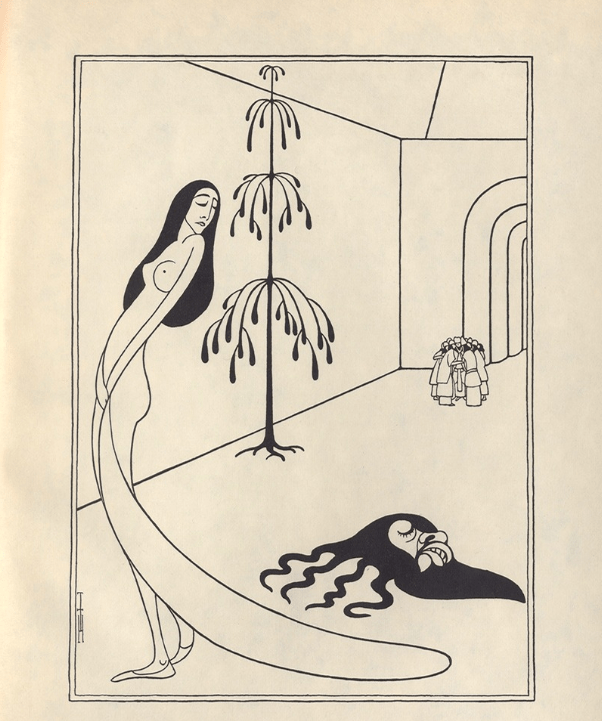
Judith with the Head of Holofernes — Thomas Theodor Heine

Screenshot 2018-06-23 at 1.46.38 PM

Judith with the Head of Holofernes, 1908 by Thomas Theodor Heine (1867-1948)

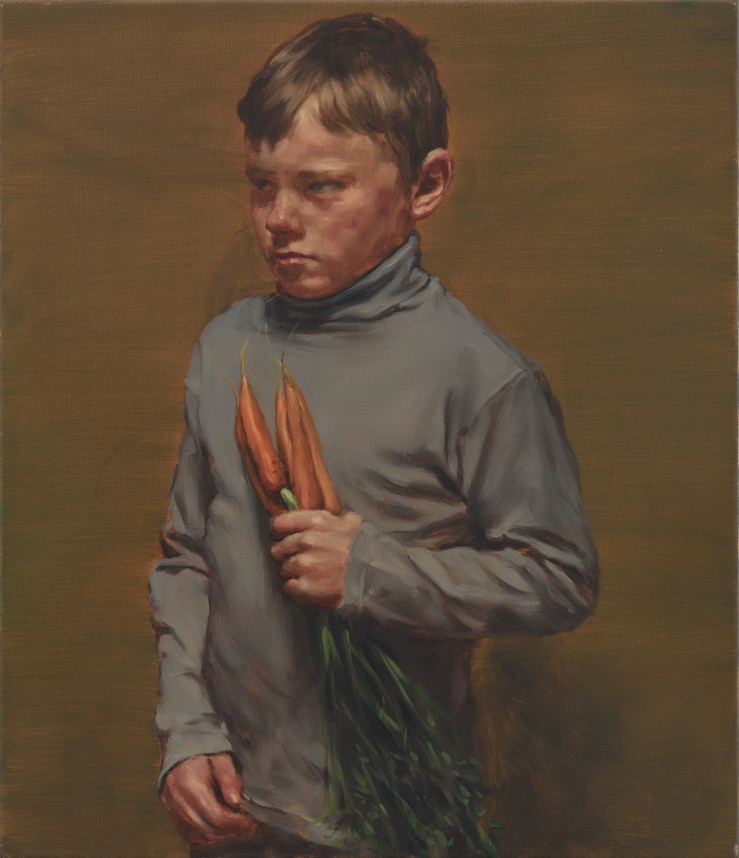
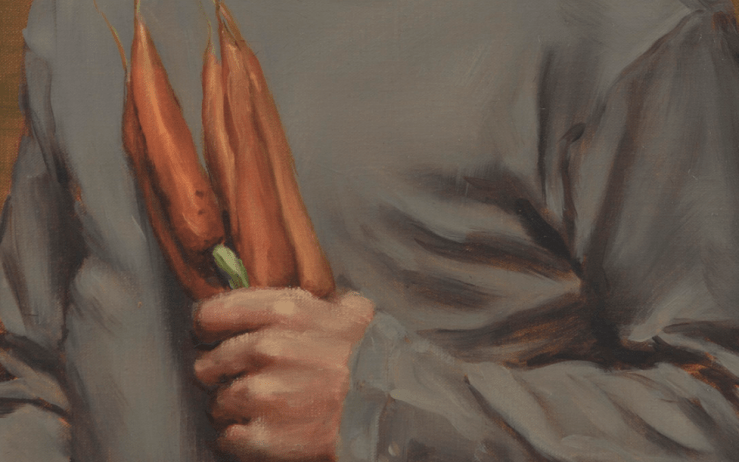
Boy with Carrots — Michaël Borremans

mb2016_13

Boy with Carrots, 2016 by Michaël Borremans (b. 1963)

Screenshot 2018-06-22 at 3.28.18 PMScreenshot 2018-06-22 at 3.28.01 PM