“The Girl” — William Carlos Williams

the girl

Blood Bath — Elizabeth Glaessner

201420eg20blood20bath20hires2022x30in

Blood Bath, 2014 by Elizabeth Glaessner (b. 1984)

The Art Lover — Jack Levine

Screenshot 2018-07-09 at 6.57.40 PM

The Art Lover, 1962 by Jack Levine (1915-2010)

Then would she wheedle and laugh and blarney, beginning in a rage, and ending as if she had been in jest | Nathaniel Hawthorne’s journal entry for July 9th, 1837

July 9th.–Went with B—- to pay a visit to the shanties of the Irish and Canadians. He says that they sell and exchange these small houses among themselves continually. They may be built in three or four days, and are valued at four or five dollars. When the turf that is piled against the walls of some of them becomes covered with grass, it makes quite a picturesque object. It was almost dusk–just candle-lighting time–when we visited them. A young Frenchwoman, with a baby in her arms, came to the door of one of them, smiling, and looking pretty and happy. Her husband, a dark, black-haired, lively little fellow, caressed the child, laughing and singing to it; and there was a red-bearded Irishman, who likewise fondled the little brat. Then we could hear them within the hut, gabbling merrily, and could see them moving about briskly in the candlelight, through the window and open door. An old Irishwoman sat in the door of another hut, under the influence of an extra dose of rum,–she being an old lady of somewhat dissipated habits. She called to B—-, and began to talk to him about her resolution not to give up her house: for it is his design to get her out of it. She is a true virago, and, though somewhat restrained by respect for him, she evinced a sturdy design to remain here through the winter, or at least for a considerable time longer. He persisting, she took her stand in the doorway of the hut, and stretched out her fist in a very Amazonian attitude. “Nobody,” quoth she, “shall drive me out of this house, till my praties are out of the ground.” Then would she wheedle and laugh and blarney, beginning in a rage, and ending as if she had been in jest. Meanwhile her husband stood by very quiet, occasionally trying to still her; but itis to be presumed, that, after our departure, they came to blows, it being a custom with the Irish husbands and wives to settle their disputes with blows; and it is said the woman often proves the better man. The different families also have battles, and occasionally the Irish fight with the Canadians. The latter, however, are much the more peaceable, never quarrelling among themselves, and seldom with their neighbors. They are frugal, and often go back to Canada with considerable sums of money. B—- has gained much influence both with the Irish and the French,–with the latter, by dint of speaking to them in their own language. He is the umpire in their disputes, and their adviser, and they look up to him as a protector and patron-friend. I have been struck to see with what careful integrity and wisdom he manages matters among them, hitherto having known him only as a free and gay young man. He appears perfectly to understand their general character, of which he gives no very flattering description. In these huts, less than twenty feet square, he tells me that upwards of twenty people have sometimes been lodged.

A description of a young lady who had formerly been insane, and now felt the approach of a new fit of madness. She had been out to ride, had exerted herself much, and had been very vivacious. On her return, she sat down in a thoughtful and despondent attitude, looking very sad, but one of the loveliest objects that ever were seen. The family spoke to her, but she made no answer, nor took the least notice; but still sat like a statue in her chair,–a statue of melancholy and beauty. At last they led her away to her chamber.

We went to meeting this forenoon. I saw nothing remarkable, unless a little girl in the next pew to us, three or four years old, who fell asleep, with her head in the lap of her maid, and looked very pretty: a picture of sleeping innocence.

Nathaniel Hawthorne’s journal entry for July 9th, 1837. From Passages from the American Note-Books.

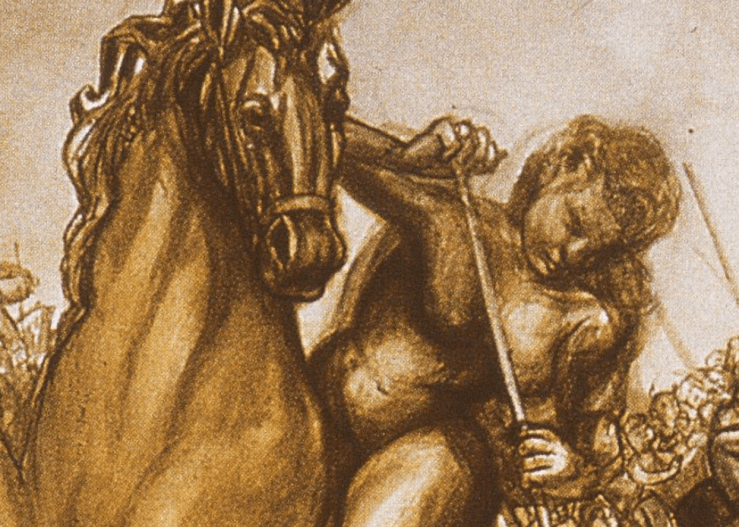
Minotaur Hunt — Nicole Eisenman

Screenshot 2018-07-09 at 6.05.14 PM.png

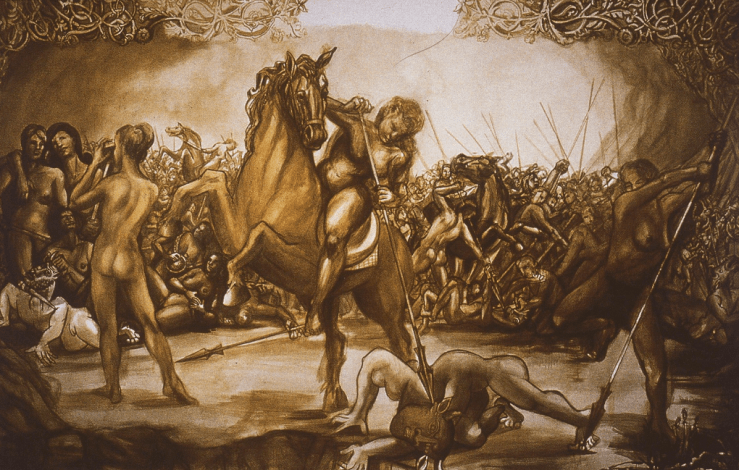
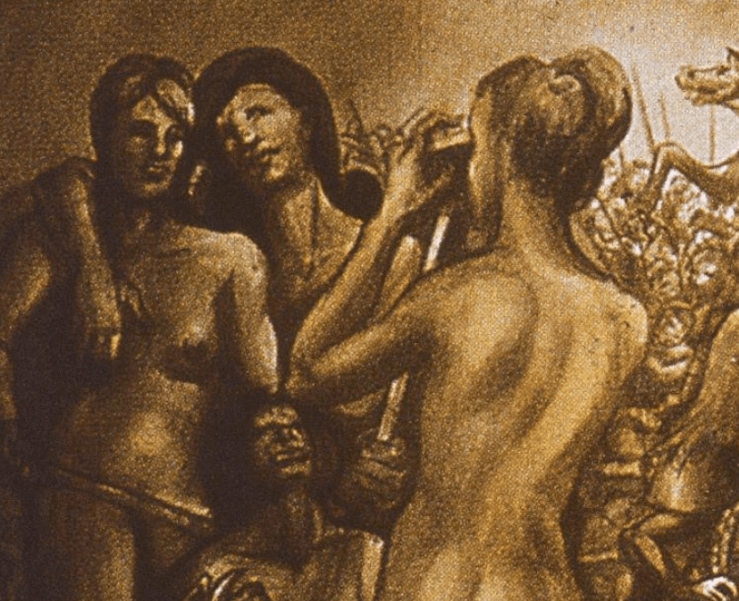
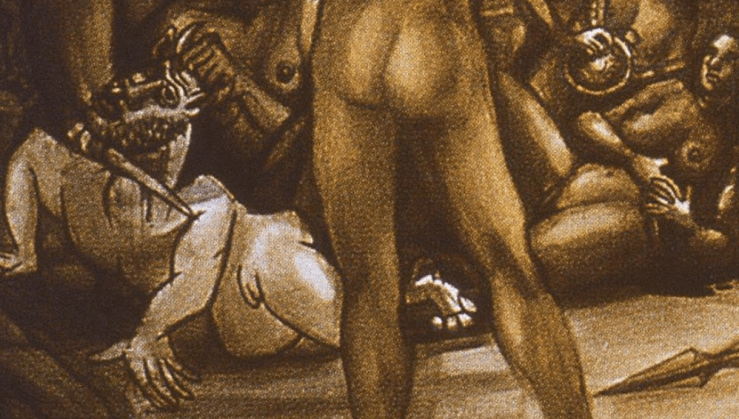
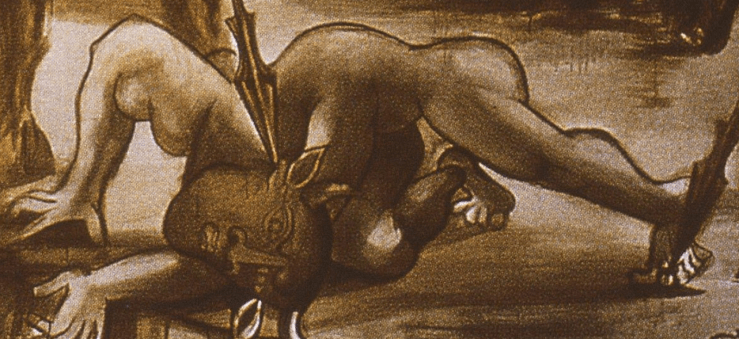
Minotaur Hunt, 1993 by Nicole Eisenman (b. 1965)

Screenshot 2018-07-09 at 6.05.29 PMScreenshot 2018-07-09 at 6.05.46 PMScreenshot 2018-07-09 at 6.06.06 PMScreenshot 2018-07-09 at 6.06.32 PM

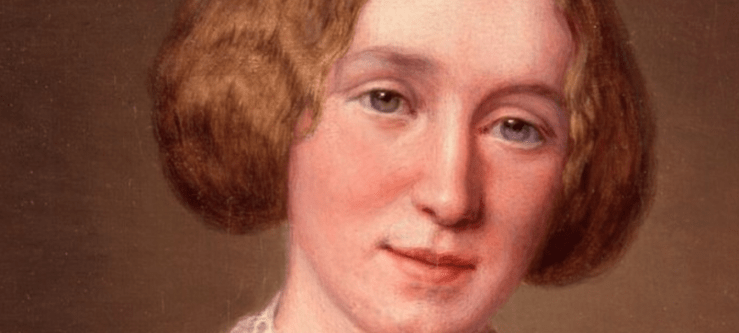
Riff on finishing Middlemarch, George Eliot’s novel of consciousness

Screenshot 2018-06-12 at 8.35.14 PM
Detail of a portrait of Mary Ann Evans (George Eliot) at age 30 by François d’Albert Durade (1804–1886)

I finally finished George Eliot’s long and marvelous 1872 novel Middlemarch.

When I wrote about reading Middlemarch last month, from not-quite-the-middle of the book, I lamented that I’d rather be rereading the book than reading it. Rich and dense, it’s the kind of big book that clearly offers more on repeat readings. And yes, I will reread Middlemarch, but I’ll give it a year or three to mellow in the back of my consciousness.

Middlemarch is a novel about consciousness, and what the novel does best in my estimation is show how different kinds of consciousness mediate and are mediated by the social forces they inhabit (and are inhabited by).

(The word consciousness appears 90 times in Middlemarch. If we include similar iterations, like consciousconsciouslyunconscious, and unconsciously, the count grows to a total of 172 times. In contrast, iterations of the word conscience appear only 38 times).

Dorothea Brooke remained my favorite consciousness throughout the novel, and I missed her when she wasn’t there, when Eliot had us hovering around or even fully inhabiting another consciousness.

I’ll admit that in the final quarter of Middlemarch I found myself a bit weary of the Bulstrode disgrace plot—and yet I appreciate how Eliot inhabited that consciousness as well. Bulstrode provides Eliot a sharp tool to show how consciousness is blind, or even self-blinding—how consciousness massages conscience in order to survive. In a passage that illustrates this process, Eliot writes,

Bulstrode shrank from a direct lie with an intensity disproportionate to the number of his more indirect misdeeds. But many of these misdeeds were like the subtle muscular movements which are not taken account of in the consciousness, though they bring about the end that we fix our mind on and desire. And it is only what we are vividly conscious of that we can vividly imagine to be seen by Omniscience.

Consciousness cannot lay claim to conceiving of an absolute omniscient conscience, an absolute and ever-present moral consciousness. Too, earlier in the novel, Eliot’s narrator observes,

For the egoism which enters into our theories does not affect their sincerity; rather, the more our egoism is satisfied, the more robust is our belief.

Egoism is a central problem in Middlemarch; indeed, Eliot seems to posit egoism as the greatest threat to how individual consciousnesses navigate social reality. Here is here narrator again:

Will not a tiny speck very close to our vision blot out the glory of the world, and leave only a margin by which we see the blot? I know no speck so troublesome as self.

I cannot improve upon “no speck so troublesome as self” and will not adventure an attempt.

But back to the consciousness I liked best in Middlemarch: Dorothea.

Dorothea is a kind of genius of intention, and Eliot harnesses that genius—she shows us Dorothea’s consciousness-in-action. Eliot doesn’t just tell us what’s happening in Dorothea’s head; she makes that consciousness live in our own heads.

Dorothea’s life, like all lives, is beset with foiled plans and terrible mistakes. Still, Middlemarch grants Dorothea something of a happy ending in her marriage to Will Ladislaw, and yet refuses the conclusion of a classical comedy. There is no wedding scene. Indeed, the last time Dorothea speaks in the novel it is to reconcile with her sister Celia—a conclusion that confirms their love story the equal to that of Dorothea and Ladislaw’s love story.

Eliot’s novel is too sophisticated and too realistic for a simplistic happy or tragic conclusion, of course. In the novel’s “Finale,” the narrator reminds us that,

Every limit is a beginning as well as an ending…the fragment of a life, however typical, is not the sample of an even web.

The narrator then gives us broad details of the fates of the novel’s principal couples: Lydgate and Rosamond, skewing depressive; Mary and Fred, skewing comic; and finally Ladislaw and Dorothea. We learn of Ladislaw’s success as a reform politician and understand that Dorothea is an instrumental force in this success.

Eliot’s conclusion for this final pair skews neither comic nor tragic, but is something more complex—more realistic. Dorothea becomes a cautionary tale in the town of Middlemarch; her legacy is one of misspent potential in the eyes of society. The novel ends without indicating that any of the grand plans of Dorothea’s youth have been achieved. And yet the novel concludes with an oblique revelation about Dorothea’s misunderstood legacy.

In the second-to-final paragraph of Middlemarch, Eliot writes that,

those determining acts of [Dorothea’s] life were not ideally beautiful. They were the mixed result of young and noble impulse struggling amidst the conditions of an imperfect social state, in which great feelings will often take the aspect of error, and great faith the aspect of illusion. For there is no creature whose inward being is so strong that it is not greatly determined by what lies outside it.

Eliot refuses a simple happy ending here; her heroine is still a consciousness subject to the social forces around it. Dorothea’s great utopian ambitions are ultimately tempered by the cultural constraints her consciousness would otherwise seek to transcend.

But then the final paragraph of the novel points towards transcendence:

Her finely touched spirit had still its fine issues, though they were not widely visible. … But the effect of her being on those around her was incalculably diffusive: for the growing good of the world is partly dependent on unhistoric acts; and that things are not so ill with you and me as they might have been, is half owing to the number who lived faithfully a hidden life, and rest in unvisited tombs.

Dorothea—and, more significantly, the spirit of Dorothea—did real grand good in the world, an immeasurable good, “incalculably diffusive.” Even if she lived ultimately a “hidden life,” Eliot insists that it is people like Dorothea who have made the world better for “you and me.”

While “hidden life” and “unvisited tombs” may harbor negative connotations, these phrases are ultimately ironic: Eliot’s novel itself is the key to the hidden life of Dorothea Brooke. Middlemarch is a vivid and vivifying tomb for Dorothea, and we readers are the lucky visitors.

Pier Paolo Pasolini — Nicola Verlato

larger

Pier Paolo Pasolini, 2014 by Nicola Verlato (b. 1965)

Growing dark with a pleasant gloom | Nathaniel Hawthorne’s journal entry for July 8th, 1837

 July 8th.–Yesterday afternoon, a stroll with B—- up a large brook, he fishing for trout, and I looking on. The brook runs through a valley, on one side bordered by a high and precipitous bank; on the other there is an interval, and then the bank rises upward and upward into a high hill, with gorges and ravines separating one summit from another, and here and there are bare places, where the rain-streams have washed away the grass. The brook is bestrewn with stones, some bare, some partially moss-grown, and sometimes so huge as–once at least–to occupy almost the whole breadth of the current. Amongst these the stream brawls, only that this word does not express its good-natured voice, and “murmur” is too quiet. It sings along, sometimes smooth, with the pebbles visible beneath, sometimes rushing dark and swift, eddying and whitening past some rock, or underneath the hither or the farther bank; and at these places B—- cast his line, and sometimes drew out a trout, small, not more than five or six inches long. The farther we went up the brook, the wilder it grew. The opposite bank was covered with pines and hemlocks, ascending high upwards, black and solemn. One knew that there must be almost a precipice behind, yet we could not see it. At the foot you could spy, a little way within the darksome shade, the roots and branches of the trees; but soon all sight was obstructed amidst the trunks. On the hither side, at first the bank was bare, then fringed with alder-bushes, bending and dipping into the stream, which, farther on, flowed through the midst of a forest of maple, beech, and other trees, its course growing wilder and wilder as we proceeded. For a considerable distance there was a causeway, built long ago of logs, to drag lumber upon; it was now decayed and rotten, a red decay, sometimes sunken down in the midst, here and there a knotty trunk stretching across, apparently sound. The sun being now low towards the west, a pleasant gloom and brightness were diffused through the forest, spots of brightness scattered upon the branches, or thrown down in gold upon the last year’s leaves among the trees. At last we came to where a dam had been built across the many years ago, and was now gone to ruin, so as to make the spot look more solitary and wilder than if man had never left vestiges of his toil there. It was a framework of logs, with a covering of plank sufficient to obstruct the onward flow of the brook; but it found its way past the side, and came foaming and struggling along among scattered rocks. Above the dam there was a broad and deep pool, one side of which was bordered by a precipitous wall of rocks, as smooth as if hewn out and squared, and piled one upon another, above which rose the forest. On the other side there was still a gently shelving bank, and the shore was covered with tall trees, among which I particularly remarked a stately pine, wholly devoid of bark, rising white in aged and majestic ruin, thrusting out its barkless arms. It must have stood there in death many years, its own ghost. Above the dam the brook flowed through the forest, a glistening and babbling water-path, illuminated by the sun, which sent its rays almost straight along its course. It was as lovely and wild and peaceful as it could possibly have been a hundred years ago; and the traces of labors of men long departed added a deeper peace to it. I bathed in the pool, and then pursued my way down beside the brook, growing dark with a pleasant gloom, as the sun sank and the water became more shadowy. B—- says that there was formerly a tradition that the Indians used to go up this brook, and return, after a brief absence, with large masses of lead, which they sold at the trading-stations in Augusta; whence there has always been an idea that there is a lead-mine hereabouts. Great toadstools were under the trees, and some small ones as yellow and almost the size of a half-broiled yolk of an egg. Strawberries were scattered along the brookside.

Dined at the hotel or Mansion House to-day. Men were playing checkers in the parlor. The Marshal of Maine, a corpulent, jolly fellow, famed for humor. A passenger left by the stage, hiring an express onward. A bottle of champagne was quaffed at the bar.

Nathaniel Hawthorne’s journal entry for July 8th, 1837. From Passages from the American Note-Books.

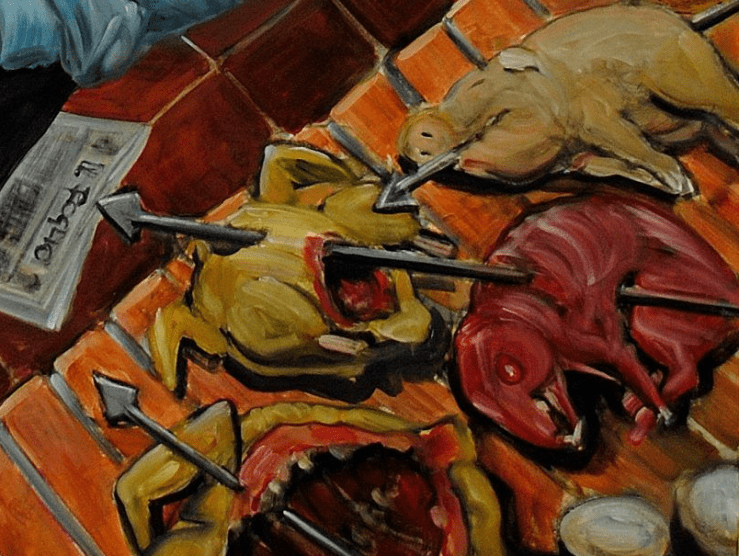
Prayer to Saint Brice — Enrico Robusti

3f102a2aafcfb2b3640fef1b43bc00b3

San Brizio epatoprotettore, veglia sulle mie vie biliari mentre preparo questi quotidiani arrostini allo spiedo (2011) by Enrico Robusti  (b. 1956)

Screenshot 2018-07-08 at 8.24.58 PMScreenshot 2018-07-08 at 8.25.27 PMScreenshot 2018-07-08 at 8.25.11 PMScreenshot 2018-07-08 at 8.24.36 PM

Approaching a City — Edward Hopper

hopper_anfahrt_in_eine_stadt_phillips_collection

Approaching a City, 1946 by Edward Hopper (1882–1967)

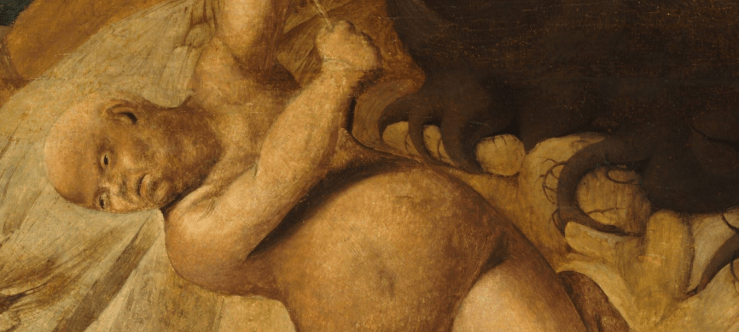
The Misfortunes of Silenus — Pierro di Cosimo

Screenshot 2018-07-05 at 8.47.50 PM

The Misfortunes of Silenus (detail), c. 1500 by Pierro di Cosimo (1462-1522)

19 annotations on an old review of Blade Runner 2049 (Summer Film Log)

blade-runner-2049-0069

I recently rewatched Blade Runner 2049 (dir. Denis Villeneuve, 2017) on a large television screen via a streaming service, breaking the viewing of this nearly three-hour long film into two nights.

I wrote a lengthy review of Blade Runner 2049 when it came out last year. The review ran over 3,000 words. I won’t repost all of them here, but instead quote from the review and add a few notes on the experience of a second viewing. The bits from the original review are indented, like this—

Like its predecessor, Blade Runner 2049 (dir. Denis Villeneuve, 2017) is also a film about not knowing. 1

1 A second viewing reconfirms this thesis for me. The film’s final moments are ambiguous for the audience—does K live or not? How does Ana Stelline receive Deckard? The film consoles the anxiety of this ambiguity by giving us an image of K in pain but also in peace. K is reconciled to not knowing.

blade-runner-2049-1754

…K is a model Nexus-9, part of a new line of replicants created by Niander Wallace and his nefarious Wallace Corporation (Jared Leto, who chews up scenery with tacky aplomb).2

2 I get what Leto was doing more on a second viewing. His highly-artificial yet often over-dramatic style is in sharp contrast to the various replicants in the film—Ryan Gosling’s K is particularly naturalistic in comparison. Leto’s Wallace is “real,” but presents as artificial. The performance worked more for me on a second viewing.

Like its prequel, Blade Runner 2049 is detective noir, and also like the original, it often doesn’t bother to clearly spell out any plot connections between cause and effect. Hell, the film employs a symbol in the form of a (literal) shaggy dog. And while BR ’49 never feels shaggy, its expansiveness, its slowness, often drag us away from the urgency of its core plot. K’s quest moves via the film’s own aesthetic energy, and the film is at its best when it lets this aesthetic energy drive its logic.3

3 The film seemed much faster-paced on a second viewing, but that is because the first viewing taught me how to view it. The greatest reward for “knowing” the contours of the plot is that one can attend better to BR ’49’s wonderful aesthetic logic.

The first two hours of BR ’49’s nearly-three-hour run glide on the film’s own aesthetic logic, which wonderfully lays out a series of aesthetic paradoxes: Blade Runner 2049 is both vast but compressed, open but confined, bright white and neon but gray black and dull. It is bustling and cramped, brimming with a cacophony of babble and deafening noise but also simultaneously empty and isolated and mute. It is somehow both slow and fast, personal and impersonal, an art film stretched a bit awkwardly over the frame of a Hollywood blockbuster.4

4 I still agree with most of this, aside from the claim that only the first two hours “glide.” The end is much stronger than I initially gave it credit for. To wit—

The commercial blockbuster touches that BR ’49 winks at early in its plot creep up in its third act. Frankly, the film doesn’t stick its ending.5

5 I was wrong. BR ’49 totally sticks the ending.

The final hour seems driven by a logic external to the aesthetic energies that drive its first two hours—a logic that belongs to the Hollywood marketplace, a market that demands resolution, backstory—more sequels! The film’s initial expansiveness and pacing condenses, culminating in a claustrophobic climax that feels forced. A few late scenes even threaten to push the plot in an entirely different direction. For example, very late in the film we’re introduced to a revolutionary resistance movement that plans to overthrow the Fascist-Police-Corporate-Dystopian-Grubs-for-Food-Farmed-by-Slaves-and-Holy-Hell-It’s-Bad-Etc.-State. The burgeoning resistance scene feels shoehorned in by some film executive who thought The Matrix sequels were a good idea. Sure, the scene does convey a crucial piece of plot information, but reader, there are other ways to achieve such ends. 6

6 While I still feel that the resistance plot is not included as gracefully as it might be, the film is already pushing towards three hours. Furthermore, the film is not about resistance—it is about K and K’s not knowing. I also no longer believe that the “claustrophobic climax” — a truly horrifying fight that takes place under threat of drowning — is forced. (Should I also admit that I had finished my second tallboy and had a terrible need to piss, which made the water-fight all the more excruciating?)

The climactic fight simply wasn’t what I was expecting. A second viewing reveals that I totally missed BR ’49’s water motif, a kind of elemental doubling of the film’s other motif of abject tears.

One prominent clue is Vladmir Nabokov’s novel Pale Fire…One string of words that K must repeat as part of his baseline test is also key to Nabokov’s novel: “A tall white fountain.” In Pale Fire, these words are of critical importance. When the poet John Shade has a transcendent near-death experience, he sees “dreadfully distinct / Against the dark, a tall white fountain.” Later, via a newspaper story, he learns about a woman who not only has a similar near-death experience, but who also glimpses the afterlife in the same way, seeing too a “tall white fountain.” However, when Shade contacts the reporter who wrote the story, he learns that “fountain” is a misprint; the woman’s original word was mountain. The difference in a single sliding phoneme, to M, is of enormous importance to Shade. …Let’s just say that the phonemic slip from to M conveys not only a symbolic connotation, but also a key plot clue.7

7  I don’t know how prominent Pale Fire is in retrospect, but it is visible. I also have no idea if Villeneuve is intentionally playing the F-M shift in the novel against the revelation of two lost children–female and male–that becomes central to K’s understanding of (not understanding) himself.

blade-runner-2049-0125

Beyond Pale Fire, there are other literary allusions in BR ’49 worth noting… 8

8 Milton, Blake, e.e. cummingsPinocchio, and Kafka. I didn’t really spot any more on a second viewing, but I also wasn’t especially looking for any. I’m sure there are more.

In addition to its literary allusions, Blade Runner 2049 also incorporates a great number of tropes from the sci-fi films that came before it. For all its visual originality, there is very little in the film that we haven’t seen in some earlier form in another film. [However] when BR ’49 replicates old tropes it breathes new life into them, making scenes we’ve seen before look and sound wholly original.9

9 This is pretty much true.

One of the more remarkable scenes in BR ’49 is a three-way sex scene between the A.I. program-hologram Joi, her boyfriend K, and the replicant prostitute Mariette (Mackenzie Davis). Watching the scene, it hit me that Like, hey, this isn’t even the first “three-way sex scene with A.I.” that I’ve seen. Jonze’s Her [2014] offers a far more awkward version of this scene, and (I know, arguably), Ex Machina [dir. Alex Garland, 2015] is basically one long implicit three way between its three primary characters. We seem to have birthed a new sci-fi trope, folks.10

10 I’m still not sure how to process the three-way in BR ’49, which makes it one of the most interesting scenes in the film. In a way, it doesn’t haven’t to be there for the film’s plot to make sense. And yet it points towards the kind of miracle that the replicants in the film’s backstory promise.

blade-runner-2049-0875

The inclusion of an inorganic and bodiless A.I. also points BR ’49 into new and different territory, into realms beyond its parent film’s imagination.11

11 Villeneuve makes a number of aesthetic breaks from Ridley Scott’s original Blade Runner (1982), but the A.I. is perhaps the biggest pushback against any anxiety of influence. It’s an ingenious inclusion.

Joi’s relationship with K is heartbreaking and tender. As the emotional core of this bleak film, the connection between Joi and K is devastating (not to mention devastated by the Kafkaesque powers haunting the story). A simulacrum of “real” emotion is thus the most authentic emotional synapse in Blade Runner 2049. An epiphanic scene of Joi crying in the rain fairly early in the film telegraphs Rutger Hauer’s unforgettable death monologue from the parent film in a way that is simultaneously ironic, earnest, painful, and profound. The transcendent moment freezes and then shatters with one of the darker punchlines I’ve seen in a film in years—a voicemail. Someone’s always calling us out from our reveries into the real world12

12 I don’t really have an annotation here. I just wanted to include an image of the scene in this riff:

blade-runner-2049-0191

[Blade Runner 2049] caters to the male gaze in an ambiguous and unsettling way. Giant naked holograms waltz across the screen, purring solid sexuality, and if their neon forms distract our boy K from the grim grey disaster of apocalyptic LA, they are also likely to captivate certain audience members’ gazes as well.13

13 I read a bunch of takes that claim that the film is sexist and I don’t really see that, but perhaps one of the constituting conditions of sexism is an inability for a consciousness to perceive its own sexism. I don’t know though.

blade-runner-2049-1085

These spectacular but hollow holograms divert attention away from a cruel dystopian reality; they lead the male gaze away from the real story. In another surreal sequence, Villeneuve fills the screen with enormous naked female statues—naked except for their high heels, which dwarf our boy K. In BR ’49, giant naked women loom over the central protagonist, a lonely, alienated male whose authentic emotional interactions are limited to his computer.14

14 I somehow missed these giant feet on first viewing:

blade-runner-2049-0468

In time, our male protagonist finds out that he isn’t nearly as special as he hoped he might be. His attempts at an authentic life are repeatedly thwarted by the dystopian world he lives in. Hell, he can’t even get a father figure out of this whole deal. If BR ’49 critiques the male gaze, it also simultaneously engenders and perhaps ultimately privileges it in a queasy, uncanny way.15 

15 I stand by this.

I’ve failed to remark on the many wonderful set pieces in this film—an apiary in a wasteland,16

16  What an unbeelievable scene! (I’m here all night folks).

blade-runner-2049-1093

…a bizarre fight in a casino soundtracked by 20th-century pop holograms. The film has a weird energy, narcotic but propulsive, gritty but also informed by sleek Pop Art touches.17

17 The whole Las Vegas section of BR ’49 is utterly fantastic, its aesthetic logic doubling the film’s themes of artificiality and reality.

blade-runner-2049-1145

Blade Runner 2049, like its parent Blade Runner, is a film about not knowing. It proffers clues, scuttles them, and casts the very notion of knowing into doubt. It’s not just the problems of knowing reality from fiction that BR ’49 addresses. No, the film points out that to know requires a consciousness that can know, and that this consciousness is the illusion of a self-originating self-presence. Hence, to live authentically, as real boys and girls, also requires that we live under a kind of radical self-doubt. The whole point of a miracle is that it suspends radical doubt and eliminates the state of radical faith that anyone believing in (even the the belief of believing in) miracles would have to have to keep believing in (even the belief of believing in) miracles. In other words, Blade Runner 2049 is a program of radical doubt|faith, a narrative that repeatedly defers the miracle it promises. This deferral points to a future, but not an endpoint, not a direct salvation. Instead we are left with our real boy K—who, yes, am I spoiling? Damn it then I spoil!—our real boy K who becomes real the moment he reconciles himself to his own ambiguous nature: to a nature of not knowing.18

18 I think all of this holds up even more on a second viewing. One thing I noticed that I didn’t catch the first time is that Blade Runner has no opening credits or title sequence—it reserves them until after the final shot.

Do watch Blade Runner 2049 in a theater on a very big screen if you can.19

19 While I’m guessing that Blade Runner 2049’s theatrical run is done for awhile, it’s the kind of film that will likely get played on the big screen again in the future. Highly recommended.
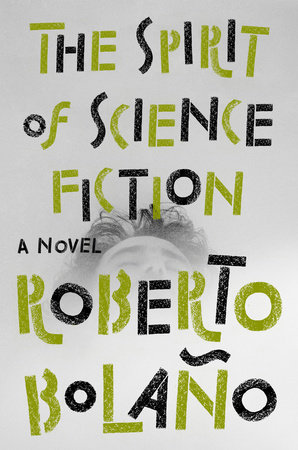
Roberto Bolaño’s novel The Spirit of Science Fiction will debut in English translation in 2019

Roberto Bolaño’s novel The Spirit of Science Fiction will be published in English translation next year. The translation is by Natasha Wimmer (who translated 2666 and The Savage Detectives, among other Bolaño works). Bolaño began The Spirit of Science Fiction in 1984 but apparently never finished it. The novel was first published in 2016 by the Spanish publishing house Alfaguara. Based on the blurb, The Spirit of Science Fiction sounds like a prototype for The Savage Detectives (much as Woes of the True Policeman is a prototype of 2666).

Here is the blurb from the publisher, Penguin Random House—

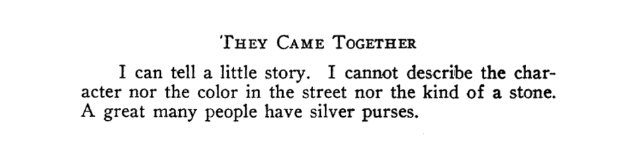
“They Came Together” — Gertrude Stein

Screenshot 2018-07-07 at 11.22.11 AM

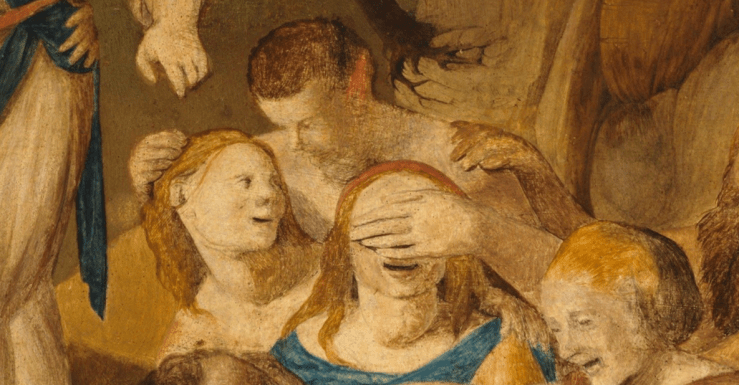
The Misfortunes of Silenus (detail)– Pierro di Cosimo

Screenshot 2018-07-05 at 8.47.28 PM

The Misfortunes of Silenus (detail), c. 1500 by Pierro di Cosimo (1462-1522)

“Farewell,” a very short story by Denis Johnson

“Farewell”

by

Denis Johnson

(A vignette from “The Largesse of the Sea Maiden”)


Elaine got a wall phone for the kitchen, a sleek blue one that wears its receiver like a hat, with a caller-I.D. readout on its face just below the keypad. While I eyeballed this instrument, having just come in from my visit with the chiropractor, a brisk, modest tone began, and the tiny screen showed ten digits I didn’t recognize. My inclination was to scorn it, like any other unknown. But this was the first call, the inaugural message.

As soon as I touched the receiver I wondered if I’d regret this, if I was holding a mistake in my hand, if I was pulling this mistake to my head and saying “Hello” to it.

The caller was my first wife, Virginia, or Ginny, as I always called her. We were married long ago, in our early twenties, and put a stop to it after three crazy years. Since then, we hadn’t spoken, we’d had no reason to, but now we had one. Ginny was dying.

Her voice came faintly. She told me the doctors had closed the book on her, she’d ordered her affairs, the good people from hospice were in attendance.

Before she ended this earthly transit, as she called it, Ginny wanted to shed any kind of bitterness against certain people, certain men, especially me. She said how much she’d been hurt, and how badly she wanted to forgive me, but she didn’t know whether she could or not—she hoped she could—and I assured her, from the abyss of a broken heart, that I hoped so, too, that I hated my infidelities and my lies about the money, and the way I’d kept my boredom secret, and my secrets in general, and Ginny and I talked, after forty years of silence, about the many other ways I’d stolen her right to the truth.

In the middle of this, I began wondering, most uncomfortably, in fact with a dizzy, sweating anxiety, if I’d made a mistake—if this wasn’t my first wife, Ginny, no, but rather my second wife, Jennifer, often called Jenny. Because of the weakness of her voice and my own humming shock at the news, also the situation around her as she tried to speak to me on this very important occasion—folks coming and going, and the sounds of a respirator, I supposed—now, fifteen minutes into this call, I couldn’t remember if she’d actually said her name when I picked up the phone and I suddenly didn’t know which set of crimes I was regretting, wasn’t sure if this dying farewell clobbering me to my knees in true repentance beside the kitchen table was Virginia’s, or Jennifer’s.

“This is hard,” I said. “Can I put the phone down a minute?” I heard her say O.K.

The house felt empty. “Elaine?” I called. Nothing. I wiped my face with a dishrag and took off my blazer and hung it on a chair and called out Elaine’s name one more time and then picked up the receiver again. There was nobody there.

Somewhere inside it, the phone had preserved the caller’s number, of course, Ginny’s number or Jenny’s, but I didn’t look for it. We’d had our talk, and Ginny or Jenny, whichever, had recognized herself in my frank apologies, and she’d been satisfied—because, after all, both sets of crimes had been the same.

I was tired. What a day. I called Elaine on her cell phone. We agreed she might as well stay at the Budget Inn on the East Side. She volunteered out there, teaching adults to read, and once in a while she got caught late and stayed over. Good. I could lock all three locks on the door and call it a day. I didn’t mention the previous call. I turned in early.

I dreamed of a wild landscape—elephants, dinosaurs, bat caves, strange natives, and so on.

I woke, couldn’t go back to sleep, put on a long terry-cloth robe over my p.j.’s and slipped into my loafers and went walking. People in bathrobes stroll around here at all hours, but not often, I think, without a pet on a leash. Ours is a good neighborhood—a Catholic church and a Mormon one, and a posh town-house development with much open green space, and, on our side of the street, some pretty nice smaller homes.

I wonder if you’re like me, if you collect and squirrel away in your soul certain odd moments when the Mystery winks at you, when you walk in your bathrobe and tasselled loafers, for instance, well out of your neighborhood and among a lot of closed shops, and you approach your very faint reflection in a window with words above it. The sign said “Sky and Celery.” Closer, it read “Ski and Cyclery.”

I headed home.

Mediation — Rosa Loy

loy_vermittlung

Mediation, 2010 by Rosa Loy (b. 1958)