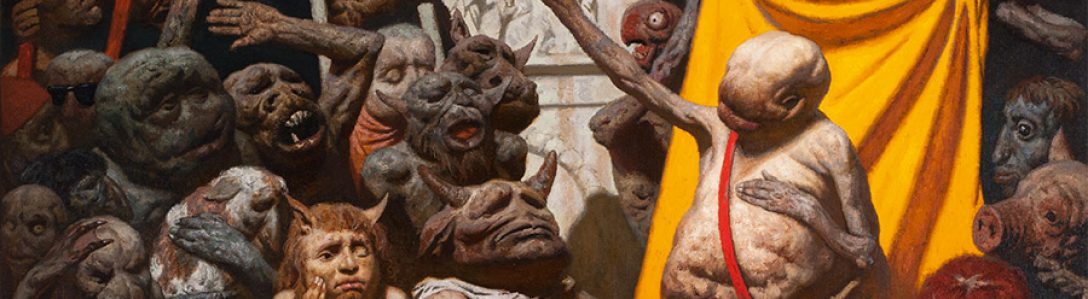
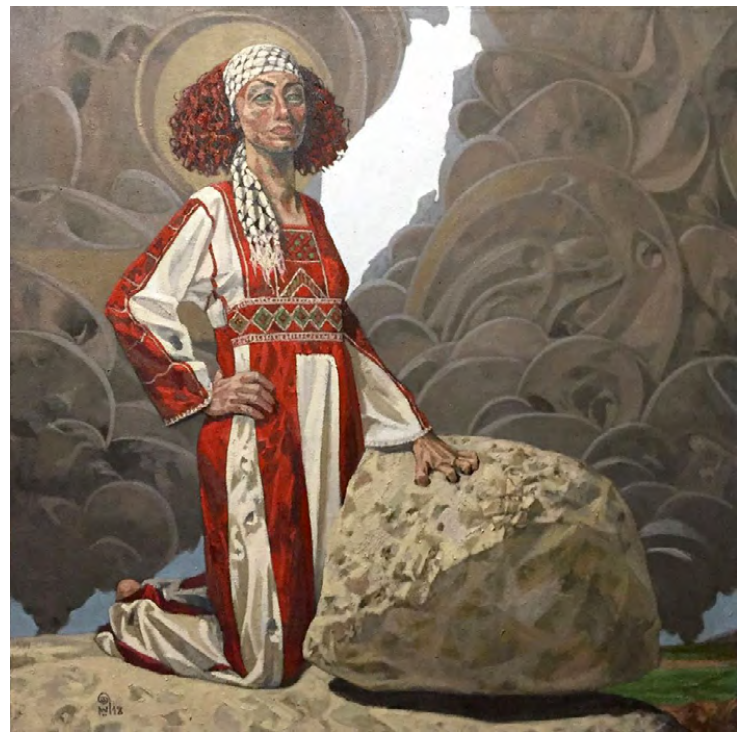
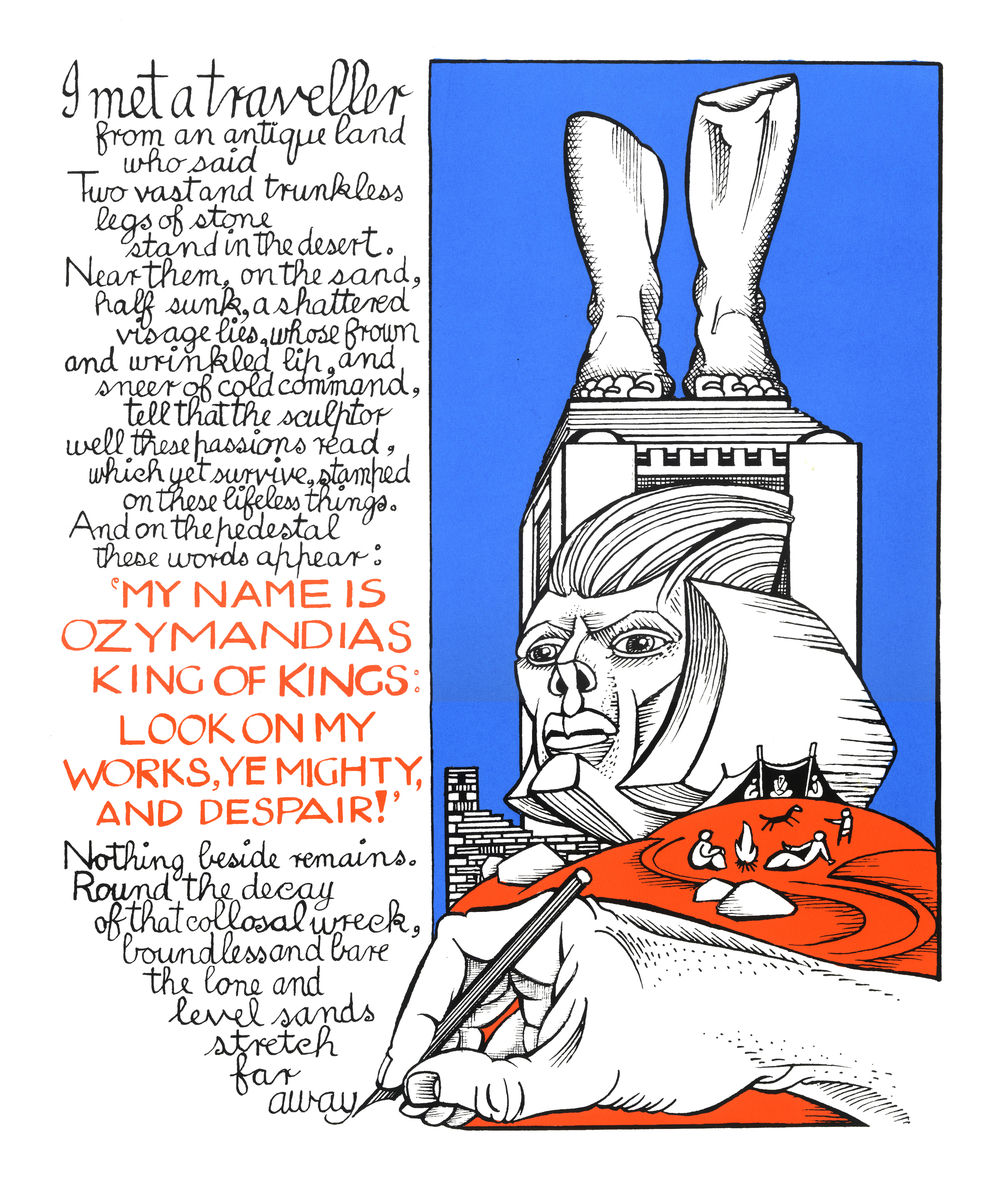
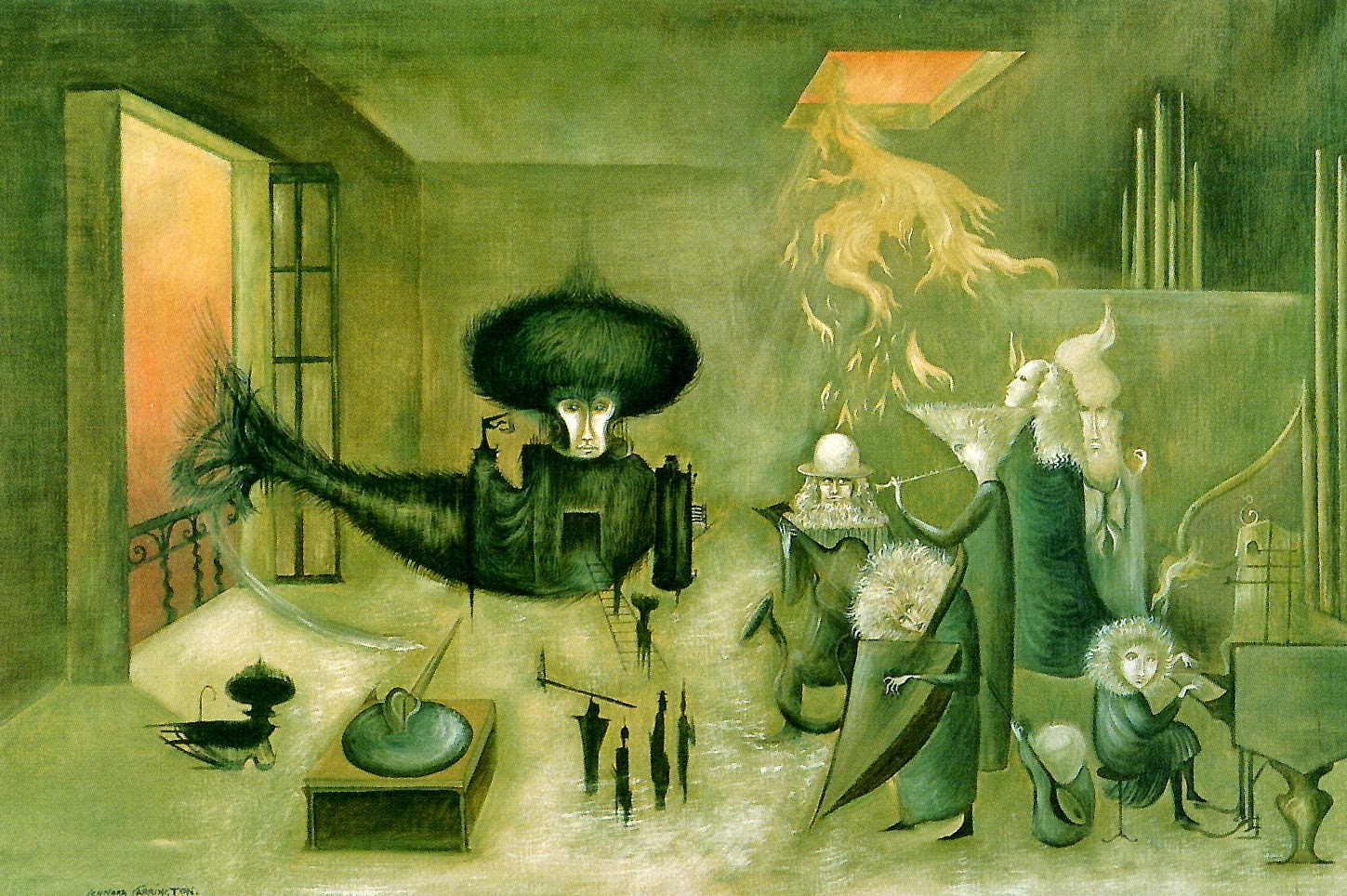
Baquiné — Marcos Irizarry

Baquiné, 1967 by Marcos Irizarry (1936–1995)

Portrait of Kafka — Adolph Hachmeister

Portrait of Kafka, c. 1967 by Adolph Hachmeister

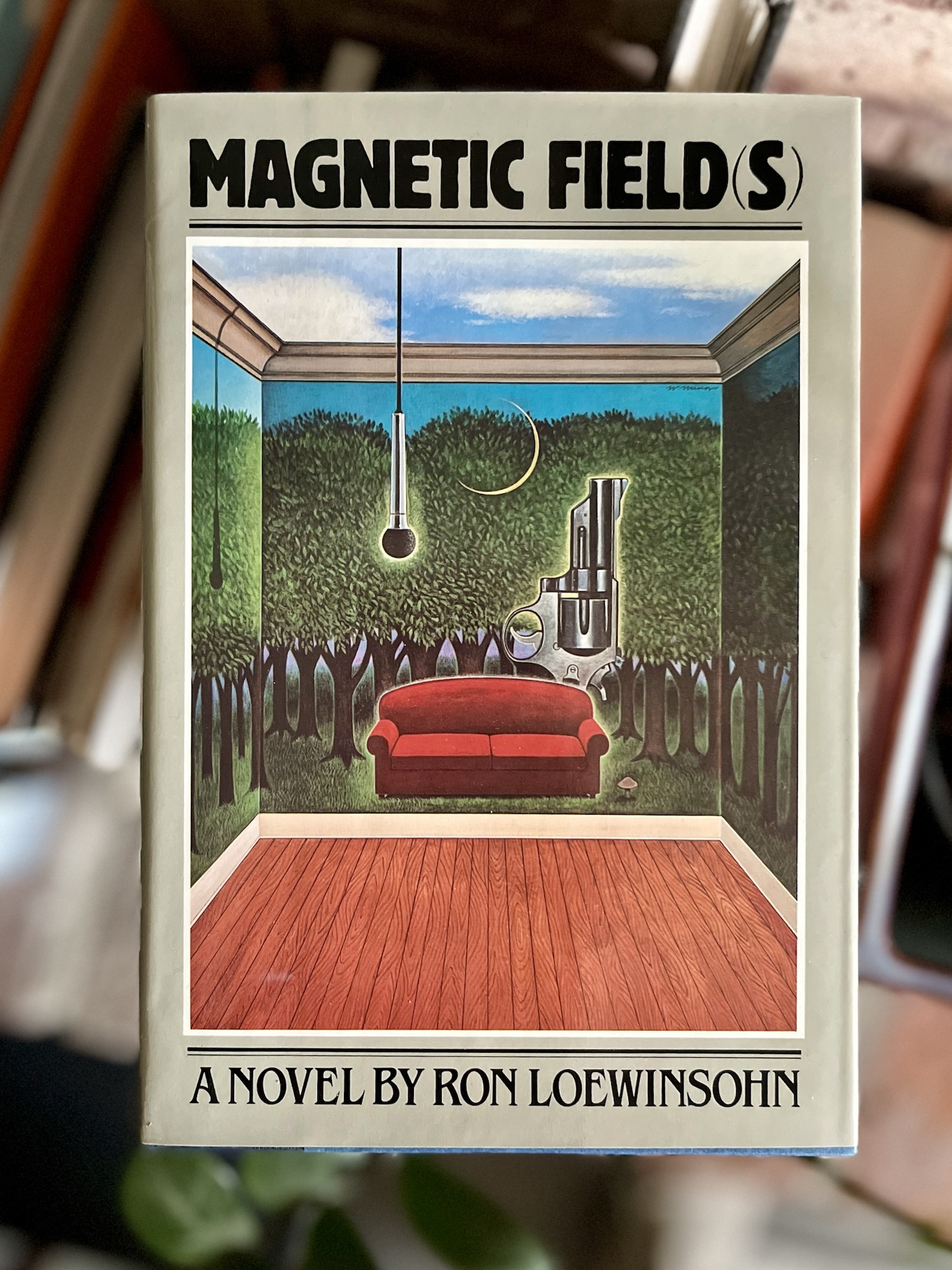
“In the Woods,” a very short story by Ron Loewinsohn

“In the Woods” by Ron Loewinsohn
The woodsman plods up the hill with his axe on his shoulder. He works for a lumber company and never sees the man who signs his checks, but his knowledge of the trees he euts down is their smells in the air become suddenly dusty around him, the squirrels and small birds who live in their branches, the squeak his axe makes as he pulls it out of the tree, the feel of his shoulders and arms as he swings, with his feet planted firmly and widely. This morning he saw the lovers lying on a bed of moss in the clearing behind him, but he didn’t stop. They were fully clothed and as they slept he saw the naked sward between them rusted to a sliver. They have been there forever, he knew, tho he’d never seen them before, with the light coming down thru the branches playing on them there as if they slept at the bottom of a lake. He will think of them once or twice as he climbs into the truck with the others, or just before he lifts a french fry to his mouth. Then someone will speak to him and he’ll answer with his mouth full, while we are haunted by the image, the two bodies filled with repose like a lake in the mountains. The two young people with perfect features fill our dreams, fill them to overflowing, even before we reach sleep, plodding toward it, shaking our heads on the pillow, reaching out to the watch, running our fingers thru our hair again, and hearing in the darkness the sound of our swallowing. And they the two lovers asleep on the mossy bank—what do they dream of? They dream of us. Their dreams are haunted by us straining our eyes in the dim light, our stomachs knotted with anxiety, spilling the drink and wiping it up, sweating and reaching for the branch, feeling the bark and smelling the sap, wanting each other in the empty room and letting our face fall into our hands, aching and hanging on. They dream of the woodsman, the actual woodsman and the dust be raises.  

Moebius’s cover illustration for Kurt Vonnegut’s novel Player Piano

Cover illustration for the French translation of Kurt Vonnegut’s novel Player Piano, 1975 by Moebius (Jean Giraud, 1938–2012)

Nude with Book — Zinaida Serebriakova

Nude with Book, 1940 by Zinaida Serebriakova (1884-1967)

Mass-market Monday | John Steinbeck’s In Dubious Battle

In Dubious Battle, John Steinbeck. Penguin Books (1979). Cover design by Neil Stuart. 313 pages.

John Steinbeck’s underrated and under-read novel In Dubious Battle seems like a good Labor Day mass-market pick. Perhaps Steinbeck’s most radical novel, In Dubious Battle details the fight for better working conditions during the Great Depression in California’s fruit orchards. The hero is young Jim Nolan who joins a labor strike organized by the Communist Party (one of the Party’s officials is named Harry Nilson). Jim is taken under the wing of the veteran organizer Mac McLeod; the pair drive a plot that focuses on the sometimes violent conflict between the workers and the landowners, who use the police and hired thugs to attempt to break the strike. Steinbeck, as is often the case with his serious novels, caps In Dubious Battle with a devastating conclusion, the final line a howl that does not end, its dash carrying the battle into the future, our own future: “Comrades! He didn’t want nothing for himself—“

And Life Anew — Rita Kernn-Larsen

And Life Anew, 1940 by Rita Kernn-Larsen (1904-1998)

“Wife in Reverse,” a very short story by Stephen Dixon

“Wife in Reverse”

by

Stephen Dixon


 His wife dies, mouth slightly parted and one eye open. He knocks on his younger daughter’s bedroom door and says “You better come. Mom seems to be expiring.” His wife slips into a coma three days after she comes home and stays in it for eleven days. They have a little party second day she’s home: Nova Scotia salmon, chocolates, a risotto he made, brie cheese, strawberries, champagne. An ambulette brings his wife home. She says to him “Wheel me around the garden before I go to bed for the last time.” His wife refuses the feeding tube the doctors want to put in her and insists she wants to die at home. She says “I don’t want any more life support, medicines, fluid or food.” He calls 911 for the fourth time in two years and tells the dispatcher “My wife; I’m sure she has pneumonia again.” His wife has a trach put in. “When will it come out?” she says, and the doctor says “To be honest? Never.” “Your wife has a very bad case of pneumonia,” the doctor in ICU tells him and his daughters the first time, “and has a one to two percent chance of surviving.” His wife now uses a wheelchair. His wife now uses a motor cart. His wife now uses a walker with wheels. His wife now uses a walker. His wife has to use a cane. His wife’s diagnosed with MS. His wife has trouble walking. His wife gives birth to their second daughter. “This time you didn’t cry,” she says, and he says “I’m just as happy, though.” His wife says to him “Something seems wrong with my eyes.” His wife gives birth to their daughter. The obstetrician says “I’ve never seen a father cry in the birthing room.” The rabbi pronounces them husband and wife, and just before he kisses her, he bursts out crying. “Let’s get married,” he says to her, and she says “It’s all right with me,” and he says “It is?” and starts crying. “What a reaction,” she says, and he says “I’m so happy, so happy,” and she hugs him and says “So am I.” She calls and says “How are you? Do you want to meet and talk?” She drops him off in front of his building and says “It’s just not working.” They go to a restaurant on their first real date and he says “The reason I’m being so picky as to what to eat is that I’m a vegetarian, something I was a little reluctant to tell you so soon,” and she says “Why? It’s not peculiar. It just means we won’t share our entrees except for the vegetables.” He meets a woman at a party. They talk for a long time. She has to leave the party and go to a concert. He gets her phone number and says “I’ll call you,” and she says “I’d like that.” He says goodbye to her at the door and shakes her hand. After she leaves he thinks “That woman’s going to be my wife.”

Illustrated manuscript page from Alasdair Gray’s Lanark

An illustrated manuscript page from Alasdair Gray’s novel Lanark. From the Glasgow University Library Special Collections Department.

Afterword — Chester Arnold

Afterword, 2009 by Chester Arnold (b. 1952)

Santa Sangre — Moebius

Sante Sangre, c. 1982 by Moebius (Jean Giraud, 1938–2012)

Mass-market Monday | Gene Wolfe’s The Shadow of the Torturer

The Shadow of the Torturer, Gene Wolfe. Timescape/Pocket Books (1981). No cover designer or artist credited. 262 pages.

While no cover artist is credited, Don Maitz is the artist for this edition of The Shadow of the Torturer, as well as for the other three books in Wolfe’s Book of the New Sun tetralogy. Maitz is credited on the dust jackets of the original hardback first editions (Simon & Schuster) of the series.

The Book of the New Sun is absolutely astounding.

From Peter Bebergal’s 2015 New Yorker profile on Wolfe, “Sci-Fi’s Difficult Genius”:

For science-fiction readers, “The Book of the New Sun” is roughly what “Ulysses” is to fans of the modern novel: far more people own a copy than have read it all the way through. A surreal bildungsroman, the book centers on a character named Severian. Trained as a torturer on the planet Urth, where torturers are a feared and powerful guild, Severian betrays his order by showing mercy, allowing a prisoner to kill herself rather than be subjected to his terrible ministrations. He then wanders the land encountering giants, anarchists, and members of religious cults. He eventually meets and supplants the ruler of Urth, the Autarch.

The four books that make up the series are sometimes vexing. A wise reader will keep a dictionary nearby, but it won’t always prove useful. Though Wolfe relies merely on the strangeness of English—rather than creating a new language, like Elven or Klingon—he nonetheless dredges up some truly obscure words: cataphract, fuligin, metamynodon, cacogens. The setting appears medieval, but slowly we tease out that what is ancient to these characters was once our own possible future. A desert’s sands are the glass of a great city, and the creaking steel walls that make up Severian’s cell in the guild dormitory is likely an ancient spaceship. Reading “The Book of the New Sun” is dizzying; at times, you become convinced that you have cracked a riddle, and yet the answer fails to illuminate the rest of the story. Wolfe doesn’t reveal the truth behind any of the central mysteries explicitly, but lets them carry the narrative along. At first, one hopes that they will eventually be resolved. Ultimately, they become less important than Severian’s quest for his own truth.

Stephen Dixon on Thomas Bernhard

“The Plug,” by Stephen Dixon, was published in the winter 1997 issue of Rain Taxi.


I did a coupla readings for my last novel, Gould, and at one of them a guy in the audience said “Were you influenced by Thomas Bernhard?” and I said “Why, because of the long paragraphs? To tell you the truth, I know he has a great reputation but I started two Bernhard books and I didn’t think he did the long paragraph that well. They were repetitive, a bit formally and almost too rigidly written, and I often lost track of the story in them, and other things why I didn’t like them, although what, I forget.” “No,” he said, “or maybe that, but also because Gould is a character in one of his books too, The Loser. I just thought it was too much of a coincidence that you hadn’t read a lot of him and been influenced,” and I said “Gould? That guy’s name in his book is Gould? I thought I made up that forename,” and he said “Glenn Gould,” and I said “No, my character is Gould Bookbinder and he doesn’t play the piano though I think he does love Bach above all composers and especially the composition Gouldberg Variations,” and he said “That’s another thing. The first part of your novel is about variations of a single theme, abortions, right?–or that’s what you said,” and I said, “So, another coincidence. But you made me interested; I’ll read The Loser.” I didn’t, though, but a month later a colleague of mine asked if I’d ever read Bernhard’s The Loser and I said “Why, because of the long paragraphs, though he only seems to have one paragraph a book, and because of the name Gould, though I don’t know if you know–” and she said “I do: first name, not last name. But I was thinking you’d like him. The two of you do a lot of the same things. The urban settings, dark but comical nature of your characters, their dislike of so many things, though your narrators for the past ten years of your work have been fathers to the extreme as well as loyal husbands, while none of his main characters seem to have children and they never marry either or have sex, at least not in the books,” and I said “This is a double coincidence, your bringing up The Loser and someone at a recent reading bringing it up, or maybe ‘coincidence’ isn’t the right word. And sure, I understand it: Gould, the name, and my love for losers, and the long paragraph, so I’m going to read that book, I promise; the next book I start will be The Loser.” “What’re you reading now?” she said and I said “I forget; what am I reading now? It can’t be too interesting if I don’t know what it is. It isn’t interesting, in fact, so I’m going to buy a copy of his book today.” Usually I put things like this off, or just forget it, but this time I didn’t. I have to have a book to read and The Loser sounded like the one, but more out of curiosity, which isn’t a good reason for me to read a book, than because I was interested in it as literature. So I bought it that day, started it that night, and loved it. There’s my literary criticism. The single paragraph worked. So did Glenn Gould as a supporting character and Horowitz in the background. The book was funny and deep and crabby and dark and obsessive. He had his Gould and I had mine and the coincidence of the two of us using the same name, though his last but first and mine first but second, and intrigued, maybe for the same reason–I don’t know what his is but mine is that I can’t write anything anymore but in a single paragraph–by the long paragraph is, well . . . I lost my thought and apologize for the disarray. I liked it because it was intelligent, or should I say “I also liked it because,” and it was short, though took me a long time to finish, relatively speaking, since my eyes aren’t what they used to be and eyeglasses don’t do what they used to do for me and my body gets tireder faster than it used to and after a long day of work, and every day seems to be a long day of work, only a little of it my writing, I don’t have that much time to read the book, which is the only way I like to read: I want to read it, I want to read him. And after I read it I wanted to immediately read another Bernhard book, that’s the effect the first one had, so I got Woodcutters and read that and loved it and thought it was better than The Loser, funnier, crabbier, darker, more opinionated and artistic, he did things in this he didn’t in the other, trickier literary things: the guy sitting in the chair three quarters of the book, never getting out of it, just observing and thinking about what he observes, like someone out of Beckett’s novels but better, though Bernhard must have lifted it from Beckett, at least spiritually–do I know what I’m saying? Let me just say there was a very Beckettian feeling about Woodcutters. Anyway, after that one I immediately got another one, Yes, and didn’t much like it–it was older Bernhard, early Bernhard, it didn’t take the risks, it didn’t compel me to read, and it had paragraphs, I think, and I got The Lime Works and it was only so-so, and I thought “Have I read the very best of Bernhard or is it that his later works are better than his early ones?” and so got Old Masters, one of the last books of Bernhard, I think, and thought that the best one, again the man sitting in a chair, though it’s a couch in a museum, and it was even more vitriolic than Woodcutters, and next immediately read Concrete and thought that a very good one and I’m now reading Correction and liking it and I will probably read The Cheap-Eaters, without even thinking “early, late, middle Bernhard,” what do I care anymore? I just want to continue to read the guy, though a German professor at Hopkins where I teach told me there are more than twenty Bernhard novels, not all of them translated but all of them to be translated, and I told her maybe that’ll be too many for me to read, but you never know. I asked this woman “By the way, this Austrian writer Stifter, he mentions in Old Masters, he’s not a real person, is he?” and she said “Oh yes, very famous, a traditionalist, not too well known in America,” and I said “Amazing what Bernhard gets away with. Imagine an American writer working into his texts such excoriations of other writers, including contemporaries, which Bernhard does too. And knocking the Academy and prize givers, as Bernhard does in almost all his books: in America writers claw each other to get prizes and, you know, throw up on the hands that pin the medals on their chests and stuff the checks into their pockets. Some of his thoughts are a bit odd and wrongheaded if not occasionally loony,” I said, “but most I agree with. And after reading a lot of him, in addition to all the other similarities people have mentioned–well, really, just two people–and I don’t think the first ever read my work, just picked it up from the reading I gave and what was on the book jacket–is . . . oh, I forget what I was going to say.” I want to end this by saying I haven’t been so taken by one writer since I was in my mid-twenties and started reading everything Saul Bellow had written up till then. And in my early twenties, I read one Thomas Mann book after the other, probably not completing his entire oeuvre but getting close. And before that, when I was eighteen, I read everything of Dostoevski’s that had been translated. And I forgot Joyce and my mid-twenties when I read everything he wrote, though his corpus wasn’t by any means as large as Mann’s or Dostoevski’s. And one last note: Please don’t think I’m writing this as a plug for my own Gould. Or that what I just said in that last sentence is an additional plug. I hate writers who plug their books, who sort of work in a reference to their books, especially the new ones, whenever they can. I only brought up my book because it’s consequential to this inconsequential minor essay on Bernhard and that if I hadn’t written a book called Gould I probably wouldn’t have read The Loser and, of course, after that, another half-dozen Bernhard books. Did I use “inconsequential” right, then? Perhaps even to call this an essay is absurd, though to call it inconsequential and minor isn’t. But I hope I just did what I always like to do and that’s to belittle my own work and show myself as a writer who’s part bumbling semimoron. And also done what I’ve never done in print before, so far as I can remember, and my memory isn’t that good, and that is to plug the work of someone else and write even in the most exaggerated definition of the word an essay. “Exaggerated” isn’t the word I meant, I think, but I’m sure you know what I mean even in my probable misuse of it.

The old men get so they can’t stand the competition and they kill off all the young men | From Angela Carter’s Wise Children

You must remember that there was a war on, when we were born. If we made her happy, then we didn’t add much to the collective sum of happiness in the whole of South London. First of all, the neighbours’ sons went marching off, sent to their deaths, God help them. Then the husbands, the brothers, the cousins, until, in the end, all the men went except the ones with one foot in the grave and those still in the cradle, so there was a female city, red-eyed, dressed in black, outside the door, and Grandma said it then, she said it again in 1939: ‘Every twenty years, it’s bound to happen. It’s to do with generations. The old men get so they can’t stand the competition and they kill off all the young men they can lay their hands on. They daren’t be seen to do it themselves, that would give the game away, the mothers wouldn’t stand for it, so all the men all over the world get together and make a deal: you kill off our boys and we’ll kill off yours. So that’s that. Soon done. Then the old men can sleep easy in their beds, again.’

From Wise Children by Angela Carter.

The Reader — Henri Fantin-Latour

The Reader (Marie Fantin Latour, the Artist’s Sister), 1861 by Henri Fantin-Latour (1836-1904)

Disjunction, simultaneity, irrationalism, anti-illusionism, self-reflexiveness, medium-as-message, political olympianism, and a moral pluralism approaching moral entropy | John Barth

Disjunction, simultaneity, irrationalism, anti-illusionism, self-reflexiveness, medium-as-message, political olympianism, and a moral pluralism approaching moral entropy—these are not the whole story either.

A worthy program for postmodernist fiction, I believe, is the synthesis or transcension of these antitheses, which may be summed up as premodernist and modernist modes of writing. My ideal postmodernist author neither merely repudiates nor merely imitates either his twentieth-century modernist parents or his nineteenth-century premodernist grandparents. He has the first half of our century under his belt, but not on his back. Without lapsing into moral or artistic simplism, shoddy craftsmanship, Madison Avenue venality, or either false or real naïveté, he nevertheless aspires to a fiction more democratic in its appeal than such late-modernist marvels (by my definition) as Beckett’s Texts for Nothing or Nabokov’s Pale Fire. He may not hope to reach and move the devotees of James Michener and Irving Wallace—not to mention the great mass of television-addicted non-readers. But he should hope to reach and delight, at least part of the time, beyond the circle of what Mann used to call the Early Christians: professional devotees of high art.

I feel this in particular for practitioners of the novel, a genre whose historical roots are famously and honorably in middle-class popular culture. The ideal postmodernist novel will somehow rise above the quarrel between realism and irrealism, formalism and “contentism,” pure and committed literature, coterie fiction and junk fiction. Alas for professors of literature, it may not need as much teaching as Joyce’s or Nabokov’s or Pynchon’s books, or some of my own. On the other hand, it will not wear its heart on its sleeve, either; at least not its whole heart. (In a recent published exchange between William Gass and John Gardner, Gardner declares that he wants everybody to love his books; Gass replies that he would no more want his books to be loved by everybody than he’d want his daughter to be loved by everybody, and suggests that Gardner is confusing love with promiscuity.) My own analogy would be with good jazz or classical music: One finds much on successive listenings or close examination of the score that one didn’t catch the first time through; but the first time through should be so ravishing—and not just to specialists—that one delights in the replay.

Lest this postmodern synthesis sound both sentimental and impossible of attainment, I offer two quite different examples of works which I believe approach it, as perhaps such giants as Dickens and Cervantes may be said to anticipate it. The first and more tentative example (it is not meant to be a blockbuster) is Italo Calvino’s Cosmicomics (1965): beautifully written, enormously appealing space-age fables—“perfect dreams,” John Updike has called them—whose materials are as modern as the new cosmology and as ancient as folktales, but whose themes are love and loss, change and permanence, illusion and reality, including a good deal of specifically Italian reality. Like all fine fantasists, Calvino grounds his nights in local, palpable detail: Along with the nebulae and the black holes and the lyricism, there is a nourishing supply of pasta, bambini, and good-looking women sharply glimpsed and gone forever. A true postmodernist, Calvino keeps one foot always in the narrative past—characteristically the Italian narrative past of Boccaccio, Marco Polo, or Italian fairy tales—and one foot in, one might say, the Parisian structuralist present; one foot in fantasy, one in objective reality, etc. It is appropriate that he has, I understand, been chastized from the left by the Italian communist critics and from the right by the Italian Catholic critics; it is symptomatic that he has been praised by fellow authors as divergent as John Updike, Gore Vidal, and myself. I urge everyone to read Calvino at once, beginning with Cosmicomics and going right on, not only because he exemplifies my postmodernist program, but because his fiction is both delicious and high in protein.

An even better example is Gabriel García Márquez’s One Hundred Years of Solitude (1967): as impressive a novel as has been written so far in the second half of our century and one of the splendid specimens of that splendid genre from any century. Here the synthesis of straightforwardness and artifice, realism and magic and myth, political passion and nonpolitical artistry, characterization and caricature, humor and terror, are so remarkably sustained that one recognizes with exhilaration very early on, as with Don Quixote and Great Expectations and Huckleberry Finn, that one is in the presence of a masterpiece not only artistically admirable, but humanly wise, lovable, literally marvelous. One had almost forgotten that new fiction could be so wonderful as well as so merely important. And the question whether my program for postmodernism is achievable goes happily out the window, like one of García Márquez’s characters on flying carpets. Praise be to the Spanish language and imagination! As Cervantes stands as an exemplar of premodernism and a great precursor of much to come, and Jorge Luis Borges as an exemplar of dernier cri modernism and at the same time as a bridge between the end of the nineteenth century and the end of the twentieth, so Gabriel García Márquez is in that enviable succession: an exemplary postmodernist and a master of the storyteller’s art.


From John Barth’s 1980 essay “The Literature of Replenishment.”

Blossoming Almond Branch in a Glass with a Book — Vincent van Gogh

Blossoming Almond Branch in a Glass with a Book, 1888 by Vincent van Gogh (1853–1890)