The Annunciation (Detail) — Jan van Eyck

anunc14

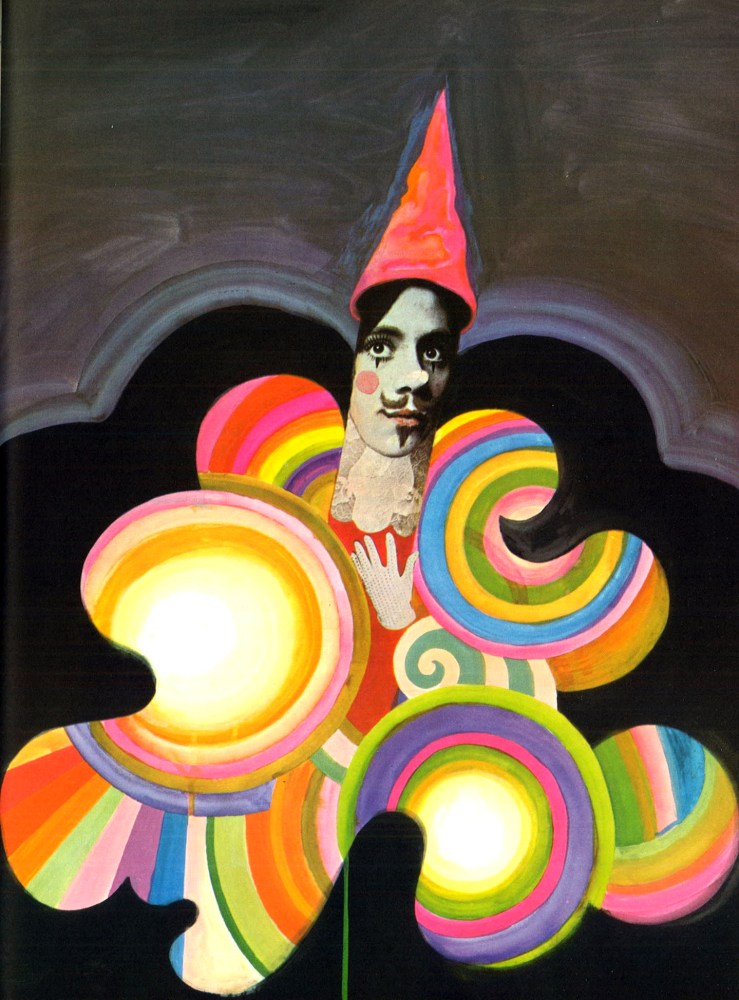
The body of the bride Lila appeared cruelly shredded (From Elena Ferrante’s novel The Story of a New Name)

It was a beautiful warm evening; the brilliant lights of the shop’s interior spread their glow into the square. The gigantic image of Lila in her wedding dress could be seen at a distance, leaning against the center wall. Stefano parked, we went in, making our way among the boxes of shoes, piled up haphazardly, cans of paint, ladders. Marcello, Rino, Gigliola, and Pinuccia were visibly irritated: for varying reasons they had no wish to submit yet again to Lila’s caprices. The only one who greeted us cordially was Michele, who turned to my friend with a mocking laugh. “Lovely signora, will you let us know, at last, what you have in mind or do you just want to ruin the evening?”

Lila looked at the panel leaning against the wall, asked them to lay it on the floor. Marcello said cautiously, with the dark timidity that he always showed toward Lila, “What for?”

“I’ll show you.”

Rino interrupted: “Don’t be an idiot, Lina. You know how much this thing cost? If you ruin it, you’re in trouble.”

The Solaras laid the image on the floor. Lila looked around, with her brow furrowed, her eyes narrowed. She was looking for something that she knew was there, that perhaps she had bought herself. In a corner she spied a roll of black paper, and she took a pair of big scissors and a box of drawing pins from a shelf. Then, with that expression of extreme concentration which enabled her to isolate herself from everything around her, she went back to the panel. Before our astonished and, in the cases of some, openly hostile eyes, she cut strips of black paper, with the manual precision she had always possessed, and pinned them here and there to the photograph, asking for my help with slight gestures or quick glances.

I joined in with the devotion that I had felt ever since we were children. Those moments were thrilling, it was a pleasure to be beside her, slipping inside her intentions, to the point of anticipating her. I felt that she was seeing something that wasn’t there, and that she was struggling to make us see it, too. I was suddenly happy, feeling the intensity that invested her, that flowed through her fingers as they grasped the scissors, as they pinned the black paper.

Finally, she tried to lift the canvas, as if she were alone in that space, but she couldn’t. Marcello readily intervened, I intervened, we leaned it against the wall. Then we all backed up toward the door, some sneering, some grim, some appalled. The body of the bride Lila appeared cruelly shredded. Much of the head had disappeared, as had the stomach. There remained an eye, the hand on which the chin rested, the brilliant stain of the mouth, the diagonal stripe of the bust, the line of the crossed legs, the shoes.

Gigliola began, scarcely containing her rage: “I cannot put a thing like that in my shop.”

“I agree,” Pinuccia exploded. “We have to sell here, and with that grotesque thing people will run away. Rino, say something to your sister, please.”

Rino pretended to ignore her, but he turned to Stefano as if his brother-in-law were to blame for what was happening. “I told you, you can’t reason with her. You have to say yes, no, and that’s it, or you see what happens? It’s a waste of time.”

Stefano didn’t answer, he stared at the panel leaning against the wall and it was evident that he was looking for a way out. He asked me, “What do you think, Lenù?”

I said in Italian, “To me it seems very beautiful. Of course, I wouldn’t want it in the neighborhood, that’s not the right place for it. But here it’s something else, it will attract attention, it will please. In Confidenze just last week I saw that in Rossano Brazzi’s house there is a painting like this.”

Hearing that, Gigliola got even angrier. “What do you mean? That Rossano Brazzi knows what’s what, that you two know everything, and Pinuccia and I don’t?”

At that point I felt the danger. I had only to glance at Lila to realize that, if when we arrived at the shop she had really felt willing to give in should the attempt prove fruitless, now that the attempt had been made and had produced that image of disfigurement she wouldn’t yield an inch. Those minutes of work on the picture had broken ties: at that moment she was overwhelmed by an exaggerated sense of herself, and it would take time for her to retreat into the dimension of the grocer’s wife, she wouldn’t accept a sigh of dissent. In fact, while Gigliola was speaking, she was already muttering: Like this or not at all. And she wanted to quarrel, she wanted to break, shatter, she would have happily hurled herself at Gigliola with the scissors.
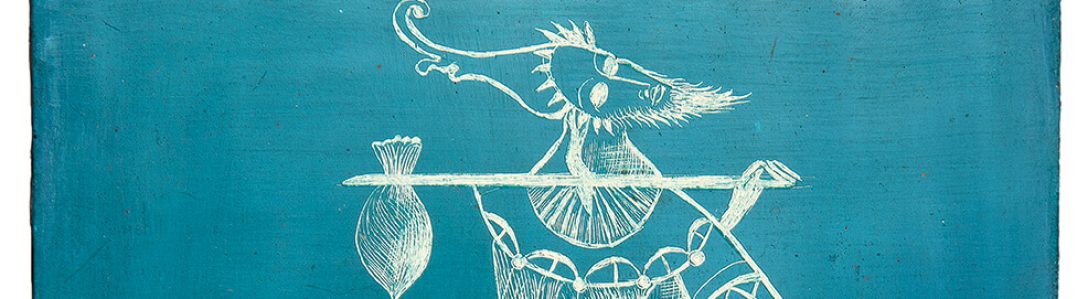
From Elena Ferrante’s 2012 novel The Story of a New Name. English translation by Ann Goldstein. I’m not sure how well the passage stands free of any context—I know there are a lot of characters here with backgrounds that won’t be clear to anyone who hasn’t read Ferrante’s novel (read it!)—but I love this passage, where brilliant friends Lila and Lenù collaborate to turn advertising into art, to artistically—and violently, perhaps—erase Lila’s body from the patriarchal order into which she has been inscribed.

William T. Vollmann talks sex and death; reads from Last Stories and Other Stories

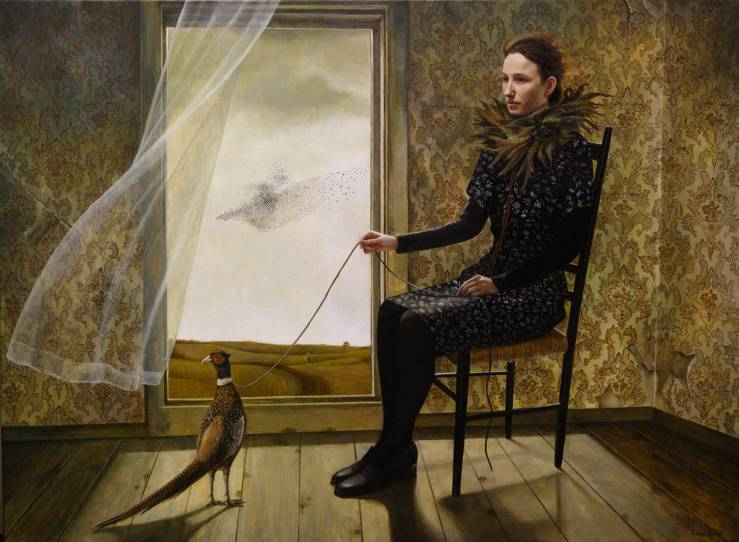
Pheasant Keeper — Andrea Kowch

kowch_pheasant_keeper_36x48_hires_l

Two Passengers — Hugo Simberg

two-passengers-1901

Three Books (that are good starting points for reading Thomas Pynchon)

Today is Pynchon in Public Day, so today’s Three Books blog offers three books that I think may make good entry points for those interested in, but perhaps unnecessarily daunted by, Thomas Pynchon. My intuition is that many readers’ first experiences reading Pynchon may have been like mine: I read The Crying of Lot 49 as a college assignment, found it bewildering and baffling, and despite understanding almost none of it, I then attempted Gravity’s Rainbow (the key word is attempted (failed will also do in a pinch)).

Many readers start with The Crying of Lot 49 because it’s short. While I like the novel (I wrote about it here), it’s also extraordinarily dense, a box so crammed with jokes and japes that some fail to spring out at full force. Lot 49 is a much better reading experience after you’ve read more of Pynchon.

Lots of readers new to Pynchon plunge into Gravity’s Rainbow, probably because it’s famous. I love love love Gravity’s Rainbow, but along with Mason & Dixon (which may be my favorite Pynchon novel), I do not think it is a good starting place for Pynchon. Gravity’s Rainbow is a rich, ringing vortex, a seven-hundred-and-something pager that almost necessitates that its reader immediately reread it. Gravity’s Rainbow is a very funny and very tragic book, and I think it is the work of genius that its reputation suggests—but it’s also one of the few books I can think of that get put on lists of Big Difficult Novels that is, actually, Difficult.

So here are my suggestions for starting places for Pynchon.

img_2195

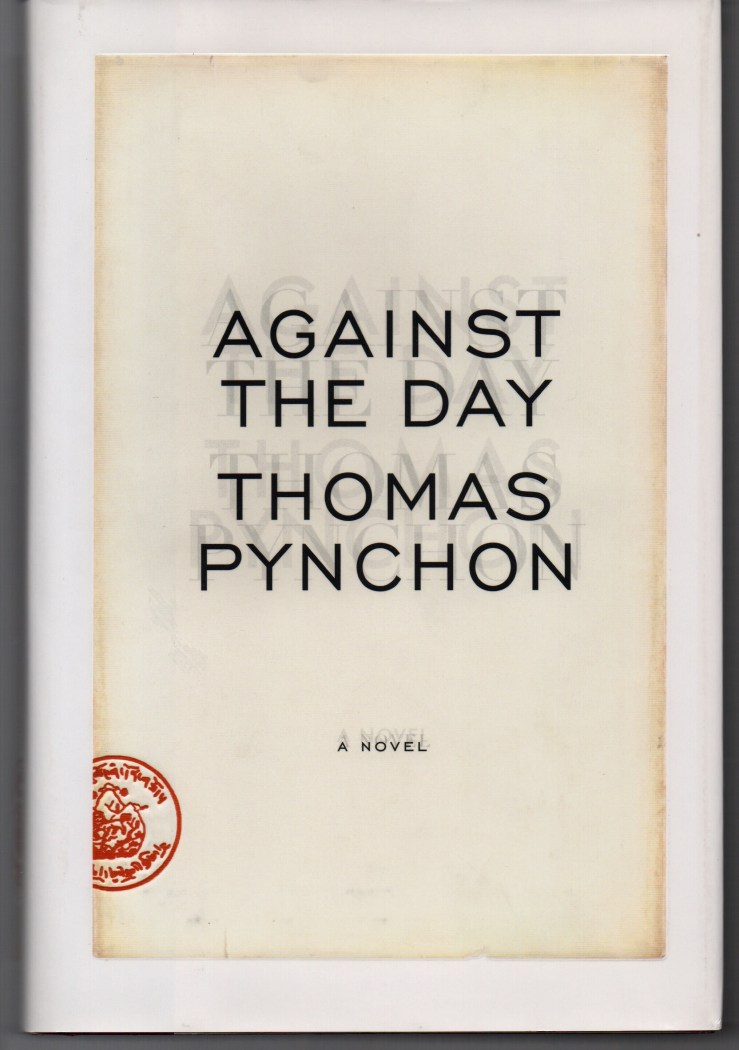
Against the Day by Thomas Pynchon. First edition Penguin hardback, 2006. Jacket design my Michael Ian Kaye.

Okay. So maybe you’re saying, Waitisn’t that one, like, really long? Reader, you’re correct. At 1,085 pages Against the Day is Pynchon’s longest novel to date. But it’s also one of his most accessible, and, most importantly, it offers a condensation of Pynchon’s Big Ideas and Big Themes. (I wrote a list of 101 possible descriptors for Against the Day, if you’re interested in a short take; I also riffed on the book at some length in a series of posts).

img_2194

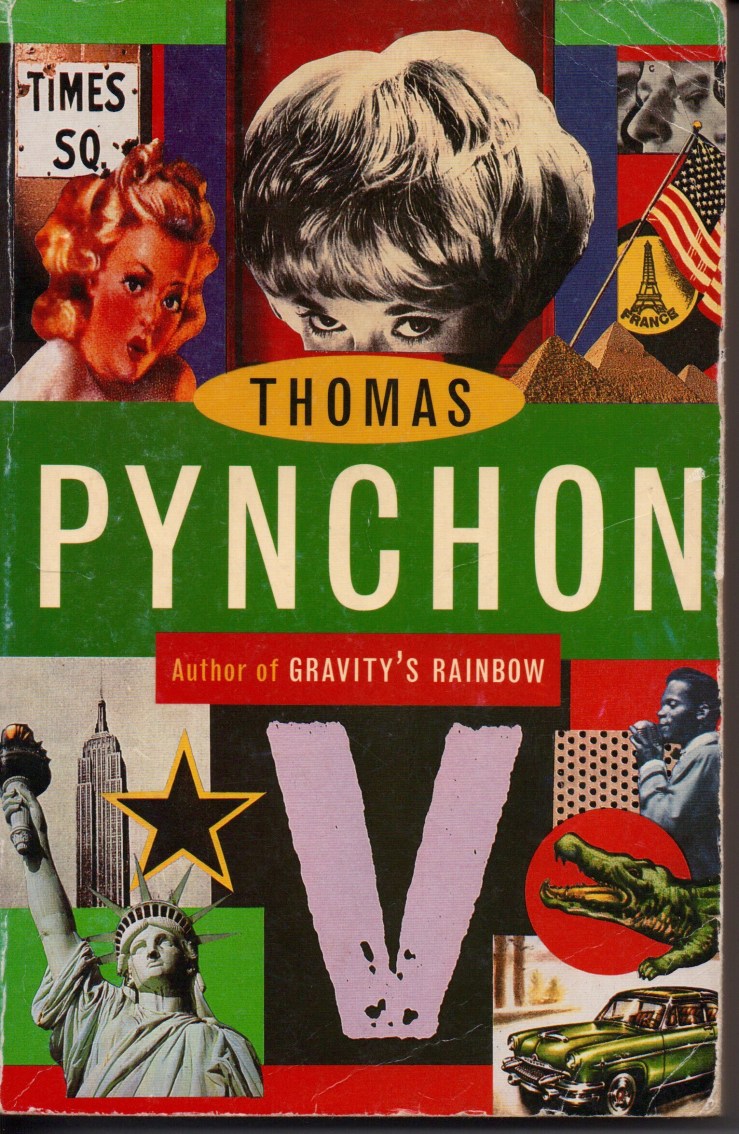
V. by Thomas Pynchon. Vintage UK trade paperback edition (1995). Cover by Paul Burgess.

V. is Thomas Pynchon’s first novel. It’s also the first Pynchon novel I read and loved and (possibly) understood. Like Against the DayV. lays out many of the themes and styles (and even a character or two) that appear elsewhere Pynchon’s oeuvre. In a loose sense, V. feels like a dress rehearsal for Gravity’s Rainbow. Oh, it’s also pretty discursive—in fact, you can read chunks of it almost as short stories. In fact, here’s a good way to break into Pynchon: Get V., and read Ch. 9–it stands on its own as a long short story, the tale of Kurt Mondaugen—and colonialism, siege paranoia, dark dread, etc.

img_2197

Inherent Vice by Thomas Pynchon. First edition hardback, Penguin, 2009. Jacket design by Tal Goretsky and Darren Haggar; image credited to Darshan Zenith and Cruiser Art.

I’ve heard Inherent Vice dismissed as “Pynchon lite,” which may be true—I’ve read the book twice now and if its shaggy threads connect, I can’t see it (unlike, say, Gravity’s Rainbow, which resolves like a complicated math problem). Still, Inherent Vice makes a nice gateway drug to Pynchon—it’s funny and loose, and even though it rambles through an enormous cast of characters and settings, it’s ultimately far, far more contained than sprawling novels like Mason & Dixon and Gravity’s Rainbow. Paul Thomas Anderson’s film adaptation also makes an interesting visual counterpart to the novel—which it somehow simultaneously condenses and expands. Inherent Vice—the novel—also seems to me a kind of bookend or sequel to The Crying of Lot 49. (I wrote a bit about that here).

Last thought: Ignore my suggestions. Pick any novel that interests you by Pynchon and dive in. Don’t get too frustrated if you’re not sure what’s going on. A lot of the time, that’s the point of it all. Enjoy it.

Portrait of the Artist’s Mother

Portrait of the Artist’s Mother — Vincent van Gogh
The Artist’s Mother — Pierre-Auguste Renoir
Portrait of the Artist’s Mother — Camille Pissarro

Continue reading “Portrait of the Artist’s Mother”

The Annunciation (Detail) — Jan van Eyck

anunc13

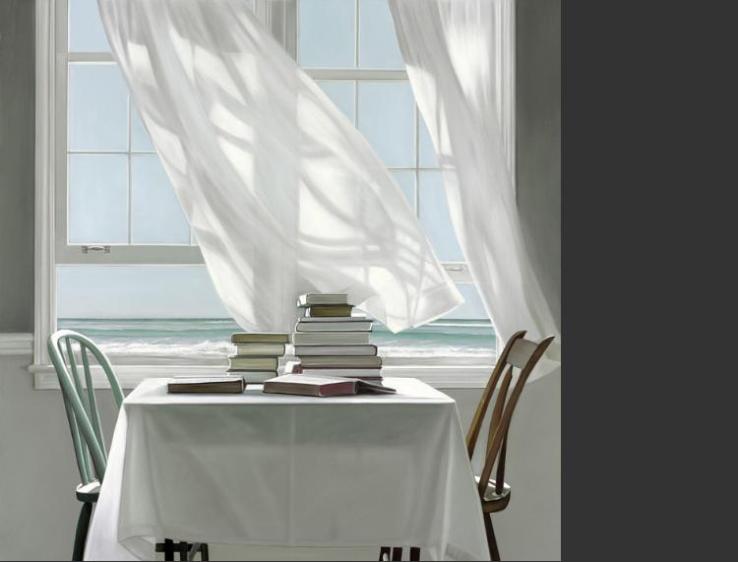
Beach Read — Karen Hollingsworth

threerockers40x4b

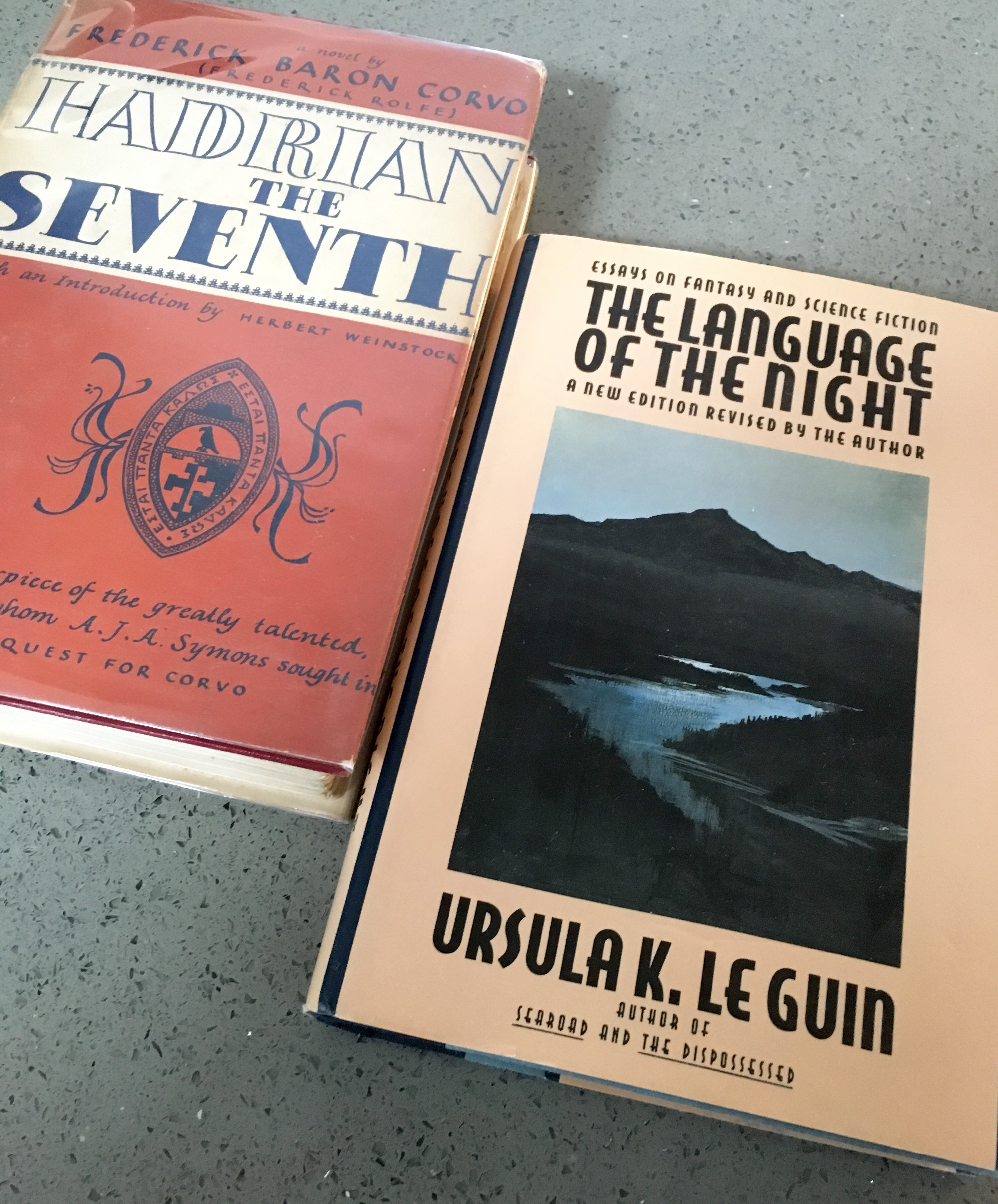
Le Guin/Corvo (Books acquired, 4.27.2016)


Thanks, Jon. 

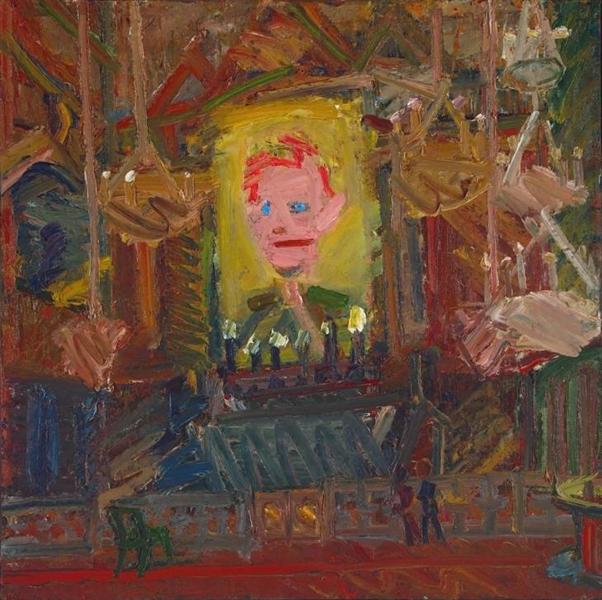
Rimbaud — Frank Auerbach

rimbaud-1976large

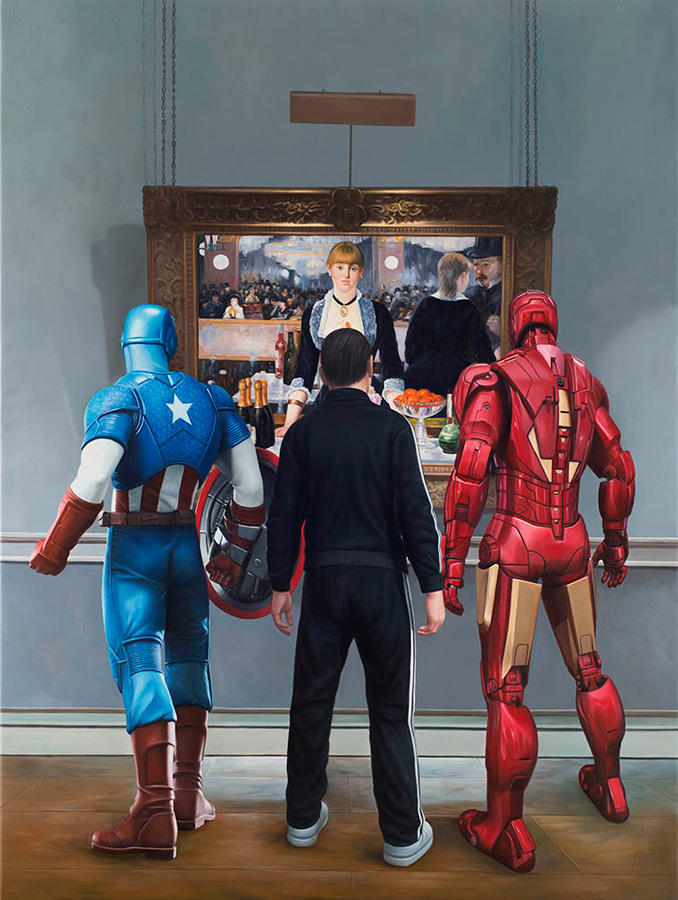
Iron Man, Captain America, and a Russian Mobster Walk into a Bar — Marc Dennis

marc-dennis_ironman-captain-america-and-a-russian-mobster-walk-into-a-bar_2015_oil-on-linen_80x60inches

The Annunciation (Detail) — Jan van Eyck

anucn12

It’s been 7 hours and 13 days

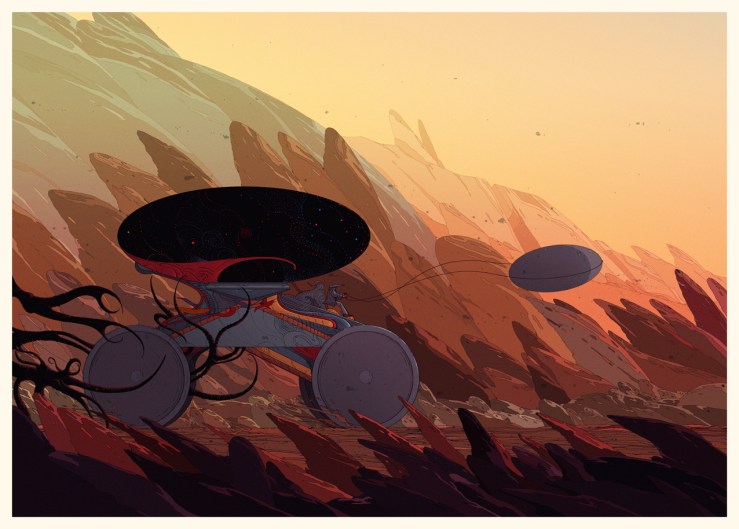
Illustration for Oscar Wilde’s “The Remarkable Rocket” — James Hill

the remarkable rocket

James Hill’s illustration for “The Remarkable Rocket” by Oscar Wilde. From The Short Stories of Oscar Wilde, Heritage Press, 1968.


“The Remarkable Rocket”

by

Oscar Wilde


The King’s son was going to be married, so there were general rejoicings. He had waited a whole year for his bride, and at last she had arrived. She was a Russian Princess, and had driven all the way from Finland in a sledge drawn by six reindeer. The sledge was shaped like a great golden swan, and between the swan’s wings lay the little Princess herself. Her long ermine cloak reached right down to her feet, on her head was a tiny cap of silver tissue, and she was as pale as the Snow Palace in which she had always lived. So pale was she that as she drove through the streets all the people wondered. ‘She is like a white rose!’ they cried, and they threw down flowers on her from the balconies.

At the gate of the Castle the Prince was waiting to receive her. He had dreamy violet eyes, and his hair was like fine gold. When he saw her he sank upon one knee, and kissed her hand.

‘Your picture was beautiful,’ he murmured, ‘but you are more beautiful than your picture;’ and the little Princess blushed.

‘She was like a white rose before,’ said a young Page to his neighbour, ‘but she is like a red rose now;’ and the whole Court was delighted.

For the next three days everybody went about saying, ‘White rose, Red rose, Red rose, White rose;’ and the King gave orders that the Page’s salary was to be doubled. As he received no salary at all this was not of much use to him, but it was considered a great honour, and was duly published in the Court Gazette.

When the three days were over the marriage was celebrated. It was a magnificent ceremony, and the bride and bridegroom walked hand in hand under a canopy of purple velvet embroidered with little pearls. Then there was a State Banquet, which lasted for five hours. The Prince and Princess sat at the top of the Great Hall and drank out of a cup of clear crystal. Only true lovers could drink out of this cup, for if false lips touched it, it grew grey and dull and cloudy.


Continue reading “Illustration for Oscar Wilde’s “The Remarkable Rocket” — James Hill”

The Annunciation (Detail) — Jan van Eyck

anunc11