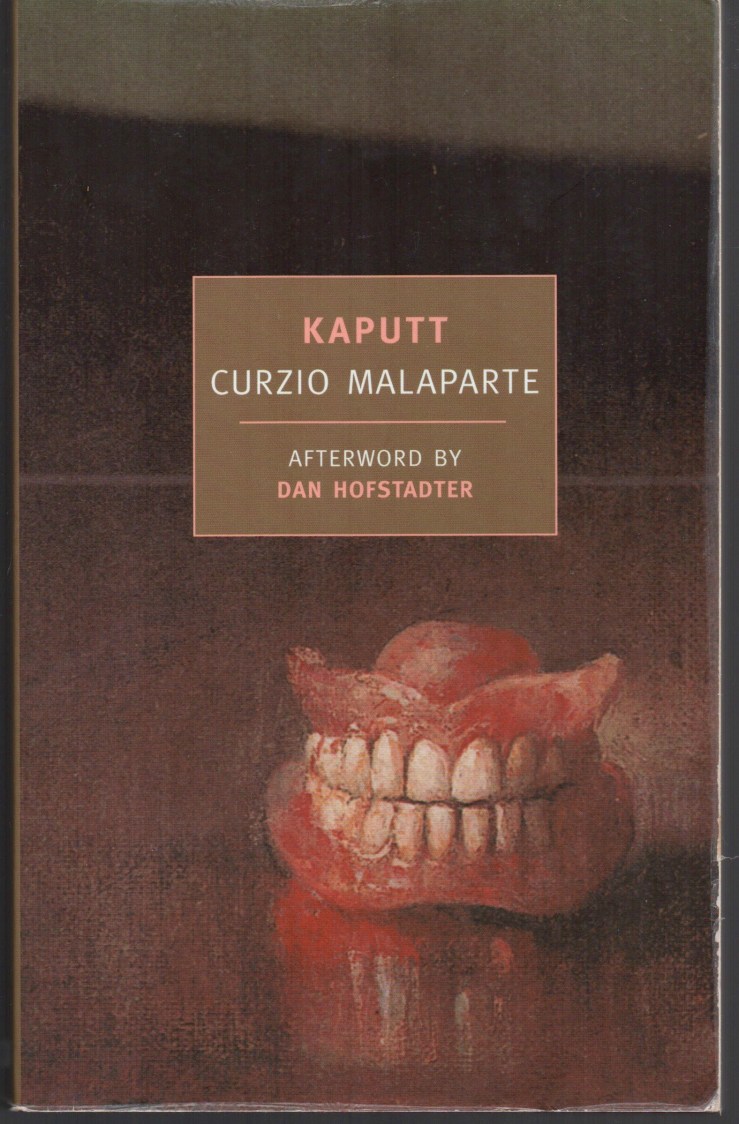
Kaputt by Curzio Malaparte. English translation by Cesare Foligno. 2005 trade paperback by NYRB. Cover painting is Odd Nerdrum’s The Dentures; cover design by Katy Homans. Bought this a while ago and have been meaning to take a serious crack at it for some time now.
1982 Janine by Alasdair Gray. 1985 trade paperback by Penguin. No designer credited, but I’d bet money Gray did the cover illustration himself. Picked this up after loving the hell out of Lanark, but I keep getting pulled away from it: another one to try in 2016.
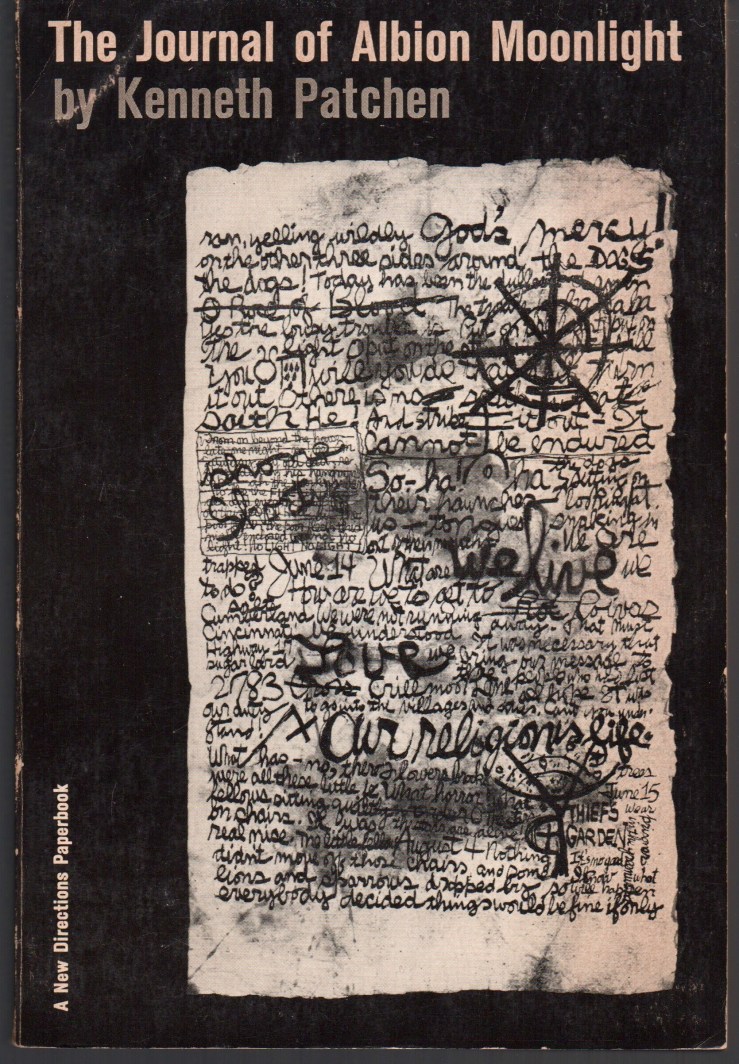
The Journal of Albion Moonlight by Kenneth Patchen. Trade paperback by New Directions (no year given, but “Fifth Printing” noted). Cover art is a photo of Patchen’s manuscript for the volume; no photographer or designer is credited. Shelved next to the Gray; will attempt again this year.
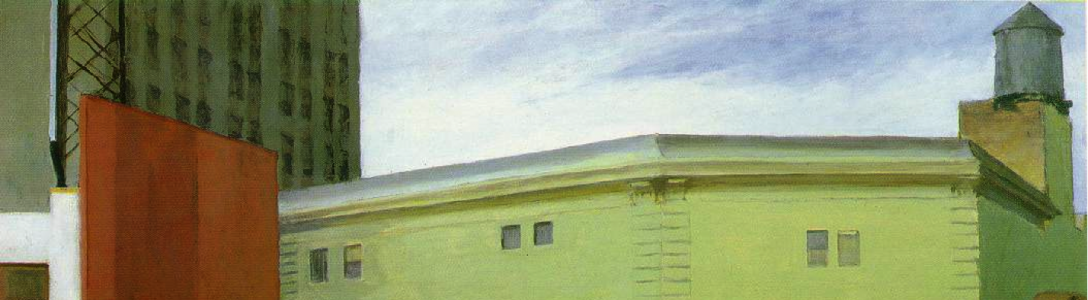
Because he needed the money Peterson answered an ad that said “We’ll pay you to be on TV if your opinions are strong enough or your personal experiences have a flavor of unusual.” He called the number and was told to come to Room 1551 in the Graybar Building on Lexington. This he did and after spending twenty minutes with a Miss Arbor who asked him if he had ever been in analysis was okeyed for a program called Who Am I? “What do you have strong opinions about?” Miss Arbor asked. “Art,” Peterson said, “life, money.” “For instance?” “I believe,” Peterson said, “that the learning ability of mice can be lowered or increased by regulating the amount of serotonin in the brain. I believe that schizophrenics have a high incidence of unusual fingerprints, including lines that make almost complete circles. I believe that the dreamer watches his dream in sleep, by moving his eyes.” “That’s very interesting!” Miss Arbor cried. “It’s all in the World Almanac,” Peterson replied.
“I see you’re a sculptor,” Miss Arbor said, “that’s wonderful.” “What is the nature of the program?” Peterson asked. “I’ve never seen it.” “Let me answer your question with another question,” Miss Arbor said. “Mr. Peterson, are you absurd?” Her enormous lips were smeared with a glowing white cream. “I beg your pardon?” “I mean,” Miss Arbor said earnestly, do you encounter your existence as gratuitous? Do you feel de trop? Is there nausea?” “I have enlarged liver,” Peterson offered. “That’s excellent!” Miss Arbor exclaimed. “That’s a very good beginning. Who Am I? tries, Mr. Peterson, to discover what people really are. People today, we feel, are hidden away inside themselves, alienated, desperate, living in anguish, despair and bad faith. Why have we been thrown here, and abandoned? That’s the question we try to answer, Mr. Peterson. Man stands alone in a featureless, anonymous landscape, in fear and trembling and sickness unto death. God is dead. Nothingness everywhere. Dread. Estrangement. Finitude. Who Am I? approaches these problems in a root radical way.” “On television?” “We’re interested in basics, Mr. Peterson. We don’t play around.” “I see,” Peterson said, wondering about the amount of the fee. “What I wanted to know now, Mr. Peterson, is this: are you interested in absurdity?” “Miss Arbor,” he said, “to tell you the truth, I don’t know. I’m not sure I believe in it.” “Oh, Mr. Peterson!” Miss Arbor said, shocked. “Don’t say that! You’ll be …” “Punished?” Peterson suggested. “You may not be interested in absurdity,” she said, “but absurdity is interested in you.” “I have a lot of problems, if that helps,” Peterson said. “Existence is problematic for you,” Miss Arbor said, relieved. “The fee is two hundred dollars.”
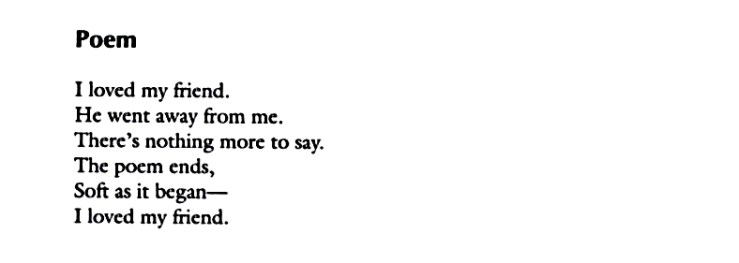
One Year ago—jots what?
God—spell the word! I—can’t—
Was’t Grace? Not that—
Was’t Glory? That—will do—
Spell slower—Glory—
Such Anniversary shall be—
Sometimes—not often—in Eternity—
When farther Parted, than the Common Woe—
Look—feed upon each other’s faces—so—
In doubtful meal, if it be possible
Their Banquet’s true—
I tasted—careless—then—
I did not know the Wine
Came once a World—Did you?
Oh, had you told me so—
This Thirst would blister—easier—now—
You said it hurt you—most—
Mine—was an Acorn’s Breast—
And could not know how fondness grew
In Shaggier Vest—
Perhaps—I couldn’t—
But, had you looked in—
A Giant—eye to eye with you, had been—
No Acorn—then—
So—Twelve months ago—
We breathed—
Then dropped the Air—
Which bore it best?
Was this—the patientest—
Because it was a Child, you know—
And could not value—Air?
If to be “Elder”—mean most pain—
I’m old enough, today, I’m certain—then—
As old as thee—how soon?
One—Birthday more—or Ten?
Let me—choose!
Ah, Sir, None!
I finally read Thomas Pynchon’s novel Gravity’s Rainbowin full in 2015. Then I immediately read it again (which is sort of like really reading it), occasionally dipping into Steven Weisenburger’s A Gravity’s Rainbow Companion. Rewarding, hilarious, challenging, perplexing, Gravity’s Rainbow is too brilliant to look at directly, and is perhaps best approached slantwise, as one Ms. Dickinson of Amherst has advised.
On page 588 of Gravity’s Rainbow, the narrator (?!) suggests that we “Check out Ishmael Reed.” So I did. His novel Mumbo Jumbois like nothing I’ve ever read before—the reviewer’s crutch “dazzling performance” comes to mind, because Mumbo Jumbois a performance (jazz, bebop, soft shoe, vaudeville, a hoodoo magic show, an exorcism: performance art), and it does dazzle, overwhelm, energize, haunt, titillate, reverberate, howl…and there are pictures! Reed uses photos in a way that Sebald would a few decades later—documentary evidence of a sort. I don’t know. I just don’t know.
Like Reed’s novel, Anne Carson’s novel-poem-myth-book Autobiography of Red is impossible to categorize and extremely difficult to describe. I tried to write about it a few times on this site and failed, which is fine. What matters here is the reading experience: Carson’s book zapped me, gave me tingles, reminded me that what I want to think and feel when I read is, How is this possible? How is this allowed? (Another huge thank you to BLCKDGRD for sending me Autobiography of Red and its sorta-sequel Red Doc>).
And finally, Ursula K. Le Guin, whose so-called Hainish Cycle I read most of this year. I still have to read The Telling, but great stuff, and a full write-up early in the new year.
Favorite Books I Read in 2015 That Were Actually Published in 2015
Favorite Films I Saw in 2015 That Came Out in 2015
I had a relatively contrarian opinion of Fury Road, but I enjoyed it overall, I suppose. The Force Awakenswas a better spectacle for my money/nostalgia. Overall, 2015 was kind of a weak year for movies, filled with overrated indies, comic book schlock, and self-serious entertainments that Tried Too Hard. Hard to Be a Godwas the only thing that really zapped me, although a quick google shows that it was actually released in 2014.
You know, Inherent Vicewas released in late 2014 too, but I saw it and loved it and obsessed over it in 2015…so, Inherent Vice, yeah…
I also liked that Scientology documentary, which was full-on Pynchon.
Favorite Television Shows of 2015
I thought the second season of Fargowas near-perfect and found the tawdry spectacle of The Jinx thrilling, but there was no show I enjoyed watching and reading about more than the second season of True Detective.
Favorite Albums of 2015
The albums I listened to the most this year were soundtracks that came out before 2015: Inherent Viceand The Good, The Bad, and The Ugly. But I did like a number of new albums this year, including Joanna Newsom’s Divers, Jim O’Rourke’s Simple Songs, and Destroyer’s Poison Season.
Favorite Books I Didn’t Finish in 2015
I’ve been crawling my way through a full read of Leslie Fiedler’s Love and Death in the American Novel, but: No end in sight. I also read most of the essays in William T. Vollmann: A Critical Companion (check out my interview with the editors). I also read a hefty chunk of the Ben Marcus-edited collection New American Stories.My favorite discursive reading though was dipping into William H. Gass’s nonfiction.
Favorite Rereads
…speaking of Gass—well, I read his essay “Even If, by All the Oxen in the World” in conjunction with a reread of David Foster Wallace’s Infinite Jest, which turned out to be most rewarding—both the rereading and the reading-in-conjunction. Reading Infinite Jest for the first time since 2001 ended up being a deflating, even depressing experience, but I wouldn’t trade it. I also reread against the second reading of Gravity’s Rainbow. Other rereading highlights included Pynchon, Ursula K. Le Guin, High Rise by J.G. Ballard, and Blood Meridian by Cormac McCarthy(which I’ve reread every year since I first read it). But it was McCarthy’s Suttree that I got the most out of rereading this year.
2016
I’ll finish out Le Guin’s Hainish books with The Telling, and then probably crack into William H. Gass’s Eyes. In between I might read Marianne Fritz’s novel The Weight of Things. More Lucia Berlin for sure. Thomas Bernhard if it ever cools down again. (End of December 2015 and it feels like early summer here in Florida). I’d also love to take a shot at William T. Vollmann’s The Dying Grass, but who knows…there are always more pages than hours.





 Biblioklept