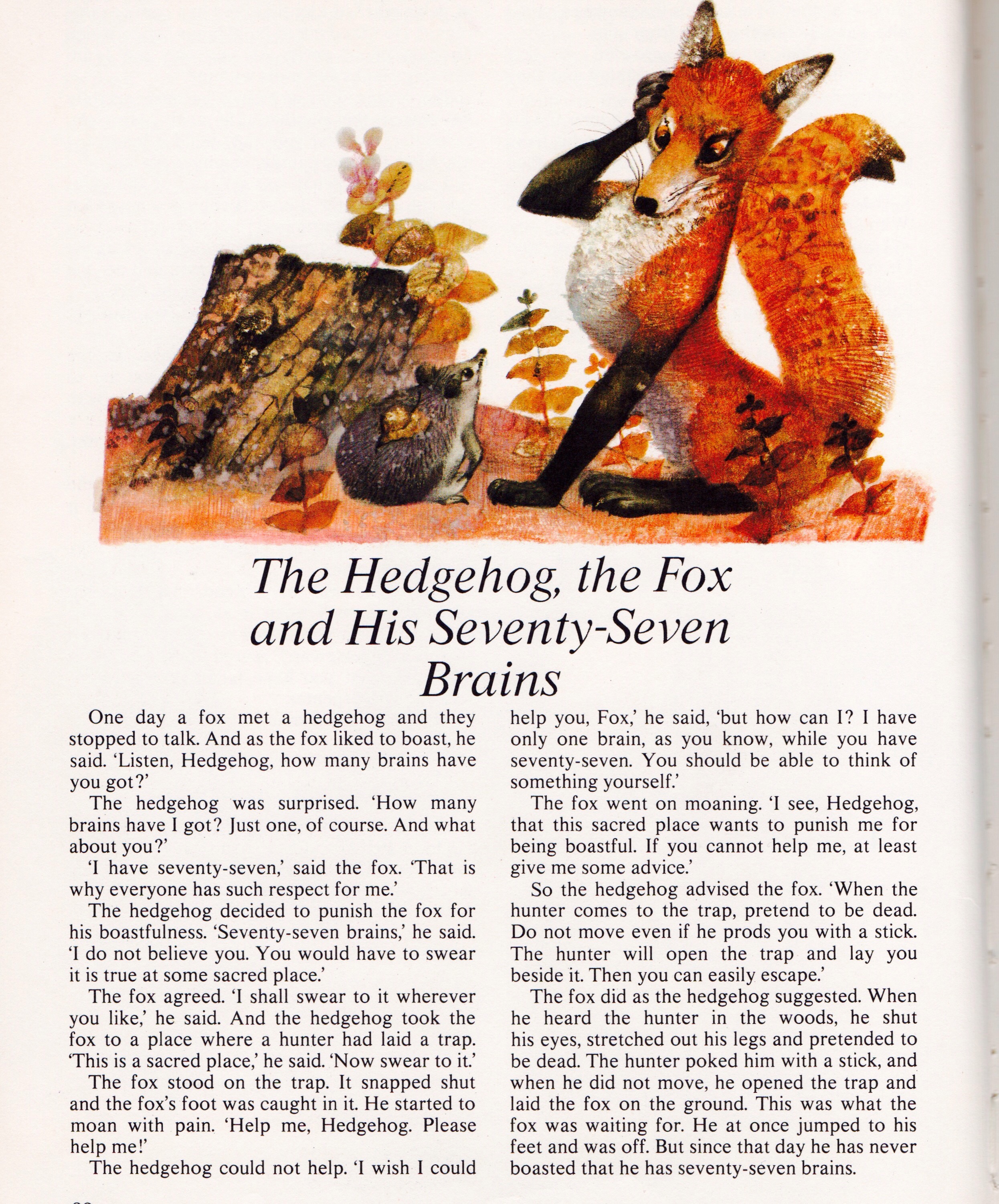
A Serbian fairy tale retold by Alena Benesova and translated into English by Ruth Shepherd. The marvelous illustration is by Karel Franta. From Animal Fairy Stories.

A Serbian fairy tale retold by Alena Benesova and translated into English by Ruth Shepherd. The marvelous illustration is by Karel Franta. From Animal Fairy Stories.


At the beginning of the last year of his life, he fell into a custom of taking, immediately after dinner, a cup of coffee, especially on those days when it happened that I was of his party. And such was the importance that he attached to his little pleasure that he would even make a memorandum beforehand, in the blank paper book that I had given him, that on the next day I was to dine with him, and consequently “that there was to be coffee.” Sometimes in the interest of conversation, the coffee was forgotten, but not for long. He would remember and with the querulousness of old age and infirm health would demand that coffee be brought “upon the spot.” Arrangements had always been made in advance, however; the coffee was ground, and the water was boiling: and in the very moment the word was given, the servant shot in like an arrow and plunged the coffee into the water. All that remained, therefore, was to give it time to boil up. But this trifling delay seemed unendurable to Kant. If it were said, “Dear Professor, the coffee will be brought up in a moment,” he would say, “Will be! There’s the rub, that it only will be.” Then he would quiet himself with a stoical air, and say, “Well, one can die after all; it is but dying; and in the next world, thank God, there is no drinking of coffee and consequently no waiting for it.”
When at length the servant’s steps were heard upon the stairs, he would turn round to us, and joyfully call out: “Land, land! my dear friends, I see land.”
This anecdote of Thomas de Quincey’s is from William H. Ukers’s All About Coffee (1922). Ukers introduces the quote: “In his old age, Immanuel Kant, the great metaphysician, became extremely fond of coffee; and Thomas de Quincey relates a little incident showing Kant’s great eagerness for the after-dinner cup.”

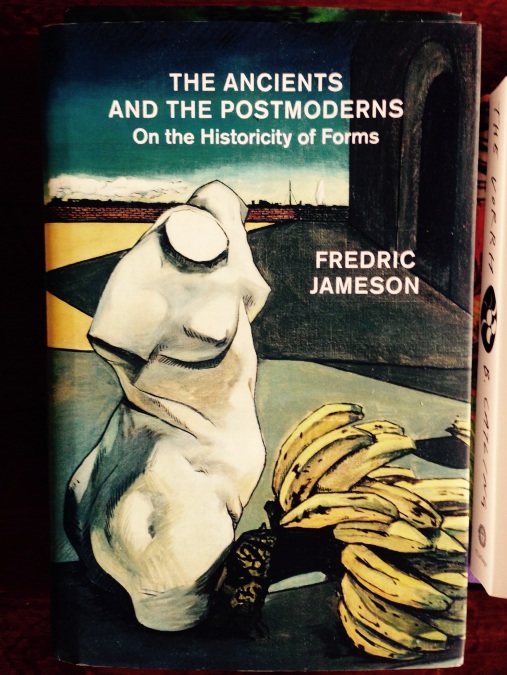
Fredric Jameson’s latest from Verso is The Ancients and the Postmoderns. Verso’s blurb:
High modernism is now as far from us as antiquity was for the Renaissance. Such is the premise of Fredric Jameson’s major new work in which modernist works, this time in painting (Rubens) and music (Wagner and Mahler), are pitted against late-modernist ones (in film) as well as a variety of postmodern experiments (from SF to The Wire, from “Eurotrash” in opera to Altman and East German literature): all of which attempt, in their different ways, to invent new forms to grasp a specific social totality. Throughout the historical periods, argues Jameson, the question of narrative persists through its multiple formal changes and metamorphoses.

“On Being in Love”
by
Jerome K. Jerome
You’ve been in love, of course! If not you’ve got it to come. Love is like the measles; we all have to go through it. Also like the measles, we take it only once. One never need be afraid of catching it a second time. The man who has had it can go into the most dangerous places and play the most foolhardy tricks with perfect safety. He can picnic in shady woods, ramble through leafy aisles, and linger on mossy seats to watch the sunset. He fears a quiet country-house no more than he would his own club. He can join a family party to go down the Rhine. He can, to see the last of a friend, venture into the very jaws of the marriage ceremony itself. He can keep his head through the whirl of a ravishing waltz, and rest afterward in a dark conservatory, catching nothing more lasting than a cold. He can brave a moonlight walk adown sweet-scented lanes or a twilight pull among the somber rushes. He can get over a stile without danger, scramble through a tangled hedge without being caught, come down a slippery path without falling. He can look into sunny eyes and not be dazzled. He listens to the siren voices, yet sails on with unveered helm. He clasps white hands in his, but no electric “Lulu”-like force holds him bound in their dainty pressure.
No, we never sicken with love twice. Cupid spends no second arrow on the same heart. Love’s handmaids are our life-long friends. Respect, and admiration, and affection, our doors may always be left open for, but their great celestial master, in his royal progress, pays but one visit and departs. We like, we cherish, we are very, very fond of—but we never love again. A man’s heart is a firework that once in its time flashes heavenward. Meteor-like, it blazes for a moment and lights with its glory the whole world beneath. Then the night of our sordid commonplace life closes in around it, and the burned-out case, falling back to earth, lies useless and uncared for, slowly smoldering into ashes. Once, breaking loose from our prison bonds, we dare, as mighty old Prometheus dared, to scale the Olympian mount and snatch from Phoebus’ chariot the fire of the gods. Happy those who, hastening down again ere it dies out, can kindle their earthly altars at its flame. Love is too pure a light to burn long among the noisome gases that we breathe, but before it is choked out we may use it as a torch to ignite the cozy fire of affection. Continue reading ““On Being in Love” — Jerome K. Jerome”

[Editorial note: Today is Roberto Bolaño’s birthday–he would’ve turned 62. The following citations come from one-star Amazon reviews of his masterpiece 2666. To be clear, I am a huge fan of 2666—I’ve written about it extensively on this site. But I never posted a review on Amazon. More one-star Amazon reviews.].
***
Awful.
Boring!
Nothing.
No Point.
No Story.
No characters.
This is not a story.
Felt it was too dark.
endless culs-de-sac
There is no premise
Numbing dumbness.
As a Literature major,
incoherent and rambling
Disconnected and tedious.
The joke is on me, I guess.
written in a type of journalese
this novel (if it can be called that)
an obtuse novel with no real point.
I would rather stick forks in my eyes
stilted, awkward, and difficult to read
I would prefer to be boiled alive in oil.
900 pages of words that mean nothing.
multiple pages are spent describing dreams
delivers little if any enjoyment to the reader.
900 pages of distinctly non-literary masochism
I hated the spewing of authors I’d never heard of.
The writing or words are geared towards intellectuals.
Imagine this: you’re dreaming a dream that never ends.
it’s one of those pretentious books for pretentious people
a sprawling, formless, utterly pretentious bloated drudge
bloated streams of consciousness which negate themselves
no subtle meassage that is worthy of discussion or thought
I can see how this might have been written by a very ill man.
boring, repetitive, pointless, misogynistic, indulgent blather
I’ve never experienced a book which was so devoid of reward.
little or no substance in terms of an overall message or theme
a pointless study of odd obsessions and the meaningless of life
On xx date, the body of xxx was found, mutilated in the dumps.
I spent most of my time looking up defintions to 100’s of words.
this book is a GRUESOME and HORRIFICALLY VIOLENT book.
Bolano could not care less what the general public thinks of his book
has little of note to say about the meaning of life or the human condition
I am hard pressed to believe that the other reviewers even read this book.
The largest section of the book is basically 300+ pages of autopsy reports.
You will read the words “vaginally and anally raped” over and over and over
This book would make a great table leg, coaster, or booster seat for a small child. Continue reading “Selections from One-Star Amazon Reviews of Roberto Bolaño’s 2666”

Tom Pynchon was quiet and neat and did his homework faithfully. He went to Mass and confessed, though to what would be a mystery. He got $25 a week spending money and managed it perfectly, did not cut class and always got grades in the high 90’s. He was disappointed not to have been pledged to a fraternity, but he lacked the crude sociability required for that. Besides, he had his own room at Cascadilla, one of the more pleasant dormitories, not tight College Tudor tile but pre-Civil War Victorian, high-ceilinged and muted. Fraternity houses offered neither the charm nor the privacy, and he was, if anything, a very private person.
From Jules Siegel’s March 1977 Playboy profile “Who is Thomas Pynchon… And Why Did He Take Off With My Wife?” Steven Weisenburger references the article a few times in his Companion, so I gave it a Googlin’.
I’d be happy to read the whole thing if someone wants to…you know, send it to me. (Thanks!)
 Biblioklept