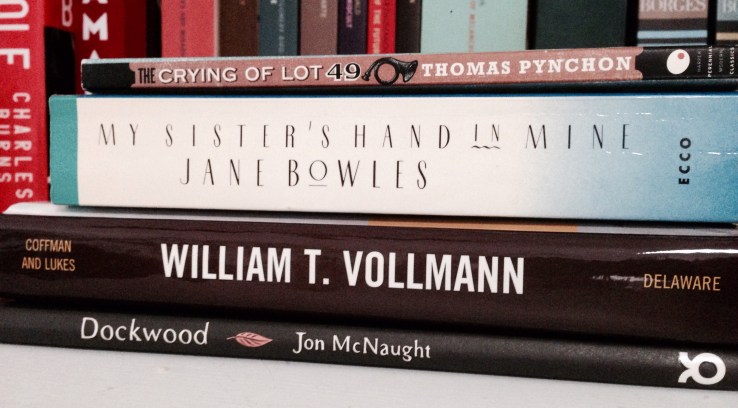
The Crying of Lot 49 by Thomas Pynchon
After a few false starts over the last decade, I finally submerged myself in Thomas Pynchon’s Mason & Dixon in those bourbon-soaked weeks between Thanksgiving and New Year. I read the book as a sort of sequel to the book Pynchon wrote after it, Against the Day—simply because I read Against the Day in 2013, before M&D. Both books are excellent, and seem to me more achieved in their vision than Inherent Vice or V or Vineland. The obvious comparison point for the pair though is Pynchon’s other big book (and, by reputation, his Big Book) Gravity’s Rainbow which I haven’t read since my freshman year of college—which is almost the same as not having read it at all. I intend to read it later this year (or maybe earlier?), but I also haven’t read The Crying of Lot 49 since my undergrad days either (which is to say, like, coming up on twenty years jesus). I’m about half way through and not zapped by it really—there are some funny jokes, but it’s just not as rich as Mason & Dixon or Against the Day (which is not meant to be a complaint, just an observation. And while I’m observing stuff parenthetically: What most bothers my attention most as I read are the reminders of David Foster Wallace’s The Broom of the System, which I have reread more recently than TCoL49).
Two Serious Ladies by Jane Bowles (collected in My Sister’s Hand in Mine)
What to say about Jane Bowles’s only novel? It goes: Propelled on its own sinister energy it goes, its vignettes flowing (or jerking or shifting or pitching wildly or dipping or soaring or sneaking) into each other with wonderfully dark comic force. I’ve sketched a full review I hope to be able to write, but for now let me excerpt a paragraph from Negar Azimi’s essay “The Madness of Queen Jane” from last summer in The New Yorker:
When it was first published, in 1943, “Two Serious Ladies” received lukewarm, even baffled, reviews. Edith Walton, writing in the Times Book Review, called the book senseless and silly: “To attempt to unravel the plot of ‘Two Serious Ladies’ would be to risk, I am sure, one’s own sanity.” Another reviewer said, simply, “The book is about nothing.” Jane’s family, in the meantime, found it unseemly in its stark depiction of lesbianism. Its characters, who have goals and motivations that are hard to grasp, were difficult to relate to. Yet another critic wrote, “The only shocking thing about this novel is that it ever managed to find its way to print.” Jane was only twenty-four.
Wharton’s line should intrigue, not repel readers. And: “The book is about nothing” — well, okay, that’s completely untrue—the book is about women searching for something, but something they can’t name, can’t conceive in language but can perhaps imagine. These women are on the brink of all those things one can be brinked upon: abysses, madness, abysses of madness, etc. But: “The book is about nothing” — well, okay, Two Serious Ladies resists unfolding in the way in which we expect narratives to be about something—Bowles withholds exposition, clarification, and motivation—well, okay, not withholds, but rather hides, or obscures, or enshadows.
I don’t have the verbs for this book.
But I loved reading it, feeling estranged from it while simultaneously invited into its darkness, bewildered by its transpositions, as Jane Bowles moves her verbal camera from one character to another—Wait, what? Okay, I guess we’re going over here now?!—its picaresque energy a strange dark joy. More to come.
William T. Vollmann: A Critical Companion, a collection of essays edited by Christopher K. Coffman and Daniel Lukes
I’ve been dipping into this kind of at random, but it’s very rewarding, and I think it would make a surprisingly good introduction to Vollmann. To be clear, academic criticism is never a substitute for, y’know, reading the author’s actual texts, the range here covers voluminous Vollmann. And look, I’ll be honest, I’ll probably never read Argall, so I very much appreciated Buell Wisner situating it for me in his essay. One of the treats of this book is how an academic essay like Wisner’s—a well-researched close reading with 64 reference notes—is followed by a reflective and informal piece by Carla Bolte on designing Vollmann’s books (“Bill’s books are not for everyone. We all know that,” she offers at one point). Good stuff, more to come.
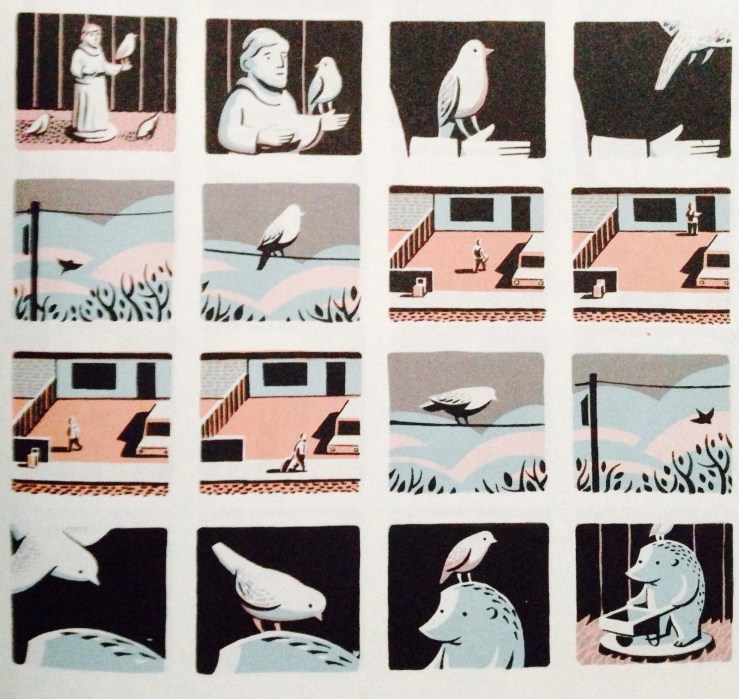
Dockwood by Jon McNaught
I owe this marvelous book a proper review. Dockwood is a kind of visual prose-poem, tranquil, meditative, autumnal. The book is its own total aesthetic; McNaught uses color and form to evoke feeling here, with minimal, unobtrusive dialogue that functions more as ambiance than exposition. Lovely.







 Biblioklept