The Top 10 Best Novels of 2014

10. The Beekeeper’s Daughter by Sissy Sextuplington

By turns uproarious, scandalous, and emotionally-moving, this kaleidoscopic novel tells the multi-generational story of the Apis clan, from their humble beginnings starting a clandestine honey-service in the catacombs of Ellis Island in the 1890s, to their triumphant crest in the honey-boom of the Buzzing Twenties, to their decline and rebirth from their own ashes/wax over the course of the 20th century. This sting stuns!

9. Cacanisius’ Crossing by Caomh-Caolan FitzSimmons-Hughes

How wonderful that this “lost classic” has been recovered anew! FitzSimmons-Hughes of course wrote the novel over a series of decades; each section was written in the language of the European country he was living in self-imposed exile in at the time. Cacanisius’ Crossing was then translated into Irish Gaelic, and has finally been translated into English. The 1085-page story details the last five minutes in the life of its central character. Kaleidoscopically stunning.

8. Dovetail by Samuel Samold

In this dystopian romance-thriller, society is split into two groups: those who have earned their genetically-grafted tails, and those who must go “SansTail.” Will plucky Becky Fang pass the Trials of Wattle and earn her place in the dominant tribe (along with dreamboat Crispin’s affection)—or will she follow the strange mysteries of the secret resistance force, The Cloacal Tunnel? A compelling stunner.

7. The Kite Runner 2 by Khaled Hosseini

The whole book club bawled. Again.

6. Jimmy Hat Johannson and the Crystal Creeper Caper (A Charleston ‘Nights’ Mystery) by Edwin Turner

I feel a little weird putting my own NaNoWriMo novel on here—not the least because it hasn’t come out yet (FS&G in hardback in the US, March 2016; Penguin in the UK, Australia, Canada, and NZ in May 2016; Japanese and Latvian translations TBD)—but it’s really, really good. I even let a friend look over it to check for any bad writing (there wasn’t any) before I sent it to the Wylie Agency. The plot: Jimmy Hat Johansson is just a good ole boy from a backwoods burg…but a summer job with his Uncle Ray’s lawn business plunges him headfirst into a world of sinister intrigue–housewife murderesses, a corrupt sheriff, and a crystal meth syndicate!

5. The Lumberjack’s Apprentice by Knob Hayden

Knob Hayden’s remarkable journey comes to life in this remarkable collection of stories (The Lumberjack’s Apprentice is a novel-in-stories). Remarkably, this book was Hayden’s thesis for an experimental MFA program offered by the EGS (via Transylvania University, Kentucky). Each short story is a remarkable entry in this angry young man’s tour-de-force-of-truth. Hayden is only 24, but he’s hardly tender—six days as a lumberjack’s apprentice will roughen any soft palms! Our hero also tries his hand as a busboy, a mail clerk at Monsanto, and a cabin boy. This guy has definitely read Jesus’ Son!

4. Working On My Screenplay by Angela Criss

Kudos to Penguin for this achievement. This is a book of tweets from people who have included the phrase “working on my screenplay” in their tweet, interspersed with sketches of kittens. Sure, you might criticize it as lazy, not particularly insightful, barely interesting, the sort of joke that others like John Cage played decades ago, a gimmick, cruel, boring, or smug. But it’s art and it’s subversive and it provides much-needed metacommentary and it can be yours for only 10 bucks!

3. Too Many Cooks: The Novelization by Jonathan Franzen

Stunningly remarkable work from Franzen, who slowly teases out the Adult Swim’s immediate cult-classic 11-minute video to 475 pages in this sweeping multigenerational epic. Stunning to think that Mr. Franzen never even watched the short film!

2. Brooklyn Novel Title TK  by Daktoa Rugburn

Wyoming Strongniece has no idea what to do after college—an internship at a Fortune 500 company offered by one of her father’s friends? An experimental MFA program offered by the EGS? Should she work the summer at her favorite bar, making artisanal cocktails for the surly locals, and continue to support her suicidal roommate Hershey as she tries to launch her acting career? Or maybe—just maybe—she can have it all. A dazzling debut sure to stun and reward.

1. The Sector of Attention by Moses Kingson

In vivid prose, Kingson’s unforgettable 27th novel explores the nadirs and acmes of the human soul. A swirling kaleidoscope of epiphanies and soul-searching, this kaleidoscopic stunner makes us reexamine all we thought we knew about WWII. I can’t wait to actually read it.
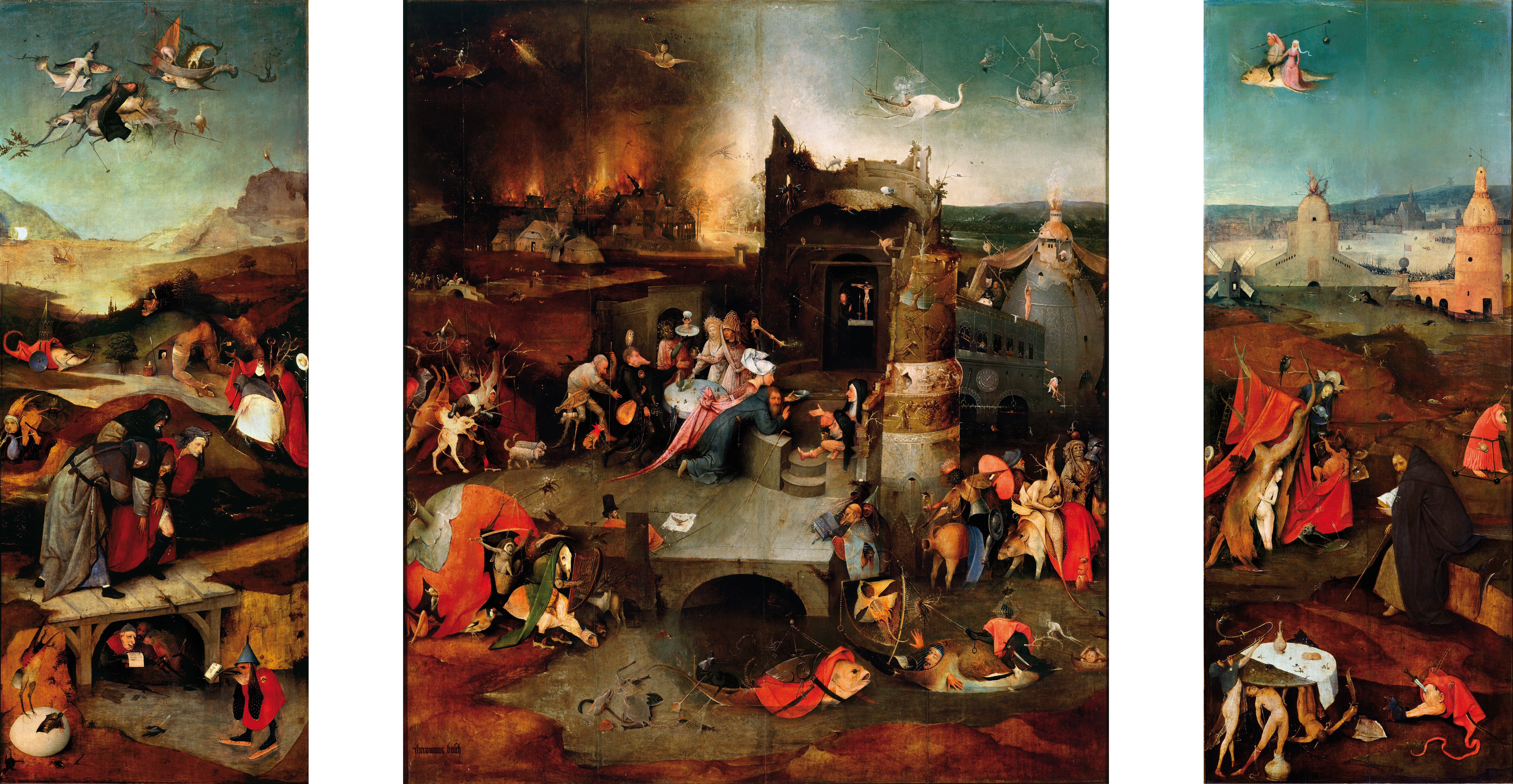
The Temptation of St. Anthony (Detail) — Hieronymus Bosch

8

Selections from Richard McGuire’s “Here”

(More/on exhibit).

Willam H. Gass’s definition of “a character”

A character for me is any linguistic location of a book toward which a great part of the rest of the text stands as a modifier. Just as the subject of a sentence say, is modified by the predicate, so frequently some character, Emma Bovary for instance, is regarded as a central character in the book because a lot of the language basically and ultimately goes back to modify, be about, Emma Bovary. Now the ideal book would have only one character; it would be like an absolute, idealist system. What we do have are subordinate locales of linguistic energy—other characters—which the words in a book flow toward and come out of. A white whale is a character; mountains in Under the Volcano are characters. Ideas can become characters. Some of the most famous characters in the history of fiction are in that great novel called philosophy. There’s free will and determinism. There’s substance and accident. They have been characters in the history of philosophy from the beginning, and I find them fascinating. Substance is more interesting than most of my friends.


Now why would one adopt such awkward language—why not just talk about character in the traditional sense? The advantage is that you avoid the tendency as a reader to psychologize and fill the work with things that aren’t there. The work is filled with only one thing—words and how they work and how they connect. That, of course, includes the meanings, the sounds, and all the rest. When people ask, “How are you building character?” they sometimes think you’re going around peering at people to decide how you’re going to render something. That isn’t a literary activity. It may be interesting, but the literary activity is constructing a linguistic source on the page

From a fantastic 1978 conversation between John Gardner and William H. Gass.

Waiting for a Loved One — Charles Joseph Grips

Head with Broken Pot — Georgia O’Keeffe

Four paintings (Georges Perec)

There are four paintings on the walls.

The first is a still life that despite its modern manner is strongly reminiscent of those compositions constructed on the theme of the five senses which were so common throughout Europe from the end of the Renaissance to the eighteenth century: on a table, there is an ashtray with a lighted Havana, a book of which the title and subtitle can be seen – The Unfinished Symphony: A Novel – though the name of the author is hidden, a bottle of rum, a cup-and-ball, and, in a shallow bowl, a pile of dried fruit, walnuts, almonds, apricot halves, prunes, etc.

The second depicts a street on the edge of a city, at night, alongside wasteland. To the right, a metal pylon with crossbars supporting at each point of intersection a large, lighted electric lamp. To the left, a constellation of stars reproduces precisely the inverse image of the pylon (base in the sky, apex towards the ground). The sky is covered in a flower pattern (dark blue on a lighter background) identical to the shapes made by frost on glass.

The third is of a legendary beast, the tarand, first described by Gelon the Sarmatian:

A tarand is an animal as big as a bullock, having a head like a stag, or a little bigger, two stately horns with large branches, cloven feet, hair long like that of a furred Muscovite, I mean a bear, and a skin almost as hard as steel armour. The Scythian said that there are but few tarands to be found in Scythia, because it varieth its colour according to the diversity of the places where it grazes and abides, and represents the colour of the grass, plants, trees, shrubs, flowers, meadows, rocks, and generally of all things near which it comes. It hath this in common with the sea-pulp, or polypus, with the thoes, with the wolves of India, and with the chameleon; which is a kind of lizard so wonderful, that Democritus hath written a whole book of its figure, and anatomy, as also of its virtue”“and property in magic. This I can confirm, that I have seen it change its colour, not only at the approach of things that have a colour, but by its own voluntary impulse, according to its fear or other affections: as for example, upon a green carpet, I have certainly seen it become green; but having remained there some time, it turned yellow, blue, tanned and purple, in course, in the same manner as you sec a turkey-cock’s comb change colour according to its passions. But what we find most surprising in this tarand is, that not only its face and skin, but also its hair could take whatever colour was about it.

The fourth picture is a black-and-white reproduction of a painting by Forbes called A Rat Behind the Arras. This painting was inspired by a true story which took place at Newcastle-upon-Tyne during the winter of 1858.

From Georges Perec’s novel Life A User’s Manual. English translation by David Bellos.

Girl Yawning — Edvard Munch

Selections from One-Star Amazon Reviews of Chinua Achebe’s Things Fall Apart

[Ed. note: The following citations come from one-star Amazon reviews of Chinua Achebe’s novel Things Fall Apart. (See also: Mary Shelley’s Frankenstein, Thomas Pynchon’s Gravity’s RainbowGeorge Orwell’s 1984, Herman Melville’s Moby-Dick, James Joyce’s Ulysses and David Markson’s Wittgenstein’s Mistress). I’ve preserved the reviewers’ own styles of punctuation and spelling].

There were too many details

no plot, lousy tales, and distant characters.

Gnerally, I am extremely open-minded about other cultures,

Don’t buy this unless you need it for some reason out of your control.

DOES THIS GUY EVEN KNOW WHAT THE FUDGE HE IS TALKING ABOUT!

I read two chapters and quit It was horrible, and I say BAH!!!!!!!!!BAH!!!!!!!and a BOOOOOOOO!!!!!

This is one of those “politically correct” books they force you to read in school, in hope of “broadening our horizons” and “opening our minds.”

The main character had a lot of mental problems, including violence, chauvinism, and overambition to become the ‘model citizen’ of his tribe. I had no sympathy for him, neither should you.

Throught the book the auther keeps bringing in new charecters that have almost the identicle spelling of another and it gets very confusing

While Chinua Achebe claims to be an African freedom activist, her(? I can never figure out these new-fangled names) style of writing is stereotypical of the reactionary Brench and their quest to retain Africa.

The author seems to have some sort of infatuation with yams, because the entire book revolves around idiotic descriptions of yams and characters struggling with their declining yam output.

I found this story went no where, there were no real accomplishments done by the main character, his could have check in to an asylum for a year, dealt with his tribal issues, what he missed out on as a kid, came back to his tribe and really made a difference with his people. Instead, we just see some ones life that just gets worse.

This story could have been told in about 20 pages, but streches out into a full book that finally makes a point in the very last pages. Achebe’s work needs some fine tuning.

Why coudln’t they just at least change the names you could at least pronoucne it, ne ways if you plan on reading it, your want lots of time, so u can understand it.

“THINGS FALL APART” IS LIKE ABOUT A GUY WHO GROWS YAMS AND BEATS HIS FAMILY, AND IT JUST TALKS ABOUT THAT THE WHOLE TIME ITS A TERRIBLE HORRIBLE BOOK!

Almost nothing happens for the first 100 pages except we find out that he has three wives and he beats his kids. GREAT, That took 100 pages to say!!

If your looking for a good novel about African people by an African writer, it’s not here. Try Toni Morrison.

Anyone with sense would be rooting for the imperialists by the end of this book.

the writer is only famous because he is a minority.

the story have no point at all.

It draged on and on.

It was like reading a quick obituary.

the names are way too hard to pronounce.

All you never wanted to know about yams… and other such things

This book is way too confusing for the average reader (I am an honors student) and even the more advanced reader would find difficulty reading this book.

Better by far to have young atudents enjoy ayn rand tom woods and john allison milton friedman and peter schiff adn be poastive free neterpirse and successful.

the only thing you’ll enjoy is saying Okwonko over and over again

This makes Africa look worse, not better….

No one cared about Okonkwo’s yams!

How DARE we let children read this book.

it just SUXED

In retrospect, the story lived up to it’s name.

The Temptation of St. Anthony (Detail) — Hieronymus Bosch

7

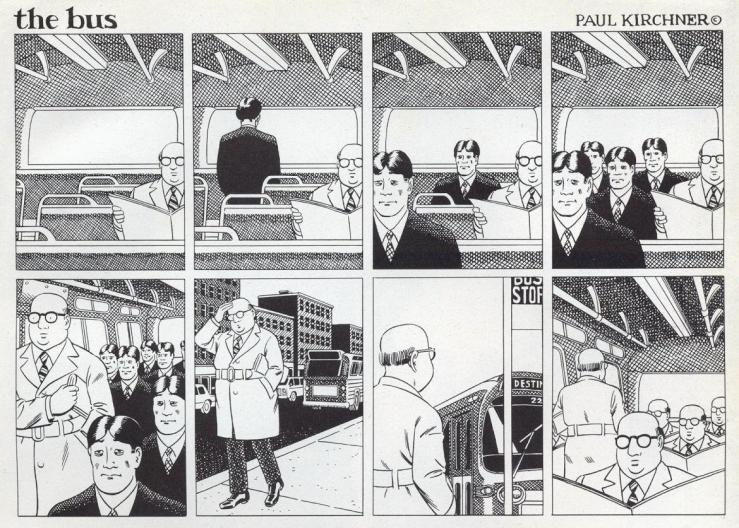
The Bus — Paul Kirchner

e

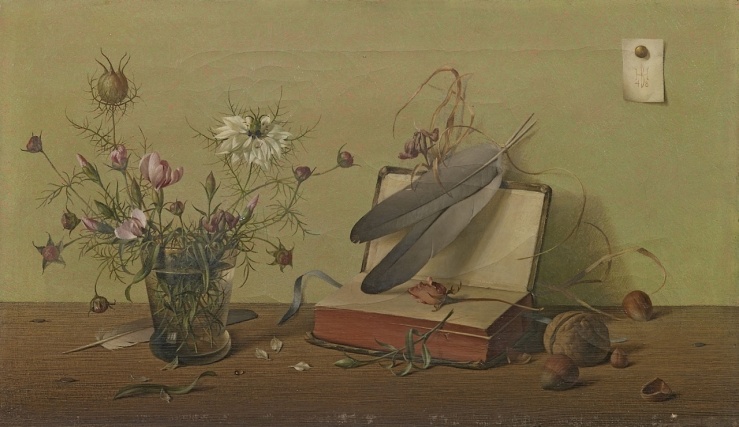
Still Life with Flowers, Book, Nuts and Feathers — Herbert Böttger

tumblr_nf3d7fgU9u1rwu8obo1_1280

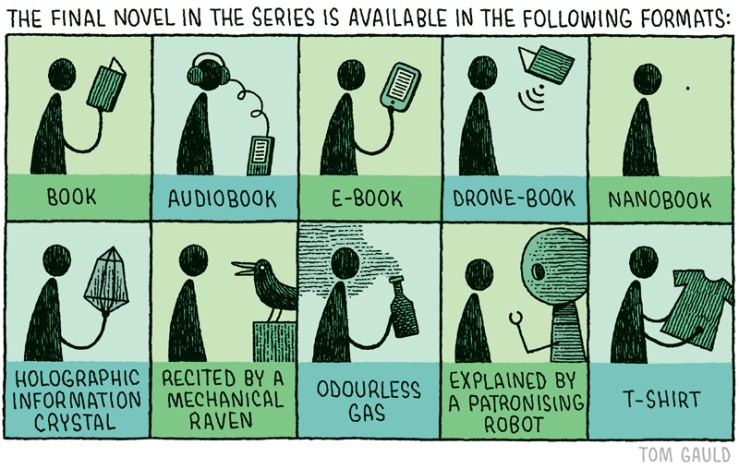
The final novel in the series is available in the following formats: (Tom Gauld)

tumblr_nexntvmgXr1rwkrdbo1_1280

The Skeleton Has the Shell — Paul Delvaux

A bunch of clips of Jean-Luc Godard being ornery

“I know of two kinds of writers” — Jorge Luis Borges

I know of two kinds of writers: those whose central preoccupation is a verbal technique, and those for whom it is human acts and passions. The former tend to be dismissed as “Byzantine” or praised as “pure artists.” The latter, more fortunately, receive the laudatory epithets “profound,” “human,” or “profoundly human,” and the flattering vituperative “savage.” The former is Swinburne or Mallarme; the latter, Celine or Theodore Dreiser. Certain exceptional cases display the virtues and joys of both categories. Victor Hugo remarked that Shakespeare contained Gongora; we might also observe that he contained Dostoevsky…Among the great novelists, Joseph Conrad was perhaps the last who was interested both in the techniques of the novel and in the fates and personalities of his characters. The last that is until the tremendous appearance of Faulkner.

From Borges’ 1937 review of William Faulkner’s Absalom! Absalom!. Originally published in the Argentine magazine El Hogar, part of Borges’ “The Literary Life” column. Republished in Selected Non-Fictions.

The Temptation of St. Anthony (Detail) — Hieronymus Bosch

6