“On Being in the Blues” — Jerome K. Jerome

“On Being in the Blues”

by

Jerome K. Jerome

I can enjoy feeling melancholy, and there is a good deal of satisfaction about being thoroughly miserable; but nobody likes a fit of the blues. Nevertheless, everybody has them; notwithstanding which, nobody can tell why. There is no accounting for them. You are just as likely to have one on the day after you have come into a large fortune as on the day after you have left your new silk umbrella in the train. Its effect upon you is somewhat similar to what would probably be produced by a combined attack of toothache, indigestion, and cold in the head. You become stupid, restless, and irritable; rude to strangers and dangerous toward your friends; clumsy, maudlin, and quarrelsome; a nuisance to yourself and everybody about you.

While it is on you can do nothing and think of nothing, though feeling at the time bound to do something. You can’t sit still so put on your hat and go for a walk; but before you get to the corner of the street you wish you hadn’t come out and you turn back. You open a book and try to read, but you find Shakespeare trite and commonplace, Dickens is dull and prosy, Thackeray a bore, and Carlyle too sentimental. You throw the book aside and call the author names. Then you “shoo” the cat out of the room and kick the door to after her. You think you will write your letters, but after sticking at “Dearest Auntie: I find I have five minutes to spare, and so hasten to write to you,” for a quarter of an hour, without being able to think of another sentence, you tumble the paper into the desk, fling the wet pen down upon the table-cloth, and start up with the resolution of going to see the Thompsons. While pulling on your gloves, however, it occurs to you that the Thompsons are idiots; that they never have supper; and that you will be expected to jump the baby. You curse the Thompsons and decide not to go. Continue reading ““On Being in the Blues” — Jerome K. Jerome”

The Housemaid — William McGregor Paxton

william-mcgregor-paxton-the-hausmaid-1910

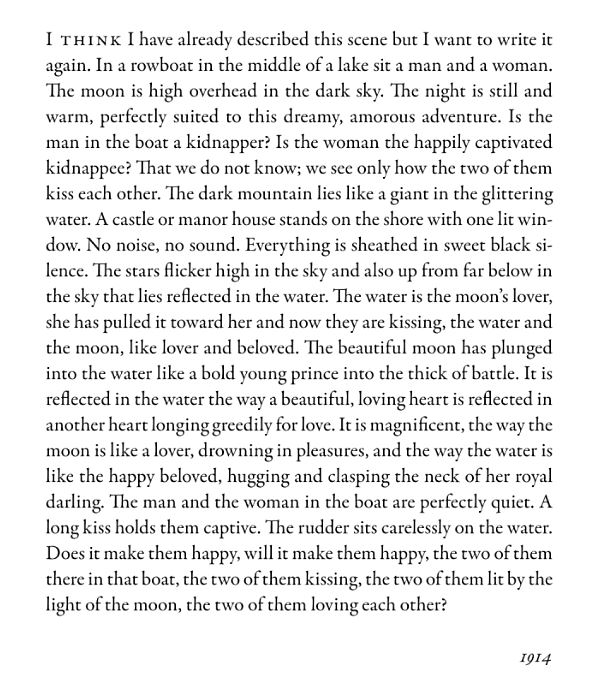
“The Rowboat” — Robert Walser

Capture

The Haunting Ballad (Book Acquired 9.12.2014)

IMG_3296.JPGThe Haunting Ballad by Michael Nethercott. PW’s review:

Set in 1957, Nethercott’s diverting second Lee Plunkett mystery (after 2013’s The Séance Society) takes the Connecticut PI and his fiancée, Audrey Valish, to Greenwich Village. At the Cafe Mercutio, they witness an acrimonious dispute between two performers, “song-catcher” Lorraine Cobble and troubadour Byron Spires. When Lorraine apparently leaps to her death from the roof of her apartment building, her distraught cousin, Sally Joan Cobble, hires Lee to prove she didn’t commit suicide. Lee is the nominal detective, but the heavy lifting is done by wily Irishman Mr. O’Nelligan, who lends sage advice and guidance. Together, the duo approach Lorraine’s former housemates, such as “ghost chanter” Mrs. Pattinshell and 105-year-old Civil War vet Cornelius Boyle. Nethercott has fun with the bustling Bohemian atmosphere and Lee and Audrey’s awkward romance, but reserves the best lines for the exchanges between O’Nelligan and Lee as they close in on the unlikely culprit.

Trompe l’oeil — Cornelis Norbertus Gysbrechts

“Secret Breathing Techniques” — Ben Marcus

I HAD APPARENTLY BEEN living in one of the towns that was now gone. According to reports, I held my own against one of the younger organizations. I fought well and long. The ending of the report is muddy, with many foreign words and phrases, and an indecipherable series of pictures. There is no clear sense that I survived.

Photographs of my body had circulated, flags had been stitched with secret instructions.

There were instances of my name in the registry—the spelling varied, and my date of birth was frequently listed as unknown. A scroll of hair, probably my own, was taped to the paper. Mention was made of what must have been my house, a vehicle I summoned to cross the water (skirmishes, courtship, evasions—the report is unclear), and the amount of sacking I had contributed to the yearly mountain effort. I ranked slightly above average.

People wrote of seeing me in the morning by the water; several photographs featured me wearing a beard, concealing something in my coat. A Nacht diagram rated me favorably, prior to the revision. The Wixx index claimed I might have perished. I read accounts of myself ostensibly accompanying a family to the market on Saturdays. I may have been their assistant; I may have been their captor. The wording is vague. Some sentences depicted me handling the bread in an aggressive manner, as if searching for something inside it.

It is possible I was collecting samples. I would not rule it out. It would explain the long clear jars I found stored in my clothing that day when I woke. But it would not explain why those jars were empty.

Read the rest of “Secret Breathing Techniques” by Ben Marcus in Conjunctions.

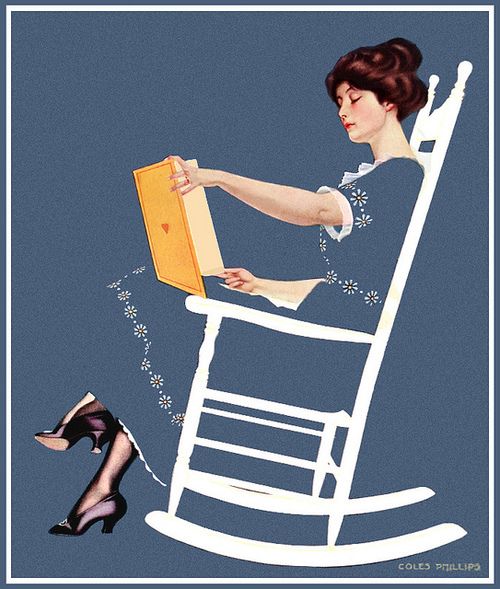
Reading — Clarence Coles Phillip

cole

“The Motive for Metaphor” — Wallace Stevens

“The Motive for Metaphor”

by

Wallace Stevens

You like it under the trees in autumn,
Because everything is half dead.
The wind moves like a cripple among the leaves
And repeats words without meaning.

In the same way, you were happy in spring,
With the half colors of quarter-things,
The slightly brighter sky, the melting clouds,
The single bird, the obscure moon–

The obscure moon lighting an obscure world
Of things that would never be quite expressed,
Where you yourself were not quite yourself,
And did not want nor have to be,

Desiring the exhilarations of changes:
The motive for metaphor, shrinking from
The weight of primary noon,
The A B C of being,

The ruddy temper, the hammer
Of red and blue, the hard sound–
Steel against intimation–the sharp flash,
The vital, arrogant, fatal, dominant X.


Cylinder Complex — Basil Wolverton

IMG_0107-2.PNG

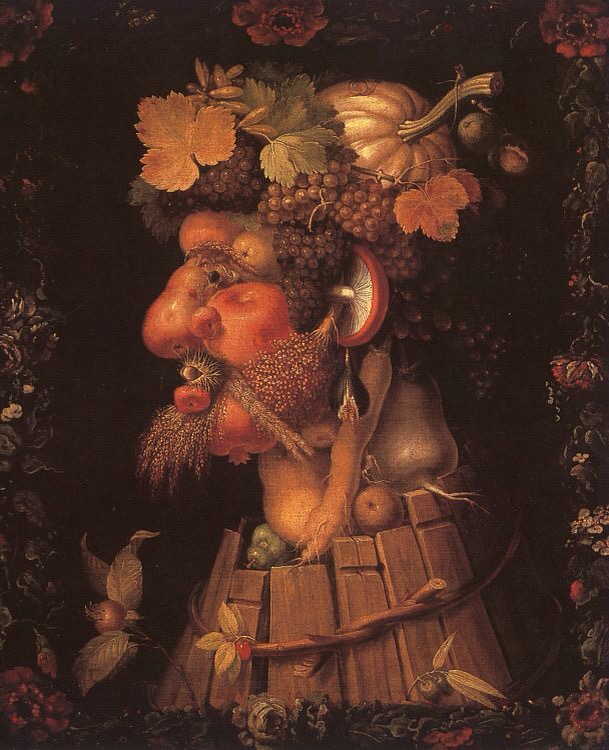
Autumn — Giuseppe Arcimboldo

IMG_3379.JPG

“All art constantly aspires towards the condition of music”

September 23, 1843 — From Nathaniel Hawthorne’s Journal

September 23d.–I have gathered the two last of our summer-squashes to-day. They have lasted ever since the 18th of July, and have numbered fifty-eight edible ones, of excellent quality. Last Wednesday, I think, I harvested our winter-squashes, sixty-three in number, and mostly of fine size. Our last series of green corn, planted about the 1st of July, was good for eating two or three days ago. We still have beans; and our tomatoes, though backward, supply us with a dish every day or two. My potato-crop promises well; and, on the whole, my first independent experiment of agriculture is quite a successful one. 

This is a glorious day,–bright, very warm, yet with an unspeakable gentleness both in its warmth and brightness. On such days it is impossible not to love Nature, for she evidently loves us. At other seasons she does not give me this impression, or only at very rare intervals; but in these happy, autumnal days, when she has perfected the harvests, and accomplished every necessary thing that she had to do, she overflows with a blessed superfluity of love. It is good to be alive now. Thank God for breath,–yes, for mere breath! when it is made up of such a heavenly breeze as this. It comes to the cheek with a real kiss; it would linger fondly around us, if it might; but, since it must be gone, it caresses us with its whole kindly heart, and passes onward, to caress likewise the next thing that it meets. There is a pervading blessing diffused over all the world. I look out of the window and think, “O perfect day! O beautiful world! O good God!” And such a day is the promise of a blissful eternity. Our Creator would never have made such weather, and given us the deep heart to enjoy it, above and beyond all thought, if he had not meant us to be immortal. It opens the gates of heaven and gives us glimpses far inward.

Bless me! this flight has carried me a great way; so now let me come back to our old abbey. Our orchard is fast ripening; and the apples and great thumping pears strew the grass in such abundance that it becomes almost a trouble–though a pleasant one–to gather them. This happy breeze, too, shakes them down, as if it flung fruit to us out of the sky; and often, when the air is perfectly still, I hear the quiet fall of a great apple. Well, we are rich in blessings, though poor in money. . . .

From Nathaniel Hawthorne’s American Note-Books.

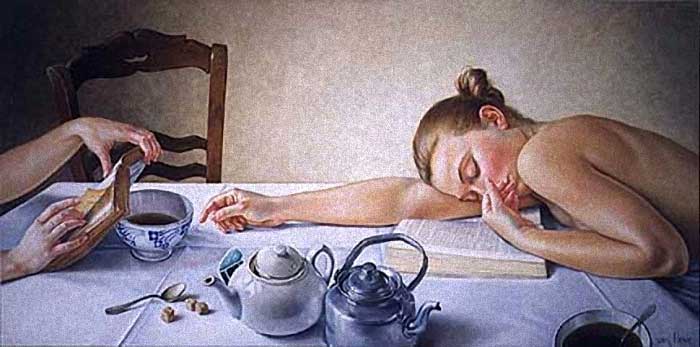
The Small Kettle — Francine Van Hove

fvp

Andromeda — Tamara de Lempicka

Cioran’s Insomnia

How did your severe insomnia affect this attitude at the time?
 
It was really the profound cause of my break with philosophy.  I realized that in moments of great despair philosophy is no help at all, that it holds absolutely no answers.  And so I turned to poetry and literature, where I found no answers either, but states that were analogous to my own.  I can say that the white nights, the sleepless nights, brought about the break with my idolatry of philosophy.
 
When did these sleepless nights begin?
 
They began in my youth, at about nineteen.  It wasn’t simply a medical problem, it was deeper than that.  It was the fundamental period of my life, the most serious experience.  All the rest is secondary.  Those sleepless nights opened my eyes, everything changed for me because of that.
 
Do you suffer it still?
 
A lot less.  But that was a precise period, about six or seven years, where my whole perspective on the world changed.  I think it’s a very important problem.  It happens like this:  normally someone who goes to bed and sleeps all night, the next day he begins a new life almost.  It’s not simply another day, it’s another life.  And so, he can undertake things, he can express himself, he has a present, a future, and so on.  But for someone who doesn’t sleep, from the time of going to bed at night to waking up in the morning it’s all continuous, there’s no interruption.  Which means, there is no suppression of consciousness.  It all turns around that.  So, instead of starting a new life, at eight in the morning you’re like you were at eight the evening before.  The nightmare continues uninterrupted in a way, and in the morning, start what?  Since there’s no difference from the night before. That new life doesn’t exist.  The whole day is a trial, it’s the continuity of the trial.  While everyone rushes toward the future, you are outside.  So, when that’s stretched out for months and years, it causes the sense of things, the conception of life, to be forcibly changed.  You don’t see what future to look forward to, because you don’t have any future.  And I really consider that the most terrible, most unsettling, in short the principal experience of my life.  There’s also the fact that you are alone with yourself.  In the middle of the night, everyone’s asleep, you are the only one who is awake.  Right away I’m not a part of mankind, I live in another world.  And it requires an extraordinary will to not succumb.
 
Succumb to what, madness?
 
Yes.  To the temptation of suicide.  In my opinion, almost all suicides, about ninety percent say, are due to insomnia.  I can’t prove that, but I’m convinced.

From Jason Weiss’s 1983 interview with Emil Cioran, which is now available in full at his website, Itineraries of a Hummingbird. The interview was originally published in Weiss’s book, Writing at Risk, which is now out of print.

The Graf Zeppelin — Walton Ford

walton-ford-the-graf-zeppelin

Reviving Álvaro Mutis, Who Died One Year Ago Today

Homenaje-Alvaro-Mutis

The Colombian writer Álvaro Mutis died one year ago today.

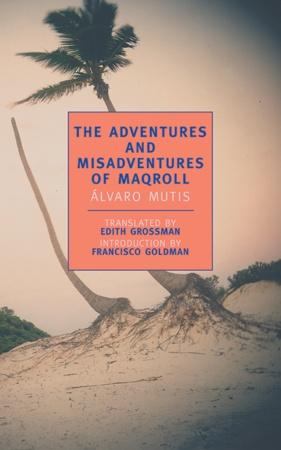
Mutis wasn’t on my radar until a few years ago, when a friend of mine, Dave Cianci, urged me to read the author’s opus, The Adventures and Misadventures of Maqroll, a collection of seven novellas that speak to each other in a loose, rich, intertextual poetics of adventure, romance, and loss. My friend Cianci was so enthusiastic about the book that he reviewed it for this blog (the review convinced me to read it). I’ll crib from that review:

The Adventures and Misadventures of Maqroll is difficult to categorize. It’s an outlaw adventure story populated by men and women who live where and how they must; these are the people who work near shipyards and the banks of unexplored river tributaries, people who value candor and honesty but for whom strict adherence to the law is often inconvenient. The book is a philosophical rumination on friendship and creation, romance and deception, obstinance and poverty.

Later in his review, Cianci characterizes the titular Maqroll—the Gaviero, the “lookout” —as “who we all dream of being when we contemplate throwing everything away.” In one of my own pieces on Maqroll, I described the world that Mutis offers, part fantasy, part nightmare, as

a life of picaresque adventures (and titular misadventures), of loss and gain, of love and despair, drinking, sailing, scheming and plotting—a life full of allusions and hints and digressions. Mutis’s technique is marvelous (literally; he made this reader marvel): he gives us an aging (anti-)hero, a hero whose life is overstuffed with stories and mishaps and feats and enterprises and hazards; he gives us one strand of that life at a time in each novella—but then he points to the other adventures, the other serials of Maqroll that we would love to tune into if only we could.
maq

John Updike explained the attraction to Mutis and Maqroll in his 2003 New Yorker review of NYRB’s Maqroll collection:

The problem of energy, in this enervated postmodern era, keeps arising in Mutis’s pursuit of a footloose, offhandedly erudite, inexplicably attractive shady character. A lowly seaman with some high-flying acquaintances on land, Maqroll is a drifter who tends to lose interest in his adventures before the dénouement is reached. Readers even slightly acquainted with Latin-American modernism will hear echoes of Borges’s cosmic portentousness, of Julio Cortázar’s fragmenting ingenuities, of Machado De Assis’s crisp pessimism, and of the something perversely hearty in Mutis’s fellow-Colombian and good friend Gabriel García Márquez—a sense of genial amplitude, as when a ceremonious host sits us down to a lunch provisioned to stretch into evening. Descriptions of food consumed and of drinks drunk, amid flourishes of cosmopolitan connoisseurship, are frequent in Mutis, even as the ascetic Maqroll goes hungry. North Americans may be reminded of Melville—more a matter, perhaps, of affinity than of influence.

Updike’s review is one of the only prominent and long English-language pieces about Álvaro Mutis that I’ve come across. There’s a good 2001 interview with Mutis in Bomb by Francisco Goldman (who wrote the NYRB edition’s introduction), and a few translated poems of Mutis’s can be found online, but on the whole, despite accolades throughout the Spanish-reading world, his reputation among English-readers seems relegated to “friend of Gabriel Garcia Marquez” (who called Mutis “one of the greatest writers of our time”).

Álvaro Mutis deserves a bigger English-reading audience. NYRB’s collection of his novellas in Edith Grossman’s translation bristles with energy. At once accessible and confounding, these tales that ask us to read them again, like Borges’s puzzles Bolaño’s labyrinths.

Is it tactless to name Bolaño here? Maybe—he’s perhaps too-easy an example: A Spanish-language author whose readership radically expanded after his death. Anyone who follows literary trends (ach!) will see how quickly a writer’s currency elevates after his or her death. (Ach! again). But I think that Mutis should attract fans of Bolaño, whose currency still spends (and will spend in the future, I think). Another comparison I would like to be able to make though would be John Williams’s sad novel Stoner, which, as any one who follows literary trends (ach!) could tell you became an unexpected best seller last yearStoner—also published by the good people at NYRB—had to wait half a century to get its due. I don’t see why the English-reading world should wait that long to embrace Mutis.