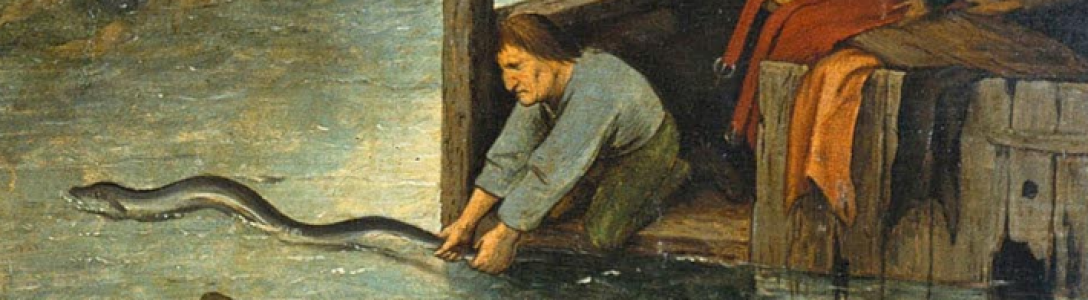
The Bus — Paul Kirchner

“Clay” — James Joyce

“Clay”

by

James Joyce

The matron had given her leave to go out as soon as the women’s tea was over and Maria looked forward to her evening out. The kitchen was spick and span: the cook said you could see yourself in the big copper boilers. The fire was nice and bright and on one of the side-tables were four very big barmbracks. These barmbracks seemed uncut; but if you went closer you would see that they had been cut into long thick even slices and were ready to be handed round at tea. Maria had cut them herself.

Maria was a very, very small person indeed but she had a very long nose and a very long chin. She talked a little through her nose, always soothingly: “Yes, my dear,” and “No, my dear.” She was always sent for when the women quarrelled over their tubs and always succeeded in making peace. One day the matron had said to her:

“Maria, you are a veritable peace-maker!”

And the sub-matron and two of the Board ladies had heard the compliment. And Ginger Mooney was always saying what she wouldn’t do to the dummy who had charge of the irons if it wasn’t for Maria. Everyone was so fond of Maria.

The women would have their tea at six o’clock and she would be able to get away before seven. From Ballsbridge to the Pillar, twenty minutes; from the Pillar to Drumcondra, twenty minutes; and twenty minutes to buy the things. She would be there before eight. She took out her purse with the silver clasps and read again the words A Present from Belfast. She was very fond of that purse because Joe had brought it to her five years before when he and Alphy had gone to Belfast on a Whit-Monday trip. In the purse were two half-crowns and some coppers. She would have five shillings clear after paying tram fare. What a nice evening they would have, all the children singing! Only she hoped that Joe wouldn’t come in drunk. He was so different when he took any drink. Continue reading ““Clay” — James Joyce”

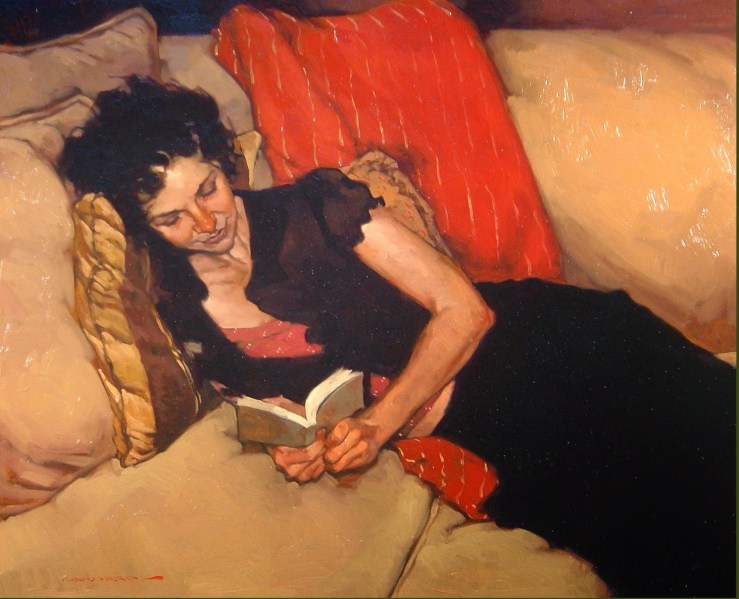
Reading the Sonnet — Joseph Lorusso

Lorusso, Joseph (1966-...) Reading the sonnet

The Tree of Life — Leonora Carrington

The Tree of Life 1960 oil on canvas 36.25 by 25.75 in. a

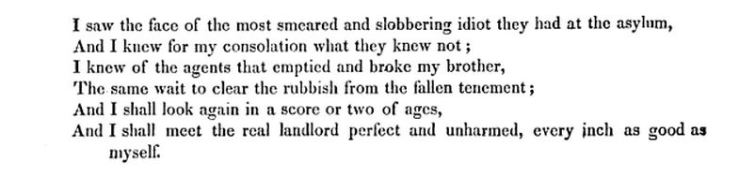
The most smeared and slobbering idiot (Walt Whitman)

ww

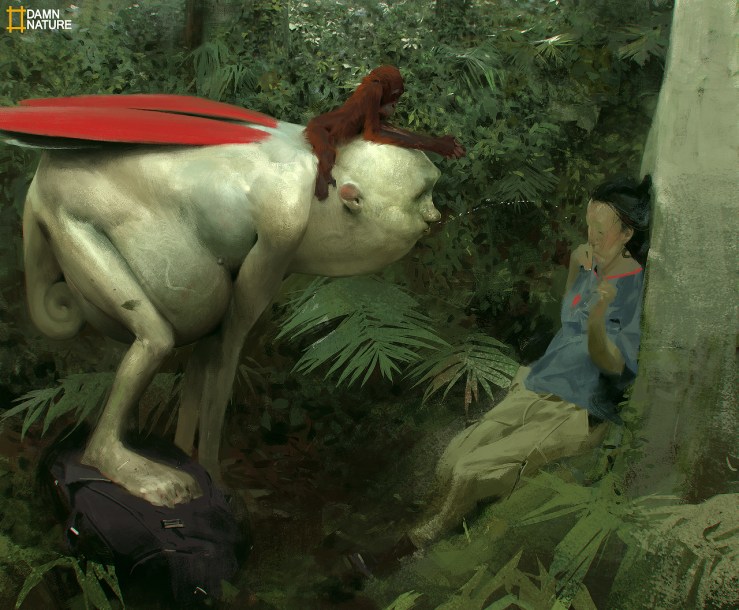
Damn Nature — Sergey Kolesov

DN

The Accidental Universe (Book Acquired, 9.17.2014)

IMG_3340

Alan Lightman’s The Accidental Universe is new in trade paperback next month from Random House. From James Orbesen’s review earlier this year in Bookslut:

Comprised of a number of essays, The Accidental Universe documents recent discoveries about our universe, the quest for a complete Standard Model of physics to explain, literally, everything, and the recently uncovered Higgs boson, the so-called “God particle” that grants subatomic particles their mass. This is balanced by Lightman’s reflections on human nature, our mutual condition, and our place in a vast cosmos beyond our reach. This creates an interesting tension that runs throughout the collection, beginning right at the beginning in the titular essay.

Lightman starts with that: “The history of science can, in fact, be viewed as the recasting of phenomena that were once accepted as ‘givens’ as phenomena that can now be understood in terms of fundamental causes and principles.”

Science peels away layers that obscure the truth at the heart of our universe. However, after centuries of constant triumph, scientists have run into a brick wall. For every new discovery, new questions arise that science may not also be able to answer. After affirming what science has done, he pulls away the table cloth: “According to the current thinking of many physicists, we are living in one of a vast number of universes. We are living in an accidental universe. We are living in a universe incalculable by science.”

Day-Dreaming — Conrad Kiesel

day-dreaming-conrad-kiesel-1352183696_b

Werner Herzog’s Where the Green Ants Dream (Full Film)

An adventure in the esthetics (Krazy Kat)

IMG_3346.JPG

Natural Encounters — René Magritte

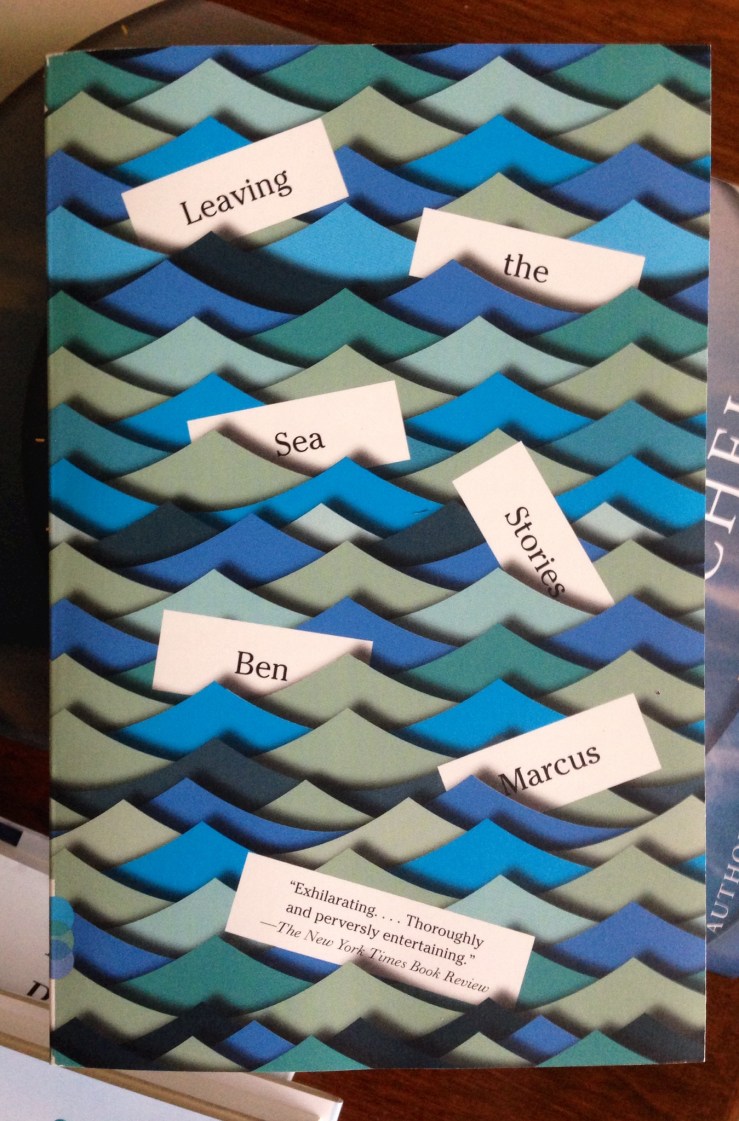
Microreview of Ben Marcus’s Leaving the Sea (Book Acquired, 9.17.2014)

IMG_3338

The kind people at Random House sent me a trade paperback of Ben Marcus’s latest collection, Leaving the Sea. The trade paperback comes out in early October.

I actually read the book this summer, and enjoyed it, was frustrated by it, occasionally sickened by it, was enthralled by at least two stories (“The Loyalty Protocol” and “The Moors”), and found one story to be so terribly sad and distressing and horrifying that I hope to never read anything like it again, which is kind of a compliment (“Rollingwood”).

I jammed Leaving the Sea into a riff on stuff I wished I’d written about in the first half of 2014. This is what I wrote:

Leaving the Sea, Ben Marcus: A weird and (thankfully) uneven collection that begins with New Yorkerish stories of a post-Lish stripe (like darker than Lipsyte stuff) and unravels (thankfully) into sketches and thought experiments and outright bizarre blips. Abjection, abjection, abjection. The final story ‘The Moors’ is a minor masterpiece.”

Read “On Not Growing Up” from the collection at Conjunctions. First paragraphs:

—HOW LONG HAVE YOU been a child?

—Seventy-one years.

—Who did you work with?

—Meyerowitz for the first phase: colic, teething, walking, talking. He taught me how to produce false prodigy markers and developmental reversals, to test the power in the room without speaking. I was encouraged to look beyond the tantrum and drastic mood migrations that depended on the environment, and if you know my work you have an idea what resulted. The rest is a hodgepodge, but I don’t advocate linear apprenticeships. A stint in the Bonn Residency. Fellowships at the Cleveland Place, then later a stage at Quebec Center. I entered that Appalachian Trail retreat in 1974, before Krenov revised it, but had to get helicoptered out. Probably my first infant crisis, before I knew to deliberately court interference. The debt to Meyerowitz is huge, obviously, if just for the innocence training. Probably I should have laid off after that, because now it’s all
about unlearning.

—Unlearning as Kugler practices it? That radical?

—I skip the hostility to animals. I skip the forced submersion and the chelation flush. That’s proven to be a dead end. But Kugler is a walking contradiction in that respect, isn’t he? He keeps a horse barn.
He does twilight childishness, and now he’s suddenly opposing the Phoenix baby-talk crowd, who I think are not as threatening as he makes out.

—They’re not registered.

Read “Consequences,” A Short Story by Willa Cather

“Consequences”

by

Willa Cather

Henry Eastman, a lawyer, aged forty, was standing beside the Flatiron building in a driving November rainstorm, signaling frantically for a taxi. It was six-thirty, and everything on wheels was engaged. The streets were in confusion about him, the sky was in turmoil above him, and the Flatiron building, which seemed about to blow down, threw water like a mill-shoot. Suddenly, out of the brutal struggle of men and cars and machines and people tilting at each other with umbrellas, a quiet, well-mannered limousine paused before him, at the curb, and an agreeable, ruddy countenance confronted him through the open window of the car.

“Don’t you want me to pick you up, Mr. Eastman? I’m running directly home now.”

Eastman recognized Kier Cavenaugh, a young man of pleasure, who lived in the house on Central Park South, where he himself had an apartment.

“Don’t I?” he exclaimed, bolting into the car. “I’ll risk getting your cushions wet without compunction. I came up in a taxi, but I didn’t hold it. Bad economy. I thought I saw your car down on Fourteenth Street about half an hour ago.”

The owner of the car smiled. He had a pleasant, round face and round eyes, and a fringe of smooth, yellow hair showed under the rim of his soft felt hat. “With a lot of little broilers fluttering into it? You did. I know some girls who work in the cheap shops down there. I happened to be down-town and I stopped and took a load of them home. I do sometimes. Saves their poor little clothes, you know. Their shoes are never any good.”

Eastman looked at his rescuer. “Aren’t they notoriously afraid of cars and smooth young men?” he inquired. Continue reading “Read “Consequences,” A Short Story by Willa Cather”

Hollander — Yoshitora Utagawa

Circular Confabulation

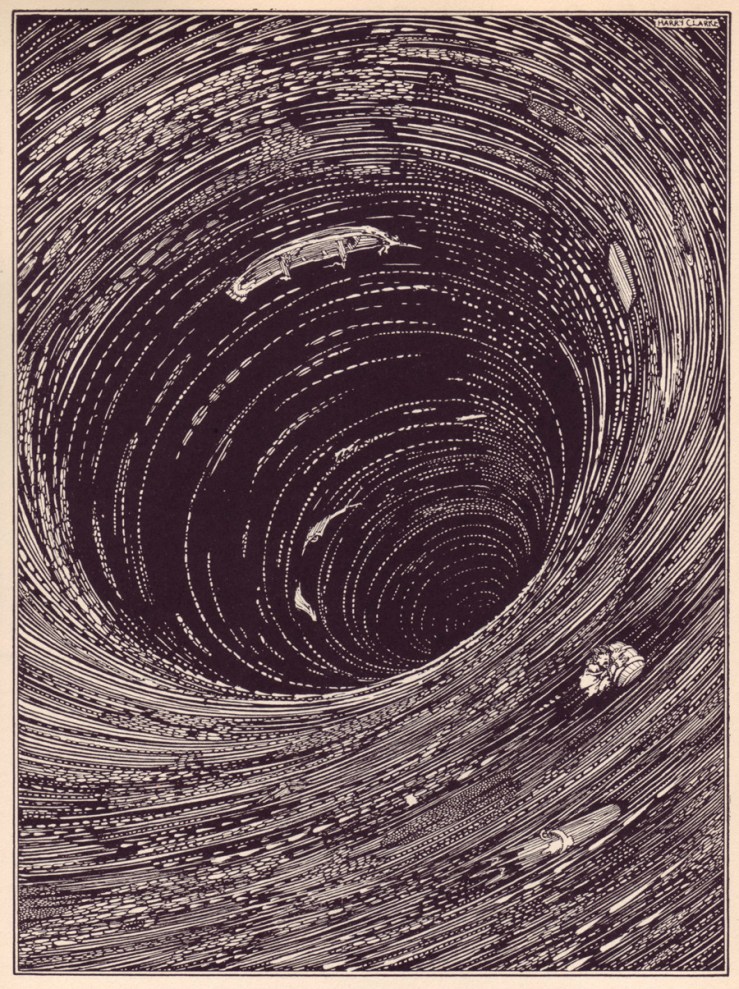
Maelström — Harry Clarke

Harry-Clarke--Poe--Tales-of-Mystery-and-Imagination--11_900

Looking about me upon the wide waste of liquid ebony on which we were thus borne, I perceived that our boat was not the only object in the embrace of the whirl. Both above and below us were visible fragments of vessels, large masses of building timber and trunks of trees, with many smaller articles, such as pieces of house furniture, broken boxes, barrels and staves. I have already described the unnatural curiosity which had taken the place of my original terrors. It appeared to grow upon me as I drew nearer and nearer to my dreadful doom. I now began to watch, with a strange interest, the numerous things that floated in our company. I must have been delirious—for I even sought amusement in speculating upon the relative velocities of their several descents toward the foam below. ‘This fir tree,’ I found myself at one time saying, ‘will certainly be the next thing that takes the awful plunge and disappears,’—and then I was disappointed to find that the wreck of a Dutch merchant ship overtook it and went down before. At length, after making several guesses of this nature, and being deceived in all—this fact—the fact of my invariable miscalculation—set me upon a train of reflection that made my limbs again tremble, and my heart beat heavily once more.

“A Descent into the Maelström,” Edgar Allan Poe.

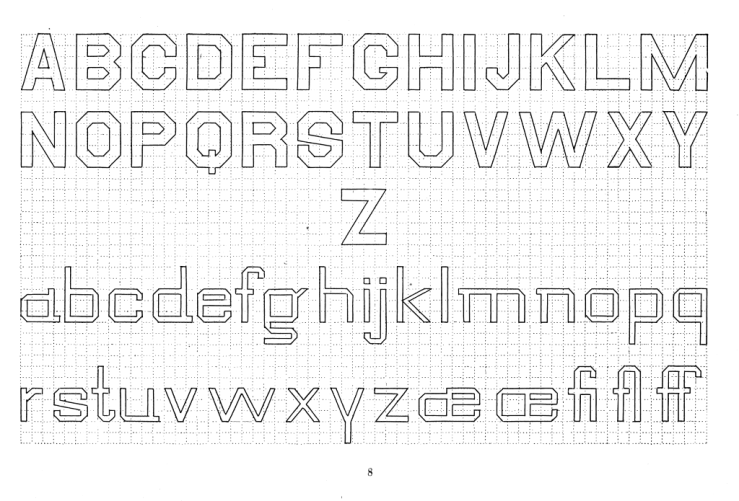
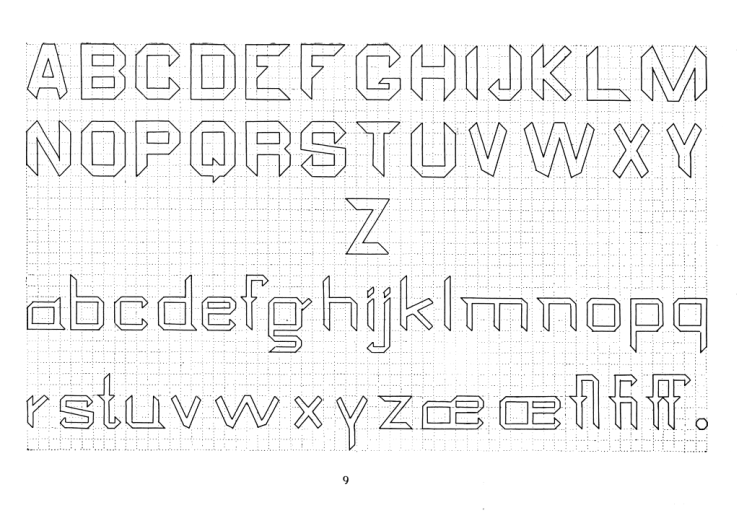
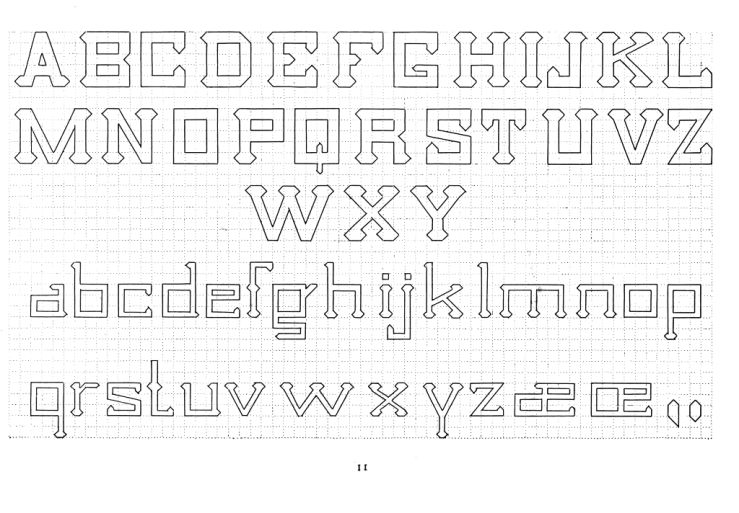
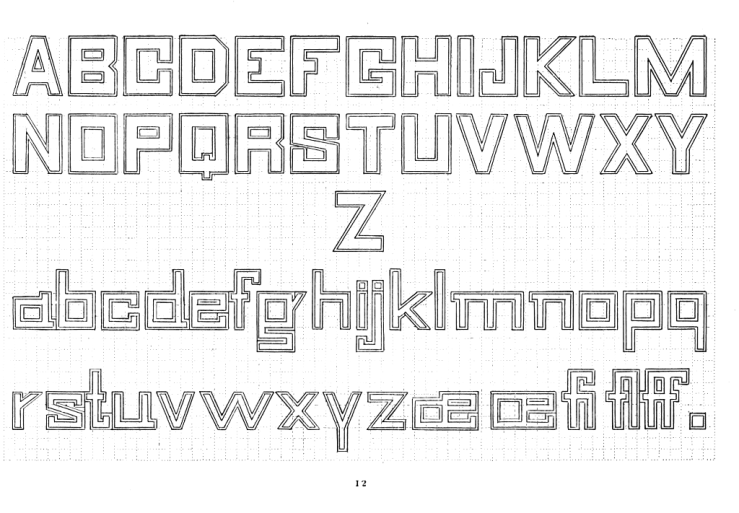
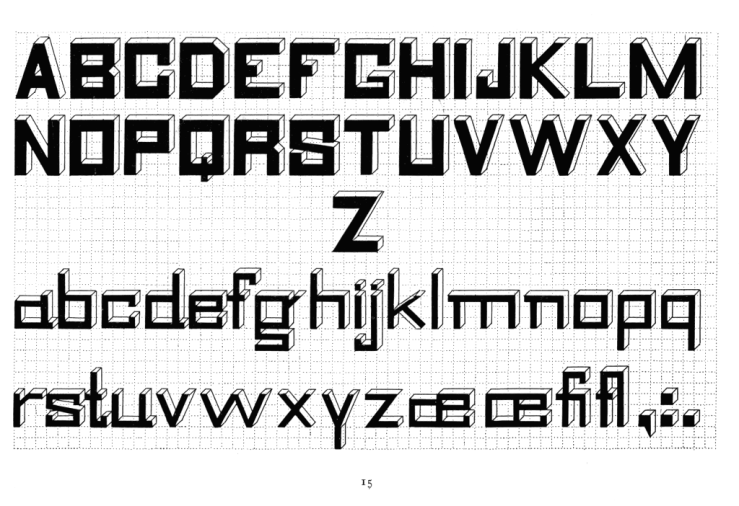
Some Lettering Fonts by J. Howard Cromwell (1887)

From A System of Easy Lettering by J. Howard  Cromwell (1887):

1 2 3 4 5 Continue reading “Some Lettering Fonts by J. Howard Cromwell (1887)”