No such discovery as “breakfast” had then been made: breakfast was not invented for many centuries after that. We have always admired, and always shall admire, as the very best of all human stories, Charles Lamb’s account of the origin of roast pig in China. Ching Ping, it seems, had suffered his father’s house to be burned down; the outhouses were burned along with the house; and in one of these the pigs, by accident, were roasted to a turn. Memorable were the results for all future China and future civilization. Ping, who (like all China beside) had hitherto eaten his pig raw, now for the first time tasted it in a state of torrefaction. Of course he made his peace with his father by a part (tradition says a leg) of the new dish. The father was so astounded with the discovery, that he burned his house down once a year for the sake of coming at an annual banquet of roast pig. A curious prying sort of fellow, one Chang Pang, got to know of this. He also burned down a house with a pig in it, and had his eyes opened. The secret was ill kept—the discovery spread—many great conversions were made—houses were blazing in every part of the Celestial Empire. The insurance offices took the matter up. One Chong Pong, detected in the very act of shutting up a pig in his drawing-room, and then firing a train, was indicted on a charge of arson. The chief justice of Pekin, on that occasion, requested an officer of the court to hand him a piece of the roast pig, the corpus delicti, for pure curiosity led him to taste; but within two days after it was observed that his lordship’s town-house was burned down. In short, all China apostatized to the new faith; and it was not until some centuries had passed, that a great genius arose, who established the second era in the history of roast pig, by showing that it could be had without burning down a house.
No such genius had yet arisen in Rome. Breakfast was not suspected. No prophecy, no type of breakfast had been published. In fact, it took as much time and research to arrive at that great discovery as at the Copernican system. True it is, reader, that you have heard of such a word as jentaculum; and your dictionary translates that old heathen word by the Christian word breakfast. But dictionaries, one and all, are dull deceivers. Betweenjentaculum and breakfast the differences are as wide as between a horse-chestnut and chestnut horse; differences in the time when, in the place where, in the manner how, but preeminently in the thing which.
Galen is a good authority upon such a subject, since, if (like other pagans) he ate no breakfast himself, in some sense he may be called the cause of breakfast to other men, by treating of those things which could safely be taken upon an empty stomach. As to the time, he (like many other authors) says, [peri tritaen, ae (to makroteron) peri tetartaen,] about the third, or at farthest about the fourth hour: and so exact is he, that he assumes the day to lie exactly between six and six o’clock, and to be divided into thirteen equal portions. So the time will be a few minutes before nine, or a few minutes before ten, in the forenoon. That seems fair enough. But it is not time in respect to its location that we are so much concerned with, as time in respect to its duration. Now, heaps of authorities take it for granted, that you are not to sit down—you are to stand; and, as to the place, that any place will do—”any corner of the forum,” says Galen, “any corner that you fancy;” which is like referring a man for his salle à manger to Westminster Hall or Fleet Street. Augustus, in a letter still surviving, tells us that he jentabat, or took hisjentaculum in his carriage; now in a wheel carriage, (in essedo,) now in a litter or palanquin (in lecticâ.) This careless and disorderly way as to time and place, and other circumstances of haste, sufficiently indicate the quality of the meal you are to expect. Already you are “sagacious of your quarry from so far.” Not that we would presume, excellent reader, to liken you to Death, or to insinuate that you are “a grim feature.” But would it not make a saint “grim,” to hear of such preparations for the morning meal? And then to hear of such consummations as panis siccus, dry bread; or, (if the learned reader thinks it will taste better in Greek,) [Greek: artos xaeros!] And what may this word dry happen to mean? “Does it mean stale bread?” says Salmasius. “Shall we suppose,” says he, in querulous words, “molli et recenti opponi,” and from that antithesis conclude it to be, “durum et non recens coctum, eoque sicciorem?” Hard and stale, and for that reason the more arid! Not quite so bad as that, we hope. Or again—”siccum pro biscocto, ut hodie vocamus, sumemus?”[5] By hodie Salmasius means, amongst his countrymen of France, where biscoctus is verbatim reproduced in the word bis (twice) cuit, (baked;) whence our own biscuit. Biscuit might do very well, could we be sure that it was cabin biscuit: but Salmasius argues—that in this case he takes it to mean “buccellatum, qui est panis nauticus;” that is, the ship company’s biscuit, broken with a sledge-hammer. In Greek, for the benefit again of the learned reader, it is termed [Greek: dipuros], indicating that it has passed twice under the action of fire.
Something to Read — Vincent Giarrano

The Edge of Doom — Samuel Colman


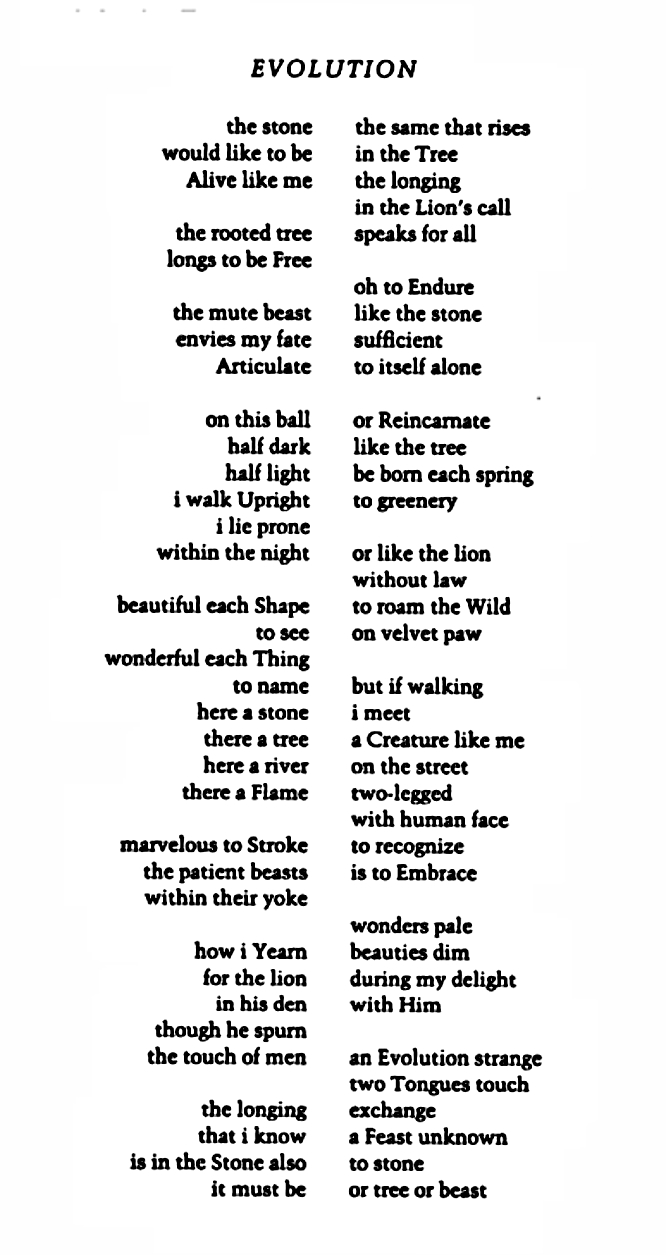
“Evolution” — May Swenson
A Symbolic Head — Arthur Merton

“All art constantly aspires towards the condition of music”
“The Legacy” — Virginia Woolf
“The Legacy”
by
Virginia Woolf
“For Sissy Miller.” Gilbert Clandon, taking up the pearl brooch that lay among a litter of rings and brooches on a little table in his wife’s drawing-room, read the inscription: “For Sissy Miller, with my love.”
It was like Angela to have remembered even Sissy Miller, her secretary. Yet how strange it was, Gilbert Clandon thought once more, that she had left everything in such order-a little gift of some sort for every one of her friends. It was as if she had foreseen her death. Yet she had been in perfect health when she left the house that morning, six weeks ago; when she stepped off the kerb in Piccadilly and the car had killed her.
He was waiting for Sissy Miller. He had asked her to come; he owed her, he felt, after all the years she had been with them, this token of consideration. Yes, he went on, as he sat there waiting, it was strange that Angela had left everything in such order. Every friend had been left some little token of her affection. Every ring, every necklace, every little Chinese box-she had a passion for little boxes-had a name on it. And each had some memory for him. This he had given her; this -the enamel dolphin with the ruby eyes-she had pounced upon one day in a back street in Venice. He could remember her little cry of delight. To him, of course, she had left nothing in particular, unless it were her diary. Fifteen little volumes, bound in green leather, stood behind him on her writing table. Ever since they were married, she had kept a diary. Some of their very few-he could not call them quarrels, say tiffs-had been about that diary. When he came in and found her writing, she always shut it or put her hand over it. “No, no, no,” he could hear her say, “After I’m dead-perhaps.” So she had left it him, as her legacy. It was the only thing they had not shared when she was alive. But he had always taken it for granted that she would outlive him. If only she had stopped one moment, and had thought what she was doing, she would be alive now. But she had stepped straight off the kerb, the driver of the car had said at the inquest. She had given him no chance to pull up. . .. Here the sound of voices in the hall interrupted him. Continue reading ““The Legacy” — Virginia Woolf”
This Charming Man of Steel — Butcher Billy

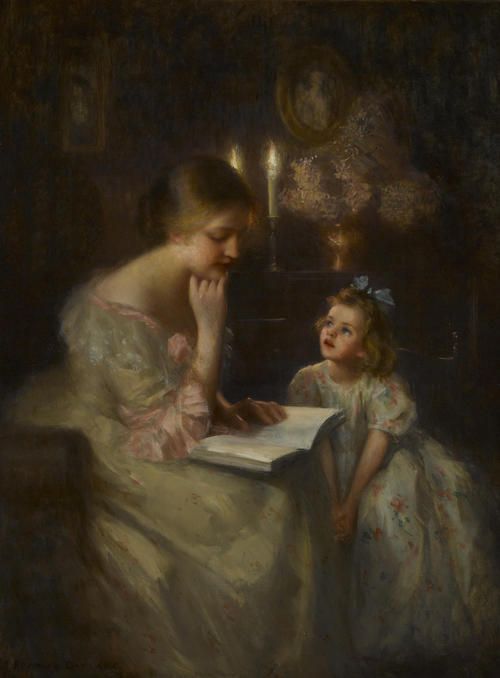
A Story Read by Candlelight — Francis Day
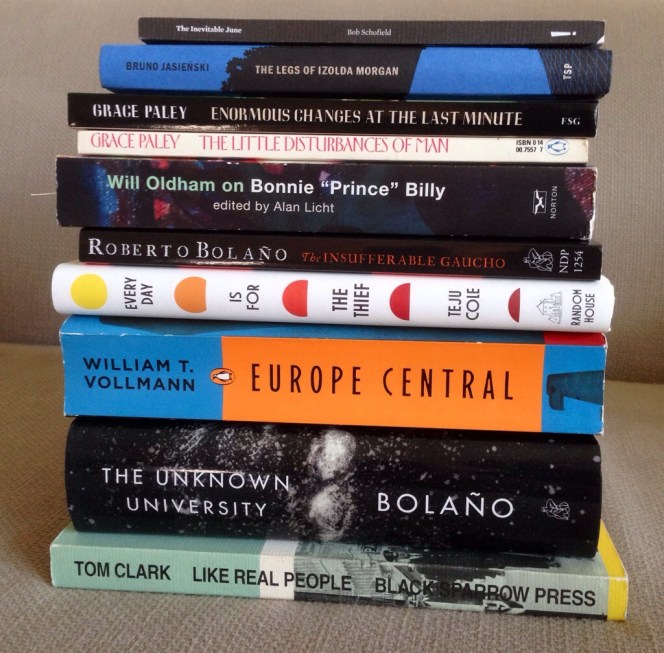
Reading/Have Read/Should Write About
Grasshoppers — Johan Thorn Prikker

“Stay a Little Longer” — Steve Earle and Rodney Crowell
Decoration Day 1934 — Gregorio Prestopino
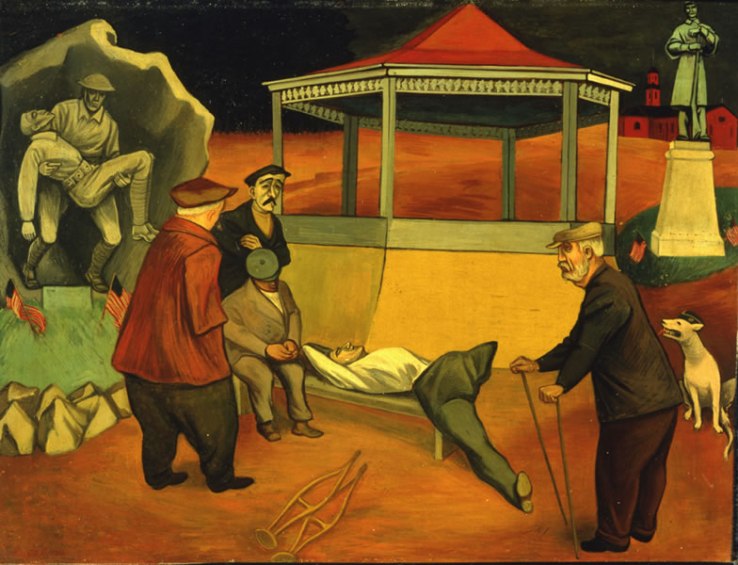
“Indian Camp” — Ernest Hemingway
“Indian Camp”
by
Ernest Hemingway
At the lake shore there was another rowboat drawn up. The two Indians stood waiting.
Nick and his father got in the stern of the boat and the Indians shoved it off and one of them got in to row. Uncle George sat in the stern of the camp rowboat. The young Indian shoved the camp boat off and got in to row Uncle George.
The two boats started off in the dark. Nick heard the oarlocks of the other boat quite a way ahead of them in the mist. The Indians rowed with quick choppy strokes. Nick lay back with his father’s arm around him. It was cold on the water. The Indian who was rowing them was working very hard, but the other boat moved further ahead in the mist all the time.
“Where are we going, Dad?” Nick asked.
“Over to the Indian camp. There is an Indian lady very sick.”
“Oh,” said Nick.
Across the bay they found the other boat beached. Uncle George was smoking a cigar in the dark. The young Indian pulled the boat way up on the beach. Uncle George gave both the Indians cigars. Continue reading ““Indian Camp” — Ernest Hemingway”
Portrait of Elizaveta Martynova — Philip Maliavin

Forest/Trees




Film Poster for The Big Lebowski — Tyler Stout

 Biblioklept